


Meta and Apex Clean Energy have signed a power purchase agreement (PPA) for a new 144-megawatt (MW) solar project in Gonzales County, Texas.
Called Starling Solar, the project is expected to begin commercial operations in 2027. Meta will receive the project’s environmental attributes, including its renewable energy certificates (RECs). Apex says Meta’s commitment will support new solar capacity that would not otherwise be built.
The deal is the seventh transaction between Meta and Apex, taking their combined clean energy portfolio to about 1.2 gigawatts (GW) across Texas, Virginia, Illinois, Kansas and Iowa.
The agreement comes as Texas prepares for major growth in electricity demand, driven by data centers, manufacturing and other large power users. Urvi Parekh, head of renewable energy at Meta, remarked:
“We appreciate Apex’s partnership in helping us bring a total of one gigawatt of new renewable energy to the grid across Texas, Virginia, Illinois, Kansas, and Iowa. This new solar project will support our commitment to 100% renewable energy and will help bring jobs and investment to the local community.”
Starling Solar Adds New Texas Capacity
Starling Solar will be built in Gonzales County, southeast of San Antonio. Apex expects the project to begin operating in 2027, although the ERCOT interconnection queue lists an anticipated commercial operation date of January 2028. The schedule can change as the project moves through the grid-connection process.
The financial terms of the PPA have not been disclosed.
Apex estimates the project could generate about $27 million in tax revenue over its lifetime, including $15.6 million for local schools. It also expects more than $26.3 million in payments to landowners and between 400 and 450 construction jobs.
The deal arrives as Texas faces a sharp increase in electricity demand. ERCOT’s preliminary 2026 long-term forecast puts potential electricity demand at about 367,790 MW by 2032.
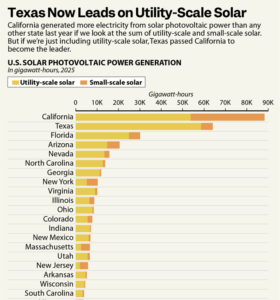
For comparison, the state’s record peak demand was 85,508 MW in 2023. ERCOT says the forecast is preliminary and can change as large-load projects develop.
Data centers are a major driver. Meta is expanding its Texas data center footprint, including a planned 1-GW facility in El Paso. Meta expects to invest more than $10 billion in the project. That growth is creating more demand for new electricity generation. Solar is one of the fastest-growing power sources on the Texas grid.
Solar Is Set to Surpass Coal
The shift in Texas’s power mix is already visible. The U.S. Energy Information Administration expects utility-scale solar generation in ERCOT to reach about 78 billion kilowatt-hours in 2026, compared with 60 billion kWh from coal.
- In 2027, EIA forecasts about 99 billion kWh from solar versus 66 billion kWh from coal.
Solar supplied about 12% of ERCOT electricity in 2025, up from 4% in 2021. Coal’s share fell from 19% to 13% over the same period. Natural gas remains the state’s largest power source.
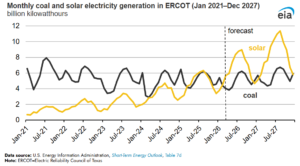
Starling Solar, therefore, enters a market where renewable generation is expanding even as total electricity demand climbs.
Meta Keeps Building Its Clean Power Portfolio
The Starling agreement is part of Meta’s wider clean energy strategy. The tech giant says it has matched 100% of its electricity use with clean and renewable energy since 2020. Its projects have added more than 30 GW of new clean and renewable energy to electricity grids around the world.
The company aims to reach net-zero emissions across its value chain by 2030. It also targets a 42% reduction in Scope 1 and 2 emissions by 2031, compared with 2021, while keeping Scope 3 emissions at or below the 2021 level.
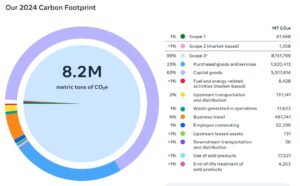
Renewable energy PPAs are an important part of that strategy as Meta’s data center demand grows. Yet, one important distinction is that Starling Solar is not a carbon credit project.
Meta will receive the project’s environmental attributes, including RECs. Those certificates represent the environmental benefits of renewable electricity generation. A REC is different from a carbon credit.
A carbon credit generally represents one tonne of greenhouse gas emissions reduced, avoided or removed under a specific methodology.
The Starling project will instead support Meta’s clean electricity strategy by adding new solar generation to the Texas grid. The Facebook owner will not physically receive every megawatt-hour generated by the project. The solar electricity will flow into the grid, while Meta receives the contracted environmental attributes.
New Projects and Additionality Matter
Meta has increasingly focused on agreements that help bring new clean energy projects onto power grids. That approach is important because simply buying certificates from existing renewable plants does not necessarily add new generation.
Long-term PPAs can help developers secure financing by providing greater certainty about future revenue. That can make it easier to build new solar, wind, and storage projects.
Starling fits this model. Meta’s long-term commitment gives Apex a major corporate buyer while helping support new generation in Texas. The approach also shows how corporate climate demand is becoming closely linked to physical power markets.
Meta Already Has a Large Texas Pipeline
The new agreement builds on Meta’s existing relationship with Apex. In 2023, Meta signed a deal for the full output of the 195-MW Angelo Solar project in Texas. Apex said its portfolio with Meta had then exceeded 1 GW across several states.
Meta has also signed large agreements with other developers. In 2025, Meta agreed to purchase 100% of the output from ENGIE’s 600-MW Swenson Ranch Solar project in Texas. That deal brought the Meta-ENGIE partnership to more than 1.3 GW across four Texas projects.
The company’s strategy is therefore spread across multiple developers and projects rather than relying on one source of renewable electricity.
The Starling deal also highlights the role of corporate PPAs in financing new renewable power. Large solar projects require significant upfront capital. A long-term buyer can provide revenue visibility, making the project more attractive to banks and investors.
This is increasingly important in Texas, where electricity demand is rising quickly but grid connections and transmission remain challenges.
ERCOT has introduced a new Batch Zero process for large electricity users requiring at least 75 MW. The system groups major projects for grid studies so ERCOT can better assess their combined impact and needed transmission upgrades.
The changes show how quickly Texas’s electricity market is evolving.
Meta Stock Moves Sharply Higher
Meta Platforms (NASDAQ: META) shares rose sharply around the time of the Apex announcement, but the move was not tied specifically to the Starling Solar deal. On September 21, Meta stock jumped 11.4%, adding about $192 billion to the company’s market value.
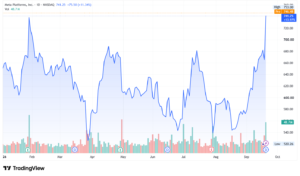
The rally was driven largely by investor enthusiasm surrounding Meta’s AI strategy and its Muse AI assistant, which became the most-downloaded free app on Apple’s App Store.
The Bigger Carbon Market Connection
Starling Solar is not a carbon credit project, but it still connects to the broader climate market. Data centers and AI are driving electricity demand higher, while companies such as Meta face growing pressure to reduce the emissions linked to that power use.
Texas shows both trends at once. Solar generation is expected to overtake coal in 2026, while ERCOT is preparing for much higher future demand.
For Meta, the 144-MW Starling Solar deal adds another source of clean electricity and renewable attributes. For Apex, it provides a major corporate buyer for a new solar project. And for Texas, it adds renewable capacity as the grid prepares for a much larger electricity market.
The wider trend is this: large technology companies are increasingly using long-term renewable energy contracts to help finance new power capacity as AI, data centers, and electrification drive electricity demand higher.