

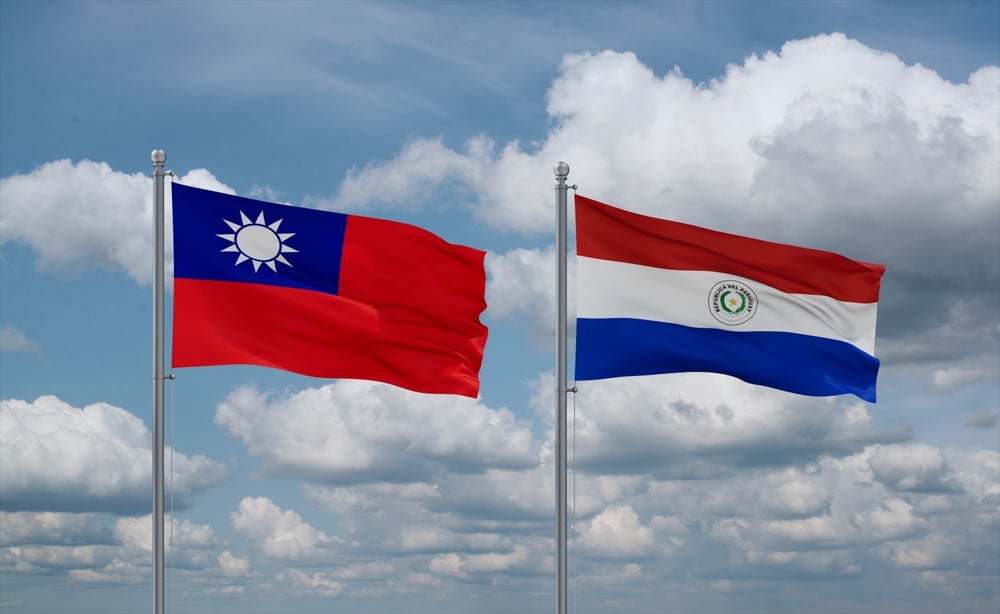
Paraguay and Taiwan are negotiating an agreement that could create a minimum market of 5 million carbon credits for climate projects in Paraguay. The two countries are working on an international transfer agreement that they expect to complete this year, according to Paraguay’s Ministry of Environment and Sustainable Development (MADES) official, Victor Gonzalez. The first phase would target demand from Asian companies.
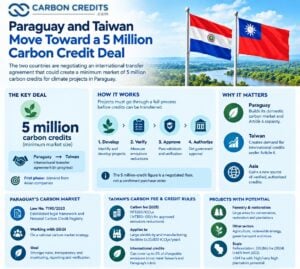
The 5 million-credit figure is a negotiated floor, not a confirmed purchase order. Projects would still need to be developed, approved, verified, and authorized before credits could be transferred.
The talks matter because Paraguay is developing its carbon market. At the same time, Asian companies seek more international carbon credits under Article 6 of the Paris Agreement.
Paraguay Builds Its Article 6 Carbon Market
The talks build on a Memorandum of Understanding signed in October 2025 between Paraguay and Taiwan to explore carbon market cooperation. The proposed Implementation Agreement would set rules for projects that cut emissions in Paraguay. It would also transfer the resulting mitigation outcomes to Taiwan.
Paraguay has also been building its domestic carbon market system. Law No. 7190/2023 established a legal framework for carbon markets and created the National Carbon Credit Registry. MADES is responsible for regulating and developing the sector.
The government is now working with the Global Green Growth Institute (GGGI) on a national carbon market strategy. In September 2026, MADES hosted a second national consultation on the strategy. About 80 representatives from government, finance, business, civil society, and international organizations attended.
The goal is to create clearer rules for projects, improve transparency, and build Paraguay’s ability to take part in international carbon markets.
Five Million Credits Would Create a Large Pipeline
The proposed 5 million credit floor would give the Paraguay-Taiwan partnership significant potential scale. However, these credits do not exist yet.
Projects must first be identified and developed. They need to measure their emissions reductions. Then, they must pass validation and verification. Finally, they should get the necessary government approvals.
Only authorized mitigation outcomes can be transferred under the Article 6 framework. This is important because Paraguay is still strengthening the systems needed to support a larger international carbon market.
MADES said its national strategy will focus on stricter rules, transparency, and systems for monitoring, reporting, and verification. Recent government work with Taiwanese officials has also focused on sharing knowledge about Paraguay’s carbon market rules and institutions.
The 5 million-ton floor should thus be viewed as a potential future supply target, rather than credits already available to buyers.
Taiwan’s Carbon Fee Creates New Credit Demand
Taiwan has a clear reason to secure international carbon credits. The country introduced its carbon fee system in 2025. The standard carbon fee is NT$300 per tonne of CO2e. However, companies that meet approved emissions reduction targets can get lower rates of NT$50 or NT$100 per tonne.
The fee applies to large electricity and manufacturing facilities with annual emissions of at least 25,000 tonnes of CO2e.
Taiwan allows eligible companies to use approved international carbon credits. They can cover up to 5% of their chargeable emissions, following the country’s rules. This creates potential demand for credits generated in Paraguay.
However, not every carbon credit will qualify. Projects must meet Taiwan’s requirements as well as Paraguay’s rules for international transfers. That could favor projects with strong measurement systems, clear carbon ownership, and credible verification.
Article 6 Rules Prevent Double Counting
The proposed deal would operate through Article 6.2 of the Paris Agreement. It allows countries to transfer emissions reductions across borders. These transferred outcomes are known as Internationally Transferred Mitigation Outcomes, or ITMOs.
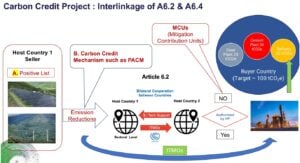
A major safeguard is the corresponding adjustment. Suppose a project in Paraguay creates an authorized emissions reduction and transfers it to a Taiwanese company.
Paraguay must adjust its national emissions accounting so it does not also count that same reduction toward its own climate target. This prevents the same climate benefit from being counted twice.
That makes Article 6 transactions different from many voluntary carbon credit purchases. Voluntary credits do not automatically receive a corresponding adjustment or government authorization.
Paraguay already has experience with this system. It signed an Article 6 Implementation Agreement with Singapore in May 2025. This agreement sets up procedures for project approval, ITMO transfers, and necessary adjustments.
A Taiwan agreement would add another international route for Paraguayan projects.
Forestry and Land Projects Could Lead
Forestry is likely to be an important part of Paraguay’s future carbon market. The country has large areas suitable for forest conservation, restoration, and plantation projects. Taiwan has also expressed interest in working with Paraguayan companies on forestry-related carbon projects.
Paraguay’s reforestation sector has expanded quickly. IMF data show that reforested land reached about 339,866 hectares in 2024, up 66% from 2022. Paraguay’s forestry institute estimates that over 5 million hectares have a high or very high potential for plantation forestry.
Not all this land will become carbon projects. Still, the figures show the scale of Paraguay’s potential forestry investment market.
The country’s opportunities also extend beyond forests. Article 6 projects could cover renewable energy, agriculture, green transport, and other emissions-reduction activities.
That wider project base could help Paraguay meet future demand if Asian buyers seek large and diverse supplies of authorized credits.
The Deal Could Open a Bigger Asian Market
The proposed Paraguay-Taiwan agreement comes as Article 6 markets are expanding across Asia and Latin America.
Singapore has already signed Article 6 agreements with countries including Paraguay, Thailand, Vietnam, the Philippines, and Laos. Japan and other governments are also developing bilateral carbon market partnerships.
These agreements create links between countries with a demand for international carbon credits and countries with larger opportunities to reduce or remove emissions.
For Paraguay, that could turn forests, agricultural land, and renewable energy resources into sources of climate finance. For Taiwan, it could create another supply of international credits for companies facing domestic carbon costs.
Yet, the 5 million-credit floor is not the final measure of success. The real test is if Paraguay can create projects that follow Article 6 rules. They need to get government approval and show verified emissions reductions.
Paraguay is now building the market infrastructure to support that growth. The government is developing its national carbon market strategy, improving technical capacity, and working with international partners.
If the agreement is completed as planned, it could give Paraguayan project developers a clearer path to Asian buyers.
For Taiwan, it could provide a new source of international mitigation outcomes as its carbon fee system develops. For the wider carbon market, the talks show how Article 6 is moving from international rules toward real commercial demand.
The 5 million-credit target is therefore only the starting point. The bigger opportunity is building a reliable market for verified, authorized, and internationally transferable carbon reductions from Paraguay.