


Renewable energy and carbon removal have emerged as two important themes at Climate Week NYC 2026, as companies and policymakers look for ways to turn climate targets into real projects. The event, running from September 20 to 27, is highlighting a growing problem: renewable energy is expanding quickly, but in many markets companies still cannot find enough clean power to meet their targets.
At the same time, US states and local governments are exploring new ways to support carbon dioxide removal (CDR) as federal support becomes less certain. The two issues are closely linked. Companies need more clean electricity as power demand rises, while CDR could help address emissions that remain after direct cuts.
Renewable Energy Is Growing, But Supply Is Still Tight
A new RE100 Annual Disclosure Report released ahead of Climate Week found that limited renewable supply and cost are the biggest barriers for companies trying to reach 100% renewable electricity. Lack of procurement options and regulatory barriers are the next biggest challenges.
The report covers 408 RE100 members, providing one of the largest datasets on corporate renewable energy procurement.
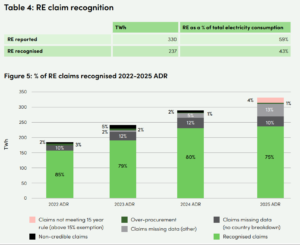
Globally, RE100 companies now source 59% of their electricity from renewable energy, up from 53% in the previous report. Importantly, 65% of that renewable electricity comes from facilities built within the past 15 years, showing that corporate buyers are helping support newer renewable capacity.
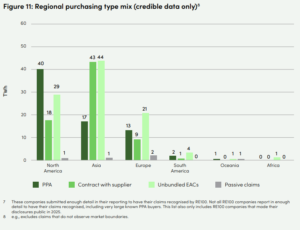
But progress varies widely by market. In South Korea, renewables account for only 12% of RE100 members’ electricity use, and just 5% of members have reached 100%. In Taiwan, renewables supply 6% of members’ electricity, while in Singapore the figure is also 6%, up only one percentage point from the previous year.
Japan improved from 36% to 40%, while South Africa jumped from 54% to 84% and Mexico from 38% to 52%. China and India each have 28% of RE100 members using 100% renewable electricity. This shows some companies are finding ways to overcome supply barriers, even in tough markets.
Renewables Hit a Record — But the 2030 Gap Remains
Corporate demand is rising as the global renewable industry expands at record speed.
The International Renewable Energy Agency (IRENA) noted that the world added a record 692 gigawatts (GW) of renewable power in 2025. This raised the total installed renewable capacity to 5,149 GW.
Renewables made up 85.6% of all new power capacity added during the year. Solar accounted for about 510 GW of the 2025 increase, while wind added nearly 159 GW. Despite this growth, the pace is still below what is needed to meet the global goal of tripling renewable power capacity by 2030.
António Guterres, United Nations Secretary-General, said:
“Renewable energy records are being smashed year after year as the clean energy revolution accelerates. But we must go further and faster to clear the bottlenecks that delay the transition, drive investment to developing countries, and break our addiction to volatile fossil fuels once and for all.”
IRENA estimates that renewable capacity must reach about 11.2 terawatts (TW) by 2030. That requires average additions of around 1,122 GW every year through 2030 and annual growth of about 16.6%.
- If the 2024 growth rate were maintained, the world would reach only about 10.3 TW, leaving a shortfall of roughly 0.9 TW.
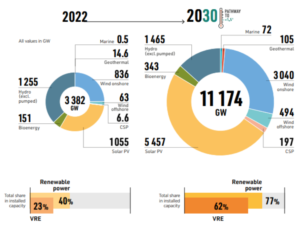
The IEA also expects strong renewable growth but says current policies are not yet enough to fully deliver the global tripling target. Its main forecast puts renewable capacity at about 9,530 GW in 2030, while an accelerated policy scenario reaches more than 10,400 GW.
The gap is not simply about building more solar and wind farms. Grid connections, transmission, storage, permitting, and access to renewable power contracts are also becoming major constraints.
- RELEVANT: TotalEnergies and Masdar’s $2.2 Billion Deal Signals a Big Push into Asia’s Renewable Energy Boom
US States Step In as Carbon Removal Needs Grow
Carbon removal was another major issue during Climate Week. At a panel on September 21 at Columbia Law School’s Sabin Center for Climate Change Law, experts looked at how US states can back CDR since federal action is uncertain.
The panel, titled “Mind the Gap: How States Can Advance Carbon Dioxide Removal Despite Federal Backsliding,” brought together experts from the Sabin Center, American University, Rocky Mountain Institute, and California Ocean Science Trust.
The discussion focused on how states can use policy and legal tools to help move CDR from research into larger commercial projects.
The need is significant. The 2026 State of Carbon Dioxide Removal report estimates current CDR at about 2.2 billion tonnes of CO2 per year. That amount needs to increase substantially in climate pathways consistent with the Paris Agreement.
The report projects a gap of 1.2 billion tonnes per year by 2035. It estimates 5.2 billion tonnes by 2050. This gap is between current country pledges and the CDR levels in high-ambition Paris-compatible scenarios.
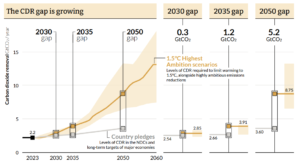
That does not mean every tonne will need to come from engineered technologies. Nature-based CDR, such as afforestation and soil carbon, remains important, while direct air capture, mineralisation, biochar and ocean-based approaches are also developing.
States Are Already Testing Market Tools
Several states are already creating policies that could support CDR development.
- California runs the Carbon Removal Innovation Support Program, which provides financial incentives for direct-air-capture projects. In 2026, the California Energy Commission opened a solicitation for pre-commercial DAC demonstrations and community engagement. California’s energy research and development programs invest over $200 million each year to create new energy technologies.
- Washington State has taken a different approach through its Climate Commitment Act and Cap-and-Invest Program. State rules accept CDR in the carbon market. They let carbon management projects create offset credits. Washington requires that captured CO2 be stored in permanent sequestration pathways. This keeps it out of the atmosphere for a minimum of 1,000 years.
- Massachusetts is building its policy base through research. The state-supported Carbon Dioxide Removal Study looks at costs, potential scale, long-term storage, environmental effects, and policy options for CDR. This includes both state and nearby federal waters.
These approaches show that state governments do not need to use one policy model. They can support CDR through grants, market rules, research, standards, and project development.
CDR Needs Demand as Well as Technology
Moving CDR from small projects to a large industry requires more than scientific progress. Developers need buyers willing to sign long-term contracts. Investors need confidence that projects will have future revenue. Governments need rules for monitoring, reporting, permanence, and community impacts.
This is a key issue for the CDR market because many projects are still expensive and operate at small scales.
The US federal government previously helped create demand through research funding and carbon removal programmes. But states are increasingly being discussed as another source of support.
The Carbon Dioxide Removal Leadership Act, reintroduced in Congress in July 2026, suggests a federal purchasing program. This program aims to boost demand significantly and reliably. Carbon180 says public procurement could help the industry raise capital, expand production, and lower costs.
State action could complement such federal efforts where they remain available.
Climate Week Puts Delivery Back at the Center of Climate Goals
The discussions at Climate Week point to a common challenge across renewable energy and carbon removal: technology alone does not create a market.
Renewable power is already expanding rapidly, with 692 GW added globally in 2025. Yet, companies in markets such as South Korea, Singapore, and Japan still report limited access to clean electricity.
CDR faces an even earlier-stage market. Current removals are in the billions of tonnes. However, the 2026 State of CDR report shows we will need much more capacity to align with Paris pathways.
For renewable energy, the priority is building generation alongside grids, storage, and procurement systems. For CDR, the priority is creating the finance, demand, and rules needed to move promising technologies into commercial use.
The Climate Week discussions show how states and companies can help fill those gaps. For the clean energy market, the message is that record renewable growth still needs faster deployment and better access to supply. For carbon removal, the message is similar: scientific progress needs policy and market systems that can turn small projects into a scalable industry.
Together, the two trends highlight a broader shift in climate finance. The next phase of the energy transition will depend not only on setting targets, but on building the infrastructure, markets and investment systems needed to deliver them.