

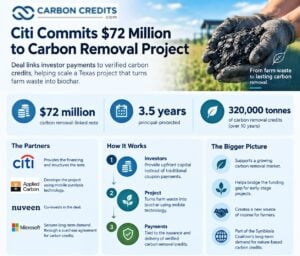
Citi has closed a $72 million carbon removal-linked note to help expand a Texas project that turns farm waste into biochar. The deal links investor payments to the delivery of verified carbon removal credits, creating a new way to finance projects that take carbon dioxide out of the atmosphere.
The 3.5-year, principal-protected note supports Applied Carbon’s mobile technology for processing agricultural waste. Nuveen, an investment firm, joined the deal. Microsoft supports long-term demand through its carbon credit purchase agreement with Applied Carbon.
The transaction highlights a growing challenge in the carbon removal market: projects need money to build and deploy equipment before they can produce credits. By linking finance to future carbon removal, Citi aims to help bridge that gap.
How Citi Links Investor Payments to Verified Carbon Removal
Citi structured the note so that investors give up traditional coupon payments in exchange for a different payment structure. An upfront amount goes toward financing Applied Carbon’s project. Investors then receive payments linked to the issuance and delivery of carbon credits generated by the project.
Sonia Battikh, Global Head of Carbon Offsets Trading at Citi, remarked:
“This Carbon Removal-Linked Note builds on Citi’s pioneering work linking bond performance to environmental outcomes and marks our first outcome bond tied to verified carbon removals. By bringing together investors, project developers and long-term carbon demand, we are continuing to expand the range of opportunities through which capital markets can finance real-world outcomes.”
The note is described as principal-protected and runs for 3.5 years. However, Citi has not publicly disclosed the full payment formula, the expected investor return, or the number of carbon removal credits tied to the transaction. The $72 million is the size of the note, not a disclosed price per tonne of carbon removed.
Citi calls the deal its first outcome bond tied to verified carbon removal. In an outcome-linked structure, financial returns depend in part on a measurable result. Here, that result is the issuance and delivery of carbon credits. This structure connects three parts of the carbon removal market:
- investors who provide capital,
- a developer that builds and operates the project, and
- buyers that create demand for the credits.
If it works as intended, the model could help other projects attract funding before they generate all their expected carbon removal.
Applied Carbon Turns Farm Waste Into Biochar
Applied Carbon uses mobile pyrolysis equipment to process crop residue into biochar. Pyrolysis heats organic material with little or no oxygen, turning it into a carbon-rich solid rather than allowing it to decompose or be burned in the open.
The company’s system can operate directly in fields or at field edges. It combines crop residue processing and biochar application in one pass, reducing the need to transport bulky agricultural waste to a separate facility. The company says this approach can make production more flexible across the farming cycle.
Biochar can store carbon in a relatively stable form when the material and its use meet the right conditions. Applying it to soil may also improve moisture retention and soil properties. But the amount of carbon stored for the long term depends on factors such as the feedstock, production process, biochar quality, and final use.

Applied Carbon announced a $21.5 million funding round in July 2024 to deploy its technology. The company has also been selected for U.S. Department of Energy carbon removal prize programs. The new Citi-linked note provides another financing route to support deployment.
Microsoft’s Credit Deal Helps Support Future Demand
A key part of the financing is the project’s existing relationship with Microsoft. In March 2022, Applied Carbon announced that Microsoft had selected its biochar project for its carbon removal portfolio. Citi says Microsoft has an offtake agreement for a portion of the credits generated by the project.
An offtake agreement is a contract to buy future production. For carbon removal projects, it can give developers a clearer view of future revenue, helping them plan investment and operations. It may also help lenders and investors assess whether a project can generate enough income to support its financing.
However, the deal does not mean every tonne of expected removal has already been delivered. The Citi note links payments to the issuance and delivery of credits, while the full credit volume and delivery schedule have not been disclosed publicly.
Carbon Removal Demand Rises as Biochar Production Expands
The financing arrives as carbon removal demand and biochar production expand, although the market still faces challenges in scaling supply. A 2026 review by Climeworks notes that, based on market data from BloombergNEF, CDR.fyi, and AlliedOffsets, carbon removal offtakes hit 64 million metric tonnes in 2025. This is an increase from 30 million tonnes in 2024.
Durable carbon removal offtakes rose from 8 million tonnes to 29 million tonnes over the same period. The report valued the overall carbon removal market at about $8 billion in 2025. These figures refer to contracted offtakes, not carbon removals already delivered or credits retired.
Biochar is part of this wider growth. The International Biochar Initiative’s 2025 Global Biochar Market Report found that global biochar production hit 520,810 metric tonnes in 2025. This is a rise from 180,150 tonnes in 2023.
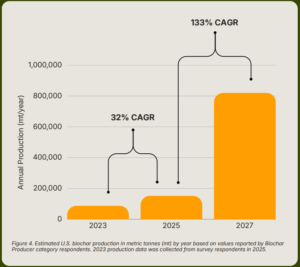
The report drew on responses from 930 stakeholders across 96 countries. Survey respondents projected production could reach 3.5 million tonnes by 2027 and 9.3 million tonnes by 2030. These are industry projections, not guaranteed outcomes.
The market still needs more investment. The same report identified limited access to capital as a barrier for 35% of respondents. A separate Climeworks review noted that carbon removal projects often need funding before construction, while buyers may prefer credits delivered years later. That gap makes financing models tied to future credit delivery potentially important.
How the Deal Fits Citi’s Wider Climate Finance Strategy
Citi’s note fits within its wider sustainable finance strategy. The bank has a goal to support $1 trillion in sustainable finance by 2030. It has also committed to net zero greenhouse gas emissions from its own operations by 2030 and from its financing activities by 2050.
These commitments cover different parts of Citi’s business. Financing a carbon removal project is not the same as cutting emissions from the bank’s own offices or reducing emissions linked to its lending and investment activities. The note should therefore be viewed as a financial product that supports a carbon removal project, rather than proof that Citi has met its own emissions targets.
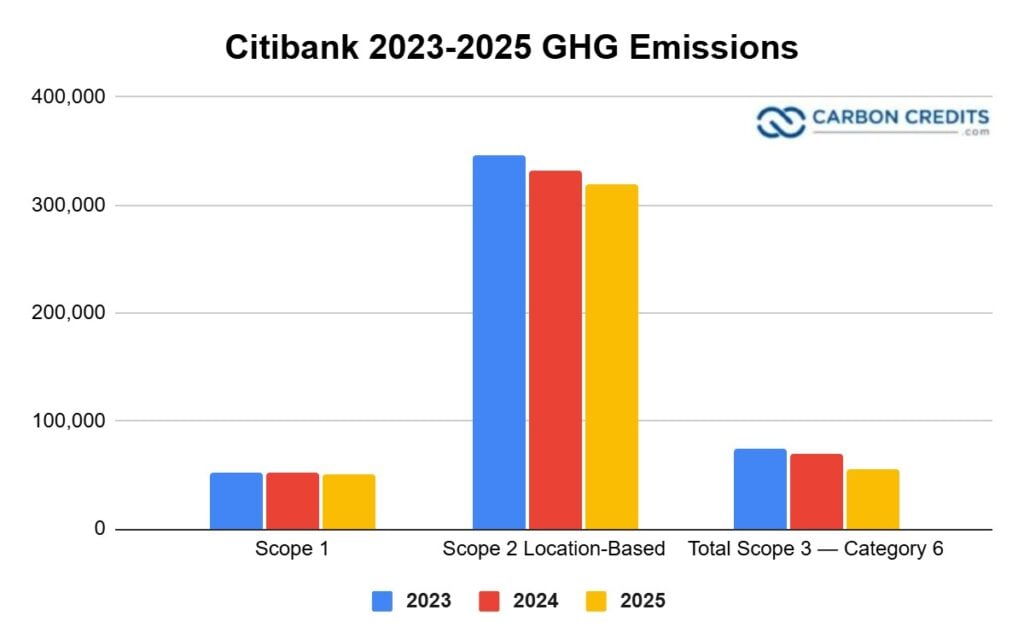
Yet, it is remarkable to note that Citi’s location-based Scope 1 and 2 emissions fell 3.8% in 2025 to 370,030 metric tons of CO₂e. The bank also reduced energy consumption by 43% from its 2010 baseline, surpassing its earlier 40% reduction target, while maintaining 100% renewable electricity sourcing in 2025. These results show progress in reducing emissions from its own operations, including buildings and electricity use.
Citi has previously structured sustainable finance products that link financial returns to environmental or social outcomes. The bank says this new note is its first outcome bond tied to verified carbon removals. The deal extends that approach into a market where developers often need large amounts of upfront capital, and buyers want confidence that credits will be delivered.
Verified Credits and Delivery Will Decide the Deal’s Success
The project’s climate value will depend on more than the size of the note. Credible carbon removal requires accurate measurement of how much carbon is stored, accounting for emissions from collecting and processing feedstock, and checks that the carbon remains stored for the period claimed.
Biochar can offer durable storage, but results vary by production method, material, and application. Project monitoring also needs to guard against overestimating the climate benefit or counting the same removal more than once.
Investors face a separate question: whether the project generates and delivers enough eligible credits, on time, to support the note’s payment structure. Citi has not disclosed the expected credit volume, price per tonne or investor returns, so the financial and climate outcomes cannot yet be fully assessed from public details.
Even so, the transaction offers a clear example of how banks, institutional investors, technology developers and corporate buyers can work together to finance carbon removal. Its longer-term significance will depend on whether Applied Carbon can scale its equipment, deliver verified credits and show that the model can support more projects.