

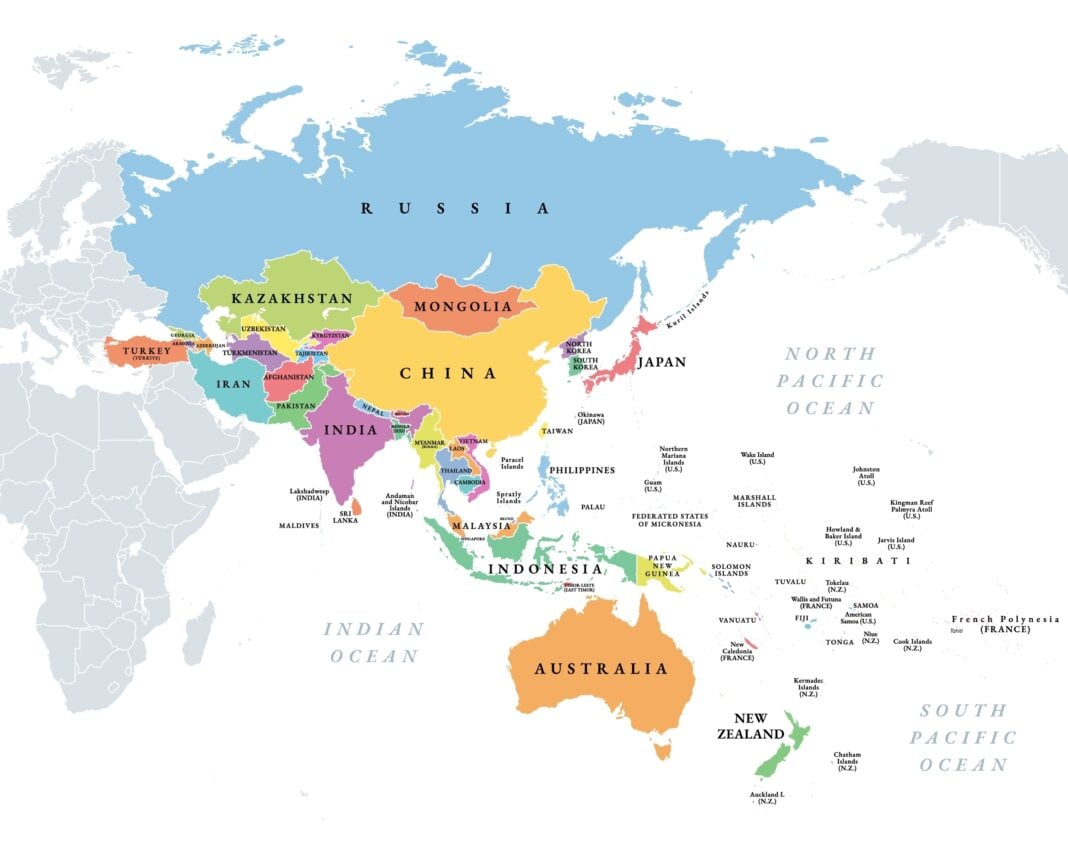
Asia-Pacific is becoming a bigger force in the global carbon market, but not in the way many might expect. The region’s share of global carbon credit issuance and retirements has fallen since 2021. At the same time, its companies are becoming a major source of new buyers, while governments are shaping how credits are produced, traded and used.
These are key findings from AlliedOffsets’ APAC Carbon Market Report 2026, published in October. The report examines carbon credit supply, buyer demand, pricing, Article 6 cooperation and aviation’s carbon offsetting system across the region.
The data reveal a market in transition. New demand is emerging, but supply is uneven. Some countries are opening new routes for international carbon trading, while others are building pipelines of credits that could qualify for use under foreign carbon market rules.
APAC’s Share of Global Carbon Credit Supply Shrinks
Asia-Pacific’s share of global carbon credit issuance fell from about 50% in 2021 to around 30% in 2025, according to AlliedOffsets. Its share of global credit retirements also declined, from 42% to 33% over the same period.
Retirement happens when a carbon credit is permanently removed from circulation. This often occurs after a company uses it to support a climate claim or meet a requirement. Issuance, by contrast, refers to credits created after a project completes the required process under a carbon crediting program.
The decline in APAC’s global share is notable because issuance and retirements grew in regions outside APAC over the same period. This suggests that the region’s carbon market has not kept pace with growth elsewhere.
However, the report identifies one area of stronger activity: offtake agreements. These contracts allow buyers to purchase credits that a project expects to deliver in the future. APAC accounted for about one-fifth of global offtake volume in 2025 and more than one-third of global volume recorded through October 19, 2026.
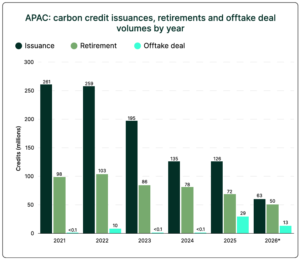
The report cautions that it is too early to know whether this increase marks a lasting trend. Still, offtake activity could help project developers secure revenue and financing before their credits are delivered.
APAC Companies Become a Major Source of New Buyers
While the region’s share of credit supply has weakened, demand from APAC-based companies is growing. In 2025, companies headquartered in APAC overtook European companies as the largest source of new carbon credit buyers.
APAC-based businesses accounted for about one-third of new buyers in 2025, up from around one-fifth in 2020. The momentum continued in 2026. AlliedOffsets counted 954 new APAC buyers through October 19, already approaching the record 1,056 recorded for all of 2025.
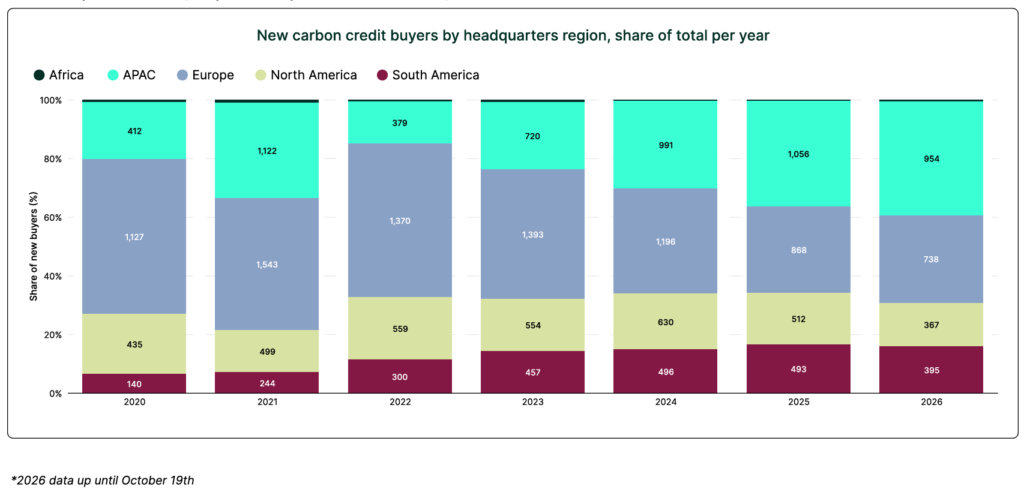
This shift matters because more buyers can create new demand for projects that deliver credible emissions reductions or remove carbon dioxide from the atmosphere. Buyer numbers alone don’t reveal how much credit each company will buy. They also don’t show if the announced interest will result in completed deals.
The report also finds that APAC nature-based removal supply remains concentrated among a relatively small group of developers. Projects in the region issued about 13.2 million nature-based removal credits in 2025.
Nepal’s Ministry of Forests and Environment accounted for 20% of this total, while Terra Carbon supplied 14%. Permian Global contributed another 12%, and Woodside Burrup accounted for 7%. Smaller developers made up the remaining 38%.
This concentration highlights the role of a few major project developers in regional carbon removal supply.
Carbon Credit Prices Vary by Project Type
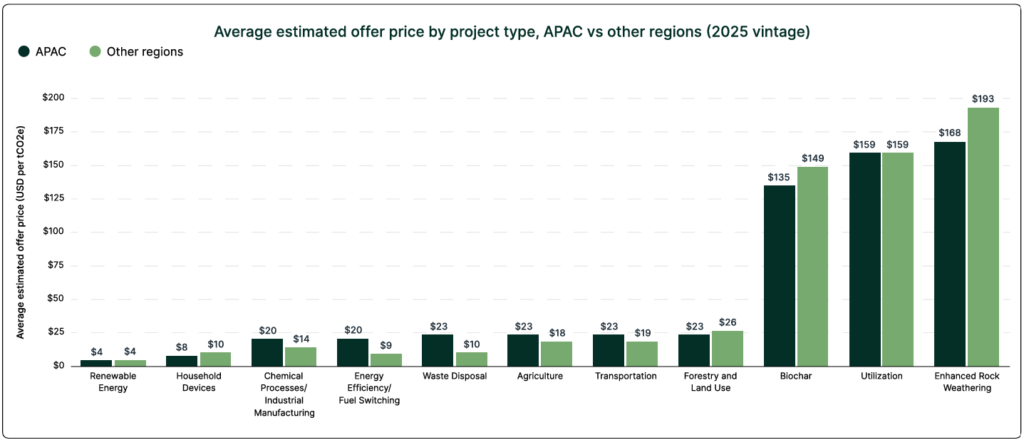
The report’s pricing data show that APAC credits do not always trade at a discount to those from other regions. Prices depend heavily on the type of project.
AlliedOffsets estimated that in 2025, APAC biochar credits cost an average of $135 per tonne of carbon dioxide equivalent. This is about 10% lower than similar offers from other regions. Enhanced rock weathering credits averaged $168 per tonne, around 13% lower than offers elsewhere.
Biochar is produced by heating organic material, such as agricultural waste, with little or no oxygen. Enhanced rock weathering uses crushed minerals to speed up natural processes that remove carbon dioxide from the atmosphere.
The pattern was different for some other project categories. APAC energy-efficiency and waste-disposal credits had estimated offer prices more than twice those of comparable credits from other regions.
These figures are estimated offer prices, not confirmed transaction prices. They also apply to specific project types and credit vintages, so they should not be treated as a single market-wide price for APAC credits. The differences show why buyers need to assess credit type, quality, and project details rather than relying only on regional averages.
Article 6 Could Open New Routes for Regional Carbon Trading
International cooperation under Article 6 of the Paris Agreement is another major development in APAC. It helps countries work together to cut emissions. This includes transferring internationally transferred mitigation outcomes, or ITMOs, based on the rules.
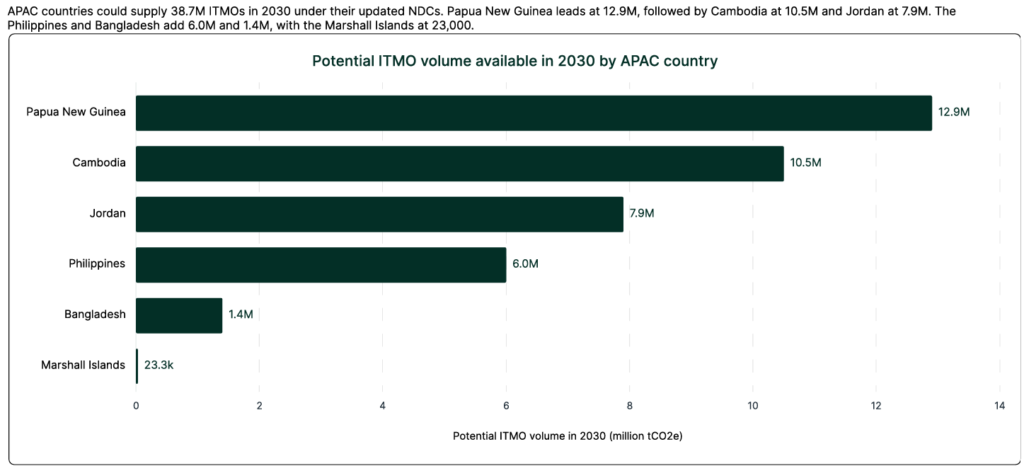
AlliedOffsets estimates that APAC countries could supply 38.7 million ITMOs in 2030 under their updated nationally determined contributions. This is potential supply, not a forecast of credits that will definitely be approved or transferred.
Papua New Guinea accounts for a potential 12.9 million tonnes, followed by Cambodia at 10.5 million and Jordan at 7.9 million. The Philippines might provide 6 million tonnes. Bangladesh contributes 1.4 million, and the Marshall Islands adds about 23,300 tonnes.
The report also tracks projects listed under Singapore’s eligible carbon credit arrangements. These published lists could provide 27.2 million credits from APAC projects with 2021–2030 vintages.
Mongolian grassland and agricultural land projects account for about 19 million, or almost 70% of the total. Philippine REDD+ projects generate about 6 million credits. Smaller amounts come from cookstoves, electric vehicle charging, reforestation, and rice methane projects.
Being listed does not mean all these credits have already been issued or transferred. Actual use depends on project delivery and the applicable rules.
Meanwhile, the Joint Crediting Mechanism (JCM), which supports cooperation between Japan and partner countries, saw a record 17 APAC projects issue credits in 2025. Yet annual issuance has generally remained at or below 100,000 credits, apart from a Cambodian project that issued about 600,000 in 2023.
Indonesia’s Carbon Credit Supply Rebounds as Retirements Slow
Indonesia provides another example of the gap between credit supply and demand. Following the reopening of international carbon trading under Presidential Regulation 110/2025, issuance remained close to zero for three quarters before rising sharply in the third quarter of 2026.
- AlliedOffsets recorded 10.9 million credits issued in that quarter, almost all from the Katingan project.
Yet, retirements have not increased at the same pace. Indonesian credit retirements fell from 5 million tonnes in the first quarter of 2025 to less than 1 million tonnes per quarter during 2026.
This difference matters. New issuance expands the amount of credit available, but it does not guarantee that buyers will purchase and retire those credits. Demand will depend on factors such as eligibility, price, quality, and the rules governing how credits can be used.
For Indonesia, the next challenge is therefore not just to restore supply, but to attract buyers for the credits coming back into the market.
Aviation Rules Add Another Source of Demand
The aviation sector is also influencing APAC’s carbon market through the Carbon Offsetting and Reduction Scheme for International Aviation, known as CORSIA. The scheme asks covered airlines to manage certain emissions. They can use approved carbon credits as one of the eligible measures.
AlliedOffsets reports that APAC airlines cancelled just over 1 million credits for CORSIA’s first compliance period. Singapore Airlines accounted for 494,196 credits, while Japan Airlines cancelled 350,200. Together, the two airlines represented about 84% of the APAC airline total recorded in the report.
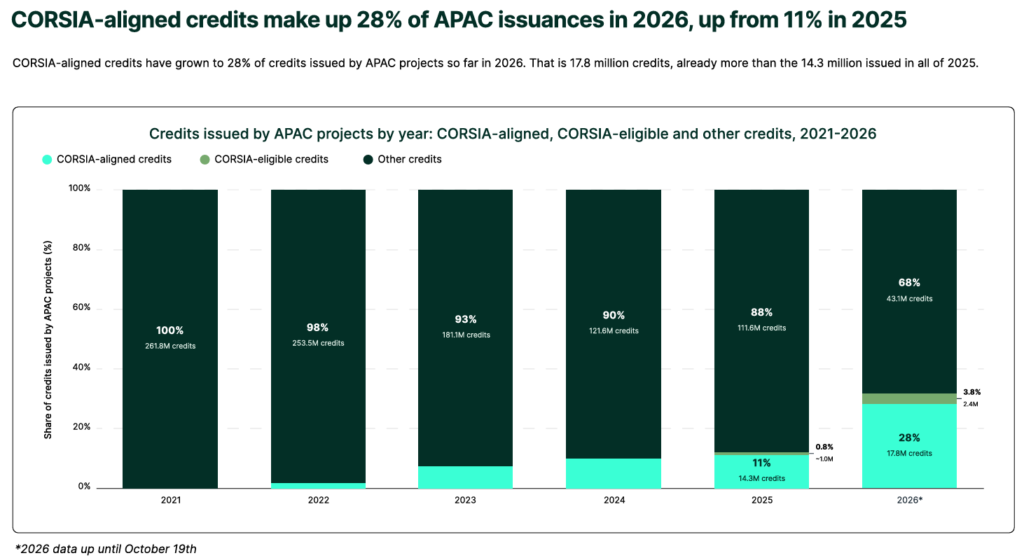
The supply of CORSIA-aligned credits from APAC projects is also growing. These credits accounted for 28% of the region’s issuance through October 19, 2026, equivalent to 17.8 million credits. In 2025, they represented 11% of issuance, or 14.3 million credits for the full year.
The 2026 figure is already higher than the 2025 total, although the 2026 reporting period is not yet complete. CORSIA eligibility and alignment also do not mean every credit can automatically be used by every airline; applicable program and compliance rules still matter.
Can APAC Turn Rising Buyer Interest Into Lasting Demand?
AlliedOffsets’ findings show a shifting APAC carbon market. Although the region’s share of global issuance and retirements has fallen, new buyers, offtake deals, Article 6 cooperation, and aviation demand are creating opportunities.
Government policy will shape the next phase. Singapore’s eligible credit lists could direct demand toward selected projects, while Indonesia’s reopening of international trading has released new supply. Article 6 growth will depend on countries establishing systems to authorize, track, and transfer credits.
The key question is whether rising buyer interest will lead to sustained purchases and retirements. Developers must deliver credible, eligible credits, while buyers need to assess quality and actual delivery. How well APAC connects demand with reliable supply will determine its future role in global carbon markets.