


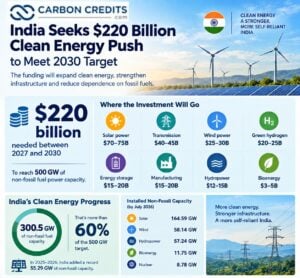
India is seeking a major investment boost to expand clean energy and reduce its dependence on fossil fuels. The government estimates that the country needs about $220 billion between 2027 and 2030 to meet its goal of 500 gigawatts (GW) of installed non-fossil fuel power capacity.
The funding would support solar and wind power, electricity transmission, energy storage, green hydrogen, and domestic manufacturing. The country is also looking for more private and foreign investment to help pay for the expansion.
The scale of the plan highlights both the opportunity and the challenge facing one of the world’s largest energy markets. India has made rapid progress in adding clean power, but it must build more infrastructure and attract enough investment to meet its 2030 target.
India Needs $220 Billion Across Clean Energy Sectors
Santosh Kumar Sarangi, secretary of India’s Ministry of New and Renewable Energy, outlined the investment need ahead of the Bharat Renewable Energy Summit and Expo, scheduled for November 2–5, 2026, in New Delhi. The government’s estimates show how the funding could be spread across the clean energy sector.
- Solar power: $70 billion to $75 billion
- Electricity transmission: $40 billion to $45 billion
- Wind power: $25 billion to $30 billion
- Green hydrogen: $20 billion to $25 billion
- Energy storage: $15 billion to $20 billion
- Domestic manufacturing: $15 billion to $20 billion
- Hydropower: $12 billion to $15 billion
- Bioenergy: $3 billion to $5 billion
Solar power accounts for the largest share of the projected investment. But the plan also shows why India cannot rely on new power plants alone.
Transmission lines are needed to move electricity from renewable energy projects to homes, businesses, and factories. Storage systems can hold surplus power and release it when solar and wind output falls.
The $220 billion figure is an estimated investment requirement. The Indian government plans to use the summit to discuss ways to bring together investors, project developers, manufacturers, and financial institutions.
India Has Added More Than 300 GW of Non-Fossil Power
India has already made significant progress toward its 2030 goal. The Ministry of New and Renewable Energy reported that the country had reached 300.5 GW of installed non-fossil fuel capacity by July 31, 2026. This represented more than 60% of the 500 GW target.
- The total included 164.59 GW of solar power, 58.14 GW of wind, 57.24 GW of large and small hydropower, 11.75 GW of bioenergy, and 8.78 GW of nuclear power.
- India added a record 55.29 GW of non-fossil fuel capacity during the 2025–2026 financial year, including 44.6 GW of solar and 6 GW of wind power.
These figures measure installed power capacity, not the amount of electricity generated at every moment. Solar and wind output changes with weather and time of day, making transmission and storage important as their share of the power system grows.
The 500 GW goal also covers more than renewable energy. It includes nuclear power and other non-fossil sources, so it should not be described as a target for renewables alone.
- RELATED: India’s Solar and Renewable Energy Outlook to 2030: Impact of the US-India 18% Tariff Cut on Exports
Grid Expansion and Storage Remain Key Challenges
Adding clean power plants is only part of the transition. India also needs a stronger electricity grid to connect new projects and deliver their output where it is needed.
This is a major concern as solar and wind capacity grows. Some projects are located far from large centres of electricity demand, requiring new transmission lines and grid upgrades.
Energy storage can help balance supply and demand. Batteries can store electricity when production is high and release it when output falls, or demand rises. Hydropower and other flexible power sources can also support the grid, depending on local conditions.
India’s Central Electricity Authority expects a need for about 74 GW of energy storage by 2031–2032. This includes around 27 GW from pumped-storage hydropower and over 47 GW from battery storage systems.
The investment plan also includes green hydrogen, which is produced using electricity to split water into hydrogen and oxygen. It can help reduce emissions in industries that are difficult to electrify, although production costs, access to clean electricity, and infrastructure remain important challenges.
India Faces a Funding Gap And a Shortage of Power Buyers
India has already attracted large amounts of capital into its clean energy sector. Sarangi told Reuters that the country received about $64 billion in private clean energy investment between 2024 and 2026, including $6.2 billion in foreign investment. The government invested an additional $6 billion over the period.
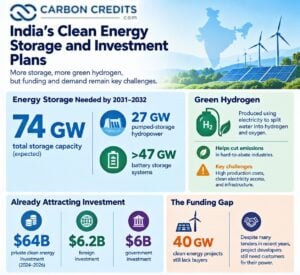
However, the country still faces a gap between developing projects and securing customers for their electricity. Reuters reported that around 40 GW of clean energy projects had yet to find buyers, following a large number of project tenders in recent years.
This highlights a problem that new investment alone cannot solve. Developers need power purchase agreements or other arrangements that give them a clear route to sell the electricity they generate. Without buyers, projects may struggle to reach construction or secure financing.
The government is working with state governments to encourage greater use of clean power and expand battery storage. The upcoming renewable energy summit is also expected to bring together domestic and international investors to discuss funding and project opportunities.
The government hopes these efforts will help turn its investment target into projects that can be built and connected to the grid.
How Clean Energy Growth Supports India’s Climate Targets
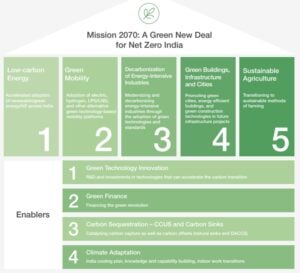
India’s clean energy expansion is also linked to its wider climate commitments. The country aims to reach net-zero greenhouse gas emissions by 2070. Under its updated climate pledge, India has committed to reduce the emissions intensity of its gross domestic product by 45% by 2030 from 2005 levels. It also aims for non-fossil fuel sources to make up about 50% of its cumulative installed electricity capacity by 2030.
Emissions intensity measures the amount of greenhouse gas emitted for each unit of economic output. It can fall even while total emissions rise, so it is different from an absolute emissions-reduction target.
Expanding non-fossil power can help India meet these goals by reducing the need for coal and other fossil fuels in electricity generation. However, the climate benefit will depend on how much clean electricity is actually produced and how it changes the role of fossil fuel power.
Manufacturing is another part of the transition. India is seeking to expand domestic production of solar equipment and other clean energy technologies. This could support local industry and reduce reliance on imported components, while creating demand for more investment across the supply chain.
Green hydrogen could also help reduce emissions in sectors such as heavy industry, but its climate value depends on how the hydrogen is produced and the energy used.
Can India Mobilize $220 Billion by 2030?
India’s $220 billion plan sets out the scale of investment needed to expand its clean energy system over the next four years. Solar and wind projects will need to grow alongside transmission networks, storage, manufacturing, and other supporting infrastructure.
The country has already added more than 300 GW of non-fossil fuel capacity and attracted billions of dollars in private investment. Still, the need for new buyers for some projects shows that funding, grid access, and reliable demand must develop together.
If India can mobilize the required capital and address these infrastructure and market barriers, the expansion could support its 2030 power target and longer-term climate goals. The outcome will depend not only on how much money is raised, but also on how quickly projects are built and how effectively the power system can use the electricity they produce.