

ArcelorMittal, Mitsubishi Heavy Industries (MHI), BHP, and Mitsubishi Development have completed the first phase of a carbon capture trial at a steel plant in Gent, Belgium. The project tested whether carbon capture technology can remove carbon dioxide (CO₂) from gas released during steel production.
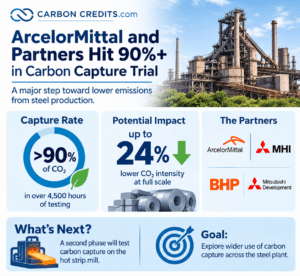
The pilot captured more than 90% of the CO₂ in the treated gas during over 4,500 hours of testing. Based on the results, the partners estimate that using the technology at full scale on the plant’s blast furnace gas could cut the site’s CO₂ emissions intensity by up to 24%.
Frederik Van De Velde, CEO of ArcelorMittal Belgium, remarked:
“Together with our partners, we set out to better understand how carbon capture technology can be incorporated into existing steel plants. I am therefore very pleased at the successful outcome of the first stage of this important carbon capture trial at ArcelorMittal Gent. Scaling up the technologies we need to decarbonise is the vital next step in our journey, and the blast furnace gas trial has given us important data in this respect.”
The result marks progress in testing ways to reduce emissions from existing steel plants. However, the 24% figure is a projection for potential full-scale use, not a reduction already achieved across the plant. The partners are now moving to the next phase, which will test the technology on gas from another part of the steelmaking process.
Carbon Capture Trial Runs for More Than 4,500 Hours
The first phase focused on gas released by the Gent plant’s blast furnace. This gas contains CO₂ and carbon monoxide, as well as dust, sulfur-containing compounds, and other impurities that can make carbon capture more difficult.
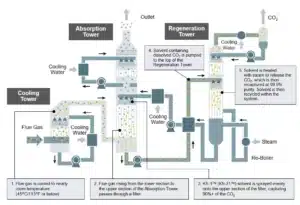
The partners used MHI’s Advanced KM CDR Process, a technology that uses a chemical solvent to separate CO₂ from gas. The trial tested the system under real steelmaking conditions rather than in a laboratory.
Over more than 4,500 hours of operation, the pilot captured over 90% of the CO₂ in the gas stream treated by the system. BHP has also reported that the separated CO₂ reached 99.9% purity on a dry basis. This is an important technical result because the purity of captured CO₂ can affect how it is handled and whether it is suitable for later use or storage.
The trial did not capture all emissions from the steel plant. It treated only a portion of the blast furnace gas, and the system captured CO₂ rather than all carbon in the gas.
The remaining carbon monoxide can still be used to produce heat and power at the site. When that gas is burned, however, it releases CO₂. This is one reason the expected emissions reduction across the plant is lower than the pilot’s capture rate.
Full-Scale Use Could Cut CO₂ Intensity by Up to 24%
The partners estimate that applying the technology at full scale to the blast furnace gas could reduce the Gent site’s CO₂ emissions intensity by up to 24%.
Emissions intensity measures the amount of greenhouse gas released for each unit of output. In this case, the estimate is based on the emissions linked to producing hot-rolled steel, using a cradle-to-gate boundary. That means the calculation covers the production stages from raw material extraction through to the finished product leaving the plant.
The estimate also reflects a specific limit: the capture process separates CO₂ from blast furnace gas before combustion. However, carbon monoxide remaining in the gas can later release CO₂ when used for heat or power. The 24% figure therefore should not be read as a 24% cut in all emissions from the plant under every condition.
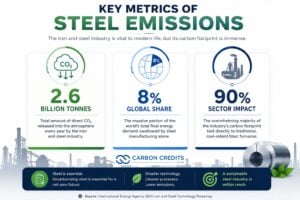
The result is still important because steelmaking is a major source of industrial emissions. The International Energy Agency estimates that the iron and steel sector accounts for about 7% of global energy-related CO₂ emissions. Cutting emissions from existing steel plants will be important while the industry develops and expands other lower-emission production methods.
Next Trial Phase Will Target Hot Strip Mill Emissions
The next phase will expand testing to gases from the Gent plant’s hot strip mill reheating furnace. This furnace heats thick steel slabs so they can be rolled into thinner sheets.
Unlike the first phase, which captured CO₂ from blast furnace gas before it was burned, the next phase will test post-combustion capture. This means separating CO₂ from gas after fuel has been burned.
The furnace uses a blend of gases produced by different steelmaking processes, along with natural gas. This creates a different and more variable gas stream for the capture system to handle.
The partners plan to use the next phase to learn how the technology performs across more than one emissions source at an integrated steel plant. The findings will support updated engineering and deployment studies for possible full-scale use.
The wider aim is to assess whether carbon capture across multiple parts of the plant could bring the blast furnace steelmaking route closer to near-zero emissions intensity. That outcome remains a potential future result, not a confirmed achievement.
Tatsuto Nagayasu, Senior Vice President and Head of CCUS at MHI, noted:
“The campaign has demonstrated the ability of the Advanced KM CDR Process™ to operate under challenging blast furnace gas conditions… The next phase at the hot strip mill will further strengthen our understanding of how carbon capture can be integrated across multiple emission sources at an operating steelworks. This project demonstrates how MHI’s proven carbon capture expertise can be applied to one of the world’s most challenging industrial decarbonisation applications.”
Why Carbon Capture Matters for Steelmaking
Steel is used in buildings, transport, machinery, and infrastructure. It is also needed for the energy transition, including wind turbines, power networks, and other clean-energy equipment.
Making steel from iron ore in a traditional blast furnace requires coal. This is both to provide heat and to help remove oxygen from iron ore. This makes emissions difficult to eliminate through renewable electricity alone.
The IEA estimates that blast furnace-based steelmaking accounts for about 70% of global steel production. Reducing emissions from this route could therefore help the industry lower its climate impact while alternative production methods develop.
Carbon capture is one option for reducing emissions from existing industrial facilities. It separates CO₂ from gas produced during industrial operations so it can potentially be transported for use or stored underground.
However, capture is only one part of the process. A project’s climate benefit also depends on how much energy the equipment uses, what happens to the captured CO₂, and whether emissions are reduced across the full system.
The Gent trial focused on testing the capture technology and generating data for future engineering assessments. The announcement does not set out a final commercial-scale cost or confirm a full-scale investment decision.
Partners Fund the Next Step Toward Lower-Emission Steel
Each partner has a different role in the project.
- ArcelorMittal is hosting the trial at its Gent steelworks.
- MHI provides the capture technology and leads the process engineering and technical assessment.
- BHP and Mitsubishi Development are providing funding, drawing on their roles as suppliers of steelmaking raw materials to ArcelorMittal’s European operations.
The project builds on a collaboration announced in 2022 to test carbon capture at industrial sites. The pilot unit began operating at Gent in 2024. It aims to assess whether the technology could eventually be used at a larger scale.
For ArcelorMittal, carbon capture is one part of a wider effort to reduce emissions from steel production. The company has a long-term net-zero emissions ambition for 2050. Yet, its ability to meet near-term targets depends on factors such as technology costs, clean energy availability, infrastructure, and policy support.
Commercial Scale Remains the Key Test
The Gent trial provides evidence that MHI’s technology can capture CO₂ from blast furnace gas under operating steel plant conditions. More than 4,500 hours of testing and capture rates above 90% give the partners data to support further engineering work.
The next challenge is to determine whether the technology can be applied across more emissions sources and at a commercial scale. That will require further testing, engineering, and decisions on cost, energy use, and how the captured CO₂ will be handled.
For the steel industry, the project offers one possible way to reduce emissions from existing blast furnace operations. However, the trial’s results are a step toward deployment. They don’t prove that large-scale carbon capture is already achieving the expected reductions.
The next phase at the hot strip mill will help show whether the technology can work across different gas streams. Its results will shape the assessment of whether carbon capture can play a larger role in lowering the carbon intensity of steel production.