


Groundwork BioAg has issued its first verified carbon credits. This is a big step for soil-based carbon removal in the United States under its Rootella Carbon® program.
The company issued 19,568 Verified Carbon Units (VCUs) after independent verification by SCS Global Services. The process used Verra’s Verified Carbon Standard (VCS) and the VM0042 Improved Agricultural Land Management method. The carbon credits have already secured multiple purchase agreements, moving the project from development into commercial delivery.
This is the first U.S. project verified under Verra’s VM0042 method. It’s also the first commercial-scale carbon removal program using mycorrhizal fungi. These naturally occurring soil fungi help plants capture more carbon and store it underground.
Groundwork says its program delivers 100% carbon dioxide removal rather than avoided emissions. It shares up to 70% of net carbon credit revenue with farmers. This creates a financial incentive for them to improve soil health and remove carbon from the atmosphere.
Groundwork BioAg CEO Alon Werber commented:
“This first-of-its-kind issuance represents the holy grail of CDR: scalable, durable, verifiable. We fully intend to disrupt the global CDR market, which delivered a total of 2 MtCO2e last year. In contrast, Rootella Carbon is set to deliver half that amount in the next two years alone.”
Why Soil Carbon Could Be a Climate Superpower
The launch happens as demand for high-quality carbon removal credits keeps rising. This demand exceeds supply, sparking interest in scalable and scientifically proven climate solutions.
Healthy soils store more carbon than the atmosphere and all vegetation combined. The Food and Agriculture Organization (FAO) says better soil management boosts carbon storage. It also improves food production and helps farms resist droughts.
Soil carbon projects use natural biological processes. This is different from engineered carbon removal technologies, which need big industrial facilities. They can also be expanded across millions of acres of farmland with relatively low infrastructure costs.
However, soil carbon has faced questions about permanence because stored carbon can be released if farming practices change.
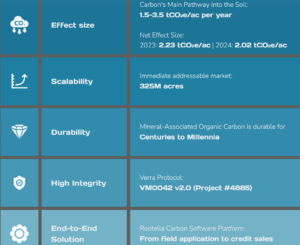
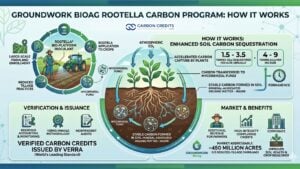
Groundwork says its use of mycorrhizal fungi helps address this issue. Fungi turn carbon into mineral-associated organic matter (MAOM). This stable soil carbon can stay stored for centuries or even thousands of years, according to studies.
According to the company, its Mycorrhizal Carbon™ system can remove between 1.5 and 3.5 metric tons of CO₂ per acre each year (4–9 metric tons per hectare). That’s around five times more than the benchmarks for many regenerative farming practices. This includes cover crops and no-till farming.
SEE MORE: Verra Greenlights Record 3 Million Soil Carbon Credits From Mexico Grasslands
Groundwork’s Rapid Expansion Across Farmland
Groundwork’s carbon program has expanded quickly over the past three years. Farmland enrolled in Rootella Carbon has grown from about 9,000 acres in 2023 to more than 700,000 acres across the U.S. Midwest and the Canadian Prairies.
The company estimates that there are around 450 million acres of reduced-tillage farmland in North and South America.
- Its broader agricultural business is also growing. In 2025, Rootella® mycorrhizal inoculants were used on 5.5 million acres globally across 23 commercial markets.
The program creates a new source of income for farmers while improving crop productivity and soil quality. Participating growers receive most of the proceeds from carbon credit sales, rewarding long-term stewardship of agricultural land.
Verra states that the project demonstrates its VM0042 methodology. This method can support strong, science-based carbon accounting for managing agricultural land. Standardized measurement will be essential as soil carbon markets continue to grow.
Why High-Quality Soil Carbon Credits Matter
Corporate buyers want carbon removal projects that offer long-term storage. They also seek projects that meet strict verification standards.
Groundwork says Rootella Carbon stands out because it generates carbon removal credits rather than avoided-emissions credits. It’s mycorrhizal fungi that also help form mineral-associated organic matter, one of the most stable forms of soil carbon. Unlike surface organic matter, it binds carbon to soil minerals, helping keep it stored much longer.
The project is verified under Verra’s VM0042 methodology. This adds credibility as buyers want more transparency and better carbon credits.
Another advantage is cost. Engineered carbon removal technologies such as direct air capture can cost several hundred dollars per metric ton. Nature-based approaches cost less and boost soil health, water retention, biodiversity, and crop resilience. They can’t replace engineered solutions, but they can quickly increase the supply of high-integrity carbon credits.
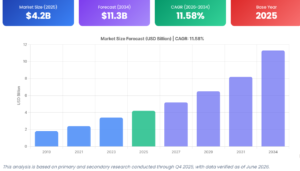
- The global soil and agricultural carbon credit market is worth $4.2 billion today. It is expected to grow to $11.3 billion by 2034, with an annual growth rate of 11.58%.
On voluntary registries, agricultural credits account for around 100 million metric tons of CO2e. They trade at a baseline carbon price of $4 to $6 per metric ton. This price is influenced by new Greenhouse Gas Protocol balance sheet rules and institutional capital, like Mirova’s recent $30 million allocation.
Industry leaders are shifting to high-quality, tech-verified removals. Key players include aggregators like Indigo Ag and Soil Capital, while major funders such as Bayer and Rabo Carbon Bank also play a role. New measurement methods from registries like Verra are pushing credit prices up. They now range from $5 to over $25 per ton. This trend is making soil carbon a key asset class.
Farmers Become Central to Carbon Removal
Groundwork’s model places farmers at the center of the carbon market. The company shares up to 70% of net carbon credit revenue. This gives growers a strong financial reason to boost soil health while farming as usual.
This reflects a broader shift in agriculture. More farmers are using regenerative practices. They are adopting reduced tillage, cover crops, and biological soil treatments. These methods help improve yields and lower costs. Carbon markets offer another source of income that can help support these changes.
Healthier soils also provide benefits beyond carbon removal. They boost biodiversity, cut erosion, enhance water retention, and support food security. This makes the projects appealing to companies aiming for wider sustainability goals.
A New Model for Nature-Based Carbon Removal
Groundwork BioAg’s first issuance marks an important step for agricultural carbon markets.
The project proves that it’s possible to measure soil carbon removal accurately. It can be verified independently and marketed under a top carbon standard. This could strengthen confidence in nature-based carbon credits as buyers demand greater transparency and integrity.
Challenges remain. Soil carbon projects need to show they last over time. They must measure well and perform consistently in various climates and farming systems. Strong monitoring and independent verification will remain essential as the market grows.
Still, Groundwork’s early success suggests biological solutions can become an important part of the global carbon removal portfolio. The company blends science-based soil management with financial incentives for farmers. This model supports agriculture and promotes climate action.
As demand for high-quality carbon removal grows, projects like Rootella Carbon can boost supply. They also make farmland more valuable in the battle against climate change.