Net Zero Industry Tracker 2022 is Out: Heavy Industries Watch Out

The World Economic Forum, together with Accenture, released the 1st edition of its report that tracks the current state of the net zero transition in 6 key industries.

WEF calls it the Net-Zero Industry Tracker 2022. The report highlights the importance to understand the challenge for the heavy industries towards net zero. It also identifies the gaps to fill to achieve net zero goals to limit global warming to 1.5 degrees by 2050.

High energy prices and supply chain concerns drive the urgency of decarbonizing the industries.

Hence, the framework offers a holistic perspective and standard metrics to measure progress of the industrial sector.

Plus, it provides seven cross-sectoral recommendations for industrial firms, consumers, and other stakeholders.

The WEF Net Zero Industry Tracker 2022

Industry accounts for around 40% of global energy consumption and over 30% of global GHG emissions.
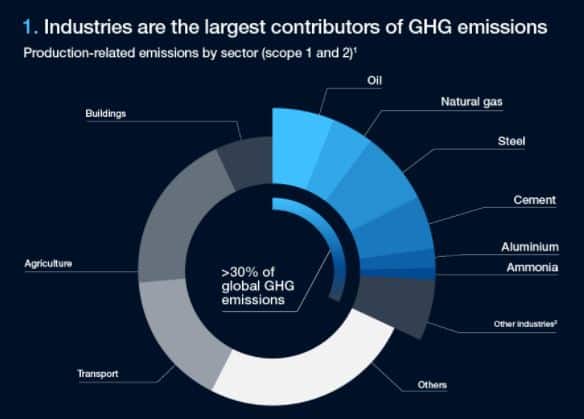
industry GHG emissions

As the largest emitter, the industries decarbonization will be critical to tackling climate change.

This is where the WEF’s net zero industry tracker framework comes in. Roberto Bocca from WEF said that:

“Several industrial sectors and individual companies have set up targets with the aim of reaching net zero emissions. We believe that bringing transparency to closing net-zero gaps and reporting on this progress is critical to achieve these ambitious goals…”

The report will track the “net zero performance” of the heavy industries and their “net zero readiness“. The six key industries include:

  • Steel
  • Cement
  • Aluminium
  • Ammonia
  • Oil and
  • Natural gas

Together, these industries account for 80% of industrial emissions as per Accenture analysis. Monitoring their readiness involves measuring 5 major enablers:

technology, infrastructure, policies, demand, and capital.

Here’s the cross-industry findings of the report for net zero readiness of each sector per enabler:
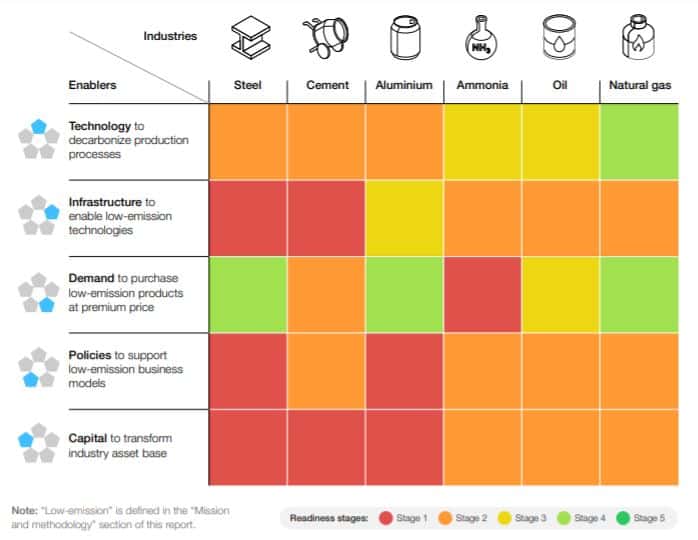
industry net zero readiness

The report also points out that ~$2 trillion is necessary to make low-emission industries a reality. This calls for huge policy incentives to level the playing field for low-emission production.

The chart below shows how much carbon pricing should be for each industry sector compared with the current price.
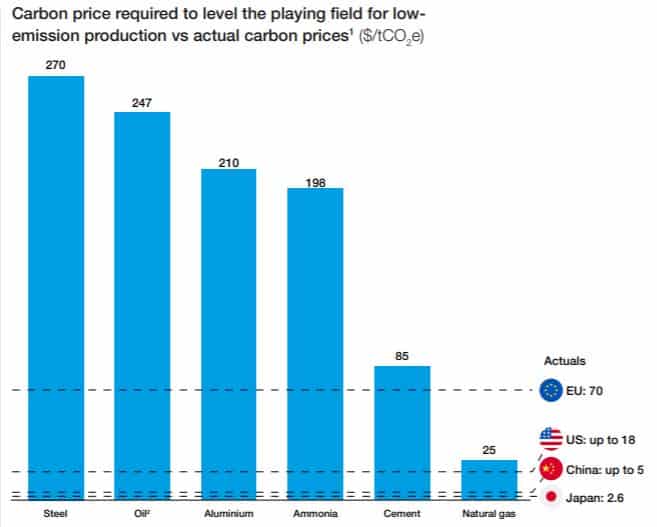
carbon price for industry low emission production

With that said, investments in low-emission assets can be riskier for firms due to their dependencies on new technologies and infrastructure.

This needs collaboration across the sectors to make the key enablers come together in the same direction to speed up progress towards net zero.

Net Zero Tracker Key Highlights Per Industry

Here are the major findings of the WEF’s net zero tracker report for each industrial sector.

Steel industry
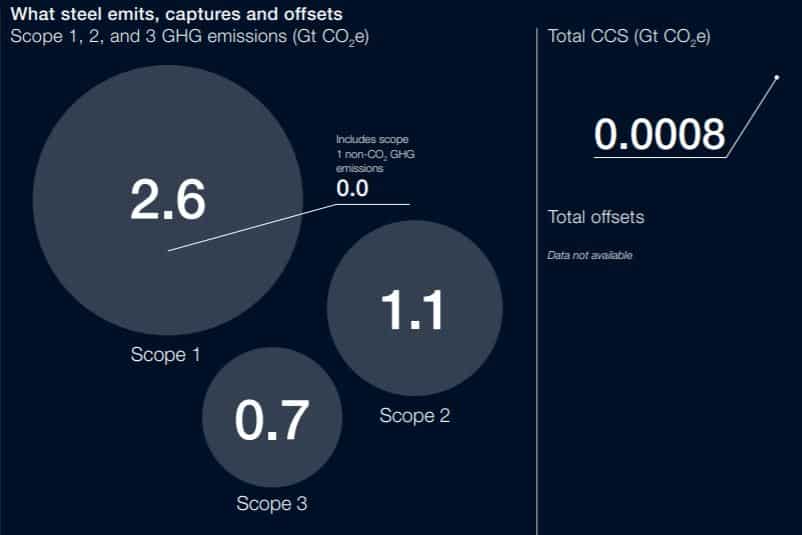
steel industry GHG emissions

  • Steel is the largest emitter, generating 7% of all man-made emissions.
  • Steel demand can increase up to 30% by 2050.
  • Needs over $2 billion investments in low-carbon power, clean hydrogen and CO2 handling infrastructure.
  • Green premium of 25-50% for buyers due to high costs of clean technologies.

There are 3 main pathways to decarbonize steelmaking: carbon capture, hydrogen and electrochemistry.

Cement industry

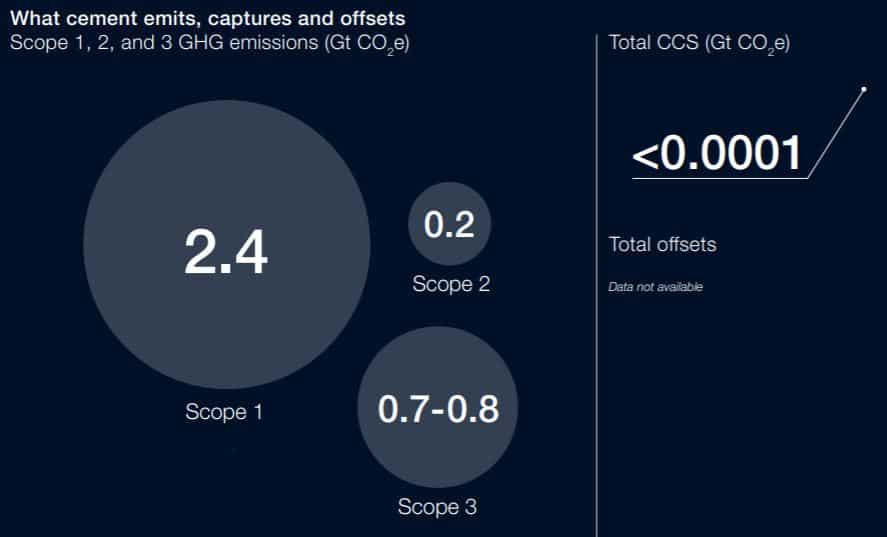
  • cement industry GHG emissions
  • Cement is the second largest emitter, generating 6% of total emissions.
  • Demand for cement can go up to 45% by 2050.
  • Requires ~$185 billion for CO2 handling infrastructure and clean hydrogen production in cement plants.
  • Green premium above 50% for low-emission cement.

Carbon capture is key to cement’s net zero pathway, but electrification and hydrogen also have roles.

Aluminium industry

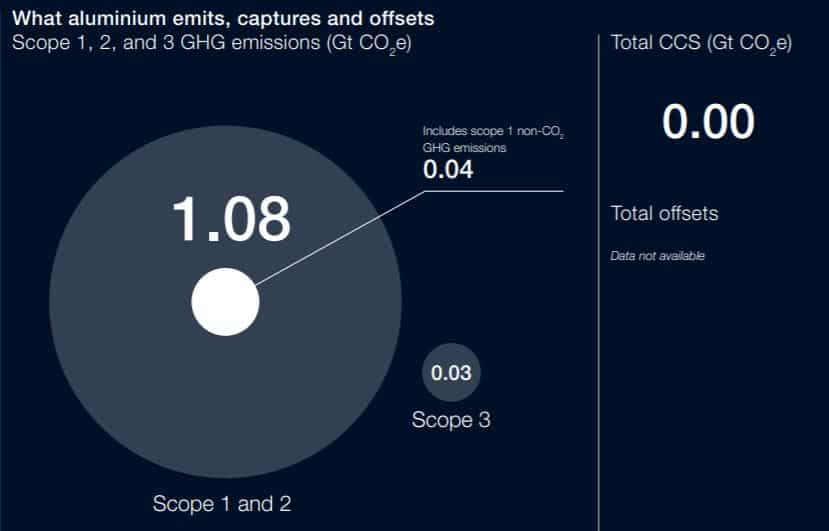
  • aluminium GHG emissions
  • Aluminium accounts for 2% of all industry emissions.
  • Aluminium demand will jump by up to 80% by 2050.
  • Calls for ~$510 billion investments to enable clean technologies and production.
  • Green premium up to 40% to wholesale buyers and 1-2% to end consumers.

The major pathway for aluminium production to achieve net zero is a mix of electrification, transition to hydrogen, and inert anodes. Yet, carbon capture is also under exploration.

Ammonia industry
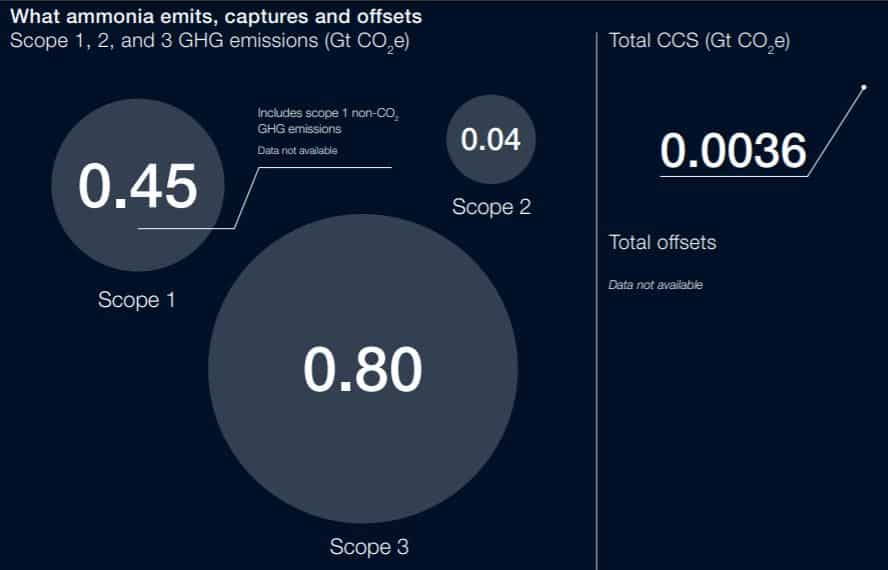
ammonia GHG emissions

  • Ammonia is the chemical sector’s largest emitting product, releasing 1.3% of all emissions.
  • Ammonia demand for fertilizer and industrial use will go up to 37% by 2050.
  • Needs ~ $850 billion investments to enable green and blue hydrogen production.
  • Green premium of up to 100%.

The best way to decarbonize ammonia production is to develop blue or green hydrogen technologies.

Oil industry
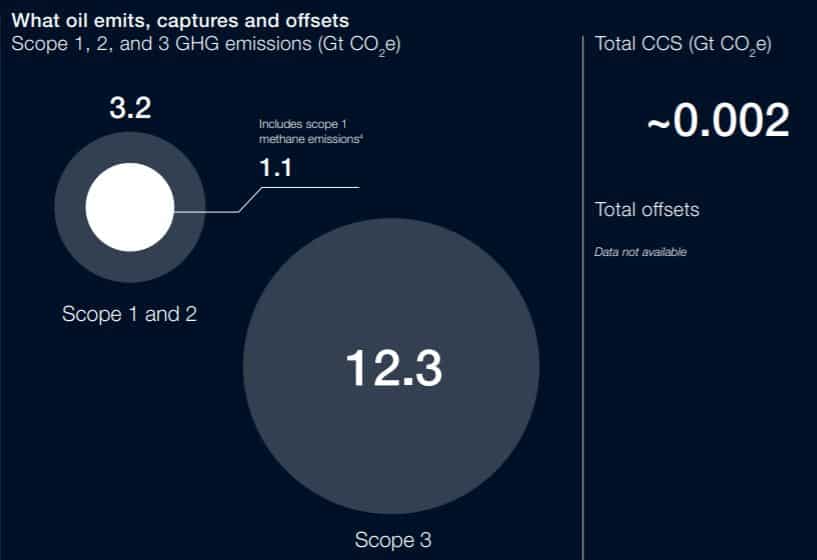
oil GHG emissions

  • The oil sector consumes so much fossil fuels and releases methane, producing 6% of total GHG emissions.
  • Demand for oil will increase by 17% by 2050 but should go down by 73% for the world to reach net-zero.
  • 35% of oil sector emissions are methane (70% of which can be abated at zero or minimal costs today).

Decarbonizing the oil sector means cutting methane and flaring emissions. The same goes for energy and process related emissions in refining oil. This requires carbon capture, use and storage, hydrogen, and electrification pathways.

Though substitutes for oil products are available, their availability and affordability remain a concern.

Natural gas industry
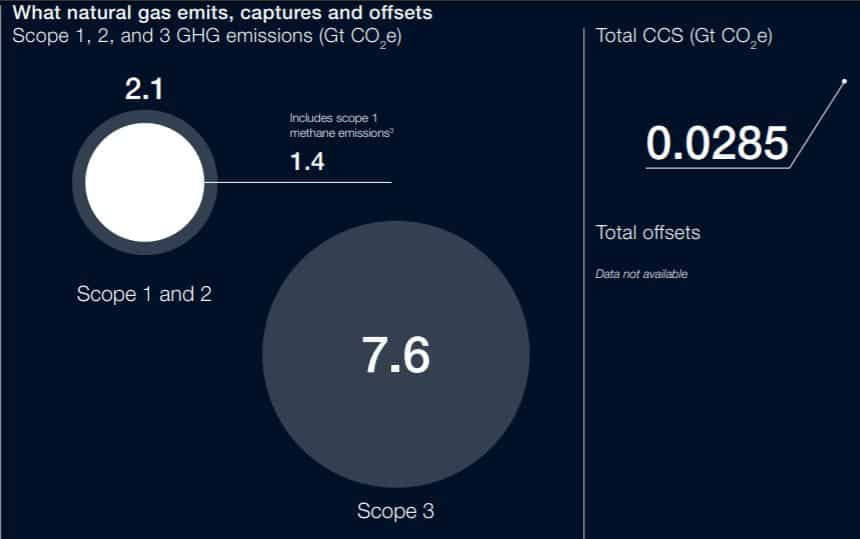
natural gas GHG emissions

  • The gas sector also uses a lot of fossil fuels and emits methane, releasing 4% of all GHG emissions.
  • Demand for gas will go up by 30% by 2050 but need to drop by 55% to reach net zero scenario.
  • 65% of the gas sector emissions are methane (70% of which can be abated at zero or minimal costs today).
  • As low as 1-3% as a green premium to end consumers.

Mature technologies exist to abate 80% of gas sector emissions. This will result in a 7% increase in production cost.

For all industrial sectors, they all need stronger demand signals from buyers and policies to incentivize investments.

The net zero industry tracker further suggests that concerted efforts should include lawmakers, financial entities, and consumers.

And of course, the biggest effort must come from the heavy industrial firms themselves.

Carbon Credits End the War Between Indigenous Peoples and Loggers

Mosaic Forest Management, a logging company, agreed with the Indigenous Peoples (IPs) to preserve forests on two Canadian islands home to 700-year old trees.

Mosaic is one of British Columbia’s largest logging companies. The firm decided to make truce with the indigenous communities in preserving forests in Vancouver Island and Haida Gwaii.

The company promised to defer logging for at least 25 years on 100,000 acres of forest lands.

Doing so will not only make them be at peace with the IPs living in the forests. They can also earn as much as $230 million (CA$300 million) over the life of the project by selling carbon credits.

Indigenous Peoples and Carbon Markets

The emergence of carbon markets created a unique opportunity for indigenous communities to develop an economic sector that can align with their lifestyles and sustainable forest management.

It also opens doors for forming partnerships and developing climate policies with the IPs.

Indigenous peoples are benefiting from two major shifts in the carbon market:

  1. There’s a growing recognition of the rights of IPs in protecting forests
  2. Prices for carbon credits make preservation of forests as profitable as logging

IPs around the world have been fighting to stop logging in the forests they’re preserving. They occupy about ⅓ of the world’s undeveloped forest lands.

In Canada, the IPs have been doing it for about 40 years now and gained double victory.

  • Logging ended on the protected forests in Vancouver Island and Haida Gwaii.
  • At the same time, Mosaic agreed to pay the IPs millions of dollars to protect the centuries old trees.

The agreement sets aside 100,000 acres of old growth trees on the said Canadian islands for over 25 years.

Many project managers believe that IPs play a critical role in fighting climate change. As per Mike Korchinsky from Wildlife Works, he said that:

“I don’t believe there is any way we can achieve our climate goals globally without ensuring the support of indigenous communities to conserve our forests…”

Wildlife Works is a U.S. conservation firm managing forest-based carbon projects in Africa, Asia and Central and South America.

The Canadian IPs

First Nation is one of the Canadian IP groups that were not in unity when Mosaic invited over 2 dozen communities to help design and manage forest conservation plans.

The protected forests are on land controlled by Mosaic under a land grant. But those forests have been home to IPs who now have more say over how to manage the land.

Mosaic’s offer includes an unrevealed share of carbon credits sales for the IPs to protect the forests. The proceeds will pay for the research, forest management training, and other conservation services.

Some members of the indigenous communities initially rejected the offer for various reasons. According to Eli Enns, a First Nation member, many were distrustful due to limited land rights, abuses, and forced assimilation.

He also said that some IP members preferred to earn income from their logging jobs. But now most of the IPs understand the potential for carbon credits to achieve what decades of protests failed to deliver.

Enns stated that:

“Mosaic was not required to include us in the project… Yet they found a way to make meaningful progress to reconcile the First Nation’s management of their forest lands.”

The timber firm stands to earn as much from selling carbon credits as it would selling logs from the protected forests. The overseer of the carbon credit project noted that it was the right time to strike the deal.

The cash from the carbon credits will be shared among the local members of the First Nation. Same with other Canadian IPs, they’re given more rights over these projects by the new federal laws.

Carbon credits from protecting forests

Carbon credits produced by projects involving forests are among the most sought after and pricey. That’s because they protect trees that store large amounts of carbon.

Rainforest protection projects are often found in countries with robust legal safeguards. Popular examples are the cases of Indonesia and Papua New Guinea. Restrictions on forest carbon credits generation were set in both forestry dense countries.

Meanwhile, forest projects in the U.S. were deemed to generate dubious carbon credits. This is quite identical in the case involving the Surui people living in the Amazon.

The Amazon project was banned in 2018 after rogue miners and loggers cleared a large number of trees. This led to warning that carbon credits may erode indigenous peoples rights.

These issues discouraged carbon credit buyers from supporting projects where IPs rights are unclear.

  • But the recent boom in the carbon credit market and improvements in IPs forest rights are drawing more attention.

Logging firms, tribal groups, and governments are now taking advantage of the developments in carbon markets.

Companies buy carbon credits to offset their emissions and achieve their climate goals. The market hit $1 billion in 2021 and will grow more to the tens of billions over the decade.

In 2021, Verra tracked the issuance of ~130 million sales of carbon credits from forest projects. That’s about a 3x increase from 2020 forest carbon credits sale.

US Congress Revives the $369 Billion Climate Change Bill

U.S. Senators Joe Manchin and Chuck Schumer unveiled a long-awaited reconciliation bill to invest $369 billion to fight climate change and advance clean energy programs.

The new U.S. bill is dubbed the “Inflation Reduction Act of 2022″. It would be the biggest and most aggressive investment ever taken by Congress for climate.

The bill is 725-page long with major provisions to cut down emissions of the U.S. by about 40% by 2030.

The deal came two weeks after Sen. Manchin said he would not support a bill with clean energy and tax provisions while inflation remains high.

But it appears that he kept the door open by reviving the climate bill once more after a year of pained negotiations.

If passed and signed into law, it would be a major victory for President Joe Biden’s climate agenda that he ran on in 2020. That agenda was attacked by the Supreme Court last June.

Taken as a whole, the bill would be a great win for clean energy tax credits as the centerpiece. The deal extends the current renewable credits. Beyond 2025, they will be technology neutral and be based on GHG emissions reductions.

Senate Finance Chair Ron Wyden said that:

“For the first time, the tax code is going to reward emissions reductions… and encourage the development of new clean energy technologies as soon as they come online.”

Lawmakers, environmentalists, and climate advocates who had been hammering Manchin for rejecting the climate measures were ecstatic at the surprise announcement.

The Inflation Reduction Act of 2022: Key Climate Provisions

The Act includes five key climate provisions with the following funding details:

Cutting Consumer Energy Costs. The bill will provide a range of incentives to consumers to relieve the high costs of energy and decrease utility bills. These include buying energy efficient appliances, clean vehicles, and rooftop solar. The specific funding includes:

  • $9 billion in consumer home energy rebate programs
  • $4,000 consumer tax credit to buy used-clean vehicles
  • Up to $7,500 tax credit to buy new clean vehicles
  • $1 billion grant program to make housing more energy efficient

Both tax credits would only be available to lower and middle income consumers.

Energy Security and Domestic Manufacturing. The climate change bill will support manufacturing cleaner energy products through historic investments. That includes ~$60 billion across the full supply chain of on-shore clean energy manufacturing and transportation technologies.

  • $30 billion production tax credits for manufacturing of solar panels, wind turbines, batteries, and critical minerals processing
  • $10 billion tax credit to build clean technology manufacturing facilities
  • Up to $20 billion in loans (with $2 billion in grants) to build new clean vehicle manufacturing facilities
  • $2 billion for National Labs to boost breakthrough energy research

These manufacturing incentives will help ease inflation by bringing down the cost of clean energy and clean vehicles. It will also relieve supply chain bottlenecks.

Decarbonizing the Economy.

Climate investments will cut emissions across all sectors of the economy. The primary sectors include electricity production, transportation, industrial manufacturing, buildings, and agriculture.

  • $30 billion tax credits (for states and electric utilities) for clean sources of electricity and energy storage
  • $6 billion grants and tax credits to reduce emissions from the largest industrial emitters (e.g. chemical, steel and cement plants)
  • $9 billion for the Fed government to buy American-made clean technologies
  • $27 billion clean energy technology accelerator to support deployment of technologies to reduce emissions

The climate change bill also includes unspecified funding for a program to reduce methane emissions from the production and distribution of natural gas. Methane emissions are more than 80x as potent as CO2 in warming the atmosphere.

Environmental Justice Investments. The climate deal includes ~$60 billion in environmental justice investments into disadvantaged communities. It will address the unequal effects of pollution on low-income communities and communities of color.

Agriculture, Forests, and Rural Communities. The funding will ensure that rural communities are at the forefront of climate solutions. Investments that will be made include:

  • Over $20 billion to support climate-smart agriculture practices
  • $5 billion in grants to support forests, forest conservation and urban tree planting
  • $2.6 billion in grants to conserve and restore coastal habitats
  • Tax credits and grants to support domestic production of biofuels

Huge Win for Clean Energy Transition

Obviously, the climate change bill puts clean energy at the forefront – from manufacturing clean energy products to buying clean vehicles and supporting clean electricity sources.

President Joe Biden said the tax credits and investments for clean energy projects in the deal will create thousands of new jobs and help lower energy costs. And so he urged the Senate to move on the legislation the soonest time possible.

President Biden has pledged to curb the country’s emissions by 50% to 52% by 2030 and reach net zero emissions by 2050. But without the bill, that goal won’t be possible as per the analysis of Rhodium Group. The president remarked that:

“This is the action the American people have been waiting for… This addresses the problems of today – high healthcare costs and overall inflation – as well as investments in our energy security for the future.”

The Senate is set to vote on the proposed climate change bill next week. Then it will go to the Democrat-dominant House of Representatives.

Integrity Council Unveils Core Carbon Principles for Consultation

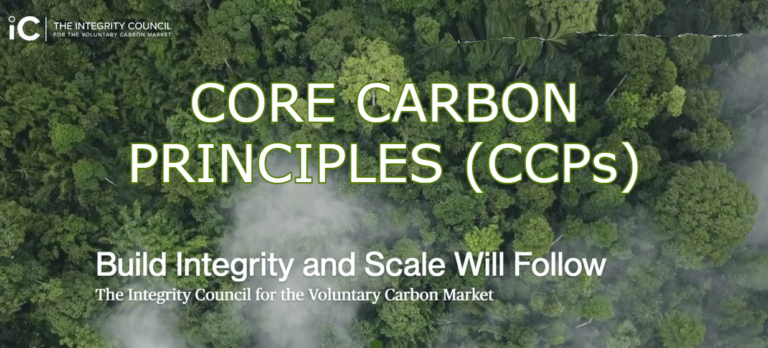
The Integrity Council for the Voluntary Carbon Market set out the draft of its Core Carbon Principles for consultation to govern real, verifiable, and high-integrity carbon credits.

The ICVCM is an independent governance body that was recently-formed from the Taskforce on Scaling Voluntary Carbon Markets (TSVCM).

TSVCM is one of the leading organizations governing the carbon markets. It seeks to establish a global benchmark for carbon credits as efforts at beefing-up standards in carbon offsetting grow.

And one big part of its efforts is what the ICVCM seeks to establish – the Core Carbon Principles (CCPs) for high-quality carbon credits. The Council released its draft for public consultation.

Integrity Council’s Core Carbon Principles for Carbon Credits

The Core Carbon Principles (CCPs) will set new threshold standards for high-quality carbon credits. They will also provide guidance on how to apply the CCPs and define which carbon-crediting programs and methods are CCP-eligible.

The Council’s CCPs are a set of criteria ensuring that carbon credits bought to offset emissions have a real, verifiable climate impact. And that’s based on solid science, not speculations.

For carbon credits to be of high integrity, the ICVCM suggests that all carbon purchases (reductions or removals) meet CCP’s 10 key criteria:

  1. Additionality
  2. Mitigation activity information
  3. No double counting
  4. Permanence
  5. Program governance
  6. Registry
  7. Robust independent 3rd party validation & verification
  8. Robust quantification of emissions reductions & removals
  9. Sustainable development impact and safeguards
  10. Transition towards net-zero emissions

Moreover, mitigation efforts must avoid locking in levels of emissions or practices that are not in line with achieving the net zero emissions by 2050.

As per Carney, the UN Special Envoy on Climate Action and Finance:

“By providing a global threshold standard for credible, transparent, high-integrity carbon credits the Integrity Council’s new Core Carbon Principles will support the net zero transitions of companies… and the reduction of global emissions while providing much-needed financing to projects in emerging and developing economies and to Indigenous Peoples.”

Emissions reduction efforts must also be guided by: “clear guidance, tools and compliance procedures”.

Plus, all carbon credit programs must also be validated and verified by third-party. They also have to be robustly quantified according to: “conservative approaches, completeness and sound scientific methods.”

The Core Carbon Principles draft also suggested that all carbon crediting programs should be available with comprehensive and transparent information. Such information should be accessible to non-specialized audiences and come in electronic format.

They must also have effective governance systems to achieve:

Lastly, they should identify, record and track mitigation activities on a registry.

All these CCP criteria will ensure projects are compatible with sustainable development goals.

Public Consultation for the CCPs

VCM experts hope that growing the carbon markets will hit two birds with one stone in driving a sustainable future:

  1. By providing additional emissions mitigation to speed up the pathway to 1.5C
  2. By channeling resources to where investments are critical for climate adaptation and resilience.

Integrity Council Chair Annette Nazareth noted that the VCM exists to hasten a just transition to 1.5C. She also said that:

“In designing an effective market that can deliver genuine climate impact at speed and scale, we need to start with integrity. It is a precondition for a transparent, deep, liquid, standardized and scalable market that efficiently channels capital to where it is most urgently needed… To make this work, we need everyone from across the VCM to come to the table, share knowledge and expertise, and collaborate to co-create the CCPs…”

Indeed, dealing with the integrity of carbon credits fast is crucial as the debates around ESG and greenwashing continue to swirl.

The public consultation for CCPs will be open to all. It has to attract interest from key stakeholder groups operating in the VCM. These include finance, business, NGOs, scientists, governments, and members of the public.

The British Standards Institute (BSI) will oversee the consultation.

The consultation will seek views on several questions on the scope of the Council’s proposed core carbon principles. These include two crucial questions:

  • Should the VCM levy a share of proceeds to development countries most vulnerable to climate change to meet the costs of adaptation?
  • Should host countries have to authorize voluntary carbon credits bought in their jurisdiction?

Through the consultation, the ICVCM said the CCPs will pave the way for developing the spot and futures markets for carbon credits.

The Integrity Council further states that via CCPs, carbon markets will be liquid, scalable, and create transparent price signals. All these result in better price risk management.

The 60-day consultation will be until 27 September 2022, expecting submissions from all corners of the market. Click here to access the draft report

DeepMarkit Partners with Flowcarbon to Host the ReFine Our Future Event in Paris

DeepMarkit announced that it participated as a partner-level participant alongside Flowcarbon at the “ReFine Our Future: An Immersive Flowcarbon Event”.

The event was held on July 20, 2022 on the Loho Rooftop in Paris, France, concurrently with the 5th Annual Ethereum Community Conference that took place from July 19-21, 2022.

DeepMarkit attended to share information about its MintCarbon.io platform and foster the ongoing development of the strategic relationship between the company and Flowcarbon.

The ReFi Event featured a gallery of carbon credit NFTs that have been minted via its MintCarbon.io platform. The event pulled together many experts and an interactive experience that highlighted novel ways to drive capital to carbon projects.

Flowcarbon believes that working together with DeepMarkit in the Web3 x carbon space will strengthen and grow the entire industry. The firm is using blockchain technology to address some of the systemic challenges in the voluntary carbon market.

These include accessibility and transparency in the spot market for carbon markets, facilitating early and efficient access to capital for project developers, and creating tokens backed by carbon credits to promote liquidity.

DeepMarkit looks forward to exploring more opportunities with Flowcarbon and growing their relationship as the both participants aim to help reduce the global carbon footprint via their corporate missions.

Read the FULL NEWS RELEASE HERE.

Saudi Prince Reveals Design of the City of the Future in NEOM

Saudi Crown Prince announced The Line’s design, a zero carbon city that he plans to build at NEOM which costs between $100 to $200 billion.

Revealed in 2017, NEOM is Prince Mohammed’s plan to turn a desert the size of Belgium into a high-tech and sustainable megacity in Saudi Arabia’s northwestern corner.

It will be a linear metropolis with a ski resort and an industrial city that partially floats on water.

NEOM is one of the largest and most complex urban construction programs in the world. It spans 26,500-square-km (10,230-square-mile) on the Red Sea with several zones.

NEOM ’s business zone costing about $500 billion is for diversifying the economy of the top oil exporter. The kingdom’s sovereign wealth fund, the Public Investment Fund, is the cornerstone investor in NEOM.

The key purpose of building the region is to house the 10 million people that will overcrowd Riyadh. By 2030, the crown prince aims for 1.5 million people to live in “The Line”. That population will be 9 million by 2045.

The Line: A Zero-Carbon City in NEOM

The Line is a zero-carbon city within NEOM. It’s only 200 meters wide, but 170 kilometers long, and 500 meters above sea level.

Prince Mohammed first unveiled plans for the city in January last year. He said about it:

“The city’s vertically layered communities will challenge the traditional flat, horizontal cities… The designs of The Line embody how urban communities will be in the future in an environment free from roads, cars, and emissions.”

The Line will vertically layer homes, offices, public parks, and schools within a mirrored facade stretching over 170 km.

A new exhibit open to the public in Jeddah displays potential designs for “modules” of the twin buildings. They’ll be built in stages by global architecture firms. Popular names include LA-based Morphosis and UK-based Archigram.

The prince said last year that the project would cost $100 to $200 billion. There are no updated figures provided so far.

The environmental solution to urban living

The Line offers a new approach to urban design that’s based on the concept of Zero Gravity Urbanism. It refers to the idea of layering city functions in a vertical way while giving people the possibility of moving seamlessly in three dimensions – up, down, or across.

The urban concept is unique from just the tall buildings we know today. As it layers various facilities, one can move fast and with less effort to reach destinations within minutes.

  • With no roads, cars or emissions, the zero-carbon city will run on 100% renewable energy while 95% of land will be preserved for nature. Unlike traditional cities, people’s health is a priority over transportation and infrastructure.

As The Line will have a footprint of only 34 square kilometers, it has a reduced emissions. Its design creates never-before-seen efficiencies in cities.

Plus, the city’s ideal climate all-year-round will ensure that residents can enjoy the surrounding nature. Tenants will also have access to all facilities within a 5-minute walk, a high-speed rail, with an end-to-end transit of 20 minutes.

The city’s zero-car environment is part of a 100% sustainable transport system – with zero pollution and zero wait time. As such, low commutes will give residents more time for leisure.

And the community will live close to, and in harmony with, nature, 95% of which is untouched by urbanization. The vertical garden city means people are always only a few minutes from nature.

In order to change business as usual, the city’s design is digitized and the construction is industrialized.

Overall, The Line’s zero carbon city offers its residents the following features:

  • Work-life balance
  • Legacy-free urbanism
  • Enhanced livability
  • Leisure and sports
  • Vertical living
  • Next-gen architecture
  • Walkable communities

The announcement of The Line is a continuation of NEOM’s progress in its development. Its final construction will be done in 2025.

NEOM will begin engaging large potential investors by the end of this year. In fact, Saudi officials are talking to different companies around the world to invest and work with NEOM.

With The Line and NEOM at stake, the prince said that he’d be happy if he’ll achieve even just 50% of what he aims with this urban project.

Understanding The Carbon Cycle and How it Changes the Climate

Carbon is the foundation of all life on Earth. Humans are made of carbon. We eat carbon and almost everything is built on carbon.

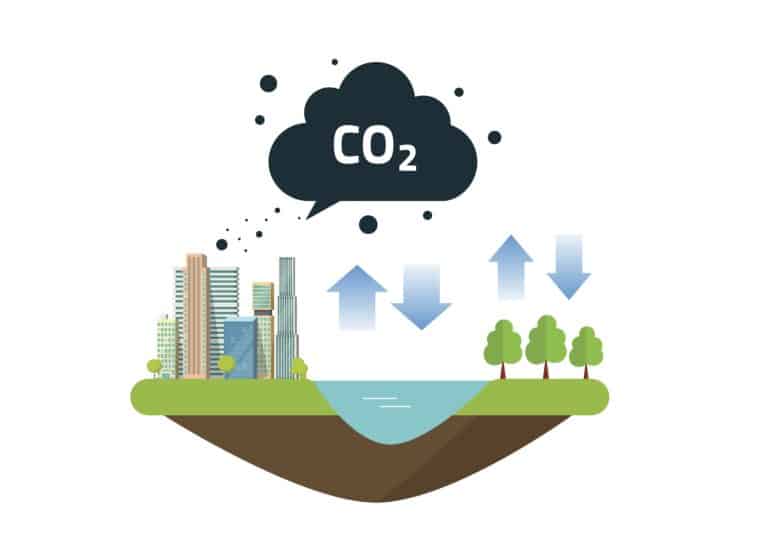
Carbon is the 4th most abundant element in the entire universe. It’s also plenty in our atmosphere in the form of carbon dioxide (CO2).

It helps regulate the planet’s temperature but any changes that put it into the atmosphere cause temperatures to rise. And so, it turns out to be the most serious concern we face today – climate change.

This article explains what happens during the carbon cycle and how it causes global warming. It will also talk about the carbon cycle in relation to the water cycle and how they both affect the earth’s temperature.

How Carbon Cycle Takes Place

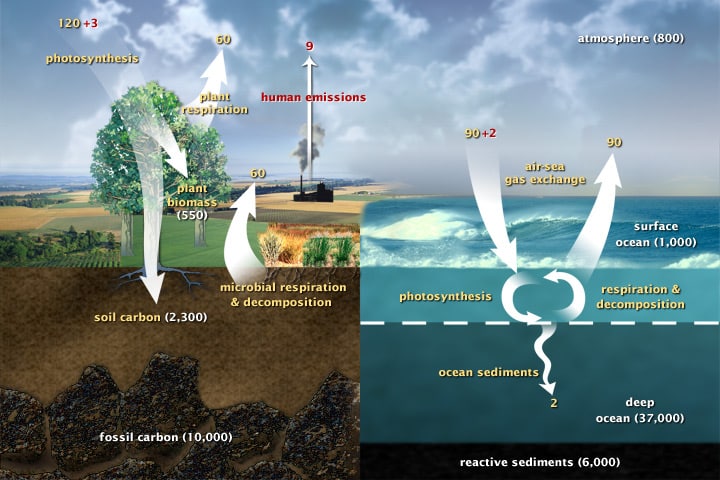
Most of Earth’s carbon, which is around 65,500 billion metric tons, is found in rocks. The rest of it is in the soil, plants, fossil fuels, oceans, and the atmosphere. They’re the reservoirs or sinks through which carbon cycles.

Carbon cycle is the exchange through which carbon flows between each of those sinks. Any change in the cycle that lets carbon flows out of one sink creates more carbon in the other sinks.

carbon cycle process
This fast carbon cycle shows the movement of carbon between land, atmosphere, and oceans. Yellow numbers are natural fluxes while red are human contributions in gigatons of carbon per year. White numbers are stored carbon. (Source: U.S. DOE, Biological and Environmental Research Information System.)

In the long run, the carbon cycle seems to keep the balance that avoids carbon from entering the atmosphere or from being stored in rocks. This balance helps keep the planet’s temperature stable.

But for some time scales, parts of the carbon cycle may amplify temperature changes that can happen for shorter time periods. This instance often occurs over tens to a hundred thousand years.

In the same manner, over very long time periods, millions to tens of millions of years, geological changes can also cause carbon to seep from the Earth’s core. This also changes the planet’s temperature from extreme hot (Cretaceous era) to extra cold (Pleistocene era).

Today, carbon escapes the sinks and reaches the atmosphere when organisms die, wildfires breakout, fossil fuels get burned, and so on.

And humans have a big role in the carbon cycle through their activities such as too much logging, burning of fossil fuels, excessive fishing, and land development. As a result, the amount of CO2 in the air has been rising so fast.

  • In fact, it’s already greater today than at any time in the last 800,000 years.

In the case of the ocean, the carbon cycle takes place between the ocean’s surface waters and the atmosphere.

The carbon cycle happens either in slow pace or fast pace.

The slow carbon cycle involves a series of chemical reactions and tectonic activity that moves carbon between different reservoirs. The process also takes place between 100 to 200 million years to complete.

On the contrary, the fast carbon cycle occurs in a lifespan and involves the movement of carbon through various life forms.

In other words, this carbon cycle moves via the biosphere. About 1,000 – 100,000 million metric tons of carbon move through this cycle each year.

For the purposes of this article, we’ll focus on this short-term, fast carbon cycle. It only takes days, months, or years for carbon to cycle through this process.

The fast (biological) carbon cycle

Plants and phytoplankton (very tiny organisms in the ocean) are the main components of the fast or biological carbon cycle. Photosynthesis is the process that forms the foundation of this carbon cycle.

During photosynthesis, plants absorb CO2 and sunlight to form sugar and oxygen they need to grow.

Next, animals and humans eat the plants or plankton, breaking down the plant sugar to get energy. During food consumption, CO2 is released into the atmosphere due to cell respiration.

Then plants and plankton die and decay, and get eaten by bacteria. Or fires can also consume the plants and release the carbon back into the atmosphere.

Changes in the Carbon Cycle

In the past years, the carbon cycle has changed in response to climate change.

Levels of CO2 in the air corresponded closely with the Earth’s temperature over the past 800,000 years. Though the temperature changes were partly due to variations in Earth’s orbit, the increased temperatures released CO2 into the air.

That, in turn, caused the planet to get warmer. That was the case tens of thousands of years ago. But today, changes in the carbon cycle are happening because of humans.

Human activities disturb the natural carbon cycle significantly. By burning coal, oil, and natural gas, we quicken the carbon cycle process, releasing large amounts of carbon into the air each year.

That carbon took millions of years to escape their sinks. As such, we enable the carbon to move from the slow cycle to the fast cycle.

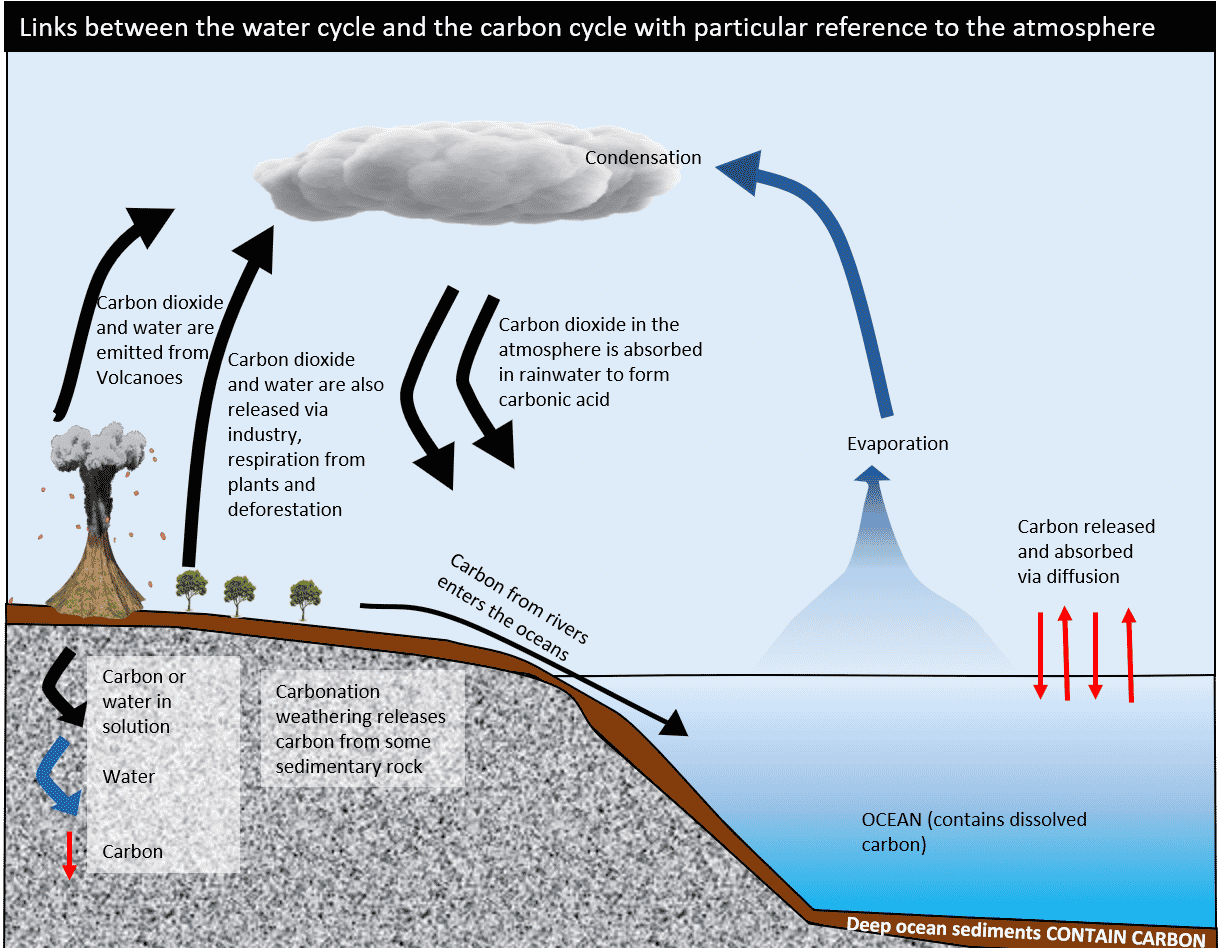
The carbon cycle and the water cycle

Energy from the sun sets in motion both the carbon and water cycles. Recall that sunlight, CO2 and water are inputs during photosynthesis.

But, changes to the carbon cycle as mentioned above affects the water cycle. With rising global warming due to increasing levels of CO2, the result is super-charging both cycles.

For instance, we’ve seen greater evaporation in regions that created heavier rainfall in some areas and deeper droughts in others. This phenomena shows that the greater amount of carbon in the air is altering the water cycle.

Meanwhile, the water cycle has been altered by the greater amount of carbon in the air. Likewise, plant growth is enhanced by higher carbon levels in the atmosphere.

This, in turn, contributes to more water vapor to the atmosphere during transpiration. It then leads to heavier downpours during rain events.

Hence, both water and carbon are cycling faster and differently than before as the climate changes.

carbon cycle and water cycle

The carbon cycle and the oceans

More CO2 concentrations and warming temperatures are causing changes in the natural carbon cycle. And much of the carbon emitted by humans has been absorbed by the oceans, causing them to become less alkaline.

This helps to slow global warming by removing some CO2 from the atmosphere. But as warmer ocean waters can hold less carbon, it will leave more in the atmosphere.

  • About 30% of the CO2 that humans dumped into the air has diffused into the ocean via direct chemical exchange.

Dissolving CO2 in the ocean creates carbonic acid that makes the water more acidic or less alkaline. Since 1750, the pH of the ocean’s surface has dropped by 0.1, a 30% change in acidity.

Warmer oceans, as a product of the greenhouse effect, can decrease the abundance of phytoplankton. These living organisms grow better in cool, nutrient-rich waters. As such, this can limit the ocean’s ability to take carbon from the air through the fast carbon cycle.

On the other hand, CO2 is essential for plant and phytoplankton growth. An increase in CO2 also increases their growth by fertilizing a few species that take CO2 from the water.

Unfortunately, most species are not like that as they’re harmed more by increasing CO2 levels in the ocean.

Feedbacks within and between cycles

The burning of fossil fuels, deforestation, and land use changes have changed the carbon budget. But it’s only the first or primary stage in the entire cycle story.

Changes in one part of the carbon and water cycles can lead to unexpected outcomes. These changes are the secondary ones which are also known as climate feedbacks.

Scientists worry that climate feedbacks can further worsen global warming due to CO2 alone.

For instance, snow and ice are melting in the Northern Hemisphere. Warming temperatures are also melting more parts of Arctic sea ice, exposing dark ocean water during hot summer days. While snow cover on land is also declining in many parts of the world.

As snow and ice cover decreases these areas absorb more sunlight instead of reflecting it. As a result, more energy gets absorbed that causes more warming. Thus, a positive feedback loop takes place.

The same holds true in the case of water vapor, which is the largest feedback factor. As temperature goes up, more water vapor evaporates into the atmosphere. This causes temperatures to climb up even more.

In effect, with more water vapor in the atmosphere we see more clouds. Clouds can both cool the planet (by reflecting sunlight) and warm it (by absorbing heat radiation from the surface). Though clouds have a cooling effect, that can change in a warmer environment.

So, everything with water seems to be closely related to carbon and how it cycles. If CO2 levels change, it goes the same with water and both cycles also change.

ZeroAvia Raises $30 Million Funding to Scale Hydrogen Aviation

Hydrogen aviation startup ZeroAvia secured another US$30 million in funding from new investors, NEOM, AENU, and Barclays, to scale sustainable aviation.

IAG also added to its prior investment that bringing the capital increase of the Series B round to US$68 million.

By increasing its investment, IAG brings along with it its arsenal of European airlines. These include Aer Lingus, British Airways, and Iberia.

Other early investors are Amazon Climate Pledge Fund, AP Ventures, Breakthrough Energy Ventures, Horizons Ventures, Summa Equity and Shell Ventures.

ZeroAvia founder and CEO Val Miftakhov remarked about the investors:

Each of these star investors brings a unique perspective and strength to ZeroAvia’s wider team… Our new investors are each looking at our journey through a different lens, but all energized by our mission to enable zero-emission flight using hydrogen-electric engines. This is a great recognition of ZeroAvia’s leadership in the space, fueled by real, tangible achievements.

With three major airlines – United Airlines, Alaska Airlines, and IAG – as strategic investors, the new investment will advance ZeroAvia’s hydrogen-electric powertrain development program.

  • The aviation startup aims to power 200+ seat planes with hydrogen zero-emission engines by 2040, from 40-80 seats by 2026.

How safer is hydrogen than conventional jet fuels?

Airships use lighter-than-air gas like hydrogen to float and they’ve been around for ~150 years. But the 1937 Hindenburg accident almost killed the airship industry.

Today, they’re making a big comeback as the aviation industry, and the entire world, race toward net zero emissions.

Airplanes emit 900+ million tonnes of CO2 which accounts for 2% of the global CO2 emissions. The aviation sector is also the fastest growing source of GHG emissions.

In comparison, modern airships use only 10% of the emissions of jet planes though they’re not yet available on a commercial scale.

But ZeroAvia is working to make it possible via its hydrogen-electric, zero-emission aviation solution.

  • Compared to air, hydrogen is 14x lighter and it dissipates much faster, too. Plus, hydrogen is 2x to 3x less flammable than gasoline when in the air. That’s because it needs 18x more oxygen concentration to ignite than gasoline.

To top it all, hydrogen production, storage, transport, and use has been safe for over 50 years.

ZeroAvia’s Hydrogen-Electric Aviation Solution: HARE

Banking on the advantages of using hydrogen over liquid gas fuel, ZeroAvia takes its climate solution much further. That’s by using carbon neutral fuel cells.

The $30 million investment will go towards its 2-5MW hydrogen-electric powertrain development program for planes. These bigger planes will use liquid hydrogen fuel as opposed to gaseous for smaller planes.

  • ZeroAvia’s hydrogen-electric powertrains offer a long range, higher energy density, lower fuel and maintenance costs. It’s the first practical hydrogen-electric, zero-emission aviation solution to replace traditional engines on existing fixed wing aircraft.

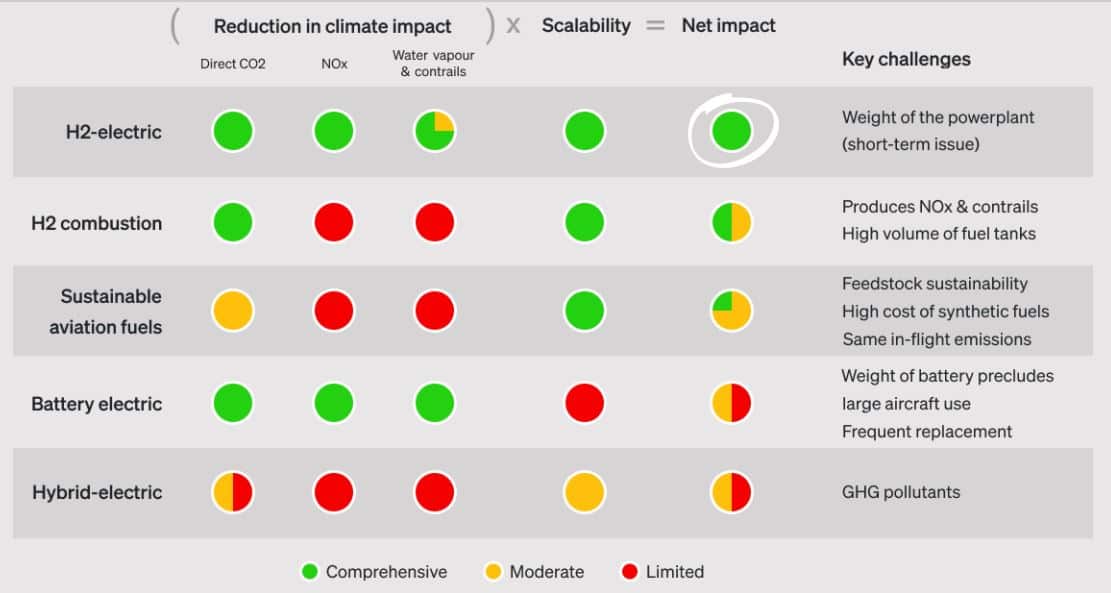
Here’s why ZeroAvia’s hydrogen-electric is a great option for long-term transition to clean aviation:

ZeroAvia hydrogen electric aviation solution

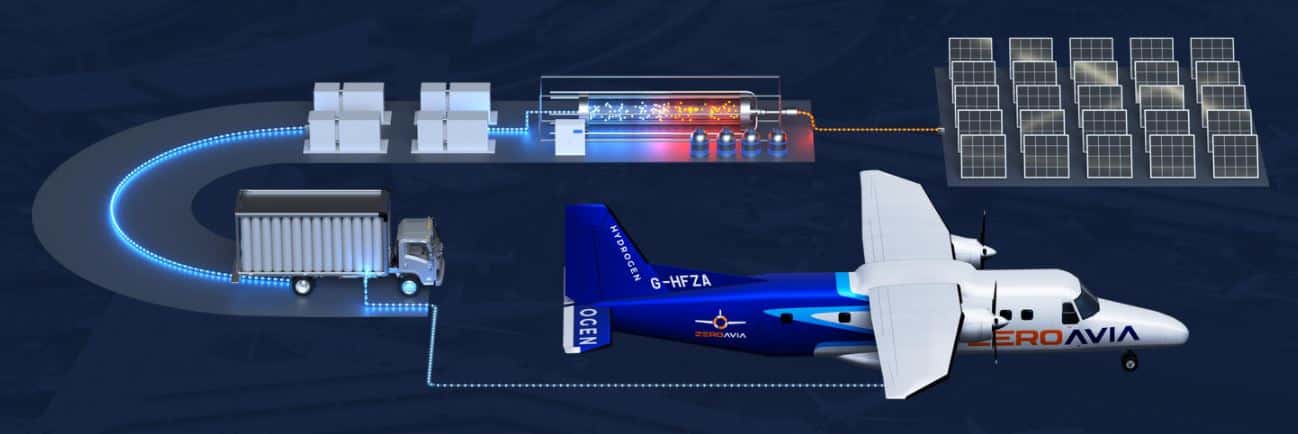
This latest funding will also help ZeroAvia deploy building infrastructure at airport sites. It will support live demonstrations of its Hydrogen Airport Refueling Ecosystem (HARE). And that’s in preparation for routes carrying passengers and cargo in the next years.

ZeroAvia HARE
A rendering of a potential (HARE) refueling process for hydrogen-electric planes.

The startup is ground testing its ZA600 powertrain at its R&D facility at Cotswold Airport in the UK. The testing is part of “Project HyFlyer II,” the name of its program to demonstrate hydrogen-electric flight in a Dornier 228 plane.

The firm also recently welcomed a second test bed to its US facility at Hollister, CA.

This is how ZeroAvia’s hydrogen-electric powertrain tech works:

Zero-emission aviation starts with green hydrogen. Green hydrogen is produced through electrolysis and stored at or near airports. This will reduce transportation costs that drive up the price of hydrogen before. Locally available renewable energy then powers the electrolyzers.

Green hydrogen powers electric propulsion via the fuel cells. Renewable hydrogen stored in tanks converts to electricity in flight using a fuel cell, which then powers the electric motors.

Both the old and new investors are betting on ZeroAvia’s novel hydrogen fuel cell aviation solution to help bring the sector to net zero emissions.

Here’s a quick overview of each of the new investors.

IAG: International Airlines Group is one of the world’s largest airline groups with major airlines in Spain, the UK, and Ireland. They include Aer Lingus, British Airways, Iberia, Vueling and LEVEL. It’s the first airline group to commit to achieving net zero emissions by 2050 and began partnering with ZeroAvia in 2020.

Barclays Sustainable Impact Capital. Barclays will invest £175m of its own capital in fast-growing, innovative, environmentally-focused companies like ZeroAvia. Its investments target the goals and timelines of the Paris Agreement.

NEOM. It’s a region in northwest Saudi Arabia on the Red Sea being built from the ground up as a living laboratory. It’s leveraging green hydrogen as a key power source in delivering the world’s first zero-carbon city. It can produce green hydrogen for power at scale.

AENU. This is an evergreen impact fund that invests multi-stage in climate-tech and social impact companies in Europe & US. AENU drives systemic transformation in venture capital towards impact, accessibility, and stakeholder-alignment.

Climate Maps of Transformed United States (Under 5 Scenarios)

Rising temperatures are causing drastic effects on the planet’s living conditions while increasing sea levels continue to consume coastlines. Thus, new climate maps show a transformed United States.

Indeed, heat wave by heat wave, scientists can now see the powerful impact of climate change behind unusual high temperatures in recent years.

Climate change is not just propaganda anymore but is a real thing that causes a catastrophic chain of events. And so, this article will reveal how new climate maps show a transformed United States.

The US climate maps are the results of the analyzed data from the Rhodium Group. They show how climate change will transform the way people in the US will live by mid-century.

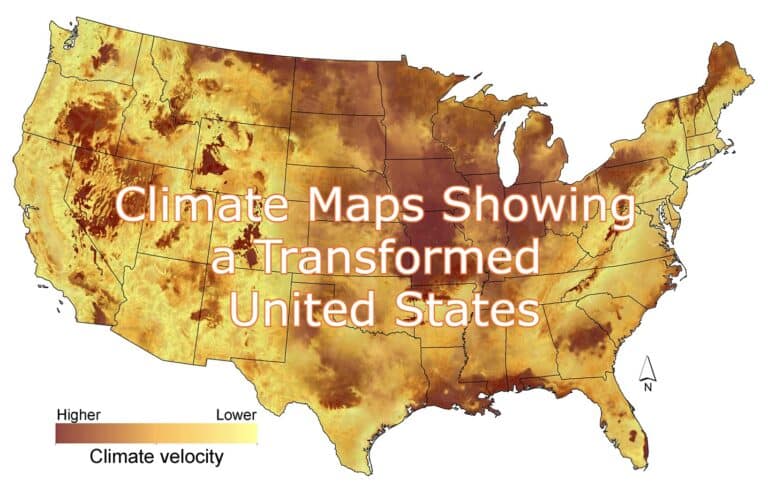
The never-before-seen climate data unveil how heat and humidity will push the South and Gulf Coast to be almost uninhabitable. You’ll also wonder how the change will show that the upper Midwest will be a more ideal place to live.

The new climate maps provide one of the most complete views of what the climate future looks like in the United States.

They’ll also show how counties will rank across the climate criteria. These include heat, sea level rise, farm crop yields, large wildfires, and economic damages.

The Changing Human Climate “Niche”

Recent research shows that the most livable climate in North America will shift northward while large fires will continue to get worse across the country.

A team of researchers coined a term to refer to the regions where temperature has been most fit for humans to live in over the past 6 millennia. They call it the human climate “niche”.

  • In the US, that niche covers the heart of America, from the Atlantic seaboard through northern Texas and Nebraska, and the California coast.

But as temperature continues to rise, the niche can move northward by 2070. Under even a moderate carbon emissions scenario (known as RCP 4.5), much of the Southeast becomes less suitable. And the niche shifts toward the Midwest by 2070.

In the case of extreme warming (RCP 8.5), the niche moves toward Canada. This shift leaves much of the lower half of the US too hot or dry as to what humans used to live before.

Both of those future climate scenarios (RCP 4.5 and RCP 8.5) suggest immense change in where Americans live and grow their food right now.

  • RCP stands for Representative Concentration Pathway referring to future emissions scenarios.

Projecting future climate change involves assessing a number of various uncertainties.

Some of them relate to the climate system. For example, how sensitive the climate might be to increased concentrations of GHG in the atmosphere.

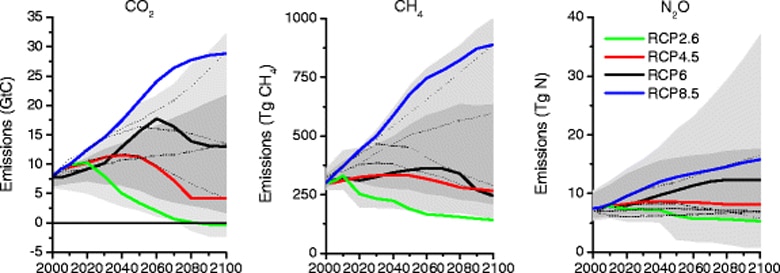
Other factors involve the amount of gas emitted using energy system models to simulate varying scenarios of future emissions. The chart illustrates the four common RCPs used by scientists to predict future emissions with 3 warming GHGs.

RCP scenarios
Greenhouse gas emissions in RCP scenarios compared to the range of projections in published scenarios – 90th percentile in dark grey, 98th percentile in light grey. Charts show CO2 (left), methane (middle) and nitrous oxide (right).

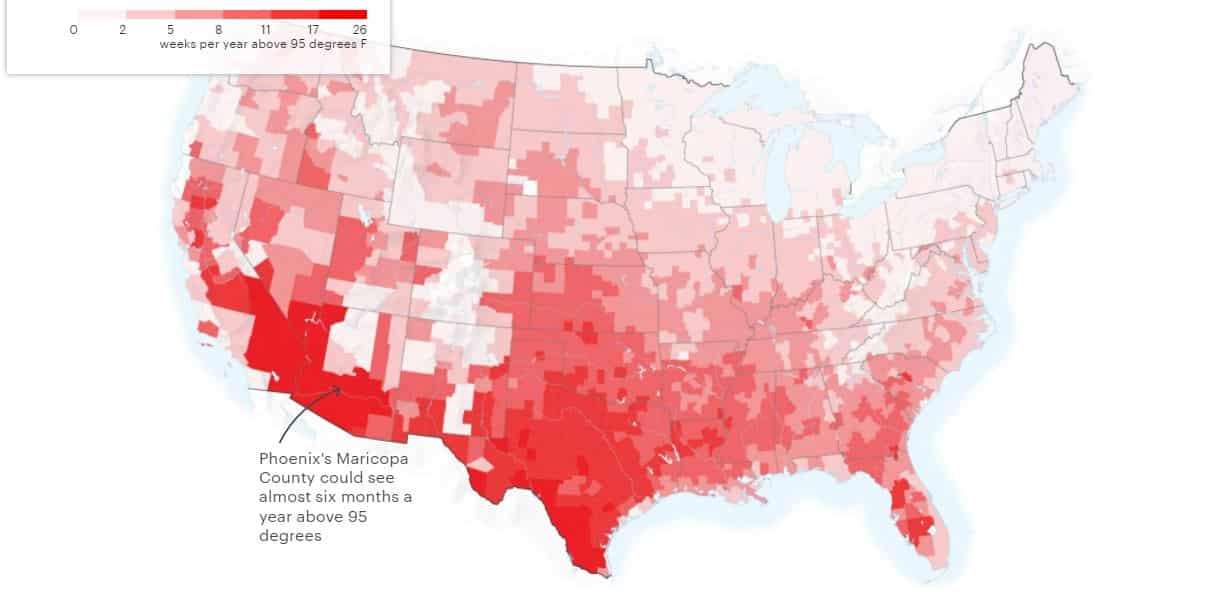
Heat is one of the biggest factors that change the niche of human habitability. Scientists expect that under the RCP 8.5 scenario, between 2040 and 2060 extreme temperatures will be common in the South and Southwest.

The future climate map below shows how Phoenix’ Maricopa county in the US will experience temperatures above 95 degrees for 6 months.

new climate maps show transformed United States

  • Concept defined: RCP 8.5 is an extreme warming scenario that also means high-emissions scenario that’s often referred to as “business as usual”. It suggests that’s a likely outcome if the world doesn’t make concerted efforts to reduce GHG emissions. It’s the worst-case scenario in a no-climate policy world.

New Climate Maps: The “Wet Bulb” Temperatures

While heat is a key climate factor, alone it won’t determine the future of Americans. The new climate maps that show a transformed United States include also humidity alongside heat.

Taken together, they form the “wet bulb” temperatures that will disrupt the daily existence of Americans.

  • Concept defined: Wet bulb temperature is the lowest temperature to which air cools down by the evaporation of water into the air at a constant pressure. It accounts for both heat and humidity in projecting temperature.

Though the dangers of wet bulb temperature is still rare today, it can be three decades from now. That’s assuming that people continue to dump more planet-warming gases.

Sample scenarios of new climate maps below show how the United States will be transformed under moderate (RCP 4.5) and high emissions (RCP 8.5). The projections include scenarios under five different phenomena.

Extreme Heat and Humidity: 2040-2060

Once heat meets excessive humidity, the body can no longer cool itself by sweating. That is the case with wet bulb temperatures.

In perspective, it’s when 82 degrees brings southern Alabama to its hottest temperature. So, working outdoors and playing school games can be both dangerous under this climate.

  • And as wet bulb temperatures rise even more, so is the risk of heat strokes that may lead to deaths.

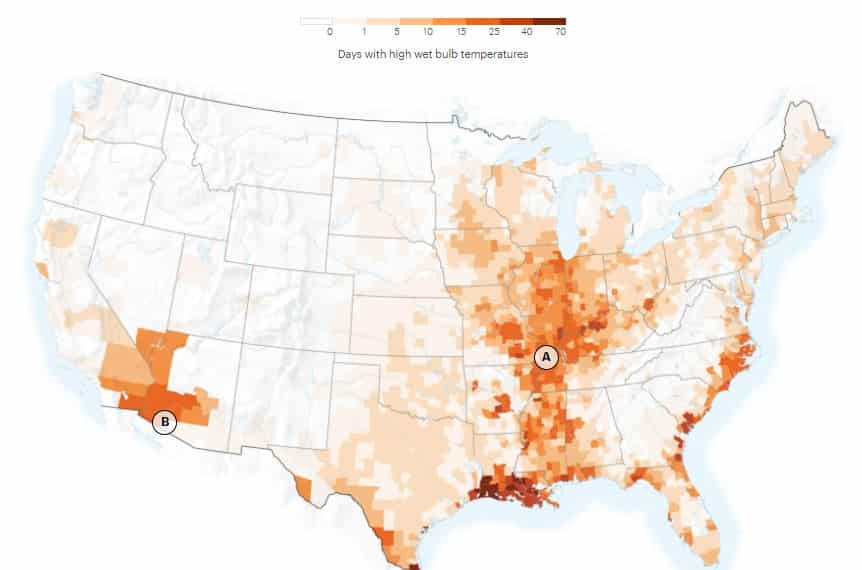
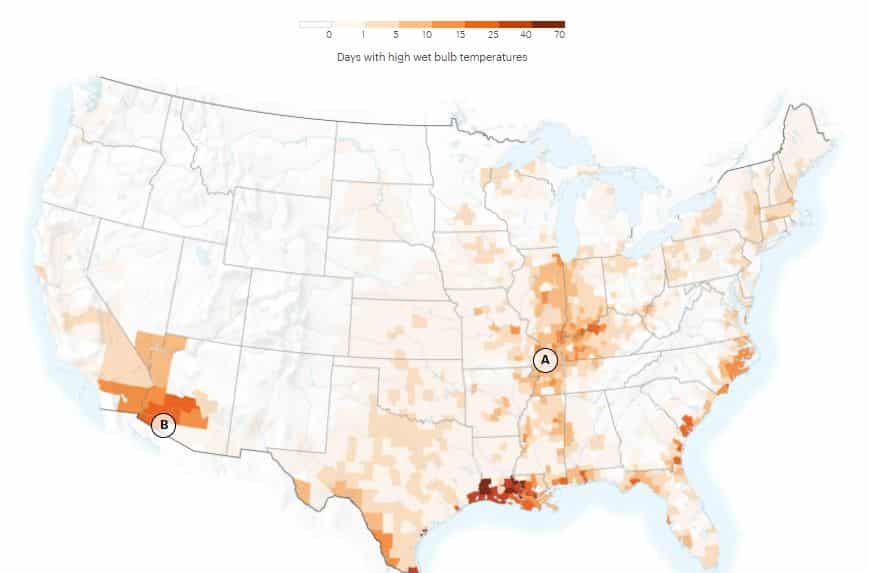
In both climate maps below, heat and humidity in Missouri (A) will feel like Louisiana today. Meanwhile, southwestern Arizona (B) that’s usually not that humid will witness rising wet bulb temperatures.

climate maps wet bulb high emissions
High emissions scenario
climate maps wet bulb moderate emissions
Moderate emissions scenario

What most likely cause such a big change are many factors that react to high temperatures such as wind speed, sun angle, and cloud cover.

Large Wildfires in the US: 2040-2060

Wildfires are also another major evidence of changing climate maps of transformed United States. The chance that huge wildfires (fires that burn ~12,000 acres) affecting the country will increase even more with heat and worsening drought.

The last two years, 2020 and 2021, saw record-breaking wildfires engulfing the West, Northwest, and the Rocky Mountains. Even parts of the Southeast and Georgia are experiencing large wildfires that weren’t seen before.

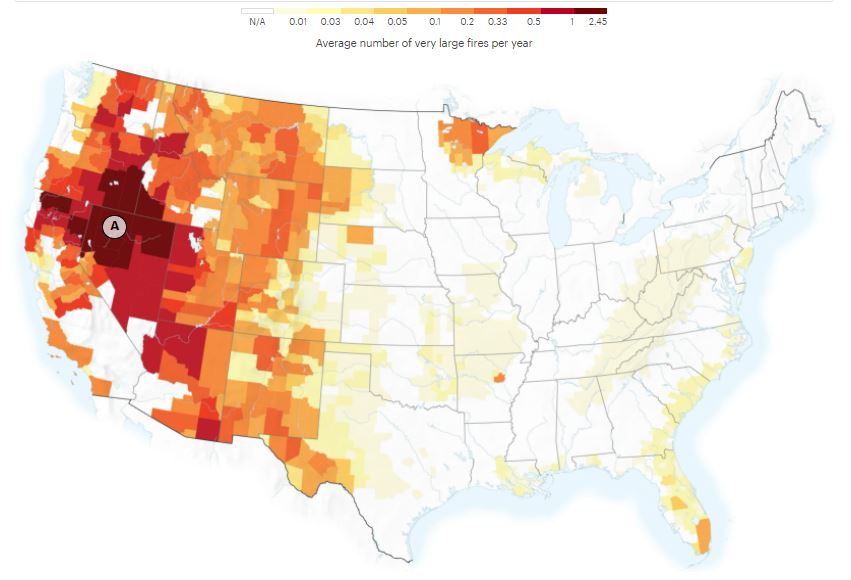
  • In fact, researchers estimate that by 2050, the northern Great Basin (A) which is not a dense forested region, will be the focal point of large wildfires.
new climate maps show transformed United States wildfires
High emissions scenario

That region where big Nevada and Oregon counties will experience wet and dry weather cycles. This can turn the grasslands into a fuel field for fires that can spread through 10,000 acres in a day with strong winds.

Sea Level Rise: 2040-2060

When it comes to sea levels, they’re also rising rapidly. As per the National Oceanic and Atmospheric Administration (NOAA), the rate at which they rise has more than doubled from 2006 to 2015.

NOAA also predicts that sea levels will likely rise by at least 1 foot (0.3 m) above the levels seen in 2000 by the start of the next century. This means high tides in the coming decades will submerge even more properties along the coastlines.

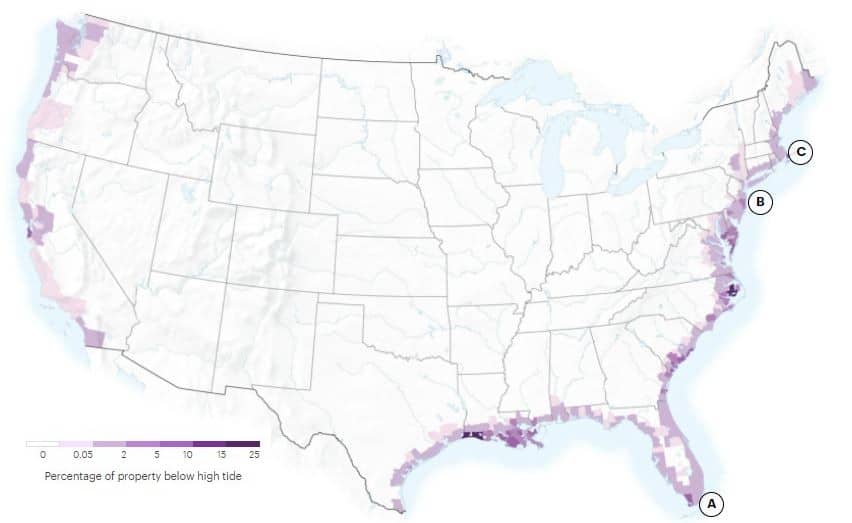
Though this will affect a small land part of the country, it will impact a large share of the population. As illustrated in the new climate map, some of the populous cities in the US will be affected.

US climate map sea level rise
High emissions scenario

About 50 million people are living in America’s metro areas. And that include Miami (A), New York (B), and Boston (C). They’re all found in counties where higher share of properties will be below high tide.

So if you or someone you know happen to live in those areas, pay attention to the rising sea levels.

Farm Crop Yields in the US: 2040-2060

Apart from wild forests and oceans, agricultural lands will also be severely harmed by the climate change.

The rate of desertification grew a lot, turning plenty of croplands into dry lands. With more warming, it will be even more difficult to grow food.

Corn and soy are the most dominant crops in the US and are vital for livestock feed and other staple foods. As such, they have high economic value.

Because they’re taking most of the croplands in the country, corn and soy production is often used to predict how rising temperatures impact farming.

As growing both crops is more sensitive to heat than drought, their production rate will go down for each degree of warming.

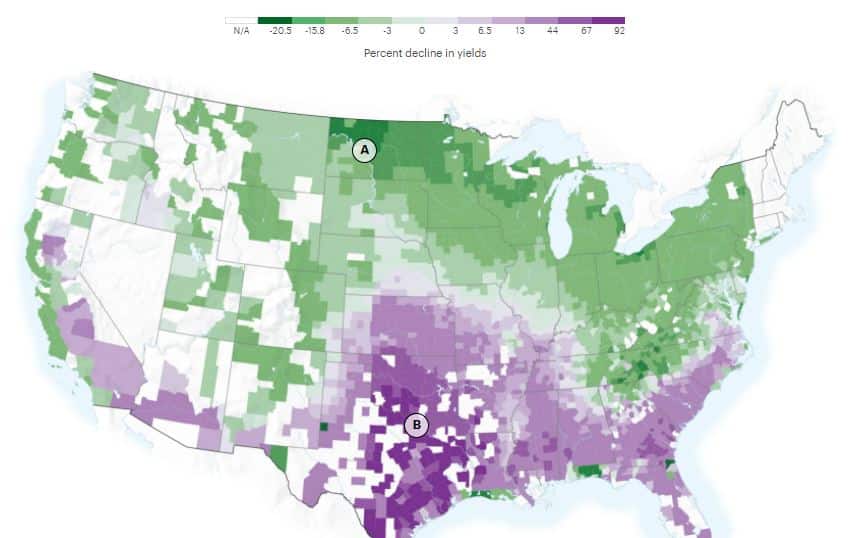
In a sense, North Dakota (A in the map) can expect to have higher yields for both crops. That’s because the place will experience warmer temperatures by midcentury. But parts of Texas and Oklahoma (B) may witness declining yields by ~70% under high emissions scenario.

climate map farm crop yield

If you’re farming in the southern regions in the map (B), your production will face challenges if the projection holds true.

Climate Change Economic Damages: 2040-2060

Lastly, climate-driven changes will also take a financial toll on the US economy. The researchers determined the economic damages as a share of the counties’ GDP. The previous maps showing a transformed United States due to climate change can also tell.

The dragging effects of climate change to the American economy are due to several factors. These include the following:

  • rising energy costs,
  • lower labor productivity,
  • poor crop yields, and
  • increasing crime

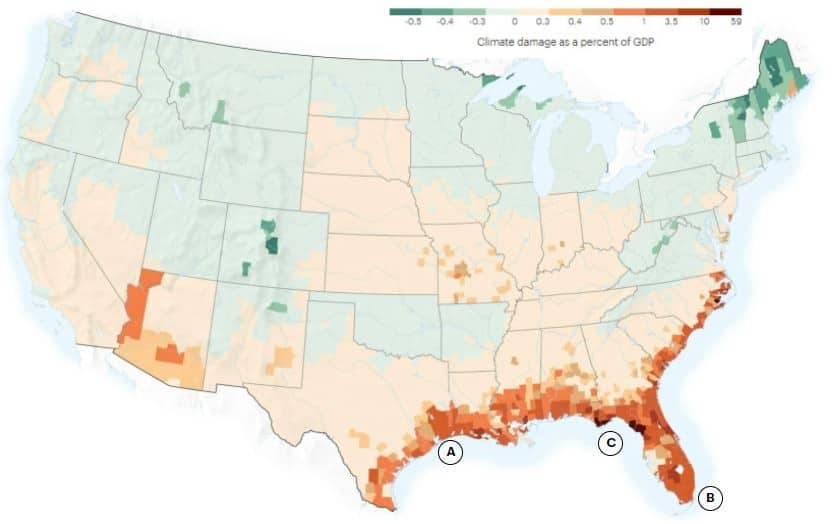
Overall, under a high emissions scenario, the US economy will lose between about 1% – 4% of GDP each year by the end of the century. The effects, however, will not be the same across the country as shown in the map.

new climate maps show transformed United States economic damages
High emissions scenario

For example, populous areas with expensive real estate like Houston (A) and Miami (B), will see economic losses in billions. That corresponds to several percentage points loss in their GDP.

What will cause such a big financial loss are rising sea levels, storms, and even deaths from extreme heat, according to the researchers.

More notable is the fact that climate change damages will be worse in poorer and rural areas. Take the case of the Gulf Country, Florida (C), for instance. They may lose even half of their economy due to those climate-related disasters.

Are Those Future Scenarios Unavoidable?

Without a doubt, those climate maps that show a transformed United States from today look scary.

Oceans swallowing more coastal lands are unimaginable while deaths due to heat strokes are more unthinkable.

Not to mention the fierceness of large wildfires claiming vast acres of land and even lives. And the idea of low food supply may prompt you to think of hoarding food today. These compounding climate change calamities seem to be like the end of world.

But the good news is that humans still have a chance to avoid them with suitable climate policies and prompt actions. The deadline is quite tight though.

Organizations and individuals alike are looking for ways to prevent those disastrous scenarios.

People develop initiatives that avoid greenhouse gas emissions.

Companies innovate technologies that remove carbon and other GHG already dumped in the air.

Nations take measures that cut down their emissions.

Investors fund projects that support all those actions above.

If you are interested in how you can join and help address climate change and reverse its catastrophic effects, there are plenty of means to do so.

But if you’re looking for a way that can both benefit the planet and your wallet, you can start by exploring the carbon market.

You can visit our education page for comprehensive guidelines all about carbon market. It’s best to begin with this beginner’s guide explaining the voluntary carbon market.

Banking on Carbon – BMO Acquires Carbon Offset Developer Radicle Group

Bank of Montreal, BMO, is buying carbon offset developer Radicle Group to meet the bank clients’ demand for advice on emissions reduction.

BMO’s acquisition reflects major banks’ growing interest to help clients measure carbon emissions. It will also allow the bank to help their clients manage a difficult transition toward net zero emissions.

The buyout is also a move by BMO to be at the forefront of developing products fit for climate transition such as carbon offsets.

Dan Goldman from BMO said that:

“Climate, energy transition and net-zero targets come up in almost every client conversation we have… It’s not topical, it’s front and centre in terms of thinking about how the world evolves… Helping our clients navigate what is clearly going to be an enormous part of their agenda going forward was paramount.”

BMO Carbon – Radicle Acquisition Deal

Buying Radicle supports BMO’s Climate Ambition to be its clients’ lead partner in the transition to a net zero world.

Founded in 2008, Radicle has built a reputation as a leading developer of carbon offsets. It’s also the leading adviser that helps organizations measure and reduce emissions.

The firm is one of Canada’s most advanced carbon offset developers that generates carbon credits that entities can buy and sell to offset their unavoidable emissions.

Radicle has 130 employees and over 4,000 clients including Imperial Oil, Meg Energy, TC Energy, Chevron, and ConocoPhillips.

Carbon offsets, despite criticisms as less effective, are Radicle’s key area of expertise. But they will not be BMO’s main focus. The bank will continue to develop and adapt new products with Radicle’s expertise.

Buying carbon offsets means paying for projects that provide positive impact to the environment. Common examples are protecting trees or capturing and storing carbon.

Radicle also helps entities measure their emissions so they can develop ways to reduce them and track their progress.

The Radicle team will work with various bankers to advise clients on several areas. These include investment and corporate banking, commercial lending, and wealth management.

BMO is aware that building the carbon offset expertise from scratch will take time. So, the bank set its eyes on Radicle which was exploring a sale.

The role of carbon offset markets

Canada’s major banks are criticized for their continued funding of the oil and gas industry. Yet, the banks defended by saying they plan to work with heavy emitters to reduce emissions.

BMO isn’t the only Canadian lender to tap the carbon market for emission offsets.

For instance, the Canadian Imperial Bank of Commerce joined 3 other banks last year to launch a pilot marketplace for trading voluntary carbon credits on a digital ledger.

It was called Project Carbon whose first trade occurred in September between the Nature Conservancy of Canada and NatWest.

Carbon markets have a vital role in fighting the effects of climate change and thus, enable a sustainable future. They’ve grown remarkably around the world as people and companies work to scale the technologies needed to reach net zero.

To achieve their own net zero pledges, banks also have to boost ways to measure and reduce emissions by the firms they finance. And BMO knows this well that’s why it struck the deal.

It also expects Radicle to speed up its emissions reduction efforts, scale its activities across BMO’s client network, and develop more sustainability services.

To date, Radicle helped its clients generate over C$100M in value and cut carbon emissions by 7 million tonnes.

BMO did not reveal the financial terms of its Radicle deal but expects it to close by the end of 2022.