Xpansiv spot market CBL will launch trading of Cercarbono carbon credits from EcoRegistry on its platform.
The world’s largest exchange for voluntary carbon credits Xpansiv will trade Cercarbono carbon offsets starting February 21.
Xpansiv CBL and EcoRegistry
The leading carbon registry in Latin America, EcoRegistry, will be fully integrated with Xpansiv CBL’s central limit order book. This integration will allow instant trade execution on the company’s offer prices and same-day settlement of cash and credits through its automated post-trade system.
The Cercarbono carbon crediting standard is using Xpansiv’s blockchain-based platform for its registry system. To date, it has issued more than 47 million credits from 138 projects with ISO’s carbon standards for high-integrity crediting.
Juan David Duran Hernandez, CEO of EcoRegistry, said that:
“We are excited that communities, proponents and representatives of projects ranging from Latin America to India to Turkey will soon be able to make their credits available for trading on the CBL spot market.”
The World Bank, along with the International Emissions Trading Association (IETA) and Singapore, launched the CAD Trust last year. The goal is to bring transparency to the carbon credits market and aid countries to raise climate finance faster.
Cercarbono Carbon Credits
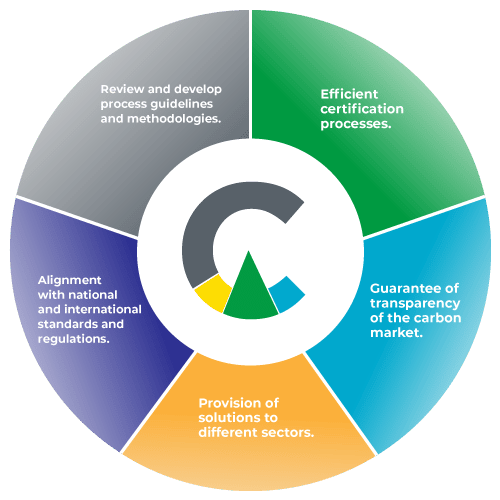
In 2016, Cercarbono was created to provide climate solutions through the voluntary certification of carbon credits. It has a Voluntary Carbon Certification Programme, which allows for the certification, issuance, and registry of carbon credits from climate change mitigation projects.
Cercarbono carbon credits will trade alongside CBL’s suite of Global Emissions Offset or GEO standardized contracts. They will also trade with other project-specific credits from American Carbon Registry, Climate Action Reserve, Gold Standard, and Verra.
Xpansiv CBL launched its latest carbon offset contract Sustainable Development Global Emissions Offset Contract (SD-GEO) in November last year. It adds up to two other contracts under the market’s GEO line of products: N-GEO and C-GEO.
In 2022, there were 250+ different projects generating carbon credits from 34 countries traded on the Xpansiv CBL spot market. Senior VP of Supply & Ecosystem, Amy Bann said that:
“Xpansiv CBL participants can now transact Cercarbono credits on our platform alongside the other carbon and renewable energy contracts they trade currently.”
Xpansiv operates the leading multi-registry portfolio management system and market data service. The spot exchange provides the market infrastructure to scale up the world’s energy transition.
Xpansiv is now working with clients to set up EcoRegistry accounts before the launch of live trading on February 21st.
Chevron Australia will invest a total of US$26 million (A$38m) to contribute to carbon capture and storage (CCS) research in Western Australia and Victoria.
The investment of the US-based energy giant seeks to advance knowledge in CCS technology to promote a lower carbon future.
The commitment comes as the Australian Petroleum Production & Exploration Association (APPEA) is calling on the Federal Government to consider more funding in new gas supply and emissions reduction measures in the 2023-24 Federal Budget. The group also calls for setting up a national carbon capture and storage roadmap.
Advancing Carbon Capture and Storage in Australia
Of the total commitment, US$15 million will go to the Barrow Dampier CCS Regional Study led by global tech firm SLB. The study will provide a 3D seismic and storage assessment to find new carbon capture and storage in the Carnarvon basin in Western Australia.
The remaining US$11 million will be for developing new infrastructure at the Otway International Test Centre in Victoria. The project is managed by the Australian CCS research organization CO2CRC. It will allow the testing of CO2 migration and validation of new modeling techniques for better CCS processes.
Chevron is a founding member of CO2CRC. Its funding will ensure that the test center stays as a critical national research infrastructure for applied research into CCS that supports Australia’s transition to net zero.
Michelle LaPoint, Chevron Australia’s general manager of asset development, said the company is committed to advancing CCS in Australia. LaPoint also noted that:
“Chevron has decades of operational experience, a proven track record of carbon-capture projects and is already deploying CCS technologies in locations across the globe, including at Gorgon in Western Australia, one of the world’s largest integrated CCS projects.”
Meeting Net Zero with CCS
The company’s VP had said that CCS has a crucial role in meeting net zero targets “in almost any scenario”. The firm has a target to bring its carbon emissions to net zero by 2050.
The energy giant’s experience has been reaffirming its confidence in the emissions reduction opportunities the CCS provides. The company believes that the technology is critical to cut emissions in hard-to-abate, energy-intensive industries.
In fact, Chevron bought stakes in three offshore carbon capture and storage projects in Australia spanning about 7.8 million acres.
In 2021, the energy firm dedicated a $10 billion dollar investment into low carbon business initiatives. Half of that budget is for reducing emissions from fossil fuel initiatives.
Chevron uses large-scale decarbonization hubs to reduce its own carbon emissions. The company partners with 3rd-party emitters and clients for carbon offset credits, green fuels, and hydrogen.
The two CCS projects in Australia, once completed, will satisfy Chevron’s expenditure commitments under a Good Standing Agreement between its affiliate company and the Joint Authority for the Commonwealth/South Australia offshore area for two exploration permits in the Great Australian Bight.
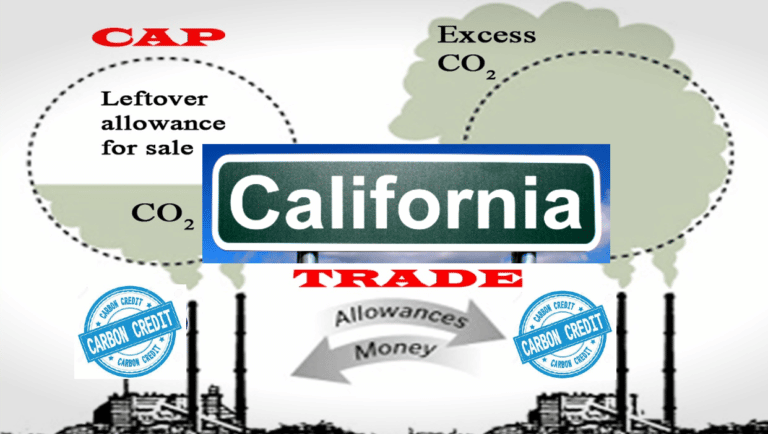
Over a decade ago, an innovative carbon credits or emissions trading system (ETS) was established in California. It refers to the state’s “cap-and-trade” program that limits carbon emissions, creates a market for tradable emissions credits, and helps fund climate-related projects.
The program is a key element of California’s strategy to cut GHG emissions while complementing other efforts to ensure that the state meets its climate goals. Its history, operations, and ways of business can help similar programs elsewhere succeed.
So, how do California carbon credits work? What are the key components of the state’s carbon credit program? Or you may want to know more about how to sell, or perhaps how to buy California carbon credits. Either way, this guide article gives you the answers you’re looking for in clear, easy way.
Let’s start off by explaining how the California carbon credits program works.
How Do Carbon Credits Work in California?
The Cap-and-Trade Program, established in 2006, sets a declining limit on major sources of GHG emissions throughout California.
The basic concept is to create a market-based compliance approach to drive investments in climate strategies. It’s the only economy-wide carbon market in the U.S. and one of the largest ETS in the world. It supplements a range of various carbon reduction programs in the state.
The program is central to meeting California’s ambitious climate goals:
To reduce emissions to 1990 levels by 2020 (which it met in 2016),
40 percent below 1990 levels by 2030, and
80 percent below 1990 levels by 2050.
The state also has additional goals of reaching 100% carbon-free electricity by 2045 and economy-wide carbon neutrality by the same period.
The California Air Resources Board (CARB) manages and oversees the program. The Climate Action Reserve (CAR) serves as the Offset Project Registry under the program. CAR can issue Registry Offset Credits (ROC) under CARB Compliance Offset Protocols.
The California carbon credits program covers about 85% of the state’s GHG emissions. The number of entities that are subject to the cap is 450+. They have to be large enough, emitting at least 25,000 MT of CO2e each year.
CARB creates allowances, also called carbon credits, equal to the total amount of allowed emissions (the cap). One allowance or carbon credit equals one metric ton of CO2 or its equivalent emissions under the 100-year global warming potential (GWP).
Every year, fewer carbon credits are created and the annual cap declines over time. Allowances have an increasing annual auction reserve or floor price. This, plus the decreasing annual credits, make a steady carbon price signal to stir action to cut emissions.
All covered entities in the California carbon credits program are still subject to existing air quality permit limits for criteria and toxic air pollutants. Each of them has to surrender one carbon credit, which represents one permit to emit for each ton of carbon.
The majority of those permits will be allowances but entities can still use a limited number of CARB offset credits.
Some entities will have some mandated allowances. Yet, they can buy additional allowances at auctions, buy them from others, or buy offset credits through projects.
Fast Fact: Compliance offset projects must be listed with an approved Offset Project Registry like CAR to be eligible to earn CARB Offset Credits. CAR offers CARB-approved services like listing projects and issuing carbon offset credits.
State-run auctions occur on a quarterly basis. Entities under compliance can participate and buy the required number of carbon credits. They have to retire the credits on an annual basis against their cap levels.
To make things even clearer, let’s break down each of the basic components of the carbon credit market in California.
Key Components of Carbon Credits System in California
When talking about carbon credits in California, there are three major elements involved – allowances, offset credits, and compliance period.
What is an allowance?
An allowance is a tradable carbon credit serving as a permit to emit one metric ton of CO2e. Each allowance has a unique serial number. The total number of allowances that CARB provides each year is equal to the annual cap.
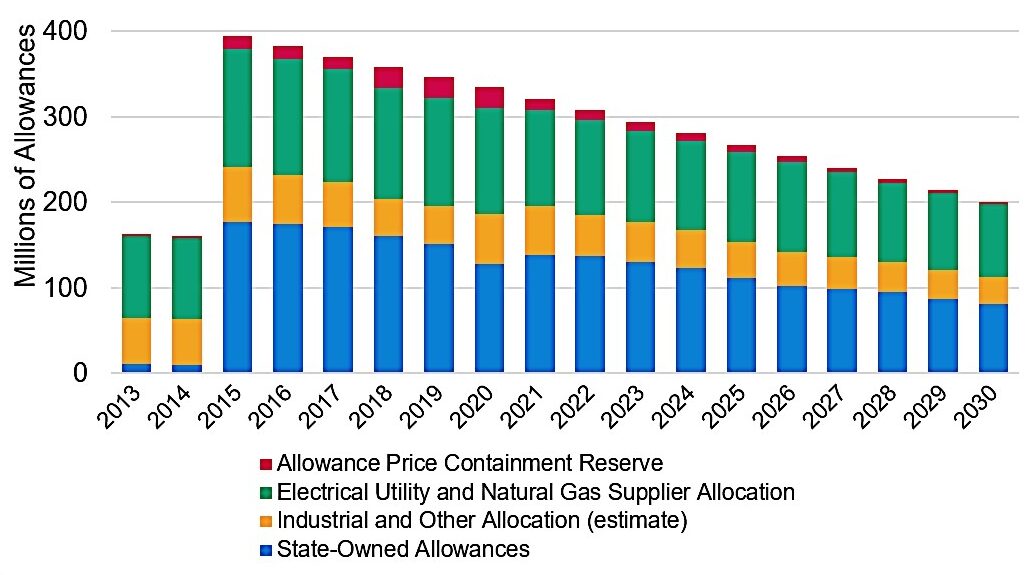
Carbon credits under the California ETS or cap-and-trade program are distributed under four broad categories:
Cost-containment (red)
Utility allocation (green)
Industrial allocation (yellow)
Auction (blue)
The chart below shows their distribution per category.
California ETS Allowances Distribution
Cost-containment reserves and a price ceiling reduce price volatility, if needed. While allocation to electric and natural gas utilities is for the benefit of end-users. Allowances for industrial facilities meant to minimize relocation of their emissions to areas without carbon pricing.
After satisfying the allocation to those three categories, the remaining state-owned carbon credits, in blue, are auctioned quarterly. Covered entities and voluntary market participants can buy the auctioned allowances.
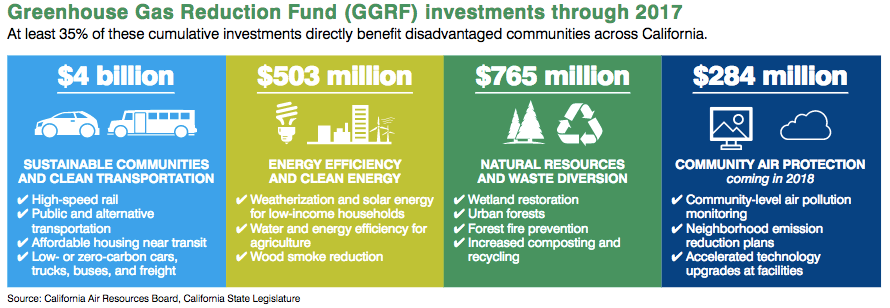
The auction proceeds go to the Greenhouse Gas Reduction Fund (GGRF). As of June 2022, the GGRF is worth ~$20 billion in total capital for the state to use. The fund has supported 500+ million individual emissions reduction projects across California.
What is an offset credit?
An offset credit is equal to a GHG reduction or removal of one metric ton of CO2e. The reduction or removal credit must be real, additional, measurable, permanent, and verifiable.
The carbon offset credits can only be issued to projects that comply with the Compliance Offset Protocols.
CARB offset credits differ from allowances, but they are often both referred to as compliance instruments. That’s understandable though as they’re both used by entities to comply with the California carbon credit program. But it’s important to take note of the difference between them.
CARB offset credits vs. allowances:
Carbon allowances don’t represent the reduction of any emissions but simply a permitted emission under a regulated scheme. They are issued by the state government who sets the overall number of allowances with an annual cap – permitted level of emission.
So, in sum, carbon allowances are issued annually by the regulator while carbon offset credits undergo a rigorous approval and verification process before being issued.
Compliance period:
It refers to the time frame that an entity has to comply with the mandated emissions reductions. The compliance period follows this breakdown:
First compliance period: 2013 and 2014
Second compliance period: 2015 – 2017
Third compliance period: 2018 – 2020
The required carbon credits under the California cap-and-trade program is determined by the amount of reported and verified emissions. CARB will directly allocate a proportion of allowances to covered facilities. Each of which is responsible to satisfy the remaining allowances or offset credits to meet the cap.
At the end of each compliance period each entity has to turn in the compliance instruments, allowances and CARB offset credits. They must be equal to their total carbon emissions throughout the compliance period.
How To Sell Carbon Credits In California Market
Same with other carbon credits programs in other parts of the world, selling the pollution permits in California also follows these general steps.
1. Get your offset project approved.
When selling carbon credits through the California ETS, your project must follow the rigorous approval and verification process set by the CARB. Examples of a carbon offset project are tree planting, seaweed farming, and capturing CO2 using a removal technology.
The CARB has carbon standards in place for producing carbon offsets. It also implements California Cap-and-Trade Program’s Compliance Offset Protocols.
If you’re a landowner, you can enroll into the program by producing the required documents showing land ownership. You also have to show that your land management practices indeed have reduced certain CO2 emissions. Only by then can you get a signed contract from a buyer.
2. Pick a carbon credit marketplace.
If your project has been issued with carbon credits, you can then sell it to a covered entity that has to meet its cap. You can also sell them in a carbon market where offsetting is voluntary.
Or you can select a carbon exchange to trade on the credits. Here are the top exchanges to choose from; they work the same way as various stock and commodity exchanges. The only difference is that instead of betting on company stocks, you’re selling carbon credits.
3. Know the rules of the program.
Most carbon programs have certain requirements and thresholds to follow. Under the California carbon credits program, covered entities have specific regulations to comply with as mandated by the CARB.
But in the state’s voluntary carbon market, trading offset credits follows different rules set by the program. For instance, smaller landowners with credits to sell sometimes “pool” their offsets together to trade on the carbon market.
4. Get to know the buyer.
If you’re selling to a company or institutional buyer, it’s crucial that you do a thorough research about it first. You should understand the terms you need to agree with them and know what’s required of you.
It’s also important that you ensure the amount you paid with is right. The current price for carbon under the California ETS averages at ~$30 per ton.
If you decide to trade the credits in a spot exchange, make sure to read the fine details. A good carbon platform shows essential information about the project that generates the credits. It also provides details about the project developer, location, and other relevant information.
The California ETS has collected over USD $14 billion since inception.
How To Buy California Carbon Credits
Buying carbon credits in California is straightforward; it works the same with other carbon markets. But before you make the purchase, you need to consider these important things first:
Timing– how fast you need to get the credits and when you need them
Quantity– how many carbon credits you need
Price– how much you can afford to buy
After you make those considerations, you can now decide how to buy California carbon credits through these various options.
Option #1. Buying from a project developer
The most direct way to purchase the credits is getting them from the source: project developer. Here are the top five project developers that have the highest ranks in the market today.
Getting carbon credits directly from a developer in California means you can either make a direct investment in the project or sign a contract for delivery.
The first option involves a long-term purchase agreement, around 3 to 5 years. But you’ll buy the credits at a lower cost than market price. The second option is to contract directly with the developer for delivery of the credits as they’re issued.
Opting for the second means brings you the benefit to get the credits also at a lower cost. But then again, you also have to commit to a long-term agreement (2 to 3 years).
Option #2: Buying from a broker
Just like other commodities, there are brokers for carbon credits. Some project developers work with them to process the credit sales.
Brokers can make it easier for you to find the credits you’re looking for (project, price, location, etc). They can also give you an analysis of the projects in California that generate the carbon credits.
This is a practical option if you need to buy a lot of carbon credits. The broker deals with all the transactions on your behalf. Plus, the acquisition process doesn’t involve long-term contracts.
In other words, you won’t be busy looking around for carbon credits you need. But that comes with a price – you may pay more for all the services the broker did for you.
Option #3: Buying from a retailer
In case you only need a small amount of California carbon credits, then this option will suit you right. Searching for a retailer could be the fastest way to get the credits you need. There are plenty of them in the California carbon market.
Retailers can give you at least basic information about the projects where the credits come from. Most often than not, they have an account on the Registry like CAR, and retire the offsets on your behalf.
Option #4: Buying from an exchange
This last option gives you the opportunity not just to buy carbon credits; you can also earn profits.
There are a number of carbon exchanges or trading platforms operating in the state. They often work with registries to enable the trading transactions. Here are the top carbon exchanges in the market right now.
Getting the credits from an exchange can be quick, easy, and cheaper than brokers. But it may also be harder to get enough information to assess the offsets’ quality. Yet, they still allow you to trade carbon credits in California ETS and earn extra income for it.
Getting the Right Carbon Offset Credits in California
The emissions trading system in California serves as a precedence for similar markets to emerge worldwide. Through the state’s “cap-and-trade” program, a market for tradable carbon offset credits is created. It helps fund climate solutions and thus, is critical to cutting the state’s carbon emissions.
If you are scouting the California market for carbon offset credits, you should know the key components involved. That means knowing what are carbon allowances versus CARB offset credits, as well as the compliance period to follow.
You must also have a general understanding how to sell or buy carbon credits, or both, in the state. The steps outlined above can help you get started to get your hands on the credits you need. Just keep them in mind and you’re good to go.
LanzaTech Global, Inc. or “LanzaTech”, formerly known as AMCI Acquisition, starts trading its stock today on Nasdaq with the LNZA and LNZAW tickers.
Chicago-based LanzaTech is an innovative carbon capture and transformation (CCT) company that converts waste carbon into materials like fabrics, packaging, and other products that people use in their daily lives. It will be the first US carbon capture company that goes public.
Chairwoman and CEO of LanzaTech, Jennifer Holmgren, stated:
“Today marks a tremendous milestone in our company’s journey, as the first shares of LanzaTech common stock will trade on Nasdaq… We are thrilled to complete this transaction, and begin this new chapter in the company’s history as we transition to a public company. The proceeds enabled by this transaction… provide a significant runway for us to drive shareholder value and execute on our mission of providing equal access to a post pollution future for all.”
A combination between LanzaTech and AMCI Acquisition brings the public company its $240 million in proceeds that will help expand its innovative CCT technology not just in the US but around the world.
Holmgren further said that this historical event can ultimately lead to the creation of a circular carbon economy.
The Tech for Circular Carbon Economy
The CCT company’s gas fermentation technology is meant to offer a solution to abate the significant carbon emitted by heavy industry and manufacturing. LanzaTech will be able to support its decarbonization efforts.
LanzaTech’s goal is to change the way the world uses carbon. It inspires a new circular carbon economy in which CO2 is not wasted but reused. How this happens in LanzaTech is shown in the video.
Its commercially scalable CCT tech can both help manufacturing firms and end users cut their carbon emissions in a profitable way. Product users can replace materials made from virgin fossils with ones made from LanzaTech’s recycled carbon. The company calls it their CarbonSmart product, making a ton of it removes two tons of CO2.
More remarkably, LanzaTech can also help industries comply with their emissions reduction goals. The company helps pave the way to global net zero emissions.
LanzaTech Paving The Way to Net Zero
Since its founding in 2005, LanzaTech has managed to scale its proprietary bio-reactors for making fuels and chemical production. The reactors use waste CO2 captured from industries as feedstock.
To date, the CCT firm has three commercial production plants and 1,250+ patents for various aspects of its technology. This caught the eyes of major investors, partners, and customers. ArcelorMittal, Suncor Energy, Shell, and BASF are just some of those who believe in LanzaTech’s technology.
Add to that list the major airlines that are confident in adopting LanzaJet’s sustainable aviation fuel (SAF). For instance, British Airways, Virgin Atlantic, and All Nippon Airways are the key partners.
LanzaJet is a spin-out company focusing on producing SAF using CO2 waste.
Using various waste feedstocks, LanzaTech’s CCT tech shows the possibility of moving away from fossil fuels. Most importantly, by licensing its patented tech to customers, the company also allows them to meet their net zero goals.
Its commercially viable technology can enable decarbonization in many of the world’s most carbon-intensive industries.
LanzaTech’s Partnerships and Developments
LanzaTech has been making major strides in the carbon capture sector, commercially and technologically. And in just one year, it’s able to achieve several tech developments and big partnerships.
Some of its most notable developments in 2022 are as follows:
Partnership with Twelve to make ethanol from CO2. The deal eliminates using fossil fuels to create ethanol by converting CO2 to CO through Twelve’s carbon transformation technology.
Renewable propane deal with SHV Energy. The strategic partnership will use LanzaTech CCT tech to bring renewable propane and other sustainable fuels to the market.
Bridgestone partnership for end-of-life tire recycling technologies. Co-developing the first dedicated end-of-life tire recycling process using LanzaTech proprietary technology for a pathway toward tire material circularity.
Strategic partnership with Brookfield. The deal is worth an initial $500 million commitment from Brookfield Renewable and its partners to build new commercial-scale production plants that will use LanzaTech’s CCT technology.
Producing ethylene from CO2. A major discovery that successfully engineers specialized biocatalysts to directly produce ethylene from CO2 in a continuous process.
Declared as a Finalist for the Earthshot Prize Awards. The Earthshot Prize, the world’s most prestigious environmental prize, is courtesy of HRH Prince William. It follows a rigorous, 10-month selection process and a panel of expert advisors who chose LanzaTech from more than 1,000 nominations.
Shares of LanzaTech’s common stock will trade under the ticker symbol LNZA while its public warrants under the ticker symbol LNZAW.
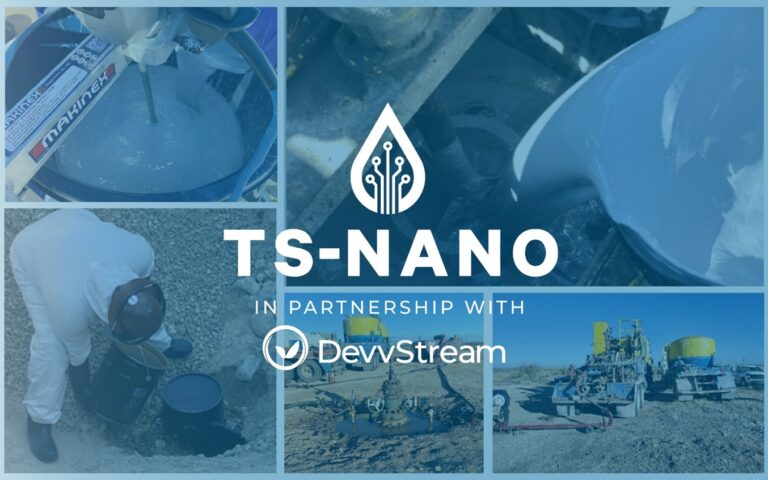
DevvStream Holdings Inc. (“DevvStream” or the “Company”) (NEO:DESG), a leading carbon credit investment firm specializing in technology solutions, is pleased to announce significant initial developments in its future methane abatement offset program (the “Offset Program”) centered around the high-volume plugging of abandoned oil and gas wells with next-generation sealant technologies developed by its partner TS-Nano.
The Offset Program has completed the sealing of 7 wells with a high rate of success, generating impermeable cement plugs and closing off microcracks in existing cement barriers, which prevents the migration of CO2 and methane to the surface.
These successful tests represent critical progress toward the Company’s goal of using its Offset Program to address the estimated 3 million decommissioned oil and gas wells in the U.S. and the estimated 225,000 in Canada, all of which typically emit considerable quantities of methane into the atmosphere.
Reducing methane emissions is critically important in the fight against climate change, with methane release being responsible for roughly 30% of the increase in global temperatures since the pre-industrial era. Methane is up to 80 times more potent than carbon dioxide at trapping heat over the first 20 years after it reaches the atmosphere.
“Methane emissions are one of the most prolific contributors to climate change, and are also one of the most insidious,” said Sunny Trinh, CEO of DevvStream.
“Tackling the methane problem by sealing abandoned oil and gas wells is a significant challenge, but thanks to the proprietary nano-based technology developed by TS-Nano, we now have a tested, field-proven method for closing extremely thin microcracks (below 30 microns) in existing wellhead barriers. We’re pleased that TS-Nano has successfully capped the first round of test wells, validating the sealant application process in real-world environments and scenarios. Once the American Carbon Registry approves the methodology surrounding quantification, monitoring, reporting and verification, we will be poised and ready to generate carbon credits that will deliver previously unrealized economic benefits for oil and gas operators while providing a valuable asset for corporations and governments in their ongoing work toward Net Zero.”
As part of its continued efforts to make the Offset Program more efficient, affordable, and scalable moving forward, DevvStream has filed a second provisional patent application outlining its innovative programmatic approach to wellbore project management and carbon credit generation.
Similar to the Company’s provisional patent applications filed in January (as described in the Company’s news release dated January 25, 2023), this provisional patent application leverages the UNFCC CDM’s Program of Activities (or PoA) approach, recognized internationally, to aggregate multiple mitigation activities across multiple oil wells into a single offset project.
This umbrella approach will allow the Company to aggregate multiple abandoned and orphaned wellbores together under a single offset project, resulting in several anticipated improvements in efficiency, cost, and scalability.
Disclosure: Owners, members, directors, and employees of carboncredits.com have/may have stock or option positions in any of the companies mentioned: DESG.
Carboncredits.com receives compensation for this publication and has a business relationship with any company whose stock(s) is/are mentioned in this article.
Additional disclosure: This communication serves the sole purpose of adding value to the research process and is for information only. Please do your own due diligence. Every investment in securities mentioned in publications of carboncredits.com involves risks that could lead to a total loss of the invested capital.
China has revealed its plans to relaunch the China Certified Emissions Reduction scheme (CCER). The plan to reboot the CCER has been in the works as early as last year. However, it is now ready for operations to start.
In 2017, China had suspended the CCER scheme due to low trading volumes. The country now plans to reboot its voluntary carbon market through CCER.
China Beijing Green Exchange (CBGE) manages the relaunching project. On February 4th, the CBGE revealed that the registration and trading schemes for CCER were complete. The systems are ready for inspection before operations commence.
There is a lot of focus on China’s carbon emissions policies as the country is one of the largest economies in the world. It is also the number one carbon emitter in the world, with more than 10,000 million tonnes of CO2 emitted in 2020. It is responsible for almost 30% of the world’s carbon emissions.
This means that if the world wants to meet its net zero goals, China must successfully manage its CO2 emissions.
A World Bank report revealed last year that China would require $17 trillion in investments to achieve their net zero targets. These investments are in the power and transport sectors alone.
CCER will supplement China’s ETS in reducing carbon emissions
The CCER and China’s ETS (Emissions Trading Scheme) are crucial to China’s goals to reduce carbon emissions. The ETS began trading in 2021 and has completed its first compliance period.
The ETS is a scheme to limit or reduce carbon emissions. It is particularly prominent within the country’s power generation sector. It allocates emissions allowances to coal and gas-fired power plants but it will expand to other industrial sectors over time. The Shanghai Environment and Energy Exchange oversees the ETS.
In terms of capacity, ETS is currently the largest carbon market in the world. It is three times the size of the EU carbon market. Its capacity is close to an annual 4.5 billion tonnes of CO2. This represents 40% of the country’s total carbon emissions per year.
The way China allocates the allowances differs from the EU. In the EU, allowances are capped and decided upfront. China determines allowances based on emissions intensity.
One allowance for a company means that it can emit 1 tonne of carbon.
In the first year of operation, the ETS was off to a slow start, which is not unusual for these schemes. In 2021, it traded 412 million tonnes worth of carbon allowances. For comparison, the EU’s ETS traded 321 million tonnes of CO2 allowances in its first year.
The current ETS only allows fossil-fuel based Independent Power Producers (IPPs) to benefit by trading credits. It leaves no room for renewables-based IPPs to benefit. This is the issue the CCER hopes to address. The current ETS will expand beyond the power sector into other industries.
China’s CCER scheme broken down
CCER was a scheme where the Chinese government certified voluntary carbon emissions reduction activities by companies. These include projects such as renewable energy, waste-to-power generation and forestry. These projects generated carbon credits which can be sold and traded.
CCERs could be used to offset carbon deficits or China Emissions Allowances (CEAs) deficits. Hence, companies with high emissions will pay entities like renewable power companies for credits.
However, there is a cap on CCER credits. It can offset 5% of emissions that exceed the ETS targets.
The CCER was first established in 2012. The country’s central economic planner, the National Development and Reform Commission (NDRC) introduced measures to encourage voluntary carbon emissions reduction activities.
With this scheme, both foreign and domestic entities were able to carry out transactions for different greenhouse gasses. These included carbon dioxide, methane, nitrous oxide, hydrofluorocarbons, perfluorocarbons and sulfur hexafluoride.
Why the CCER was suspended
According to the NDRC, the CCER had some issues that caused its suspension. Firstly, there were low trading volumes on the CCER. Secondly, there was little standardization when it came to carbon audits. As a result, CCER registrations were temporarily suspended.
What to expect with the relaunch
It was announced at the end of 2021 that the Beijing Green Exchange will oversee the CCER trading. The exchange will also be open to foreign investors.
Once launched, analysts predict that CCERs worth 300 million tonnes will be traded. The previous issue of low trading volumes in the CCER is also expected to be resolved. As the ETS expands to include more energy-intensive sectors, the CCER’s trading volume will increase.
However, the CCER relaunch does pose some challenges. How the ETS will incorporate the CCER scheme is not entirely clear yet. Currently, only wind and solar projects with an internal rate of return (IRR) of lower than 8% can apply for the CCER.
This requirement leaves out a lot of renewable energy projects. It means that only new renewable projects with low IRRs can truly benefit from the CCER relaunch.
Nine global banks have invested a sum of $45 million in a new carbon credit platform to help ramp up transactions in the voluntary carbon market (VCM) and give the banks’ clients easier access to the market.
Banks’ $45M Climate Commitment
Demand for carbon offset credits is estimated to grow significantly as businesses are using them to achieve their net zero emissions targets.
Right now, carbon credits change hands bilaterally on a project-by-project basis as well as through exchanges.
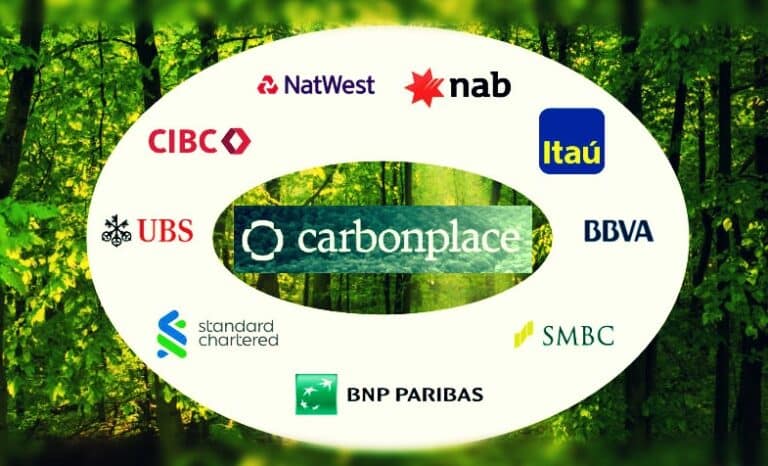
Each of the nine banks entrusted $5 million into the carbon credit trading platform Carbonplace. The trading platform will connect buyers and sellers of carbon credits through the banks, namely.
BBVA
BNP Paribas
CIBC
Itaú Unibanco
National Australia Bank
NatWest
Standard Chartered
SMBC
UBS
Their $45 million capital injection shows a commitment to help tackle climate change. Those nine world’s largest bankers represent about $9 trillion in total assets. With their investment, each bank shares equal equity ownership in Carbonplace.
With this technological solution, each bank can now offer its customers committed to decarbonize direct access to carbon credits to offset their footprint.
Carbonplace stated in its statement:
“The capital injection represents a commitment from some of the world’s largest financial institutions… to achieve Carbonplace’s vision of accelerating corporate climate action by providing transparent, secure and accessible carbon markets.”
The Carbonplace Platform
Carbonplace is a trading platform launched in 2021 to connect buyers and sellers of carbon credits through their respective banks. The company received its seed funding from its founding institutions that developed its technology.
Carbonplace’ headquarters is in London under the leadership of its new CEO, Scott Eaton. He’s a financial tech veteran who chaired Nivaura, a capital markets fintech. Eaton described Carbonplace as transforming the way carbon credits are bought, distributed, and held.
The trading network will use the $45m investment to scale up its platform’s infrastructure and grow its team. It will also seek more partnerships with other major market players such as stock exchanges and carbon registries worldwide.
The carbon tech firm said the carbon credits available would be from existing carbon offset standards bodies like Gold Standard and Verra.
Hailed as the “SWIFT of carbon markets”, Carbonplace has done pilot transactions with several buyers, sellers, exchanges, and registries. Some names include the global payments tech giant Visa and Climate Impact X, a carbon marketplace based in Singapore.
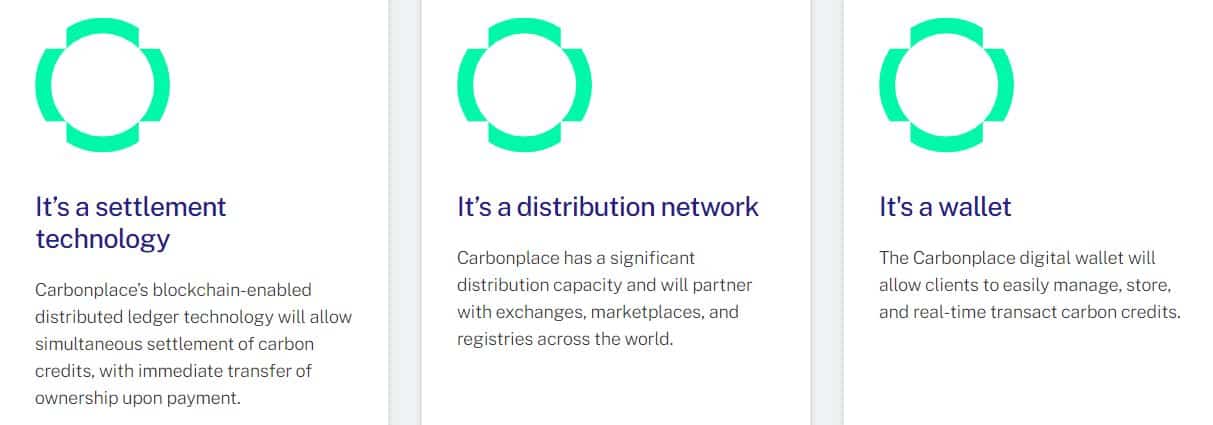
In summary, here’s what Carbonplace is all about.
The network is seen as Xpansiv’s new carbon credit rival. It will facilitate the simple, secure, and transparent transfer of certified carbon credits. And that happens in real time.
Digital wallets allow the ownership of a credit to be reliably proven to the market, which lowers the risk of double counting and simplifies transparency.
Driving Corporate Climate Action
Large companies have been setting lofty net zero pledges such as these major airlines, T-Mobile, Disney, Stellantis, Lenovo, and more. Most of them follow the world’s goal to hit net zero emissions by 2050 while others have targets 10 years ahead.
As the number of companies pledging to cut their emissions grows and investor pressure for clear plans intensifies, the importance of voluntary carbon market becomes even more obvious.
A representative from BBVA, Ingo Ramming, commented:
“Carbon markets are a fundamental pillar of our sustainability strategy and an enormous business opportunity… Carbonplace strengthens our value chain. Its modern, flexible, and secure technology will enable carbon markets to realize their full potential to drive large-scale climate action.”
The VCM has a key role in driving corporate climate action and helping companies achieve their net zero goals. Firms buy carbon credits to offset emissions they can’t avoid or reduce.
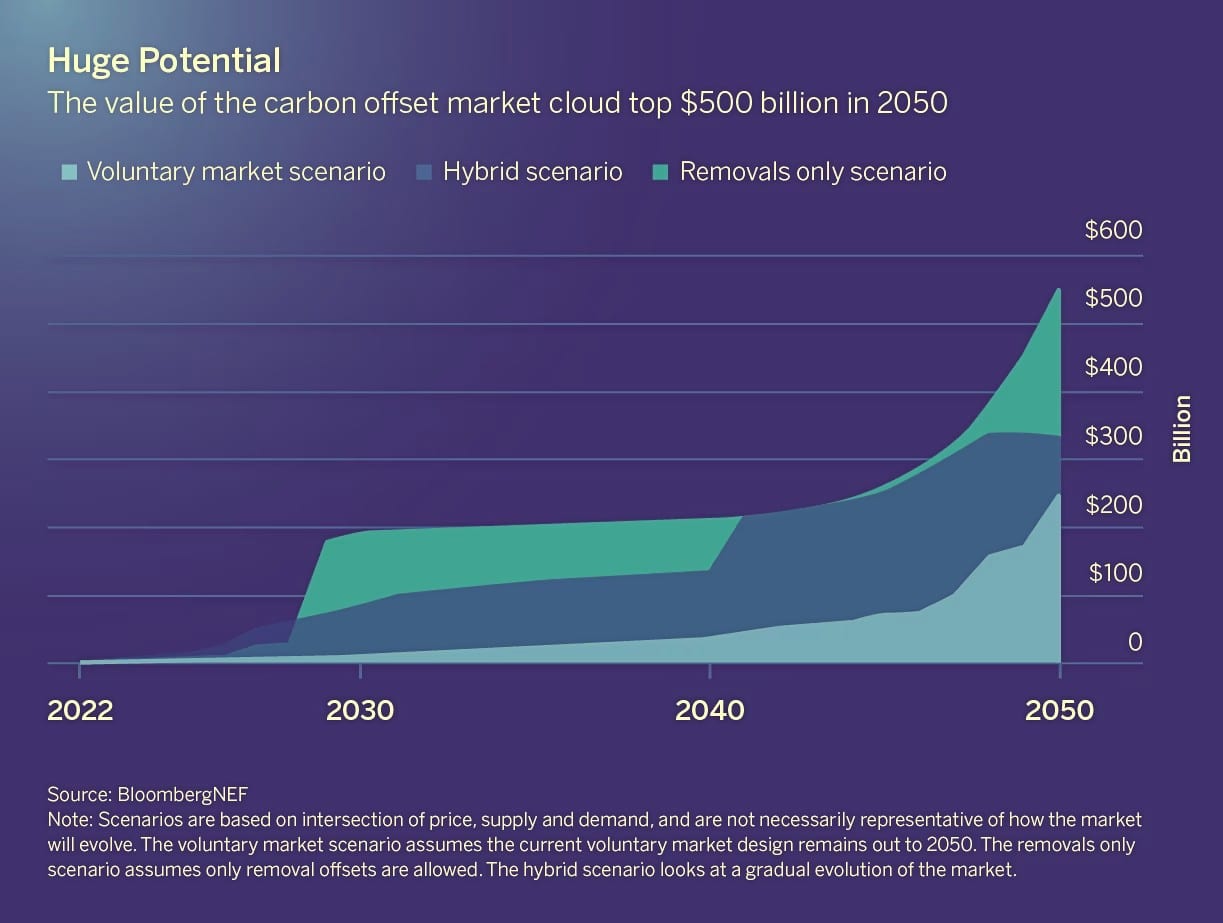
As per BloombergNEF’ projection, demand for carbon offset credits can grow 40x to 5.2 billion tons of CO2 in 2050. That represents 10% of current global carbon emissions.
Investments in VCM projects grew to $10 billion last year, up from $7 billion in 2021, according to a report. While the volume of carbon credits bought as offsets (155 million) went down 4% from 2021, global supply jumped 2% (255 million).
Carbonplace’ carbon credit platform will be available to the banks’ corporate customers later this year. It can also be open to retail customers in the future, the firm’s chief technology officer says.
Carbon credit rating firms seek to help companies have a better sense of carbon offset credits, from which many have turned their backs on due to the reputational risk of greenwashing.
The notion of greenwashing refers to projects that don’t follow standards and have inaccurate measurements. It weakens the confidence of carbon credit buyers, especially businesses wanting to decarbonize their operations.
Rating Carbon Credit Projects
Corporations, online carbon marketplaces, and traders are the common clients of carbon credit ratings. But recently, intermediaries that sell carbon credits also now have the scores along with them.
Each carbon credit represents one metric ton of carbon dioxide avoided or removed from the atmosphere.
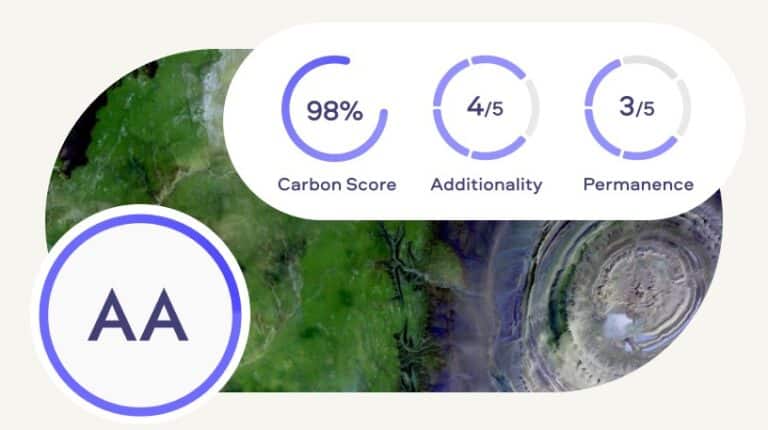
Carbon credit rating agencies grade projects by considering social and economic data, academic research, and satellite imagery. They flag risks using various criteria. For instance, if a project issues too many credits or it’s financially reliant on income from carbon credits.
The rating firms have been flagging projects like anti-deforestation for issuing more credits than they should be. In fact, they already provided early warnings way before the media claims that projects don’t deliver the carbon reductions they promise.
For example, one of the carbon credit rating agencies, Sylvera, reported that below a third of REDD+ projects (preventing deforestation) are high quality. The rater’s CEO Allister Furey noted:
“There is a historic problem with carbon markets lacking transparency and a big spread in quality has undermined [their] legitimacy.”
How grading or scoring is done
The market for voluntary carbon credits (VCM) reached $2 billion in 2022, according to Ecosystem Marketplace. Different estimates say it will hit $50 billion by 2030.
The carbon credit ratings industry primarily earns through subscriptions. The 4 most well-known companies in the sector are Sylvera, BeZero Carbon, Calyx Global, and Renoster Systems.
Nina Schoen, head of product for Salesforce’s Net-Zero Marketplace said:
“A third-party rating for us is almost like education for buyers. It’s one piece of critical information alongside all sorts of critical information that buyers need.”
Sylvera scored projects using an 8-point scale with AAA as highest to D as lowest. BeZero uses a 7-point letter scale from a high of AAA+ to a low of A.
Calyx Global opted to use a 5-point scale from A to E while Renoster rates projects in two stages and assigns a numeric score beginning at zero. The numbering represents how many tons of CO2 or equivalent emissions each credit abates.
Rating agencies say that not every credit represents an actual ton of carbon avoidance or removal. Not all credits are made equal; some don’t deliver on their claims while others could be doing more than what they promise.
Apart from the scores that carbon credit rating firms have, there are other grades that companies and investors use in measuring sustainability such as ESG scores and green bond assessment of a project.
Discrepancies in Ratings
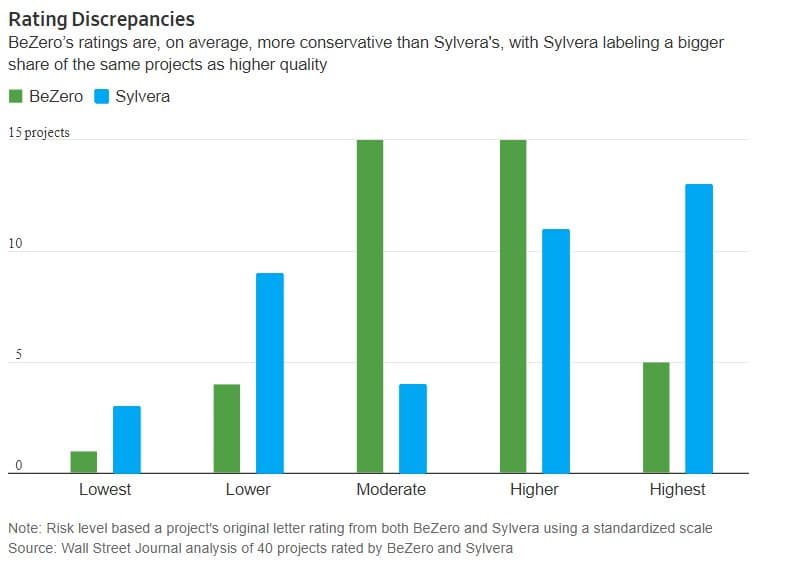
Scores from raters often vary. In fact, 26 out of 40 projects reviewed by the Wall Street Journal agree in broad terms but significant differences exist in rating large forestry projects.
For example, a forestry project in Brazil got the lowest score from BeZero and Calyx but Sylvera gave it a better grade.
In BeZero’s assessment, the project won’t likely need funding support from carbon credits as it is exporting lucrative wood products like mahogany. The rating agency also noted that Brazilian laws would protect the trees from getting harvested.
Meanwhile, Calyx has three significant risk factors for the project. Potential over-crediting is one of them.
Agrocortex, the project developer, said revenue from carbon credits accounts for about 60% of its income in 2021 and 2022. The developer said it will earn a gross profit of $17 million at the most during a three-decade period of producing timber sustainably while also allowing it to sell carbon credits.
The developer also said that despite selling high-value timber, the return on investments is very low as it competes with illegal loggers that offer products at lower prices.
More remarkably, carbon credits prompt the company not to harvest economically viable wood. This keeps deforestation rates in line with Sylvera’s expectations.
Among the carbon credit rating agencies, BeZero rates more conservatively than others. 20% of projects got the highest rating from Sylvera, 10% of them were reviewed by Calyx, and 8% earned the top ratings from BeZero.
For instance, 40 projects rated by Sylvera and BeZero compared on a standardized scale showed the following differences on 5-point rating scales.
Overall, there are thousands of projects in place that generate carbon credits. But only a fraction of them has been scored and rated, including the largest projects by credit volume. BeZero rated the most projects (280), followed by Calyx (260), Sylvera (115), and Renoster (9).
BeZero and Calyx cover a broader range of projects, from capturing methane leaks from landfills to energy-efficient cookstoves. Sylvera and Renoster focus on rating nature-based projects.
Voluntary carbon credit markets (VCM) have a big role to play in financing climate actions but the actual amount of money that intermediaries earn and goes to climate projects remains unknown.
According to a study commissioned by the Carbon Market Watch, 9 out of 10 intermediaries don’t reveal the fees they charge or profits they earn. Their role in the VCM has been increasingly scrutinized.
Intermediaries – brokers, retailers, or exchanges of carbon credits – have been under interrogation.
Last year, an investigation noted that several brokers in the VCM are buying carbon credits from forestry projects in poorer nations and selling them at big margins. Likewise, an inquiry on SouthPole showed that the company was earning millions of dollars from brokering low-quality carbon credits.
In a similar finding, Carbon Market Watch released a report saying that 90% of the intermediaries under investigation don’t reveal the exact fees or profits earned from selling carbon credits on the VCM.
This lack of transparency in the financial transactions involving carbon credits is alarming. It doesn’t give the market players the true insight whether the VCMs are indeed successful in financing climate actions.
Plus, it also makes it impossible to measure the real amount of earnings and speculation on the part of the intermediaries. These include the emerging craze among carbon crypto companies.
This opacity has to change.
Checklist in Buying Carbon Credits
Being transparent about the information on the middlemen’s earnings per credit will allow buyers to support projects where the gap between how much they pay and what the project owner gets is the smallest. This will greatly benefit the project owners or developers, with more bargaining power with intermediaries.
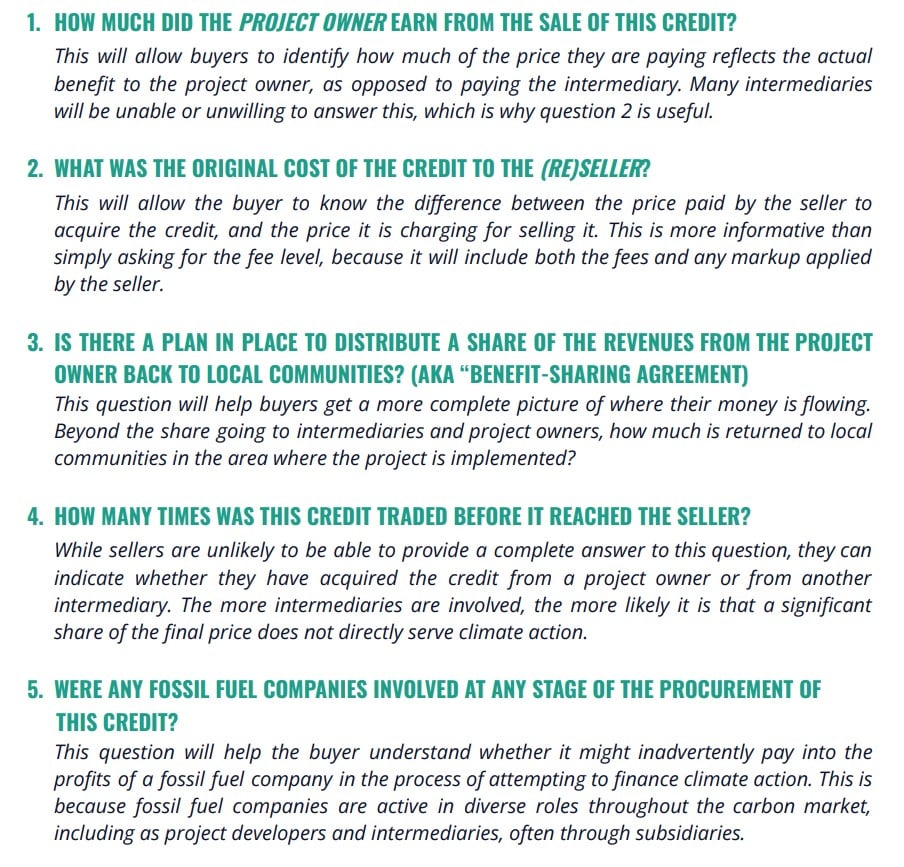
So, carbon credit buyers should not be lenient anymore on demanding transparency from intermediaries. They must know what questions to ask to make informed decisions.
According to Carbon Market Watch, here are the questions that buyers must ask to channel their money to the right projects.
Carbon markets are a tool to channel finance to climate related projects. Yet, there’s limited data available to quantify it.
There is not enough data on how much finance is going to climate action through the VCM.
The value of market size is determined by multiplying the number of trades by the estimated price.
Apart from carbon credit price transparency concerns, where the money paid by the final buyers goes is also unclear. This includes the amount of money that stays in the hands of the intermediaries and the cash that project developers make as profits.
In a best-case scenario, project developers sell directly to end buyers without the need for an intermediary. In this case, as much as 60% of revenues goes back to the climate project or local communities.
Under a worst-case scenario, brokers can take as much as 78% of the revenues of the carbon credit sales.
So why do project developers still work with brokers? Some think that they help connect with buyers and it’s convenient for price discovery.
The Role of Intermediaries in the VCM
Intermediaries have a big role to play in the VCM. They help connect project developers and carbon credit buyers.
Speculative intermediaries, in particular, are investing to buy carbon credits at a time when demand is extremely low at cheap prices. In effect, they’re still providing a lifeline to projects. But that was the case before.
Today, those speculative intermediaries are now cashing in, by reselling the credits at several times more the price they bought them. Though nothing is wrong in earning a profit, it would be if most of the money paid supposedly to finance climate action get stuck on intermediaries’ wallets.
In a report by Thallo on scaling up the VCM, $650 million went to the pockets of investors and brokers – not project developers – out of the 500 million carbon credits traded in 2021,
That accounts for 1/3 of the revenues the VCM generated in 2021.
This is where the concept of “fair deals” comes in. It offers a floor price to project developers and includes a means to ensure that they will benefit as well if market prices rise before the credit is used.
This calls for a discussion defining “fairness” in the carbon market, which has a positive societal and environmental impact.
But if intermediaries still won’t disclose their fees and mark-ups, the real path that a carbon credit takes and the number of times it changes hands will remain secret. Keeping this information hidden will raise suspicions about who really benefits.
Thus, intermediaries must improve transparency in their transactions to also improve trust in the VCM.
Carbon capture and storage (CCS) companies in Europe face several roadblocks in getting their projects up and running on a commercial scale and that’s despite record carbon prices in the region.
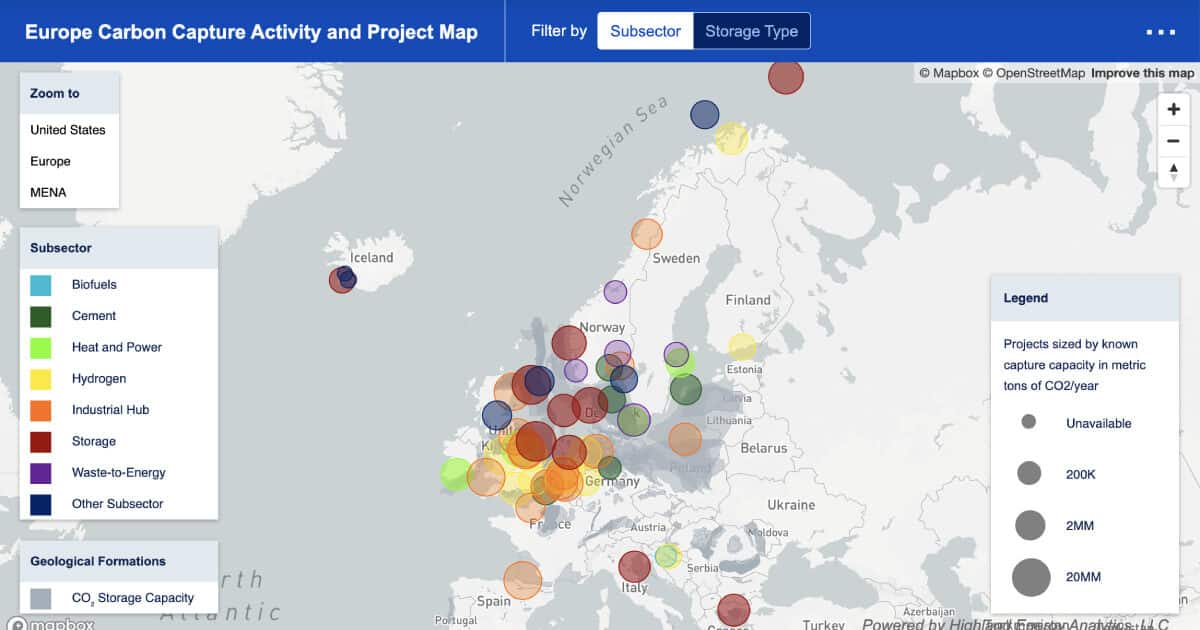
Interest in CCS now spans several countries in the region. These include Italy, Germany, Greece, Belgium, Iceland, Sweden, Poland, and Denmark, following first movers Norway, the Netherlands, and the UK.
Costs of Carbon Capture & Storage in Europe
The complex nature of CCS projects calls for a high initial investment which restricts product adoption. But forecasts show promising growth for the sector.
In 2022, the industry is valued at over $6 billion and is projected to grow to over $35 billion by 2032.
Carbon prices cover some part of the costs of the carbon capture and storage process in the EU.
Last month, carbon prices in the EU ETS – Emissions Trading System – surged over 100 Euros per metric tonne for the first time. It has remained at high levels since then and didn’t go below 95 Euros, so far.
Still, CCS developers said that they need government support to make their projects alive.
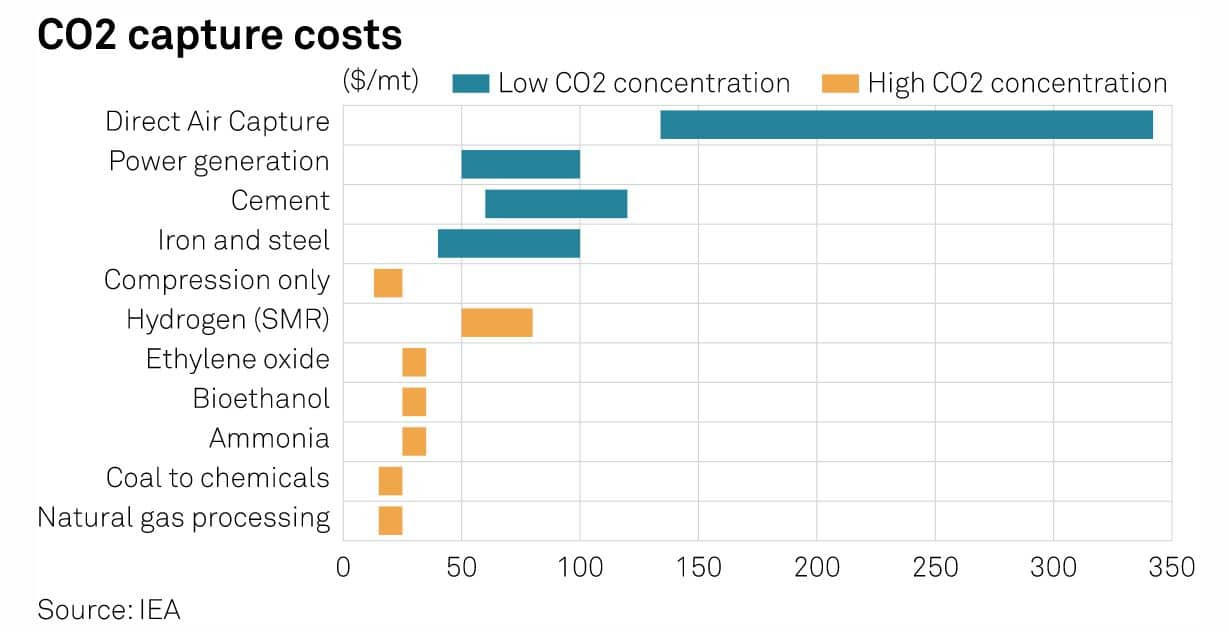
When it comes to actual costs, carbon capture costs in the EU vary a lot, depending on the specific sector. For carbon storage and transport, the costs range between 9 to 19 Euros/mt or US$10 to $20/mt.
For some CCS developers, the costs of capturing carbon are around $30-$40/mt. But for industries with lower carbon emission concentration, the costs are higher as per the International Energy Agency estimates.
As seen in the chart, direct air capture (DAC) systems cost highly expensive, ranging from about $130 to $340/mt.
Though EU carbon prices seem to cover the CCS costs, there are still some things that make commercial scale-up challenging.
Barring CCS Commercialization
The CCS industry is very nascent with the largest market in North America. Europe has the least market share but it’s also the fastest-growing market for CCS.
One of the hurdles for the entire CCS sector to become established in the EU is the right economic model. After all, the global LNG sector took a very long time to achieve its maturity today. The same might be the case for CCS.
So, without support from the state, building the CCS sector from scratch may take even longer to mature.
Models both for capture and storage
Just like other sectors, CCS also needs to have business models that work for both sides of the market.
On one side, the polluters need some kind of insurance so that the carbon captured from their facilities will have a place to go to. On the other side, the storage facilities also have to know that there’s enough carbon for them to store.
A leader of the UK’s Viking CCS project noted that the system of carbon capture and storage itself doesn’t need funding from the government, but the emitters do.
Located in the Humber, the Viking CCS project aims to create a CO2 capture, transport, and storage network. It targets start-up in 2027 and an emission reduction of 10 million tonnes a year in the UK by 2030.
Harbour Energy, the largest London-listed independent oil and gas company, is leading the Viking CCS project. According to its CEO, “at least part of our project will be regulated in terms of what we can charge”. And so they need to know how that model will work.
What that means is the importance of having a regulatory framework in place indicating the government’s support for liability related to carbon storage. The state has to regulate the polluters within the CCS network.
Bringing forward regulation for CCS projects and delivering the business models they need in legislation is urgently needed. Without acting fast enough and causing project delays will only further increase the cost of developing and commercializing CCS in Europe.
Too early to tell
The CCS sector is at its early stage of market development, which creates another roadblock for growth – technology risk.
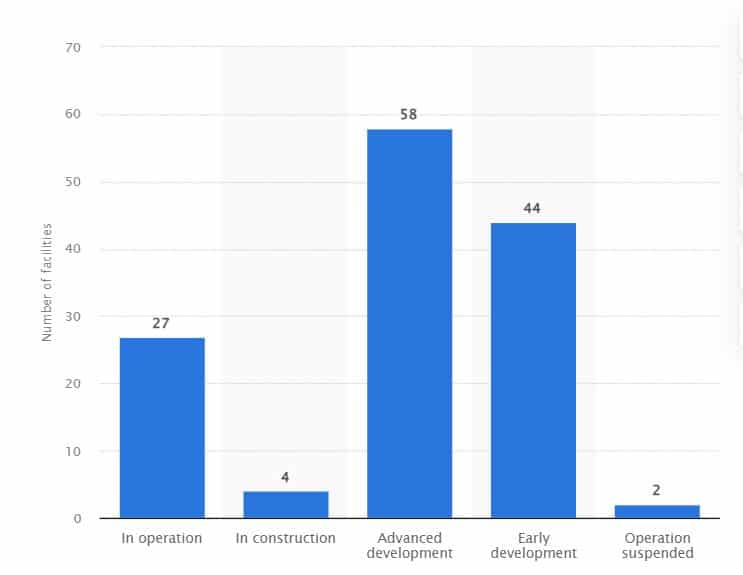
Globally, there are only about 27 large-scale CCS facilities in operation around the world as of 2021.
Number of large-scale CCS facilities as of 2021, by status
Source: Statista
One of the largest projects in the world – Gorgon – is run by Chevron in partnership with Shell and Exxon. It’s in Australia linked with Chevron’s LNG facility.
It’s an example of a commercial-scale CCS project that experienced commissioning delays and start-up problems. It didn’t meet its carbon capture targets while putting the energy companies liable for regulatory issues.
These problems are common in a market that’s still in its infancy stage like CCS. This puts project developers in a position where research and surveys, which are time-consuming, don’t always translate to project development.
In a sense, developers are still exploring the space and discovering which systems or technologies are best to invest in.
Attracting Project Financing
Another barrier for carbon capture and storage to take off in Europe is the concern with project financing.
As an investor or financier, one would like to ensure that the money it lends won’t end up in a loss. But more importantly, when financing this kind of project, lenders will give it a go if there’s strong support for the technology.
Meanwhile, bankers interested in funding CCS projects prefer the contract-for-difference arrangements against the EU ETS carbon prices for a period of one decade.
Fortunately, venture capital-supported startups and large oil and gas firms mentioned above also show a strong commitment to promoting the sector.
But one more problem persists – large discounts on carbon prices in favor of the lenders, according to Ruth Herbert. The CEO of CCSA said:
“The challenge is convincing financiers to invest capital. They do not quite trust the carbon price or politicians.”
She added that financiers wanting to support long-term CCS think that only 30% of carbon prices is worth funding.
To provide the best experiences, we use technologies like cookies to store and/or access device information. Consenting to these technologies will allow us to process data such as browsing behavior or unique IDs on this site. Not consenting or withdrawing consent, may adversely affect certain features and functions.
Functional
Always active
The technical storage or access is strictly necessary for the legitimate purpose of enabling the use of a specific service explicitly requested by the subscriber or user, or for the sole purpose of carrying out the transmission of a communication over an electronic communications network.
Preferences
The technical storage or access is necessary for the legitimate purpose of storing preferences that are not requested by the subscriber or user.
Statistics
The technical storage or access that is used exclusively for statistical purposes.The technical storage or access that is used exclusively for anonymous statistical purposes. Without a subpoena, voluntary compliance on the part of your Internet Service Provider, or additional records from a third party, information stored or retrieved for this purpose alone cannot usually be used to identify you.
Marketing
The technical storage or access is required to create user profiles to send advertising, or to track the user on a website or across several websites for similar marketing purposes.