Climate tech firm Patch secured $55 million to scale their business to meet the growing demand for climate action through voluntary carbon markets.
U.S.-based Energize Ventures led the Series B financing round with Singaporean sovereign wealth fund GIC as its new investor. Existing investors that joined include Coatue Management, Version One Ventures, and Andreessen Horowitz.
The fund will be for hiring more staff, expanding into new markets and developing Patch technology.
This latest round brings the company to a total of $80 million in funding to date.
Patch Platform: Bridging Climate & Technology
Climate scientists agreed that reaching global climate goals will need carbon removal to scale 1 million times its current capacity by mid-century.
Removing carbon from the atmosphere is key to fighting climate change. And many businesses are looking to help fund this climate action as part of offsetting their emissions.
This is where Patch comes in, playing a crucial role in bridging climate and technology. Its platform has the ability to embed climate action into each product and service via its API.
The software allows users to build carbon removal directly into their digital products and services to deliver an automated carbon neutralizing experience.
This is ideal for e-commerce and deliveries, as well as for travel and financial service products.
It’s important to get as many firms as possible to take action to reverse climate change. But many are struggling to integrate this into their businesses.
Remarking on this, Patch CEO and co-founder Brennan Spellacy said that:
“At Patch, we are changing that. Our infrastructure lowers the barrier to entry for both businesses and climate project developers looking to enter the carbon market which, in turn, could help unlock 20% of the climate change solution the world so desperately needs…”
With Patch’s platform, businesses of any size and budget can buy carbon credits to tackle their emissions.
The infrastructure transforms a traditionally complex and opaque system for buying carbon credits.
Patch gives entities seeking climate solutions the infrastructure they need to grow and scale their businesses. Its platform also helps facilitate impactful transactions on the VCM.
The market is seen to grow to $50 billion in 2030 and $100 billion by 2050.
For Tyler Lancaster of Energize Ventures who’s joining Patch board of directors, this growth makes “it one of the largest and most paramount markets of our time.”
But today’s carbon credit infrastructure is so fragmented and lacks standardization. This makes it difficult and complex to tap into, according to Lancaster. He added that:
“Patch’s platform provides a much-needed digital backbone that simplifies the transaction complexity of the carbon management ecosystem for both buyers and suppliers… It also increases transparency, and enables the carbon market to scale to meet global climate goals.”
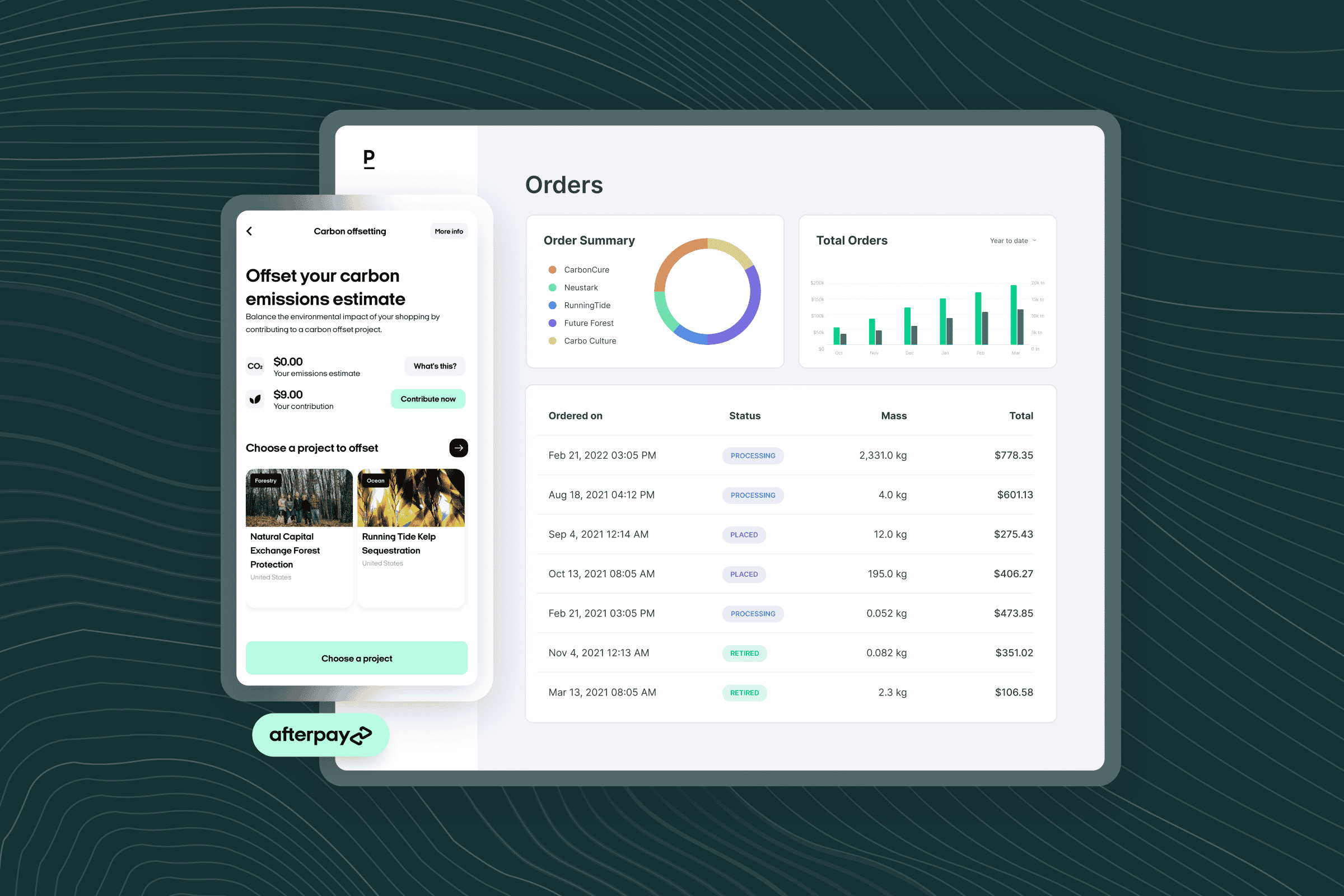
The image below shows a snapshot of Patch carbon credit platform.
100+ Corporate Customers
For a year, Patch grew its customers 5x more to over 100 companies across all industries. They span from e-commerce to financial services.
Some of the firms that integrate climate action into their business using Patch platform include:
Afterpay: the buy now pay later group
The group said that Patch platform enables thousands of its customers to understand and take action to offset the emissions of their purchases.
European investor EQT
EQT leveraged Patch to place itself at the forefront of climate innovation. It’s using the platform to neutralize its emissions through bold investments in frontier technologies.
Shop Apotheke Europe
One of Europe’s leading e-pharmacies is also using Patch to buy credits to neutralize the firm’s emissions for the first half of 2022. This is part of the company’s robust decoupling strategies.
Restaurant company Just Salad
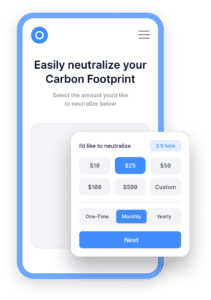
The food company recently integrated Patch right into its mobile app. This offers customers the ability to neutralize their order’s carbon footprint in an easy swipe.
Patch itself has grown its team very fast by 400% to over 60 employees worldwide in the last year. The tech company had opened a European headquarters in London.
The firm has been attracting top talent from leading tech companies like Shopify, Stripe, and Plaid.
Its latest funding round includes new investors such as B Capital Group, AENU, Blue Impact, Andrew Robb, Frank Slootman, GIC, and MCJ Collective.
The $55 million will put the company on track to deliver a massive climate impact worldwide.
Are you looking to directly reduce your carbon footprint or support projects that cut emissions elsewhere? Then carbon credits allow you to do either of these.
Each credit goes through a general lifecycle process that starts from creation to retirement. Individuals and firms use these credits to voluntarily offset their emissions.
With growing pressure on corporations to take climate action, the VCM demand deems to grow up to 10x over the next 10 years and 30x by 2050 from 2020 value.
As such, we’re also expecting to see more carbon offset project developers enter the market to meet the rising demand.
This calls for a better understanding of the role of developers in the VCM. The same goes for the state of the carbon project developer ecosystem and its maturity level.
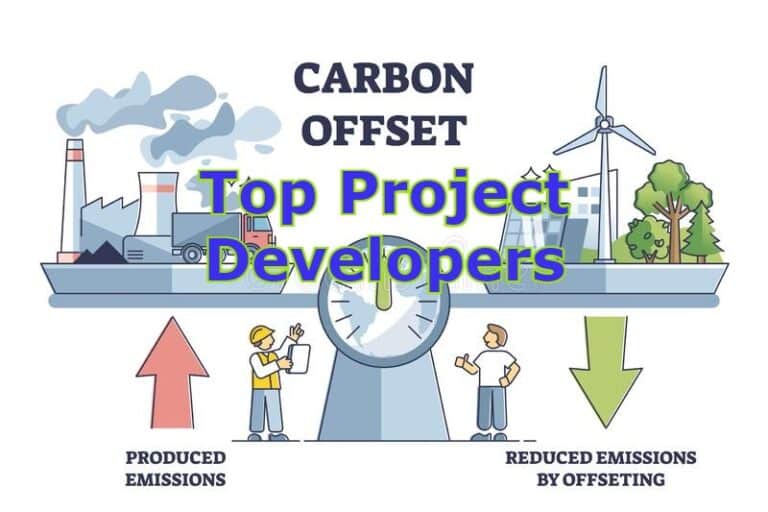
Most notably, this article will also shed light on what are the top carbon offset project developers that contribute to the growth of the market. We’ll identify five of them to help you find the best developer you need.
The Role of Carbon Project Developers in the VCM
Delivering the promise of the Paris Agreement calls for adopting more ambitious emission reduction initiatives.
It also requires more commitments to develop carbon offset projects to neutralize unavoidable emissions.
It’s becoming clearer that well-designed VCMs are critical to achieve the Paris Agreement goal. That’s to enable the world to reach net zero emissions by 2050.
And carbon project developers play a central role in the VCM. They are key to delivering its success given the current state of the market and its projection.
Project developers perform several tasks to help ensure the growth of the VCM. These include:
Bearing the financial risks of developing carbon projects
The Current State of Carbon Project Development
Observing the current state of the carbon project development ecosystem reveals a couple of insight.
One of them tells us that the carbon project developer ecosystem remains concentrated by volume into a few players with big portfolios.
Yet, it’s the small and mid-sized carbon project developers holding smaller carbon portfolios that dominate the market.
The difference is so huge that you’d think the developer market remains largely untapped. And it seems to be the case right now.
9 out of the top 10 carbon offset project developers by issued volume are working on large-scale avoided conversion / REDD+ or improved forest management projects.
Another notable observation is the dominance of avoidance carbon offsets, particularly with renewable energy.
Renewable energy developers, which are mostly from India and China, dominate the market by number.
But the recent supply shifts prompt project developers with avoided emissions portfolios to expand into nature-based projects.
However, lack of expertise in nature-based projects may limit developers with removal portfolios producing industrial carbon capture credits.
This may give them higher project development risks like fire.
Lastly, when it comes to type of project, nature-based seems to be dominant.
Almost half of total volumes of credits issued was from nature-based project developers. This result is due to high entry to market barriers.
Most issuances are in the hands of a few large nature-based operators in the Global South.
While the top carbon offset project developers of most improved forest management portfolios are in the U.S. Blue Source and Finite Carbon are the dominant players in this field.
Offset buyer preferences are forcing project developers to shift to nature-based solutions and removal credits.
But with limited new market players, there’s a risk of failing to meet increasing demand. This may further impact the current carbon pricing.
Project developers tend to focus on nature-based avoidance carbon credits. But other types of carbon credit projects are also available to consider for your offsetting needs.
With that being said, here are the top five carbon offset project developers that made it to our list.
Top Carbon Offset Project Developers
1. BlueSource, now Anew
Formally founded in 2001, Blue Source has a new brand name called Anew after merging with the Element Markets last June. It gets the top one slot when it comes to providing offset credits from improved forest management, carbon capture, and other projects.
It has offices in the U.S., Canada, and Europe, and an environmental commodities portfolio that extends across 5 continents.
Since the inception of its legacy companies, Anew has had the following achievements:
transacted 150+ million tonnes of carbon
provided 240+ million diesel gallons equivalent of renewable fuels for transportation
developed projects on over 3.5 million acres of forest and farmland
developed 400+ overall projects
Anew’s activities amount to the emissions avoidance of 539 million solar panels generating power for an entire year.
Plus, the firm has developed projects with protocols made via scientific review and public stakeholder processes. Oversight for these projects comes from the top carbon standards, including:
What sets Anew apart from other project developers is that it serves the multiple functions of a broker, trader, retailer, and advisor in the carbon space.
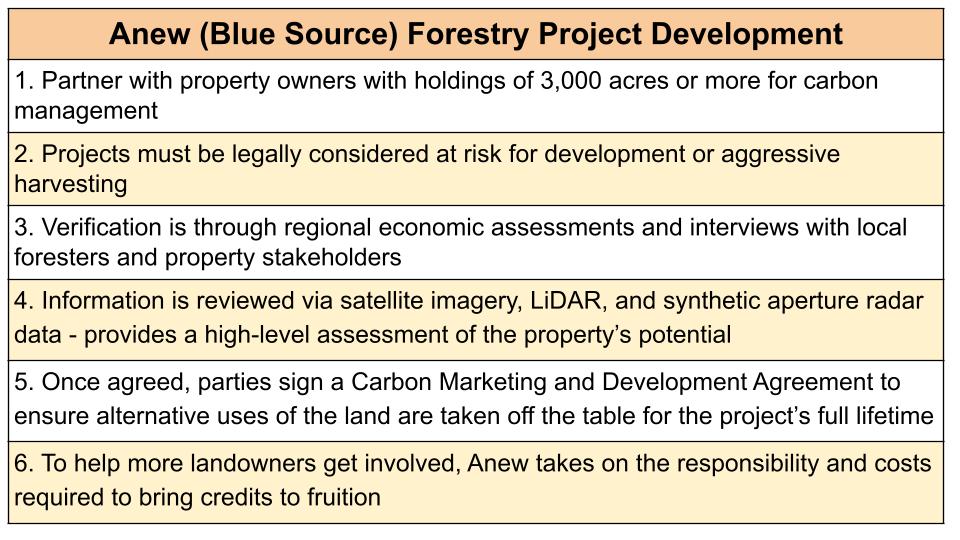
Under its core project development expertise, forestry projects, Anew follows these steps for a project to be eligible for offset crediting:
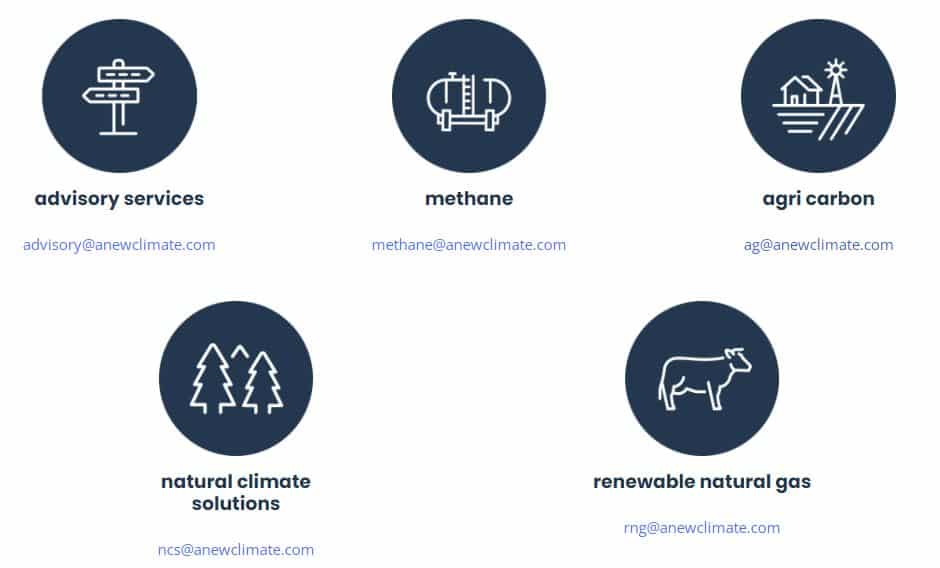
Apart from developing natural climate solutions like forestry projects, Anew also offers the following services and project development:
2. Finite Carbon
Finite Carbon, founded in 2009, is North America’s biggest developer of forest carbon offsets by volume. It focuses mainly on improved forest management projects.
With offices in 7 US states, it combines unparalleled project development experience with extensive carbon market knowledge.
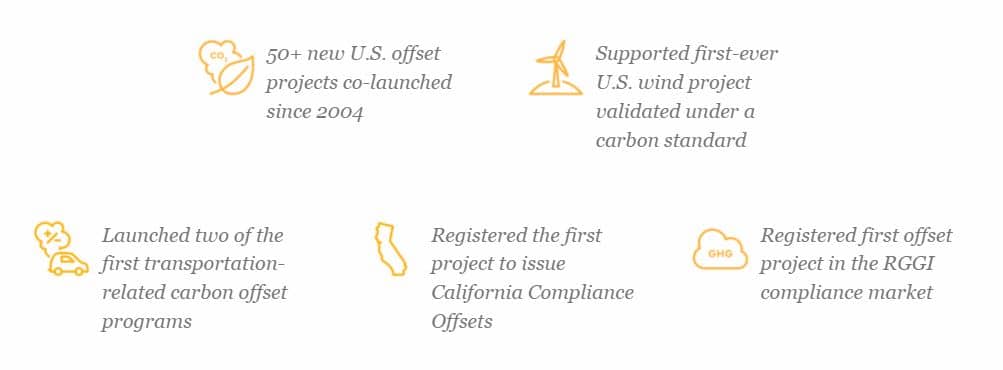
To date, this offset developer is able to achieve the following performance.
The developer generated over ⅓ of all compliance offset supply. It has also delivered 800+ million dollars to landowners.
Unlike other top carbon offset project developers such as Anew, Finite Carbon is working with landowners who have 5,000 acres or more. Anything less than 1,000 acres is not a cost-effective project for the company.
However, with its upcoming Core Carbon program, those who own as little as 40 acres can enter the growing carbon offset market.
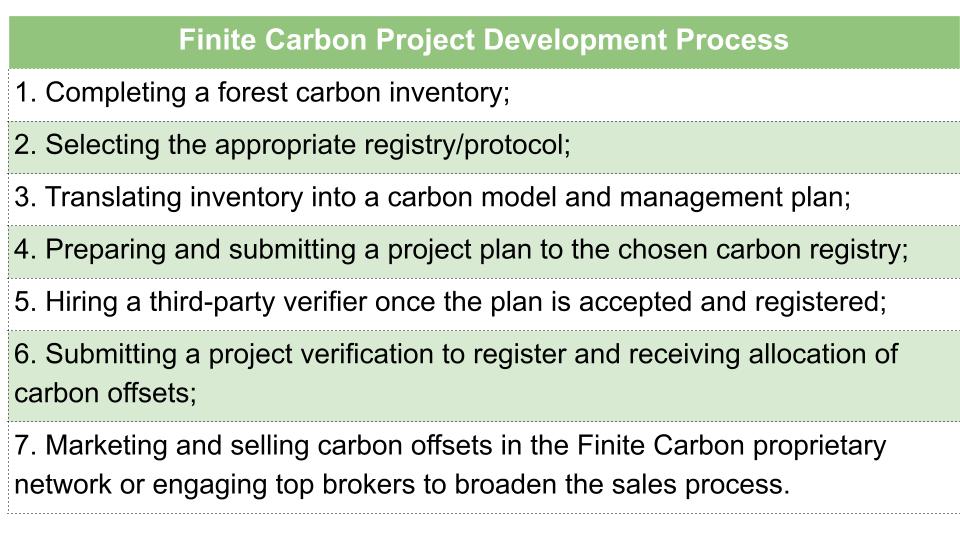
Its entire offset project development process can take up to 6 months, depending on several factors. In general, it involves the following processes:
Like other developers, Finite Carbon pays the capital for each project. And then it collects only a percentage of the carbon offsets once completed.
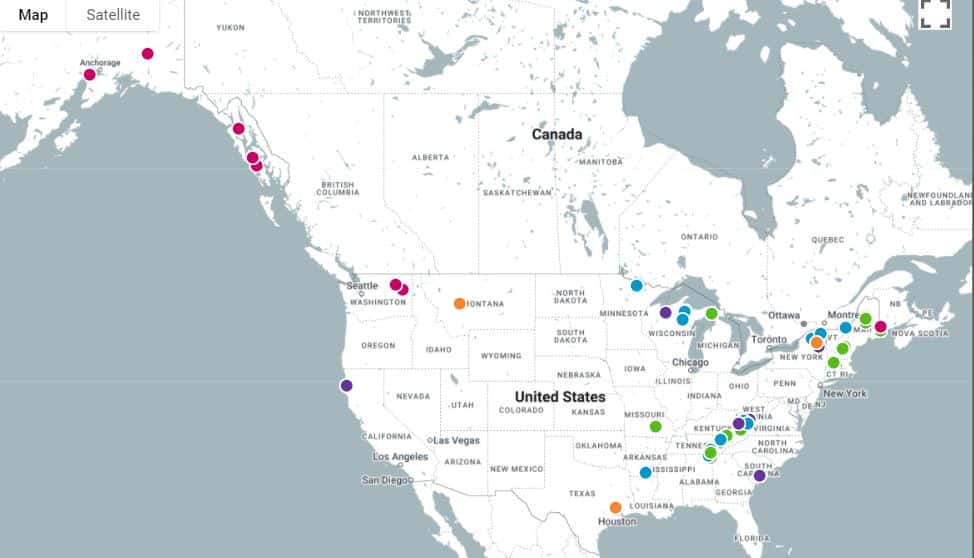
With its wide coverage, the developer’s projects are in every region and major forest type from the Appalachians to coastal Alaska. Below is its project map showing its forest projects.
If you’re after a project developer that demonstrates expertise in forestry offsets, Finite Carbon should be on your top list.
3. 3Degrees
For over 15 years, 3Degrees has been a pioneer in providing climate solutions. Within that time period in the project development market, the company has achieved these results:
The company also deals with many other carbon offset projects apart from nature-based solutions. They mostly include landfill gas capture projects.
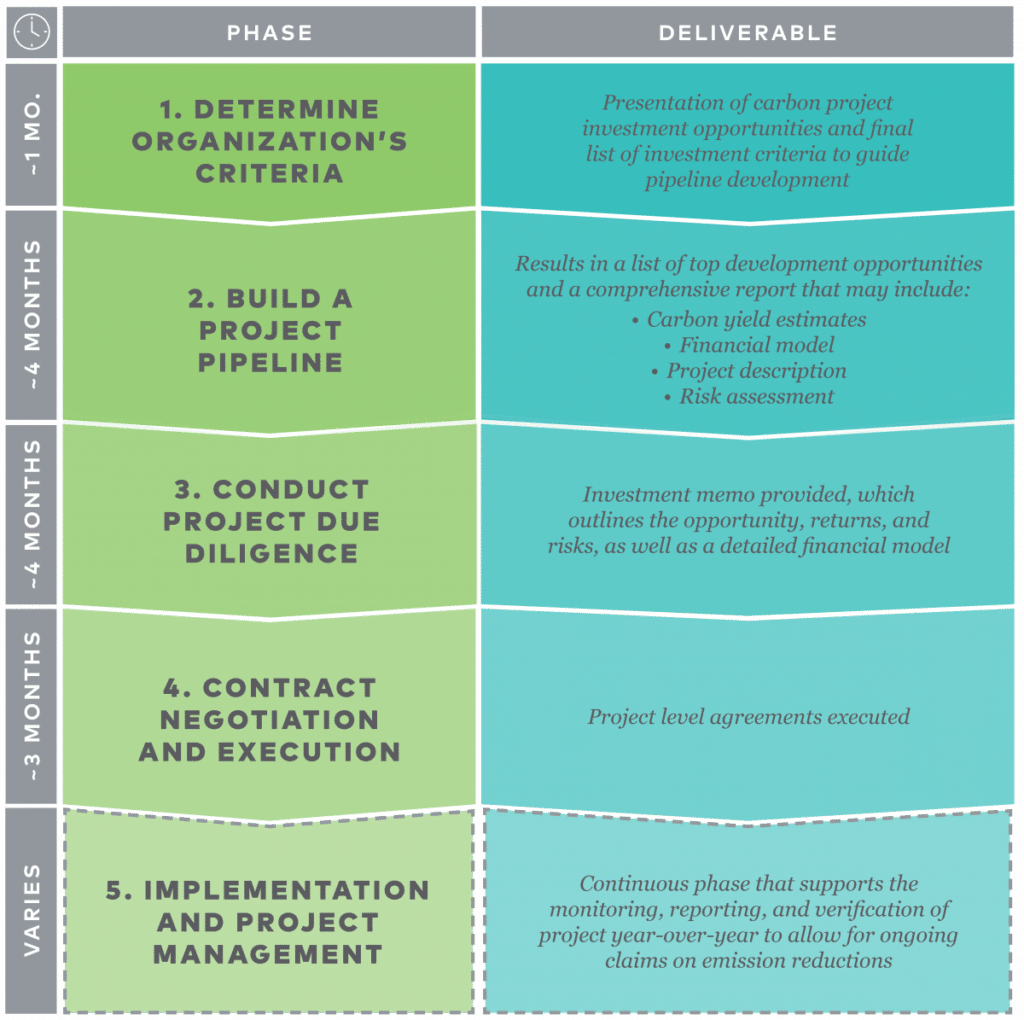
3Degrees’ project development solution is broken down into 5 major phases:
Setting aside its proven track record in the space, what makes 3Degrees stand out from other top carbon offset project developers are a couple of differences. They include the following:
Quality Standards:
3Degrees works with all four of the major internationally recognized voluntary carbon offset standards. They include Verra, Gold Standard, American Carbon Registry, and Climate Action Reserve. The firm ensures that each project adheres to approved protocols.
Tailored Solutions:
3Degrees helps organizations build a portfolio of high-quality projects that are relevant to their business and engage stakeholders.
Portfolio Management:
The project developer takes a holistic approach to portfolio management. It works with clients to balance immediate needs with long-term program goals.
All these enable 3Degrees to be a strategic partner for entities looking to build a portfolio of high-integrity carbon reduction and removal projects. They include opportunities both for long-term and new project development.
4. Forest Carbon
Making it to the top 4 spots, Forest Carbon’s main goal is to restore degraded tropical forest and wetland ecosystems. These projects fall under the broad category of REDD+.
So far, it’s a premium restoration project developer in Southeast Asia. Its projects deliver benefits for local communities, biodiversity, and investors.
With offices in Jakarta and Singapore, Forest Carbon’s team is built on a track record of success in the region. The team brings a decade of experience working on the ground, from mapping wetlands and assessing below-ground carbon storage to winning community support.
The REDD+ developer follows these key project development stages.
Feasibility assessment:
Forest Carbon is on the ground to assess threats to tropical forest ecosystems and develop business models to protect them.
From the dry dipterocarp forests of Malaysia to the carbon-rich peat swamp forests of Indonesia, the developer specializes in assessing these areas. It offers the following major advantages in creating carbon credits from natural climate solutions:
In designing its REDD+ projects, Forest Carbon works exclusively under the Verified Carbon Standard (VCS). It also adopts the Climate Community and Biodiversity Standard.
Forest Carbon has designed Indonesia’s first peatland restoration project in Central Kalimantan under VCS. It also did the same with Seima, Cambodia – WCS Restoration Project.
Impact verification:
Forest Carbon is leveraging IoT sensors and machine learning for a project’s robust impact verification.
These IoT sensors monitor water table levels for peatland ecosystems. They also provide fire risk data in real time in a project dashboard. The data generated makes it easier to measure project impact by auditors.
5. C-Quest Capital
C-Quest Capital (CQC) is a social impact project developer that aims to transform the lives of families in poor communities worldwide.
The firm does it by providing access to sustainable energy services and clean energy technologies that reduce emissions.
CQC was founded in 2008 and is headquartered in Washington D.C., USA, with local offices in India, Malawi, Malaysia, Singapore, Cambodia and Australia. Its global teams lead project operations across Sub-Saharan Africa, Central America, and South and Southeast Asia.
The developer creates high-impact carbon offset credits under three operational platforms:
Cleaner Cooking,
Efficient Lighting, and
Sustainable Energy (Nature-based Projects).
Together, they form the so-called Transformation Carbon projects. They all comply with specific carbon offset standards. They then go through rigorous 3rd-party assessments by auditors to ensure credits are real and measurable.
Currently, CQC certifies all new projects under the Verra Verified Carbon Standard (VCS) same as other top carbon offset project developers on our list.
Each project is registered onto a cloud-based data management system using Android phones or tablets. Registration involves data collection for monitoring and follow-up.
Doing all these is critical for project evaluation, verification, and improvement.
So, for high integrity and high-impact offsets that help the poorest communities, CQC tops this project category.
As you can see, each project developer has its own set of processes when developing a project. But overall, you have to carefully think about the specific results you want to achieve.
They may follow the same offsetting standards but not all carbon offset project developers will make it to the top of our list. You’ll never go wrong with any of them.
Carbon Fund Advisors introduced the Carbon Strategy ETF with NYSE Ticker KARB to provide exposure to global compliance carbon markets.
The Carbon Strategy ETF “KARB”
The Carbon Strategy ETF is an actively managed exchange-traded fund that uses a reference index – the Carbon Streaming BITA Compliance Index.
It’s a rules-based index that tracks the performance of the compliance carbon markets via an allocation into a series of carbon allowance futures.
KARB ETF will hold futures contracts on carbon allowances in emissions trading systems (ETS) in North America and Europe. These particularly include:
European Union Allowances (EUA)
California Carbon Allowances (CCA)
US Regional Greenhouse Gas Initiative (RGGI) CO2 Allowances
United Kingdom Emissions Trading Scheme (“UK ETS”)
The Fund aims to maximize capital appreciation while minimizing the cost of rolling futures.
Apart from providing exposure to regulated carbon markets, KARB ETF may also bring potential appreciation in carbon prices as the world aims to achieve the Paris Agreement goals.
The ETF also seeks to give investors a vehicle to benefit from stricter regulations and reductions in the amount of allowances. This may lead to higher prices.
It may also act as a hedge against climate-related risks. And it can even give investors access to the emerging asset class of carbon.
Compliance Carbon Markets & KARB
Governments and jurisdictions that form the compliance carbon markets created the ETS to put a price on emissions. They’re also to incentivize carbon-intensive industries to cut down their emissions.
ETS is also known as the cap-and-trade program.
As for Tim Collins, Carbon Fund Advisors’ founder and president:
“There is a growing global push to regulate and reduce greenhouse gas emissions in an effort to combat climate change… and ETS can be an effective tool for governments across the globe to achieve their climate goals.”
They’re established by regional, national or subnational jurisdictions to cap total emissions allowed for certain industries.
The cap, or permitted emissions, declines each year to achieve the climate goals of the jurisdiction.
Carbon allowances, also called carbon credits, equal to the emissions cap can either be freely allocated and/or auctioned to emitting companies by the regulating body.
Firms with caps may buy or sell carbon allowances based on their need. For instance, a company with lower emissions can sell their allocated carbon allowances to others with higher emissions.
Tesla is a perfect example for this, earning billions of dollars in regulatory carbon credits sales.
Entities that don’t have enough allowances to offset their emissions at the end of the reporting period will face fines.
Trading carbon credits is limited to entities registered in an ETS only. And most investors do not have access to this carbon trading.
Some active futures markets may provide investors with exposure to compliance carbon markets.
Still, the challenges of getting access to derivative markets make direct investments in carbon allowance futures contracts difficult.
This is where the Carbon Strategy ETF offers a potential solution.
The KARB ETF opens the door to invest in a portfolio of carbon credit futures at a time when prices will increase further to meet the Paris Agreement targets.
Also, reduction in the supply of carbon credits each year as the cap declines may lead to higher prices. High carbon prices are crucial to prompt companies to invest in lower emission alternatives.
In fact, carbon prices need to reach $130/ton by 2030 and $250/ton by 2050 to meet net zero ambitions.
Carbon Streaming Corporation holds a 50% equity interest in Carbon Fund Advisors Inc.
As the global economy is racing to net zero emissions, Environmental, Social, and Governmental (ESG) investors are considering how they can measure the Scope 4 emissions into their analysis.
The path to net zero has been the common direction as the world tackles climate change. But taking this road calls for going beyond the common ways of categorizing various emissions into different scopes.
Many are familiar with the Scope 1, 2, and 3 emissions. Yet, we also have to take into account the climate-related benefits of new technologies and products. Or what is otherwise called the Scope 4 emissions.
This new category refers to the emissions saved or avoided for customers/clients due to product performance.
ESG investors are now thinking about factoring this kind of emissions into their portfolio analysis.
Who Should Measure Scope 4?
The first three emissions sources are well-known within the investment world. But Scope 4 emissions emerge as the new disclosure frontier for investors to ponder.
Scope 4 emissions are the avoided emissions happening outside of a product’s life cycle or value chain.
Integrating it is crucial when an investor prefers a holistic approach on a firm’s contribution to Paris Agreement climate goals.
The common examples of companies adopting this new emissions disclosure are in the capital goods sector. They develop and provide a wide range of parts and even automation solutions.
As such, they’re in the position to allow for energy efficiency, green mobility, and decarbonization of electricity systems for a broad range of products.
More significantly, they provide equipment and technological solutions to the end-users of the products. These users are often the largest emitting sectors affected by climate regulations.
Take for instance the case of Schneider Electric, a French company that focuses on digital automation and energy management. Through its variable speed drives (VSDs), the company offers a specific example of generating saved and avoided emissions on electricity use.
Using the VSDs allows customers to save on energy consumption by motors by regulating speed and rotational force.
Most notably, the energy company distinguishes between its saved and avoided emissions per type of product installation. The firm is also using a forward-looking energy mix in calculating Scope 4 emissions.
Plus, it’s even more interesting to note that Schneider Electric reports sales by country. This enables them to adjust for national electricity generation sources. They can also measure different averages for the emissions of purchased electricity by nation and by year.
For example, one of its advanced platforms helped product users to save as much as 134 million metric tonnes of carbon dioxide since 2018. This is equal to the emissions of 28+ million gas-powered passenger cars driven for a year.
Key Barrier in Reporting Scope 4
Apart from a limited method of disclosure, the biggest challenge in reporting Scope 4 emissions is the lack of standardization. This means firms need to have their own way to account for this emission and report any saved or avoided emissions.
But this issue is manageable as Scope 4 emissions are still in its early stage. And given the lack of standards in this field, firms can be transparent in their reporting methods and in auditing their annual reports.
For instance, when reporting saved/avoided emissions, companies must not deduct these from their real emissions to prevent mixing theoretical and real figures.
Rather, firms may apply a ratio approach where they report Scope 1, 2, and 3 emissions over saved/avoided emissions.
How Should Investors Take This?
The world is witnessing great efforts on avoiding emissions via the net zero pledges from corporations. But measuring scope 4 emissions is very new.
So getting consensus on measurement methods and improving transparency in reporting can improve its usefulness to investors.
It can also help bring a consensus among climate standards and bodies as to how to include Scope 4 emissions officially in climate goals. It’s not an official category of the GHG Protocol.
Instead, it represents a theoretical measurement of emissions via a reference scenario only. This often involves comparing products to the average market solution. It’s a solution that’s previously in place or a previous generation of a product.
Measuring this metric enables the economy to appreciate the products’ decarbonization power. It also shows a company’s innovative quality.
Not to mention that the three known emissions scopes have their own limitations, too. They may understate the climate positive value of products.
Finally, disclosing Scope 4 emissions doesn’t only favor sustainability reputation but it can also show the real added value a company makes towards its ESG agenda.
DeepMarkit Corp. provided its industry and corporate update to keep shareholders and the media informed about its unique competitive position in a growing asset class.
The recent milestones in the carbon industry include:
Blackstone’s investing $400 million in Xpansiv
BMO purchasing Radicle Group
CPP Investments adding an “Investing in the Potential of Carbon Credits” section to its website; and
Norton Rose Fulbright publishing its “Draft Core Carbon Principles for the Voluntary Carbon Market”
Bloomberg reported that “a record US$1.4 billion poured into climate and carbon-focused startups in the Q2 2022
DeepMarkit’s Competitive Position
DeepMarkit’s overall plan is based on combining the growth of the informal carbon offset market with the maturation of blockchain technology.
The company launched MintCarbon.io to offer a simple onboarding process to users in the VCM to access carbon offsets via blockchain.
The platform’s user-focused service seeks to ensure that carbon offsets that are onboarded are only of the highest quality and have passed third-party checks.
Its focus is to add a project’s story and embed project data within the token for a more robust, project-friendly offering.
Carbon Offsets – A Growing Asset Class
The size of the VCM has grown rapidly in recent years with its value almost quadrupling in 2021 towards US$2 billion.
Also, prices climbed in 2021 ($4.0) by nearly 60% over 2020 ($2.5) to a point not seen since 2013. Looking ahead, the rise in corporate net zero pledges will further drive demand growth and expansion in VCMs.
Global carbon project developer South Pole and agricultural tech company Regrow Ag work together to scale the adoption of regenerative agriculture.
South Pole is a global developer of carbon projects and climate solutions provider with 20 years of experience.
Its project development covers various areas including:
sustainable agriculture
forest conservation
waste management
energy efficiency
renewable energy
The firm also advises thousands of companies on their journey to reach net zero emissions.
The partnership with Regrow Ag will allow South Pole’s projects to get access to the latest scientific and technological best practices for agricultural project monitoring and emissions accounting.
Regrow Ag is a tech company that seeks to boost regenerative agriculture practices and make them available across the globe. It uses science and technology to develop solutions across all aspects of the supply chain, from growers to global food companies.
South Pole’s CEO, Renat Heuberger remarked about the partnership:
“As an early advocate for and developer of agriculture projects that help lower emissions and generate carbon offsets, I am thrilled to see us partnering with Regrow to evolve industry best practices.”
Regrow’s MRV Platform
Measurement, Reporting, and Verification (MRV) is a critical element in climate mitigation efforts. It refers to the multi-step process to measure the number of emissions reduced by a project like reforestation.
The findings are then reported to a 3rd-party that verifies the report so that the results can be certified and carbon credits can be issued.
It seeks to prove that activity has actually avoided or removed emissions. Only by then that those reductions can be converted into credits with monetary value.
In a sense, MRV is the key to unlocking climate finance. It helps carbon project developers, brokers, and buyers ensure the quality of carbon credits.
Regrow’s proprietary MRV platform will enable agriculture projects to scale up by using science and technology in novel ways.
It gives farmers scenario planning tools and measures the environmental impact assessment of practices that are most suitable for their operations.
The MRV tool enhances scalability by reducing the need for manual soil sampling. It also provides a data collection and modeling system that’s replicable on different soil and crop types.
The key aspects of Regrow’s MRV are transparency and quantifiable uncertainty.
Transparency and integrity come with the MRV’s independence. This means it has not been developed by the entities that set credit prices.
Quantifiable uncertainty is the ability to quantify how confident the verification software is in estimating the amount of carbon that the farm’s soil sequesters or stores.
The lower the uncertainty, the more credits can be issued to the farmer.
MRV doesn’t rely on costly field visits and laboratory soil testing. Instead, it takes advantage of the latest tech in farm digitization, remote sensing, and soil modeling.
ICROA-endorsed certification standards recognize the scientific rigor of Regrow’s MRV. These standards include the Climate Action Reserve, one of the best carbon registries.
By using the latest in satellite monitoring and crop detention in regenerative agriculture, Regrow can help South Pole meet the stricter rules of carbon certification standards.
The tech company will do this by:
contributing to the design of South Pole’s project monitoring protocols,
calibrating models for the measurement of carbon stock, and
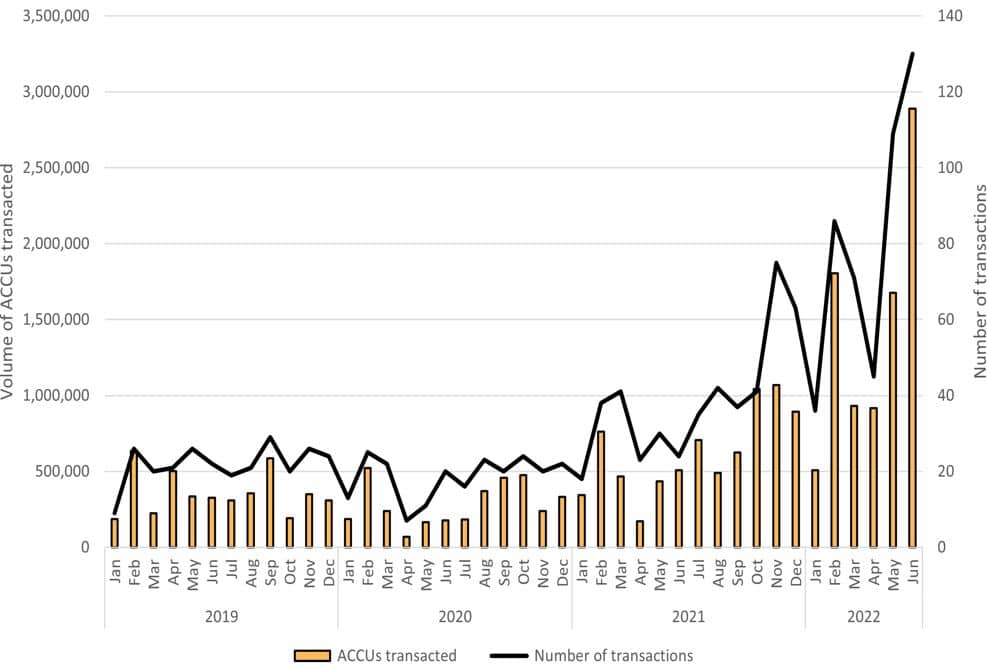
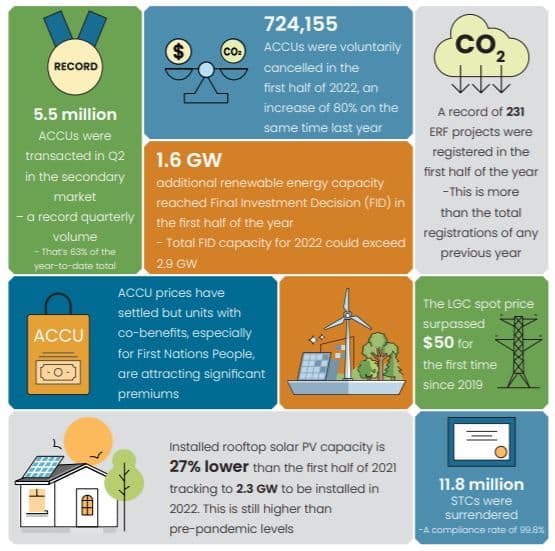
The total transaction volume of 5.5 million ACCUs – 4x more than Q2 2021.
Comparing June 2021 to June 2022 there was a 5-fold increase in carbon credits traded.
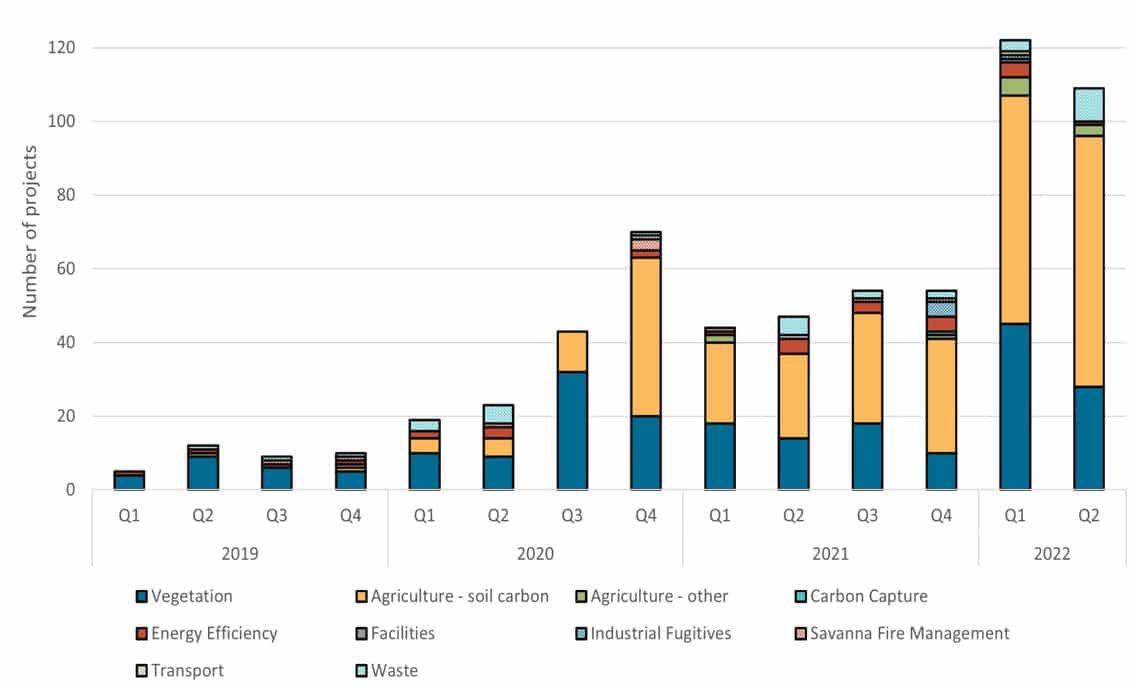
Even the number of ERF (Emissions Reduction Fund) projects (231) registered during the period also reached a new record, with 68 new Soil carbon projects getting registered.
Generic ACCU spot prices also jumped 15% over the quarter to reach $35.10. ACCU price with co-benefits is also rising, especially for First Nations People.
Large-scale renewables investment maintains strength while small-scale solar PV is stable at the lower level seen in Q1.
Here are the other major highlights of the Aussie carbon market in Q2.
Labor’s Climate Change Bill Signed into Law
With the recent change in Australia’s federal government, there has also been a shift in the nation’s position on climate change.
Australia’s parliament had passed the Labor government climate change legislation. The new law pledges to cut carbon emissions by 43% by 2030, define a process to ramp it up, and the goal of net zero by 2050.
Commenting on the bill’s passage, Climate Change and Energy Minister Chris Bowen said that:
“The passage of the climate change legislation sends a message to the world that Australia is serious about driving down emissions, and serious about reaping the economic opportunities from affordable renewable energy.”
The law, supported by the Greens party and independent senators, marked a first step on climate action by the Labor government. Still, it will continue to face tougher challenges to pass more climate-related bills.
But industry groups welcomed the legislation after over a decade of uncertainty in climate policy. Some noted that it will give Aussie businesses and industry more clarity in their climate actions.
Plus, it will also reform the existing “safeguard mechanism” that puts a cap on the biggest industrial polluters. The Greens said they will back this up by blocking any new coal mines and natural gas projects proposals.
With the climate bill passed, attention will soon shift to Australia’s 2035 emissions target.
The Climate Change Authority recommends that target and new targets every 5 years from then on.
While it’s a good process to suggest an interim target, the country also needs to draw a forward trajectory beyond the next five-year period.
And that’s because investments in Australian carbon credits that are most impactful require longer timescales.
This net zero road mapping is critical in tackling significant matters like these two points:
Targets for 2040 and beyond as the nation moves to net zero
The gap between remaining emissions and removing them, and what solutions to employ, e.g. nature-based or technological
The Climate Change Authority may conduct this analysis and map out possible net zero scenarios. But its recommendations would have better standing with a legal requirement attached.
All that said, the new emission reduction target improves a lot on the previous government’s target. And enshrining it in law sends an important message.
It makes net zero emissions options more investable while telling the world that Australia is back on climate change action.
The new law is expected next year, with a target implementation on July 1.
International insurance broker Howden has launched the first-ever voluntary carbon credit insurance. The aim is to limit fraud and negligence and increase confidence in the carbon market.
UK-based Howden Group is the largest European broker managing insurance for $10+ billion. Its key purpose in launching the carbon credit insurance product is to bring more confidence to the voluntary carbon market (VCM).
The product was developed in partnership with:
Respira International, a carbon finance business, and
Nephila Capital, an investment manager for reinsurance risk.
Parhelion, a climate risk finance firm, advised the partnership. While it was through Prince Charles’ initiative, the Insurance Task Force of the Sustainable Markets Initiative, that the product was created.
Added Layer of Security to the VCM
The broker believes that the VCM has a critical role in the world’s transition to a low-carbon economy.
Howden referred to various estimates suggesting that the market for carbon credits will grow from $20 billion to $50 billion by 2030.
The buyer of carbon credits (or carbon offsets) can emit a certain amount of carbon dioxide. One credit equals one tonne of CO2 or its equivalent.
The company also pointed out that the trading turnover of the VCM grew steadily over recent years. Last year, it recorded almost $2 billion in traded offsets.
That figure can grow even more as large companies are striving to reach their ambitious climate targets. This will significantly drive demand for carbon credits.
Yet, the VCM remains complex, particularly for new buyers.
Howden also said it doesn’t deliver consistent results of carbon reduction and removals projects on the ground.
In fact, there were a number of carbon credit scams in the market at the beginning of this millennium. In Britain alone, the High Court issued winding-up orders for 19 firms in 2016. They’re part of a fraudulent scheme involving over 5 million carbon credits.
Plus, the market is still under-regulated. The quality of some of the sold credits remains questionable. This is why some entities are still not willing to invest in carbon credits.
So, Howden stated it’s vital for the VCM to put in place processes that improve the credibility and transparency of carbon credits.
It’s also crucial to have ways to distinguish verified, high-quality credits from unverified ones. This is to give buyers enough confidence in the market.
The first-of-its-kind VCM insurance product of Howden aims to add another layer of security for carbon credit buyers.
Carbon Credit Insurance for Integrity & Transparency
Insurers have been reluctant to offer cover for carbon credits. That’s mainly due to insufficient data on historic losses and weak legal systems for the VCM.
Howden’s carbon credit insurance provides cover for 3rd-party negligence and fraud. The product is from books of independently verified, high-quality carbon credits.
Charlie Langdale, Head of Climate Risk and Resilience at Howden, commented that:
“For the VCM to grow to $50bn by 2030, buyers need to be able to trust that the carbon credits they are buying are removing the promised volume of carbon from the atmosphere… The added layer of security provided by this product, combined with independent verification from established, reputable bodies will help buyers to purchase with confidence and should drive more buyers towards high-quality projects…”
Howden and its partners said they have a portfolio of verified credits and insured them as a bundle to diversify risk for the insurer.
In case of fraud or negligence after credit sale, Respira would be able to claim the insurance and compensate the buyer.
As per Respira’s CEO, Ana Haurie, the VCM is a vital element if the world is to reach net zero. So, the new insurance product will appeal to a lot of businesses that plan to buy carbon credits as part of their net zero pathways.
She also said that insurance backing for carbon credits “underpins the fact these are good quality projects if you can get them insured.”
And that will provide much needed capital for the integrity, transparency, and high quality of carbon projects on the ground.
The plan for the next months is for larger firms with diverse portfolios to secure their own carbon credit insurance.
Accenture has acquired Carbon Intelligence, a leading carbon and climate change strategy consultancy, adding 160+ professionals to its growing pool of sustainability experts to help companies achieve net zero.
Accenture is a Fortune 500 company specializing in IT services and consulting. It’s a global professional services firm with leading abilities in digital, cloud, and security catering to over 40 industries.
Acquiring Carbon Intelligence adds more than 160 professionals to the NYSE-listed growing group of data scientists, consultants, and sustainability experts.
Peter Lacy, Accenture’s Sustainability Services lead officer, remarked on this recent acquisition:
“Carbon Intelligence expands our expertise in carbon strategy and delivery, building on the insights of our recently created global carbon intelligence network.”
Supporting Global Companies’ Net Zero Goals
Carbon Intelligence is a carbon and climate change strategy consultancy firm. It focuses on helping large businesses understand their carbon footprints and how to reduce them.
The company is using the Science Based Targets Initiative (SBTi) strategies to rethink clients’ business models and value chains.
As such, Carbon Intelligence has helped many global companies set science-based net zero targets and how to achieve them. It’s a key partner to CDP (formerly the Carbon Disclosure Project).
The company is also popular for its high standards in helping businesses measure and manage emissions. As per the firm’s CEO, Jonathan Sykes:
“The Carbon Intelligence team is made up of amazing, passionate people who are committed to driving real impact on climate change… We are excited to be joining Accenture, which will help us scale our capabilities and fulfill our mission to help businesses make a successful transition to a low-carbon world.”
The deal shows Accenture’s strong commitment to embed sustainability into everything it does and with everyone it works with.
With the entire world racing to net zero, the ability to measure, interpret and act on carbon data using the latest analytics, AI and visualization technologies has never been more critical.
So the addition of Carbon Intelligence will help Accenture ramp up true impact in reducing its clients’ total emissions.
The terms of the acquisition were not revealed.
Expanding Sustainability Services across ESG
Carbon Intelligence is Accenture’s 5th acquisition focusing on sustainability and net zero emissions.
The firm continues to highlight sustainability by expanding its capabilities in this area. It does the same in supply chain transformation and data-driven measurement of value and impact.
Earlier this year, Accenture acquired the following four companies. This move is to expand its services and solutions across ESG matters, including reaching net zero emissions.
Greenfish in France, Belgium and the Netherlands – June 2022
Greenfish is an independent engineering and advisory company specializing in sustainability consultancy services.
With a team of over 270 highly skilled professionals, the consulting firm joined Accenture to further enhance the provision of global Sustainability Services. This is to help clients improve their ESG performance and include sustainability in their operations.
akzente helps companies across a broad range of industries build sustainability into the core of their businesses while creating sustainable values for stakeholders. These include the automotive, financial services, energy and consumer goods sectors.
Its team of 60+ professionals brings extensive knowledge in sustainability strategy, reporting, communication, and stakeholder management to Accenture Sustainability Services.
Avieco in the UK – April 2022
Avieco plays a central role in helping businesses in the U.K. and Ireland to create a sustainable, low-carbon economy.
Accenture’s commitment to sustainability aligns to that of Avieco’s. Being part of Accenture will create new opportunities for its people while helping businesses become truly sustainable.
Avieco’s team of over 60 professionals will bring more knowledge in ESG reporting, net zero strategy, and real-time data analytics to Accenture’s Sustainability Services in the U.K.
Avieco’s expertise in sustainability consulting spans a broad range of industries including retail and consumer goods, financial services, technology and media.
Zestgroup in the Netherlands – December 2021
Zestgroup was acquired by Accenture last year in December. It’s a services firm specializing in energy transitions, net carbon-zero projects, and procurement of renewables.
Zestgroup brings deep industry knowledge, project expertise and market regulation experience into helping entities move to net zero. This will further enhance Accenture’s ability to build more trusted, circular and net zero value chains.
Accenture itself has set its ambitious net zero aim by 2025. It’s committed to reduce emissions across the board, focusing on Scope 2 electricity use and Scope 3 business travels.
To tackle its unavoidable emissions, Accenture invests in its own proprietary nature-based carbon removal projects.
DeepMarkit Corp announces that its common shares have been successfully up-listed from the OTC Pink Sheet Open Market to the OTCQB Venture Market by the OTC Markets Group Inc.
The firm’s common shares will start trading on the OTCQB under the symbol “MKTDF” on September 6, 2022.
The listing to the OTCQB complements DeepMarkit’s previous receipt of DTC Eligibility.
The OTCQB is a premier and established marketplace for entrepreneurial and development-stage companies, including ESG focused, to trade in the US.
It offers companies the opportunity to build their visibility, expand their liquidity and diversify their shareholder base.
DeepMarkit’s common shares will continue to trade under the symbol “MKT” and the Frankfurt Stock Exchange under the symbol “DEP”.
To provide the best experiences, we use technologies like cookies to store and/or access device information. Consenting to these technologies will allow us to process data such as browsing behavior or unique IDs on this site. Not consenting or withdrawing consent, may adversely affect certain features and functions.
Functional
Always active
The technical storage or access is strictly necessary for the legitimate purpose of enabling the use of a specific service explicitly requested by the subscriber or user, or for the sole purpose of carrying out the transmission of a communication over an electronic communications network.
Preferences
The technical storage or access is necessary for the legitimate purpose of storing preferences that are not requested by the subscriber or user.
Statistics
The technical storage or access that is used exclusively for statistical purposes.The technical storage or access that is used exclusively for anonymous statistical purposes. Without a subpoena, voluntary compliance on the part of your Internet Service Provider, or additional records from a third party, information stored or retrieved for this purpose alone cannot usually be used to identify you.
Marketing
The technical storage or access is required to create user profiles to send advertising, or to track the user on a website or across several websites for similar marketing purposes.