As world leaders gather at the COP27 summit in Sharm el Sheikh, Egypt, carbon credits take center stage as well as the push for the ‘loss and damage’ compensation from the largest polluters.
At the same time, the International Monetary Fund (IMF) chief says a $75/ton carbon price is a must by 2030.
As the latest climate change conference is happening this week, concerns about tackling the catastrophic effects of global warming have never been more urgent during COP27.
And as nations meet to address climate change, the U.S. aims to reassert its global leadership by working on a plan to develop a new framework for carbon credits.
Another critical question on the agenda is whether rich nations will pay for climate-related losses and damage.
U.S.’ New Framework for Carbon Credits
The U.S. plans to pool money from the world’s largest companies to help developing countries stop using fossil fuels. This would be under a new framework for carbon credits which proceeds will fund new clean energy projects.
Under this plan, state bodies can earn carbon credits by reducing their power sector’s emissions if they cut their use of fossil fuels and increase renewable energy use instead.
There will be an independent, accreditation body, which remains unspecified yet, that will certify the credits. Entities can then buy those credits to offset their emissions.
The scheme is considered a power-sector version of the so-called Lowering Emissions by Accelerating Forest Finance (LEAF) venture launched at last year’s COP26. Big corporations will back up the plan such as Nestlé, Amazon, and BCG. The credits will be from avoiding deforestation in countries like Brazil and Indonesia.
US president Joe Biden’s climate envoy John Kerry is to unveil this plan at the COP27 where over 110 heads of state are present.
Though it’s voluntary, the scheme will give the biggest polluters a means to address their footprint, according to Kerry. And so, it can entice participation from the private sector.
U.S. officials hope the plan will unlock ‘tens of billions’ of cash to fund the energy transition and said they would ensure the environmental integrity of the carbon credits.
Apart from the U.S., other world leaders are also racing to fund the shift to clean energy and reduce developing countries’ reliance on fossil fuels.
For instance, Mike Bloomberg, a billionaire special U.N. envoy on climate change, revealed a new initiative to help developing countries phase out coal by 2040.
Meanwhile, environmental activists at COP27 are calling for a “fossil fuel nonproliferation treaty.” They’re asking governments to promise an end to all new oil, gas, and coal projects. But such a “treaty” to end fossil fuel use is not on the agenda at the conference.
But there’s another big issue on COP27’s agenda for the first time – compensation for the “loss and damage”. That will be paid by the world’s largest polluters to the most climate vulnerable nations.
COP27 Agenda: “Loss and Damage”
Loss and damage refer to the concept wherein rich countries, who emit the most greenhouse gasses, should pay poorer nations that suffer the most from climate disasters.
Lossrefers to economic impacts that are harder to quantify. For example, lost agricultural production due to extreme drought or rising sea levels flooding fields.
Damage, which means the destruction of homes, roads, bridges, and other infrastructures, is easier to calculate.
The funding needed to compensate for the loss and damage varies.
According to a study, it’s worth up to $580 billion annually by 2030, increasing to $1.7 trillion by 2050. The money differs from the funds to help poor nations adapt to climate change.
Asking for loss and damage compensation is not new. It was first championed by nations in the Pacific Ocean and then embraced by other developing countries. And real losses and damages keep on piling up.
Then came record flooding in Pakistan last month, which the World Bank estimated to incur economic losses worth $30 billion.
At this year’s COP27, “funding arrangements” for loss and damage were part of the formal agenda that overcame long-standing objections from the U.S. and the E.U.
The biggest debate at the summit will be over whether to create a dedicated financial mechanism for loss and damage. Or clarity on whether funds might come from new or existing sources.
While this agenda is a hot topic, talk about carbon pricing is also on the sidelines of the COP27 discussion.
IMF Managing Director Kristalina Georgieva said:
“Unless we price carbon predictably on a trajectory that gets us at least to [a] $75 average price per ton of carbon in 2030, we simply don’t create the incentive for businesses and consumers to shift…”
The problem is that the acceptance of pricing carbon is still low in many countries, as per Georgieva. The EU may already price carbon above that level, but other regions like California have much lower carbon prices under $30/ton. While some regions don’t even price pollution at all.
Veterans from Shell and other oil majors have launched ZeroSix, which plans to tackle 1 gigatonne of carbon emissions from oil & gas wells and generate carbon credits.
ZeroSix offers a digital platform for a new era of high-quality carbon credits addressing accuracy, additionality, permanence, and transparency in the voluntary carbon market (VCM).
The company will convert unextracted, unburned oil and gas into protected carbon credits.
The new greentech venture will create, track, trade, and retire carbon credits on a decentralized digital platform.
This unique approach introduces a revolutionary kind of carbon credit. That’s an upstream carbon offset from fossil fuels that never burn while incentivizing oil and gas producers to shut their wells early.
ZeroSix Carbon Credit Solution
According to Greenpeace, “carbon stored in trees or other ecosystems is not the same as fossil carbon left underground.” And ⅔ of global GHG emissions are from fossil fuels.
So, a team of energy and digital technology professionals from the oil and gas sector and sustainability initiatives, form ZeroSix to provide a solution that keeps fossil fuel reserves in the ground. The founders include Shell and other oil majors veterans.
As per ZeroSix’ CEO, Martijn Dekker:
“We believe the voluntary carbon market can be a critical driver of fossil fuel emissions reductions. But the market must improve in size, quality, and transparency to ensure carbon offsets are actually an effective tool. ZeroSix will contribute to all three areas of growth and improvement as we work to bring the world closer to net-zero.”
In the U.S. there were over 930,000 hydrocarbon-producing wells in 2020. And about 870,000 of them produced less than 100 barrels of oil a day (bottom-quartile).
Those wells with the lowest production contribute only 0.2% of oil and 0.4%of gas. But they account for a disproportionate 11% of annual methane emissions from all U.S. oil and gas production. This translates to 280,000 tonnes of methane per year.
For ZeroSix, that fact offers a huge opportunity for both an economic and a climate win.
To address the problem, ZeroSix creates a financial incentive for producers to “mine” their reserves differently. That’s by permanently protecting their wells from extraction via a new zero-carbon fossil fuel value chain.
The company calls it a new era of fossil fuel “prospecting” that leaves fossil fuel reserves unextracted and unburned. And that generates high-integrity carbon credits via ZeroSix platform.
How ZeroSix Platform Works
The new platform offers a robust digital solution to mint, sell, buy, hold, transfer, and retire ZeroSix token-based carbon credits. This solution involves two main users: project owners and token buyers.
Project owners refer to entities that produce the carbon credits. Token buyers are firms, individuals, and other entities looking to offset their emissions.
The solution follows a blockchain-based approach and other decentralized digital technologies. The system uses a ZeroSix token: 1 token = one tonne CO2e.
ZeroSix tokenized system provides a shared, immutable, tamper-proof digital record of events and transactions related to the creation, sale, and retirement of carbon credits.
The token uses the ERC-1155 multi-token standard. That means it includes both non-fungible (information that is unique and specific to a token) and fungible (information that is uniform across all tokens) components. This standard is the same approach adopted for digitalized renewable energy markets.
Following the stringent ZeroSix protocol, fossil fuel wells are shut-in forever. The forfeited reserves convert to carbon credits that can be used in the VCM. This solution fixes the four weak areas that put carbon credits under scrutiny:
Accuracy: ZeroSix carbon credits are based on government regulatory standards (SEC standard) in calculating hydrocarbon reserves emissions for precise measurements and reporting.
Additionality: Keeping oil and gas reserves from proven producing wells in the ground avoids all emissions related to their potential surfacing, processing, and consumption. ZeroSix carbon credits are only issued for those wells which would have otherwise resulted in extracting, refining, and burning of the oil or gas.
Permanence: ZeroSix carbon credits require that the fossil fuel reserves are never extracted, with insurance against event of reversals. The shutting in of oil and gas wells is irreversible.
Transparency: The decentralized, digital platform used by ZeroSix allows anyone to easily verify carbon credits, which are independently verifiable.
ZeroSix’s operating system will launch at the end of 2022 while aiming for a full carbon credit platform launch in 2023.
The company also plans to scale to take on other emissions reduction projects apart from oil and gas. These include other hydrocarbons and CO2 removal technologies such as direct air capture.
A consortium led by Oak Hill Advisors bought 1.7 million acres of hardwood timberland for $1.8 billion to reduce logging and boost forest carbon deals.
Oak Hill Advisors, made one of the largest timberland purchases in the U.S. Oak Hill is a subsidiary of T. Rowe Price Group Inc. They can tap into the $57 billion of assets under management to get the $1.8 billion for 1.7 million acres of forest it bought from The Forestland Group (TFG).
Oak Hill Acquiring TFG for Forest Carbon
The Forestland Group manages natural forests to deliver financial returns, climate mitigation, and ecological impact. It’s a liquidating investment firm that raised funds from endowments, rich individuals, and other investors.
TFG bought the timberland from families and small mills, reaching 2.3 million acres of forestland. Out of that, 1.7 million acres now go to Oak Hill.
The group’s strategy in managing forests differs from its rival investors. Instead of focusing on monoculture timber or crop plantations, TFG opted to focus on regenerating forests naturally.
Their 56 properties are mainly hardwood forests. They range from Michigan’s Upper Peninsula down to Louisiana’s Atchafalaya Basin, over to the Apalachicola River in Florida, and up to New York’s Adirondack Mountains.
Those properties span 17 states in the eastern region, which will be under the management of Anew Climate LLC’s subsidiary Bluesource Sustainable Forests.
Oak Hill partnered with Anew to learn how much carbon the trees can store. That’s in preparation for the firm’s acquisition of TFG and takeover of its timberland management.
The acquired forestland from TFG and previous purchase of 100,000 acres more made the investment firm one of the ten largest timberland owners in the U.S. And among them, Oak Hill Advisors is the only one focusing on forest carbon markets. The rest are busy supplying the timber and pulp mills.
Managing Oak Hills’ forest carbon deals rests on Anew which seeks to reduce logging. In fact, Anew aims to earn only 10% – 20% from wood harvests. Whereas 80% – 90% has been the previous owner’s (TFG) targets.
According to the Anew unit head, Jamie Houston:
“We’re really going to be focused on forest health. We’re thinking about this in decades, not years.”
Trailing the Carbon Offset Market Growth
While timber firms are busy cutting down trees, other businesses are also looking for ways to cut down their carbon emissions. This led to the forest carbon credit market boon.
Forest carbon credits or offsets are meant to incentivize timberland owners to log less for trees to continue storing carbon. Entities can then buy and use those credits to offset their emissions under regulation.
But apart from regulated emissions under the so-called cap-and-trade system, forest carbon credits are also popular in the voluntary carbon market (VCM).
In the VCM, companies can voluntarily use the offsets in their carbon accounting. Prices for carbon offsets vary, depending on types and terms.
As per the Bank of Montreal (BMO) estimates, the VCM has the potential to grow 6.5x by 2030 ($50 billion). By 2050, its growth would be 17.4x relative to 2020 volume. This growth will be likely driven by companies in need of offsets as part of their climate goals.
Forestland owners have a big role to play in creating carbon credits, which are priced higher in the market than other offsets.
While some timberland owners are eager to produce forest carbon credits, Oak Hill and Anew say they’re not in a hurry. They prefer to let more carbon sinks into the trees as the market matures.
In the coming winter season, Anew plans to dispatch foresters to get baseline volumes of biomass carbon storage. It will be the basis of measuring carbon captured by the trees.
For instance, one forester has been using a laser hypsometer to measure trees in woodlands.
Anew will allow the forest understory – the layer of shrubs, small trees, and vines between forest floor and canopy – to grow.
One reason for this strategy, according to the former TFG president who now joined Oak Hill, is that:
“…there was less competition to buy slow-growing deciduous forests that supply wood for furniture, flooring and cabinetry than for the stands of softwood, such as pine, that are harvested to make lumber and mashed into pulp for delivery boxes and coffee cups…”
Anew is reducing wood harvests and seeks to promote the growth of all the trees, not only those that mills value. In a sense, what would be wasted in a typical harvest has value in forest carbon credit markets. And that includes holly bushes, a towering beech, and a black cherry bent.
Oak Hill initially aimed to buy $500 million of timberland. But it was able to convince more investors to buy all of TFG’s holdings. And so, there are over 150 foresters dispatched to size up each property.
Salesforce is set to launch three new initiatives at the COP27 next week in Egypt, deepening its climate commitment while boosting efforts to promote climate solutions.
Salesforce has been showing its commitment to climate action for more than a decade now.
In 2021, the global leader in CRM attained net zero residual emissions. And just over a month ago, it launched its own carbon credit marketplace called the Net Zero Marketplace. It’s a market platform connecting ecopreneurs and buyers of carbon credits and helping firms hasten climate action.
During critical climate moments like the 2022 United Nations Climate Change Conference (COP27), Salesforce strengthens its sustainability agenda by committing more funds and resources to help achieve a 1.5°C future.
Here are the 3 environmental initiatives where Salesforce’s climate actions will focus on. The San Francisco-based CRM company also revealed its new Nature Policy Priorities that protect natural ecosystems.
Initiative #1: The Blue Carbon Framework
The global voluntary carbon market (VCM) is forecasted to grow to $50 billion USD by 2030 as firms strive to reach net zero emissions. Blue carbon is especially seeing a rapid demand growth.
Blue carbon is the carbon captured and sequestered by coastal and marine ecosystems such as seagrass meadows and mangroves.
The framework’s principles will serve as safeguards in developing and managing blue carbon projects, making sure they’re equitable, fair, and credible.
The WEF Friends of Ocean Action, the Ocean Risk and Resilience Action Alliance (ORRAA), The Nature Conservancy, and Conservation International, and Salesforce laid out the groundwork for the framework. It also includes input from various public stakeholders.
The Director of Ocean Sustainability of Salesforce, Whitney Johnston, noted that:
“This [the framework] is only the beginning of a shared journey to ensure accountability, sustainability, and transparency in the rapidly evolving blue carbon marketplace.”
Initiative #2: The Nature Accelerator
Salesforce is launching another initiative called Nature Accelerator. It will give nonprofit organizations the capital they need to pursue innovative ideas and scale climate actions.
The initiative will pool resources from across the company to help empower those nonprofits. Through it, they will have access to various resources such as philanthropic investments, product donations, and pro bono support.
Through a dedicated Salesforce team, the pilot program will let nonprofits explore nature-based climate solutions. It will also enable them to develop organizational capacity and insights that the broader climate sector can learn from.
Putting it all together, Senior VP of Philanthropy in Salesforce captured the key purpose of this climate commitment:
“Salesforce’s Nature Accelerator provides nonprofits with funding, technology, and support to make big bets and explore the innovative new solutions our planet needs.”
Initiative #3: The Eco-Restoration Project in Zambia
Lastly, the CRM tech company will also announce at COP27 its ecosystem restoration project in Zambia. This is in support of the Global EverGreening Alliance (GEA) to restore and grow 30 million trees across the African nation.
The restoration project is part of climate commitment of Salesforce to conserve, restore, and grow 100 million trees by 2030.
It’s also part of GEA’s Restore Africa Programme, seeking to scale regenerative farming practices across Africa and bring 100 million hectares of degraded land under restoration by 2030.
As Zambia faces land degradation and poor environmental governance, its natural resources and the rural communities depending on them are suffering.
Salesforce’s project resolves the issue by restoring ecosystems in the country. It will help reverse the effects of climate change, promote wildlife conservation, and support small farmers in Zambia.
This support from Salesforce will allow GEA to scale up “proven and effective approaches to improve the productivity, profitability, and resilience of food production systems to the impacts of climate change.”
The firm also has supported similar nature-based projects globally, in Australia, Latin America and Europe.
Salesforce Nature Policy Priorities
In addition to the above climate action, Salesforce recently revealed its new Nature Policy Priorities to guide its advocacy and policy engagement to protect natural ecosystems. The priorities nest under the firm’s corporate Climate Policy Principles.
Salesforce will perform three major actions under this climate commitment:
Promote strong global, national, and regional policies to prevent, halt, and reverse nature loss and degradation.
Advocate for increased fair and equitable investments into nature-based solutions.
Support and recognize local communities and Indigenous peoples as leaders for conservation and restoration.
As part of these priorities, Salesforce participated in the Business for Nature and the Taskforce on Nature-related Financial Disclosures (TNFD) to call on organizations to assess and disclose their nature-related dependencies by 2030.
All these initiatives are part of broader leadership of Salesforce on global climate commitment. The company will also share the details of these new undertakings at the COP27.
Swedish startup Heart Aerospace is developing a next-generation solution to aviation carbon emissions with their new 30-seater electric plane.
Gothenburg-based Heart Aerospace is an electric airplane maker with the mission “to create the world’s greenest, most affordable, and most accessible form of transport”.
The company seeks to make electric air travel the new normal for regional flights. With the cost of electric planes dropping it will soon start to compete with traditional aircrafts as the industry evolves.
Electrifying Regional Air Travels
Airlines – and the aviation industry as a whole – have come under fire for their air pollution. By some estimates, air travel is accountable for 3% to 4% of all GHG emissions in the U.S.
The industry even has its own carbon credit scheme CORSIA.
Globally, the International Air Transport Association (IATA) forecasted the following scenario by 2050 for global aviation emissions.
Though airlines have different ways to address their emissions, electrifying air travel is one solution to reduce the sector’s climate impact. And while some experts say that commercial operation is still far down the line, electric or battery-powered planes are gaining more traction.
Introducing Heart Aerospace’s Electric Plane
Founded in 2018, Heart Aerospace has been developing a regional electric-hybrid plane named ES-30. It has a standard seating capacity of 30 passengers driven by electric motors with battery-derived power. It’s the manufacturer’s second prototype, after its 19-seater ES-19.
The ES-30 will have a fully electric zero emissions flight range of 200 kilometers. It also has an extended range of 400 km for 30 travelers. Better yet, it can fly up to 800 km with 25 passengers which includes typical airline reserves.
The ES-30 also flies more quietly than conventional airplanes for its fewer moving parts.
All these features combine with the possibility of decreasing costs due to lower fuel cost and maintenance. This will enable airline operators to offer new routes that were not viable before and bolster regional air travel.
The upgraded aircraft will be in full service in 2028.
Heart Aerospace’s founder and CEO, Anders Forslund, remarked that:
“We have designed a cost efficient airplane that allows airlines to deliver good service on a wide range of routes.. With the ES-30 we can start cutting emissions from air travel well before the end of this decade and the response from the market has been fantastic.”
He also noted that used to be hundreds of small planes serving a lot of communities that have now lost service. Small city residents prefer more to drive on trips of 250 miles rather than take a plane.
In fact, less than 1% of travelers making a 250-mile trip choose to fly as per estimates. That’s because jet engines made for planes were too expensive today to serve them profitably, according to Forslund.
With that said, an executive from the United Airlines pointed out that a small city will either get service they didn’t have before or they’ll have a greater frequency of service. This will allow travelers from smaller cities to fly in and out on the same day, which was not possible with traditional jet powered planes.
These decreased costs will be a big plus to the $26 billion short-haul air travel market, consisting ~30% of all flights. In effect, there will be more service between smaller regional airports that are uneconomical right now.
Add to this the 66%quieter movements and zero tailpipe emissions of electric planes. Hence, the likes of ES-30 will be cheaper to run than traditional jet engines within a decade as the industry evolves, experts say.
With such a revolutionary electric aircraft design, ES-30 draws a lot of attention and money.
Who’s Dipping Their Wings Into Electric Planes?
Heart Aerospace is not only attracting some of the world’s largest investors such as the Breakthrough Energy Ventures, EQT Ventures, European Investment Council, and Lower Carbon Capital. The electric plane maker has also won the trust of major industry players around the world, including:
Mesa Air Group Inc.,
United Airlines,
Air Canada, and
Swedish aerospace and defense company Saab
Last September, both Air Canada and Saab confirmed holding minority stakes in Heart Aerospace. Each company invested US$5 million in the startup.
The North America’s largest airlines also placed a purchase order for 30 ES-30 units. Air Canada’s President and CEO Michael Rousseau commented that:
“We have been working hard with much success to reduce our footprint, but we know that meeting our net-zero emissions goals will require new technology such as the ES-30. We have every confidence that the team at Heart Aerospace has the expertise to deliver on the ES-30’s promise of a cleaner and greener aviation future.”
United Airlines and Mesa Air Group also placed previous orders for ES-19 units for a total of 200 with an option for an additional 100 planes. But they’re reconfirmed for the updated ES-30 design.
Apart from those commitments, plenty of other holders of Letter of Intent (LOI) for ES-19 have also updated their intent to go for ES-30. They include:
Portuguese airline Sevenair also signed an LOI to buy ES-30s. With this latest interest, Heart Aerospace has a total of 230 orders and 100 options for its electric plane, along with LOIs for 99 planes.
With lower costs and zero carbon emissions, the business case for electric planes with the promise for cleaner aviation seems to be taking off.
Following the wake of the Montreal Protocol in 1987 the UN in conjunction with the World Meteorological Organization established the Intergovernmental Panel on Climate Change (IPCC) in 1988.
For a brief history of climate change before this, click here.
The IPCC’s first assessment report, released in 1990, would conclusively assert that human activities were the leading cause of global warming.
This report would set the foundation for the United Nations Conference on Environment and Development (UNCED) in RIO in 1992.
From that event three Conferences of the Parties or COP emerged, focused on desertification, biodiversity, and climate change.
United Nations Convention to Combat Desertification (the UNCCD)
The Convention on Biological Diversity (CBD)
The United Nations Framework Convention on Climate Change (the UNFCCC)
The first international climate change conference COP was held in Berlin in 1995. With 118 parties representing UN member states in attendance.
Among other things, on the agenda for COP1 was a review of the commitments made under the UNFCCC. And one of the first decisions agreed on at the first COP was that prior commitments made under the UNFCCC would not be adequate to combat climate change.
Discussions on what exactly would be adequate would continue at COP2 in Geneva. It was decided that flexible policies for each country would be preferable over a single unified policy. Legally binding mid-term targets would be required as well.
At the same time, the IPCC’s second assessment report was accepted by the parties. Here’s the COPs in a timeline.
The Kyoto Protocol: COP3 – COP20
COP3 would take place in Kyoto in 1997, and it was there, after extensive negotiations, that the Kyoto Protocol would be implemented.
An extension of the original UNFCCC commitments, the Kyoto Protocol was adopted that same year but wouldn’t come into effect until 2007.
Under the Kyoto Protocol, more economically developed countries would take the lead in limiting their greenhouse gas emissions. This reflected the fact that their higher level of industrialization would have given them historically higher emissions.
At the following meeting, COP4 in Buenos Aires in 1998, final details regarding the Kyoto Protocol were supposed to be resolved. But the remaining issues proved to be too difficult for the parties to agree.
As a result, these negotiations would carry forward into a “Plan of Action” through COP5 in Bonn in 1999 and COP6 in The Hague in 2000.
COP’s Plan of Action
Though this Plan of Action was supposed to be wrapped up by COP6, talks fell through at the conference and had to be continued in a “part 2” COP6 in 2001.
During this second COP6 meeting, which took place after the Bush administration withdrew the United States from the Kyoto Protocol. A number of key agreements were made there, such as those regarding the Clean Development Mechanism (CDM) that the Kyoto Protocol is notable for.
Under the CDM, the private and public sectors of high-income nations have the opportunity to purchase carbon credits from projects in middle and lower-income nations.
Further details regarding the Kyoto Protocol would be finalized at COP7 in Marrakech later that same year. This capped off the Plan of Action that had been established three years earlier at COP4.
COP8 in New Delhi in 2002 and COP9 in Milan in 2003 set some provisions. They require the more economically developed nations to assist developing countries in adapting to climate change through the transfer of technology.
Then came the ten-year anniversary of the climate change conference, the COP10 in Buenos Aires in 2004. It saw another special Plan of Action to continue supporting developing countries.
This was also the first conference where the parties began discussing the next step in their emission reduction efforts past the Kyoto Protocol, which was scheduled to end in 2012.
COP11, held in Montreal in 2005, was where the Kyoto Protocol was finally entered into force for the initial commitment period of 2008-2012.
Another Action Plan was devised. This time, the plan is to extend the Kyoto Protocol beyond its initial end date in 2012. Also, to negotiate even deeper cuts in GHG emissions.
Further refinements to the support for developing countries through processes such as the Clean Development Mechanism were made during COP12 in Nairobi in 2006.
During COP13 at Bali in 2007, a timeline and structure for negotiation of what to do after the expiry of the Kyoto Protocol was laid out through the Bali Action Plan. And a new working group was established to manage said negotiations.
This is the first conference held following the commencement of the Kyoto Protocol. The main issue discussed at COP14 in Poznań in 2008 was for a replacement agreement that would succeed the Protocol.
Going into COP15 at Copenhagen in 2009, the primary aim of all parties in attendance was to hash out an agreement for 2013 onwards.
However, the countries present could not come to an accord. And so, their discussions were continued at the next COP.
COP16 in Cancún saw the establishment of a “Green Climate Fund”. Under this Fund, the wealthier nations were supposed to provide US$100 billion to developing countries each year. The aim is to assist them in mitigating the impact of climate change.
However, agreement for the actual funding of this $100 billion a year was not actually reached.
COP17 in Durban in 2011 marked the beginning of negotiations for what would become the successor to the Kyoto Protocol – the Paris Agreement. It was set to be adopted in 2015 and go into effect after 2020.
Discussion also continued on an extension of the Kyoto Protocol. It covers the period between the end of the initial commitment period in 2013, and the start of the Paris Agreement in 2021.
COP18 took place at Doha in 2012, during the last year of the initial Kyoto Protocol commitment period. Negotiations were successful here to create the Doha Amendment to the Kyoto Protocol. It created a second commitment period from 2012 to 2020.
Unfortunately, a number of major countries such as the U.S., Canada, China, India, Japan, and Russia either did not commit to this second period, or were not subject to emissions reductions under the Protocol. This makes the Doha Amendment somewhat of a stopgap measure.
The next COP, COP19 in Warsaw in 2013, continued discussions regarding the proposed international agreement in 2015. But the talks were marred by a series of walkouts from poorer developing countries. They accused the most industrialized countries of putting too much of the burden on them.
Further groundwork was laid for what would become the Paris Agreement at COP20 in Lima in 2014.
The Paris Agreement: COP21 – COP26+
Discussions that first began at COP17 in Durban would finally conclude at COP21 in Paris in 2015. This COP established what we now know as the Paris Agreement.
The Agreement was ratified by 194 parties – all but four member nations of the UNFCCC. Its primary goal is to limit global warming below 2°C above pre-industrial levels and, ideally, below 1.5°C if possible.
In order to achieve this, global emissions would roughly need to halve by 2030, and be completely net zero by 2050.
The Paris Agreement consists of rolling five-year periods in which each country agrees to a reduction plan. It’s what they referred to as their Nationally Determined Contribution (NDC).
A new NDC must be submitted every five years, and each NDC must be more ambitious than the last.
Set up this way, the Paris Agreement is the “final” international climate change agreement for the foreseeable future. It was also the first one to be legally binding and hence enforceable.
Several countries and even oil majors like Shell facing climate litigation on the grounds of violating the Paris Agreement.
The Paris Agreement entered into force in November 2016. This is when further work on the actual implementation and details of the Agreement would take place at COP22 in Marrakech later that month. Then COP23 was held in Bonn the next year.
Rules governing the implementation of the Paris Agreement were mostly settled at COP24 in Katowice in 2018. One notable exception was Article 6 of the Agreement, the rules covering the establishment and management of an international carbon market.
Discussion over the particulars of Article 6 was the primary focus of COP25 in Madrid in 2019. Yet, the issue went unresolved. Talks were supposed to resume at COP26 in 2020, but the conference was delayed due to the COVID-19 pandemic.
It wouldn’t be until 2021 in Glasgow that the issue of Article 6 of the Paris Agreement would finally be settled at COP26, setting the foundation for an international carbon market.
What to Expect From COP 27 in 2022
Up next on the calendar is COP27. It will take place in Sharm El Sheikh in Egypt from Sunday, November 6 to Friday, November 18.
Usually, there are dozens of topics of discussion at each annual COP. The abbreviated summary provided above highlights just one or two major points of interest from each previous conference. However, there are often several different minor agreements and details addressed at each COP.
Likewise, there are a couple of different things we’ll probably see on the agenda for COP27:
The IPCC’s sixth assessment report was released just earlier this year. And it’s expected that the parties will recognize the report’s results.
There is scheduled to be a “global stocktake” of climate action at COP28 in Dubai next year. The aim is to measure the actual progress made by the Paris Agreement towards combating climate change. The focus will be on results at COP 27, and whether or not countries are actually hitting their targets.
Back at COP16 in Cancún, a Green Climate Fund was established that was supposed to provide $100 billion a year in climate assistance. However, this fund still remains some $17 billion short. And this will likely be addressed once again as it has been regularly since 2010.
“Loss and damage”, or permanent harm caused by climate change is a term that was coined back at COP18 in 2012. An example is sea level rises rendering areas uninhabitable. There’s an expected financial responsibility for the wealthy industrialized nations, who were the primary drivers of climate change in the past, to assist lesser developed nations suffering from loss and damage; but the exact particulars remain unresolved.
There has been the recent bouts of inflation and food/energy shortages. So, expect a further focus on climate finance particularly from developing nations.
Taking all current climate change pledges and NDCs into account, it’s been calculated that global warming will still exceed the 2°C target set by the Paris Agreement. Expect to see further rhetoric revolving around the Paris Agreement’s mechanism of increasing ambition.
All in all, the key themes of COP27 will likely revolve around Implementation and Climate Finance.
Xpansiv Market CBL launched a new benchmark carbon offset contract called Sustainable Development Global Emissions Offset Contract (SD-GEO).
Xpansiv is a market infrastructure and data platform for environmental commodities. One of the firm’s main business units is the CBL, the largest spot exchange for ESG commodities such as carbon, renewable energy certificates, and digital natural gas.
The new standardized offset contract called SD-GEO trades on Xpansiv market CBL. Its announcement comes after Xpansiv firm APX, one of the leading registry and ledger providers for environmental markets, launched ESGclear.
The Xpansiv CBL’s SD-GEO
Before CBL SD-GEO, there were two other contracts under the market’s GEO line of products:
the CBL Nature-Based Global Emissions Offset (N-GEO), and
the CBL Core Global Emissions Offset (C-GEO) contracts.
The GEO product suite were launched by the Chicago Mercantile Exchange (CME Group), the world’s largest derivatives marketplace. Their creation is a response to the growing demand for carbon offset products in the carbon space.
And now Xpansiv market CBL introduces its most recent product under its GEO series: SD-GEO.
CBL SD-GEO offers a benchmark for market players to transact high-quality carbon offsets from projects that promise to bring social impact, too.
The new contract is essential to liquidity and price discovery in the emerging household device market. As such, it helps simplify the selection process for those who want to buy high-quality offsets with assured integrity and validation.
In particular, CBL SD-GEO will enable the delivery of cookstove projects that deliver at least five UN Sustainable Development Goals (SDGs) either from Verra or Gold Standard. This ensures that CBL SD-GEO credits have substantial co-benefits apart from abating carbon emissions.
Those projects must follow the Xpansiv CBL Standard Instruments Program that consists of the Global Emissions Offset (GEO). It’s the first in the standardized offset contracts established by Xpansiv.
Cookstove projects focus on delivering positive impacts to local communities and often touch the following SDGs:
No Poverty (SDG 1)
Good Health and Well-Being (SDG 3)
Gender Equality (SDG 5)
Affordable and Clean Energy (SDG 7)
Responsible Consumption and Production (SDG 12)
Climate Action (SDG 13)
Russell Karas, Xpansiv Head of Carbon Market Development, noted that:
“Corporates often look for offset projects that mitigate emissions while also having co-benefits for local communities—projects like clean cookstoves… This emerging segment of the carbon market will grow exponentially in the coming years, and Xpansiv offers a better way to price and trade these high-quality credits.”
The Concept of Co-Benefits
Co-benefits refer to the additional outcomes from carbon projects that benefit society in general. They include benefits that go above and beyond the direct impact of mitigating climate change.
Co-benefits are often identified under the three pillars of sustainability — social, environmental, and economic.
Common examples of co-benefits are cleaner air, creation of local jobs, improved public health, and promotion of biodiversity.
The concept of co-benefits is not new to CBL’s standardized offset contracts. According to Xpansiv Chief Commercial Officer Ben Stuart, the CBL N-GEO also calls for a Climate, Community, and Biodiversity accreditation from Verra. He also added that:
“The SD-GEO is the next contract in the GEO series that will bring transparency, price certainty, and a simplified selection process to a vital subset of the offset market—another important step toward a carbon-neutral future.”
Amid the various types of offset projects, clean cookstoves is one among them that brings sustainable development impact. It falls under the low-cost environmental and community-based energy efficiency projects.
Clean cookstoves allow households to switch to an efficient cooking solution. They’re far more efficient than traditional mud/stone fire cookstoves. Plus, they also reduce the use of firewood as fuel, avoiding CO2 emission.
In particular, for a carbon project developer C-Quest Capital (CQC), their clean cookstove projects can deliver about 9 to 11 SDGs. They bring permanent and verifiable improvements to the rural poor communities.
CQC’s Chief Commercial Officer remarked that:
“As one of the leading clean cookstove project developers, we welcome Xpansiv’s initiative, setting a core impact benchmark for this project type and establishing a robust market that will support the future of clean cookstove projects…”
While for other investors of Xpansiv, the introduction of CBL SD-GEO serves as a pivotal moment that simplifies the race to net zero. Entities will now have transparent, direct access to high-quality carbon credits with co-benefits.
Xpansiv market CBL said that SD-GEO will start to trade on 5 December.
The federal government of Nigeria is pioneering a billion-dollar worth of voluntary carbon market on the African continent.
The news was announced in a statement from the Office of the Vice President.
“It is an innovative climate change solution which will create, over the period of energy transition, millions of new jobs in Nigeria alone, according to estimates of the international experts.”
The establishment of the voluntary carbon market (VCM) is one of the efforts of Nigeria to help achieve the global net zero emissions target.
The Africa Carbon Markets Initiative (ACMI)
Led by a 14-member steering committee of African leaders, CEOs, and carbon credit experts, the Africa Carbon Markets Initiative (ACMI) seeks to expand Africa’s participation in the global VCMs.
Members include the VP of Nigeria, the former President of Colombia, the President of the African Development Bank, U.N officials, USAID, the Gates Foundation, and other international private sector participants.
ACMI will be launched during the upcoming COP27 (International Climate Change Conference of the Parties) in Egypt in November. It will lead the way in making carbon credits an effective tool to reduce emissions while financing green initiatives across Africa.
The launching is in collaboration with several organizations namely:
Global Energy Alliance for People and Planet,
Sustainable Energy for All,
UN Climate Change High-Level Champions, and
UN Economic Commission for Africa
This African carbon credit initiative will promote the use of eco-friendly energy sources both for domestic and industrial purposes.
Nigeria Carbon Credit Potential
ACMI estimated that Nigeria itself can generate as much as 30 million carbon credits every year by 2030. Using a price of $20 dollars per credit, the country’s VCM will be worth over half a billion dollars per year.
According to ACMI’s estimates:
“At this level of production, the industry could potentially support over 3 million Nigerian jobs… And Nigeria has only a portion of Africa’s total potential – the impact for the continent as a whole could be far greater.”
The number of jobs supported will be from the time when the Nigerian VCM will start to kick off until 2060. It‘s also the period covering the nation’s energy transition.
Part of this vision is the nation’s goal to pioneer climate solutions that will benefit the continent and the world. And one key solution is the generation and sale of carbon credits. This financial instrument offers Africa a great potential to be explored.
Nigeria’s carbon credit potential will come mostly from the forestry sector and household devices. Projects in both sectors deliver significant climate benefits.
For instance, carbon credits from clean cookstoves and solar lamps help expand access to clean energy and improve health outcomes. Likewise, forestry carbon credits will help conserve the nation’s rich biodiversity and support sustainable livelihoods.
Most remarkably, carbon credits will support Nigeria and other African countries’ nationally determined contributions (NDCs) under the Paris Agreement.
Boosting Nigeria Voluntary Carbon Market
Nigeria commits to support the development of its domestic voluntary carbon credit market. It explores strategies for how the credits can best spur investment and economic growth in the region.
Both leaders of the federal government, President Muhammadu Buhari and Mr. Osinbajo’s have won applause for their climate leadership. They put in place policies that support the development of the carbon credit industry.
In August this year, Nigeria took its first major step to benefit from the over $175 billion global carbon trade by developing the country’s own Emission Trading Framework.
Building on its previous climate actions, Pres. Buhari signed the Climate Change Act of 2021. It provides a framework for national coordination on climate change issues.
The current administration of Buhari is known to achieve significant climate efforts. These include the creation of the National Council on Climate Change inaugurated last month. The council will oversee actions that reduce emissions.
As for the Vice Pres. Osinbajo, he also launched Nigeria’s Energy Transition Plan. It details the roadmap Nigeria will follow to reach net zero emissions by 2060.
To further encourage the production of carbon credits, the federal government is also devising a carbon credit activation plan. It will determine who will be responsible for the regulation and promotion of carbon credits,
The plan will also outline actions the government can take to support the industry.
Oil giant Occidental Petroleum (OXY) and Carbon Engineering (CE) are constructing the world’s largest direct air carbon capture (DAC) plant in the United States’ Permian basin.
Carbon Engineering focuses on the global deployment of megaton-scale DAC technology. The company has been working on capturing CO2 from the air since 2015.
According to Occidental Petroleum CEO Vicki Hollub, their plant will capture up to 500,000 tons of CO2 each year. This plant will be 120x bigger than the other largest DAC facility called Mammoth.
The Swiss startup Climeworks AG runs Mammoth in Iceland. The facility, once finished, will remove around 36,000 tons of CO2 per year. That corresponds to only 0.0001% of the 36 billion tons of CO2 emitted by humans each year.
Largest Carbon Capture Plant & Net Zero
Occidental Petroleum has already made commitments to reach net zero by 2050. In particular, it seeks to negate emissions from customers who burn the oil and gas extracts, also called Scope 3 emissions. This emission makes up as much as 80% of the firm’s total emissions.
But most of the company’s rivals in the U.S. don’t include customer emissions in their climate goals.
In an interview on a recent podcast, OXY’s CEO revealed their plan to focus more on carbon capture and sequestration than exclusive fossil fuel extraction.
The firm realized that establishing the world’s largest carbon capture plant is one way to be part of the energy transition. That’s because using CO2 generated by human activities is a way that Occidental can continue with its incremental oil production.
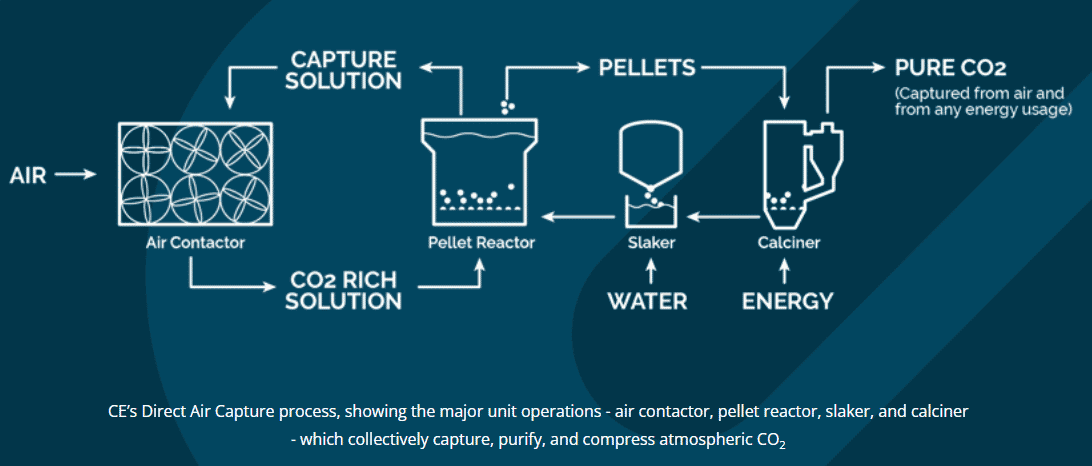
The Direct Air Capture plant will rely on carbon capture tech to suck in emissions directly from industrial sources or from the air that will be injected underground.
Here’s how the Direct Air Capture process works:
Large businesses that are striving to have climate plans are relying on offsets to include in their carbon accounting. Coming up with net zero plans is just the first part of the process. Achieving them is even more critical.
However, the supply of carbon removal offsets is more limited than the offsets from carbon avoidance projects such as forestry and renewable energy.
The plant will provide cost-effective solutions that hard-to-decarbonize industries can use like offsets and their own emissions reduction programs to help achieve net zero.
Captured CO2 can be safely sequestered deep underground in saline formations. It is also useful in producing hydrocarbons for low-carbon fuels and in products like chemicals and building materials.
OXY and Net Zero Oil
The largest carbon capture plant is also looking forward to the revenue from “net zero oil” it aims to produce. This oil is produced through the process called Enhanced Oil Recovery (EOR) which extracts more oil from reservoirs than other methods.
Net zero oil with EOR means injecting more captured CO2 into oil reservoirs than what’s released during the extraction and burning of the oil.
Currently, Occidental Petroleum is using CO2 emitted by underground mines and not the CO2 removed from the air or direct emissions from industrial plants.
If OXY reaches net zero by 2050, the company aims to have revenue from carbon capture equal to that from Enhanced Oil Recovery.
The ground-breaking ceremony for the world’s largest carbon capture plant is set for November 29, with commercial operations to begin at the end of 2024.
A group of U.S. lawmakers are pushing the Commodity Futures Trading Commission (CFTC) to deal with the integrity of carbon credit markets and regulate them.
Senators Cory Booker, Elizabeth Warren, Edward Markey, Richard Blumenthal, Bernard Sanders, Jeffrey Merkley, and Kirsten Gillibrand sent a letter to CFTC Chairman Rostin Behnam.
They requested that the CFTC establish “rules governing the carbon market.” They refer to the schemes that are used by firms to offset their carbon emissions.
Carbon offsets are carbon credits in the voluntary carbon market (VCM). Unlike the compliance carbon market, the VCM works based on market dynamics.
The Plea to Regulate the Carbon Credit Markets
In the letter, the U.S. senators stated that buying offsets enables companies to:
“…make bold claims about emission reductions and pledges to reach “net zero”, when in fact they are taking little action to address the climate impacts of their industry…”
Carbon credits are designed to provide offsets from actions that reduced or removed CO2 from the atmosphere.
Theoretically, one carbon credit represents one tonne of carbon removed or avoided. But in practice, the lawmakers claim that carbon offset projects are illegitimate and can often represent the broader ‘pay to pollute’ schemes.
While carbon credits fall under the CFTC-regulated derivatives, the agency only has anti-fraud and anti-manipulation authority over the VCM. Also, the Commodity Exchange Act doesn’t directly govern a registration and oversight structure on cash or spot markets.
In a sense, the lawmakers’ requests to act on the carbon credit markets go beyond the statutory authority of CFTC. And so, it’s the U.S. Congress that has to act.
But the CFTC continues to consider whether the offsets market is indeed “susceptible to fraud and manipulation” as the senators said in their letter.
Their letter stated that offsets that didn’t deliver the environmental benefits they promised constituted “fraudulent investments”. And that they served as:
“… a convenient and profitable way to market climate consciousness without requiring real action to reduce emissions…”
Carbon Offsets: A ‘Pay to Pollute’ Permit or a Path to Net Zero?
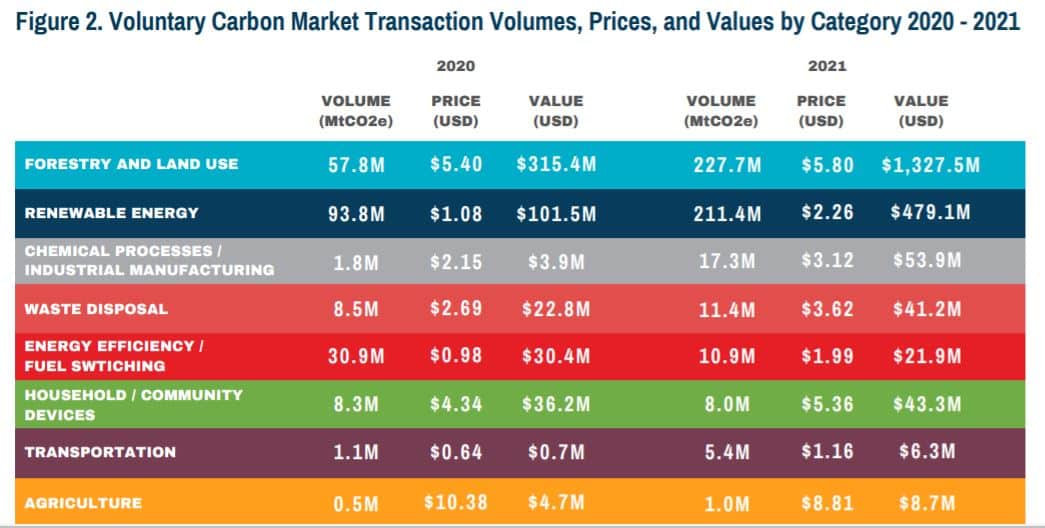
Carbon offsets have grown so popular over the past two years. According to the Ecosystem Marketplace, trading of voluntary carbon credits increased from $520mn in 2020 to $2bn in 2021.
Here’s the VCM transaction volumes, prices, and values by category, comparing 2020 and 2021 results.
Along with its growth, however, is the criticism about a lack of market standards. Critics say that the market is unregulated and very fragmented.
In the UK, a similar trend is happening. The country’s Climate Change Committee (CCC) had warned that without reform, the offsets market may risk challenging net zero plans.
Hence, the CCC also requested the British government to provide guidance, regulation, and standards to the market. This is to improve market transparency and boost standards.
Meanwhile, supporters of the VCM noted that greenwashing could destroy the offsets market.
Amid all the scrutiny, several initiatives from the private sector draw rules to improve market credibility.
Proponents of carbon credit markets say they help channel money into the right projects. Plus, a carbon price urges firms to curb their emissions.
They also argue that while entities should reduce emissions as much as possible, offsets offer a solution to deal with hard-to-abate emissions.
Right now, carbon credits trade in various voluntary markets. This means that the markets are not governed by federal regulations like the ones that regulate derivatives and securities markets.
The lawmakers recommended the following to CFTC to deal with their concerns on carbon credit markets.
Investigate the integrity of currently approved derivatives and their underlying carbon offsets;
Develop standards for carbon offsets that reduce emissions and can serve as underlying commodities for approved derivatives;
Create a registration framework for offsets, offset brokers, and offset registries;
Pursue cases of individual project fraud; and
Develop a working group to study both the risk to investors associated with carbon offsets and derivatives and the climate financial risk they may bring.
The CFTC’s focus on carbon credits is part of its broader role in managing climate-related financial risks. This is evident in its various efforts such as establishing the Climate Risk Unit, hosting the Voluntary Carbon Market Convening, and its most recent request for information on climate risk in the nation’s financial system.
The senators’ letter responds to the CFTC’s public call for information on climate-related financial risks.
To provide the best experiences, we use technologies like cookies to store and/or access device information. Consenting to these technologies will allow us to process data such as browsing behavior or unique IDs on this site. Not consenting or withdrawing consent, may adversely affect certain features and functions.
Functional
Always active
The technical storage or access is strictly necessary for the legitimate purpose of enabling the use of a specific service explicitly requested by the subscriber or user, or for the sole purpose of carrying out the transmission of a communication over an electronic communications network.
Preferences
The technical storage or access is necessary for the legitimate purpose of storing preferences that are not requested by the subscriber or user.
Statistics
The technical storage or access that is used exclusively for statistical purposes.The technical storage or access that is used exclusively for anonymous statistical purposes. Without a subpoena, voluntary compliance on the part of your Internet Service Provider, or additional records from a third party, information stored or retrieved for this purpose alone cannot usually be used to identify you.
Marketing
The technical storage or access is required to create user profiles to send advertising, or to track the user on a website or across several websites for similar marketing purposes.






 Large businesses that are striving to have climate plans are relying on offsets to include in their