Oklo Stock Rockets After Nvidia CEO Jensen Huang Backs Nuclear for AI Data Centers

Artificial intelligence is expanding at a breathtaking pace, and its growing energy needs are creating a new problem for the tech world. This week, the discussion took a dramatic turn after Nvidia (NASDAQ: NVDA) CEO Jensen Huang backed nuclear power as the key to powering the next generation of AI. His comments immediately sent ripples through the marketโ€”especially for SMR companies Oklo (NYSE: OKLO).

Oklo shares surged almost 24% after Huang predicted that advanced reactors would become essential within six to seven years. The move added to Okloโ€™s already unbelievable 1,000% gain over the past year. Investors took Huangโ€™s view seriously, and nuclear energy stocks suddenly looked like the next beneficiaries of the AI boom.
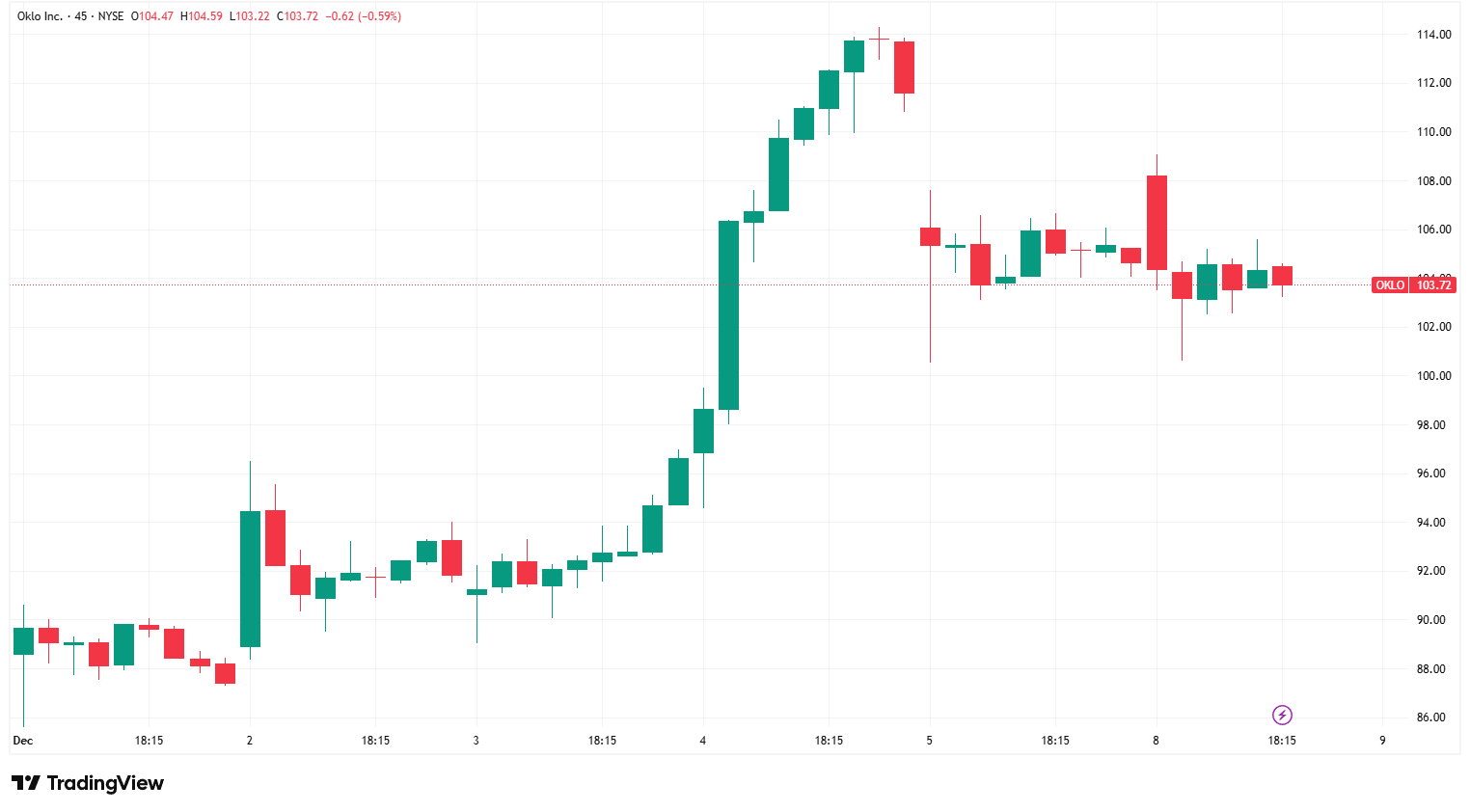
OKLO share price

The One Comment That Made Oklo an AI Stock Sensation

Huang didnโ€™t comment lightly. As per media reports, during his appearance on The Joe Rogan Experience, he warned that energy is becoming โ€œthe bottleneckโ€ for AI. Data centers, he said, are turning into โ€œgigawatt factories,โ€ and the current grid simply cannot handle the pressure.

  • His message was clear: AI will need stable, round-the-clock, carbon-free powerโ€”and nuclear checks every box.

Okloโ€™s momentum reflects this shift. The California company is developing fast-neutron microreactors called Aurora powerhouses, which deliver 15โ€“75 MW of clean energy using recycled nuclear waste. These reactors can run up to 10 years without refueling, making them ideal for remote areas or power-hungry AI campuses.

This year, Oklo struck a historic deal with data-center giant Switch. Under what the companies call the โ€œMaster Power Agreement,โ€ Switch plans to deploy 12 gigawatts of Okloโ€™s reactors through 2044. It is one of the largest corporate clean-power agreements ever signed and places Oklo at the center of the AI energy transition.

Okloโ€™s market cap has now reached about $16.35, driven by both investor enthusiasm and the belief that nuclear microreactors will become standard infrastructure for AI-ready data centers. Wedbush analyst Daniel Ives even raised his price target to $150, saying the demand for reliable new energy sources is overwhelming.

Regulators Still Stand in the Way

Despite the excitement, Oklo remains a pre-revenue company. It is still navigating the lengthy U.S. Nuclear Regulatory Commission (NRC) approval process, which has hindered the advancement of nuclear technology for years. The company aims to deploy its first reactors by 2027 or early 2028; however, timelines in the nuclear industry are rarely straightforward.

Even so, Oklo is making progress. It received clearance from the DOE and Idaho National Laboratory (INL) to begin site characterization for its first commercial plant. It also received a permit to access fuel material from INL and submitted the first custom combined license application for an advanced fission plant.

NuScale Power also rallied after Huangโ€™s comments. However, NuScale remains a speculative investment, though, because it does not generate meaningful revenue and has struggled with costs. Analysts note that investors who want nuclear exposure without company-specific risks may prefer nuclear energy ETFs.

DOE Plans a Nuclear Boom to Feed Exploding AI Demand

The nuclear momentum isnโ€™t just coming from Silicon Valley. The Department of Energy and the National Nuclear Security Administration (NNSA) are turning to nuclear power as the backbone for future AI growth.

Federal agencies are preparing major sitesโ€”Savannah River Site, Oak Ridge Reservation, Idaho National Laboratory, and the Paducah Gaseous Diffusion Plantโ€”to host AI data centers powered by advanced reactors. This signals a major shift in how the U.S. plans to fuel digital infrastructure.

A key DOE study called for tripling U.S. nuclear capacity from todayโ€™s 100 GW to 300 GW by 2050. The report identified 190 potential coal and retired nuclear sites that could host up to 269 GW of new reactors.

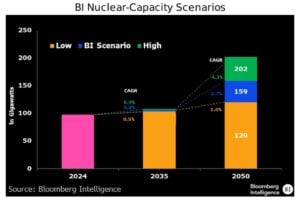
Bloomberg Intelligence projects U.S. nuclear capacity could rise 63% to 159 GW by 2050, requiring around $350 billion in investmentโ€”much of it driven by AI.

US nuclear

Only Nuclear Fits the Bill

The numbers reveal the urgency. According to the U.S. Department of Energy (DOE):

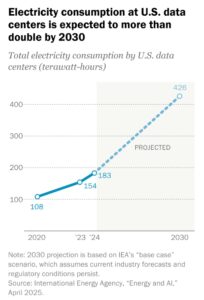
  • U.S. data centers consumed 176 TWh of electricity in 2023, equal to around 4.4% of all U.S. power use.

  • By 2028, this could reach 325โ€“580 TWh, mainly because of AI servers.

  • By 2035, AI data centers alone could double total U.S. data-center demand to about 9% of the national grid.

Globally, data centers could consume over 4% of electricity by 2035, making them one of the worldโ€™s biggest power users.

us data center energy
Image sourced from: PEW research center

As AI models grow, so does the energy intensity. Next-generation chips generate more heat, require more cooling, and most importantly, need nonstop power. Solar and wind can contribute, but their intermittent nature makes them difficult to rely on 24/7. Nuclear, in contrast, offers constant, carbon-free electricity that fits perfectly with AIโ€™s nonstop compute cycles.

Tech Giants Secure Nuclear Deals

Big Tech doesnโ€™t want to wait for grid upgrades. Companies are directly partnering with nuclear operators to secure decades of stable power:

  • Microsoft signed a 20-year agreement with Constellation to restart the Three Mile Island Unit 1 reactor, bringing 837 MW of power to its data centers.

  • Meta signed a long-term deal with Constellation to expand an Illinois nuclear plant by 30 MW, protecting local jobs and boosting the grid.

  • Amazon Web Services secured a 10-year contract for several hundred MW from Talen Energyโ€™s Susquehanna nuclear plant.

These deals show that nuclear power is becoming a competitive advantage in the AI race. Companies that secure clean, steady electricity today will scale faster than those stuck waiting for the next power line.
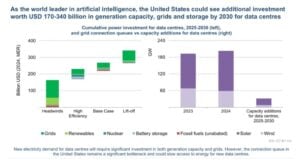
nuclear power investment
Source: IEA

Is Oklo Ready to Fuel the AI Era?

Huangโ€™s endorsement gave Oklo a huge confidence boost. The company sits at the intersection of AI, clean energy, and next-gen nuclear technology. If its Aurora powerhouses reach commercial deployment on schedule, Oklo could become one of the most important energy suppliers for the AI era.

Still, it faces years of regulatory review, technical testing, and construction challenges. NuScale has similar hurdles and remains a high-risk bet.

Yet the broader trend is undeniable: AI needs nuclear power to grow, and nuclear companies are finally receiving the attention and investment they long waited for. And with Nvidiaโ€™s CEO putting the spotlight on advanced reactors, Oklo may be stepping into its most important chapter yet.


Peatland Carbon Credits: Microsoft Invests in Pantheon to Restore Peatlands for Durable Carbon Removal

Recently, Microsoft partnered with Pantheon Regeneration to restore degraded peatlands in the U.S. The partnership aims to generate high-quality peatland carbon credits, sequester carbon for centuries, and provide one of the most durable nature-based climate solutions.

Before diving deeper into the deal, itโ€™s important to understand how peatland restoration works and how it generates carbon credits. Let’s read on.

Peatlands: Natureโ€™s Most Concentrated and Durable Carbon Sink

Surprisingly, peatlands are one of Earthโ€™s most powerful climate allies. These waterlogged ecosystems hold the largest natural land-based carbon reserve on the planet. Scientists estimate that peatlands store roughly 455 gigatonnes (Pg) of carbonโ€”about twice the amount locked in all the worldโ€™s forests combined. Most of this carbon sits deep within saturated peat soils, built over thousands of years as partially decomposed plants accumulated layer after layer.

pantheon peatland
Source: pantheon

Because of this extraordinary carbon density, peatlands play a huge role in global climate regulation. However, when they are drained, disturbed, or converted for agriculture and development, they shift from carbon sinks to major carbon sources. Restoring and rewetting peatlands has therefore become one of the most critical nature-based actions for climate mitigation today.

Why Peatland Rewetting Matters for Climate Action

Peatlands store more carbon per hectare than any other ecosystemโ€”even more than lush tropical forests. Their natural state is wet, oxygen-poor, and stable, which keeps organic matter from breaking down. But once drained, peat dries out and decomposes rapidly, releasing heavy amounts of COโ‚‚ into the atmosphere.

Drained peatlands contribute a surprisingly large share of global emissions. They are prone to fire, especially during periods of heat and drought intensified by climate change. Wildfires in degraded peatlands burn underground for weeks or months, releasing enormous carbon plumes while destroying biodiversity and threatening communities.

Rewetting turns this trend around. By restoring natural water levels, peatlands return to their slow, steady carbon-locking function. Wet soil prevents decomposition, sharply reduces fire risk, and revives entire ecosystems. As a result, peatland rewetting is now widely recognized as one of the most impactful nature-based climate solutions.

Peat performs multiple roles at onceโ€”it removes carbon, buffers floods, filters water, and supports rare species. Restoring peatlands delivers benefits for climate mitigation, climate adaptation, and ecological recovery, all at the same time.

Carbon Credits from Peatland Rewetting

Peatland rewetting not only cuts emissions but also generates verified carbon credits. Several established methodologies allow restoration projects to measure, certify, and issue credits based on avoided emissions and enhanced carbon storage.

Key methodologies include:

  • Verra VM0027 โ€“ Designed specifically for rewetting tropical peatlands.
  • Verra VM0036 โ€“ Tailored for temperate and boreal peatland restoration.
  • MoorFutures โ€“ A pioneering regional standard developed in Germany for peatland-based credits.

These standards have already been used in real-world projects. We found out that one of the earliest examples, the Kieve Polder project in Germany, is projected to remove 38,655 tonnes of COโ‚‚ over 50 years. The project demonstrates how peatland restoration can deliver both ecological gains and economic value through the carbon market.

Durable carbon removal peatland

The Power of Rewetting Peat

Pantheon has explained the following attributes of rewetting peat.

  1. Exceptional Carbon Density: Peatlands are the planetโ€™s most concentrated terrestrial carbon stores. They can hold up to 10 times more carbon per hectare compared to forests or grasslands. This unique density means that even small peatland areas have global significance.
  1. Long-Term Permanence: Once rewetted, peat soils remain waterlogged, which dramatically slows decomposition. This natural process locks carbon away for thousands of years. As long as the site stays wet, permanence is extremely high, making peat restoration one of the most durable forms of natural carbon removal.
  1. Resilience and Climate Adaptation: Healthy peatlands moderate water flow, reducing the impact of droughts, floods, and storms. Rewetting also lowers wildfire risk and stabilizes landscapes. These hydrological benefits create safer environments for both people and wildlife.
  1. Biodiversity Revival: Restoration reestablishes habitats for rare plants, migratory birds, and other peat-dependent species. Biodiversity bounces back quickly when peatlands return to their natural, wet conditions.
  1. Water Quality Improvements: Rewetted peatlands act like natural sponges and filters. They absorb and store freshwater, gradually releasing it downstream while improving water quality.
  2. Health Benefits: By reducing peat fires and smoke pollution, rewetting helps lower respiratory health risks for nearby communitiesโ€”a key but often overlooked benefit.

Pantheon Regeneration and Microsoft: A Major Step for U.S. Peatland Restoration

Pantheon Regeneration recently secured a strategic investment from Microsoftโ€™s Climate Innovation Fund, marking a significant milestone for peatland restoration in the United States. This funding will accelerate Pantheonโ€™s ability to develop and scale ecological restoration projects that deliver high-quality carbon removal.

Pantheonโ€™s approach combines scientific rigor with large-scale project execution. By focusing on peatlandsโ€”one of Earthโ€™s most carbon-dense ecosystemsโ€”the company aims to generate meaningful volumes of high-quality, durable carbon credits. At the same time, its restoration efforts bring back critical wetland ecosystems that have quietly supported climate balance for thousands of years.

Pantheon CEO Tripp Wall noted the significance of the investment:

โ€œSupport from the Microsoft Climate Innovation Fund is a profound game-changer. The Pantheon team has been driven from day one by the enormous potential of our ecosystem restoration work to deliver the type of landscape scale climate solutions the planet needs and the carbon credit quality and volumes the market craves. We are grateful for this recognition of the quality of what weโ€™re doing and know their support will enable us to scale our work.โ€

Pocosin Ecological Reserve I: A Flagship Project

Pantheonโ€™s first major project, Pocosin Ecological Reserve I (PER I), is among the earliest commercial peatland restoration initiatives in the U.S. Located on the Scuppernong High in the Southeastern United States, the site contains some of the deepest peat deposits in the regionโ€™s coastal plain.

Historically drained for farming and forestry, the land experienced large carbon releases and frequent fire risks. Today, PER I spans 14,500 acres and is bordered on three sides by a federal wildlife refugeโ€”an ideal setup for landscape-scale restoration.

PER I is designed to show what peatland restoration can achieve when science, land stewardship, and carbon markets align. The project aims to reverse decades of degradation, bring back natural hydrology, sequester large amounts of carbon, and enhance biodiversity across a vast ecosystem.

A Science-Led Approach

Pantheon works closely with Duke University to monitor ecosystem recovery, carbon storage, water benefits, and biodiversity outcomes. This science-first strategy ensures that the carbon credits produced meet the highest quality expectations for corporate buyers seeking durable, verifiable climate solutions.

Microsoftโ€™s investment strengthens Pantheonโ€™s ability to scale its project pipeline, improve monitoring systems, and accelerate the delivery of high-quality credits. Erika Basham, Director of Microsoftโ€™s Climate Innovation Fund, will join Pantheonโ€™s board as an observerโ€”underscoring the strategic importance of the partnership.

Microsoftโ€™s Broader Climate Strategy

Microsoft has committed to becoming carbon negative by 2030 and removing all historical emissions by 2050. Achieving this ambition requires a diverse portfolio of both natural and engineered carbon removal approaches. Peatland restoration fits squarely into this strategy because of its durability, ecological benefits, and scalability potential.

The investment in Pantheon reflects Microsoftโ€™s recognition that nature-based solutionsโ€”when implemented with scientific integrityโ€”play a vital role in global decarbonization.

A Climate Solution Rooted in Nature

Peatlands may be quiet landscapes, but their importance is immense. Rewetting them prevents large emissions, restores natural resilience, and locks carbon away for millennia. With growing momentum from developers like Pantheon and buyers like Microsoft, peatland restoration is gaining long-overdue recognition as one of the most powerful and durable climate solutions available today.

FURTHER READING:

EU Unlocks โ‚ฌ5.2B for Clean-Tech Innovation: Hydrogen, Heat, and Net-Zero Projects

The European Commission has launched a major funding package worth โ‚ฌ5.2 billion, drawn from revenues under the EU Emissions Trading System (EU ETS). It aims to support clean transition technologies and push Europe toward a low-carbon future.

The EU package, under the Innovation Fund, has three funding tracks that opened together:

  • Net-zero technology projects
  • Hydrogen production
  • Industrial heat decarbonization

This shows a coordinated effort across different sectors. The EU wants to decarbonize heavy industries and aims to promote renewable energy and boost clean-technology innovation in member states.

What Is the Innovation Fund?

The funding is part of the EU Innovation Fund. This is the EUโ€™s main tool for backing net-zero and low-carbon technologies. The Fund gets money from the EU ETS. Companies pay for carbon allowances, also known as carbon credits. Then, the proceeds go into clean-tech projects.

From 2020 to 2030, the Innovation Fund aims to mobilise up to โ‚ฌ40 billion, assuming a carbon price of โ‚ฌ75 per tonne. So the new โ‚ฌ5.2 billion allocation is a big part of the Fundโ€™s 10-year budget. This shows the EU’s strong commitment to becoming climate-neutral.

The Fund backs many technologies. These include renewable energy, energy storage, industrial decarbonisation, carbon capture, green mobility, and clean buildings. It also supports unique projects that are too risky for private investors on their own.

The Three Pillars: Net-Zero, Hydrogen, and Industrial Heat

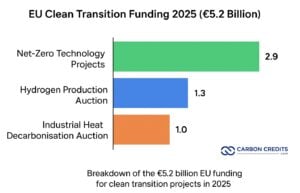
According to the Commissionโ€™s โ€œCalls for Proposalsโ€ page, the โ‚ฌ5.2 billion is split into three parts: a net-zero technology fund, a hydrogen auction, and a heat-decarbonization auction.

  • โ‚ฌ2.9 billion โ€” for the 2025 Net-Zero Technologies Call (grant funding)
  • โ‚ฌ1.3 billion โ€” for the third hydrogen auction under the European Hydrogen Bank
  • โ‚ฌ1.0 billion โ€” for the first industrial process-heat decarbonisation auction under the Industrial Decarbonisation Bank

EU innovation fund for clean transition 2025

This structure takes a broad approach. It promotes clean technologies, enables green fuels, and targets a tough area to decarbonize: industrial heat.ย The EC states:

“Together, these opportunities mark a major step forward in achieving the EU’s climate and energy objectives by 2030 and climate neutrality by 2050. They will also significantly contribute to progress on the clean transition and deliver the Clean Industrial Deal, boosting the competitiveness and resilience of European industry.”

What the โ‚ฌ2.9 Billion Net-Zero Funding Covers

On November 3, 2025, the Commission announced that the โ‚ฌ2.9 billion grant will support 61 net-zero technology projects across Europe. The projects span 19 different industrial sectors and take place in 18 European countries.

The targeted sectors are:

  • Energy-intensive industries (like steel, cement, and chemicals)
  • Renewable energy and energy storage
  • Clean mobility
  • Net-zero buildings
  • Cleantech manufacturing
  • Industrial carbon management

The Commission says these projects will reduce 221 million tonnes of COโ‚‚ equivalent in their first ten years. That is roughly equal to taking nearly 10 million average European cars off the road for a year.

The call attracted 359 applications, requesting a total of โ‚ฌ21.7 billion โ€” more than nine times the available budget. This strong interest shows high demand for clean tech in Europe, even when support is limited.

The 61 projects are now moving into the grant agreement preparation phase with CINEA, the European Climate, Infrastructure and Environment Executive Agency. Contracts are expected to be finalised in the first half of 2026.

Hydrogen Auction: Betting on Clean Fuel Supply

The second pillar is a โ‚ฌ1.3 billion auction under the European Hydrogen Bank. This auction supports renewable hydrogen production. It is key for heavy industry, shipping, aviation, and other hard-to-electrify sectors.

For the first time in this auction, low-carbon hydrogen made by electrolysis can join renewable hydrogen. This expanded eligibility shows the Commission’s practical approach.

Renewable hydrogen is the long-term goal, but low-carbon hydrogen can meet immediate needs. It also helps industries transition more smoothly.

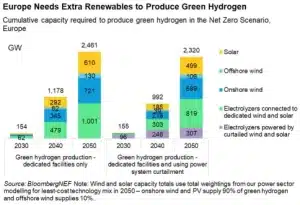
Europe green hydrogen production 2050

By subsidising the gap between production costs and market price, the auction helps make hydrogen more competitive with fossil fuels. The expected outcome: a growing supply of clean hydrogen, enabling industries to switch away from natural gas and oil.

The EU views hydrogen as key to its clean energy shift. This is especially true for heavy industries and transport sectors that are hard to electrify.

Industrial Heat: Targeting a Hard-to-Decarbonize Sector

The third funding track allocates โ‚ฌ1.0 billion for an auction through the Industrial Decarbonisation Bank. It aims to decarbonise industrial process heat. Long-term industrial heat is tough to reduce. Factories often use fossil fuels for high-temperature processes.

The auction supports innovative technologies like heat pumps, electric boilers, and induction heating. It also includes other renewable or electricity-based heating solutions. It may also support renewable heat sources such as solar thermal or geothermal, where applicable.

The EU plans to offer dedicated funding for industrial heat. This will help energy-intensive industries cut emissions and stay competitive. The program welcomes many sectors, including heavy manufacturing and smaller to medium-sized factories. This creates a chance for wide impact throughout Europe.

Why Now? Timing and Climate Ambitions

The new funding package arrives as Europe seeks to meet its climate goals under the European Green Deal. The EU Innovation Fund is key to this effort. It offers money for new, hard-to-commercialize clean technologies throughout the continent.

EU 2040 climate goal

The size and scope of the โ‚ฌ5.2 billion package underline the EUโ€™s commitment. The Innovation Fund aims to raise up to โ‚ฌ40 billion from 2020 to 2030. This recent funding round is a key step forward.

The program also helps balance climate ambitions with economic competitiveness. By supporting emerging technologies and clean energy supply chains, the EU aims to reduce dependence on imports, create jobs, and secure its industrial future.

The Source of Funding: EU ETS

The EU ETS requires companies in power, industry, aviation and now shipping to pay for their greenhouseโ€‘gas emissions. Every allowance โ€” which allows a company emit one tonne of COโ‚‚ โ€” is auctioned under a cap that shrinks each year to cut total emissions.

The money raised from selling these allowances helps fund the Innovation Fund. Through this system, polluters pay for emissions while those revenues are reinvested to support clean energy projects, renewable fuels, and lowโ€‘carbon industry across Europe.

What to Watch in 2026 and Beyond

The 61 selected net-zero projects are expected to sign grant agreements and begin implementation in 2026. At the same time, the auctions for hydrogen and industrial heat are open for new bids, inviting project proposals across the EU.

If successful, the combined effort could accelerate Europeโ€™s clean energy transition, reduce emissions in heavy industry, and build a stronger industrial base for green technologies. It can also help Europe secure future energy and industry supply chains, covering clean hydrogen, renewable energy systems, low-carbon manufacturing, and carbon capture.

The โ‚ฌ5.2 billion package is not the final word. The EU Innovation Fund is active through 2030. As projects mature and new rounds of funding open, the scale and ambition may grow. Success will depend not only on grant money but also on efficient implementation, robust policy support, and market adaptation.

For now, the package marks a clear and coordinated move by the European Commission. It backs innovation, promoting clean energy, and betting on technologies that can transform Europeโ€™s industrial and energy landscape.

BYD Breaks Records While Xiaomi Slows: Despite Split Fortunes, Theyโ€™re Still Driving Chinaโ€™s Emissions Down

Chinaโ€™s electric vehicle scene stayed red-hot in November 2025, but the results werenโ€™t the same for everyone. BYD hit its strongest sales month of the year, even as profits and quality concerns weighed it down. Xiaomi, the fast-rising tech newcomer, kept delivering strong numbers too, but not strong enough to satisfy investors.

Together, the two companies offered a clear snapshot of where Chinaโ€™s fast-growing EV market is heading โ€” and what customers want next.

BYD Scores Biggest Month of 2025 โ€” Despite Profit Squeeze

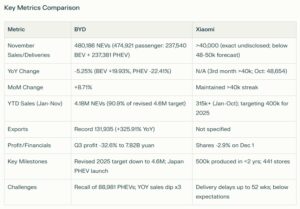
BYD once again proved why it leads the global EV market. The company sold 480,186 new energy vehicles in November, its highest monthly total this year. But the celebration came with a twist. Sales still dipped 5.25% year-over-year, marking BYDโ€™s third straight month of falling annual sales.

Still, things looked better compared to October. BYD managed an 8.71% month-over-month boost, suggesting the company still has plenty of momentum.

But the most interesting part? The gap between BYDโ€™s battery models.

  • Battery electric vehicles (BEVs) jumped 19.93% year-over-year to 237,540 units.

  • Plug-in hybrids (PHEVs) tumbled 22.41% to 237,381 units.

This shift says a lot about Chinese car buyers. Theyโ€™re moving toward full EVs and leaving hybrids behind as technology improves and charging networks grow.

Even with the strong sales, BYD felt the financial pressure. Its third-quarter profit dropped 32.6% to 7.82 billion yuan ($1.1 billion). Thatโ€™s the second quarter in a row that profits slipped.

Because of these setbacks, BYD trimmed its 2025 sales target from 5.5 million to 4.6 million vehicles. Still, with 4.18 million units already sold, the company has already hit 90.9% of its updated goal.

Surprisingly, BYDโ€™s (BYDDY stock)ย Hong Kong shares still finished December 1 up 1.18%, showing that investors havenโ€™t lost faith in the companyโ€™s global strategy.

Exports Save the Day as BYD Goes Global

If domestic sales were a bit shaky, BYDโ€™s overseas performance more than made up for it. November exports hit an eye-popping 131,935 units โ€” BYDโ€™s highest export number ever. Thatโ€™s a 325.91% jump from last year and a 57.25% increase from October.

Simply put, BYD is winning big outside China.

The company is moving fast to build a global footprint. On December 1, BYD launched the Sealion 6 plug-in hybrid SUV in Japan โ€” the country where Toyota has long ruled. Priced from ยฅ3.982 million ($25,620), the model marks BYDโ€™s first PHEV in Japan and signals that the company is ready to take on its fiercest rivals.

But Recalls Return as Quality Concerns Grow

Not everything went smoothly for BYD in November. Chinaโ€™s safety regulator ordered the recall of 88,981 Qin PLUS DM-i plug-in hybrids built between January 2021 and September 2023. The issue? Battery pack inconsistencies could reduce electric-only range under extreme conditions.

With this recall, BYD has pulled more than 210,000 vehicles off the road in 2025 alone.

The recall involves older cars, but it still adds fuel to worries about BYDโ€™s manufacturing quality. Even so, the companyโ€™s expanding export success helped soften the blow.

Xiaomi Cruises Past 40,000 Deliveries โ€” But Investors Wanted More

Xiaomi, Chinaโ€™s fast-growing EV challenger, stayed above the 40,000-unit mark in November for a third straight month. The company didnโ€™t reveal exact numbers, keeping to its habit of letting third-party reports handle that. But one thing was clear: analysts expected more.

Citi projected 48,000โ€“50,000 deliveries, so Xiaomiโ€™s number โ€” likely just above 40,000 โ€” disappointed the market. Investors reacted fast, pulling Xiaomi shares down 2.9% on December 1 to HK$39.84.

Still, Xiaomiโ€™s growth story remains one of the most impressive in the EV world.

  • It topped 41,948 deliveries in September as per the China Passenger Car Association (CPCA) data.

  • It smashed records in October with 48,654 units.

  • From January to October, it delivered 315,376 EVs in total.

Despite the slowdown, it’s certainly not bad for a company that entered the car business only 19 months ago.

Celebrates 500,000 Cars Built in Under Two Years

Xiaomi reached a milestone few automakers have achieved so quickly. On November 20, it celebrated its 500,000th EV rolling off the production line. Deliveries only began in April 2024, making the accomplishment even more remarkable.

At the event, CEO Lei Jun lifted the companyโ€™s 2025 delivery target to 400,000 vehicles. This was the second upgrade of the year, following earlier hikes from 300,000 to 350,000.

Citi analysts backed the new goal. With Xiaomi delivering around 10,000 vehicles per week, they said the company is well-positioned to hit the 400,000 mark. They reaffirmed their โ€œbuyโ€ rating and set a HK$50 price target.

Expands Stores and Speeds Up Deliveries

To keep up with rising demand, Xiaomi opened 17 new stores in November, pushing its total to 441 stores across 131 cities. Its service network is also expanding, with 249 centers now operating in 144 cities.

But success brought a new challenge: long wait times. Some customers faced delays of up to 52 weeks. To fix that, Xiaomi launched an โ€œIn-Stock Vehicle Purchase Programโ€ on December 1.

Buyers can now get brand-new cars, official display models, or nearly new vehiclesโ€”all with faster delivery, full warranties, and possible discounts if they lock in orders by December 26.

The companyโ€™s lineup is also gaining momentum. The YU7 SUV, launched in June, accounted for 69% of Xiaomiโ€™s deliveries in October,ย with 33,662 units. The model even beat Teslaโ€™s Model Y in domestic sales that month. Meanwhile, the SU7 sedan continues to attract huge interest.

BYD Vs XIAOMI

EV Race Tightens as 2025 Winds Down

BYD and Xiaomi both ended November with momentum, but the paths they followed looked very different. BYD leaned on exports to keep growth steady, even as profits fell and recalls returned. Xiaomi kept expanding at lightning speed, but Novemberโ€™s softer numbers reminded investors that rapid growth also brings volatility.

As the EV market becomes more competitive and global, Novemberโ€™s results showed one clear message: Chinaโ€™s biggest EV players are evolving fast โ€” and the race is far from over.

Chinaโ€™s EV Boom Helps Push Emissions Down

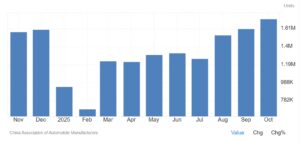
Electric car registrations in China jumped to 1.72 million units in October 2025, up from 1.60 million in September. This marked a new all-time high and showed how quickly the countryโ€™s EV market kept growing. For context, China averaged just over 419,000 monthly registrations between 2017 and 2025, with the lowest point recorded in early 2017.

china ev
Image sourced from Trading Economics

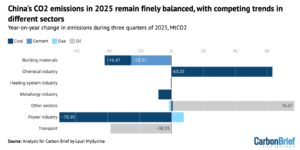
This rapid rise in EV adoption has also played a major role in flattening Chinaโ€™s emissions curve. According to CarbonBrief, transport fuel emissions fell by 5% year-on-year in Q3 2025. More drivers moved away from gasoline and diesel vehicles and shifted toward cleaner electric options.

China emissions

Moreover, this momentum reflects the strength of Chinaโ€™s electrification policies. The country leads the world in EV production and sales, backed by incentives, improving charging networks, and strong industrial support. As a result, China continued to steer its transport sector toward lower emissions and a cleaner energy future.

China Joins Google, Amazon, and xAI in the Race to Build AI Supercomputers in Space!

In late 2025, space is emerging as a new frontier for artificial intelligence (AI) infrastructure. What was once a futuristic concept is now becoming a realistic goal. Global tech firms and Chinese aerospace companies are racing to deploy AI data centers in orbit. Their goal is to tackle the power, cooling, and data limits that challenge Earth-based systems.

Why Space โ€” and Why Now

AI workloads are growing at an unprecedented pace. Training and running large models need a lot of computing power. They also use a lot of energy and need advanced cooling systems.

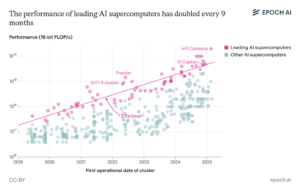
On Earth, these demands strain not only data centers but also power grids, water resources, and land availability. From 2019 to 2025, AI supercomputers saw their performance double every 9 months or 2.5x per year. In contrast, hardware costs and energy usage doubled about every year.

computational performance of AI supercomputers
Source: EPOCH AI

Space-based computing offers a promising alternative. Satellites in orbit get almost constant sunlight. This makes solar power generation more efficient than solar farms on the ground.

The vacuum of space also allows heat to dissipate naturally. This reduces the need for energy-intensive cooling systems.

Orbital โ€œedge computingโ€ allows engineers to process a lot of data right in space, including data from Earth observation satellites. This approach avoids the bandwidth limits and delays that occur when transferring vast amounts of raw data to Earth.

Experts view 2025โ€“2027 as a key turning point. During this time, tech advances, costs, and goals will align.

Whoโ€™s Doing It: Rivals in Orbit

Chinese companies are taking the lead in deployment. Zhongke Tiansuan (Comospace), founded in 2024, has operated a space computer on a Jilinโ€‘1 satellite for over 1,000 days. Their new system, โ€œAurora 5000,โ€ uses a powerful domestic GPU. It will be tested in orbit soon.ย 

Liu Yaoqi, CEO of Zhongke, said:

“Orbital edge computing moves AI directly to the source of data filtering petabytes of daily satellite imagery and traffic before the narrow downlink chokes.”

At Zhejiang Laboratory, engineers are developing a โ€œmini computing constellationโ€ called the Three-Body Computing Constellation. Its first batch of 12 satellites was launched in May 2025.

Each satellite carries an 8-billion-parameter AI model and can perform around 744 trillion operations per second. Together, they form the first stage of a network that could reach 1,000 peta-operations per second if fully scaled.

China plans a central space data center in dawnโ€“dusk orbit (700โ€“800 km altitude) with a power capacity exceeding 1 gigawatt. The plan is phased: test satellites from 2025 to 2027, followed by a full-scale megawatt-class orbital data center by 2035. If realized, it could surpass the total capacity of Chinaโ€™s current terrestrial data centers.

Key technologies include high-speed laser links between satellites. These links recently showed a 400 Gbps connection. They also use advanced cooling and error-correction systems to tackle radiation and thermal challenges.

If it works, the constellation can handle data for Earth observation, maritime tracking, environmental monitoring, and disaster response. It could also support global AI services. This would not depend entirely on ground-based infrastructure.

Global Tech Giants: Orbital AI as the Next Moonshot

International tech companies are pursuing similar goals. Googleโ€™s Project Suncatcher plans solar-powered AI data centers in low Earth orbit. Each satellite would carry Tensor Processing Units (TPUs) and operate in dawnโ€“dusk orbits for continuous sunlight.

Google anticipates launching the first test satellites by 2027. These small racks of hardware will test whether TPUs can operate reliably in orbit.

Other tech companies, including those running satellite internet constellations, are exploring space-based computing. Amazonโ€™s โ€œLeoโ€ project, for example, may one day link satellites to cloud and AI infrastructure.

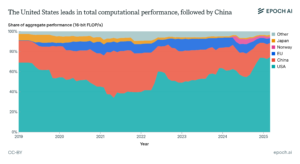
According to Epoch AIโ€™s 2025 report on AI supercomputers, the United States accounts for about threeโ€‘quarters of total global AI supercomputer compute capacity. This dominance reflects how U.S.-based companies deploy the largest and most powerful GPU clusters.

total computational performance
Source: EPOCH AI

Why the Market Is Moving to Space-Based Compute

  • The shift to space-based AI reflects broader trends: increasing compute demand, rising energy costs, and sustainability concerns.

The global AI supercomputer sector is expected to grow dramatically. By 2030, top supercomputers might handle about 2 ร— 10ยฒยฒ 16-bit operations each second. They will use millions of AI chips and need gigawatts of power.

Space-based computing could ease pressure on terrestrial grids, lower carbon footprints, and reduce reliance on water for cooling. This is appealing to both technology companies and governments seeking sustainable infrastructure.

Orbital data centers are much more energy-efficient than those on Earth. They capture nearly constant solar power, being up to 10 times more effective than ground panels because thereโ€™s no atmosphere to interfere. They also use radiative cooling in spaceโ€™s vacuum. This cuts cooling needs, which usually consume 40% of Earth’s data center energy, with average PUEs of 1.5 to 1.7.

  • As such, it could reduce emissions by 50-80% by operating without fossil fuels. It would also ease pressure on the grid.

Currently, data centers use 4-12% of U.S. electricity, mainly from carbon-heavy sources. By 2028, this shift can make a big difference. Projects like Google’s Suncatcher target this for scalable AI without water or land impacts.

As launch costs drop, thanks to reusable rockets and mass-produced satellites, orbital data centers could compete with ground options by the mid-2030s.

A full-scale orbital network, like Chinaโ€™s gigawatt-class constellation, could match or exceed Earthโ€™s mega data centers. It could offer worldwide low-latency coverage. This may change industries like Earth observation, environmental monitoring, global connectivity, autonomous logistics, and disaster response.

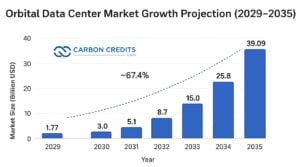
Whatโ€™s Next: The Road to 2035 Orbital Megacenters

orbital data center market growth 2035

Key milestones to watch include:

  • 2027: First test satellites from Google and other firms. Early results will show if solar-powered TPUs can operate reliably.
  • 2025โ€“2030: AI compute demand continues to rise, and electricity and water costs increase on Earth. Launch costs may drop, making space deployment more viable.
  • 2030โ€“2035: Large constellations, such as Chinaโ€™s gigawatt-class network, may start operating fully. This will provide global coverage and high computing power. The market could grow up to $39 billion in value.
  • Governance and regulation: Nations and companies will need new rules for orbital infrastructure, data rights, and collision avoidance.

Overall, the move to space represents a major evolution in cloud computing. AI infrastructure could shift from Earth to orbit, which could provide high performance and nearly universal coverage. It also offers a more sustainable path for AI growth.

Africaโ€™s Forests Are Now Emitting Carbon Instead of Absorbing It

Africaโ€™s forests have reached a worrying turning point. A new study shows that many forests now release more carbon dioxide than they take in. This change is mainly due to deforestation and forest degradation. It is the first time in modern records that Africaโ€™s forests have become a net carbon source instead of a natural buffer against global warming.

The research, published in Scientific Reports, was led by scientists from the National Centre for Earth Observation at the Universities of Leicester, Sheffield, and Edinburgh. Using satellite data, they tracked changes in forest biomass over time. Their findings are crucial for global climate goals, which is especially true for the targets set in the Paris Agreement.

A Major Shift After 2010

The study shows that Africaโ€™s forest carbon balance changed around 2010. Between 2007 and 2010, forests were still gaining carbon, acting as a natural sink. But from 2010 to 2017, the continent lost roughly 106 million tonnes of forest biomass each year. Converted to carbon dioxide, this equals about 200 million tonnes of COโ‚‚ emissions annually.

This is significant because Africa is home to the second-largest block of tropical rainforest, mainly in the Congo Basin. These forests store carbon, regulate rainfall, and support biodiversity. Losing their ability to absorb carbon means the world must reduce emissions faster elsewhere.

The trend comes from two main causes: deforestation, which is when forests are cleared, and forest degradation. In degradation, forests stay, but they lose biomass from selective logging, fires, or mining. These processes reduce the amount of carbon stored in vegetation.

Hotspots of Concern: DRC, Madagascar, and West Africa

Central Africa, Madagascar, and parts of West Africa show the most pronounced changes. The Democratic Republic of Congo (DRC) holds more than half of the Congo Basin rainforest. In 2024, it lost a record 590,000 hectares of primary forest. This is the largest loss in its monitoring history.

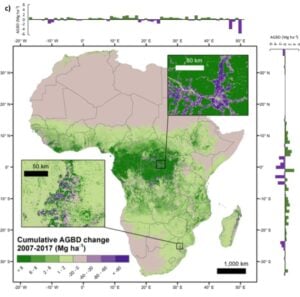
The map below shows changes in Aboveground Biomass Density (AGBD) from 2007 to 2017. Green areas represent gains, while purple areas indicate losses.

The upper-right inset shows biomass loss due to deforestation near settlements, rivers, and roads in the DRC. The lower-left inset features a South African forest plantation, highlighting clearcuts next to newly planted areas.

cumulative Aboveground Biomass Density (AGBD) net gains (green) and losses (purple) from 2007 to 2017
Source: Rodrรญguez-Veiga, P., Carreiras, J.M.B., Quegan, S.ย et al.ย Loss of tropical moist broadleaf forest has turned Africaโ€™s forests from a carbon sink into a source.ย Sci Repย 15, 41744 (2025). https://doi.org/10.1038/s41598-025-27462-3

The main pressures come from small-scale farming. Rural communities clear forests for crops. Artisanal mining has also grown because of global demand for minerals like cobalt, copper, and gold.

Madagascar faces deforestation from slash-and-burn farming, charcoal production, and commercial logging. In West Africa, countries like Ghana, the Ivory Coast, and Nigeria are losing forests due to agriculture and timber extraction. Together, these regions contribute most of the 200 million tonnes of COโ‚‚ now released by Africaโ€™s forests annually.

Global Context: How Africa Compares

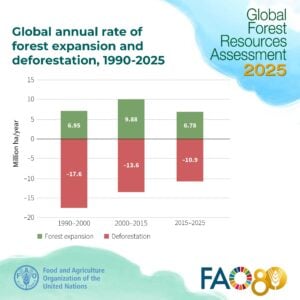
Worldwide, forests remain under pressure. Between 2015 and 2025, the world lost about 10.9 million hectares of forest annually, down from 17.6 million hectares per year in 1990โ€“2000.

forest expansion vs deforestation 2015 2025

In 2024, the world lost 6.7 million hectares of primary forest. This loss was caused by fires, logging, agriculture, and land clearing. Notably, fires have recently overtaken agriculture as the main cause of tropical forest loss.

Within this global picture, Africa has the highest rate of net forest loss among all regions during 2010โ€“2020. This aligns with the new study showing that Africaโ€™s forests have shifted from being carbon sinks to carbon sources.

South America, with the Amazon, still loses a lot of forest, but slower now. Meanwhile, some Asian countries have gained forest areas in recent years.

This contrast reveals a troubling trend. While some areas reduce forest loss, tropical forests in Africa and parts of South America are under serious pressure. This situation endangers ecosystems and jeopardizes global climate efforts.

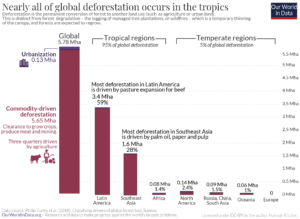
forest loss by driver by region

Why Forest Biomass Is Falling

Several factors explain Africaโ€™s forest losses:

  • Expanding agricultural land
  • Timber harvesting, legal and illegal
  • Mining and mineral extraction
  • Charcoal and fuelwood production
  • Population growth and land pressure

Even partial forest losses across large areas add up to significant carbon emissions. Climate change also weakens forests: higher temperatures, droughts, and more frequent fires slow regrowth and reduce forest health.

Implications for Climate Targets

Africaโ€™s weakening forest sink has serious global implications. Forests in Africa, Asia, and South America currently absorb much of the worldโ€™s emissions. If Africaโ€™s forests stop absorbing carbon and start releasing it, the global carbon budget tightens.

Professor Heiko Balzter, senior author of the study, notes:ย 

“If we are losing the tropical forests as one of the means of mitigating climate change, then we basically have to reduce our emissions of greenhouse gases from fossil fuel burning even faster to get to near-zero emissions.”

National climate strategies also face more pressure, as many countries rely on forests to meet their climate pledges.

COP30 and Funding Efforts: Are They Enough?

The study was released after COP30 in Brazil, where countries discussed new funding for forest protection. The Tropical Forests Forever Facility (TFFF) launched with $5.5โ€“$6.6 billion. It will pay tropical countries about $4 per hectare to keep their forests. At least 20% of funds will go to Indigenous Peoples and local communities who play a major role in forest protection.

Forest carbon financing is picking up speed. Global investment in sustainable forest management, restoration, and conservation almost doubled from 2020 to 2024. It grew from under US$12 billion a year to about US$23.5 billion annually.

This surge comes from a mix of public funds, which make up about 60% of total flows, and growing private capital. Private capital’s share increased from about 25% in 2020 to around 40% in 2024.

More companies are aiming for net-zero emissions. As demand rises for verified forest carbon credits, forests are seen as both ecological assets and investment opportunities.

However, experts note that the funding is far below what is needed. Brazil had proposed $125 billion to protect and restore tropical forests globally. Africaโ€™s fast-changing ecosystems make this gap even more urgent.

The Congo Basin: A Carbon Giant Under Pressure

The Congo Basin absorbs about 600 million tonnes of COโ‚‚ each year. This helps balance emissions from other continents. But its capacity is declining due to increasing forest disturbance.

If the trend continues, the world could lose one of its last major natural carbon buffers. Protecting this region is vital for Africa and the worldโ€™s climate. It impacts biodiversity and rainfall patterns well beyond the continent.

Reversing the Trend: Can Africa Save Its Forests?

Reversing the trend is still possible but requires strong action. Protecting remaining forests is the most urgent step. Governments should reduce pressure from agriculture and mining. They also need to improve land-use planning and monitor illegal logging.

Funding mechanisms like TFFF can help, but must increase to match the scale of the problem. Local communities and Indigenous groups, who manage large forest areas, need financial and technical support. Restoring degraded forests can help recover some carbon storage, but it takes time.ย 

Africaโ€™s forests shifting from absorbing to emitting carbon is a major warning for the planet. It shows how fast natural systems can change under pressure. This highlights the need for stronger global cooperation, better funding for forest protection, and support for local communities.

If action is delayed, the world will face an even harder path to meet climate goals. With stronger investment and protection measures, however, forests can continue storing carbon, supporting biodiversity, and sustaining millions of people across Africa.

Adani Pledges $5 Billion for Googleโ€™s AI Data Center in India

India is taking a major step toward becoming a global hub for digital infrastructure. The Adani Group will invest up to US$5 billion in Googleโ€™s new AI data center project in India. This investment comes through their joint venture, AdaniConneX. It also shows how fast India is growing its data center capacity. This growth supports cloud computing, AI, and the digital services that millions use daily.

The new campus will be in Visakhapatnam, Andhra Pradesh, with the first phase aiming to deliver about 1 gigawatt (GW) of power. This makes it one of the largest data center projects in India so far.

The development is not only about servers and storage. It also involves a big investment in clean energy, subsea cables, and infrastructure. This supports the high electricity and cooling needs of AI workloads. These facilities are larger than typical data centers and are also much more complex. They need to manage huge amounts of computation. At the same time, they must stay efficient and reliable.

Why Indiaโ€™s Data Center Market Is Exploding

Indiaโ€™s data center industry has grown steadily for the past decade. Recently, this growth has sped up even more.

  • As of April 2025, total data center capacity across Indiaโ€™s top markets reached 1,263 megawatts (MW). Analysts predict that by 2030, capacity could reach 5,000 MW (4.5 GW) if investment trends continue, quadrupling the current size.

India data center capacity current vs plannedIndia data center capacity current vs planned

The country has drawn about US$15 billion in investments from 2020 to 2025. It expects another US$20โ€“25 billion over the next five years.

Several trends explain this rapid growth. More people and businesses are using cloud computing, storing data online, streaming video content, and deploying AI-based tools.

Government initiatives, data-localization rules, and infrastructure growth have made India a great place for large-scale data centers. Technologies like AI, machine learning, IoT, and 5G need strong computing power and fast networks. This drives the demand for solid infrastructure.

Rising demand, supportive policies, and lower costs have made India appealing. Adani, Google, and others are making big investments. This shows they believe the country will grow its data center ecosystem over the next ten years.

What Makes the Adaniโ€“Google Project Significant

The collaboration between AdaniConneX and Google stands out for several reasons. The project is large. A 1 GW data center campus is one of the biggest in the country. This shows Indiaโ€™s ability to handle major AI workloads.

The plan focuses on sustainable energy and infrastructure. It includes renewable power, high-capacity transmission lines, and energy storage systems. These elements are key to powering energy-heavy AI computing while reducing environmental impact.

Gautam Adani, chairman of the Adani Group, said:

“The Adani Group is proud to partner with Google on this historic project that will define the future of India’s digital landscape. This is more than just an investment in infrastructure.”

This initiative is also likely to stimulate the local economy. Large data center projects require support services, ranging from construction and technical work to energy production and telecommunications. A major tech hub can create thousands of jobs. It also attracts more companies, building a cluster of innovation and digital skills.

Some of the benefits include:

  • Creation of technical and construction jobs, along with supporting roles in energy and networking.
  • Development of renewable energy and battery storage infrastructure to support reliable operations.
  • Attraction of other tech companies and startups seeking access to AI-ready computing facilities.

By building this kind of ecosystem, India is moving from being a consumer of technology to becoming a provider of global digital infrastructure.

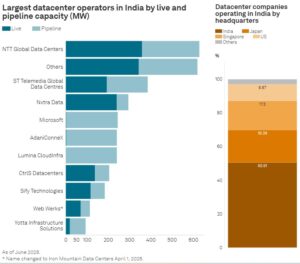
Indiaโ€™s data center landscape is dominated by a mix of global and local operators. According to S&P Global, CtrlS, Nxtra (Bharti Airtel), NTT, and AdaniConneX are among the largest players by IT-load capacity.

Largest datacenter operators in India
Sources: S&P Global Market Intelligence 451 Research; S&P Global Commodity Insights. ยฉ 2025 S&P Global.

These companies excel at creating hyperscale and enterprise-grade facilities. They often exceed tens of megawatts for each campus. Their investments boost total capacity and promote advanced technologies like AI, cloud services, and edge computing. This helps India become a competitive hub for digital infrastructure.

Looking Ahead: India as a Global AI Backbone

If current plans and forecasts are realized, Indiaโ€™s data center landscape in 2030 could look very different from today.ย 

S&P Global estimates that data center electricity consumption was about 13โ€ฏTWh by endโ€‘2024. That’s roughly 0.8% of Indiaโ€™s total electricity demand. But with the projected expansion, electricity demand from data centers could rise nearly fivefold โ€” to about 57โ€ฏTWh by 2030. Thisย means data centers could account for around 2.6% of the countryโ€™s total electricity demand by 2030.

Datacenter growth will drive power demand from 2024 to 2030

This expansion underscores why investments like the Adaniโ€“Google AI campus, with its 1โ€ฏGW scale and renewable energy focus, are critical for meeting future demand.

The S&P report further notes that most data centers currently use grid electricity, much of which comes from coal. However, there is potential to meet future demand with renewable energy.

S&P says that India will need โ€œ15โ€“30 GW of additional renewable capacityโ€ in the next five years to meet data center demand. They think this is doable since India has a lot of untapped renewable resources.

As infrastructure expands, India may become a hub not only for domestic AI and cloud workloads but also for international clients. This includes large data centers that can support big AI models and cloud computing for businesses.

The availability of local high-performance computing could encourage startups, research institutions, and multinational companies to base operations in India, rather than relying on overseas servers.

Global Context: Data Center Growth and Regional Trends

Indiaโ€™s growth fits within a broader global trend. Worldwide, demand for data centers continues to rise, driven by cloud services, AI, machine learning, and IoT. Hyperscale data centers and colocation facilities are growing fast. This trend is especially strong in North America, Europe, and the Asia-Pacific region.

North America leads with its strong infrastructure and big hyperscale operators. However, the Asia-Pacific is the fastest-growing region now. Countries in this region, including India, are building capacity quickly to keep up with rising demand.

By 2030, the Asia-Pacific region might match North America in influence and infrastructure. This shift could change where AI-ready data centers are located globally.

Partnerships That Shape the Future of Computing

The Adani-ConneX and Google partnership marks a turning point for India. The project builds one of the largest AI-ready data center campuses in the country. This shows a shift from just using digital services to becoming a global infrastructure provider.

This transformation will affect more than technology companies. It will create jobs, stimulate renewable energy development, strengthen local economies, and encourage innovation in AI and computing. India is positioning itself to be not only a home for digital users but a builder of the technology that powers the world.

A Recap of the Voluntary Carbon Market: Quality Over Quantity

The voluntary carbon credit market (VCM) has undergone notable changes from 2021 to 2024, according to the latest Ecosystem Marketplace (EM) report. After a trading peak, total volumes dropped. Still, demand for high-quality, high-integrity carbon credits is strong. This is especially true for those providing real carbon removals and environmental co-benefits. This shift signals a maturing market focused more on impact than sheer volume.

A Price Jump in 2022, With Less Trading

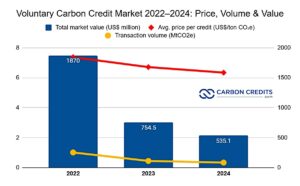
After 2021, many companies renewed or launched carbon credit purchases. In 2022, the average price per carbon credit (each credit represents one ton of COโ‚‚e removed or avoided) jumped. It rose from $4.04 per ton in 2021 to $7.37 per ton in 2022 โ€” an increase of 82%. This was the highest price level seen in 15 years.

Despite the higher price, the total trade volume dropped from its 2021 peak. Trading slowed while buyers became more selective about what credits they bought.

Because the carbon price rose as volume dropped, the overall market value in 2022 stayed roughly stable, at just under $2โ€ฏbillion. This shows the market still had strong demand, but buyers favored fewer, pricier credits rather than many lowโ€‘cost ones.

2023: Market Contracts, But Credit Quality Matters

In 2023, the voluntary carbon market shrank sharply. The total reported transaction volume fell by 56% compared with 2022. At the same time, the total value of transactions dropped to $723โ€ฏmillion.

The average credit price in 2023 settled at about $6.53 per ton COโ‚‚e. Some project types suffered more than others.

Credits tied to forestry and landโ€‘use (including REDD+ projects) โ€” once among the most popular โ€” saw a steep decline in trade, as buyers paused buying while waiting for clearer standards.

Yet, credits from projects with more robust environmental or social benefits โ€” such as biodiversity, community support, or sustainable land use โ€” remained in demand. The market began favouring โ€œhighโ€‘integrityโ€ credits or those with:

  • strong verification,
  • clear additionality (meaning the credit reflects real, extra emission reductions or removals), and
  • coโ€‘benefits beyond carbon.

2024: Lower Trading, But Underlying Demand Persists

According to the 2025 update from Forest Trends / EM, the VCM continued contracting in 2024. Transaction volumes dropped by about 25โ€ฏ% compared to 2023. Yet, credit prices fell only modestly โ€” about 5.5%.

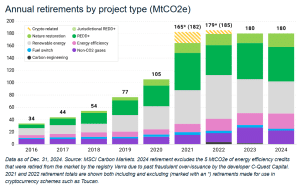
carbon credits annual retirements 2024 by project type

More importantly, the number of credits โ€œretiredโ€ (i.e., used to offset emissions) remained stable. In 2024, a little over 180 million tons of COโ‚‚e carbon credits were retired under the largest certifying standards โ€” roughly the same as in prior years.

This suggests that while fewer credits are being traded, companies and organizations continue to use offsets to meet climate goals. In other words, the trading market is smaller, but demand for real credits has not vanished.

The EM report also notes a growing price gap between different types of credits. Credits representing actual carbon removals (e.g., from reforestation or removal technologies) were, on average, 381% more expensive than credits representing only emissions avoidance.

  • This growing premium reflects buyer demand for greater assurance: they want credits that remove or permanently store carbon, not just avoid future emissions.

Voluntary carbon credit market; price, volume, value 2022-2024

SEE MORE: Base Carbon: A Rising Force in the Voluntary Carbon Market

Lessons from Two Decades: Market Evolution and Maturity

In another report by EM, the VCM has grown over almost 20 years. It started as a small, experimental area and has become a more organized and advanced system.

In the early 2000s, dubbed as “The Wild West,” companies joined in mainly due to social responsibility. They wanted to โ€œwalk the talkโ€ on climate action. Dell, Google, and Nike were among the first to make significant purchases. Verification standards were limited, and concerns over additionality and real climate impact were common.

Over time, third-party standards and transparency measures strengthened. By 2008, 96% of credits were verified, showing that buyers increasingly valued quality and integrity. The market faced tough times, especially after the 2008 financial crisis. It also struggled after early platforms, like the Chicago Climate Exchange, closed down.

Voluntary markets kept going, even with slowdowns. They highlighted co-benefits such as:

  • Protecting biodiversity

  • Supporting community livelihoods

  • Promoting sustainable land use

Recent trends show the market split into two: technological removals, like direct air capture, and nature-based solutions. Buyers now want high-integrity carbon credits. They look for permanence, co-benefits, or both.

The market has grown up from its โ€œwild westโ€ days. Now, quality, transparency, and long-term impact drive value. It’s not just about trading volume anymore.

What Type of Credits Now Lead the Market?

Several shifts stand out in what kinds of credits buyers prefer. The top ones include:

  • Natureโ€‘based and highโ€‘integrity credits lead demand. Projects in forestry, land use, agriculture, and similar areas remained important, especially when they include social or environmental coโ€‘benefits.

  • Carbon removal credits gain higher price premiums. Credits from activities that remove COโ‚‚ or store carbon longโ€‘term now cost far more than reductionโ€‘only credits. This shows buyers prioritizing permanence and longโ€‘term impact over cheaper, shortโ€‘term reductions.

carbon credit price per project type abatable

  • Lowerโ€‘integrity credits โ€” especially older or riskier projects โ€” lose traction. Credits from some legacy project types (like certain REDD+ or basic clean energy projects) saw steep declines. Some buyers paused new purchases while waiting for clearer integrity standards.

Thus, the market seems to be shifting away from volume-driven trading to a smaller, more focused market driven by quality, trust, and long-term climate impact.

What This Means for Carbon Credit Use and Climate Efforts

These recent trends offer important signals about how voluntary carbon credits are used today:

  1. Offsetting now leans toward actual carbon removals and natureโ€‘positive projects. Buyers seem more interested in credits that make a tangible, lasting difference, not just claims of avoided emissions.

  2. Highโ€‘quality verification and coโ€‘benefits encourage trust. Credits that deliver environmental or social benefits beyond carbon โ€” like biodiversity protection or community livelihood support โ€” appear more desirable.

  3. Strong demand remains even as trading shrinks. The fact that credit retirement stayed high in 2024 shows that many buyers still believe in carbon credits as part of their climate strategy. Trading markets may fluctuate, but the demand for real carbon offsets persists.

  4. Credit markets are maturing and reโ€‘sorting. The voluntary market seems to be evolving: less speculative or volumeโ€‘based trading, more emphasis on integrity, quality, and longโ€‘term value.

  5. Not all credits are equal. The wide price divergence between credit types underscores that buyers must look carefully at what a credit represents โ€” removal or reduction, short-term or permanent, peopleโ€‘friendly or just carbonโ€‘focused.

The VCM Is in Transition โ€” Not Collapse

From 2021 to 2024, the voluntary carbon credit market has undergone a major shift. After a peak in trading, volume dropped. Yet, demand did not disappear. Instead, buyers turned more toward highโ€‘integrity, often more expensive credits that offer real carbon removals and coโ€‘benefits beyond carbon alone.

Todayโ€™s market values quality over quantity. Market value has dropped from its peak. But companies and organizations continue to retire credits, showing that credits remain a tool for climate action.

The current state suggests the VCM is not collapsing. It is evolving, becoming more selective and โ€” for those credits that meet higher standards โ€” more valuable. For carbonโ€credit markets to truly support climate goals, this shift toward integrity, transparency, and impact may be necessary.

Walmart and Kellanova Partner for Regenerative Rice Farming in Arkansas

Walmart, Kellanova, and Indigo Ag formed a new partnership to help rice farmers in Arkansas. Their goal is to make farming more profitable and better for the environment. These companies plan to support farmers by giving them training, digital tools, and extra payments for using regenerative agriculture methods.

Walmart has already worked with Indigo Ag to support cleaner and more sustainable farming. With Kellanova now joining, the program will reach more farmers and cover more rice-growing areas. The hope is that farmers can earn more money while using practices that protect their land for the future.

What Is Regenerative Agriculture?

Regenerative agriculture is a way of farming that helps restore soil health, conserve water, and support biodiversity. Instead of relying only on heavy chemical inputs, this approach works with nature to grow crops. Farmers might use methods like:

  • crop rotation,
  • careful water management, and
  • soil-restoring techniques.

This type of farming can help soil store nutrients and moisture better. That improves crop stability even when the weather gets tough. Over time, regenerative farms may need less fertilizer and water.

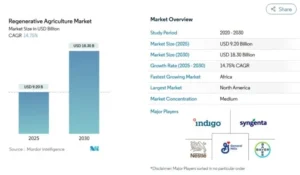
Globally, interest in regenerative agriculture is rising. The market for regenerative agriculture services โ€” like soil testing, consulting, and sustainable farming tools โ€” is growing quickly. A recent industry forecast estimates strong growth through 2030, $18.3 billion at 15-20% annual growth.

regenerative agriculture market
Source: Mordor Intelligence

This growth reflects a shift among food companies, farmers, and investors toward sustainable supply chains and climate-smart farming.

Arkansas Rice: A Big Deal for U.S. Farming

Arkansas leads U.S. rice production. In 2024, the stateโ€™s rice growers harvested about 1.432 million acres at a record yield of 7,640 pounds per acre. That production made up 49.3% of all U.S. rice output.

Rice is one of the top three crops in Arkansas in terms of money earned by farmers. It also supports thousands of jobs in rural communities.

But rice farming has become harder lately. Many Arkansas farmers face economic pressure. Input costs such as fertilizer, fuel, and irrigation have gone up.

At the same time, rice market prices have weakened. Some estimates show significant losses per acre for long-grain rice in such conditions. This economic squeeze makes support and innovation more urgent.

The New Partnership and What It Offersย 

The companies involved โ€” Walmart, Kellanova, and Indigo Ag โ€” plan to help Arkansas rice farmers move to regenerative agriculture. Under this approach, farms receive guidance, tools, and extra pay when they follow certain sustainable practices.

Farmers joining the program get help with soil, water, and crop management. They also get payments (a โ€œpremiumโ€) for rice grown under these sustainable practices. That extra pay helps cover the risks and costs of changing farming methods.

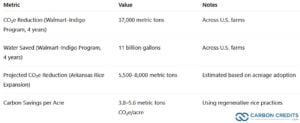
Moreover, sustainable farming practices are shown to lower the industry’s carbon emissions. The initiative is projected to reduce 35,500โ€“8,000 metricย tonsย basedย on acreage adoption.

regenerative agriculture and carbon reductions

Why the Timing Is Important

The new partnership comes at a time when Arkansas rice farmers face major economic challenges. Rising costs for fuel, fertilizer, and water make farming more expensive. Meanwhile, global rice prices remain under pressure because of large supplies from abroad. These conditions reduce profits and increase risks for farmers.

In that context, the support from Walmart, Kellanova, and Indigo Ag may help stabilize farm incomes. The premium payment offers an extra financial cushion while farmers transition to sustainable practices.

Also, a move to regenerative farming may increase long-term resilience. Healthier soil and better water management can help farms survive extreme weather โ€” a growing concern in climate change.

Mikel Hancock, Senior Director, Strategic Initiatives, Sustainability at Walmart, stated:

“We are excited to see our regenerative agriculture goals becoming a reality. Expanding our partnership with Indigo Ag to include Kellanova reflects the scale of impact we can achieve by working together to strengthen supply chains, support farmers, and advance environmental stewardship.”

Walmartโ€™s Sustainability and Environmental Initiatives

Walmart has been actively pursuing sustainability across its global operations. The company plans to achieve net-zero emissions by 2040. It has invested in renewable energy, energy-efficient stores, and low-emission logistics. This powers over 50% of its operations with renewable energy. It also aims to source 100% of its electricity from renewables in the U.S. and around the world when possible.

Walmart teams up with suppliers to cut greenhouse gas emissions in its supply chain. They focus on reducing Scope 3 emissions. One key effort is Project Gigaton, which aims for suppliers to lower COโ‚‚e by one billion metric tons by 2030.

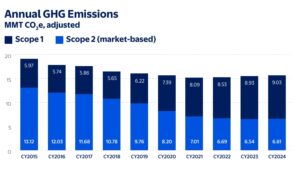
walmart emissions 2024
Source: Walmart

The company also promotes sustainable sourcing, including responsible agriculture, forestry, and seafood programs. The recent partnership with Kellanova and Indigo Ag is an example. These efforts show Walmart’s commitment to protecting the environment and ensuring a strong supply chain for the future.

Kellanova and Indigo Ag: Driving Sustainable Agriculture

Kellanova and Indigo Ag are both actively advancing sustainable practices across the food and agriculture sectors. The Pringles producer aims to lower its environmental impact. It does this by sourcing responsibly, reducing waste, and improving energy efficiency in its supply chain.

The company is focused on cutting greenhouse gas emissions. It also seeks to use more sustainable ingredients in its products, which aligns its work with larger climate goals.

Janelle Meyers, Chief Sustainability Officer, Kellanova, said:

“Our Kellanova Better Daysโ„ข Promise aims to advance sustainable practices and mitigate the impacts of climate changeโ€”but we know we canโ€™t achieve our goals without our partners. By joining forces with Indigo Ag and Walmart, weโ€™re creating agricultural resiliency that increases farmer revenues, advances climate-smart practices, and drives long-term, systemic impact across the value chain.”

Indigo Ag works directly with farmers to implement climate-smart and regenerative agriculture practices. The programs focus on improving soil health, saving water, and cutting carbon emissions. They also aim to boost farm profits.

The agritech firm uses digital tools and technical support to measure and verify environmental benefits. This gives farmers and buyers confidence in the supply chain’s sustainability.

indigoag carbon credits Carbon by Indigo
Source: Carbon by Indigo

Indigo partners with big retailers like Walmart, which helps scale initiatives for lower-carbon, resilient farming. These efforts benefit farmers, communities, and the environment.

Dean Banks, CEO of Indigo Ag, remarked:

“Together, we are building prosperity from the ground up: safeguarding water resources, improving soil health, reducing emissions, and supporting farmers.”

What This Means for the Future of Farming

This partnership among Walmart, Kellanova, and Indigo Ag shows a deeper shift in agriculture. Instead of just growing more crops, they aim to grow crops sustainably.

For farmers in Arkansas, it could mean a better future: a more stable income, healthier farms, and less risk. For companies, it offers a more dependable supply chain, while for communities and the environment, it offers a chance at long-term sustainability.

As demand grows for sustainable and responsibly grown food, regenerative agriculture may move from niche to mainstream. We could see growing interest, more investments, and wider adoption, not just for rice, but for other crops too.

This partnership could create a future where farming, business, and the environment work together, benefiting farmers, consumers, and the land.

Valeโ€“Glencore Sudbury Venture Aims to Unlock 880,000-Ton Copper Volume for North America

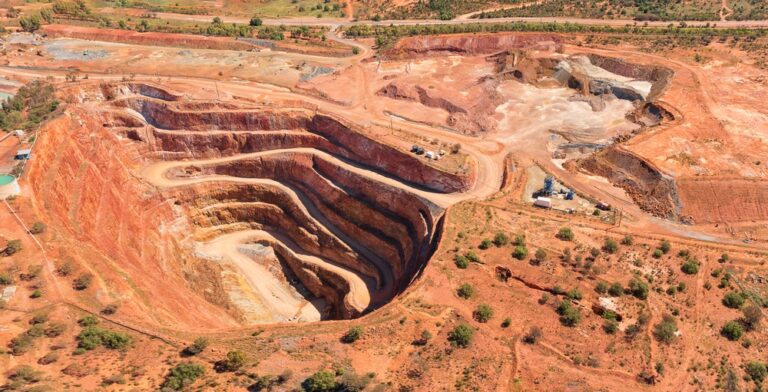
Vale Base Metals (VBM) and Glencore Canada took a major step toward expanding North Americaโ€™s copper supply. The two companies signed an agreement to study a new brownfield copper project in the Sudbury Basin, one of Canadaโ€™s most important mining regions.ย The plan focuses on using Glencoreโ€™s Nickel Rim South Mine infrastructure to safely and efficiently reach underground copper deposits owned by both companies.

Shaun Usmar, CEO of Vale Base Metals, further explained the project. He noted,

“Opportunities to partner and unlock synergistic value between neighbouring miners in the Sudbury Basin have been pursued for decades, without meaningful success. I’m grateful for the commitment shown by both Glencore and our VBM team for coming together to finally unlock this historic opportunity by demonstrating a new collaborative way of working.

“The contemplated partnership paves the way to extract valuable copper-rich orebodies for our respective operations that would otherwise be lost to both companies. The proposed 50-50 joint venture aims to leverage Glencore’s unused infrastructure to access orebodies on both our properties. This will benefit our respective companies, our local communities in and around Sudbury, and it has the potential to produce nearer-term critical minerals from this prolific brownfield project for the Canadian economy. My hope is it will be a catalyst to unearth further synergies in the region.”

A Project That Unlocks Untapped Resources

The agreement allows both companies to examine how they can mine their adjacent copper deposits through Glencoreโ€™s current mine shaft. Instead of building a new shaft from scratch, they intend to deepen and extend the existing one. This approach reduces environmental impacts, shortens construction timelines, and avoids the major capital expenses associated with greenfield developments.

The partners estimate the project will deliver about 880,000 metric tons of copper over 21 years. The total investment is expected to fall between $1.6 billion and $2 billion USD. Given the strong demand for copper and the tight supply, the timing of this plan aligns well with the current market.

At Glencore’s Capital Markets Day presentation, held on Wednesday, 3 December 2025, in the UK, CEO Gary Nagle commented:

โ€œSince our last Capital Markets Day in 2022, we have made significant progress on de-risking our exceptional portfolio of copper projects. These projects are mostly brownfield and expected to be highly capital efficient. We have a clear pathway for our base copper business to exceed 1 million tonnes of annual production by the end of 2028, with a target to produce c. 1.6 million tonnes by 2035, which would make Glencore one of the largest copper producers in the world. We have already taken key steps on this journey, including the submission of our Argentinian RIGI applications in August and our decision to restart the Alumbrera copper/gold operation in Argentina which we are announcing today.”

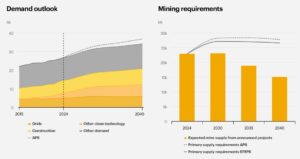
COPPER DEMAND
Source: IEA

Sudburyโ€™s Rich Mix of Critical Minerals

Since the Sudbury Basin contains a mix of valuable minerals, the project would also produce nickel, cobalt, platinum group metals (PGMs), gold, and other critical materials. These metals are important for batteries, renewable power systems, and global clean-energy supply chains.

The companies plan to begin detailed engineering work in 2026. This phase will include environmental assessments, community consultations, and technical design studies. A final investment decision is set for the first half of 2027.

If approved, the new operation would not only unlock ore that could have remained untouched but also support long-term planning for both companiesโ€™ Canadian mining portfolios.

Notably, Vale’s broad global network of operations gives it significant experience in complex underground mining. And that strengthens the Sudbury partnership.

Sustainable Mining Gains Ground Through Brownfield Strategy

The partnersโ€™ decision to build on existing infrastructure reduces the environmental footprint of the project. Brownfield developments generally require fewer land disturbances, lower water use, and smaller construction areas than brand-new mines. This approach fits well with growing expectations for sustainable mining practices in Canada and worldwide.

Economically, the project could create high-quality jobs in Sudbury and support local businesses. Because the region has a long history of mining, the community already has a strong workforce, training programs, and service ecosystem that can support new developments.

The initiative also supports Canadaโ€™s Critical Minerals Strategy, which aims to secure domestic supplies of materials needed for clean energy technologies. Copper, nickel, and cobalt are at the heart of that effort.

Canada and the U.S. Expand Their Copper Capacity

Copper is becoming even more important as renewable energy, electric vehicles, and power grid upgrades expand worldwide. The metal is also vital for semiconductor manufacturing and military equipment. Significantly, Canada already holds strong copper resources, especially in Ontario, and continues to grow as a major contributor to global supply.

Additionally, a more stable domestic supply reduces reliance on foreign mineral supply chains for both Canada and the U.S.

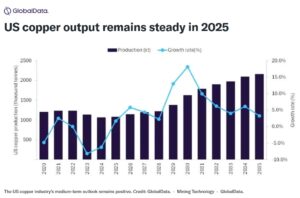
Meanwhile, the United States is also preparing for major growth. U.S. copper production is projected to reach 1,077 kilotonnes in 2025, an increase of nearly 2% from the previous year. By 2030, new large-scale projects could push the U.S. into the global top five copper-producing nations. By 2035, output may more than double to over 2 million tonnes per year.

copper output US

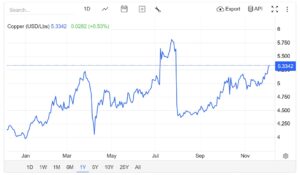
Copper Prices Stay Strong in 2025

As per Trading Economics, Copper prices rose above $5.20 per pound, reaching a four-month high. The increase followed a record peak on the London Metal Exchange due to lower output in Chile, planned Chinese smelter cuts, and a weaker U.S. dollar.

Since late August, copper has climbed about 13% on the LME amid supply shortages. Traders also boosted shipments to the U.S. to take advantage of high Comex prices, while uncertainty over future tariffs added extra market pressure.

Because of this price environment, the Vale-Glencore collaboration appears especially timely. High prices offer a strong economic case for unlocking new supply from brownfield sites like Sudbury and supporting long-term market stability.

copper prices
Source: Trading Economics

Unlocking Copper to Power a Cleaner Future

Overall, the planned Sudbury project reflects a shift in mining strategy as companies look for smarter, lower-impact ways to increase critical mineral supply. By using existing assets, Vale and Glencore can reach valuable copper deposits faster, reduce costs, and strengthen North America’s mineral independence.

As demand rises for clean energy technologies and electrification, projects like this will play a major role in supporting economic growth, energy security, and the global transition to a low-carbon future.

If the joint venture moves forward after the 2027 investment decision, the Vale-Glencore partnership could become one of the most important copper developments in Canadaโ€”helping power everything from EVs to renewable grids for years to come.