


The Science-Based Targets initiative (SBTi) has released the finalized Corporate Net-Zero Standard Version 2.0, creating new rules that will guide how companies set, manage, and report their net-zero plans.
The update arrives as more companies than ever are adopting climate targets. However, investors, regulators, and customers increasingly want proof that companies are reducing emissions, not just making promises. The revised standard reflects that shift. It moves the focus from target setting to implementation and accountability.
For businesses, the new framework provides a clearer roadmap to net zero. For carbon markets, it offers more guidance on the role of carbon removals and high-quality carbon credits.
David Kennedy, Chief Executive Officer at the SBTi, remarked:
“Businesses now have a great opportunity to manage their transition risk and strengthen resilience in a fast-changing world. The Standard provides a framework to achieve this in practice across a wide range of contexts, through aligning climate science with actions that they can and should take to transform their businesses. Those that use it will gain a competitive advantage while contributing to international climate objectives.”
How the New Rules Could Reshape Corporate Climate Strategy
The SBTi has become one of the most influential climate organizations in the corporate world. The initiative was started by CDP, the United Nations Global Compact, the World Resources Institute (WRI), and WWF.
The initiative helps companies set emissions targets that match climate science and the Paris Agreement goals. Its influence continues to grow.
According to SBTi, more than 11,000 companies worldwide have either set science-based targets or committed to doing so. The organization reported a 40% increase in corporate climate target adoption in 2025. This growth was particularly strong in Asia and emerging markets.
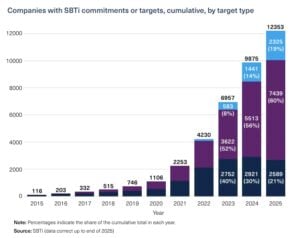
Together, these companies make up a large part of the global economy. They also produce billions of tonnes of greenhouse gas emissions every year. That means changes to the SBTi framework can influence climate strategies across entire industries.
From Climate Targets to Climate Delivery
The biggest message from Version 2.0 is simple: setting a target is no longer enough. As Francesco Starace, SBTi Chair, stated, “Commitment is not the hardest part. Delivery is.”
That means the new standard seeks to move companies from climate ambition to real-world implementation.
The original Corporate Net-Zero Standard, released in 2021, focused mainly on helping companies establish science-based net-zero goals. The updated version places greater attention on how companies achieve those goals and how they report progress.
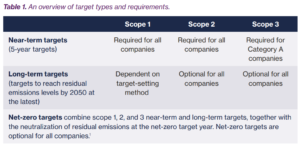
The new framework introduces stronger expectations in five key areas:
- Net-zero governance – embedding climate goals into business decisions.
- Target setting – maintaining science-based emissions targets.
- Target implementation – showing actions taken to reduce emissions.
- Reporting and assessment – tracking and disclosing progress regularly.
- Progressive responsibility – addressing remaining emissions over time.
These changes aim to make corporate climate plans more transparent and measurable. For investors and stakeholders, that could improve confidence in net-zero claims.
According to Mark Kenber, Executive Director of the Voluntary Carbon Markets Integrity Initiative (VCMI), the new standard provides clearer guidance on how high-integrity carbon credits can complement direct emissions reductions in corporate net-zero plans. He further commented:
“It draws meaningfully on the work of VCMI to define best-practice corporate use of carbon credits, as well as recognizing ICVCM’s Core Carbon Principles as the benchmark for credit quality, sending a helpful signal of increasing alignment with business. We’re pleased SBTi has opened the door to recognizing companies that purchase carbon credits and stand ready to continuing to work with them to give businesses the confidence to act now.”
RELATED: SBTi Hits 10,000 Companies with Validated Targets in 2026: Asia Fuels the Net-Zero Momentum
Scope 3 Emissions Remain the Biggest Challenge
One of the most important parts of the new standard is its treatment of Scope 3 emissions. These emissions come from a company’s value chain, including suppliers, transportation, purchased goods, and product use.
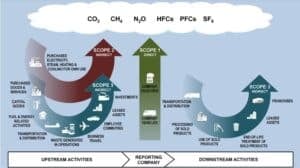
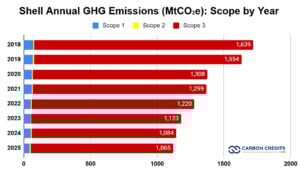
For many businesses, Scope 3 emissions account for more than 70% of their total carbon footprint, even over 95% for others. This is especially true for oil majors like Shell. Yet, they are often the hardest emissions to measure and reduce because companies do not directly control them.
The updated standard gives companies more flexibility in how they address Scope 3 emissions while still requiring meaningful action. SBTi says businesses should work with suppliers, customers, and partners to cut emissions. They need to focus on the entire value chain, not just their own operations.
This reflects a growing understanding that reaching net zero will require action across entire economic systems, not just within individual companies.
Carbon Removals Gain a Bigger Role
One of the most closely watched changes involves carbon removals. The debate over carbon credits has intensified in recent years. Critics argue that some companies have relied too heavily on offsets instead of reducing their own emissions.
The new net-zero standard attempts to draw a clearer line.
Companies must still prioritize direct emissions reductions. However, SBTi acknowledges that some residual emissions will likely remain, especially in sectors such as aviation, shipping, steel, cement, and heavy industry.
To address those emissions, the framework allows a greater role for carbon removals and certain high-integrity environmental instruments. This change aligns with findings from the Intergovernmental Panel on Climate Change (IPCC). Most climate pathways that limit global warming require large-scale carbon removal by mid-century.
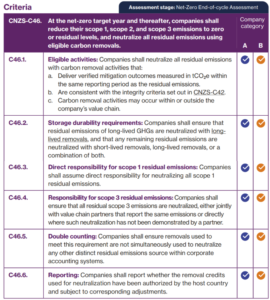
Demand is already rising. According to CDR.fyi, buyers have contracted more than 8 million tonnes of carbon removal credits globally. Technology companies have led much of that demand through investments in direct air capture, bioenergy with carbon capture, and other removal technologies.
The SBTi update might boost demand for top-notch carbon removals. It will also raise attention to project quality and verification standards.
A Major Signal for the Future of Carbon Credits
The revised standard may have significant implications for voluntary carbon markets (VCMs). Over the past few years, concerns about credit quality have slowed market growth. Buyers increasingly want assurance that carbon credits deliver real, measurable, and lasting climate benefits.

Version 2.0 reinforces that trend. The framework places greater emphasis on transparency, accountability, and measurable outcomes. As a result, demand could shift further toward higher-quality projects with stronger monitoring and verification systems.
This could benefit sectors such as:
- Carbon dioxide removal (CDR),
- Methane reduction,
- Durable carbon storage, and
- High-integrity nature-based projects.
The result may be a smaller but stronger carbon market focused on quality rather than volume. For project developers, that means demonstrating additionality, permanence, and long-term climate impact will become even more important.
A New Era for Corporate Net Zero
The release of the Corporate Net-Zero Standard Version 2.0 marks an important step in the evolution of corporate climate action. For years, companies focused on announcing climate commitments. Now the focus is shifting toward proving results.
The new framework maintains strong emissions-reduction goals. It also provides companies with clearer guidance on how to implement, govern, and report.
SBTi plans to begin validating targets under Version 2.0 in 2027. Companies can continue using the current Version 1.3.1 framework until January 2028. After that, new submissions will need to align with the updated standard.
As net-zero deadlines move closer, companies will increasingly be judged by the emissions they reduce, not the targets they announce.
The new SBTi standard reflects that reality. It raises expectations for transparency, accountability, and execution—three areas that are becoming just as important as ambition in the race to net zero.