

Europe’s battery storage market is rapidly expanding, and Tesla (TSLA stock) has secured a major energy storage deal. The electric vehicle maker signed a multi-year agreement with NatPower to supply over 25 GWh of Battery Energy Storage Systems (BESS) in Italy and the UK.
This partnership merges technology, engineering, financing, grid integration, and energy trading into one model. With an initial portfolio of five projects, they aim to exceed 100 GWh over time.
- The collaboration could generate over $15 billion in revenue over 20 years while strengthening Europe’s power grid.
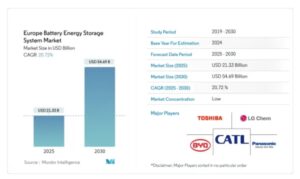
- Reports indicate that the European Battery Energy Storage System (BESS) could reach $54.7 billion by 2030, at an average rate of 20.7% per year between 2025 and 2030.
Mike Snyder, VP Tesla Energy & Charging, said:
“Tesla is excited to partner with NatPower on this long-term agreement. They have a strong vision for scaling battery deployments quickly and efficiently across Europe. Our team of experts are helping accelerate these deployments through our vertically integrated offering, providing hardware, software, construction, trading optimization and service to bring projects online faster and ensure they operate smoothly throughout the lifetime of the product.”
Tesla Brings More Than Batteries to the Deal
The press release revealed that NatPower will own and operate the battery projects, while Tesla will supply its Megapack systems. However, Tesla’s role goes further. The company will provide engineering, procurement, and construction (EPC) services, along with energy trading solutions through its Autobidder platform.
This integrated approach gives NatPower confidence in project execution. Instead of juggling multiple contractors, it can rely on one framework for battery manufacturing, project delivery, and long-term energy operations.
The agreement also allows NatPower to use Tesla’s latest technology while enhancing financial security for large-scale projects.
Fabrizio Zago, CEO of NatPower, noted:
“The significance of this agreement lies in its ability to turn project development into concrete execution. The sector has access to technology and capital but still struggles to deliver infrastructure consistently and within the required timelines. What we have built with Tesla is an ecosystem that enables alignment between capital and execution, and that can be replicated across multiple markets.
Today, with this strategic agreement, we are launching the delivery of the first five major projects developed over recent years in Italy and the United Kingdom. This is a historic moment for our companies, not only because of the scale of the agreement, but also because of the impact it will have on the energy infrastructures.”
A New Model for Delivering Battery Storage
- The first phase includes five utility-scale battery projects in Italy and the UK. These mark the start of a much larger program targeting over 100 GWh of storage capacity.
- The total construction value is estimated at $4 billion to $5 billion, with projected revenues exceeding $15 billion over 20 years.
Unlike traditional projects that often progress through separate stages, this agreement coordinates all major steps within a single framework.
The partnership addresses five key challenges that often delay energy infrastructure projects:
- Reserving manufacturing capacity
- Securing grid connections
- Managing permits and regulatory approvals
- Structuring project financing
- Coordinating construction schedules
By linking battery production directly to project delivery, Tesla and NatPower aim to reduce delays as demand for energy storage surges.
Megapack Drives Tesla’s Energy Growth
While Tesla’s automotive growth has slowed, its energy division is expanding quickly. The company deployed a record 46.7 GWh of energy storage in 2025, showing 48% year-over-year growth. Analysts expect strong deployments in 2026, with first-quarter installations around 8.8 GWh.
Tesla has also sped up product development. Last year, it introduced Megapack 3 and Megablock, pre-integrated systems that reduce installation time and simplify deployment. These innovations help developers build storage facilities faster, addressing a major industry challenge.
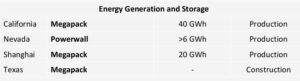
The NatPower agreement boosts Tesla’s position in Europe’s utility-scale storage market and highlights energy storage as a key growth area.
Why Europe Needs More Battery Storage
The agreement comes as Europe’s electricity system faces increasing pressure. Countries are adding wind and solar generation rapidly, but renewable electricity relies on weather, not demand. Battery storage helps by storing excess power and delivering it when needed.
The planned systems will provide crucial services, including:
- Stabilizing electricity grids
- Supporting renewable energy integration
- Supplying dispatchable electricity during high demand
- Providing backup power for industrial facilities and large data centers
Demand for these services is rising as electrification accelerates in transportation, manufacturing, and heating. Additionally, artificial intelligence drives unprecedented electricity consumption from data centers, making reliable infrastructure essential.
This agreement emphasizes fast project delivery, a vital advantage as Europe modernizes its electricity network.
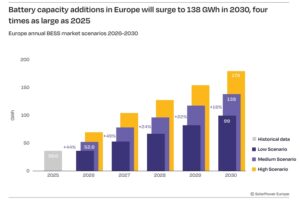
The timing of the agreement aligns with a booming European battery storage market. According to SolarPower Europe’s European Battery Market Outlook 2026-2030, Europe installed 36 GWh of new battery storage in 2025, marking the twelfth year of growth.
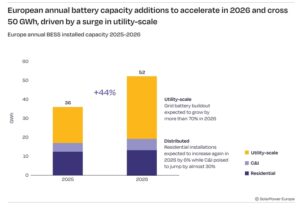
These additions pushed the continent’s total operational capacity above 100 GWh for the first time. After a slow 2024, the market surged, growing 48% year over year. Much of this growth came from utility-scale projects, which now account for over half of all new installations.
The trend reflects rising demand for grid flexibility and strong project economics.
- Germany, the UK, and Italy remained the largest markets, while countries like Ukraine and Bulgaria entered the top five, showing that battery deployment is spreading.
The growth outlook remains strong. Projections include:
- Annual installations are expected to exceed 50 GWh in 2026, reaching around 138 GWh by 2030—nearly four times the 2025 level.
- Installed capacity could reach about 470 GWh by the decade’s end.
- Utility-scale storage is likely to dominate, making up around 75% of Europe’s total capacity by 2030.
Execution May Be the Industry’s Biggest Competitive Advantage
The Tesla-NatPower agreement signals a shift in the battery storage industry. Building battery projects now involves securing equipment, manufacturing capacity, financing, approvals, grid access, and construction expertise.
By combining these elements into one framework, the partnership offers a model for future large-scale energy projects.
As electricity demand grows faster than new power infrastructure, delivering projects on time has become just as important as the technology itself.
Through this partnership, Tesla (TSLA) expands its role in the energy storage market while NatPower bolsters its position in Europe. Together, they will help build a more reliable power grid that supports renewable energy, rising AI-driven electricity demand, and long-term energy security.