


BYD is making major moves across the global clean energy market. The Chinese company is speeding up its expansion into Europe and also helping to build the largest battery storage facility in the Americas.
These developments occur when BYD’s stock has faced pressure from slowing profit growth, intense competition in China’s electric vehicle (EV) market, and concerns about pricing. Yet the company’s latest projects suggest it is pursuing a much bigger strategy than vehicle sales alone.
Today, BYD is emerging as a global player across electric vehicles, battery manufacturing, renewable energy, and energy storage.
The company’s growing footprint reflects broader trends reshaping the energy transition. Demand for EVs continues to rise worldwide, while grid operators are investing heavily in battery storage to support growing amounts of solar and wind power.
Against this backdrop, BYD is positioning itself at the center of two of the fastest-growing clean energy markets.
Europe: BYD’s Most Important Battleground
Europe is becoming one of BYD’s most important international markets. The company plans to begin production at its first European passenger vehicle factory in Hungary during the fourth quarter of 2026. The facility could help BYD grow its local manufacturing. It will also lower tariffs on imports of Chinese-made EVs.
The move comes as BYD’s European sales continue to surge. It sold nearly 188,000 vehicles across Europe in 2025, a jump of about 270% from the previous year. Sales growth stayed strong in 2026. Registrations climbed about 144% year-over-year through May, surpassing 100,000 vehicles.

The expansion reflects the growing importance of the European EV market. The International Energy Agency (IEA) reports that global electric car sales topped 17 million in 2024. This means over 20% of all new cars sold worldwide were electric. The agency expects EV adoption to continue growing as battery costs decline and governments strengthen emissions policies.
Europe remains one of the largest EV markets globally. However, competition is intensifying as Chinese manufacturers gain market share and challenge established automakers.
For BYD, local production could help strengthen its position in the region while supporting long-term growth.
A Record-Breaking Chile Project Showcases BYD’s Battery Power
While BYD is best known for electric vehicles, energy storage is becoming an increasingly important part of its business. That strategy received a major boost with the inauguration of the Elena battery storage project in Chile’s Atacama Desert.
- The facility can store 3.5 gigawatt-hours (GWh) of energy. This makes it the largest battery energy storage system in the Americas.
Grenergy, a Spanish renewable energy company, developed the project. It uses 6,240 battery modules from BYD, all stored in 624 containers.
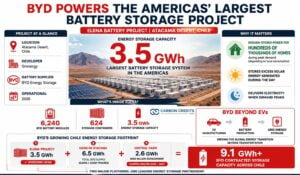
The scale is significant. This battery system can store enough electricity to power hundreds of thousands of homes during peak demand. It all depends on local consumption patterns.
The Elena project’s launch increases BYD’s total battery supply to the Oasis de Atacama development to 6.5 GWh. In March, Grenergy signed another agreement with BYD for 2.6 GWh of battery storage for the Central Oasis project in central Chile.
The $900 million development is expected to begin operations between 2026 and 2027. Together, the two projects give BYD more than 9 GWh of contracted battery storage capacity in Chile. This shows the company’s expanding role in one of the world’s fastest-growing energy storage markets.
Why Batteries Are Becoming the Backbone of the Energy Transition
The timing of BYD’s energy storage expansion aligns with powerful global trends. As renewable energy deployment accelerates, demand for battery storage is growing rapidly.
Solar and wind generation can fluctuate depending on weather conditions and time of day. Battery systems help solve that challenge by storing excess electricity and releasing it when needed.
According to the International Energy Agency, global battery storage capacity surpassed 280 gigawatts (GW) in 2025. The IEA expects deployment to grow several times over by 2030 as countries invest in more flexible electricity grids. Bloomberg’s forecast also shows the same trend.
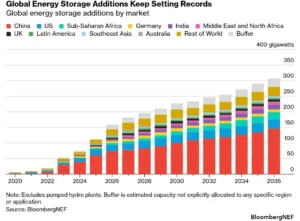
Energy storage is now considered a critical technology for achieving climate goals. The IEA estimates that global renewable energy capacity additions reached nearly 700 GW in 2024, the highest annual increase ever recorded. Much of that growth will require large-scale storage systems to maintain grid reliability.
Chile has become an important test case for this transition. The Atacama Desert receives some of the highest levels of solar radiation in the world. However, much of that solar power is generated during the day when electricity demand is lower.
Battery storage allows excess energy to be saved and delivered later, increasing the value of renewable generation. Projects like Elena show how batteries are becoming essential infrastructure for modern power systems.
From Electric Cars to Energy Systems: BYD’s Expanding Climate Vision
The company’s expansion also supports broader climate goals. BYD has become one of the world’s largest producers of electric and plug-in hybrid vehicles. The company sold approximately 4.6 million vehicles in 2025, making it one of the six largest automakers globally.
The EV giant stopped making regular gasoline-only cars in 2022 and is now focusing only on new energy vehicles. The company believes its vehicles have reduced carbon dioxide emissions by hundreds of millions of tons. This is a significant drop compared to traditional transportation.
At the same time, BYD continues to invest heavily in battery technology, manufacturing efficiency, and renewable energy integration.
Its battery business now serves both transportation and stationary energy storage markets. This dual strategy could become increasingly important as global electricity systems electrify and demand for clean energy infrastructure grows.
Investors’ Take: Why BYD’s Stock Trades Low
Despite these operational achievements, investor caution has intensified as BYD’s financial slowdown extends deep into 2026. The company faced its first annual profit decline in four years in 2025. Net profit dropped by 19% to 32.6 billion yuan (US$4.7 billion).
Automotive gross margins fell to 20.5%, and revenue growth slowed to a six-year low of 3.5%. This financial strain worsened significantly. BYD’s net profit fell by 55% year-on-year in the first quarter of 2026. A fierce price war drove this drop at home. It signals a harsh new “elimination phase” for the industry.
The results reflect the challenges facing China’s EV industry. Competition has intensified as manufacturers cut prices to defend market share. The resulting pressure has weighed on profitability across the sector.
Investors are also watching how quickly BYD can translate strong international sales growth into sustainable earnings growth. As a result, the company’s shares have experienced periods of volatility and recently traded near their lowest levels in more than a year.

Analysts say BYD keeps investing heavily in manufacturing, exports, battery production, and energy infrastructure. This is despite short-term pressures.
A Broader Energy Company Is Taking Shape
BYD’s latest projects show how the company is evolving beyond electric vehicles. Its new factory in Hungary supports global EV growth, while the Chile battery project strengthens its position in energy storage.
The shift reflects a broader trend across the energy transition, where electric vehicles, batteries, renewable power, and electricity grids are becoming more connected.
BYD’s exports continue to grow, its European expansion is accelerating, and its battery storage business is reaching record scale. Despite investor concerns about short-term profitability, the company is increasingly positioning itself as a major clean energy player, not just an automaker.