

BYD (1211.HK Stock) made headlines for three different reasons. The company reported record overseas sales, outlined plans to introduce solid-state batteries, and announced a new policy tied to its driver-assistance technology. On the surface, these developments appear unrelated. However, together they tell a larger story about where BYD is heading.
The Chinese automaker is no longer competing only on vehicle sales. It is expanding globally, investing in next-generation battery technology, and adding advanced software features that could shape the future of electric mobility.
Global Expansion Fuels BYD’s Next Growth Engine
The strategy comes at an important time for the automotive industry. Governments are pushing for lower emissions. Automakers face growing pressure to support net-zero goals.
At the same time, consumers are demanding longer driving ranges, better safety features, and lower vehicle costs. BYD is positioning itself across all three areas.
One of the strongest signals came from BYD’s latest sales figures. The company sold 383,453 new energy vehicles in May 2026. That includes battery electric vehicles and plug-in hybrids. More importantly, overseas sales reached a record 160,644 units during the month.
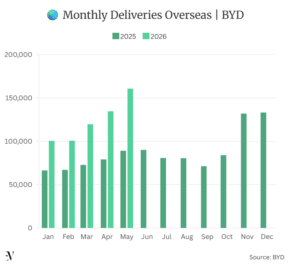
This was the first time international deliveries exceeded 160,000 vehicles in a single month. Overseas sales were up more than 80% compared with the same period a year earlier.
Between January and May, BYD sold 616,263 vehicles outside China. International markets now account for more than 40% of the company’s monthly sales. The growth reflects BYD’s rapid expansion into Europe, Southeast Asia, Latin America, Australia, and the Middle East.
This matters because transportation remains one of the world’s largest sources of greenhouse gas emissions. According to the International Energy Agency (IEA), transport accounts for roughly one-quarter of global energy-related carbon dioxide emissions.
Electric vehicle adoption is becoming one of the main tools for reducing those emissions.
Global EV sales exceeded 17 million units in 2024, according to the IEA. The agency estimates that electric vehicles displaced more than 1.8 million barrels of oil demand per day during the year.
As EV adoption grows, companies with global reach will play a larger role in transport decarbonization. BYD is increasingly becoming one of those companies.
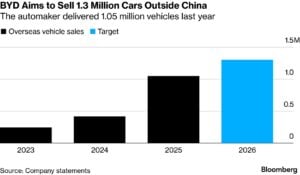
Several analysts expect overseas sales to become one of the company’s biggest growth drivers over the next decade. Citi previously estimated that BYD could sell as many as 1.6 million vehicles outside China in 2026. But the EV giant aims to sell about 1.3 million cars overseas.
Solid-State Batteries Could Shape the Next Phase of EV Adoption
While sales are growing today, BYD is also preparing for the next generation of electric vehicles. The company recently confirmed plans to begin limited deployment of all-solid-state batteries by 2027. Broader commercialization is expected closer to 2030.
Solid-state batteries have been viewed as one of the most promising advances in battery technology.
Unlike conventional lithium-ion batteries, solid-state batteries replace liquid electrolytes with solid materials. This can improve energy density, increase safety, and potentially reduce charging times.
BYD has indicated that its future solid-state batteries could exceed 400 watt-hours per kilogram (Wh/kg). That is significantly higher than many current EV battery systems.
Higher energy density means more energy can be stored in the same amount of space and weight. In practical terms, this could help support driving ranges of more than 1,000 kilometers under certain conditions.
The technology could also address one of the biggest concerns among potential EV buyers: range anxiety.
Battery innovation remains critical for the industry’s long-term growth. BloombergNEF predicts that global demand for lithium-ion batteries will keep growing fast. This increase is driven by transportation, energy storage, and electrification.
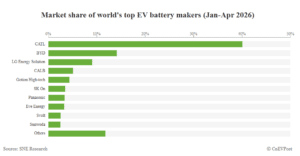
BYD already plays a major role in that market. The company is the world’s second-largest battery manufacturer by installed capacity, behind CATL. Its battery business accounts for more than 17% of global battery installations.
This gives BYD a unique advantage. Unlike many automakers, it manages most of its battery supply chain. This enables the company to add new technologies directly to its vehicles.
The EV Battle Is Shifting From Hardware to Software
The latest driver-assistance announcement highlights another shift taking place across the industry. For years, EV competition focused mainly on battery range and vehicle pricing. Today, software is becoming equally important.
BYD recently announced that it would assume liability in certain situations when its driver-assistance system is active. The move signals growing confidence in the company’s advanced driving technologies.
The announcement comes as automakers invest billions of dollars in software development, artificial intelligence, sensors, and computing systems. These technologies can improve safety, reduce driver workload, and support future automated driving capabilities.
The race is becoming increasingly competitive. Companies such as Tesla, Mercedes-Benz, XPeng, Huawei-backed automakers, and BYD are all investing heavily in intelligent driving systems.
As EV hardware becomes more standardized, software capabilities may become a major factor in purchasing decisions.
Why EVs Are Central to Global Net-Zero Strategies
BYD’s recent announcements also reflect a broader shift in the global energy transition. Countries, cities, and corporations are increasingly adopting net-zero targets. Transportation is a major focus because it remains one of the hardest sectors to decarbonize.
Transport remains one of the largest sources of emissions globally. According to the International Energy Agency, the transport sector accounts for about 23% of global energy-related CO₂ emissions. Road vehicles generate the majority of those emissions.
This is why electric vehicles become crucial in decarbonizing the sector. In the IEA’s Net Zero Emissions Scenario, EVs must make up about two-thirds of global vehicle sales by 2035. This is crucial to meet international climate goals.
EV adoption continues to accelerate. Global EV sales surpassed 17 million vehicles in 2024, representing more than 20% of all new vehicle sales worldwide.
This is where BYD’s scale becomes important. The company sold more than 4.2 million new-energy vehicles in 2024, making it the world’s largest NEV manufacturer.
As governments continue investing in renewable energy and grid modernization, battery manufacturers are expected to play an increasingly important role. That trend could create additional growth opportunities beyond vehicle sales alone.
BYD’s role extends beyond vehicles. The company makes batteries and energy storage systems. These are vital for adding renewable energy to power grids. As more solar and wind capacity comes online, demand for battery storage is expected to grow rapidly.
BYD Stock Reflects Growing Expectations
The company’s recent announcements have also drawn attention from investors. As of June 2, 2026, BYD’s Hong Kong-listed shares were trading around HK$96-97, following a recent rebound driven by record overseas sales figures.
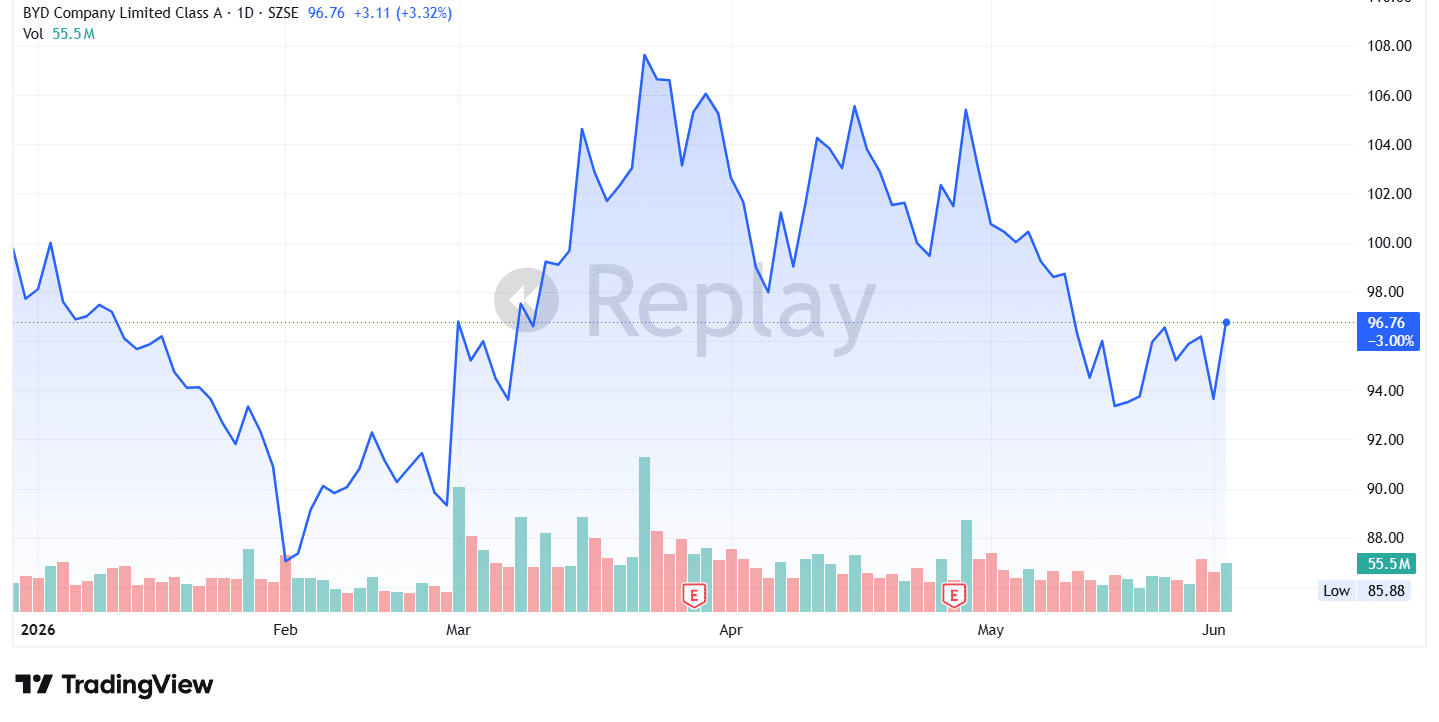
The stock jumped about 6.6% on June 2. This came after the company announced that overseas deliveries soared over 80% year over year in May. This marked the end of eight straight months of declining annual sales.
BYD stock has benefited from strong sales growth, expanding international operations, and continued technology development. Investors increasingly view the company as more than an automaker. Many now see it as a broader clean energy and battery technology company.
Markets are paying close attention to several factors. These include overseas sales growth, battery innovation, profitability, and the company’s ability to compete in international markets.
Taken together, these developments show how the EV industry is evolving. Success is no longer determined by vehicle production alone. It now depends on a combination of scale, battery innovation, software capabilities, and participation in the wider clean energy transition.
BYD appears intent on competing across all of those fronts.