


Google has reached another important climate milestone. Yet, the company says its biggest environmental goal is becoming more difficult to achieve.
In its 2026 Environmental Report, Google announced a 2% reduction in its operational greenhouse gas emissions (Scope 1 and market-based Scope 2) for 2025. This came even though the company saw its highest annual rise in electricity use.
At the same time, the company acknowledged that its long-term climate “moonshot” is facing growing pressure. This is due to artificial intelligence rapidly expanding demand for data centers, electricity, and construction materials.
The report marks an important shift in Google’s climate story. Kate Brandt, Chief Sustainability Officer at Google, remarked:
“While the path to achieving our climate ambitions will not be linear — given our AI infrastructure buildout is currently accelerating faster than the grid is decarbonizing — we remain focused on scaling abundant and affordable clean power globally and progressing technological innovations that drive down emissions across our operations and the broader industry.”
Cleaner Operations, Bigger Climate Challenge
For years, the company focused on reducing emissions from its own operations. Today, the bigger challenge lies outside its direct control. Supply-chain emissions are growing faster than operational emissions. This increase is mainly due to Google expanding its AI infrastructure and purchasing more servers, semiconductors, and other equipment.
“Our climate moonshot is getting harder,” Google said in the report. They point to these reasons:
- rising electricity demand,
- slow grid connections,
- supply chain bottlenecks, and
- limited availability of carbon-free energy in many regions.
The report highlights a broader trend across the technology industry. As companies rush to develop AI infrastructure, they discover that reducing emissions becomes tougher. This is true even as they invest heavily in clean energy.
Google’s operational progress remains significant.
The company reported combined Scope 1 and market-based Scope 2 emissions of about 2.9 million metric tons of CO₂e in 2025, down 2% from 2024. This is the second year of operational gains after a 12% drop in 2024. Google’s investments in clean energy and efficient data centers are showing real results.
However, the broader picture is more challenging.
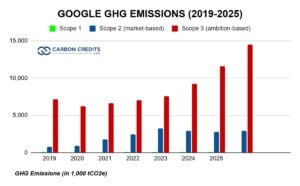
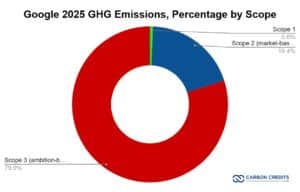
Google’s ambition-based emissions hit around 14.5 million metric tons of CO₂e in 2025. This is an 18% rise from last year and 81% higher than its 2019 baseline. About 80% of emissions came from Scope 3. This includes purchased goods, construction materials, transportation, and manufacturing in its global supply chain.
The biggest driver is AI.
Google’s data center footprint continues to expand to support products such as Gemini and other AI services. The company reported a 37% increase in electricity load year over year. Improvements in AI hardware and software helped control demand, keeping it from rising even more.
This reflects a growing challenge across the technology sector. The International Energy Agency (IEA) says that electricity demand from AI, data centers, and digital tools will increase rapidly in the coming years. This makes clean electricity a top priority for the industry.
Clean Energy Is Central to Google’s Climate Strategy
The tech giant continues to invest heavily in clean energy as electricity demand grows. In 2025, the company signed deals for over 12 GW of new clean energy. It also launched more than 25 projects, adding nearly 2 GW to the grids that power its operations. It also maintained its goal of matching 100% of its annual electricity use with renewable energy purchases.
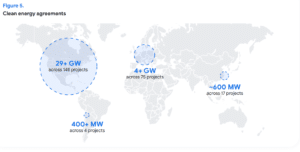
Google is investing in advanced geothermal, nuclear, and other carbon-free energy. This will help provide reliable power for AI data centers.
Its global data centers reached an average Power Usage Effectiveness (PUE) of 1.09. This makes them some of the most energy-efficient in the world. Google states that cleaner electricity grids are crucial. Efficiency alone can’t match the fast growth of AI.
RELATED: Google’s Wild AI Strategy: 500 MW Solar Deal and Potential SpaceX Orbital Data Centers
The Hardest Emissions Now Come From Google’s Supply Chain
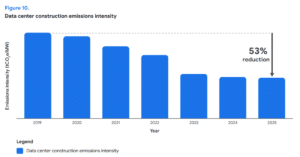
Google’s biggest climate challenge is no longer running its offices or data centers. It is building them.
In 2025, Scope 3 emissions made up nearly 80% of Google’s total carbon footprint. Most came from purchased goods and services, capital equipment, and construction materials needed for AI infrastructure. The company says demand for servers, chips, networking equipment, and new data centers continues to grow as AI adoption accelerates.
To address this, Google is working directly with suppliers.
The company launched a Clean Energy Addendum. It asks key hardware suppliers to use 100% clean electricity by the end of 2029. Google estimates the program could cut up to 8 million metric tons of CO₂e. It also helps suppliers create cleaner manufacturing operations, and more than 75 of them have already signed the agreement.
The tech giant is also helping suppliers with clean electricity buying programs and financing tools. This is especially true in Asia, where many electronics makers still depend on fossil fuels for power.
The company states that cutting supply chain emissions needs teamwork across the whole tech sector, not just one company acting alone.
Carbon Removals: Can It Help Close the Gap?
Google acknowledges that clean electricity alone will not eliminate all emissions.
Some emissions from aviation, construction materials, and semiconductor manufacturing remain difficult to avoid. To address these, the company is investing in high-quality carbon removal solutions.
Its portfolio includes direct air capture, biochar, enhanced rock weathering, forest restoration, and nature-based carbon removal projects. Google states these technologies will help reduce emissions that can’t be eliminated by operational improvements alone.
At the same time, the company continues to strengthen its climate governance.
Google’s net-zero goal is backed by the Science Based Targets initiative (SBTi). It also reports its progress through well-known climate disclosure frameworks. The company states that transparent reporting is crucial. Investors, regulators, and customers want clear proof of corporate climate action.
Overall, the sustainability report showed a big 18% jump in greenhouse gas emissions from high energy use in AI data centers. But Wall Street is focusing on Alphabet’s 21.8% revenue growth and strong “Buy” ratings from investors.

Google’s Moonshot Reflects a Broader Industry Challenge
Google’s latest environmental report tells two stories at once.
On one hand, the company continues to reduce emissions from its own operations while expanding one of the world’s largest portfolios of clean electricity projects. Improvements in renewable energy procurement, efficient data centers, and supplier engagement show that meaningful progress is still possible.
On the other hand, AI is changing the scale of the challenge.
Building the infrastructure needed for the next generation of computing requires more electricity, more materials, and more complex global supply chains. These factors are making net-zero targets harder to achieve—not only for Google but for much of the technology industry.
The company’s experience highlights a broader shift in corporate sustainability. The climate conversation is no longer just about reducing emissions from day-to-day operations. It is increasingly about transforming entire value chains while supporting the rapid growth of AI and other digital technologies.
For Google, operational emissions are moving in the right direction. The harder task now is ensuring that the infrastructure powering the AI era can grow without leaving a larger carbon footprint behind.