

Tesla’s latest earnings, Q2 2026, show that the company is entering a new chapter. For years, the EV giant earned hundreds of millions of dollars by selling regulatory carbon credits to other automakers that failed to meet emissions rules. Those credits helped support profits, especially during periods of heavy investment.
That business is now shrinking and dropped 67% compared to the previous year. The sharp decline shows rising competition in the electric vehicle (EV) market. More automakers are now making enough zero-emission vehicles to meet regulations on their own.
Instead of relying on carbon credit sales, Tesla is increasingly betting on artificial intelligence (AI), battery storage, robotics, and manufacturing to drive future growth. Those investments are putting pressure on short-term profits but could strengthen the company’s position in the long run.
The Numbers Behind Tesla’s Transition
Tesla’s financial results showed a mixed picture. Revenue rose 26% year over year to $28.24 billion, helped by growth in its energy generation and storage business, services, and vehicle sales.
However, gross margin fell to 17.2%, down from 18.0% a year earlier, as the company continued investing heavily in AI, manufacturing, and new products. Operating income reached $1.28 billion, while net income totaled $1.11 billion.
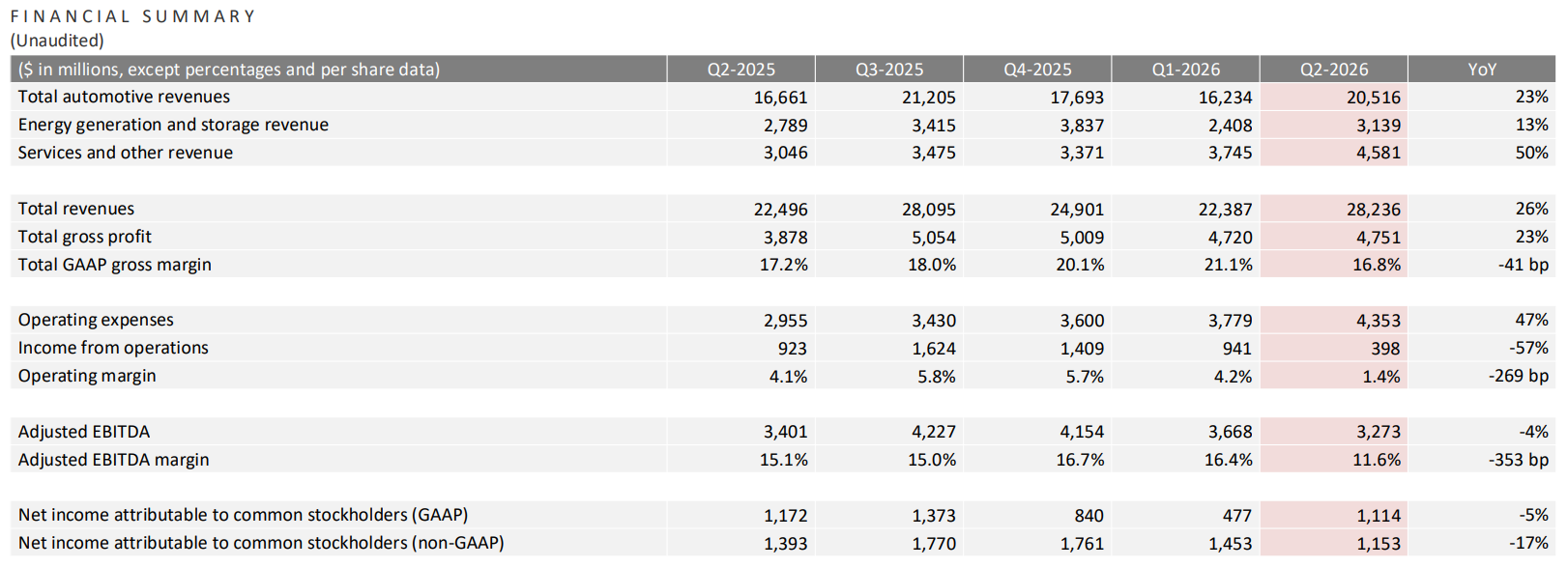
Tesla ended the quarter with a strong balance sheet, holding $36.8 billion in cash, cash equivalents, and investments, giving it significant financial flexibility to fund future growth.
The EV maker reported $28.24 billion in revenue during the second quarter, up 26% from a year earlier. Growth came mainly from its energy business, services, and software, while vehicle deliveries also improved.
However, net income declined as the company continues to invest heavily in future technologies and expand manufacturing.
Carbon Credit Revenue Takes a Back Seat
One of the biggest changes was the drop in regulatory credit sales.
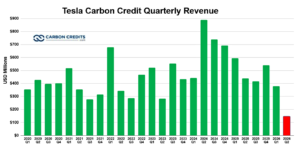
In the second quarter of 2026, Tesla’s regulatory credit revenue fell to $146 million, down about 67% from $439 million a year earlier. The credits accounted for just 0.6% of total revenue, their lowest share in years. Most remarkably, it’s the lowest quarterly revenue from regulatory credits since 2020.
For much of the past decade, legacy automakers bought credits from Tesla to comply with emissions rules in the United States and Europe. Since producing electric vehicles generates regulatory credits, Tesla built up large surpluses that it could sell for high margins.
That source of income is becoming less important today.
Many global automakers have expanded their own EV lineups, reducing the number of credits they need to buy. Governments are also tightening emissions standards while encouraging manufacturers to produce more zero-emission vehicles instead of relying on purchased credits.
The decline does not mean carbon markets are disappearing. Rather, it suggests that one part of the market is maturing as the broader auto industry electrifies.
Why Tesla Is Spending Billions on AI and Robotics
As carbon credit revenue declines, Tesla is investing aggressively in its next phase of growth.
During the quarter, capital spending climbed to $5.8 billion, pushing free cash flow into negative territory. The company said the higher spending reflects continued investments in AI computing, manufacturing capacity, robotics, battery production, and energy infrastructure.
Chief Executive Elon Musk has repeatedly said Tesla’s future extends well beyond selling electric cars. The company’s strategy now includes autonomous driving, Robotaxi services, the Optimus humanoid robot, stationary battery storage, and AI-powered software.
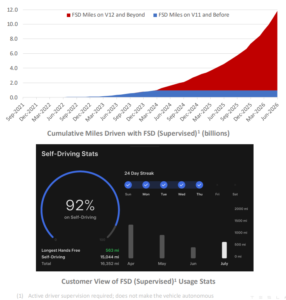
The EV giant expanded its Robotaxi service to the San Francisco Bay Area, while customers logged more than 7 million miles using FSD (Supervised) since the Robotaxi launch. At the same time, its Optimus humanoid robot is already performing tasks inside Tesla factories as the company works toward larger-scale deployment.
Those investments are expensive today. But Tesla believes they will create new revenue streams while supporting the transition to a low-carbon economy.
Battery Storage Is Emerging as Tesla’s Next Powerhouse
Tesla’s energy business delivered one of its strongest quarters yet.
The company deployed a record 13.5 gigawatt-hours (GWh) of battery storage during the quarter, surpassing its previous highs. Megapack systems help utilities and businesses store electricity from solar and wind projects. This makes renewable energy more reliable and cuts down on reliance on fossil-fuel power plants.
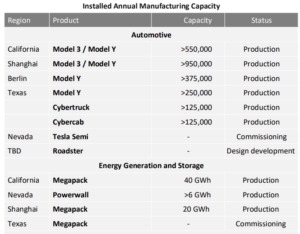
The timing is important.
The International Energy Agency (IEA) reports that global electricity demand is rising faster than total energy demand. This growth is fueled by electric vehicles, data centers, air conditioning, and industrial electrification. To keep pace, countries need much more battery storage to balance renewable energy and stabilize power grids.
BloombergNEF forecasts that global energy storage installations will keep growing quickly until the decade ends. Utilities are investing in cleaner, more flexible electricity systems.
For Tesla, that creates an opportunity beyond vehicles. As battery use increases, the company’s energy business may become a key source of revenue and help cut emissions.
Tesla’s Climate Vision Is Bigger Than EVs
Tesla’s latest results show that the company’s climate strategy is becoming much broader than selling EVs.
The company continues to invest in technologies that support a cleaner energy system. These include battery storage, artificial intelligence, autonomous driving, robotics, and manufacturing improvements. Together, they aim to speed up the shift away from fossil fuels while creating new sources of growth.
Tesla has also continued improving the environmental impact of its operations. According to its latest Impact Report, the company says every product it builds is designed to help replace fossil fuel use.
Since 2018, Tesla vehicles have helped customers cut over 41 million metric tons of CO₂-equivalent emissions. Also, its energy storage products support more renewable electricity on power grids.
The company’s factories are also becoming more efficient. Tesla is boosting its use of renewable electricity and is also cutting down on water use. The EV giant also plans to recycle more battery materials.
Additionally, Tesla is expanding closed-loop manufacturing to recover valuable metals like lithium, nickel, cobalt, and copper.
More EV Competition Means Fewer Carbon Credits
Tesla’s falling carbon credit revenue also reflects a major shift across the auto industry.
Several large automakers are now producing enough electric vehicles to reduce their need for regulatory credits. Companies such as BYD, Hyundai, BMW, Mercedes-Benz, Volkswagen, and General Motors have expanded their EV lineups over the past few years.
At the same time, global EV demand continues to grow.
According to the IEA, electric car sales topped 21 million vehicles in 2025, accounting for more than one in every four new cars sold worldwide. China remains the largest EV market, while sales continue to rise across Europe and North America.
This means Tesla is operating in a much larger market—but also a much more competitive one. Future success will rely more on technology and innovation than on regulatory credits. It will also depend on manufacturing efficiency and new businesses like energy storage and AI.
Wall Street Watches Tesla’s Next Big Bet
Tesla’s earnings received a mixed reaction from investors. After the company shared its Q2 results, the stock dropped in after-hours trading. Investors reacted to lower profits, reduced regulatory credit revenue, and increased spending on AI and new technologies.
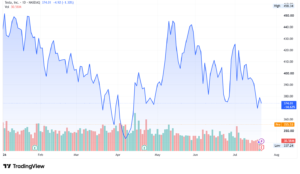
The market reacted to management’s cautious comments. They highlighted near-term challenges, like changes to U.S. EV incentives and ongoing investment in future products.
However, many analysts noted that Tesla’s long-term story remains tied to businesses beyond vehicle sales. Growth in energy storage, autonomous driving, AI, and robotics could become increasingly important over the next decade if those investments succeed.
Tesla’s Next Chapter Will Look Very Different
Tesla’s latest quarter marks the end of an important era.
For years, regulatory carbon credits provided a valuable financial boost while the rest of the auto industry caught up on electric vehicles. That advantage is fading as EV adoption becomes more widespread.
However, that may not be bad news. The company’s record 13.5 GWh of battery deployments this quarter shows that Tesla is becoming more than an automaker. It is increasingly positioning itself as a broader clean energy and technology company.
As the global economy moves toward lower emissions, Tesla’s next growth chapter may be driven less by selling carbon credits and more by providing the technologies needed to power the energy transition.