

Citigroup has committed an estimated $647.2 billion to sustainable finance since 2020, putting the bank more than halfway toward its $1 trillion goal by 2030.
Citi reported the milestone in its latest 2025 Sustainability Report, released in July 2026. The bank also set new targets to cut its own operational emissions and energy use through 2030 after exceeding several of its previous climate goals.
Citi committed $91.3 billion to sustainable finance in 2025 alone. Of that amount, 62% went to international markets outside North America, while 38% went to North America.
The latest numbers show how banks are becoming a major source of capital for the energy transition. They also highlight a key difference between financing climate projects and cutting the bank’s own emissions.
Citi Crosses the $647 Billion Mark
Citi launched its $1 trillion Sustainable Finance Goal in 2021. The target covers both environmental and social finance, so the full amount does not represent spending on climate projects alone.
- By the end of 2025, Citi had financed and facilitated an estimated $647.2 billion toward the goal. That equals about 65% of the $1 trillion target.
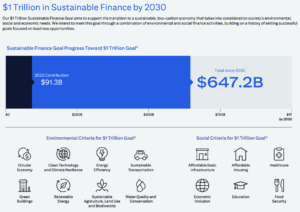
The bank added $91.3 billion in 2025. Banking contributed $67.5 billion, while Investment Banking accounted for $65.7 billion in eligible activity. Renewable energy and sustainable transportation were among the largest environmental categories.
The company estimates that financing since 2020 has helped avoid around 8.8 million metric tons of greenhouse gas emissions. It has also supported over 4.4 million jobs and reached nearly 67 million people.
Citi says it uses a conservative approach to estimate these impacts and only includes transactions where it has suitable methods and data. Those impact figures are estimated outcomes linked to financing, not direct reductions in Citi’s own corporate emissions.
Citi’s Climate Capital Goes Global
Citi’s sustainable finance activity is also becoming more international. Of the $91.3 billion committed in 2025, about $56.6 billion, or 62%, supported projects outside North America. North American projects received $34.7 billion, or 38%.
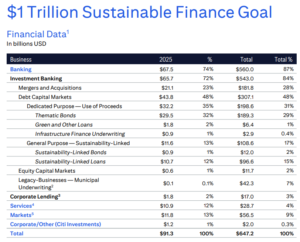
Looking at the full program since 2020, international markets received $363.8 billion, or 56% of total commitments. North America accounted for $283.3 billion, or 44%.
This mix is important because many emerging markets need private capital to grow. They want to expand clean energy, improve infrastructure, and boost climate resilience.
For Citi, it also creates a bigger opportunity to finance projects in markets where energy demand and investment needs are growing quickly.
Citi Exceeded Its 2025 Emissions Goal
Citi also reported strong progress in its own operations. The bank had set a 2025 goal to cut location-based Scope 1 and Scope 2 emissions by 45% from its 2010 baseline. It achieved a 58% reduction instead.
The major financier noted in its report:
“At the end of 2025, we closed out our fourth generation of goals, which have helped drive performance improvements related to GHG emissions, energy, water, waste, and sustainable building design.”
Citi’s total location-based Scope 1 and 2 emissions stood at 370,030 metric tons of CO2e in 2025, about 3.8% lower than in 2024. Scope 1 emissions accounted for 50,790 tonnes, while location-based Scope 2 emissions totaled 319,240 tonnes.
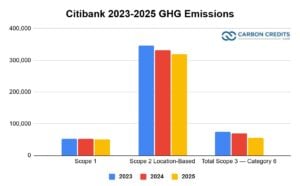
The bank also achieved its energy goal. It cut total energy consumption by 43% from the 2010 baseline, beating its earlier target of 40%. Citi also maintained 100% renewable electricity sourcing in 2025.
These results show progress in the areas Citi can control directly, such as its buildings, electricity use and other operating activities.
New 2030 Goals Raise the Bar
After exceeding its previous targets, Citi has set a new set of operational goals for 2030. The bank plans to cut location-based emissions by another 15% from its 2025 baseline. It also aims to reduce energy consumption by 10% from the same baseline.
Citi says the new goals use revised boundaries and baselines, so the comparison does not simply extend the older 2010 targets.
The bank will focus on areas such as energy efficiency, facility upgrades, and onsite renewable generation. Citi installed onsite renewable systems at 17 locations during its previous goals. It also added batteries at some sites to store extra renewable power.
The new targets support Citi’s broader commitment to reach net-zero emissions from its own operations by 2030.
Carbon Credits Do Not Count Toward the Goal
The major bank also reports carbon credit purchases, but it keeps them separate from its operational emissions target.
The bank reported 50,790 metric tons of carbon credits for 2025. This includes projects like nature-based solutions, energy efficiency, and methane destruction. Those credits did not count toward Citi’s operational emissions goals.
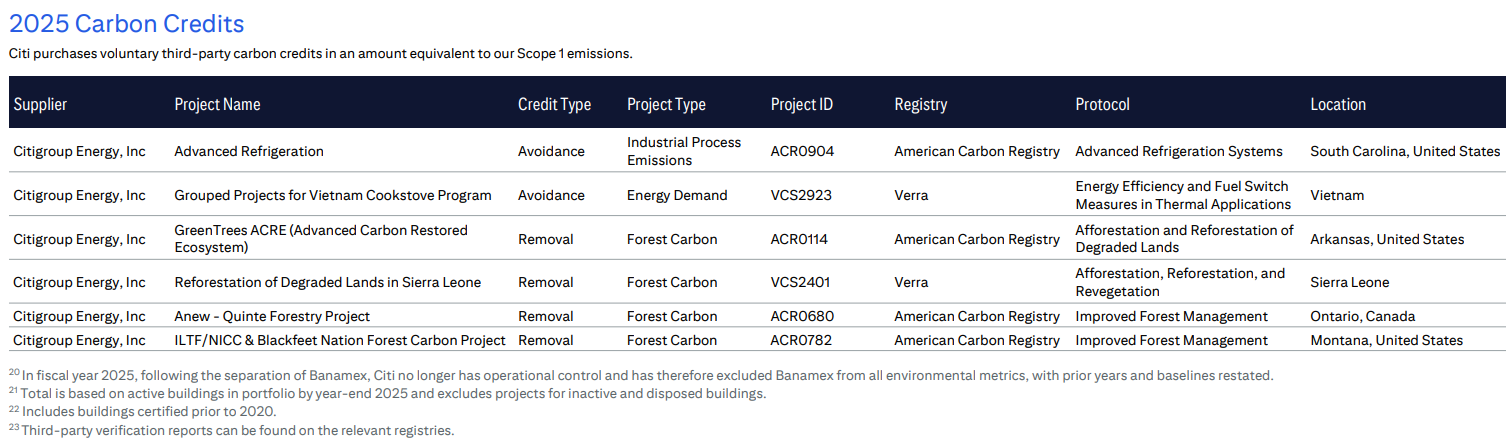
That distinction is important. Citi has said its operations target focuses on reducing its own Scope 1 and Scope 2 emissions rather than relying on offsets. Its net-zero commitment covers its global operations by 2030, while its financing-related emissions target extends to 2050.
This approach separates direct emissions cuts from voluntary carbon market activity. This is important for carbon markets. Companies must show that carbon credits lead to real emissions cuts, not just replace them.
The Bigger Challenge Is Citi’s Financed Emissions
For a major bank, its biggest climate impact does not come from its offices. It comes from the businesses and projects it finances.
Citi committed to reach net-zero greenhouse gas emissions associated with its financing by 2050. Since 2021, it has established 2030 interim emissions reduction targets for 10 sectors in its portfolio, including some of the most carbon-intensive parts of the economy.
These areas include sectors such as energy, power, steel, and other carbon-intensive industries. This creates a harder challenge than cutting electricity use in offices.
Citi can control its own facilities directly. It has much less direct control over the emissions produced by companies and projects that receive its financing.
The bank therefore uses client engagement, emissions data, and transition plans as part of its net-zero strategy.
Sustainable Finance Is Not the Same as Green Finance
Citi’s $647 billion figure needs some context. The bank’s $1 trillion goal includes both environmental and social finance. Eligible areas range from renewable energy and clean technology to affordable housing, health care, education and food security.
That means the full $647.2 billion cannot be described as climate finance. It is also important to distinguish financing activity from actual investment.
Citi says the goal can include transactions it has financed or facilitated, and a transaction may qualify under more than one environmental or social category but counts only once toward the overall goal.
Citi’s Two-Front Climate Fight
Citi’s latest report shows progress on two different fronts. The bank has reached $647.2 billion toward its $1 trillion sustainable finance goal, leaving about $352.8 billion to reach the target by 2030.
It also reduced location-based operational emissions by 58% from 2010 levels and energy use by 43%. At the same time, it maintained 100% renewable electricity sourcing.
Now Citi wants another 15% cut in location-based emissions and a 10% reduction in energy use by 2030 from its 2025 baseline.
The harder test will remain financed emissions. Citi’s role as a global lender means its climate impact depends heavily on where it directs capital and how quickly its clients cut emissions.
As the bank moves toward its $1 trillion sustainable finance goal and its 2050 net-zero financing commitment, the key measure will be how much money Citi labels as sustainable and whether that capital helps deliver measurable emissions cuts across the wider economy.