

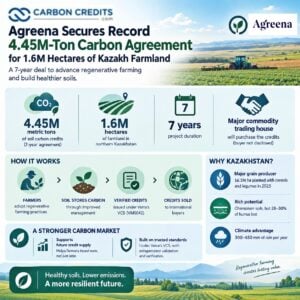
Agreena has signed a 7-year agreement for 4.45 million metric tons of soil carbon credits linked to regenerative farming across 1.6 million hectares of farmland in northern Kazakhstan. The agreement is the largest publicly communicated agricultural carbon agreement to date, according to Agreena. A major commodity trading house will purchase the credits, although the buyer has not been named.
The project is targeting the transition of 1.6 million hectares to regenerative farming by 2028. It will generate credits through AgreenaCarbon Kazakhstan, a new project that has entered validation under the Verra Verified Carbon Standard (VCS).
Frederik Aagaard, chief commercial officer, Agreena said:
“A buyer of this scale only commits to those terms when it is confident the supply will be delivered. That assurance rests on the platform behind it: the scientists who design the program, the dMRV technology that measures it, and the commercial team that brings farmers and buyers to the same table.”
The deal is important for more than its size. It shows that buyers are increasingly willing to commit to future carbon credit supply years before credits are issued.
- RELATED: Kazakhstan Opens 5.2M Hectares for Carbon Projects, Eyes Article 6 Credit Trading
- ALSO: Live Carbon Prices Today
A Large Forward Carbon Deal for Agriculture
Agreena announced a 4.45 million-ton agreement. This deal spans seven years, making it one of the longest commitments for a soil carbon project.
The partnership is a forward purchase agreement, meaning the carbon credits will be delivered over time rather than being available immediately. This model can help solve one of the biggest challenges in agricultural carbon markets: financing the changes needed before credits are generated.
Farmers often need to change equipment, crop management, and field practices before measurable climate benefits appear. Long-term buyer commitments can provide more certainty that a market will exist for those future credits.
Agreena says the revenue from the agreement will support Kazakh farmers as they adopt regenerative farming practices. The company currently works with about 2,500 farmers across approximately 5 million hectares in 20 countries. Kazakhstan is its 21st market.
The 1.6 million hectares targeted by the new project would equal roughly 7% of Kazakhstan’s 23.6 million hectares of sown land in 2025, based on national statistics.
Why Kazakhstan Could Become a Soil Carbon Powerhouse
Kazakhstan is a major grain producer with a large farming base, making it an attractive market for soil carbon projects. National statistics show that the country planted about 16.1 million hectares of cereals and legumes in 2025. Total crop production also grew, with the physical volume of crop output increasing 7.8% during the year.
The new project focuses on the country’s northern grain belt. Agreena reports that the region’s Chernozem soils are rich in organic matter. However, they have lost around 28% to 30% of their humus due to decades of conventional farming. Rebuilding soil organic carbon could therefore provide both climate and agricultural benefits.
Regenerative practices in the project include reduced tillage, better residue management and cover crops. These practices can help keep more carbon in the soil while improving moisture retention and reducing soil disturbance.
Agreena says the region receives only about 300 to 450 millimeters of rain each year, making soil moisture an important issue for farmers. Keeping crop residues on fields can help retain moisture, while reduced tillage can lower fuel use.
The Credits Still Need to Pass Verra Validation
The size of the agreement should not be confused with credits already issued. AgreenaCarbon Kazakhstan, Verra project ID 6105, is currently undergoing validation under Verra’s VM0042 v2.2 Improved Agricultural Land Management methodology.
Validation checks whether the project meets the right carbon standards and methods. Credits can only move forward after the necessary climate outcomes are measured and independently assessed.
This distinction matters for buyers and investors. The 4.45 million tons are contracted future credits, not 4.45 million verified carbon units available today.
Verra’s VM0042 methodology covers greenhouse gas emission reductions and soil organic carbon removals resulting from improved agricultural practices. These include reduced tillage, improved fertilizer use, residue and water management, and cover crop practices.
The methodology was approved by the Integrity Council for the Voluntary Carbon Market (ICVCM) as meeting its Core Carbon Principles requirements. However, projects still have to meet project-level conditions before their credits can receive a CCP label.
Soil Carbon Is Gaining Credibility
Agricultural carbon has faced questions about measurement, additionality, and permanence. Soil carbon can change because of weather, farming practices, and other factors, making accurate measurement difficult.
Verra has been tightening its rules to address those challenges. VM0042 v2.2 added changes to baseline setting and additionality and strengthened requirements around measuring soil organic carbon.
In June 2026, Verra made more corrections and clarifications. These included rules about additionality evidence, baseline descriptions, and when to measure and model. The ICVCM’s Core Carbon Principles also require projects to demonstrate additionality and provide safeguards against reversal risks.
These requirements matter because soil carbon is not simply a matter of counting how much carbon is present in a field at one point in time. Projects must establish credible baselines and show that the credited climate benefits would not have occurred without the project incentive.
Agreena’s First Verified Project Sets the Stage
The Kazakhstan project is not Agreena’s first major soil carbon initiative. In September 2025, the AgreenaCarbon Project became the first large-scale agricultural project to get verified under Verra’s VCS. The project received approval for 2.3 million VCUs across more than 1.6 million hectares.
Agreena reported 1.2 million tons of CO2 reductions and 1.1 million tons of CO2 removals. These came from better farming practices and soil carbon sequestration. That experience could help the company scale its Kazakhstan project, although the new project still has to complete its own validation and verification process.
Agreena also uses digital measurement, reporting, and verification tools alongside field data, soil sampling, and modeling. Its programme has previously undergone independent assessment under ISO 14064-2.
The Carbon Market Is Moving Toward Forward Supply
The agreement also reflects a broader change in voluntary carbon markets. Buyers looking for large volumes of credits increasingly need to secure future supply rather than rely only on spot purchases. That is especially relevant for sectors with limited options for cutting their remaining emissions.
The data from Sylvera shows that offtake agreements in the market have grown 205% in 2025 from the previous year.
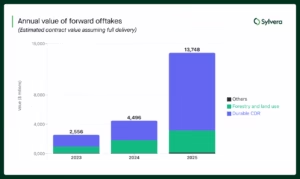
A seven-year commitment can give developers capital and visibility while giving buyers greater certainty over future volumes.
However, forward deals also carry risk. Projects may experience delays, low credit generation, or changes in methods. Also, verification requirements can shift, and future demand may be uncertain.
For agricultural projects, weather is another major variable. Drought, flooding, and changes in crop yields can affect the ability of farmers to maintain regenerative practices and the amount of carbon stored in soil. Strong measurement and risk-management systems are therefore essential.
Regenerative Farming Could Deliver Wider Benefits
The carbon benefits are only part of the potential value. Agreena says reduced tillage can save farmers about 40 to 60 liters of diesel per hectare. Keeping crop residues helps save soil moisture. Stopping stubble burning cuts down on pollution and nitrogen oxide emissions.
The company also expects improved soil practices to support biodiversity and make farmland more resilient to drought and flooding.
Northern Kazakhstan’s grain belt is home to important steppe ecosystems. Agreena highlights two key species: the Sociable Lapwing, which is critically endangered, and the Steppe Eagle, which is endangered. Both could thrive with improved land management.
These co-benefits could become increasingly important as carbon buyers look beyond the number of tonnes on a credit and assess broader environmental outcomes.
A Major Test for Agricultural Carbon at Scale
The 4.45 million-ton agreement is significant, but its real impact will depend on delivery. Still, the opportunity is substantial. Kazakhstan has a large farming sector, while demand for large volumes of higher-quality carbon credits is growing.
For Agreena, the agreement provides a major long-term commercial commitment. For Kazakhstan, it could bring new income to farmers while improving soil health and resilience. And for the wider carbon market, the deal sends a clear message: soil carbon is moving from small farm-level projects toward large, long-term carbon supply agreements.