


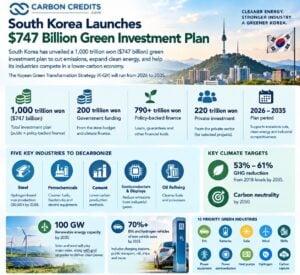
South Korea has unveiled a 1,000 trillion won ($747 billion) green investment plan to cut emissions, expand clean energy, and help its industries compete in a lower-carbon economy.
The Korean Green Transformation Strategy, known as K-GX, will run from 2026 to 2035. Announced on October 7, 2026, it aims to support cleaner manufacturing, renewable energy, electric vehicles, and new climate technologies.
The government plans to mobilize 1,000 trillion won through public funding and policy-backed climate finance. It also expects a further 220 trillion won in private-sector investment for selected green projects. These are investment targets, not funds already spent.
South Korea’s Ministry of Climate, Energy and Environment said:
“This framework guarantees that South Korea will firmly adhere to its global carbon neutrality milestones while actively building domestic green jobs and securing the next generation of energy self-reliance.”
How South Korea Will Fund the Plan
South Korea wants to cut greenhouse gas emissions by 53% to 61% from 2018 levels by 2035 and reach carbon neutrality by 2050. The new plan is designed to support those goals while protecting the country’s manufacturing and export industries.
The government plans to combine public spending with loans, guarantees, and private investment. Its financing plan includes around 200 trillion won from government budgets and more than 790 trillion won in policy-backed climate finance. This financing aims to support clean energy infrastructure, industrial upgrades, and research into low-carbon technologies.
The government also wants private companies to invest another 220 trillion won in designated projects. Tax incentives, easier access to financing, and public-private partnerships are expected to help attract that money.
The goal is to help companies manage the high cost of changing how they make products. Many factories rely on fossil fuels, and replacing their equipment can take years and require major investment. However, the plan’s success will depend on how much funding reaches actual projects and whether those projects deliver measurable emissions cuts.
Five Industries Face Pressure to Cut Emissions
K-GX focuses on five major industrial groups:
- steel,
- petrochemicals,
- cement,
- semiconductors and displays, and
- oil refining.
These industries support South Korea’s economy but can produce large amounts of greenhouse gases. Some also need very high temperatures or specialized industrial gases that are difficult to replace. The government plans to support cleaner production methods across these sectors.
In steelmaking, it aims to demonstrate hydrogen-based iron production at a scale of 30,000 tonnes by 2030. This technology uses hydrogen instead of coal to remove oxygen from iron ore.
Petrochemical and refining companies are expected to explore cleaner fuels, feedstocks, and electric equipment. Cement makers will focus on lower-carbon methods. At the same time, semiconductor and display manufacturers will find ways to cut emissions from industrial gases.
These changes could help South Korean manufacturers supply customers seeking lower-carbon products. But companies will need affordable clean electricity, reliable technology, and suitable infrastructure to make the transition.
South Korea Targets 100 GW of Renewable Power by 2030
South Korea aims to expand its renewable energy capacity to 100 gigawatts by 2030. Solar and wind power are expected to play major roles.
The government plans to upgrade the electricity grid. This will help it carry more renewable power from generation sites to factories and cities.
This is important because building solar and wind farms alone will not be enough. The country also needs transmission lines and other equipment to deliver that electricity where it is needed.
More renewable power could help manufacturers reduce emissions from their electricity use. It could also create opportunities for solar panel makers, wind developers, battery companies, and grid equipment suppliers. Still, meeting the target will depend on construction, permits, financing, and the speed of grid upgrades.
EVs and Hydrogen Vehicles to Gain Ground
South Korea wants electric and hydrogen-powered vehicles to account for more than 70% of new vehicle sales by 2035. The plan includes support for charging stations and cleaner transport. It also covers buses, rail, construction equipment, ports and ships.
The shift could support South Korean companies that make electric vehicles, batteries and charging equipment. It may also increase demand for better battery technology and related infrastructure.
The government has identified 10 priority green industries for support. These include electric vehicles, batteries, solar panels, wind power, small modular nuclear reactors, power equipment, power semiconductors, heat pumps, hydrogen and carbon capture.
It plans to support research and demonstration projects to help these technologies reach the market. However, growth will depend on costs, customer demand, and competition from other countries.
Can South Korea Cut Emissions Without Losing Industrial Ground?
South Korea’s climate targets require changes across its energy and manufacturing sectors. As a top ten global energy consumer reliant on coal for 33% of its power, the nation faces a steep climb to modernize its massive steel, semiconductor, and petrochemical industries.
Through new transition finance frameworks and stricter ESG reporting, the government aims to channel this capital into renewable energy, hydrogen tech, and low-carbon manufacturing. The ultimate goal is to help corporate giants slash emissions to hit South Korea’s aggressive climate targets: a 40% reduction by 2030 and full carbon neutrality by 2050.
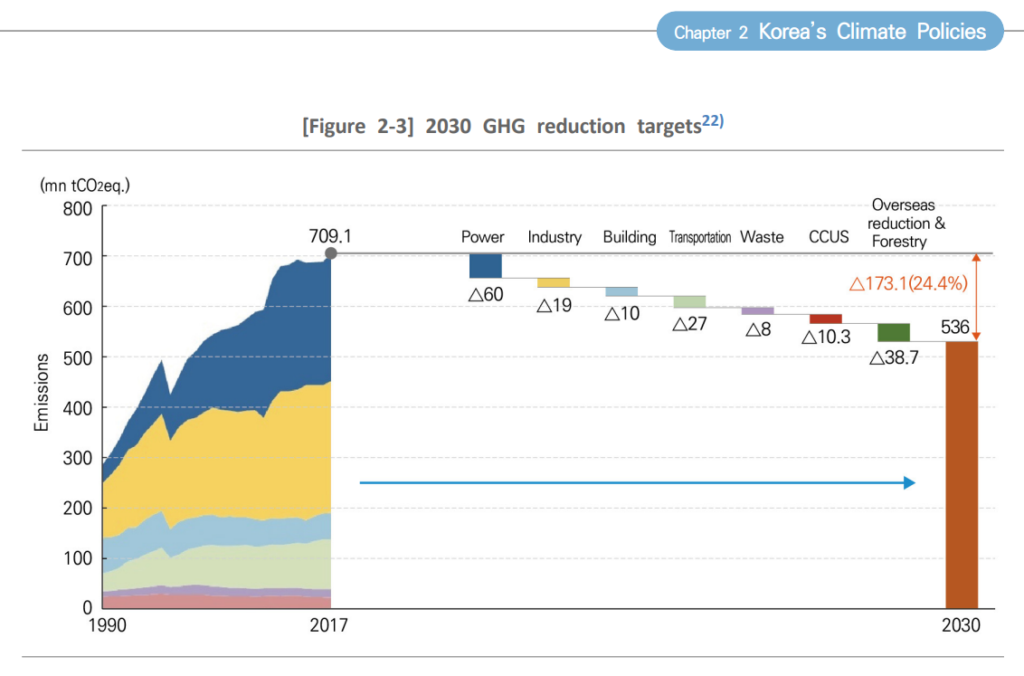
The plan includes support for workers and regions affected by the shift away from high-emission industries. It also calls for stronger protection against climate risks for industrial sites and sectors such as shipbuilding and logistics.
These measures aim to make the transition easier for businesses and communities while encouraging companies to adopt cleaner technologies.
What the Plan Means for Green Investment
The strategy could create new demand for renewable power, grid upgrades, batteries, and low-carbon industrial equipment.
South Korea has also highlighted projects involving Hanwha Qcells, POSCO Holdings, LG Electronics, and Samsung Electronics. These companies presented projects linked to renewable energy, cleaner industry, and greener buildings at the strategy’s launch.
For investors, the $747 billion headline figure needs context. It represents planned financing to be mobilized over a decade, not a single government payment or guaranteed return.
Actual investment will depend on project approvals, company spending, and the ability of new technologies to compete on cost. Renewable energy growth needs better grid systems. Industrial upgrades must cut emissions effectively.
A Decade-Long Shift Toward a Lower-Carbon Economy
South Korea’s K-GX strategy sets out a 10-year plan to change how the country produces energy, manufactures goods, and moves people and products.
Its main goals are to:
- Mobilize 1,000 trillion won in financing.
- Attract 220 trillion won for private projects.
- Reach 100 GW of renewable energy by 2030.
- Make electric and hydrogen vehicles over 70% of new sales by 2035.
The plan supports South Korea’s wider target of cutting emissions by 53% to 61% from 2018 levels by 2035 and reaching carbon neutrality by 2050.
Whether it achieves these goals will depend on how quickly funding reaches projects, how much clean energy becomes available, and whether industries can adopt lower-carbon technologies at scale.