


International carbon market cooperation is gaining ground as more countries sign agreements to trade carbon credits under the Paris Agreement. However, a new report highlights a big challenge: turning agreements into verified emissions reductions. Countries need these reductions to reach their climate goals.
The 2026 Article 6 Implementation Status Report, released by the Paris Agreement Article 6 Implementation Partnership (A6IP), found that bilateral carbon market arrangements rose 14% in one year, reaching 113 by July 2026. These arrangements allow countries to work together on projects that reduce or remove greenhouse gas emissions.
The report also found that countries are making progress on approval rules, carbon registries, and emissions tracking. Yet, many governments still lack the systems needed to fully carry out international carbon trading.
For carbon project developers and investors, the findings point to a growing market opportunity. More countries are building the rules for cross-border carbon deals, but the pace of actual credit transfers will depend on how quickly they can put those systems into practice.
Article 6 Agreements Reach 113 as Global Cooperation Expands
The report recorded 113 bilateral arrangements in 2026, up from 99 in 2025. Of these:
- 61 were memorandums of understanding (MoUs),
- 44 were bilateral agreements, and
- 8 fell into other categories, such as declarations or statements of intent.
These arrangements provide a starting point for countries to cooperate on emissions-cutting projects and the transfer of carbon credits. However, an MoU or other arrangement does not automatically authorize projects or allow credits to be transferred.
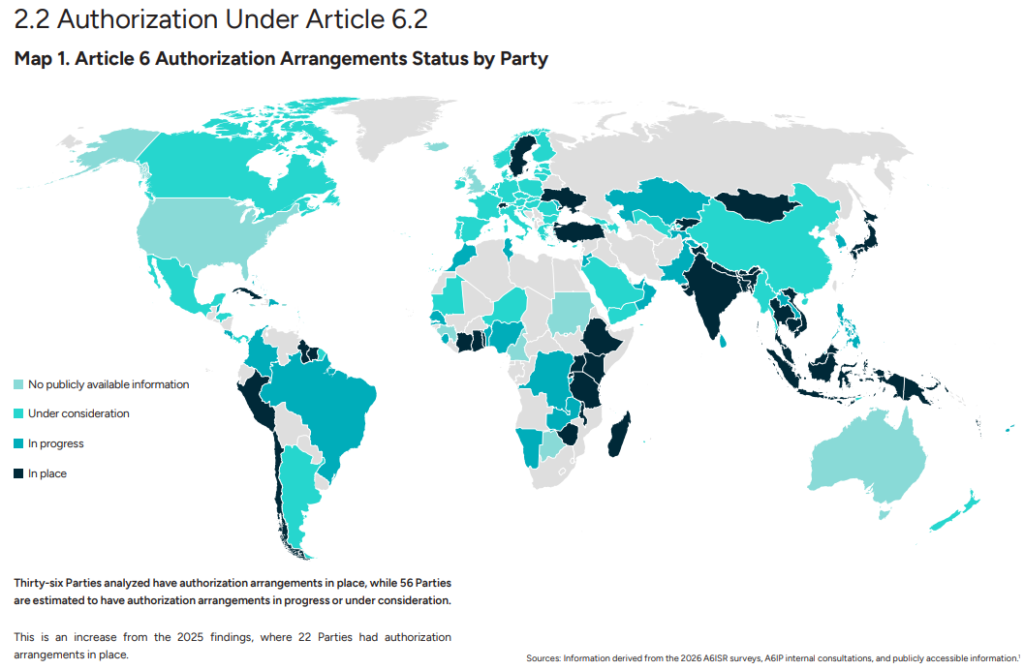
The report identified 68 countries taking part in bilateral cooperation: 58 host countries and 10 countries seeking to acquire emissions reductions.
Japan remained the leading acquiring country, with 32 agreements. Singapore followed with 29, up from 24 in 2025. Switzerland increased its agreements from 17 to 20, while South Korea rose from 11 to 14.
Among host countries, Ghana and Kenya had the highest engagement, each working with five acquiring countries. Indonesia, Mongolia, Senegal, and Zambia followed, each with four partners.
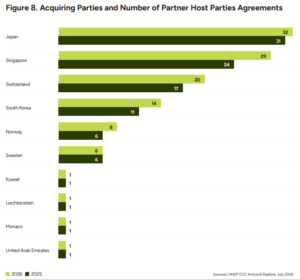
These figures show that international carbon cooperation is spreading across regions. They also highlight the growing role of Asian countries in building cross-border carbon markets.
More Countries Are Preparing to Authorize Carbon Credits
Bilateral agreements are only one part of the process. Countries also need rules for deciding which projects can generate credits for international transfer.
Under Article 6.2 of the Paris Agreement, countries can cooperate by transferring internationally transferred mitigation outcomes, or ITMOs. These transfers need government approval and clear records. This stops the same emissions reduction from counting for more than one country’s climate goal.
The A6IP report found that 36 countries had authorization arrangements in place, compared with 22 in the 2025 report. Another 56 were developing or considering these arrangements.
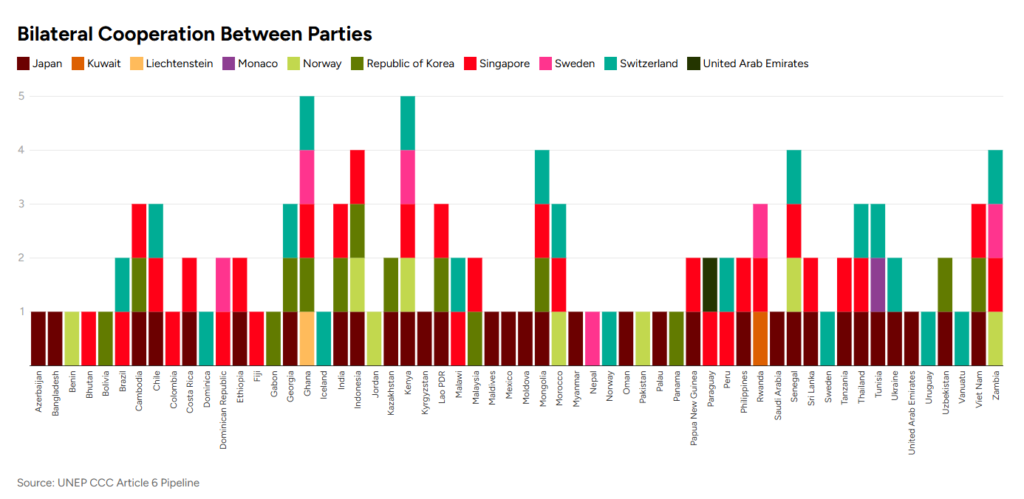
Tracking systems are also advancing. Sixteen countries had systems in place to track ITMOs, while many others were still developing or considering them.
However, only 15 of the 106 countries analyzed had both authorization and tracking arrangements in place. Just 23 had submitted initial reports to the United Nations Framework Convention on Climate Change (UNFCCC).
This gap matters. Countries must know who can approve credit, how to track it, and how to report transfers. This knowledge is key for confident international trading.
Actual Carbon Transfers Remain Small
The report’s figures show why the growth in agreements should not be mistaken for a mature trading market. By July 2026, countries had transferred 151,566 tonnes of carbon dioxide equivalent (tCO₂e) in ITMOs under bilateral cooperation, according to the report.
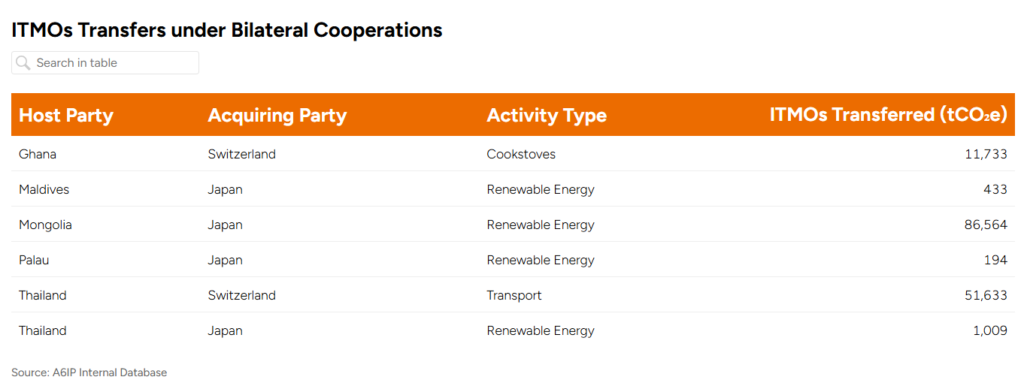
This is a small volume compared with the number of agreements and projects being developed. It shows that many countries are still building the systems needed to move from policy commitments to completed transactions.
The report also tracked progress under Article 6.4, which created the Paris Agreement Crediting Mechanism (PACM), a centralized United Nations system for issuing carbon credits.
By the report’s cutoff, host countries had approved 415 activities for transition from the earlier Clean Development Mechanism. Two transitioned programs of activities had generated about 1.11 million Article 6.4 emission reductions (A6.4ERs).
These developments show that different parts of the Paris Agreement carbon market are progressing at different speeds. The next challenge is to convert project pipelines and approvals into credits. These credits must follow the rules and be usable for their intended purposes.
Singapore and Southeast Asia Build New Opportunities
Recent developments in Southeast Asia offer a clear example of how Article 6 cooperation is moving forward.
Singapore and Laos signed an implementation agreement in September 2026 and agreed on 58 eligible carbon credit methodologies. The list covers areas such as forestry, agriculture, methane reduction, biochar, and renewable energy.
The agreement gives project developers a clearer starting point for preparing eligible projects in Laos. However, the 58 methodologies do not represent 58 approved projects. Individual projects must still meet the countries’ requirements before credits can be authorized for international transfer.
Singapore’s network of 29 bilateral arrangements also makes it one of the most active acquiring countries in the report. Its agreements aim to provide access to eligible international carbon credits as the country works toward its climate targets.
Indonesia is another important market to watch. Its government is developing the systems needed to participate in Article 6.2 cooperation, including preparation of its initial report. The Philippines is still working on its national carbon market framework. It is also assigning the relevant authorities, as noted in the A6IP report.
These examples show that countries are at different stages. Some are already transferring credits, while others are building national rules, registries, and project approval processes.
Carbon Project Developers Still Face Readiness Gaps
The report highlights a growing need for technical support as countries move toward implementation.
Governments need clear laws, trained officials, carbon registries, and systems to measure, report, and verify emissions reductions. They also need to decide which project types are eligible and how to protect their own climate targets when credits are transferred abroad.
For project developers, these rules affect how quickly projects can move from planning to approval and credit issuance. Unclear procedures can increase costs and delay investment.
The report identified 38 support programs focused on policies and frameworks, 34 focused on project development and methods, and 16 focused on registries and infrastructure. Another 54 programs covered knowledge-sharing and other forms of support.
These efforts are important because signing an agreement is only the first step. Countries must also show that projects deliver real emissions cuts or removals, avoid double counting, and meet the reporting requirements of the Paris Agreement.
For buyers and investors, the main opportunity is a growing pipeline of potential projects. The main risk is that delays in national systems may slow the supply of credits that are ready for transfer.
Can Article 6 Turn More Agreements Into Verified Carbon Credits?
The 2026 report points to clear progress in international carbon market cooperation. Bilateral arrangements are growing, more countries are preparing authorization systems, and new projects are moving through the Paris Agreement’s crediting mechanisms.
However, the gap between agreements and actual transfers remains wide. Countries still need stronger tracking, reporting, and approval systems to support a market that buyers and governments can trust.
For Asia, the growth of Singapore’s network and ongoing work in countries such as Laos, Indonesia, and the Philippines show how Article 6 could support investment in emissions-cutting projects.
The next stage will be measured not by the number of agreements signed, but by how many projects deliver verified emissions reductions and how effectively countries authorize, track, and transfer those results.