Tesla Robotaxi Secures Permit in Texas, Fuels TSLA Stock Surge and Market Buzz

Featured image sourced from Tesla Robotaxi

Tesla has cleared a major hurdle in its push toward fully autonomous transportation. As per reports, the Texas Department of Licensing and Regulation (TDLR) has granted Tesla Robotaxi LLC a permit to operate as a transportation network company (TNC) across the state.

This green light allows the electric vehicle giant to roll out its ride-hailing service, both with and without human safety drivers. It marks its boldest step yet into the competitive robotaxi market.

The permit, issued this week, remains valid until August 6, 2026, setting the stage for Tesla to expand beyond its current limited service in Austin and directly challenge rivals like Uber, Lyft, and Waymo.

A Big Win for Teslaโ€™s Autonomous Ride-Hailing Battle

Teslaโ€™s latest permit authorizes the company to legally deploy fully driverless vehicles across Texas without a safety driver in the car, aligning perfectly with Elon Muskโ€™s long-standing vision of a driverless future.

The company has been operating a pilot program in Austin since June 22, 2025, offering rides to a select group of influencers and industry analysts. These early riders, many of them active Tesla promoters on platforms like X and YouTube, have been experiencing trips in Model Y vehicles equipped with Teslaโ€™s newest partially automated driving systems.

Although the cars currently run with a โ€œvaletโ€ sitting in the passenger seat to step in during emergencies, they are also monitored remotely by Teslaโ€™s operations center staff. With the new permit, Tesla now has the legal right to remove that in-person safety presence altogether.

tesla robotaxi
Source: Tesla

Going Statewide: From Austin to All of Texas

Until now, Teslaโ€™s robotaxi program was limited to small-scale trials in Austin. The TDLR permit changes that entirely, giving Tesla permission to operate anywhere in Texas. That includes bustling urban centers like Dallas and Houston, where demand for ride-hailing is strong.

More importantly, the permit gives Tesla the ability to expand rapidlyโ€”something Musk has hinted at repeatedly. On a recent earnings call, he predicted Tesla could serve half of the U.S. population with robotaxi services by the end of 2025.

The approval also places Tesla in a direct turf war with Waymo, Googleโ€™s self-driving unit, which already operates a robotaxi fleet in Austin through a partnership with Uber.

First Steps into Driverless Service

Teslaโ€™s push into Texas marks the first time the company has deployed autonomous vehicles with paying passengers. This milestone puts it ahead of many automakers still in the testing phase.

In a surprise twist, just days after securing the Texas license, Tesla was spotted testing its robotaxi in Miami without any safety driver at all. While that was outside the Texas jurisdiction, it hints at Teslaโ€™s national ambitions and confidence in its self-driving system.

Why Texas Matters for Tesla

Texas is a proving ground for Tesla’s robotaxi. The state has generally been friendly to autonomous vehicle testing and has clear legal frameworks that support driverless deployment.

By securing the TDLR permit, the company gains the freedom to launch fully driverless services statewide, scale operations without the legal hurdle of keeping human supervisors in every vehicle, and position itself as a first mover ahead of competing EV makers and robotaxi operators.

If successful, Texas could become the blueprint for Teslaโ€™s expansion into other large, car-dependent states.

TSLA Stock Jumps on Robotaxi Momentum

Investor excitement has been quick to follow Teslaโ€™s progress. After Elon Musk confirmed that Austinโ€™s robotaxi service will open to the general public next month, TSLA shares surged more than 5%, closing at $346.50.

This rally reflects investor belief that robotaxi services could become a major revenue stream for Tesla, complementing its core EV sales. Analysts say the Texas approval strengthens Teslaโ€™s first-mover advantage in the driverless ride-hailing market and could accelerate its push toward Muskโ€™s ambitious target of serving half of the U.S. population by the end of 2025.

tsla stock
Source: Yahoo Finance

Whatโ€™s Driving NHTSAโ€™s Probe into Teslaโ€™s Self-Driving Tech?

While the vision is ambitious, Teslaโ€™s autonomous program hasnโ€™t been without criticism. Early trial data in Austin shows around one notable system failure per vehicle every 2โ€“8 days, equivalent to roughly 0.314 failures per day per car.

Videos posted online have captured incidents of Teslaโ€™s robotaxis running stop signs, drifting into the wrong lanes, and failing to detect oncoming trains. The BBC highlighted that these issues have caught the attention of NHTSA, which confirmed it is in contact with Tesla to gather more information.

Early Performance and Safety Concerns

The NHTSA investigation adds to growing regulatory pressure. Reports suggest that Tesla has withheld certain incident data from public release, raising concerns about transparency in its robotaxi program.

Teslaโ€™s self-driving systems face mounting scrutiny as new crash data raises safety concerns.

  • 51 deaths since October 2024, including 2 linked to Full Self-Driving

  • Highest US crash rate in 2024: 26.67 accidents per 1,000 drivers โ€” up 13.3% from 2023

  • Autopilot safety gap: 1 crash every 7.44 million miles on Autopilot vs. every 1.51 million miles without, as per Teslaโ€™s Q1 2025 Vehicle Safety Report.

Statistically, Tesla currently has the highest crash rate of any U.S. automaker in 2024. Critics point out that while Musk often cites safety metrics favorable to Tesla, independent experts argue the data lacks consistent, third-party validation.

Muskโ€™s Optimism vs. Robotaxi Reality

Elon Musk describes himself as โ€œpathologically optimisticโ€, and his track record of bold promises supports that claim. Predicting that Tesla could cover half of the U.S. with robotaxi services within months is no small statement.

For now, Teslaโ€™s Texas permit officially marks its entry into the stateโ€™s ride-hailing market. It puts the company in direct competition with Waymo, and brings Muskโ€™s vision of a driverless future closer to reality.

robotaxi
Source: Global Market Insights

However, Tesla still faces challenges. Experts are saying that it must improve safety, address regulatory concerns, and convince riders that its vision-only self-driving is as safe or safer than competitors using more sensors.

If Tesla succeeds, Texas could become the launchpad for a nationwide rollout, changing urban transportation and ride-hailing economics.

BBVA Hits โ‚ฌ30 Billion in Q2 for Sustainable Finance

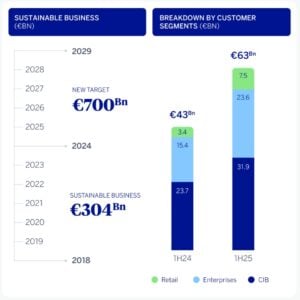
Spanish banking firm Banco Bilbao Vizcaya Argentaria, aka BBVA, has set a new pace in sustainable finance. The bank recently announced that it has mobilized โ‚ฌ30 billion ($32.5 billion) in green and social projects in Q2 2025 โ€” its highest quarterly result ever. This brought its total for the first half of the year to โ‚ฌ63 billion ($68.5 billion), marking a sharp 48% jump from the same period in 2024.

From Climate Action to Social Impact: BBVAโ€™s โ‚ฌ63 Billion Green Push

The growth pushes BBVA closer to its new target: channeling โ‚ฌ700 billion ($760 billion) into sustainable financing between 2025 and 2029. The bank had already met its earlier โ‚ฌ300 billion goal for 2018โ€“2025 a year ahead of schedule, hitting the milestone in December 2024.

Of the โ‚ฌ63 billion mobilized in H1 2025, 76% went toward climate change and natural capital projects. These covered areas such as renewable energy, efficient water use, sustainable agriculture, biodiversity protection, and the circular economy.

The remaining 24% went to social projects, including infrastructure for education and healthcare, entrepreneurship support, funding for small businesses, and financial inclusion for underserved communities.

Record Growth Across Business Segments

BBVAโ€™s momentum came from strong growth in all business lines:

  • Commercial Banking: Mobilized โ‚ฌ23.6 billion, up 53% year-on-year. Natural capital financing totaled โ‚ฌ2.34 billion, with Mexicoโ€™s agricultural sector contributing half of that.

  • Corporate and Investment Banking (CIB): Contributed โ‚ฌ31.9 billion, up 34%. The bank financed clean technologies, renewable projects, and sustainable supply chain solutions such as reverse factoring with green criteria. Renewable energy project funding alone reached โ‚ฌ1.6 billion.

  • Retail Banking: Channeled โ‚ฌ7.5 billion, up 119%. This included โ‚ฌ742 million for hybrid and electric vehicle financing and digital tools that help customers measure potential energy savings.

Backing Breakthrough Clean Energy Projects

BBVAโ€™s sustainability push isnโ€™t just about volume โ€” itโ€™s also about innovation. In Q2 2025, the bank sponsored the Energy Tech Summit in Bilbao, attracting over 1,500 cleantech experts from 40+ countries.

There, it announced a landmark project finance deal โ€” the first in the Iberian Peninsula for a hydrogen plant powered entirely by renewable energy. Scheduled to begin operations in H1 2026, the plant will be a key step in decarbonizing heavy industry.

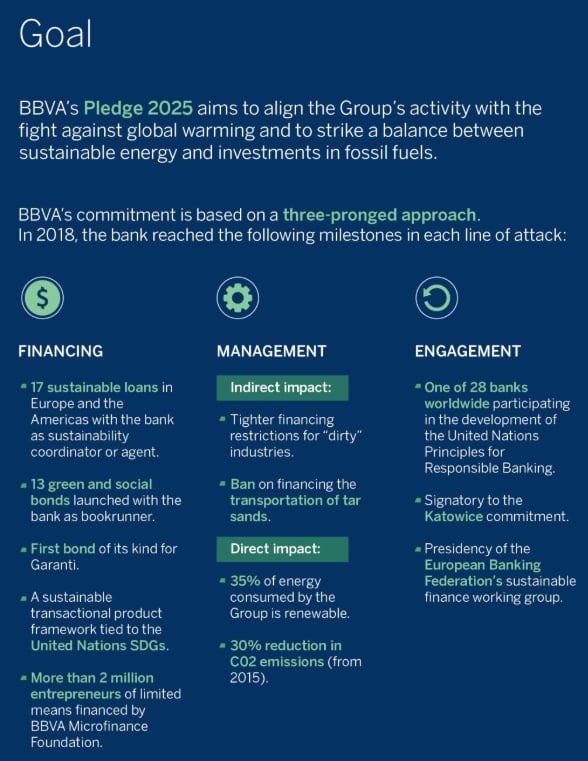
BBVA climate targets

A More Ambitious โ‚ฌ700 Billion Target

BBVAโ€™s expanded goal more than doubles its previous plan, with a shorter deadline. The aim is to channel โ‚ฌ700 billion in sustainable finance from 2025 to 2029, compared to the earlier โ‚ฌ300 billion over eight years.

The strategy focuses on three pillars:

  1. Climate Action โ€“ Funding renewable energy, clean technologies, and emissions reduction.

  2. Natural Capital โ€“ Supporting agriculture, water conservation, biodiversity, and land restoration.

  3. Social Opportunities โ€“ Financing healthcare, education, affordable housing, and entrepreneurship.

Driving the Net Zero Transition

Alongside its financing efforts, BBVA is working toward Net Zero emissions by 2050. It has already set interim 2030 decarbonization targets for ten sectors, including oil and gas, power generation, automotive, steel, cement, coal, aviation, shipping, aluminum, and real estate.

The bank is now preparing sector targets for agriculture โ€” a major source of global emissions โ€” as part of its broader climate plan.

bbva sustainability
Source: BBVA

Why This โ‚ฌ30 Billion Surge Matters

BBVAโ€™s record-breaking quarter shows that sustainable finance is moving into the mainstream. The bankโ€™s retail segment โ€” up 119% โ€” proves that demand for eco-friendly banking isnโ€™t limited to corporations. Everyday, customers are increasingly choosing green loans, energy-saving solutions, and sustainable investment options.

These projects deliver dual benefits: reducing carbon footprints while improving social well-being. From renewable power plants to inclusive financing for small businesses, BBVA is aligning its growth with global sustainability goals.

How BBVA Plans to Hit the โ‚ฌ700 Billion Mark

The bankโ€™s roadmap includes expanding partnerships, scaling retail offerings, and enhancing digital sustainability tools. These platforms help clients understand the environmental impact of their investments, building transparency and trust.

For example, customers can estimate energy savings from home upgrades or track CO2 reductions from EV financing. By merging finance with real-time environmental insights, BBVA is turning sustainability into an accessible, measurable choice for more people.

Environmental and Carbon Benefits of These Investments

With 76% of funding directed to environmental projects in H1 2025, BBVA is investing heavily in emissions reduction, renewable energy, and ecosystem restoration.

Key highlights include:

  • Hydrogen & Renewables โ€“ โ‚ฌ1.6 billion for renewable power and financing Iberiaโ€™s first renewable hydrogen plant.

  • Natural Capital โ€“ โ‚ฌ2.34 billion for water conservation, sustainable agriculture, and biodiversity protection.

  • EV Transition โ€“ โ‚ฌ742 million in hybrid and electric vehicle loans, cutting transport-related CO2.

These initiatives help replace fossil fuels, store carbon in healthier ecosystems, and encourage sustainable consumer behavior.

The Global Trend Fueling BBVAโ€™s Growth

BBVAโ€™s performance mirrors a global boom in sustainable finance. Green bond issuance could surpass โ‚ฌ1 trillion annually by the end of 2025. Over 70% of large corporations now follow ESG strategies, driven by customer demand and regulatory pressure.

By beating its 2018โ€“2025 target ahead of schedule and setting a new, more ambitious goal, BBVA is positioning itself among the leaders in climate-aligned banking. Its mix of green and social investments also supports the UN Sustainable Development Goals (SDGs).

Notably, its sustainability push comes with solid financial backing. The bank reported โ‚ฌ5.45 billion in profit for H1 2025 and maintains strong capital reserves. Its โ€œcapital-lightโ€ growth model balances risk and return, keeping investors confident while pursuing long-term environmental impact.

Whatโ€™s Next for Banking and Sustainability

The rise of ESG investing signals a shift in the role of banks. Customers, investors, and governments now expect institutions to be active players in the climate transition. BBVAโ€™s quick pivot demonstrates its readiness to meet this demand at scale.

Going forward, expect more banks to adopt:

  • Clear Targets โ€“ Time-bound climate and social finance goals.

  • Transparency Tools โ€“ Digital platforms that track impact.

  • Innovation Financing โ€“ Support for emerging decarbonization technologies.

BBVAโ€™s Role in Shaping the Future

From clean hydrogen plants to small business inclusion programs, BBVAโ€™s sustainable finance strategy blends profitability with purpose. The bank is proving that climate action and social impact can be growth drivers, not just compliance measures.

Its combination of technology, strong performance, and measurable impact makes it a leader in the green banking race. As industries decarbonize and regulations tighten, banks that move early, like BBVA, will set the standard for the financial sectorโ€™s role in building a sustainable future.

Metaโ€™s AI Forest Map: The Game-Changer for Carbon Tracking

Forests are vital for our planet. They help fight climate change by absorbing a lot of carbon dioxide from the air, acting as major carbon sinks. They store large amounts of carbon in biomass and soil,ย estimated to absorb about 30% of human-caused CO2 emissions annually worldwide.

However, scientists and project managers must track forest health. They need to know how much carbon forests store. This helps ensure that efforts to protect or grow forests are effective. This is called measuring, monitoring, reporting, and verifying forest carbon, often shortened to MMRV.

Recently, Meta has developed an AI-powered canopy height map that offers unprecedented detail in tracking forest health and carbon storage. This open-source tool helps project developers monitor changes, verify carbon credits, and boost climate action.

Eyes in the Sky: How Remote Sensing Sees Forests Differently

Measuring carbon in forests is tricky and expensive. Usually, people go out into the forest and measure trees by hand, which takes a lot of time and effort. Itโ€™s hard to do this over large areas, especially in dense or remote forests.

This is where remote sensing comes in.ย 

Remote sensing is a way to gather information about forests without going there in person. It uses satellites, airplanes, or drones equipped with cameras and sensors. This technology can take pictures and collect data. It helps scientists learn how tall trees are, how dense the forest is, and how much carbon it might store.

There are different kinds of remote sensing data:

  • Optical imagery: like normal photos taken from space or planes, showing the tops of trees and land features.
  • Radar: which uses radio waves and can see through clouds and work at night.
  • Lidar: which uses lasers to map the exact height and shape of trees in 3D.

The Challenge with Remote Sensing Data

Each data type has strengths and weaknesses. Optical images are good and widely available, but they canโ€™t see through clouds and only show forest surfaces. Radar can see through clouds but has trouble measuring details in dense forests. Lidar is very accurate but expensive and covers less area.

To get the best info, scientists combine different types of data using artificial intelligence (AI) and machine learning techniques. Machine learning helps computers find patterns in huge amounts of data to make better estimates.

Metaโ€™s Canopy Height Map: AI-Powered Forest Intelligence

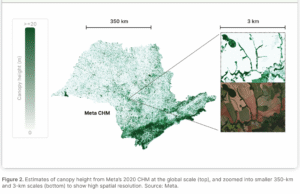
Meta developed a unique AI model that merges high-resolution satellite images with lidar data. This model maps tree canopy heights globally with great detailโ€”less than one meter per pixel. This means it can see individual trees in many places.

Meta AI forest map
Source: Meta

The map and the AI model are open-source and freely available, so anyone can use them to help forest projects. They enable better planning, monitoring, and verification of forest carbon projects. Reza Rastegar, Senior Manager of Research Science at Meta, stated:

“When applied thoughtfully, we believe AI research and remote-sensing tools, particularly those that are open source, have the potential to revolutionize the transparency and accessibility of the carbon market.”

Meta’s model has been validated with mean absolute errors of 2.8 meters in U.S. forests and 5.1 meters in Brazil. This reflects a promising improvement in estimating canopy height at fine scales. These advanced datasets and models are helping to track natural regeneration, selective logging, and forest degradation more accurately, which is vital for credible MMRV of carbon credits.

Whatโ€™s special about this model?

  • It works globally with very fine detail.
  • It can help identify important areas to protect or restore.
  • It can make new maps for different times if good images are available.
  • It helps detect small changes in forests, like selective logging (cutting some trees but not all).
  • It supports methods from carbon credit standards. This is important for those who need dynamic baselining or updating project baselines with real data from nature.

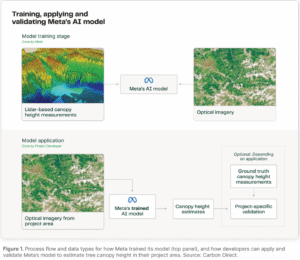
How Meta train AI model

RELATED: Meta and Microsoft Secured Long-Term Carbon Credit Deals to Support Olympic Rainforest

From Pixels to Carbon Credits: Turning Data into Climate Action

Forest carbon projects use different official methods to create and verify forest carbon credits. The three main methods Meta focuses on are:

  1. Verra VM0045 โ€“ for improved forest management (IFM).
  2. Verra VM0047 โ€“ for afforestation, reforestation, and revegetation (ARR).
  3. American Carbon Registry (ACR) IFM โ€“ a US-based improved forest management method.

Hereโ€™s how Metaโ€™s canopy height map and AI model fit into these methods:

  • In project planning, the map helps find good parcels of forest to include, determine project boundaries, and understand forest structure.
  • For dynamic baselining, especially in ARR and ACRโ€™s IFM methods, the AI model can help update baselines based on real forest growth or loss over time.
  • For reversals monitoring (tracking if carbon gains are lost, e.g., due to fire or logging), the map gives better details to detect forest disturbances.

The Fine Print: What Metaโ€™s Model Gets Rightโ€”and Where It Struggles

Many traditional satellite products canโ€™t reliably measure forest height or biomass in dense forests or small areas. Metaโ€™s model, because it uses very high-resolution images, helps overcome this.

Monitoring small or fragmented forests, river corridors, or areas with selective logging is crucial. These places are difficult to track using low-resolution data.

Metaโ€™s canopy height model is a powerful tool for estimating forest structure, but it comes with limitations. It works best with high-quality imagery at 0.5โ€“1 meter resolution. The global canopy height map uses images from 2009 to 2020. This means it might not show current forest conditions. So, there’s a need for updated maps.

Accuracy may also drop in underrepresented forest types, so local validation with field or lidar data is advised. Using the model requires significant computing power and technical expertise, which may limit adoption.

For forest carbon projects, remote sensing offers great promise but faces barriers. There is no universal agreement among registries, buyers, and developers on acceptable methods or datasets.

In addition, technical skills, computational capacity, and access to affordable, high-quality datasets remain limited. Uncertainty around accuracyโ€”and lack of consensus on acceptable error levelsโ€”make trust and comparability difficult.

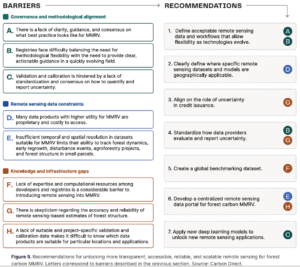
For the identified barriers, the report authors recommend the following:

barriers and recommendation

Closing the Gap Between Innovation and Impact

Experts want clearer standards for how datasets can be used. They also seek better reporting on uncertainty and clearer rules for issuing carbon credits. A global benchmarking database with verified data and a central portal for quality datasets could help boost adoption.

Moreover, easier AI tools would make this process smoother. Integrating advanced models like Metaโ€™s into accessible platforms, alongside collaborative standard-setting, will be crucial to scaling reliable forest carbon monitoring and verification.

Examples of New and Exciting Uses of Metaโ€™s Model

  • Counting trees in agroforestry projects to monitor performance.
  • Mapping old-growth forests and biodiversity hotspots.
  • Detecting subtle forest degradation, like selective logging.
  • Monitoring reversals (losses of carbon stored) with greater accuracy.
  • Supporting more accurate estimates of above-ground biomass.

Forests are vital to fighting climate change by storing carbon, but measuring how much carbon they hold and how this changes over time is tough. New technologies like remote sensing are making this easier, faster, and cheaper.

Metaโ€™s AI-powered canopy height map is a cutting-edge tool offering very detailed, global forest height data that can help in planning, monitoring, and verifying forest carbon projects.

CDR Credit Sales Hit Record High, Powering Market Growth in 2025

The voluntary carbon market is booming in 2025. Allied Offsets data showed that in the first quarter of 2025, around 780,000 CDR credits were contracted โ€” a surge of 122% compared to the same period in 2024.

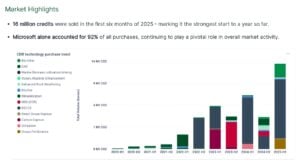
Additionally, 16 million credits were sold in the first six months of 2025 – marking it the strongest start to a year so far. The momentum is fueled by major buyers like Microsoft, aiming to be carbon negative by 2030, and by a surge in biomass-based removal methods that are reshaping corporate offset strategies.

Why Carbon Dioxide Removal Credits Are Surging

Businesses are racing to hit climate targets faster, and carbon dioxide removal (CDR) is emerging as the go-to solution. The biggest boost this year comes from biomass-based methods โ€” like turning farming and forestry waste into tools for trapping COโ‚‚. These projects are cheaper, easier to scale, and more accessible than high-cost tech such as direct air capture (DAC).

By early 2025, biomass CDR accounted for about 40% of credit volumes. Microsoft and other big players are securing large volumes, setting quality benchmarks, and pushing the market toward transparent, high-integrity projects.

Source: Zion Market Research

Technology Shifts in CDR

  • Biomass-based CDR โ€” including BECCS, biochar, bio-oil, and biomass burial โ€” made up a massive 94% of total volumes in the first half of 2025.

  • Investment focus, however, is still heavily skewed toward DAC and carbon utilization projects, despite other scalable and cost-effective CDR options.

  • More public awareness and funding diversity are needed to unlock the full potential of multiple CDR pathways.

New innovations are also redefining CDR. About 30% of new projects now use methods such as advanced soil carbon storage, bio-oil injection, and marine carbon removal, which can store COโ‚‚ for hundreds or even thousands of years.

Digital MRV platforms are also transforming the space, offering real-time tracking to boost transparency, prevent fraud, and speed up purchase decisions. Meanwhile, integrated projects like agroforestry, regenerative agriculture, and biodiversity restoration are gaining traction for their multi-benefit environmental impact.

carbon dioxide removal CDR credits
Source: AlliedOffsets

Environmental Benefits of Biomass CDR

Biomass approaches like biochar and BECCS offer cost-effective solutions, often ranging from $80โ€“$200 per ton.

These methods work within a circular economy model โ€” repurposing agricultural and forestry waste into long-term carbon storage. BECCS delivers a dual benefit by producing renewable energy while storing COโ‚‚ underground.

However, without strict MRV protocols, poorly managed biomass projects risk deforestation or biodiversity loss. Global removal capacity is still only 41 million tons COโ‚‚/year, yet it needs to grow 25โ€“100x by 2030 to meet climate goals.

Market Segmentation

By technology: DAC, afforestation & reforestation, soil carbon sequestration, BECCS, ocean-based CDR, and enhanced weathering.

  • DAC, holding 67% of global revenue in 2023, is set for the fastest growth thanks to flexible deployment and industrial COโ‚‚ utilization.

By application: Consumer products, energy, transport, and industrial sectors.

  • The industrial sector leads due to rising emissions from cement, steel, and chemicals.

CDR Buyer Trends in 2025

  • Financial services firms led in the number of unique buyers, while technology companies dominated purchase volumes with over 50 million credits bought so far.

  • Half of all buyers in early 2025 were first-time participants, collectively purchasing around 6 million credits which is a promising sign of market expansion.

Market Momentum and Future Projections

The CDR market hit $3.9 billion in Q2 2025, with biomass projects making up 99% of transactions. Microsoft continues to drive momentum by locking in long-term purchase agreements that help projects scale.

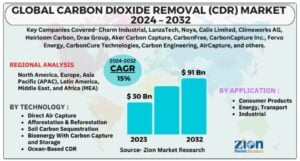
Market forecasts suggest CDRโ€™s value will grow from $842 million in 2025 to $2.85 billion by 2034, while durable carbon credits could soar to $14 billion by 2035, growing 38% annually.

Rising buyer expectations โ€” around permanence, transparency, and quality โ€” are further reinforced by new regulations, particularly in Europe, pushing out low-integrity credits.

CDR market
Source: Zion Market Research

Opportunities and Challenges Ahead

The CDR market stands to benefit from government-backed carbon incentives, increasing demand for carbon credits, and the potential to create new jobs in sectors such as farming, engineering, and construction. However, its growth faces hurdles, including limited public awareness of CDRโ€™s advantages and the risk of political instability slowing adoption.

Whatโ€™s Next for Carbon Dioxide Removal?

The market is at a turning point. Experts predict a blend of nature-based and durable removals, with the latter gaining ground toward 2050 as quality demands rise. The future will rely on smarter investments, high-fidelity data tracking, and clear global standards.

Corporate leaders like Microsoft are already showing the way โ€” proving that transparency, permanence, and innovation will define the next era of climate action.

Toyotaโ€™s (TM Stock) Q1 Twist: Why Profits Dip But Hybrids Surge, and Net Zero Goals Accelerate

Toyota Motor Corporation reported a sharp drop in earnings for the quarter ending June 30, 2025. Net profit fell 37% to ยฅ841 billion ($5.7 billion), down from ยฅ1.33 trillion a year earlier. This marked one of the steepest quarterly declines in recent years. Revenue, however, rose 3% year-over-year to ยฅ12 trillion ($82 billion), supported by strong demand in North America and Asia.

The primary drag came from new U.S. tariffs of 15% on Japanese car imports, which reduced profit by an estimated ยฅ450 billion. Higher costs for raw materials and a stronger yen hurt overseas earnings. Global inflation also impacted the results.

Toyota has revised its full-year operating profit forecast downward to ยฅ2.66 trillion ($18 billion). This speaks of a more cautious outlook for 2025. Analysts say the biggest automaker is keeping strong sales. However, profit margins face pressure from outside economic factors.

Amid the financial hiccup, the company reaffirmed its commitment to climate leadership. It aims for carbon neutrality with strong emissions targets, green manufacturing projects, and renewable energy investments. This effort is part of its Environmental Challenge 2050 framework.

Hybrids Take the Wheel as Sales Defy the Downturn

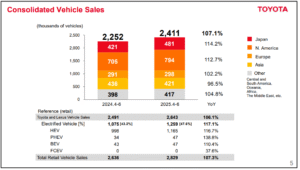
Global vehicle sales for the quarter reached 2.4 million units, up from 2.2 million a year ago. Toyota’s sales in North America rose nearly 20% in July. This boost came from its hybrid models, like the RAV4 Hybrid and Camry Hybrid, which both showed double-digit growth.

Toyota vehicle sales
Source: Toyota

Hybrid and plug-in hybrid models make up over one-third of Toyotaโ€™s total sales. This shows how important electrified powertrains are becoming in the companyโ€™s lineup.

Battery electric vehicle (BEV) sales, while still a smaller portion, increased steadily in markets with expanding charging infrastructure.

Toyota stayed on top in Japan and Southeast Asia. This was thanks to its compact cars and commercial vehicles. However, European sales dipped a bit due to tougher emissions rules and strong competition from local EV brands.

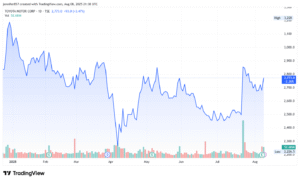
Toyotaโ€™s share price fell about 1.6% following the earnings announcement, as tariff concerns weighed on investor sentiment. Even with this dip, the stock still looks good. Its forward price-to-earnings (P/E) ratio is 6.9. Thatโ€™s lower than the industry average of 8.0 and Toyota’s five-year average of 9.3.

toyota stock price
Source: TradingView

Driving Toward 2050: Toyotaโ€™s Net Zero Roadmap

Toyota has set a long-term target to achieve carbon neutrality across the entire life cycle of its vehicles by 2050. This goal covers emissions from all stages: vehicle design, production, use, and recycling. It also includes emissions from suppliers and logistics partners.

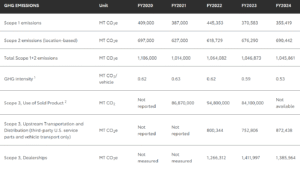
In its latest sustainability report, Toyota reported its Scope 1 and Scope 2 greenhouse gas emissions. These emissions, from direct operations and purchased electricity, reached around 2.05 million metric tons of COโ‚‚e in FY 2024. This shows a 15% drop from FY 2019 levels. The company aims to cut these emissions by 68% by 2035, using 2019 as the baseline year.

For Scope 3 emissions, which account for most of Toyota’s footprint, targets are set. By 2030, Toyota aims for a 30% reduction from suppliers, logistics, and dealerships. They also seek a 35% cut in average vehicle-use emissions. These goals account for the fact that tailpipe emissions from vehicles remain the single largest part of the companyโ€™s climate impact.

Globally, Toyota is investing in solar, wind, hydrogen, and renewable natural gas to power its factories. It has also joined multiple international coalitions to accelerate low-carbon manufacturing and logistics.
The largest carmaker is investing a lot in renewable energy. They plan to use 45% renewable electricity in North America by 2026. By 2035, they aim for 100% renewable energy at all global plants.

Projects include:

  • Large-scale solar panel installations at assembly plants
  • Hydrogen-powered forklifts
  • Renewable natural gas systems at engine facilities.

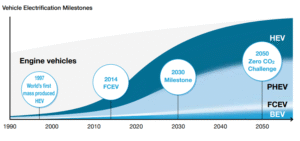
The company’s approach combines electrification with manufacturing decarbonization. This includes hybrids, battery electric vehicles (BEVs), and hydrogen fuel cell vehicles.

Toyota’s leaders think this multi-pathway strategy will reduce emissions quickly. This is especially true in areas where full BEV infrastructure is still growing. It also helps ensure steady progress toward the company’s 2050 carbon neutrality goal.

toyota ghg carbon emissions
Source: Toyota

In summary, the companyโ€™s near-term reduction targets are:

  • 68% reduction in Scope 1 and 2 emissions by 2035 (compared to 2019 levels).
  • 30% cut in Scope 3 emissions from suppliers, logistics, and dealerships by 2030.
  • Matching 45% of electricity use with renewables in North America by 2026.

Environmental Challenge 2050: Six Pillars of Action

Toyotaโ€™s Environmental Challenge 2050, launched in 2015, remains its guiding framework for sustainability. The initiative is built on six core challenges:

  1. Zero COโ‚‚ emissions from new vehicles through hybrid, BEV, and hydrogen fuel cell adoption.
  2. Zero COโ‚‚ emissions in manufacturing by shifting to renewable energy and low-carbon processes.
  3. Life cycle zero COโ‚‚ emissions, including recycling and parts reuse.
  4. Minimizing water usage and improving water discharge quality.
  5. Protecting biodiversity around manufacturing sites and supply chains.
  6. Advancing a circular economy by extending product lifecycles and reducing waste.

Toyota aims to sell 1.5 million BEVs annually by 2026 and 3.5 million by 2030, alongside continuing hybrid and fuel cell development. This multi-path approach allows the company to meet varying customer needs and infrastructure readiness levels worldwide.

TOYOTA electrification milestone
Source: Toyota

Green Manufacturing: Major Investments in Low-Carbon Plants and ESGย 

Toyotaโ€™s largest new sustainability investment is a ยฅ140 billion ($922 million) advanced paint facility in Georgetown, Kentucky. Set to open in 2027, the plant will reduce paint shop carbon emissions by 30% and cut water use by 1.5 million gallons annually.

In Japan, Toyota is piloting hydrogen-powered forklifts and solar-powered assembly lines. The company will use 100% renewable electricity for its manufacturing in Europe by 2030.

These projects reduce environmental impact and boost operational efficiency. They support Toyotaโ€™s goals of sustainability and profitability.

Beyond emissions, Toyota is strengthening its broader ESG performance. The company has strict human rights rules for suppliers. These rules include labor conditions, conflict minerals, and environmental compliance. By 2030, Toyota aims for 90% of its top suppliers to set their own science-based emissions targets.

In 2024, Toyota diverted 94% of waste from landfills globally and recycled over 99% of scrap metal from manufacturing. It also invested in reforestation projects in Asia and Africa as part of its carbon offset strategy.

Balancing Short-Term Pressures With Long-Term Goals

The Aprilโ€“June quarter highlighted Toyotaโ€™s resilience in the face of macroeconomic challenges. Tariffs and currency changes have hurt short-term profits. However, strong vehicle sales, especially in hybrids, keep the company competitive.

At the same time, Toyota is moving ahead with one of the most thorough sustainability programs in the auto industry. Its carbon neutrality goals and the Environmental Challenge 2050 framework guide its actions. Also, large-scale green manufacturing investments help meet the growing demands for cleaner mobility from regulators and consumers.

As Toyota navigates market volatility, its ability to deliver both financial and environmental strategies will be key to maintaining global leadership in the shift toward sustainable transportation.

JOBY Aviation Stock Soars on Blade Acquisition and Electric Air Taxi Commercial Launch Plans

Joby Aviation Inc. (NYSE: JOBY) is closing in on its dream of launching electric air taxis. The California-based company has spent years building its all-electric, vertical take-off and landing (eVTOL) aircraft, designed for fast, quiet, and convenient city travel.

Air Taxis: The Future of Fast, Clean, and Congestion-Free Urban Travel

Air taxis are small electric or hybrid aircraft that take off and land vertically, ideal for short city hops, airport transfers, and reaching remote areas. Target users include executives, business travelers, and emergency services. Countries like the U.S., Germany, and the UAE are investing heavily in supporting infrastructure.

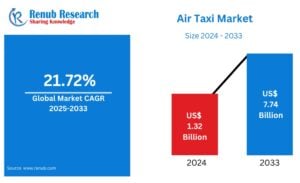
A report highlighted that the global air taxi market, valued at USD 1.32 billion in 2024, is projected to hit USD 7.74 billion by 2033 at a 21.72% CAGR, driven by eVTOL technology, urban mobility demand, and congestion-free travel needs.

air taxi JOby
Source: Renub Research

Growth is fueled by advances in batteries, lightweight materials, and electric propulsion, making aircraft cleaner and more efficient, plus worsening city traffic that air taxis can bypassโ€”cutting multi-hour trips to just 15โ€“20 minutes.

This August, Joby made a series of bold moves that pushed it closer to commercial operations, from a high-profile acquisition and defense partnership to major FAA progress and manufacturing growth. Investors noticed, sending the stock near record highs.

Blade Deal Unlocks Instant Market Access and Growth

One of the monthโ€™s biggest headlines came on August 4, when Joby announced plans to acquire Blade Air Mobilityโ€™s passenger business for up to $125 million in cash or stock.

The deal is a game-changer. Blade brings premium infrastructure, including dedicated terminals at major New York airports and a strong presence in Southern Europe. More importantly, it comes with a loyal customer base โ€” more than 50,000 passengers flew Blade in 2024.

By absorbing Bladeโ€™s passenger operations, Joby gains instant market access without the time and expense of building from scratch. The acquisition is expected to slash infrastructure costs, speed up customer acquisition, and put Joby ahead of competitors in key urban corridors.

The transaction is set to close in the coming weeks, pending customary approvals. Once complete, Bladeโ€™s passenger services will continue under Jobyโ€™s ownership, setting the stage for a smooth integration.

Defense Partnership Opens a New Revenue Stream

Joby revealed another major move, a collaboration with defense contractor L3Harris.

The partnership will develop a gas turbine hybrid variant of Jobyโ€™s existing eVTOL aircraft for low-altitude defense missions. The design aims to combine Jobyโ€™s manufacturing expertise with L3Harrisโ€™ deep defense technology capabilities.

Flight testing is set to begin this fall, with operational demonstrations planned during government exercises in 2026.

This venture signals Jobyโ€™s ambition to be more than just a commercial passenger service. By stepping into the defense sector, Joby diversifies its revenue streams and showcases its aircraftโ€™s versatility for both civilian and military use.

FAA Certification Moves Into Final Stages

On August 6, Joby shared a crucial regulatory update. It has started final assembly of its first FAA-approved electric air taxi, a major step toward Type Inspection Authorization (TIA) flight testing. This stage needs FAA-approved test plans, a certified design, and proven manufacturing โ€” all of which Joby has achieved, with over 50% of its test plans already accepted.

The aircraft, developed over years of testing, will fly with Joby pilots in 2025, followed by FAA pilots. Structural and systems tests have confirmed its strength and readiness.

Jobyโ€™s in-house design and manufacturing have boosted development and improved quality. With new facilities in California and Ohio, backed by Toyota, the company will soon be able to build up to 24 aircraft a year.

Cash-Rich and Backed by Toyota, Joby Eyes Massive Growth Ahead

  • Jobyโ€™s balance sheet is strong, ending Q2 2025 with $991 million in cash, cash equivalents, and marketable securities.

The company also closed the first $250 million tranche of a $500 million strategic investment from Toyota, one of Jobyโ€™s largest and most influential partners.

For 2025, Joby expects to use between $500 million and $540 million in cash, excluding the Blade acquisition. Revenue remains small, just $59,600 expected for Q2, but growth projections are huge, with a forecasted 900% year-on-year increase from a low base.

JoeBen Bevirt, founder and CEO of Joby, said,

โ€œThis is a pivotal moment. Regulatory progress around the world is unlocking market access, our commercialization strategy is taking hold, and weโ€™re now focused on scaling production to meet real demandโ€”a challenge weโ€™re fully committed to and working hard to deliver on.โ€ย 

JOBY Stock Surge Reflects Growing Investor Confidence

Jobyโ€™s recent string of announcements sent its stock soaring. In the past month alone, shares have jumped more than 70% due to heavy trading. Year-to-date, the stock has risen 142%, surpassing its market capitalization of $14 billion.

However, volatility remains. Analyst price target changes and insider sales have caused swings, but the long-term outlook hinges more on regulatory milestones than short-term earnings.

JOBY
Source: Yahoo Finance

Manufacturing Expansion Doubles Output

To meet growing demand, Joby expanded its Marina, California, manufacturing facility to 435,000 square feet. This upgrade will double production capacity to 24 aircraft per year.

Meanwhile, its newly renovated Dayton, Ohio, site is ramping up to produce and test key aircraft components. Over time, Dayton could scale to build up to 500 aircraft annually, making it a cornerstone of Jobyโ€™s manufacturing strategy.

International Partnerships Boost Global Reach

Joby is not just looking at U.S. cities. The company also announced an expanded partnership with ANA Holdings in Japan.

The two companies plan to deploy over 100 Joby air taxis starting in Tokyo, creating an urban air mobility ecosystem complete with dedicated vertiports and operational support. The partnership will leverage Toyotaโ€™s network and government cooperation to fast-track development.

Joby also signed new agreements with Abdul Latif Jameel and ANA to explore deploying approximately 300 aircraft in other markets.

Whatโ€™s Next for Joby Aviation?

With the Blade acquisition, defense partnership, FAA certification progress, and global expansion, Joby is executing on multiple fronts at once.

The next 12 months will be critical. If Joby completes certification on schedule, ramps production, and integrates Bladeโ€™s passenger network, it could be one of the first eVTOL companies to operate at scale.

For now, investors are betting big that Jobyโ€™s head start, strategic partnerships, and strong balance sheet will translate into a dominant position in the fast-emerging air taxi market.

Joby Aviation isnโ€™t just inching toward launch; itโ€™s accelerating. From New York to Dubai to Tokyo, the pieces are falling into place for a global eVTOL network. If all goes according to plan, 2026 could be the year flying taxis move from concept to reality.

Standard Chartered to Sell 5M Carbon Credits to Help Protect Amazon Rainforest

Standard Chartered has signed a five-year deal to sell up to five million carbon credits on behalf of the Brazilian state of Acre. The major bank and the state are working together to fund rainforest conservation using the carbon credit market.

Credits will be created within a REDD+ framework. This global system aims to cut emissions from deforestation and forest degradation.

Carbon credits will start being issued in 2026. They will be in the โ€œavoided deforestationโ€ category. This means they help prevent emissions by preserving current forests instead of creating new ones.ย The goal is to prevent deforestation and protect biodiversity and community livelihoods. It also helps reduce greenhouse gas emissions.

The deal could raise as much as $150 million in funding. Acre officials say that 72% of the proceeds will go to local and Indigenous communities. This will help them protect and conserve forests. The rest of the funds will support project management and monitoring systems. This will help ensure transparency and effectiveness.

Why Rainforest Protection Matters in Global Climate Goals

Forestsโ€”especially tropical rainforests like the Amazonโ€”are among the most important carbon sinks on the planet. When theyโ€™re cut down or degraded, the carbon stored in trees and soil is released into the atmosphere.

The Amazon rainforest absorbs billions of tons of carbon dioxide each year. A NASA-led study found that, in a typical year, the Amazon rainforest absorbs about 2.2 billion metric tons (2 billion tons) of CO2. This is crucial for stabilizing the Earth’s climate.

Experts say that about 20% of global land-use emissions come from deforestation and forest degradation. This makes protecting rainforests one of the quickest and cheapest climate actions today.

carbon emissions from Amazon deforestation
Source: Frontiers in Forests and Global Change

Deals like Standard Charteredโ€™s with Acre help banks and businesses support conservation. They can also meet their corporate net-zero goals.

The agreement combines solid financial support with environmental care. It shows how carbon credits can work with climate science and help communities grow.

Standard Charteredโ€™s Chief Sustainability Officer, Marisa Drew, remarked:ย 

โ€œWeโ€™re leveraging our global network and carbon market expertise to address this challenge directly, offering a means to help preserve standing forests that act as vital carbon sinks, and in turn help the communities that depend on them continue to realise the economic and social returns they provide.โ€

High Integrity or Bust: Building Trust in Carbon Offsets

One of the biggest challenges in carbon markets today is credibility. Over the past few years, concerns have emerged about the quality and transparency of carbon offset projects. Some faced criticism for exaggerating emissions cuts. Others did not provide real environmental or social benefits.

To help address this, the Acreโ€“Standard Chartered deal includes safeguards. First, there will be no forward selling of creditsโ€”this means credits will only be sold once they are officially issued and verified.

This reduces the risk of overpromising and underdelivering. The transaction also supports adherence to the Core Carbon Principles (CCPs) developed by the Integrity Council for the Voluntary Carbon Market (ICVCM).ย These principles define standards for top-quality carbon credits and include key factors like:

  • permanence,
  • additionality,
  • leakage, and
  • solid monitoring, reporting, and verification (MRV) systems.

The Acre project aims to create a real, measurable impact. Buyers and climate watchdogs want this more than ever.

Beyond the Trees: Inside the Bankโ€™s Broader Climate Finance Strategy

This deal with Acre is part of a bigger move by Standard Chartered to increase its activity in sustainable finance and carbon markets. The bank has supported early-stage carbon removal firms like UNDO. UNDO uses enhanced weathering of rocks to take carbon out of the air.

The financing deal, supported by British Airways, had a unique structure. It included insurance and long-term offtake agreements.

Standard Chartered also partners with Puro.earth, a top carbon removal registry. This gives clients access to high-quality Carbon Dioxide Removal Certificates (CORCs). These types of credits are increasingly in demand from companies that want to go beyond carbon neutrality and achieve net-negative emissions.

The bank plans to achieve net-zero operations by 2025. It will use high-integrity carbon credits to offset emissions from energy use, air travel, and data centers. It also has a 2050 net-zero target for its financed emissionsโ€”those generated by the activities of companies it lends to or invests in.

Standard Chartered bank emissions 2024
Source: Standard Chartered 2024 Annual Report

The Carbon Market Is Growing Up – Fast

Standard Charteredโ€™s deal also reflects broader trends in the voluntary carbon market (VCM). According to recent reports, the VCM was valued at around $2 billion in 2024, and could grow significantly in the coming years.ย 

carbon credit market value 2024

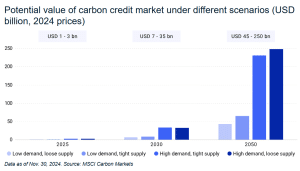
McKinsey & Company projects the VCM could reach over $50 billion by 2030 under favorable policy and corporate demand conditions. With strong market reform, the value could exceed $250 billion by 2050, driven by net-zero goals and increasing regulation.

carbon credit market value 2050 MSCI
Source: MSCI

One of the most important shifts is the rise of jurisdictional REDD+ creditsโ€”like those offered by Acre. Jurisdictional credits differ from small-scale projects because they cover whole regions or states.

This approach offers wider environmental protection. It also lowers the risk of “leakage.” This is when conservation in one area leads to deforestation moving elsewhere.

Jurisdictional programs are also more attractive to institutional investors and sovereign funds. Large buyers usually want scalability, accountability, and local community benefits. Traditional project-level carbon offsets often fail to meet these needs.

The carbon market is expanding beyond forest protection. It now includes carbon removal technologies like direct air capture, biochar, and mineralization. These solutions are still new, but they are vital for reaching global net-zero goals. This is especially true in tough sectors to decarbonize, like cement, aviation, and steel.

A New Standard for Carbon Finance and COP30

The Standard Charteredโ€“Acre partnership stands out not just for its scale, but for its approach. It focuses on real climate outcomes, community benefits, and market integrity. In doing so, it may serve as a model for future deals between financial institutions, governments, and Indigenous groups.

This is especially important ahead of COP30, the global climate summit set to be hosted in Belรฉm, Brazil, in 2025. As the world focuses on Amazon conservation and climate justice, projects like Acreโ€™s are set to shine. They show how nature-based solutions can achieve financial, environmental, and social goals.

By treating forests not just as carbon stores but as living ecosystems supported by local people, this deal shows that climate action and development do not have to be at oddsโ€”they can move forward together.

UEC Stock Surges as Sweetwater Uranium Project Gets Federal Fast-Track Approval

Uranium Energy Corp (UEC) announced that its Sweetwater Uranium Complex in Wyoming had been officially designated as a transparency project by the U.S. Federal Permitting Improvement Steering Council. This recognition comes under President Trumpโ€™s March 20, 2025, Executive Order aimed at accelerating domestic mineral production.

The decision allows Sweetwater to move through a fast-track permitting process, cutting project delays that are critical to national mineral and energy goals. Once upgrades are complete, Sweetwater will be the largest dual-feed uranium facility in the United States.

Significantly, it marks a major step toward restoring domestic uranium production and advancing U.S. energy security.

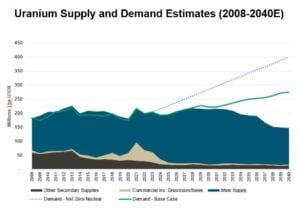
GLOBAL uranium demand and supply
Source: Source: Sprott (UxC and Cameco Corp. Data as of 9/30/2024)

Trump Administration Presidential Appointee, Emily Domenech, Executive Director of the Federal Permitting Improvement Steering Council, highlighted:

โ€œI am excited to welcome the Sweetwater Complex to the FAST-41 transparency dashboard in support of President Trumpโ€™s goal of unlocking Americaโ€™s mineral resources. The uranium that this project can produce would be game-changing for our nation as we work to reduce our reliance on Russia and China, strengthen our national and economic security, and reestablish a robust domestic supply chain of nuclear fuel.”

UEC’s Strategic Acquisition Pays Off

UEC acquired 100% of Rio Tintoโ€™s Wyoming uranium assets, including the fully licensed Sweetwater Plant and 175 million pounds of historic resources. This purchase added eight permitted and exploration-stage projects to UECโ€™s portfolio, strengthening its hub-and-spoke production platform in Wyoming.

The complex now boasts a licensed production capacity of 4.1 million pounds of Uโ‚ƒOโ‚ˆ annually, giving UEC a significant position in the U.S. uranium supply chain. The upcoming TRS (Technical Report Summary), expected by the end of fiscal 2025, will formally outline the Great Divide Basin Hub-and-Spoke model, designating Sweetwater as the hub supported by multiple satellite mines.

Amir Adnani, UEC President and CEO, stated:

โ€œSweetwaterโ€™s selection under FAST-41 reinforces its national importance as a key project to achieve the United States’ goals of establishing reliable infrastructure, supporting nuclear fuel independence. Acquired from Rio Tinto in 2024, Sweetwater will be UECโ€™s third hub-and-spoke production platform, following operational advancements underway in Wyomingโ€™s Powder River Basin and South Texas. On completing this tack-on permitting initiative, Sweetwater will be the largest dual-feed uranium facility in the United States, licensed to process both conventional ore and ISR resin. This will provide the Company unrivaled flexibility to scale production across the Great Divide Basin, leveraging UECโ€™s leading domestic resource base. Weโ€™re proud of and grateful for the Steering Councilโ€™s support under President Trumpโ€™s Executive Order to fast-track a secure, predictable, and affordable supply of critical minerals.โ€

Building a Scalable ISR Mining Platform

The company recently revealed that it is working to amend Sweetwaterโ€™s permits to include In-Situ Recovery (ISR) mining methodsโ€”an environmentally friendly and lower-impact uranium extraction process. The plan includes adding a new ion exchange and elution circuit at the Sweetwater Plant.

The โ€œspokesโ€ in this system will draw resources from:

  • Red Desert deposits: REB, ENQ, and Sweetwater
  • Green Mountain zones: Round Park, Phase 2, Whiskey Peak, and Desert View
  • Other nearby deposits: JAB, Clarkson Hill, and Red Rim

This hub-and-spoke approach is designed to scale production while lowering costs and minimizing environmental disturbance.

Why Sweetwater Matters to U.S. Energy Policy?

The Executive Order that triggered Sweetwaterโ€™s fast-track status reflects a broader White House push to rebuild the nuclear fuel supply chain. The U.S. has been increasingly dependent on foreign uranium sources, making domestic production a matter of energy security.

By adding Sweetwater to the FAST-41 transparency dashboard, federal agencies are prioritizing faster reviews, more transparency, and better coordination for critical mineral projects. The Bureau of Land Management will serve as the lead agency for Sweetwaterโ€™s permitting process.

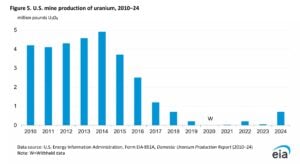
u.s. uranium
Source: EIA

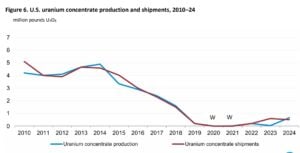
The chart from EIA’s Domestic Uranium Production shows that the U.S. uranium mines produced about 0.6โ€“0.7 million pounds of Uโ‚ƒOโ‚ˆ in 2024. This big drop over the years has made the U.S. more dependent on imported uranium.

Thatโ€™s why the government is now pushing to boost local production. UECโ€™s Sweetwater Uranium Complex is part of that plan. Once upgrades are complete, Sweetwater’s estimate of 4.1 million pounds annually could be enough to cover most of todayโ€™s total U.S. uranium output on its own.

Americaโ€™s Largest Licensed Uranium Complex

The Sweetwater Processing Plant is a 3,000-ton-per-day conventional uranium mill with full licensing and state permits in place. Once ISR methods are approved, Sweetwater will become the largest licensed uranium production facility in the country with dual-feed capability.

Key advantages include:

  • Massive Resource Base โ€“ Over 175 million pounds of historic uranium resources
  • Extensive Exploration Data โ€“ 6.1 million feet of historic drilling and ~108,000 acres under control
  • Existing Permits โ€“ Approval already in place for conventional mining at Sweetwater, Big Eagle, and Jackpot mines
  • Cost and Time Efficiency โ€“ Upgrading an existing plant is far faster and cheaper than building a new one, leveraging existing infrastructure for synergy and scale

The company also owns a high-grade Canadian project portfolio anchored by the world-class Roughrider deposit- one of the largest physical uranium stockpiles in the United States. In addition, it maintains a significant equity stake in Uranium Royalty Corp. This diversified portfolio would help UEC tap into opportunities from the growing global demand for uranium.

uranium
Source: EIA

UEC Joins Global Push to Triple Nuclear Power by 2050

Nuclear power has long been the backbone of U.S. carbon-free electricity. According to the World Nuclear Association, in 2022, nuclear accounted for 19% of U.S. electricity generationโ€”and 55% of the countryโ€™s carbon-free power. This avoided 482 million metric tons of COโ‚‚ emissions, equivalent to removing about 107 million gasoline cars from the road for a year.

The push for nuclear energy has global momentum. At the COP28 climate summit in 2023, more than 20 nations agreed to triple nuclear capacity by 2050. UEC has pledged support for this international effort.

Green Mining Goals

UEC has committed to producing uranium under the highest environmental standards, aiming for net-zero COโ‚‚ emissions across its U.S. ISR operations and maintaining zero significant environmental incidents annually.

The companyโ€™s air quality monitoring program reported no non-compliance in 2023. Radon and uranium particulate emissions were kept well below regulatory limits, with no harmful environmental releases.

This environmental track record supports UECโ€™s claim that ISR mining can be both commercially viable and environmentally responsible.

uranium energy corp UEC Emission
Source: UEC

UEC Stock Market Momentum

UECโ€™s strong operational news has translated into equally strong stock performance. Over the past year, the share price has surged by approximately 114%, with gains of 51.8% in the past month and 14.1% in the past week alone.

On August 7, 2025, the stock reached a new 52-week high of $9.91 and is currently trading at around $9.85. Analysts remain bullish, citing sector optimism and positive policy developments, with most price targets above current levels.

UEC stock
Source: Yahoo Finance

However, they caution that high volatility remains due to the companyโ€™s current lack of profitability and its sensitivity to broader market shifts. In short, momentum is strong, but risk is real.

The Bigger Picture: U.S. Uranium Revival

Sweetwaterโ€™s fast-track designation signals more than just a win for UECโ€”itโ€™s part of a national strategy to rebuild Americaโ€™s nuclear industrial base. By unlocking domestic uranium resources, the U.S. can reduce its reliance on imports and strengthen its clean energy mix.

For UEC, it cements the companyโ€™s role as a leading domestic uranium supplier, capable of scaling production rapidly to meet future nuclear energy demand.

Lenovo Launches TruScale DaaS for Sustainability to Cut IT Carbon Emissions by 35%

Lenovo launched its TruScale Device-as-a-Service (DaaS) for Sustainability. This subscription service helps businesses cut their IT carbon footprint by up to 35%. It also lowers device costs.

This all-in-one service manages the entire lifecycle of devices, incorporates carbon tracking tools, and offers flexible subscriptions. In doing so, it supports sustainability goals while improving budget efficiency.

The launch shows a bigger change in how companies view technology. Itโ€™s not just about tools for getting things done; it is also about helping with corporate climate action.

IT now plays a key role in helping organizations meet their net-zero and ESG (Environmental, Social, and Governance) commitments.

John Stamer, Lenovo’s Vice President and General Manager for Global Product Services, stated:

“Enterprises are rethinking how they manage IT โ€“ not just for performance, but for purpose. TruScale DaaS for Sustainability reflects our vision for the future of IT: circular by default, intelligent by design, and accountable by outcome.”

What Is TruScale DaaS and How Does It Work?

TruScale DaaS lets companies subscribe to laptops, desktops, servers, and other IT devices. This way, they can use the equipment without owning it.

Lenovo takes charge of device deployment, maintenance, refurbishment, and safe disposal. This setup cuts eโ€‘waste, reduces the need for new device production, and lowers emissions tied to supply chains.

Key features include:

  • Lifecycle Management:

Devices are refurbished and redeployed, extending their usable life and conserving resources. Lenovo reports that more than 1 million devices have already been recovered and reconditioned under its asset recovery services.

  • Carbon Impact Portal:

Businesses can monitor emissions at each stageโ€”manufacture, use, and disposalโ€”helping them understand where to target reductions. It supports detailed Scope 1, 2, and some Scope 3 tracking for IT equipment.

  • COโ‚‚ Offset Services:

Organizations can offset emissions they cannot avoid, aligning with their science-based targets or internal climate pledges. Lenovo partners with verified third-party carbon offset providers to ensure quality and transparency.

This model supports both ecological stewardship and operational efficiency. By outsourcing the management of IT assets, companies can also free up internal resources to focus on core priorities.

How TruScale Slashes Costs

Traditional IT spending often locks companies into fixed costs for hardware they may underuse. TruScale reduces waste by allowing businesses to adjust subscriptions to meet actual demand. This means no more overspending on unused or old devices.

According to Lenovo, businesses using TruScale can reduce IT maintenance costs by up to 40%. They also benefit from lower downtime due to AI-assisted diagnostics, proactive repairs, and optimized logistics. This boosts workforce productivity while extending the useful life of every device.
The subscription model takes away capital expenses (CapEx). It turns IT spending into operational expenses (OpEx). This flexibility is especially valuable during uncertain economic conditions or rapid business changes.

Environmental Impact: From Eโ€‘Waste to Carbon Savings

The core strength of TruScale lies in its environmental benefits, which include:

Eโ€‘Waste Reduction

Refurbishing used devices helps the environment. It keeps electronics out of landfills and reduces the need to mine raw materials. This includes lithium, cobalt, and rare earth metals. Mining these materials may harm the environment and raise human rights issues.

Carbon Footprint Reduction

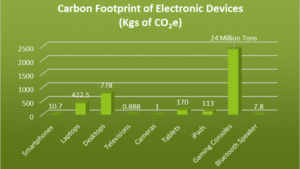
Manufacturing one laptop can produce 200โ€“400 kg of COโ‚‚, depending on the materials and energy mix used. By refurbishing instead of replacing, TruScale avoids these emissions. Lenovo estimates customers can reduce IT-related emissions by up to 35%.

carbon footprint of laptop
Source: 8BillionTrees

Circular Economy Model

TruScale aligns with global movements to reduce, reuse, and recycle. The circular approach saves energy, cuts pollution, and boosts resource efficiency.

Additionally, Lenovo itself has committed to reducing its own carbon emissions. It also aims for 90% of products to be repairable and recyclable by 2025โ€”further reinforcing the company’s focus on sustainability.

Lenovo’s Journey to Net Zero by 2050

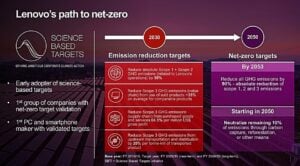
Lenovo is aligning its climate strategy with the Paris Agreementโ€™s 1.5โ€ฏยฐC goal. It aims for net-zero greenhouse gas emissions by 2050. The Science Based Targets initiative (SBTi) validated this target in January 2023.

Lenovo path to net zero
Source: Lenovo

Its near-term goals are to cut Scope 1 and 2 emissions by 50% by 2030. This is based on the 2019 level. They also aim for significant Scope 3 reductions:

  • 35% for product use, 66.5% per revenue in purchased goods and services, and 25% per tonne-km in logistics.

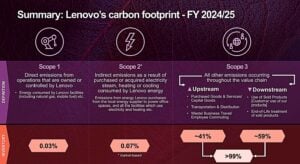
Lenovo is boosting its climate efforts with a supplier emissions reduction program. This program affects almost all of its procurement spending. It also features renewable energy pilots. These pilots aim to reduce emissions by about 30,000 metric tons in 2025.

Lenovo carbon footprint or emissions 2024
Source: Lenovo

In its 2025 ESG Report, Lenovo highlighted its progress. The company received top honors, including Platinum from EcoVadis and an โ€˜AAAโ€™ MSCI ESG rating.

Lenovoโ€™s move comes as the carbon credit market gains momentum. By 2024, the voluntary carbon market (VCM) is worth about $2 billion. Analysts believe it could hit $50 billion by 2030. It may go even higher if policy support and corporate demand keep increasing.

TruScaleโ€™s carbon offset offerings tap into this trend. Clients can offset emissions from IT hardware. They do this by buying high-quality credits.

Prices for these credits now range between $13 and $15 per metric ton of COโ‚‚, up from $3โ€“5 just a few years ago, as quality and scrutiny have improved.

Lenovo ensures its offset services meet international standards such as Verraโ€™s VCS, Gold Standard, or American Carbon Registry (ACR). This helps companies cut greenwashing risks. It also improves climate disclosures. They follow frameworks like the Task Force on Climate-related Financial Disclosures (TCFD) or CSRD in the EU.

Why Businesses Embrace Sustainable IT Solutions

Across sectors, businesses face rising pressure from investors, regulators, and consumers to clean up their environmental footprint. At the same time, companies need more agile and cost-efficient IT systems to remain competitive in the digital economy.

By offering a bundled solution, TruScale allows firms to hit both targets. Companies can cut emissions and e-waste. They can also follow regulations and report ESG performance. This can all happen while remaining lean and flexible.

According to a recent survey by IDC, over 70% of IT decision-makers say that sustainability will be a key driver of IT purchases within the next five years. Early adopters of sustainable services, like TruScale, can boost their reputation. This is especially true with eco-aware clients and stakeholders.

Why TruScale Is a Climate-Smart Investment

For companies looking to lower costs, meet climate goals, and stay ahead of tech trends, TruScale offers a clear advantage. It does the following:

  • Cuts emissions from IT hardware.

  • Reduces e-waste and material use.

  • Lowers total cost of ownership.

  • Enables better ESG reporting.

  • Increases IT agility and resilience.

In a world where every business is under pressure to prove its climate action, TruScale helps translate sustainability into everyday operations. Lenovo is showing that smart, scalable IT management can also be a powerful tool for environmental leadership.

READ MORE: Schneider Electric Launches AI-Native Initiative for Sustainability and Energy Management

Mercedes-Benz Goes Electric: Biggest Model Launch Set for 2026 & Zero-Emission Commitment

After a 3% sales dip in 2024 and 6.2% in early 2025, Mercedes-Benz is going all-in on electrification. As per media reports, the company plans to launch 18 new models in 2026โ€”many of them fully electricโ€”in what it calls the biggest product rollout in its history. The goal is to revive interest by merging classic luxury with clean, future-ready tech.

Mercedes-Benzโ€™s Strong Electric Vehicle Commitment

The company plans to make at least 50% of its vehicle sales fully electric or plug-in hybrid by 2030. This shift positions Mercedes-Benz to stay ahead of regulations and consumer trends, especially in regions tightening emissions standards.

Entry-Level EVs Kick Off the Shift

In 2025, Mercedes will introduce two compact electric crossoversโ€”likely EV versions of the GLA and GLBโ€”targeting urban drivers. These models are built for efficiency and practicality, but also sustainability.

Core Models Go Dual-Track

In the mid-range โ€œCoreโ€ segmentโ€”including the C-Class and GLCโ€”the company will offer both refreshed gas versions and new EVs. A fully electric C-Class will join the lineup with better range and performance.

  • By 2027, a new Core EV built on a dedicated electric platform will mark a deeper shift toward full electrification.

Luxury EVs Take the Spotlight

Mercedesโ€™ high-end โ€œTop Endโ€ line gets five new EVs in 2026, including a revamped EQS. The S-Class also receives a major update, with the EQS expected to match its luxury and tech upgrades.

  • Through 2027, five more luxury EVs will follow, including the โ€œLittle G,โ€ a compact electric version of the iconic G-Wagon, blending off-road ruggedness with zero emissions.

GLC EV Redefines Design

Replacing the EQC, the new electric GLC debuts at Munichโ€™s IAA show this fall. It retains a bold grille, a nod to tradition, while boasting upgraded styling and charging tech.

AMG Joins the EV Push

Mercedes-AMG is developing an electric super sedan and SUV based on the GT XX concept, delivering high performance without emissions. A new V8 is also in development for gas holdouts, though the updated C63 may switch to a six-cylinder model. The challenge is honoring AMGโ€™s legacy while embracing electric speed.

Mercedes is moving away from the minimalist EQ design language. Instead, future EVs and gas vehicles will share a cohesive, luxurious aesthetic. The aim is to make electric models feel just as familiar and desirable as their combustion counterparts.

Mercedes-Benz Drives Toward a Greener Future

Sustainability is extremely vital for Mercedes-Benz Groupโ€™s corporate strategy. Last year, the company sharpened its focus, identifying six priority areas that align with both environmental and stakeholder expectations.

From decarbonization to digital trust, Mercedes-Benz is not only adapting to global climate goals but aiming to lead the way in clean, ethical, and responsible mobility.

Six Strategic Pillars of Sustainability

Mercedes-Benz updated its materiality assessment in line with the Corporate Sustainability Reporting Directive (CSRD) and European Sustainability Reporting Standards (ESRS). This evaluation factored in the views of all key stakeholdersโ€”customers, investors, employees, suppliers, and society at large.

As a result, the company established six key focus areas:

  • Decarbonization
  • Resource Use & Circularity
  • Human Rights
  • Digital Trust
  • People (Employees)
  • Traffic Safety

Each of these areas includes defined targets and is tracked using internal scorecards, ensuring progress remains measurable and transparent.

Net-Zero Goals: Ambition 2039

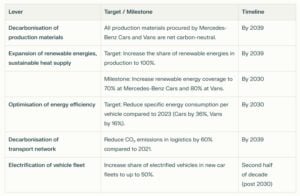
Under the “Ambition 2039“ roadmap, Mercedes-Benz aims for its new vehicle fleet to be net carbon-neutral across its entire lifecycle, including production, logistics, and supply chain, by 2039.

The company is taking bold steps to cut emissions and increase clean energy usage across all business segments.

Mercedez benz climate
Source: Mercedes-Benz Climate Transition Action Plan-2025

Major Progress in Carbon Emissions Reduction

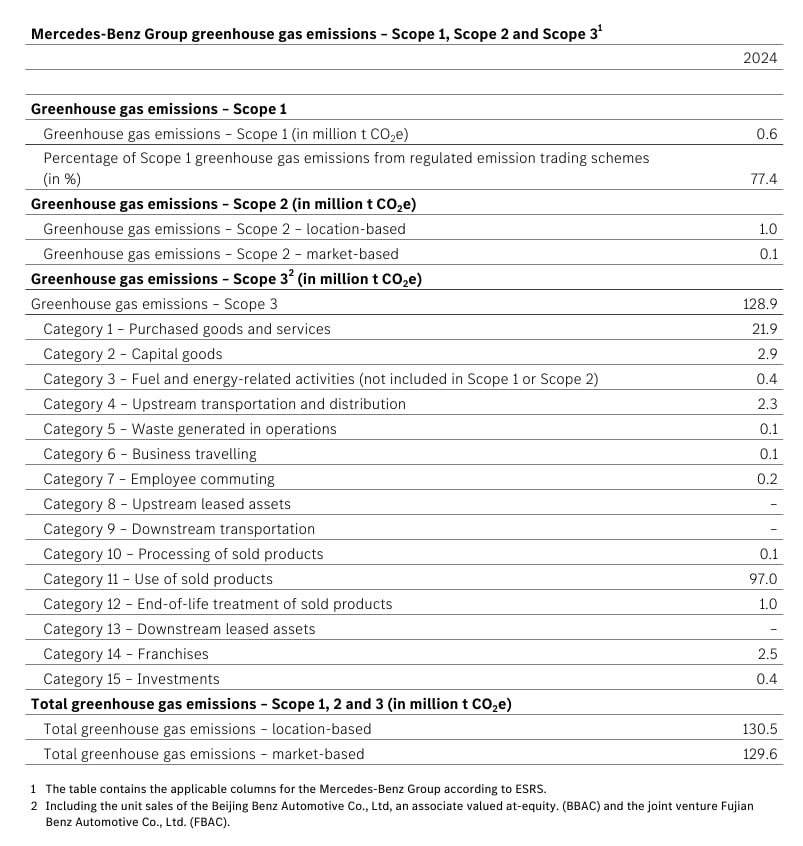
The company reports greenhouse gas emissions under Scopes 1, 2, and 3, including biogenic emissions.

  • Scope 1 & 2: Emissions from direct operations and purchased energy. The company calculates biogenic COโ‚‚ emissions separately from fossil sources using standardized factors.
  • Scope 3: Indirect emissions across the value chain. The majorityโ€”around 75%โ€”come from vehicle use (tank-to-wheel) and fuel/electricity production (well-to-tank).

MB’s 2024 Emissions Report

mercedes benz
Source: Mercedes-Benz

It has significantly lowered its carbon footprint in recent years. The company’s decarbonization strategy revealed:

  • Factory Emissions: All production facilities have operated on 100% renewable electricity since 2022. Between 2018 and 2023, production-related COโ‚‚ emissions fell by 72%.
  • Vehicle Lifecycle Emissions: Emissions per vehicle dropped to 46.3 tonnes in 2023, down from 49.7 tonnes in 2020. The target is to achieve a 50% reduction by 2030.
  • Green Supply Chain: From 2025, Mercedes will integrate COโ‚‚-free โ€œgreen steelโ€ into vehicle production. More than 85% of its supplier base has now committed to carbon-neutral materials.

Advancing Circularity and Recycling

Circularity is another core focus. The company launched a battery recycling plant in Kuppenheim, Germany, which aims to recover up to 96% of materials. By 2030, Mercedes targets 40% recycled material usage across its vehicle lineup.

Smart Carbon Credit Strategy

To meet stringent EU carbon limits, Mercedes-Benz has already transitioned to carbon-neutral production since 2022. It also utilizes emissions pooling with partners such as Polestar, Volvo, and Smart to balance the average emissions of its fleet while transitioning toward full electrification.

Spotlight: The New Electric CLA

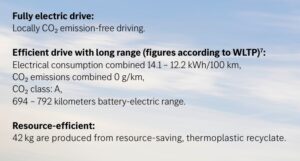
Mercedes-Benzโ€™s new fully electric CLA model showcases the company’s shift to climate-smart design. This next-gen EV reduces its carbon footprint by 40% over its lifecycle compared to its internal combustion predecessor. With further supply chain and battery optimizations, total reductions could reach up to two-thirds.

Key sustainability measures in the CLA include:

MB electric cla
Source: MB

This comprehensive environmental check demonstrates the brandโ€™s commitment to integrating sustainability into every vehicle componentโ€”from raw materials to end-of-life.

Overall, Mercedes-Benz is transforming from a traditional luxury automaker to a sustainability-driven mobility leader. With concrete goals, significant achievements, and a growing EV lineup, the company is aligning with global calls for cleaner transportation.