The Impact of Carbon Credits on Renewable Energy Development

The boiling concerns on climate change have made renewable energy sources and their development a key topic of research. Companies that are leading the clean energy transition have been, or are, considering to leverage the carbon credit markets.

What does the current carbon market boom mean to startups that develop renewable energy projects? How should venture capitalists and impact investors assess them? 

In other words, how do carbon credits impact the development of renewable energy projects such as solar and wind farms? This article will explore the answers to these important questions and more using relevant case studies and data available. 

Let’s first explain what a carbon credit is and its role in energy transition. 

Carbon Credits and the Energy Transition

The global climate crisis caused by the over consumption of fossil energy needs urgent action. To address the rising temperatures threatening lives and productions, environmental policies were in place to drive renewable energy development globally. 

Common examples of these policies include carbon tax, carbon emissions trading, and government subsidies. Carbon emissions trading involves the use of carbon credits as market instruments that many find essential in fighting climate change. 
What are Carbon Credits?

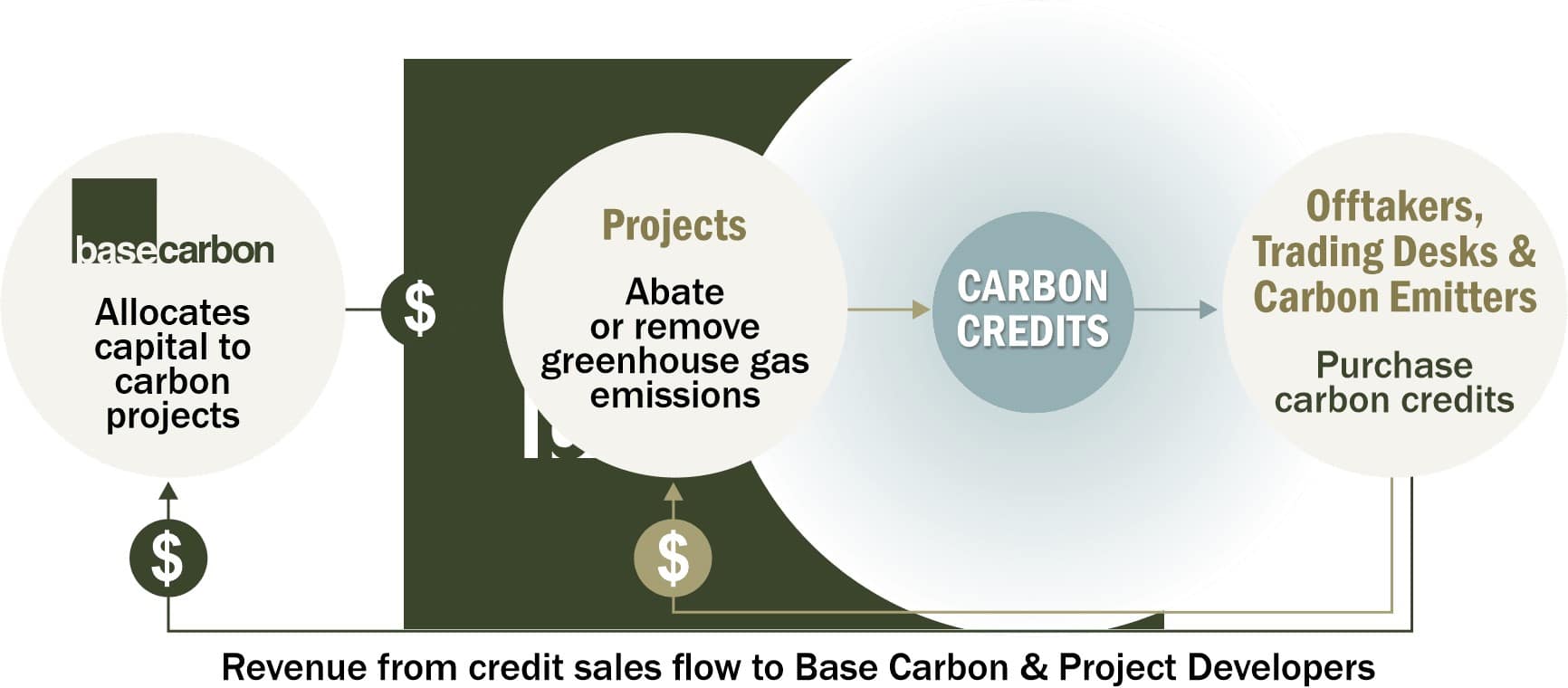
Carbon credits are generated by activities, projects or any initiatives that avoid, reduce, or remove CO2 emissions. Over 95% of carbon credits in the market fall under the first two categories. 

That means projects lead to fewer units of carbon in the atmosphere as compared to the “business-as-usual” scenario. The types of credits that these projects often generate include renewable energy credits, clean cookstove credits, and e-mobile credits. 

Though they vary when it comes to specific climate objectives, they all share the same goal – to replace the “dirty” sources of energy with sustainable, cleaner and greener alternatives.

The remaining credits are carbon removal projects such as reforestation (nature-based removal) and direct air capture (technological CO2 removal). 

Industry estimates show that demand for carbon credits will soar up exponentially, primarily due to corporate net zero pledges. Large companies’ climate commitments will bolster trading of carbon credits in the voluntary market (VCM)

  • Over ⅓ of the world’s biggest publicly traded firms unveiled their decarbonization targets in 2022. They purchase carbon credits to offset their CO2 emissions that they can’t yet avoid or reduce, alongside direct CO2 reductions. 

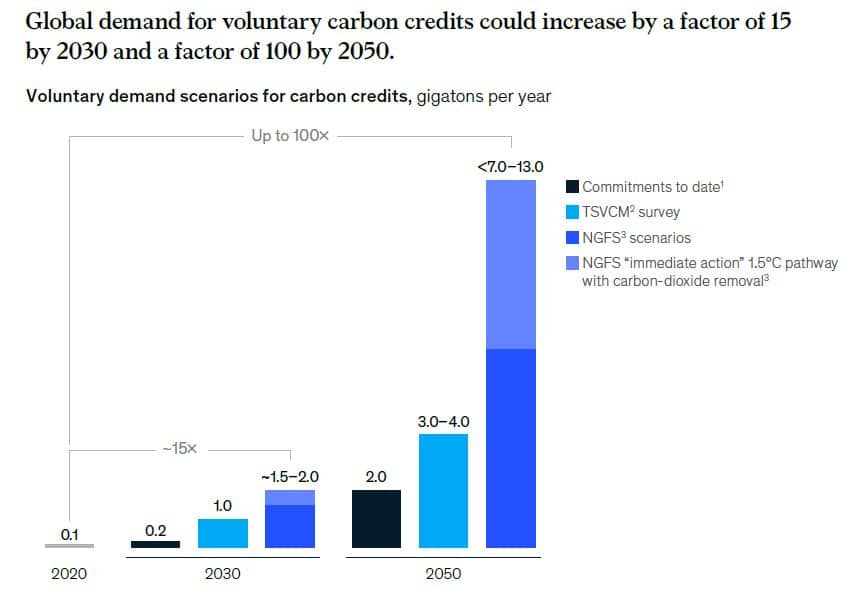
The VCM has already reached $1 billion in 2021, and projections show that demand for voluntary credits will grow to up to 2 gigatons/year of CO2 reduced and removed.

projected growth of carbon offset demand

Impact on Renewable Energy Development

So, how does carbon credits and their increasing trend impact the energy transition, especially the renewable energy development?  

Perhaps most significantly, carbon credits help support the cost of developing clean energy sources and make them more affordable. 

Currently, scaling green technologies such as solar mini-grids at the rate that matches the net zero scenario is almost impossible given their prices today. This is where carbon credits can be useful to lower prices for these clean energy products. And that would make these products affordable for low-income households.

Those who manage to use the credits in this way were able to have additional revenue streams while promoting clean energy.

Moreover, projects generating carbon credits in developing nations often have other outcomes benefiting the local community called co-benefits. For instance, the use of clean cookstoves can help improve the skills of women in Africa and their cooking conditions. These projects also provide health and social co-benefits such as eliminating or reducing harmful particulate matter from burning woods. 

Overall, the booming carbon credit market will be beneficial for startups or companies that are developing renewable energy projects. This market mechanism enables them to leverage the financing sector and drive more investments into renewables. 

According to the International Energy Agency (IEA), investments in renewable energy accounts for about ¾ of the growth in overall energy investment. And it has been rising at an average rate of 12% since 2020.

renewable energy capacity 2023 IEA
Renewable Energy Capacity 2023 IEA

The IEA believes this is a sign of going in the right direction when it comes to achieving the global climate goals. Still, the agency thinks that the rate is not fast enough to be on track in decarbonizing the global economy. 

  • Getting on track to net zero emissions by 2050 will need annual investment in clean energy infrastructure, including renewables, to reach around $4 trillion by 2030, says the IEA.

A significant part of that funding will be coming from the revenue of carbon credits or emissions trading. And though carbon credits differ from renewable energy credits, they are under the same tree and the former substantially impacts the development of renewable energy projects. 

To make it clearer, let’s provide you with a couple of case studies showing the significant effects of carbon credits in the creation of renewables and energy developers. Two major case studies stand out – China and India. 

Case Study #1: Wind Farms in China 

A study by Sun et al., (2020) found that carbon credits from emissions trading in China is more effective at promoting renewable energy development than imposing a carbon tax policy. 

Based on their findings, the authors also said that investors would prefer to put their money in renewable power under the compliance carbon credit market than carbon tax.  

In particular, without government subsidies, only by implementing carbon emissions trading policy can increase investment in wind power in China. More interestingly, the free allowance for CO2 emission reduction trading or carbon credits can offset any reduction in subsidies. 

That means the renewable energy development plan like the case of wind power is achievable even without increasing government subsidy. Specifically, the Chinese government can cut its total subsidy in wind power by about 4020 million yuan per year by reducing the carbon credit quote from 95% to 60%

The study, therefore, suggests that the establishment of appropriate emission quotas and trading prices of carbon credits can propel investors to continue supporting renewable energy development in China. 

Case Study #2: Solar Renewable Energy in India 

You can believe it or not but India has seen the fastest growth in renewable energy across all large economies. This is all thanks to private and foreign investments made into renewable energy projects in the country. 

Putting those investments into context, the 3rd largest emitter received ~$64 billion for renewable energy development from 2014 to 2019.

Back in 2015, India aimed to source 40%, or 500 MW capacity, of its energy from renewable energy by 2030. And the country had achieved that goal in 2021, with over 40% of its electricity capacity coming from non-fossil sources. 

So what attracts great interest from developers of renewable power in India? 

According to a report by the Institute for Energy Economics and Financial Analysis (IEEFA), there are enough boosts for them to pour their money into the sector. 

For one, the declining costs of solar modules propelled the growth of renewable energy in India. This, in turn, decreased the tariffs for the associated products.

Unfortunately, the Russian-Ukraine war and surging inflation pushed the financing costs higher, increasing interest rates for renewable energy developers. But the good news is that there are some levers that enhance returns for developers, encouraging them to build more projects. 

renewable energy India case study

As seen in the chart above, revenues from carbon credits trading is one of the reasons that developers continue innovating. Selling carbon credits from renewable energy generation to developed countries became a viable source of extra income for developers. This further enhances their returns.

The IEEFA report particularly showed how renewable energy credits and other levers help renewable power project developers grow their income. Their findings suggest that sales from carbon credits can give them an additional 3% to their returns. 

And that is quite big enough financial incentive to keep developing projects that significantly reduce carbon emissions. Not to mention that they’re helping the country reach its net zero emissions goal by 2070. 

No wonder Amazon has signed a total of 720 MW worth of renewable energy purchasing agreements in India. It has also closed deals with partners such as Vibrant Energy, ReNew Power Global, Amp Energy India and Brookfield Renewable. The retail giant will manage all its energy trading through its subsidiary, AEI New Energy Trading. 

So, how should potential clean energy investors take advantage of the exciting disruption that carbon credit markets bring? Here are the top ways to keep in mind.

3 Ways Investors can Capitalize in the Renewable Energy Market

  • Evaluate companies carefully and critically

First of all, investors should evaluate which companies promise strong revenue carefully. Do they have a clear and detailed plan and strategy for their carbon credit generation?

Ensure that the company is reliable enough in forecasting their carbon credit sales or that their basic product value proposition is strong enough without the credits. Keep an eye on their carbon credits pricing and quantity assumptions. 

These are critical especially now that many startups in the renewable energy sector are hopping into the carbon credit bandwagon.

  • Provide support to portfolio companies

Next step is to provide necessary support to companies in developing their carbon strategies. For instance, suggest any opportunities that they can employ to expand their markets through carbon credits trading. 

Determine what aspects or areas to further improve to develop high-quality renewable energy projects. If investors can connect their portfolio companies with credit buyers, that’s even better. The key to delivering superb support is understanding the different types of activities qualifying for carbon credits. 

  • Explore investment opportunities

Lastly, explore any opportunities for investing in carbon credit pre-financing deals. Some developers would require upfront capital to kick-start their renewable energy projects. For investors, this kind of investment has the potential to bring a high return of over 20%

But, of course, just like other investment opportunities, investors still have to take caution in assessing the projects. Would their funding be worth the risk? 

Only with enough knowledge and information could they be able to answer that question. This and the bright projections of the growth of the global renewable energy market are a good sign for those interested to invest in the space and see more projects being developed.

Should you want to know more about renewable energy credits (RECs) and how they differ from carbon credits in broader terms, go over this complete guide. You’ll also learn how RECs work and how to buy them.

NextGen CDR Unveils Massive 200K Mt Carbon Removal Credits Purchase

NextGen CDR Facility revealed the advance purchase of almost 200,000 tonnes of carbon removal credits from three different projects, including Summit Carbon Solutions, 1PointFive, and Carbo Culture, making it one of the biggest CDR transactions to date. 

NextGen is a joint venture between Swiss carbon project developer South Pole and Mitsubishi Corporation and is backed by founding buyers Boston Consulting Group, LGT, Mitsui O.S.K. Lines, Swiss Re, and UBS. 

The company aims to unlock the potential of large-scale carbon removal and plans to buy over 1 million CDR credits by 2025. 

When asked about the CDR purchase deal, Jim Pirolli from Summit Carbon Solutions commented that:

“Through this landmark purchase of CDRs, NextGen and their founding partners have taken a bold step to accelerate the implementation of the technologies and infrastructure required to permanently remove carbon dioxide from the atmosphere at a meaningful scale. We are thrilled that CDRs from our BiCRS project were selected for one of the largest, most important transactions of carbon removals in history.”

Buying Certified Carbon Removal Credits 

Climate scientists said that removing CO2 from the atmosphere, either through nature or technology, is critical to meeting the 1.5°C Paris climate goal. But the recent report from IPCC made it clear that the current rates of global CDR operations are not enough. 

The carbon removal market is still below the level to what the UN panel deems necessary for a livable future. 

The volume of NextGen’s advance carbon removal credits purchase is equal to about 25% of all CDR transactions made globally. They will be registered under the International Carbon Reduction and Offset Alliance (ICROA) endorsed certification standards, making the credits certified and trustworthy.

The carbon credits are from projects that provide long-term storage while removing large volumes of CO2 in the coming years. 

NextGen didn’t specify how many carbon credits will come from each project and their cost. But the CDR buyer said it targets an average price of $200 per tonne across its 1M tonne portfolio

The three projects that NextGen will be buying the CDR credits include:

  • Summit Carbon Solutions 

A portion of the 200k tonnes of CDR credits will be from Summit Carbon Solutions‘ $5.1 billion project. It represents the world’s largest tech carbon removal project, the Biomass Carbon Removal and Storage (BiCRS) project in particular. When completed, the project will remove over 9 million tonnes of CO2 per year.

To meet the stringent requirements of ICROA standards, Summit has developed a methodology for its BiCRS project that’s currently under review with the Gold Standard for the Global Goals. Gold Standard is one of the leading global registries through which CDR credits are verified to ensure project quality.

  • 1PointFive

1PointFive is developing the world’s largest Direct Air Capture and Storage (DACS) project in Texas, an Occidental Petroleum initiative.

A part of NextGen advanced carbon credits purchase will include CDRs from this DACS project. Once operational, it will remove and store up to 500k tonnes of CO2 per year.

  • Carbo Culture

NextGen will also buy carbon removal credits from climate tech company Carbo Culture’s high tech biochar project in Finland. The manufacturer plans to produce high-quality biochar that can remove and store 2.5 million tonnes of CO2 by 2030. 

The Finnish company’s approach involves producing biochar at very high temperatures for  maximum carbon removal capacity, achieving 1000+ years of permanence.

Here’s what it looks like within NextGen’s CDR Facility:

NextGen CDR Facility
Source: Mitsui O.S.K. Lines website

Scaling up the CDR Market

NextGen’s CDR portfolio offers best practice for project standard certification. Each project, like the ones above, will be certified and verified under ICROA standards to ensure highest environmental integrity. This 3rd-party assurance will also see to it that projects benefit not just the environment but also the local communities. 

Moreover, a robust MRV – monitoring, reporting, and verification – standards is crucial in the carbon removal market. It will help assure that the removal projects result in high-quality carbon removal credits that are additional, measurable, and permanent. 

NextGen CDR Criteria

NextGen carbon removal credits criteria

NextGen is developing one of the world’s largest diversified portfolios of CDRs by using different technological approaches offering significant promise to scale. These include the following:

Companies in NextGen will have access to those diverse global portfolios of carbon removal and storage solutions. This approach enables risk diversification for corporate buyers of carbon removal credits

In all, by providing access to deeper market expertise and pooling together buyers and sellers of high-integrity CDR credits, NextGen helps enable the carbon removal market to scale. Its landmark CDR deal sends a strong signal that corporations are serious in developing a market for high-quality CDR credits. 

More details on this news and NextGen CDR portfolio will be featured at the Carbon Unbound conference on May 11 in New York City.

$62B VC Firms Form Venture Climate Alliance for Net Zero

The Venture Climate Alliance (VCA), an organization formed by 23 leading global venture capital (VC) firms, was launched to support early-stage climate tech startups to cut their emissions and tackle net zero by 2050. 

In revealing the alliance’s launch, a representative from one of VCA’s founding members, Prelude Ventures stated that:

“We invest in climate tech companies that are transforming multi-billion dollar industries… As public markets, asset managers, and policymakers implement 2050 decarbonization goals, disclosure of climate-related risks, carbon emissions, and impact will matter for everyone — including those at the earliest stages of business building.”

What is the Venture Climate Alliance (VCA) and Who are the Members?

Venture capital investors have a big role in shaping the pathways to net zero emissions across sectors and industries. The Venture Climate Alliance is founded by a group of leading VCs aiming to achieve a rapid transition to net zero emissions by 2050 or earlier. 

VCA members will work together to achieve net zero emissions for the group’s own operations by 2030 or sooner. As part of the alliance, VCs can share common best practices for gathering, interpreting and reporting climate impact data. 

The alliance will also encourage their portfolio firms to have their own net zero targets. Collectively, they will build climate-aligned businesses for “net zero from day zero”.

The 23 VCs involved represent a total of $62.3 billion in assets, with their portfolios range from below $50 million to over $50 billion. The group’s members are the following:

Other Members:

VC Funding Climate Tech is Soaring Up

In the past years, momentum across venture-backed climate tech innovations is building up. According to HolonIQ, climate tech VC funding reached over $70 billion in 2022

climate tech VC funding 2022

Several factors are at play but most significantly, supportive policies such as the US Inflation Reduction Act and the EU Green Deal Industrial Plan are driving more innovations.  

  • As the bridge between capital markets and startups, VC investors are critical in helping companies develop, commercialize, and scale up. 

The VCA provides a platform through which member VCs can develop tools and offer guidance to help tear up barriers in aligning early-stage investments with net zero goals.

The alliance is officially a part of the United Nations’ Race to Zero campaign, an initiative rallying to bring businesses to a zero-carbon economy. It is under the leadership of the UN Climate Change High-Level Champions. 

Moreover, the VCA will be operating under the Glasgow Financial Alliance for Net Zero (GFANZ), co-led by former Bank of England governor Mark Carney. GFANZ brings together larger companies aiming to cut emissions to levels that the natural or technological carbon sinks can absorb. 

The VCA will join others belonging to GFANZ’ “sector-specific alliance” to create methodologies and tools for early-stage investments while sharing expertise across the wider financial sector.

The 4 Commitments Guiding the VCA

Guiding the VCA’s operations are the members four commitments – commit, recruit, assist and track. 

  1. Commit:

Committing to the alliance means a VC firm must do an internal inventory of its emissions from all sources – Scopes 1, 2, and 3. Then it pledges to reach net zero or negative emissions for its operations by 2030 or sooner.

  1. Recruit:

Portfolio companies will be encouraged to set their own net zero targets by 2050 or earlier. VCA provides tools and support to each company, while leveraging existing methodologies and guidance like those of the GFANZ.

  1. Assist:

When a portfolio company has a net zero target in place, VCA will provide stage-appropriate assistance to achieve those goals. The alliance assistance comes in different ways, e.g. serving as adviser or shareholder and giving support in policy development. 

  1. Track:

The alliance will monitor and share progress toward net zero targets. Though detailed emissions data per portfolio company may not be available all the time, a 3rd-party body will report on how that company progresses in its goals.  

Project Frame for Net Zero Methodology

Putting together a pack of VC firms is just the first step for the Venture Climate Alliance. The next step for the investors is to develop a methodology to guide their emission reductions activities, accounting and reporting.  

VCA members have been consulting one of their strategic partners, Project Frame which is an initiative of the nonprofit Prime Coalition. Project Frame develops emissions-impact methodologies and reporting standards for climate-driven investors. The image below is an example of the initiative’s methodology differentiating potential and planned impact. 

Project Frame Pre-Investment Considerations Methodology

Venture Climate Alliance and Project Frame
Source: Project Frame

A potential impact is a top-down approach which estimates what a net zero solution can achieve. Whereas a planned impact is a bottom-up approach of calculating the solution’s achievement based on a realistic analysis of its business model. 

The VCA and Project Frame will work together to develop a way for the alliance’s members to quantify their emissions. It will also help them determine how to reduce their footprint over time. This strategy includes the role of carbon credits as emissions offsets to help ensure that VCs portfolios reach net zero. 

Carbon credits give the holder the right to emit a corresponding amount of carbon. Each credit represents one ton of CO2 reduced, avoided or removed. 

Membership in the VCA is open to any venture capital firm, or a division of a larger firm engaged primarily in venture investing. To be part of the alliance, a firm agrees to fulfill the VCA’s four commitments and to actively contribute to the group where appropriate. 

Xpansiv Breaks 2 Major Deals at Once: T-REX and I-REC

The leading spot exchange for environmental commodities, Xpansiv, announced two major deals with T-REX and I-REC.

Xpansiv and T-REX partner to directly link environmental performance data to sustainably financed projects through Xpansiv’s Universal Project Numbers (UPN).

Meanwhile, Xpansiv will launch trading in renewable energy certificates (RECs) from the International REC Standard (I-REC) and the Evident registry on its CBL spot exchange.

T-REX is a financial infrastructure provider for complex fixed income investments. It combines SaaS technology with data and asset class expertise to lower expenses, reduce risk exposure, and improve performance. 

Tying the Knot Between Data and Finance

Just last month, Xpansiv announced it will provide access to intellectual property components that will let companies to identify environmental assets across their entire lifecycle – the Environmental Instrument Numbers (EINs). They are standardized reference numbers that Xpansiv Registry Services issues for each transferable asset upon issuance. 

To boost EINs application in support of the energy transition, the exchange also provides access to its UPNs. They represent a reference number for any tangible energy transition asset beginning at the onset of finance.

By integrating Xpansiv’s UPN in T-REX platform, the latter expands its system’s availability to tackle challenges preventing the energy transition finance to scale up. It will also allow lenders to structure, monitor, and track the impacts of their sustainable financing. 

For borrowers, the integration will improve transparency and simplify reporting while enabling portfolio monitoring, risk management, and investment impact measurement. 

Andy Bose, a Senior VP at Xpansiv, had spoken about the deal:

“The T-REX platform will directly tie energy transition finance to environmental performance metrics using UPNs. The breadth and flexibility of T-REX’s platform and its broad base of top-tier financial institutions provides the ideal format to bridge sustainable finance with Xpansiv’s global registry and environmental market infrastructure.” 

On their side, T-REX CEO Benjamin Cohen said that the integration of Xpansiv’s UPN will allow their clients to “track the real-time results of their investments across the lifecycle of any asset that is financed”. It will also enable companies to create data-driven sustainability-linked covenants and benchmark across a wider range of metrics. He added that:

“Trusted and scalable financial infrastructure is needed to facilitate the trillions of dollars of investment required to meet net zero greenhouse gas (GHG) emission goals by 2050.”

Xpansiv’s UPN-linked Environmental Instrument Numbers are used by the company to track billions of registered, tradable assets. These include renewable energy certificates, carbon credits, digital fuels, and recycled plastics. 

The largest spot exchange for environmental commodities also announced that it will launch its newest instrument – the International Renewable Energy Certificates (I-REC) spot contracts. 

No Silver Bullet, Only More Credits

Xpansiv will soon trade RECs from the I-REC Standard and the Evident registry on its CBL spot market. Adding the new contracts will expand the range of RECs and carbon credits currently trading on the platform. This will improve RECs’ price discovery and liquidity formation.  

Launching the I-REC in Xpansiv’s market ecosystem will broaden options for developers and traders across Asia, Latin America, the Middle East, and Africa. The spot exchange currently trades about 100 global voluntary and compliance RECs, including North American and Australian RECs. 

In 2021, CBL REC volumes rose 28% due to broader market participation and a sharp increase in solar REC traded. And given the projected rising demand for renewable energy, there’s also growing interests in trading of RECs globally. 

According to research estimates, global REC market value will grow to over $111 billion.

global REC market size projection
Source: www.fnfresearch.com

Xpansiv will list different I-REC offerings based on host country and project type. The company will also integrate the Evident Registry, which issues and manages I-REC renewable energy products, with the exchange trading platform and multi-asset, multi-registry portfolio management system. 

Commenting on this development, another Senior VP at Xpansiv said that “there is no silver bullet in the energy transition”. Instead, market players need various tools to meet their decarbonization goals. 

I-RECs are a useful addition to the diverse set of RECs and carbon credits that entities can access through Xpansiv. This is more crucial for global companies aiming to abate their carbon emissions in countries without compliance markets for RECs.

Xpansiv plans to launch I-REC trading in the 2nd quarter, followed by the integration of the Evident registry.

EPA to Regulate Gas-Fired Power Plants with Carbon Capture

President Joe Biden will soon reveal US’ newest climate rules requiring gas-fired power plants to capture their carbon emissions through the Environmental Protection Agency (EPA).

This plan will come just ten months after the Supreme Court restricted the EPA’s authority to reduce power plants’ emissions.

Biden’s Proposed Climate Rules

According to sources, the EPA will make the new rules public as soon as this week, covering both the existing and new power generators running on natural gas. 

Natural gas is responsible for a quarter of the country’s total carbon footprint. The total share of fossil fuels in the mix in 2022 was 60% and 60% of that was natural gas. The remaining 40% was coal.

Biden’s proposed climate rules will replace his two predecessors’ mandates – Obama’s Clean Power Plan and Trump’s American Clean Energy, both of which have failed. 

The current administration is under pressure from various environmentalists to be bold and stay true to its campaign promises to take on climate change. With the yet-to-reveal proposal, it seems the government is heading towards that direction.

The recent proposal comes as EPA aims to reduce the use of fossil fuels both in the power and transport sectors to meet Biden’s ambitious climate goals – to cut U.S. GHG emissions by 50% by 2030. 

The agency proposed the biggest-ever limits on the transport vehicles CO2 emissions earlier this month. The goal is to shift into producing and using electric vehicles (EVs). 

EPA projected that its car and truck emissions rule can result in expanded electrification of transportation, with EVs comprising ⅔ of new automobile sales by 2032. Tesla is taking the lead in this direction, reporting record sales in EVs and the corresponding carbon credits it generates. 

Backing Up the Proposal: CAA and IRA

The proposed emissions standards for the power sector is based on a plant’s capacity to reduce CO2 footprint using the carbon capture and storage (CCS) technology. 

Earlier this year, the Department of Energy rolled out over $2 billion to fund two carbon capture initiatives aiming to boost investment in technologies that capture, transport and store carbon.

Under the new rules, utilities must decide which from these options they would prefer to continue operating:

  • Construct new baseload gas-fired plants with carbon capture in place, or 
  • Opt to use renewable energy to power their facilities.

As the proposal will go through SC’s deliberations, Pres. Biden and the EPA have two existing laws holding their ground legally. 

The Clean Air Act: 

Even if the Supreme Court had forbidden the agency to enforce a system-wide regulations over the power generators, EPA still can issue facility-specific rules under the Clean Air Act (CAA). 

The Act allows the agency to set CO2 emissions limits based on the “best available control technology”. It’s up to the utility companies and states to work out their plans to meet it. 

The newest rules proposed can help carbon capture to go mainstream or propel the use of renewables for generating electricity. It can also promote the use of other clean technology such as hydrogen. 

The Inflation Reduction Act: 

The IRA is perhaps the biggest promoter of CCS adoption across industries, particularly in the power sector. It increases the tax credits for capturing CO2 directly from a smokestack or source, from $45/ton to $85/ton. The incentive for CO2 captured from the air is even much bigger – $180/ton.

The law also authorizes the EPA to regulate power plants, while providing over $100 billion in clean electricity tax credits. 

A Cleaner Source of Power 

As per the energy think tank Ember, the global electricity sector’s carbon emissions may have peaked in 2022 and will begin to fall in the coming years. The group also reported that clean power sources have reached a new record of 12% share in the electricity mix. 

clean power generation 2022 wind+solar

In the US, the Energy Information Administration reported that fossil fuels accounted for over 60% of electricity generation in 2022. Renewable sources accounted for over 21% while nuclear takes up the rest. 

  • This year, solar will take up 54% of new power generation while 14% will be natural gas, says the IEA.

Though it appears that the EPA will largely rely on carbon capture and storage, opponents argue that it won’t discourage demand for fossil fuels. But the Biden administration makes it clear, with the IRA, that carbon capture is a big part of their plan.

The Natural Resources Defense Council’s director of the federal group remarked on the proposal, saying:

“We’ve been encouraged by what we’ve heard from EPA [climate rule proposal for power plants]…and what we’ve seen from them in other rules.” 

Some industry players think that carbon capture and storage is not an “adequately tested technology” as power plant standards. They pointed to the failure of Texas’ Petra Nova. Others said that commercial deployment of the carbon capture technology will be many years away, despite the huge tax incentives.

To meet the most stringent standards, the largest power plants have to make the deepest and earliest cuts to their CO2 emissions. But for facilities that are about to retire and units that run at times of peak demand will have lenient rules. 

Carbon Credits and the Role of Governments: Encouraging Climate Action Through Policy

0

To limit global warming in line with the Paris Agreement, the world has to cut greenhouse gas emissions by 50% by 2030 and bring them to net zero by 2050.

But that’s easier said than done because there are many human activities that can’t be done without using carbon. So how should we go about those things that continue to contribute to climate change? One way is through carbon credits, with more push from the governments.  

Companies can neutralize their carbon footprint by paying someone else to reduce their emissions or capture them. And in the most lofty situations, entities can use carbon credits to achieve their climate goals. 

What are Carbon Credits and How Can They be a Climate Action?

The idea behind the creation of carbon credits is very simple. If an entity can’t avoid releasing CO2, it can ask another to emit less so that the total level of CO2 in the atmosphere is cut even if the first emitter continues on producing CO2.

Carbon credits, also known as carbon allowances, are like permission slips for carbon emissions. When an entity buys a carbon credit, it gets the permission to emit one ton of CO2. 

It is traded in two different markets – compliance and voluntary. Under the compliance carbon market, companies are obliged to follow the allowed emission level they’re given. Usually, a company buys the credits from the government regulated body. 

The number of credits every year is based on the emissions limit (cap) the government set. If the regulated company goes above those limits, it can buy from another company. On the contrary, if that firm has excess credits, it can sell to its peers (trade).

Hence, these programs that trade carbon credits are also known as “cap-and-trade”. The cap that regulators set decreases over time, prompting carbon-intensive industries to reduce their emissions.

Under the voluntary carbon market (VCM), carbon credits are also called carbon offsets. The credits are traded in various carbon exchanges and online marketplaces without being regulated by the government. Entities buy or trade them voluntarily to offset their carbon footprint. 

So, in a sense, governments have a direct influence on CO2 emissions levels under the compliance carbon markets. 

Right now, several countries have included in their government policies the element of carbon allowances. The big ones are the EU Emissions Trading System (ETS), the California Global Warming Solutions Act (USA), and the China Certified Emissions Reduction (CCER) scheme. 

These government carbon schemes particularly focus on regulating emissions from the heavy emitters such as steel, cement, and transportation. Through carbon credit schemes, companies operating in regulated industries don’t have a choice but to lower their footprint. 

Unless they’re willing to just pay the hefty fines and be left behind by their peers keeping pace with the clean renewable energy trend.  

So, carbon credits serve an instrumental role in not just regulating emissions, but also as a climate mitigation. Governments, thus, have a critical role in taking advantage of carbon credits and turning them into a climate action. 

In the Absence of a Government Policy

Even without the mandate, companies can still set climate goals and achieve them by buying carbon credits or supporting the projects that generate them. 

Companies can pick from the different types of carbon credits available on emissions trading platforms.

Three Types of Carbon Credits

  1. Credits from reduced emissions, e.g. energy efficient technologies
  2. Credits from removed emissions, e.g. tree planting and carbon capture tech
  3. Credits from avoided emissions, e.g. not cutting down trees

Though the process of creating carbon credits differ, each credit represents the same amount of reduction: one tonne of CO2. 

Encouragement from both the government and investors to cut down emissions continues to intensify as the deadline for the world to reach net zero emissions is fast approaching. 

The fastest action we can take to prevent catastrophic effects of climate change is by the end of this decade. Only if we cut global CO2 levels by half that period will we hit net zero the soonest. 

  • Estimates say that 2 billion tonnes of CO2 reduction/avoidance, or the same amount of carbon credits, is necessary to get to the 2030 goal. 

Some businesses offset their current emissions that they can’t avoid, but others have pledged to go further and use carbon credits to compensate for their historic emissions. 

Take for instance the case of Microsoft. The tech giant seeks to offset its huge footprint from over 4 decades back. And they’re not compelled to do so; it’s voluntary and part of the company’s corporate sustainability efforts.

Most shareholders are shaping how businesses handle their corporate social responsibility, which now primarily concerns sustainability and climate change actions.

Building Transparency, Boosting Corporate Sustainability

Until now, voluntary emissions trading systems don’t have a standardized way in trading carbon credits. In other words, project developers and traders can go in their own way on how to transact business.

This causes some projects to be developed in a manner that creates questionable credits. Environmentalists accuse some projects that don’t deliver their promised carbon reductions. They also claim that some countries have increased their emissions just to be paid for slashing them. 

A landmark decision was made by President Biden’s climate envoy during the COP27 climate conference by creating a framework for carbon credits. The framework associates the cash from the credits to putting an end to developing countries’ reliance on fossil fuel. 

The plan particularly focuses on reducing governments emissions from power generation and replacing fossil fuels with renewable sources of energy. The scheme specifies independent, 3rd-party verification of emission reductions. 

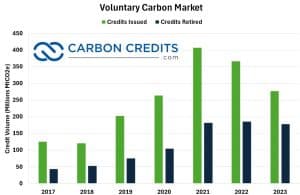
Meanwhile, the voluntary carbon credit market has shown an impressive growth since 2010. The chart plots this growth of the VCM.  

Growth of Demand in the Voluntary Carbon Markets

That rising trend is despite the lack of standardization and transparency in the VCM. But as the world races to net zero, carbon offsets would be here to stay. 

To build credibility and trust in the market, guidelines and principles are in place to encourage more transparent carbon trading markets. The Integrity Council for the VCM just recently published its Core Carbon Principles.

CCPs will set a global standard for high-integrity carbon credits based on clear and verifiable data. Credits that have a CCP label will be recognized as high-quality.

Encouragement to support high-quality credits is not just for the big polluters but for all actors across the value chain. 

Essentially, supporting credits with high transparency also translates to boosting reputation on corporate sustainability and climate actions. If companies choose to take this path, the growth of the carbon markets may even beat industry projections.  

projected growth of carbon offset demand

Pricing Carbon Credits and Sustainable Development

Pricing carbon offsets or carbon credits often follows a free-market approach to putting a cost on emissions. But pricing carbon credits based on market dynamics alone may not be enough.

That’s because paying for carbon credits at prices below what they cost to sustain a project means that those projects may stop running in communities they support. It may also not consider the additional value that a project delivers in terms of sustainable development.

Taking into account the socio-economic benefits, a.k.a. co-benefits delivered by a project in pricing carbon credits is important. Let’s give an example to show this is so.

For instance, prices for community-based clean cookstoves projects are higher than large-scale renewable energy projects. That could be because the former often deliver health benefits to women and children. 

So, some carbon standards factor in the co-benefits that a project delivers that go beyond carbon reduction. They are reflected in the final price of carbon credits. 

Co-benefits also refer to the United Nations 17 Sustainable Development Goals, which are adopted by the national governments that are Parties to the 2015 Paris Agreement.

They are often identified under the three pillars of sustainability — social, environmental, and economic.

  • In the context of climate change, co-benefits are the additional positive social, environmental, and economic benefits of climate mitigation projects that are above and beyond the key benefit of reducing emissions.

Climate change mitigation and co-benefits can go hand in hand if considered from the early stages of the project. Careful integration of co-benefits into a project’s blueprint can ensure their delivery. Examples of co-benefits include:

  • improved air, water, or soil quality;
  • employment generation;
  • improved livelihoods;
  • improved energy security and access to energy services;
  • infrastructure development; and
  • technology transfer.

The Gold Standard is famous for quantifying the beyond-carbon impacts of a project and reflecting them in the final price of carbon credits.

Here’s an example where various project types have different shared values based on the bundled SDGs they deliver.

carbon credit price with bundled SDGs

The creation of the UN SDGs provides important momentum for integrating sustainable development into climate change mitigation agreements. As seen in the example above, projects that bundle sustainable development goals can maximize co-benefits. This, in turn, may also push carbon credit prices up.

To know more about pricing carbon credits, here’s a comprehensive guide for that.

Each SDG has its own set of targets to achieve. And though SDG 13 is specifically for tackling climate change, other SDGs also generate different types of carbon credits.

For instance, projects that speed up the clean energy transition (SDG 7) can produce renewable energy credits. This type of carbon credit is from replacing fossil fuels by renewables such as hydro, solar, and wind, and government subsidies for them are growing.

There’s also the agricultural or soil carbon credits that sustainable agriculture (SDG 2) projects can earn. Regenerative farming practices often yield high credit prices.

SDG 15 or sustainably managing forests and other terrestrial ecosystems yield nature-based removal credits. REDD+ or forestry and land use projects are a most common example.

Both the corporate world and the governments are pressing harder to make these projects deliver on their carbon reduction promise. 

Europe’s most energy-intensive industries such as aviation can use carbon credits to meet their mandatory emissions limits under the EU Emissions Trading Scheme.

In Colombia, polluters can also pay for their carbon taxes with carbon credits. And in the U.S., the government established new rules that require entities who claim for carbon capture tax credits to verify the carbon captured by the projects or initiatives they support. 

Canada Commits $9.7 Billion to Propel Volkswagen Battery Plant

0

In a bold and strategic move, Prime Minister Justin Trudeau’s government has approved a whopping C$13 billion ($9.7 billion) in subsidies over ten years, securing a monumental Volkswagen AG electric-vehicle battery plant in Canada. It’s Volkswagen’s first outside Europe. 

This decisive action demonstrates Canada’s dedication to staying competitive in the global shift towards clean energy and technology.

As the world races towards achieving net-zero emissions, the demand for battery metals has skyrocketed. North America must urgently scale up the production and recycling of these metals to create a sustainable, secure supply chain. This is critical to support the exponential growth of electric vehicles and renewable energy infrastructure.

annual EV sales

Canada’s Commitment to Clean Energy

By making a significant investment in the Volkswagen plant, Canada is staking its claim as not only a provider of critical minerals but a hub for advanced manufacturing and clean technology, too.

The Canadian government’s extraordinary subsidies are a direct response to the competitive financial incentives in President Joe Biden’s climate legislation. Trudeau’s administration recognizes that such investments are not only crucial to keeping pace with the US. They will also allow Canada to maintain a strong position in the North American auto sector as it transitions away from internal combustion engines.

Industry Minister François-Philippe Champagne asserts,

This is about us seizing generational opportunities. This is about raising our level of ambition.”

The Volkswagen plant has a massive footprint equal to 350 football fields. But on the positive side, it will create thousands of jobs in the region around St. Thomas, southern Ontario.

Furthermore, the economic value of this colossal project far outweighs the cost of the subsidies. Not to mention the supply chain spinoffs it will generate.

The staggering incentives package comprises annual production subsidies and a grant towards the factory’s capital cost. It effectively matches the benefits the German automaker would have received via the Inflation Reduction Act if it had chosen to build the plant in the US. 

The Canadian government is also in talks to provide financial assistance for an LG Energy Solution and Stellantis NV plant in Ontario.

It is worth noting that the Inflation Reduction Act offers generous, large-scale subsidies for low-carbon industries. This put pressure on Canada and other US trade partners to either provide similar support or risk losing out on lucrative new investments in the green economy.

Canada’s assertive move to land the Volkswagen electric-vehicle battery plant shows the country’s commitment to clean energy and technology. And by investing heavily in this sector, the country ensures that it remains competitive in the global race towards net zero emissions and a greener future.

As other nations vie for their share of the green economy, Canada has shown that it is ready and willing to go the distance in this critical mission.

The Carbon Capture Abilities of Algae

Seed Health, a microbial science company, revealed its recent research showing that microorganisms, particularly blue-green algae, can unlock new carbon capture solutions. 

The research is a collaboration between SeedLabs, an environmental research division of Seed Health, and the team of the Two Frontiers Project (2FP) led by Dr. Braden Tierney. 

Remarking on the announcement, a co-founder of Seed Health stresses:

“…we founded SeedLabs to harness the power of microbes to enhance biodiversity and restore ecosystems impacted by human activity. With this collaboration, we have the potential to power the ‘bio-revolution’ in carbon technology and uncover novel solutions to address the climate crisis.”

The Need for Radical Carbon Capture 

The world is under extreme pressure to curb carbon emissions fueled by deforestation, increased use of fossil fuels, and industrial activities. All these make climate change worse, and the United Nations’ IPCC stressed the importance of carbon removal to mitigate it.

Scientists are making great strides towards scaling up the world’s capacity to remove and sequester carbon emissions in the atmosphere. And the research team from SeedLabs and 2FP. 

2FP’s innovative, data-driven approach to studying the planet’s carbon-rich environments is perfect for discovering microbes ideal for carbon capture. Their results can help drive the discovery and development of advanced CO2 sequestration technologies.

Dr. Tierney said that microbial dark matter has the great “potential for understanding and improving the health of our planet.” He added that their team at the 2FP is using microbial exploration and scaling it to provide next-gen sequencing technologies. 

Powering the Bio-Revolution to Seize Carbon

SeedLabs funded the research composed of two expeditions. These are CARBON1 in Vulcano, a small island off Sicily’s coast, and CARBON2 in the Rocky Mountains of Colorado. Research team members are from the University of Palermo, Harvard Medical School, Colorado State University, and the University of Wisconsin-Madison.

Using advanced scientific methods, they succeeded in discovering a never-before-seen volcanic green photosynthetic bacteria known as cyanobacteria that are so efficient at consuming CO2 and seem to outperform other microbes. 

Cyanobacteria, or blue-green algae, are microscopic organisms that naturally live in water and have a big appetite for carbon dioxide. They are also capable of converting the captured carbon into biodegradable bioplastic.

The team in the first expedition, CARBON1, sampled water, sediment, and other sources of microbial life present in Vulcano. The collected carbon-capturing microbes were cultured in a lab environment, from which a bigger team discovered a new cyanobacteria strain. 

According to a researcher from Harvard, the strain they isolated was more efficient at capturing carbon and seemed to adapt to the environment of the volcanic plumes by “becoming denser and sinking more readily”. This unique quality is ideal for carbon capture and deep ocean sequestration.  

The team of the second expedition, CARBON2, explored the carbonated springs in Colorado’s Rocky Mountains (captured below), which are known to contain a thousand times more CO2 levels than the volcanic seeps in Sicily’s Vulcano. 

blue-green algae thermal pool
A thermal pool in Colorado’s Rocky Mountains. Source: Seed Health

The scientists used the Oxford Nanopore’s MinION system in sequencing DNA in the field and designing media on-site to isolate microbes that capture carbon. The system shows the possibility of conducting remote science in extreme environments.

Creating a Unique, Open-Source ‘Living Database’ of Microbes

The group is creating a unique, open-source ‘living database’ of extreme microbiomes. It combines DNA sequencing data with a biobank of thousands of different environmental and biological samples. 

Their research approach is cutting-edge with the help of machine learning and microbial bioinformatics. This enables the team to continue their investigation from the field long after coming back to the lab. They can also go back to their stored samples and culture more microbes, depending on their scientific analysis.

Ultimately, the team can preserve and protect their metadata and biological material that future researchers can use. Their groundbreaking approach – DNA sequencing + cultivated biobank – is unmatched in extremophile (organism that thrives in extreme environments) microbiology.

This initiative expands SeedLabs’ environmental works beyond probiotic innovations in restoring ecosystems to include pioneering microbial technologies that can help address the most serious issues presented by climate change. 

Former Tesla and Google X Executives Close $20M for CDR Tech

Ebb Carbon, an ocean-based carbon dioxide removal (CDR) company founded by former executives of Tesla and Google X, secured a $20 million funding for the development and deployment of its technology.  

The investment raised by Ebb Carbon in Series A round is the largest to date in an ocean-based CDR technology. It was raised in two closes, led by Prelude Ventures and Evok Innovations. 

The second close brought the total funds raised by the firm to $23 million, seed round is worth $3 million. Joining the recent investment round are investors from Incite, Congruent, and Grantham.

Remarking on Prelude Ventures’ investment, its Managing Director and Co-founder Gabriel Kra, said that:

“The team [Ebb] has previously demonstrated their abilities to build and scale industrial machinery, and has invented a technology that is a least-cost solution for ocean carbon dioxide removal.”

What is Ocean-based Carbon Removal? 

The goal of this type of CDR is to enhance and speed up the ocean’s natural ability to capture and store CO2 permanently. 

While reducing carbon emissions is a must, it’s not enough to meet the climate goal set during the Paris Agreement. The United Nations Intergovernmental Panel on Climate Change (IPCC) made it clear that removing CO2 already emitted is necessary to avoid the worst effects of climate change. 

Currently, there are various CDR technologies that are underway or being developed to do the job. One example is the Direct Air Capture (DAC) which directly draws in CO2 and extracts it for permanent storage underground. 

What makes ocean-based CDR different from those technologies is that it turns the 2-step process – capture and storage – into just one. Moreover, it reduces energy use requirements, streamlines the storage part, and offers one of the most cost-effective ways to remove CO2.

The oceans are constantly absorbing and storing CO2 from the atmosphere. But rising levels of this gas do not only change the climate, they also make the ocean more acidic. This, in effect, makes marine life at risk of extinction and coastal communities suffer from it. 

Meet Ebb Carbon, a California-based startup that pioneers a new method of carbon removal using electrochemistry. 

Ebb Carbon and Its CDR Solution 

Ebb Carbon is founded by scientists and climate tech veterans, with a team of chemists, engineers, physicists, oceanographers, and more. Collectively, they have more than 6 decades of experience in developing clean technologies at SolarCity, Tesla, and Google X. 

Ben Tarbell, CEO and Co-Founder of Ebb Carbon, commented on the fundraising:

“The ocean is a natural and vastly underutilized ally in this fight. Our approach combines capture and storage into one step, by accelerating naturally occurring processes that benefit from the immensity of the ocean’s surface area. This enables one of the lowest cost solutions for atmospheric CO2 removal at scale.”

The CDR company has developed a solution that’s one of the most promising to remove carbon at the gigaton scale. It’s using an electrochemical ocean alkalinity enhancement technology, which attracted commitments from Stripe for the purchase of carbon removal credits.

Ebb’s solution speeds up a natural process called ocean alkalization that restores ocean chemistry and safely absorbs CO2. It then converts the captured CO2 to bicarbonate, a safe and stable form of the gas.

Ocean alkalization occurs naturally over millions of years but Ebb’s electrochemical system enhances it, in a fraction of the time. The patented CDR tech rearranges the salt and water molecules and turns them into acid and slightly alkaline salt water solutions. 

After removing acidity from seawater, Ebb returns the alkaline seawater to the ocean where it mimics the natural alkalization process. This solution results in: 

  • Ocean deacidification: The alkalinity returned to the ocean acts like an antacid, lowering ocean acidity locally.
  • Permanent carbon storage: Bicarbonate naturally resides in the ocean and can store CO2 for 10,000+ years.
  • ​Additional carbon removal: As CO2 in seawater converts to bicarbonate, the ocean pulls down more CO2 from the air.

How Ebb CDR System Works

Ebb’s ocean-based CDR system is modular, can process seawater directly from the ocean, and can be installed near any industrial source of salty water. These include desalination plants, aquaculture or energy production facilities that use ocean water for cooling.

Here’s how the proprietary Ebb Carbon ocean-based CDR system works.

Ebb’s Electrochemical Ocean Alkalinity Enhancement Process

Ebb Carbon ocean CDR system

As more CO2 locked away as bicarbonate, the ocean will naturally equilibrate and sequester more CO2 from the air. Ebb measures and monitors the pH level and alkalinity volume it creates using sensors and software. The data they generate is important for measuring and verifying the amount of CO2 that the system removes. 

Accurate and verified data is also crucial when the company claims the corresponding carbon credits. Every tonne of CO2 their system removes can earn them one carbon credit. 

With the recent $20 million investment, Ebb will start to deploy its first systems. One has the capacity to remove 100 tons of CO2 later this year, and the other system boosts a 1,000 tons removal capacity.

Tesla Carbon Credits Revenue Up by 12%

Tesla, once again, is grabbing attention with its Q1 2023 revenue from the sales of carbon credits alone, not to mention income from selling electric vehicles (EVs).

The automaker recorded a 12% increase from the prior quarter’s sales, with $521 million in this first quarter compared to $467 million in Q4 2022.

Tesla has been earning revenues from the sales of its carbon credits for the previous years, reported a whopping $1.78 billion in 2022 alone.

Carbon credits, also known as carbon allowances or carbon offsets, are a way for companies to offset their footprint by investing in carbon reduction projects. These credits can be sold to other firms that struggle to meet emissions standards set by regulatory bodies like the California Air Resources Board or CARB.

Towering Up: Tesla Carbon Credits Revenue

Though Tesla has managed to improve its bottom line in previous quarters, carbon credit revenue continues to be a significant factor in Tesla’s earnings. In the current tough macro environment, Tesla would be in the red were it not for carbon credits – something that hasn’t happened in the last two years.

Tesla has been selling carbon credits to its peers such as Chrysler. It reportedly bought US$2.4 billion worth of Tesla’s carbon credits, accounting for most of the company’s sales in past years.

Tesla carbon credits revenue 2023

In 2019, the company made headlines when it earned a total of $600 million from selling carbon credits to fellow automakers that didn’t meet emissions standards set by CARB. 

Buying credits from Tesla allowed those companies to comply with regulations without making big changes in their own operations.

Reducing GHG emissions requires addressing both energy generation and use. This is what the transportation and energy sectors have been focusing on to slash their emissions.

Same as Tesla, other carmakers such as Audi, Porsche and Chrysler are also ramping up their electrification plans. Audi, for instance, aims to have 30 EV models by 2025 and have a 40% volume share of the EV market by that year.

Tesla has seized the net zero market through various revenue streams including EVs, solar installations, and carbon credits. But the rise of Tesla’s carbon credits sales over the years has significantly contributed to its revenues and profits.

Where Do All Tesla Carbon Credits Come From?

Tesla’s carbon credit income is all thanks to its EV production, which the company has also been the industry leader. The carmaker has been the top producer of innovative and eye-catching EV models since it started operating 20 years ago. 

In the first 3 months of the year, Tesla produced about 441,000 vehicles at four factories. Deliveries came in at about 423,000, representing a 36% increase year-over-year.

Tesla’s mission is to speed up the world’s transition to sustainable energy by electrifying transportation and the global economy.

Last month, Tesla proposed a path to reach a sustainable global energy economy through end-use electrification and sustainable electricity generation and storage. It’s outlined in the company’s paper “Master Plan Part 3 – Sustainable Energy for All of Earth”, with assumptions and calculations behind the proposal.

  • According to its analysis, the electricity sector gets 65 PWh per year of primary energy, including 46 PWh/year of fossil fuels. If the grid sources its power from renewable energy, the sector would need only 26 PWh/year of sustainable electricity generation.

In addition to producing EVs, Tesla also runs a solar panel installation business and sells energy storage systems. These operations are part of its quest for sustainability, which all generate carbon credits by avoiding carbon emissions.

Turning on the Switch of EVs

Electric vehicles are about 4x more efficient than internal combustion engine (ICE) vehicles, as per Tesla calculation. That’s mainly due to EVs’ higher powertrain efficiency, regenerative braking capability, and optimized platform design. 

The figure holds true across vehicle types – passenger vehicles, light-duty trucks, and Class 8 semis as shown in the table. 

Tesla EV vs. ICE energy efficiency

For example, Tesla’s Model 3 energy consumption is 131MPGe compared with a Toyota Corolla with 34MPG, or 3.9x lower. The ratio is even more when factoring in upstream losses such as those from extracting refining fuel energy use. 

TESLA MODEL 3 vs. TOYOTA COROLLA ENERGY USE

Tesla EV vs. Toyota ICE energy use

Electrifying the transportation sector globally will reduce use of fossil fuels by 28 PWh each year. Applying the 4x efficiency factor for EVs, there will be an additional demand of ~7 PWh a year for electricity. 

According to a research body, the global EV market size accounted for US$205 billion in 2022 and will grow to around US$1.7 trillion by 2032.

EV market size, 2022-2032
Source: Precedence Research

In 2021, global EV purchases grew to 6.6 million, up from 3 million a year earlier, according to the International Energy Agency (IEA). EVs got a 9% share of the entire market and represented the total growth in global car sales. 

Tesla still took the lead in the U.S. EV market last year. Its cars are powered solely by the electrical charge stored in batteries. Technically, they’re called Battery Electric Vehicles or BEVs. 

One of the major reasons for Tesla’s dominance in the sector is this: Lithium ion batteries have the highest charge capacity among existing battery formulations. Thus, it makes Tesla EVs practical to have and to drive. 

As the world races to net zero emissions by 2050, electrification not just in transportation but across sectors is critical. Does this mean that demand for lithium will also increase?

The Rise of the “White Gold” 

Lithium is a non-ferrous metal known as “white gold”. It is one of the key components in EV batteries, alongside nickel and cobalt. 

A lithium-ion battery pack for a single EV contains about 8 kg of lithium, according to the US Department of Energy. But it can also depend on the battery size. A Tesla Model S’ battery, for instance, has over 62 kg of lithium.

The leading carmaker used around 42,000 tons of lithium carbonate equivalent in 2021. That’s more than 5x the combined lithium used by Ford and GM, according to BNEF data calculations

Global lithium production reached 100,000 tons or over 90 million kg last year. Meanwhile, the worldwide lithium reserves are about 22 million tons – or 20 billion kg, as per the US Geological Survey (USGS).

While China owns 70% to 80% of the entire supply chain for EVs and lithium-ion batteries, Chile has the world’s biggest lithium reserves. The South American nation is one of the so-called “Lithium Triangle” countries, along with Argentina and Bolivia. A little below 60% of Earth’s lithium resources are found in those three American countries.

The IEA’s 2050 Net Zero scenario says the world has to have 2 billion battery electric, plug‐in hybrid and fuel-cell electric light‐duty vehicles on the road by that date.

In Tesla analysis, lithium comprises 20% of the materials needed to deliver the energy storage in batteries for EVs relative to 2023 USGS data.

lithium for EV battery

Statista projected the rising global demand for the white gold until 2030, increasing by over 700% from 2019.

lithium demand projection 2030

Batteries will account for the bulk of lithium demand by the end of this decade, fueling the EV revolution.