Most of the world’s largest banks and asset managers are failing to put into action their climate goals.
Three major banks recently rejected shareholders’ proposals to align lending practices with climate targets while three more will do the same.
Shareholders of Citigroup, Wells Fargo, and Bank of America passed resolutions to end support for fossil fuels. A specific resolution from Citigroup shareholders proposed that the bank,
“…adopt proactive measures to ensure that the company’s lending and underwriting do not contribute to new fossil fuel supplies.”
It was denied the same with similar resolutions from the two other banks.
Banks’ Climate Goals Versus Actions
Banks have been pumping about $4.1 trillion of financing to the oil, gas, and coal sector via loans and bond sales since the Paris Agreement in 2015. $656 billion of that was for last year only.
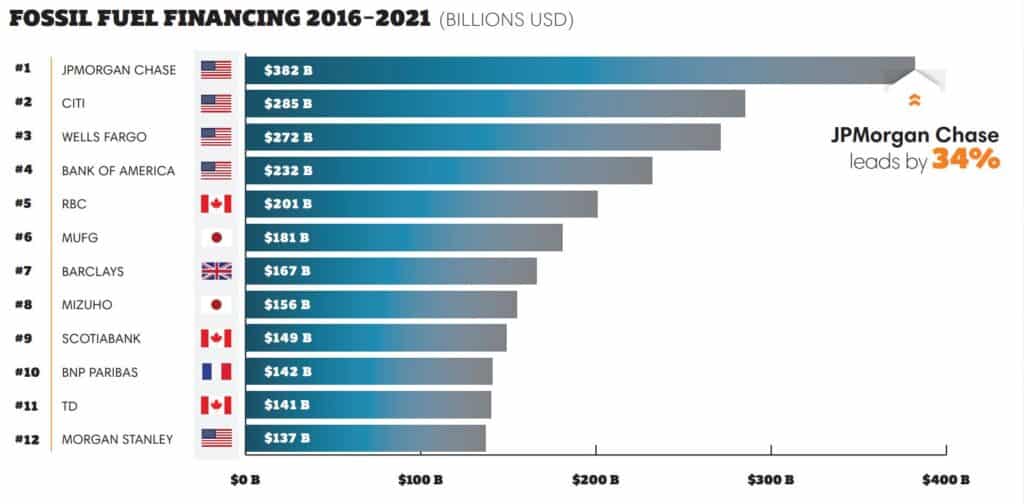
Worse is that Wells Fargo has the biggest fossil fuel funding increase from 2020 to 2021 ($20B more).
The chart below shows the banks supporting fossil fuels, with JP Morgan topping the list.
Shareholders of those banks demanded that they act according to their climate goals. This means taking actions in line with the banking sector’s net zero commitments.
Also, all these financiers have signed up to the Glasgow Financial Alliance for Net Zero, or GFANZ. This alliance works to align banks, insurers, and asset managers with the goal of hitting net zero by 2050.
GFANZ covers two important net zero alliances in the financing sector.
The Net Zero Asset Managers alliance
The Net-Zero Banking Alliance.
Both commit to aligning lending and investment portfolios with net zero emissions.
But what occurred during the banks’ Annual General Meetings tells a different story.
Banks Denied Shareholders’ Desire to Embrace Climate Goals
Only 12.3% voted for Citi to adopt lending practices that are consistent with climate goals.
The same pattern emerged in Wells Fargo and Bank of America, with about 11% of votes for each bank.
Research from InfluenceMap also revealed similar climate change responses from the financial sector. Only 11 out of 30 largest traded financiers and banks even have reliable climate goals to cut emissions.
“There is a stark disconnect between what they [financing firms] say about climate change and what they’re actually doing.”
Climate advocates in the sector contended that it’s not enough to set a net zero target. What’s needed is a credible plan for achieving those targets as emphasized in the resolutions.
And the sure-fire way to that is to stop new fossil fuel expansion and new supply, immediately.
Yet, management from the three banks rejected such proposals focusing on climate goals.
Citi CEO Jane Fraser, for instance, opposed the resolution saying that,
“It’s not feasible for the global economy, for human health or livelihoods to shut down the fossil fuel economy overnight.”
Big Asset Managers and Bankers Are Not Supportive, Too
Blackrock, State Street, and Vanguard have also most likely voted quietly against the proposal. These big three asset managers are top shareholders in Citi, Wells Fargo, and Bank of America.
They also own about 20% of America’s 6 largest banks and 20% of the average company listed on the S&P 500 index.
JP Morgan Chase, Morgan Stanley, and Goldman Sachs are also expecting to face similar resolutions in the coming weeks. But speculations indicate that most shareholders are likely to reject them as well.
These giant financiers even lobbied the Securities and Exchange Commission to toss out the resolution. They argued that it will set inflexible and heavy restraints on their daily business.
While those biggest banks decide not to vote for climate goals, a few others have been pursuing measures that cut emissions.
And the votes for the resolutions calling on banks to pursue climate goals urgently say one clear thing.
That there’s a small yet notable number of Wall Street investors who want to do away with fossil fuels. In a figure, it’s accounted for $65 billion in capitalization.
Scientists made a new enzyme to break down plastics very fast, which can boost plastic credits.
Plastic credits are eyed as the next big thing to deal with sustainability, next to carbon credits.
Plastic is one of the major pollutions damaging the environment, especially the oceans. About 80% of all debris polluting the seas is plastic waste.
Companies have been working to find solutions to deal with the plastic crisis.
Luckily, scientists recently created an enzyme that breaks down plastic waste very fast. This new enzyme reduces the time it takes to decompose plastics to hours, not decades.
The New Discovery That Can Boost Plastic Credits
A team of scientists from the University of Texas at Austin discovered the new enzyme. They called it the FAST-PETase – functional, active, stable, and tolerant PETase.
PET refers to polymer polyethylene terephthalate, one kind of plastic material.
FAST-PETase involved the study of 51 different plastic containers, 5 polyester fibers, and water bottles made from PET.
The team used a natural PETase that is capable of degrading PET plastic while modifying it using machine learning.
Their technology discovers mutations that degrade the plastic faster under different environmental conditions. It can break down PET within a week or as fast as 24 hours, which took decades to centuries to happen before.
More interesting is that the scientists also showed that decomposed plastic can become a new plastic product.
The team said that they can use the new enzyme to clean up areas polluted by plastics. Also, their technology can work in environments with ambient temperatures.
There are endless possibilities for various industries to leverage this novel plastic solution. According to one of the chemical engineers,
“Beyond the obvious waste management industry, this provides corporations from every sector the opportunity to take a lead in recycling their products.”
Currently, the most common way to dispose of plastics is to throw them in landfills where they rot at a very slow rate. Others are even burning them which further pollutes the air.
Thus, there’s a need for alternative strategies to resolve plastic pollution. And the discovery of FAST-PETase can be a solution that’s cheap, portable, and not too difficult to scale up.
Better yet, it’s a great aid to the emerging rise of plastic offset or credit schemes.
How Do Plastic Credits Work
The plastic credit industry works like how the carbon credit industry does.
In the carbon credit market, entities buy carbon credits. Each credit equals one metric ton of carbon, which is then “offset” through carbon projects. These often involve renewable energy and nature-based projects.
The carbon credit market has been growing rapidly over the last few years. Verification of carbon credit projects becomes stricter to ensure the quality of carbon credits.
Both countries and companies are thriving to reduce their carbon emissions as part of their climate goals in line with the Paris Accord. And so, the carbon credit industry is booming as the world races to net zero by 2050.
Essentially, the plastic credit industry works the same way. The only difference is that companies claim credits for projects that tackle plastics.
Each plastic credit is equal to one ton of plastic waste that would otherwise have not been collected or recycled.
Plastic credits also have to meet certain quality assurance criteria or principles. Confirmation of quality is done via the project’s validation and verification process.
And like carbon credits, companies also have to retire plastic credits to offset their plastic waste footprint.
Plastic credits can help enhance technologies and systems that collect and recycle plastics. It’s very much the same as how carbon credits can help reduce carbon emissions.
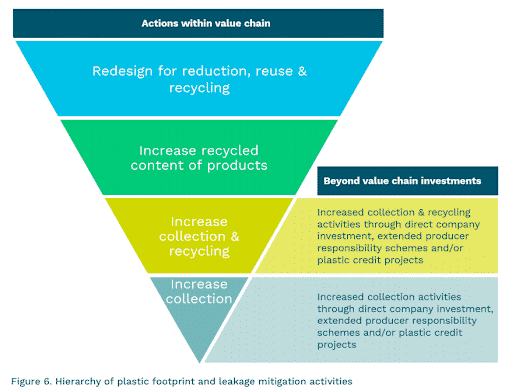
Companies can use plastic credits to address the plastic wastes that they can’t get rid of yet. And like establishing a robust carbon footprint, a company needs to assess its plastic footprint to engage well in plastic offsets.
Here are some activities companies can do to mitigate their plastic footprint:
From Verra Registry
Plastic credits are issued to registry account holders listed on the Verra Registry. Under its Plastic Program, the issuance of plastic credits involves two parts.
One is the Waste Collection Credits (WCCs) for projects involving plastic collections. The other one is the Waste Recycling Credits (WRCs) for plastic recycling projects.
The discovery of the new plastic decomposing enzyme opens a new door for those who want to offset their plastic footprint.
Companies can leverage plastic credits with this enzyme along with carbon credits to address sustainability concerns.
The Bahamas plans to sell blue carbon credits on the voluntary carbon market by the end of this year.
The island nation is counting its carbon-sink assets like mangroves and hopes to sell blue carbon credits out of them.
The inventory of its ocean-based assets is still ongoing. But the Prime Minister said they can produce at least $300 million worth of blue carbon credits.
The Role of Ocean-based Carbon Sink in Cutting Emissions
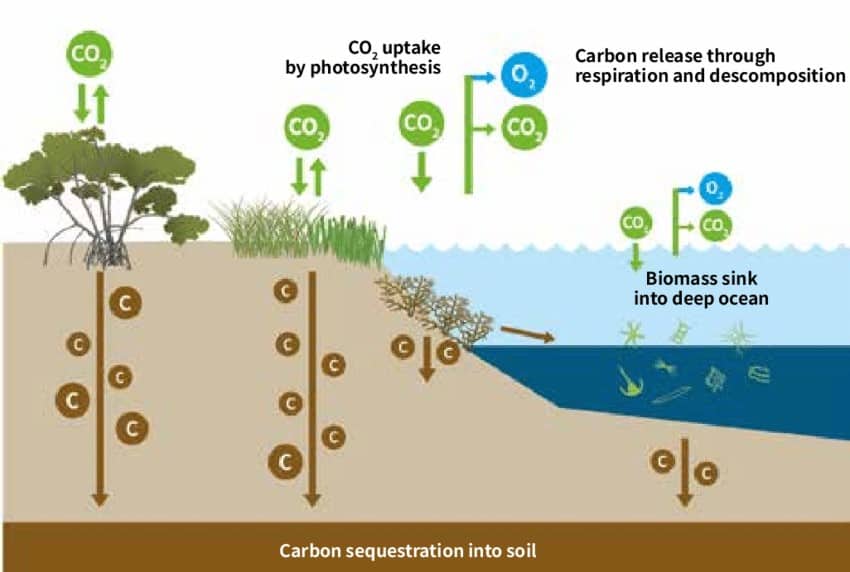
Coastal ecosystems like mangroves and seagrass meadows can store big amounts of CO2. In fact, mangroves store 10x more carbon than terrestrial forests. Mangrove forests usually grow in sea bays.
Also, as mangroves capture and store CO2 below water, it’s sequestered there for over 10x longer than tropical forests do. As such, they have a crucial role in fighting climate change.
The image below shows how a typical blue carbon sink sequesters CO2.
There are other positive effects of coastal forests on climate change and the economy. They help reduce coastal wave energy and the impact of harsh coastal storms and events.
Plus, blue carbon systems also filter pollution and trap sediments that support coastal habitats.
The Bahamas Timely Move with Blue Carbon Credits
Market analysis also shows that global demand for carbon credits is surging as companies are in a race to offset their emissions. Countries are also striving hard to meet their emissions reduction targets.
Countries and businesses alike are setting goals to achieve net-zero emissions by 2050. For the same year, the BloombergNEF, clean energy research team, expects the market for carbon credits to reach as high as above $500 billion.
The carbon market has seen money pouring in on green carbon credits projects, involving forests and grasslands. So if The Bahamas begins selling blue carbon credits, it will be among the first nations to focus on this space.
And the Bahamas PM thinks that it’s time for the country to get paid for the services of its coastal carbon sinks. Philip Davis said that,
“I want to see the Caribbean that is not dumped on any further… We are a major carbon sink for the world, and we need to benefit from cleaning the Earth’s atmosphere.”
The Caribbean contributes very little to global emissions. But the region is among the world’s most vulnerable to climate change.
Hurricanes and other ecosystem damages experienced by the country that cost it $10 billion in national debt are due to the climate crisis.
The Bahamas hopes that other Caribbean nations will join them in this initiative. They’ll be having a regional meeting in the coming weeks.
Meanwhile, the country had recently introduced its landmark legislation to regulate carbon credits. This policy will aid the Bahamas in promoting blue carbon credits and removing CO2 from the air. It will also help boost its coastal conservation and restoration efforts.
Other Plans to Tackle Climate Change
The Bahamas plans to invest the money from selling blue carbon credits in renewable energy and other green projects.
The island nation promised to generate at least 30% of its energy from renewable sources by 2030.
It also seeks to transition its public sector to a fleet of electric cars and retrofit buildings with renewable energy elements. In particular, the government focuses on solar energy projects in various areas.
It partnered with the EU and the Inter-American Development Bank for solar generation and storage. The solar infrastructures will be in places damaged by hurricanes.
There are also plans to use reverse metering to credit people who produce more electricity than they use.
As for its plan to sell blue carbon credits, the Bahamas expects to earn much to fund its transition to renewable energy and be climate-resilient.
As such, carbon markets serve as a bridge to a renewable energy future for nations like the Bahamas.
States and counties across the U.S. are looking at public forests for carbon credits hoping to generate millions of dollars.
The State of Michigan and five counties in Wisconsin set the precedence.
Michigan had inked agreements with Blue Source, LLC, a carbon development firm. This partnership aims to produce carbon credits starting later this year or in 2023.
The agreement also creates projects covering about 800,000 acres of forest. This is 3x bigger than the current public forestland producing carbon credits in the U.S.
The State of Michigan expects to generate 10 million credits with the projects over the next decade. This amount corresponds to the emissions of over 2 million cars or a big coal power plant in a year.
US Forests Enrolling Dubious Carbon Credits
The promise of credit generation of those carbon projects is huge. But reviews and interviews by the Bloomberg Green team revealed that the case seems to be not likely.
Overseers of the U.S. forests involved in the projects don’t expect changes in how they’re managing the public land. Rather, the promised payments would be capitalizing on the same forest practices.
Responses from interviewed state and county officials share the same message. That’s the carbon projects won’t impact their forest management practices and harvest.
As per Jeremy Koslowski, forest administrator for Rusk County,
“We’ve already done the legwork to get where we need to be.”
Also, another state official, Scott Whitcomb, said that the carbon project is consistent with their timber harvest strategies. He noted,
“We’re not expecting to see a change or difference in management from the working forest model we have now.”
Officials’ statements bring light to the “additionality” that these carbon credits will generate.
Meanwhile, the market for carbon credits had reached past $1 billion for the first time. But the questionable U.S. forest carbon offsets have cast doubt on the market’s future.
Analysts suggest that the carbon market can surge as high as $100 billion or more. But it may crash if there are no big improvements made in ensuring the quality of carbon credits.
Some specific cases raise key questions about the quality of carbon credits generated by U.S. forests.
The case of Michigan’s Pigeon River County state forest
Michigan’s Pigeon River County project covering 105,000 acres claims about 1 million carbon credits over the next decade. The basis of this credit generation is on expectations that harvests will increase.
The project claims that timber harvest will triple in the following decade (from 20,000 to 55,000 cords) a year.
But that will only be the case if the state has plans to triple its harvests. Officials said there weren’t any such plans.
Yet, Blue Source countered that the carbon projects they signed with the State of Michigan meet the highest quality standards. The carbon project development firm will earn about 10% – 33% of the project’s proceeds.
The firm said that their US forest carbon projects heed the rules set up by the American Carbon Registry. It’s one of the carbon registries that make protocols for carbon projects.
Meanwhile, DTE Energy, a Detroit-based energy company, agreed to buy $10 million worth of credits from the project.
The firm plans to sell carbon credits from this U.S. forest project to its climate-conscious customers who want to pay extra to cut emissions. DTE seeks to add about $48 to $192 per year to their rate for those wanting to offset their natural gas consumption.
As per the American Carbon Registry’s point of view, the executive director said that,
“…Harvest plans frequently change and the carbon project now provides legal certainty, which was absent before, that the project area will increase its carbon stocks over time…”
Michigan is also working with Blue Source to develop a second carbon project on another 125,000 acres of public forest. Other states seem to follow suit.
The case of Wisconsin counties
Blue Source is also partnering with the State of Wisconsin. The state counties own some 2.4 million acres of forests, which is over 40% of all county-owned forests in the U.S.
Five counties in Wisconsin have signed carbon project contracts with Blue Source. The firm said that these projects will create a lot of carbon credits.
Both parties to the agreement believe the projects will help preserve trees. There’ll be highly motivated to cut fewer trees to gain more carbon credits.
But same with the case of Michigan, forest administrators in five counties said those projects won’t affect their harvests. They’re also not anticipating any changes to their timber management.
Other officials in Wisconsin say the carbon payments will help lock in their current practices for decades to come.
And if carbon prices will rise high enough to rival timber values, it can encourage them to harvest less.
Blue Source and other carbon development firms are pitching officials who think they can get over $30 million out of carbon projects.
Still, the calculation of carbon credits that those US public forest projects will generate seems questionable.
As one county official said,
“It’s a little silly to pay us to do something that was already going to happen, which could allow someone to pollute somewhere else.”
Why do companies have to consider carbon credit accounting along with their climate goals?
This question has been bouncing around the corporate world for several years. But its urgency began to kick in when the Securities and Exchange Commission released its initial GHG emissions disclosure rule.
The proposed regulation requires public firms, particularly the big ones, to report emissions. This includes Scopes 1 and 2 as well as Scope 3 emissions if found material.
And a big change the rule will cause is how companies will account for emissions transactions in their financial reports.
This guide will help address this concern. It will help you know how to weigh the effects of top net zero initiatives on financial reporting.
It will also provide guidance on how carbon credit or allowance items will be accounted for with some illustrative examples.
Carbon Credit Accounting and Achieving Net Zero
Investors, consumers, and regulators worldwide are making emissions reporting imperative for businesses.
Hence, the concept of net zero emerged. It’s a balancing act between the amount of emissions produced and the offsets and emissions reduced/removed from the air.
A simple yet profound quote “reduce what you can, offset what you can’t” has never been more vital to hit net zero.
There’s no single approach that works for any business, big or small, to account for its climate goals. Be it a net zero, carbon neutral, or carbon negative target.
The most effective strategy toward net zero is a combination of various actions. These include:
Emissions reduction across the value chain (Scopes 1, 2, and 3 emissions)
So, accounting for each carbon credit that a company has is important in its journey to net zero.
Despite some confusion surrounding the three actions above, corporate net zero pledges are ramping up. Many Fortune 500 companies have pledged to reduce their Scope 1 or direct emissions.
Firms that haven’t considered cutting their indirect emissions (Scopes 2 and 3) may be in a disadvantaged position. Their business partners may look for others with clear CO2 reduction targets, for instance.
Or worse, they could be placing themselves at reputational risk or even a lower market cap. In this sense, knowing how to create and execute a net zero plan is crucial to do away with the risks involved.
And a sure-fire way to that is understanding the common net zero initiatives and how they affect financial accounting.
Common Net Zero Initiatives and Their Impact on Financial Reporting
Developing a good approach to getting net zero needs consideration of various means.
For instance, a company has to recognize what current technology is out there or what’s underway. It also has to know what others in the firm’s ecosystem are doing that may cause Scope 3 emissions.
Most important is that the costs of each selected strategy has to be accounted for.
The major accounting guideline for some net zero initiatives in the U.S. is the Generally Accepted Accounting Principles (GAAP). And the GAAP mostly reflects the key international accounting principles of the International Accounting Standards Board (IASB).
So, a company may use the IASB accounting guidelines which most firms do. Or it may be necessary for a firm to make its own accounting policies based on certain transactions.
Here are the 3 common net zero strategies businesses are using today and their impact on financial reporting.
Technology and its impact on financial statements:
Technological solutions are a major path taken by many companies toward net zero. They invest in capital projects that improve efficiencies of operations while reducing emissions.
Most common examples are electrification and making buildings or infrastructures greener (green certifications).
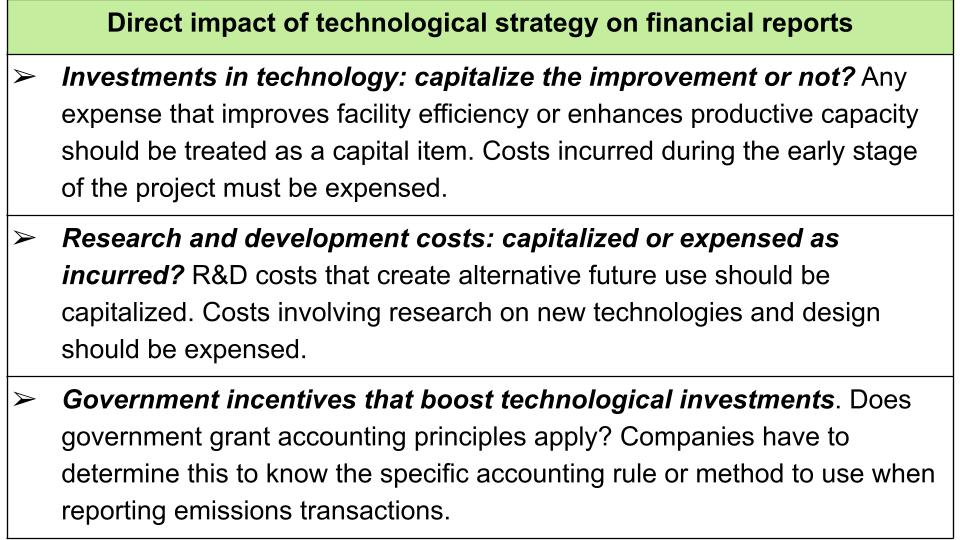
Others are focusing on research and development (R&D) to improve technology to both reduce and remove carbon. Examples include Direct Air Capture (DAC), carbon mineralization, and growing algae in deserts.
Here are major accounting considerations to make when exploring this carbon reduction initiative.
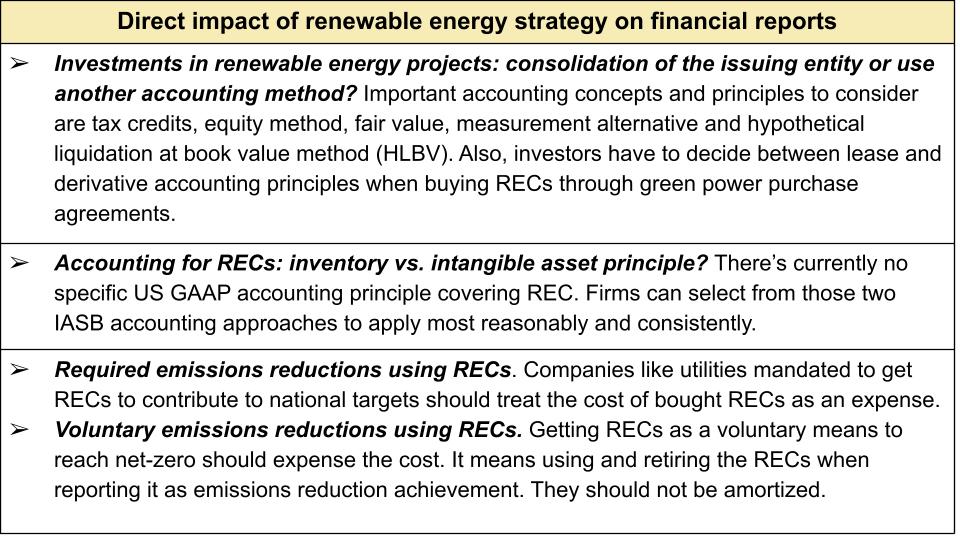
Renewable energy and its impact on financial statements:
A lot of companies and countries are investing in renewable sources (wind, solar, hydro). This net zero strategy generates the REC or Renewable Energy Credit. Each megawatt-hour of electricity produced from a renewable resource creates one REC.
A state or jurisdiction or an agency certifies REC. It can also be tradable between firms similar to carbon credits. A company may invest directly in renewable projects to earn RECs. It can also buy it from power generators or move to a greener facility to claim RECs.
REC holders can use the credits to offset power used from other sources and account for the reduced emissions into net zero goals. Accounting for these carbon credit alternatives is a bit more complex.
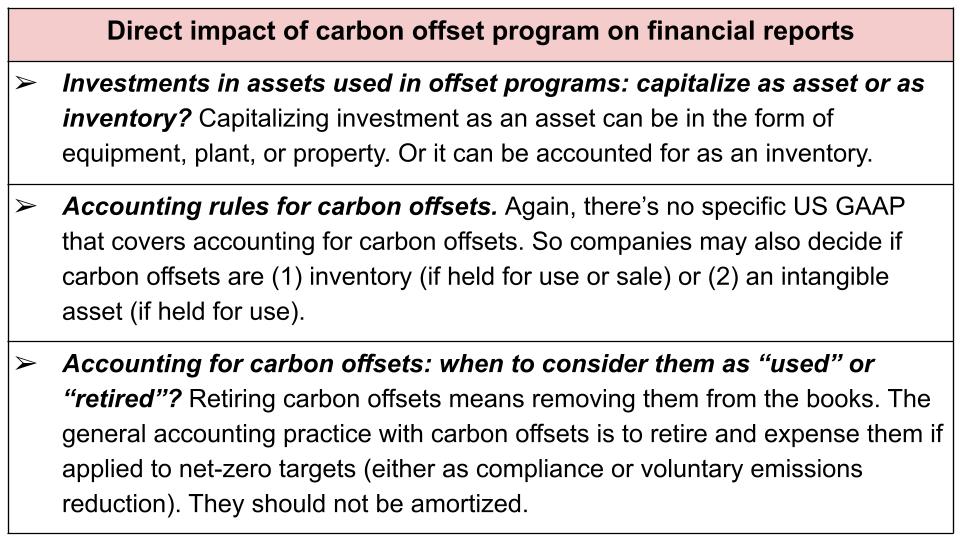
Carbon offset program and its impact on financial statements:
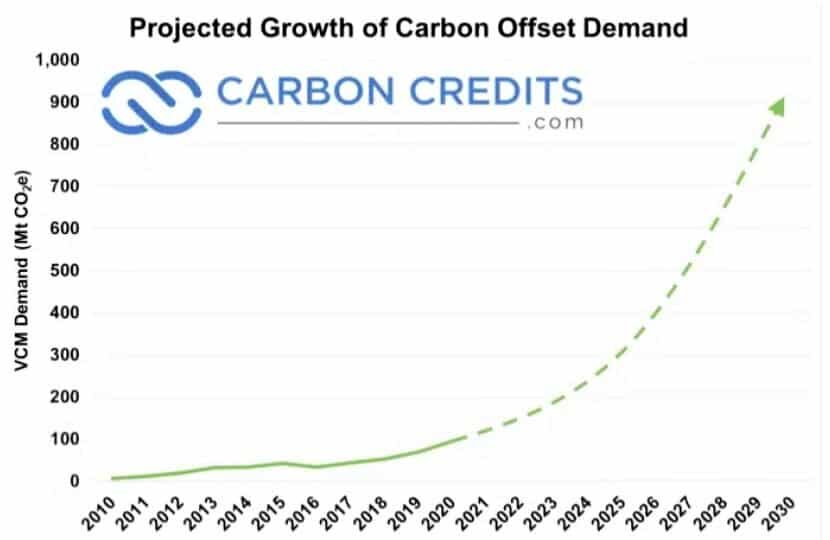
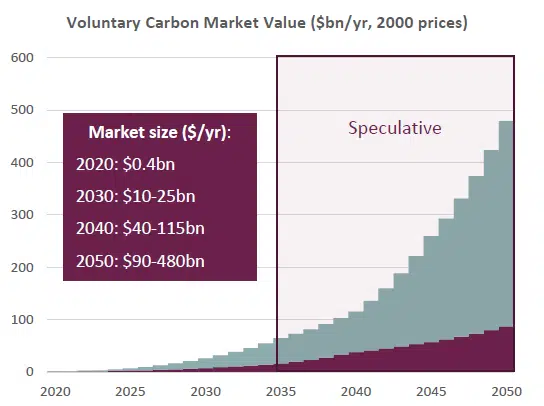
Many emitters are using this net zero initiative to offset emissions they can’t reduce. In fact, the projected growth in demand for carbon offsets in this decade looks very promising as shown in the chart below.
High CO2 emitting sectors (e.g. energy, aviation, and automobile) are under regulatory or compliance credit schemes. It means they have to meet a certain limit on emissions set by a government regulatory framework.
This is also called the cap-and-trade scheme or Emissions Trading System (ETS). Currently, there are three major ETS existing worldwide. These are the European Union ETS, California ETS (US), and Chinese National ETS (China).
These systems create the Certified Emissions Reduction (CER) credits.
Firms with excess CER credits can trade with others who are over their limits and can be subject to fines.
Globally, ETS systems are the most prevalent market mechanism for carbon credits. It reached ~$850 billion in 2021, a 164% increase from 2020.
Unfortunately, there’s a variety of carbon credit accounting issues due to the lack of mandatory rules until now. So, this section provides some insights on how to tackle this matter.
Key International Accounting Bodies for Carbon Credits
After the Kyoto Protocol ratification, some initiatives in accounting for credits are from:
Emerging Issues Task Force (EITF) in 2003
International Financial Reporting Interpretations Committee (IFRIC) in 2004
International Accounting Standards Board (IASB) with Financial Accounting Standards Board (FASB) in 2007
Both accounting agendas by the EITF and IFRIC were not pursued due to controversies.
The IASB Accounting Principles
Since there’s no regulatory guidance yet, some firms made their own emissions accounting policies. But most companies are accounting for their carbon credit transactions using the IASB’s IFRS.
This accounting standard specified that:
Emission allowances (CER) are intangible assets and measured following IAS 38 Intangible Assets
If the CER is from a government, an entity can treat the credits as government grants on initial recognition (IAS 20)
As an entity produces emissions, a provision for its obligation is recognized to deliver allowances as per IAS 37
CER is a non-monetary asset that has no physical substance. So, it’s treatable as an intangible asset. But it’s an asset that’s often not held for use in the production of goods or services.
Rather, it’s held for sale and self-generated by the entity in the ordinary course of business. In this case, these allowances should be accounted for as the valuation of inventories as per IAS 2.
CER as Inventory Item (IAS 2)
IAS 2: an entity must account for inventories at a lower cost and net realizable value
Net realizable value: estimated selling price less estimated costs of completion and other costs to make the sale.
The cost of inventories consists of all costs of: purchase, conversion, and other costs incurred in bringing the inventory to its present condition.
Major inventory costs may include:
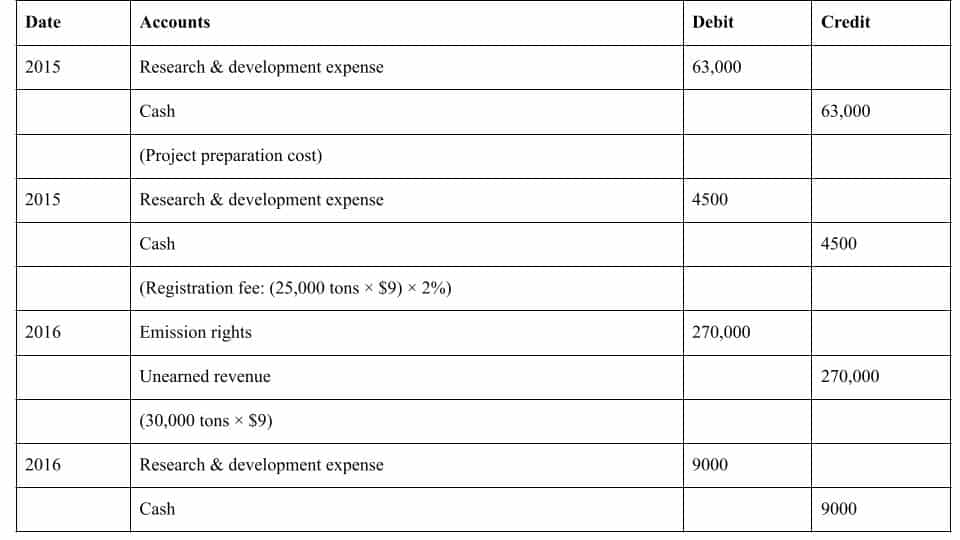
Research costs from exploring measures to reduce emissions
Costs incurred in developing the selected alternative measures
Cost of preparing the Project Design Documents
Registration fees with the United Nations Framework Convention on Climate Change (UNFCCC)
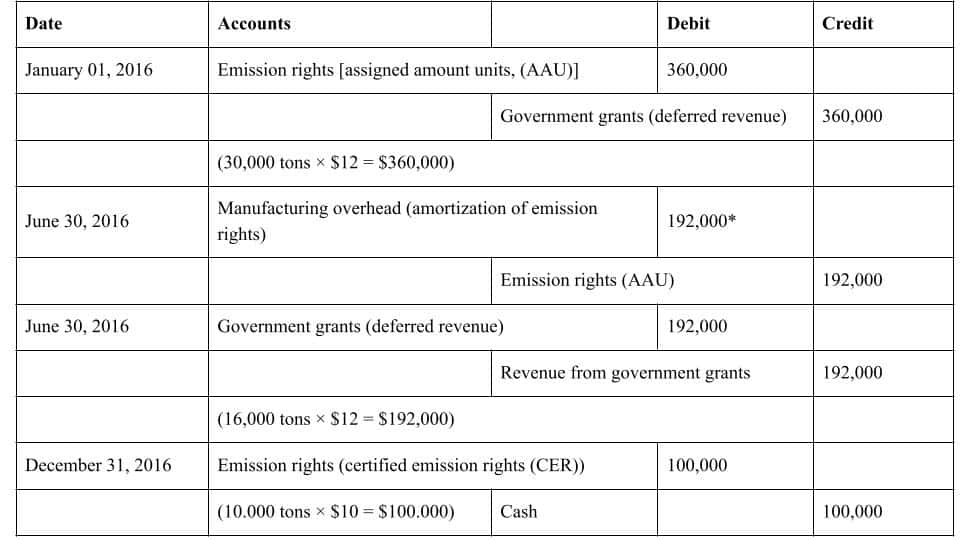
Here’s what accounting for the costs of CER looks like when making a financial report:
Source: Gokten, S., Accounting and Corporate Reporting, 2017
Accounting for Carbon Credits under a Voluntary Market
A company can also get carbon credits through a voluntary carbon project. The steps involved are identical only without the national or regulatory approving bodies.
But a third-party entity must verify the carbon credits created by the emissions reduction of the project.
Here’s how the accounting goes like for carbon credits under the voluntary market:
Source: Gokten, S., Accounting and Corporate Reporting, 2017
When it comes to accounting for the income from selling carbon credits, it may follow the IAS 9. It’s the accounting principle for revenue recognition.
In the U.S., reporting of regulatory credit sales falls under a non-GAAP treatment.
But more importantly, these credits created a dominant market mechanism that helps cut emissions. They give companies and countries viable options to reverse climate change effects.
KraneShares announced the launch of its Global Carbon Offset Strategy ETF (Ticker: KSET) on the New York Stock Exchange.
Krane Funds Advisors, LLC (” KraneShares”) is an asset management firm known for its global exchange-traded funds (ETFs).
In 2020, they launched the KRBN Global Carbon ETF (KRBN) which gives investors exposure to the EU ETS carbon credits, California’s CCA carbon credits, and the RGGI of the northeastern United States.
KraneShares also provides differentiated and innovative investment strategies to global investors. And KSET is one of them and its most recent ETF strategy.
KraneShares Global Carbon Offset ETF KSET
KSET, KraneShares’ latest addition to its suite of carbon market ETFs, is the first in the U.S. to offer exposure to carbon offset futures. This marks a departure from the existing carbon credit funds. It debuted on the NYSE with an expense ratio of 0.79%.
KraneShares Global Carbon Offset KSET will track carbon offset futures contracts. It also gives investors access to futures contracts that are not available through an ETF before.
In particular, KSET will include the CBL Nature-Based Global Emissions Offset (N-GEOs) and also the CBL Global Emissions Offset (GEO).
These futures contracts trade via the CME Group, the largest financial derivatives exchange. The Group sells those offsets to entities that volunteer to cut their emissions.
KSET will add new offset markets as they reach scale.
What are Carbon Offset Futures?
The VCM has to scale by about 15x its present size to help reach global emissions goals as per CME Group analysis. And they believe that having a physically delivered futures market is one way to scale up the VCM.
N-GEO futures follow the Verified Carbon Standard (VCS) requirements for AFOLU (Agriculture, Forestry, and Other Land Use) projects.
Also, these futures get certified by the Verra Registry’s Standard. It’s the go-to standard that identifies projects that particularly address climate change. It also verifies projects that conserve biodiversity and support local communities and smallholders.
Meanwhile, GEO contracts are CORSIA-compliant offsets. They aim to zero out the airlines’ carbon footprint.
GEO offset criteria are from the International Civil Aviation Organization (ICAO). They are also from the VCS, Climate Action Reserve, or American Carbon Registry.
These offsets differ from credits tracked in the KraneShares Global Carbon ETF KRBN. The latter allows entities to make emissions under compliance markets.
The Timely Debut of KraneShares KSET
Buyers of carbon offsets should reduce their Scope 1, 2, and 3 emissions first. They can then buy carbon credits to offset their unavoidable emissions.
Firms use carbon offsets as a short-term solution while working on long-term emission reduction efforts. This is where KSET’s launch is a timely market expansion.
KSET includes the $1.4bn KraneShares Global Carbon Offset ETF. It now covers both the compliance market and the VCMs.
As per Jonathan Krane, the company’s CEO,
“KSET is the first US-listed ETF to combine the leading carbon offset futures markets into a single investable fund… It gives investors holistic access to global decarbonization efforts.”
VCMs are a vital mechanism that boosts global efforts to achieve net-zero targets. Though they’re voluntary, pressure from stakeholders will make VCM’s reductions a must.
Luke Oliver, KraneShare’s head of climate investing, said that carbon offsets will drive demand and returns on tow for the contracts.
Investors can be confident that credits behind KraneShares global carbon offset KSET are reliable. They’re from emission reduction activities verified by renowned carbon offset registries.
Analysts said that a total of 1.2 billion metric tons of carbon credits surplus could flood the market at short notice.
A Trove Research consultant indicated that there’s a market surplus of 600 million MTof carbon credits. These credits have been issued but not retired and enough to meet market demand for about 3.5 years.
There are also another 600 million MT credits that sit in project developers’ accounts. They’re created but lack verification yet from accrediting bodies. And so, these credits are “ghosts” – they’re not in emissions registries but could flood the voluntary market if prices rise.
Guy Turner, Trove Research CEO and founder, said that
“There is 1.2 billion Mt of credits that can be issued today and be provided by existing projects…That can weigh on the market at certain points in time… this could lead to volatility.”
Why Is There A Carbon Credits Surplus?
The excess credit supplies are likely old and may lead to price discounts in voluntary markets. Why is there a surplus?
Trading carbon credits started way back after the ratification of the UN Kyoto Protocol. It’s the first international pact to cut down emissions.
While the trading volume via the regulated market is huge, sizable trading is also happening in the voluntary carbon market (VCM). The momentum behind the VCMs has been strong and trading volume jumped high last year.
In fact, it’s expected to grow from $0.4 billion a year in 2020 to up to $25 billion in 2030 and as much as $480 billion in 2050. The world targets to reach net-zero emissions by 2050.
In 2021, carbon credits for almost one billion tons of CO2 were for sale to would-be carbon offsetters on the VCM. But there have been more sellers than buyers.
Hence, there’s a surplus from old carbon credits. This excess in supply is equal to about 7 to 8 times the present annual demand.
Plus, there are also credits not verified by certifying bodies. They emerge when some project developers didn’t pay their verification fees before issuing the credits. It happens when carbon credit prices are too low.
Turner from Trove Research predicts that spending on carbon credits will jump 20-fold in the next decade.
But there’s a fear that the surplus stocks of ghost carbon credits will meet much of that credit demand.
So What Should Happen?
Some governments review their current carbon credit schemes to weed out the junk. While new rules are being written to ensure the quality and reliability of the credits.
Better yet, investors have to assess first the credits they’re going to buy using a set of criteria. This is important to prevent double-counting for the same credits or buying credits that can’t provide real offsets.
Despite some doubts about the role of carbon credits in offsetting footprint, there are many projects that need them to take off and cut emissions.
Best of all, a lot of companies are committing to report their GHG emissions based on the Science Based Targets initiative’s (SBTi) approach. It’s the go-to standard for corporate emissions reporting.
In the last quarter, over 400 businesses signed up with SBTi. This corresponds to around 370 million metric tons of GHG emissions.
Thus, we can still expect that the reported carbon credits surplus will be actual reductions if more firms and individuals seek to offset their footprint.
Original source: Quantum, Trove Intelligence,|Yale School of the Environment
Elon Musk-funded $100 million XPRIZE Carbon Removal competition revealed its 15 milestone round winners.
The XPRIZE competition aims to encourage the development of innovative CO2 removal solutions to cut emissions.
XPRIZE aims to tackle the world’s biggest challenges in exploration, environment, and human equity. It does so by crowdsourcing solutions through large-scale competitions like the Musk Foundation’s’ $100M prize.
The 15 winning teams will be receiving $1 million each to help advance their projects. The XPRIZE carbon removal competition started last year and will continue until 2025.
The XPRIZE Carbon Removal Competition Mechanics
This XPRIZE carbon removal competition has the biggest collection of carbon removal innovators. The milestone winners are from nine different countries. These are the U.S., the U.K., Canada, Australia, France, Iceland, Kenya, the Netherlands, and the Philippines.
It’s important to emphasize that these winners are not privileged to win the grand prize. Other groups are still eligible to join until December 2023 and compete for the final prize.
Essentially, the XPRIZE is not an ideas competition. Rather, it’s an execution and demonstration carbon removal competition. The entire submission and selection process was demanding.
There were 287 teams out of 1,133 teams that joined the competition that met the eligibility criteria for the Milestone Awards. Then a 70-expert panel screened and judged the proposals for scientific validity.
Finally, based on a set of criteria, the top 15 teams took home $1M each. The criteria include operations plans, performance data, life cycle analysis, and cost estimates. They also accomplished three major winning points.
They showed that their technologies are capable of removing 1,000 metric tons of CO2 from the air each year.
Demonstrated how much it costs to remove up to 1M metric tons of CO2 a year.
Show that they have a sustainable path to remove carbon at the gigaton scale.
The XPRIZE Carbon Removal Milestone Round Winners
Here’s a quick overview of each of the 15 XPRIZE carbon removal winners:
Calcite from 8 Rivers Capital – USA
8 Rivers Capital created calcite in collaboration with scientific institutes. Calcite uses the natural carbon absorbing abilities of Calcium Hydroxide. Calcite’s process captures CO2 fast at low cost (less than $100 per ton). Calcium hydroxide absorbs CO2 into calcium carbonate crystals same with how concrete dry and absorb CO2 in the process.
Carbyon – Netherlands
Carbyon develops a direct air capture (DAC) technology. It also uses a CO2 adsorbing substance with modified fiber membrane that has a huge internal surface and works at very low pressure drops. But its fast swing process allows for a very compact and reproducible machine design. As such, it results in a high CO2 capturing capacity and low manufacturing costs.
Heirloom – USA
Heirloom also offers DAC solution using natural processes and minerals in capturing CO2. Same with some XPRIZE carbon removal winners, its technology enhances the natural process of carbon mineralization. It helps minerals absorb CO2 from the air in days, rather than years.
CarbFix – Iceland
Carbfix speeds up natural processes wherein CO2 dissolves in water and interacts with reactive rock formations to form basalts. These are stable carbonate minerals that provide carbon sink for thousands of years. In this project, 95% of the injected CO2 mineralizes within 2 years, much faster than expected.
Bioeconomy Institute Carbon Removal Team from Iowa State – USA
Bioeconomy Institute takes a systems-wide approach to find environmentally and economically sustainable solutions. In particular, the XPRIZE carbon removal winner will use its prize to advance its use of pyrolysis. The process turns biomass from crop residues into a soil amendment and other goods.
Project Hangar – UK
Project Hajar is a joint project between Mission Zero Technologies and 44.01 that combines DAC with mineralization in geological formations. CO2 is captured from the air and transferred to peridotite underground using renewables. The natural process is then enhanced with the fastest mineral carbonation rates ever known.
Sustaera – USA
Sustaera’s solution is engineered to harness renewable electricity that minimizes new emissions. Its modular DAC system works around the clock in various locations (deserts, savannas, and grasslands). And its carbon-negative technology can capture, sequester, and utilize carbon.
Verdox – USA
Verdox designed an electric system that makes it easier to both soak up the CO2 and squeeze it back out. This DAC design allows for gases to flow through with less resistance, making the process more efficient. This different approach results in more efficient CO2 capture and release using only electricity, less the heat or water.
Global Algae Innovations – USA
Global Algae developed dozens of new technologies that made algae production commercial for food, fuel, and feed. Its patent pending Zobi Harvester technology, for instance, uses advanced membranes and very low energy. It achieves 100% algae harvest efficiency and rid the need for secondary dewatering.
NetZero – France
NetZero turns agricultural residues into biochar, a very stable form of carbon. Through pyrolysis process, biochar gets buried in the soil for good. Biochar is one of only a few long-term sequestration technologies, with high technology readiness level. It also increases crop yields and renewable electricity production from pyrolysis.
PlantVillage from Penn State – USA
PlantVillage created a triple A model – Algorithmic Agricultural Advice – to increase farmer’s yield and profits. The algorithm comes from integration of AI (Nuru), satellite, and unique field force. After inputting farming details, the algorithms then send out advices to farmers via phones, TV, and social networks.
Takachar & Safi Organics – Kenya
Takachar’s technology transforms massive amounts of waste biomass into marketable goods. Its equipment uses a novel concept called oxygen-lean torrefaction. It converts biomass into fuel, fertilizer, and other specialty chemicals. Takachar’s system is thus profitable by reducing the logistics cost of hauling biomass.
Captura – USA
Captura is a team of scientists, engineers, professors, oceanographers and business leaders. They’re developing cost competitive CO2 capture technology that extracts CO2 from oceanwater. It will then contribute gigaton scale of CO2 reductions.
Marine Permaculture SeaForestation from the Climate Foundation – USA, the Philippines & Australia
Climate Foundation’s marine permaculture systems consist of floating platforms that use wave energy. The platforms will be placed at a depth of 25 meters, making them safe for navigation and deal with bad weather. Also, they’ll help restore nutrient upwelling to pre-global warming levels by promoting kelp forest.
Planetary Technologies – Canada
Planetary introduces the first Accelerated Carbon Transition (ACT) Platform, addressing many climate issues. In particular, it will remove CO2 and store it for good and convert mine tailings into safe, pure, alkalinity. It will also generate green hydrogen and battery metals that replace fossil fuels.
Carbin Minerals from the University of British Columbia, Vancouver – Canada
This XPRIZE winner optimizes carbon removal in mine tailings via carbon mineralization. The team developed proprietary technologies that speed up CO2 mineralization in ultramafic rocks. It also has the potential for gigaton-scale capture and permanent storage of CO2.
Obviously, the pace and depth of carbon removal initiatives have never been greater. But, the world still needs more and deeper emissions cuts through similar CO2 removal solutions.
EKI Energy Services announced its target to mobilize 1 billion carbon credits by 2027, along with its commitment to be net-zero by 2030.
EKI Energy or EnKing International is an Indian-based carbon credits developer and supplier. It delivers a wide range of services, particularly in the areas of climate change, carbon credits, and sustainability.
EKI help businesses and organizations to achieve their climate ambitions. It does so by offering carbon offsetting, carbon footprinting, and carbon-neutrality.
The developer also provides help with renewable energy and carbon offset standards.
The company also provides counseling on implementing nature-based solutions and generating nature-based credits.
It has traded more than 100 million offsets to date.
EKI is India’s largest Carbon Asset Management company that handled more than 100 ETS and over 200 voluntary projects.
EKI Energy’s Investment Focus on Carbon Credits
The firm’s target to produce 1 billion carbon credits by 2027 has a big role to meet the world’s need of 58 billion credits a year.
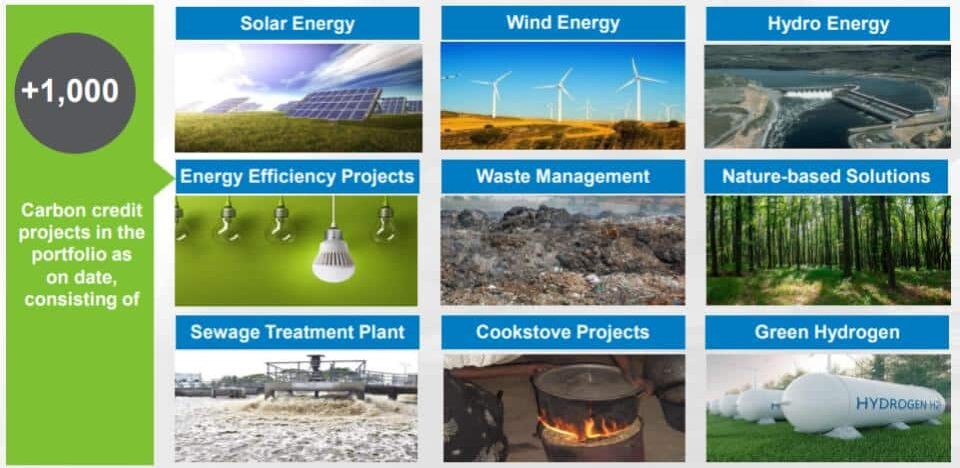
EKI has been identifying projects within and outside Indian territory that cut emissions. The major carbon credit projects it has been supporting include the use of renewables (e.g. solar, wind, and hydro). It also supported plenty of energy efficiency projects.
But with the new pledge of generating around $1 billion carbon credits, it’s largely focused on carbon reduction measures. In particular, the company aims to do backward integration of its carbon credit projects.
It plans to invest in low-cost environmental and community-based energy efficiency projects. Examples are biogas, tree plantation, and its own manufactured Improved CookStoves (ICS).
EKI said that their ICS will allow households to switch to an efficient cooking solution. Each cookstove is about 30% more efficient than traditional mud/stone fire cookstoves.
And so, it leads to a 45%-55% reduction in the use of firewood as fuel. Each of the ICS helps prevent as much as 4,000 kg of CO2 emissions a year.
The company aims to distribute 1.5 million cookstoves in the following year, some are for exports.
Meanwhile, the firm also plans to invest in safe water technology and green hydrogen projects to generate credits.
Below is the EKI’s project portfolio. All these projects are in line with the goals of Kyoto Protocol, Paris Agreement and the UN SDGs.
EKI Energy Investor Report
As per the firm’s CEO,
“Our renewed commitments will enable us to take greater charge of steering the planet to net-zero by becoming a service provider who leads by example to inspire million others in this quest…”
EKI’s “Steering the Planet to Net-Zero”
As the company’s gearing up for COP27 which is about six months from now, it unveils its new brand identity. It’s called “Steering the Planet to Net-Zero”, speeding up its climate action to full blown.
A key component of the firm’s net-zero goals is speed-up its community-based projects.
In fact, the company had signed an agreement with Singapore-led Vitol Asia for distribution of its cookstoves. This project will generate over 11 million carbon offsets.
Moreover, EKI incorporated its associated company – GHG Reduction Technologies Private Ltd. earlier this year. This new entity has one sole task. That’s to fortify EKI Energy’s backward integration of carbon credit supply with its green initiatives.
According to the firm, community upliftment is its core focus area. But it also focuses on providing nature-based solutions (NBS) for companies to help them reduce/offset their emissions.
For instance, it partnered with Shell Overseas and form a joint venture that boost NBS in India. It’s a $1.6 billion investment from JV over a 5-year period to develop 155 million carbon credits.
Finally, EKI announced a renewed structure in line with its net-zero commitment. This includes the establishment of four key business units:
Carbon Credit Portfolio Management,
Environmental Commodity Supply,
Carbon Project investments, and
Net Zero Services & ESG
Other net-zero initiatives by EKI Energy include:
Transitioning to renewables by using solar panels on its corporate office
Introducing its “Green Initiative” policy across business division to reduce paper waste
Introducing Cloud-based applications for reduced data/storage emissions
On top of all these, the firm will focus on its new brand-building initiatives. That includes creating awareness about carbon credits.
Shopify’s commitment to support carbon removal companies has now reached $32 million.
Shopify added nine new companies to its Sustainability Fund. This latest purchases strengthens the company’s position as the biggest carbon removal credits purchaser.
Each of the firms that Shopify had purchased from is working towards a common goal. That’s creating solutions that can make a significant contribution in reversing climate change impact.
Shopify’s new partners are from various industries. These include the following from each respective segment:
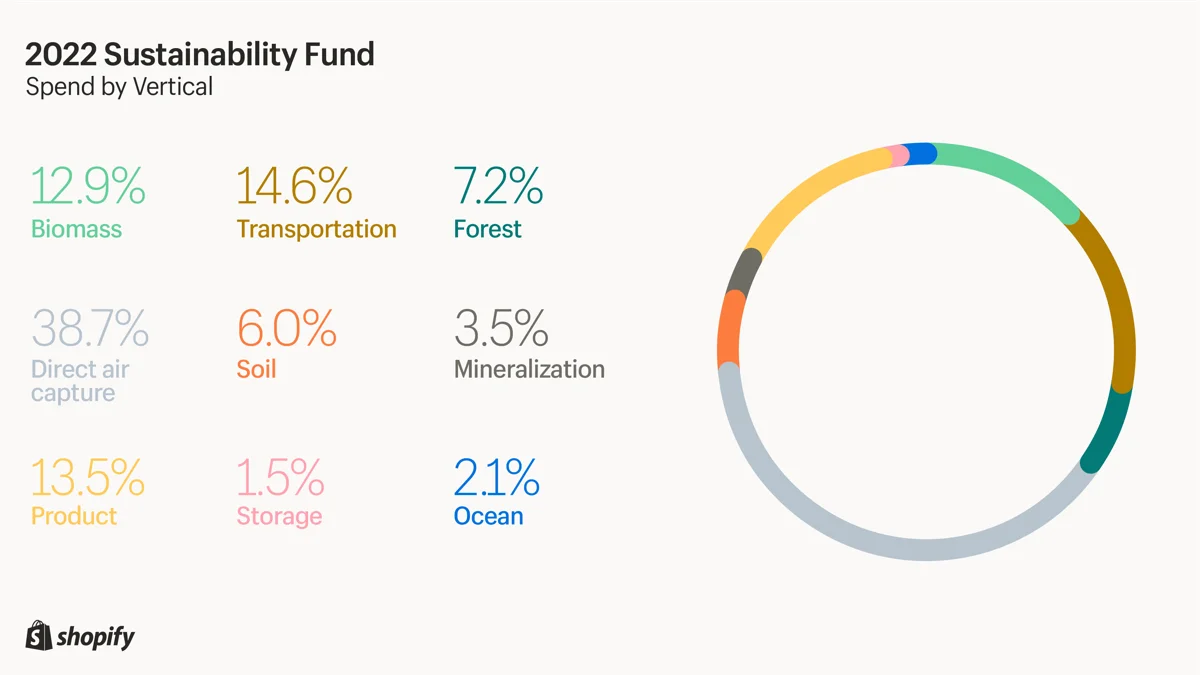
Direct Air Capture: Noya and Sustaera
Forest: DroneSeed
Mineralization: Carbin Minerals
Product: CarbonBuilt
Soil: Loam
Storage: 44.01
Transportation: Twelve and Remora
They’re now joining 13 other companies that Shopify’s Sustainability Fund has been supporting.
Shopify’s Carbon Removal and Reduction Portfolios
The firm’s Sustainability Fund is split into two key portfolios. These are the Frontier Portfolio and Evergreen Portfolio.
The Frontier Portfolio supports firms that remove carbon from the air and store it for the long term. Shopify is one of the large companies that’s part of the almost $1 billion Frontier fund. It has the same goal of speeding up carbon removal technologies.
While the Evergreen Portfolio funds temporary solutions like nature-based approaches and renewable power.
Here’s the breakdown of Shopify’s Sustainability Fund per carbon removal or reduction category:
Shopify had shown demand for carbon removal where there’s none before within 3 years after the creation of the Fund. More buyers are now entering the market.
Also, carbon removal companies have been scaling their development through Shopify’s funding support. In fact, they are growing their carbon removal capacity by up to 80x and increasing customers by 40x more.
Shopify’s approach on carbon removal purchases through its Sustainability Fund seems to work. It’s doubling down both current carbon reductions and permanent carbon removal initiatives.
But the company acknowledges that it can’t scale up its efforts alone. And so, its recent support of nine new companies is critical to its mission to ramp up carbon removal.
Shopify’s New Carbon Removal Partners
Here’s a sneak peek of each of the climate, tech-driven carbon removal enterprises that Shopify supports.
New partners under Frontier Portfolio:
44.01 (2,882 tons). Injects CO2 into peridotite rock where it mineralizes and stores there for good. Shopify covers the mineralization costs.
Carbin Minerals (200 tons). Optimizes carbon removal in mine tailings for net-negative emissions and metals vital for clean energy. Shopify’s funding supports expensive early testing.
CarbonBuilt (5,200 tons). Creates technology for low-cost, low-carbon concrete products like blocks. Shopify’s multi-year purchase gives a guaranteed revenue stream for concrete producers.
Noya (1,445 tons). Captures CO2 from air moved by existing cooling towers. Shopify’s funding helps Noya to scale up its technology and get more buy-in from others.
Sustaera (5,000 tons). Will create modular direct air capture tech that uses natural materials to suck in CO2. Shopify supports to hasten carbon removal technology deployment.
New partners under Evergreen Portfolio:
DroneSeed (50,000 tons). Reforests 300 acres of land ruined by wildfires in Oregon using drones. Shopify purchased DroneSeed’s biggest Climate Action Reserve-certified carbon offsets.
Loam (7,901 tons). Develops a microbial seed coating that increases carbon in soils for big CO2 removal. Shopify’s purchases help scale up technology and boost trust in soil carbon credits.
Remora (23,166 tons). Captures CO2 from semi-truck tailpipes as they drive and store it for long term. Shopify’s fund helps speed up tech adoption to decarbonize land shipping.
Twelve ($2.5M of E-Jet). Transforms captured CO2 to make E-Jet that uses fuel with an 80%+ lower carbon than fossil fuel jet. Shopify helps E-Jet adoption by commercial airlines and freight carriers.
Shopify chose these carbon removal companies using a set of criteria. These include technology and process, plans to scale, and purchases’ impact.
The company’s purchases will help those startups to speed up adoption of their technological solutions.
Stacy Kauk, Shopify Head of Sustainability, said that purchasing carbon removal credits from startups with new approaches is very essential. It’s as important as buying carbon removal from leading companies with proven technologies.
She further noted that,
“Our dollars will allow them to scale up so they can provide customers with effective and affordable carbon removal solutions… We need as many innovative companies to remove over 200 years of emissions to save our planet.”
To provide the best experiences, we use technologies like cookies to store and/or access device information. Consenting to these technologies will allow us to process data such as browsing behavior or unique IDs on this site. Not consenting or withdrawing consent, may adversely affect certain features and functions.
Functional
Always active
The technical storage or access is strictly necessary for the legitimate purpose of enabling the use of a specific service explicitly requested by the subscriber or user, or for the sole purpose of carrying out the transmission of a communication over an electronic communications network.
Preferences
The technical storage or access is necessary for the legitimate purpose of storing preferences that are not requested by the subscriber or user.
Statistics
The technical storage or access that is used exclusively for statistical purposes.The technical storage or access that is used exclusively for anonymous statistical purposes. Without a subpoena, voluntary compliance on the part of your Internet Service Provider, or additional records from a third party, information stored or retrieved for this purpose alone cannot usually be used to identify you.
Marketing
The technical storage or access is required to create user profiles to send advertising, or to track the user on a website or across several websites for similar marketing purposes.