Isometric Hits 100-Supplier Milestone with Flux, Setting New Standard for Durable Carbon Removal

Isometric, today recognized as the world’s leading carbon removal registry, has hit a major milestone—signing its 100th supplier, Flux. Over the past year, the number of organizations working with Isometric has more than quadrupled. That growth highlights one clear trend: the market is demanding transparency, scientific rigor, and fast verification.
Lukas May, Chief Commercial Officer of Isometric, noted that the Isometric Registry now represents the broadest mix of carbon removal technologies in the industry.
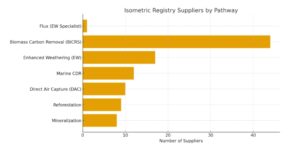
Suppliers span across every major pathway, as shown in the chart below. This list includes industry pioneers such as Charm Industrial, Mati Carbon, Vaulted Deep, Varaha, Carboneers, Deep Sky, Living Carbon, re.green, and Planetary.
isometric carbon removal
Source: Isometric

Flux Joins as the 100th Supplier

Flux, a fast-rising Enhanced Weathering company, is on a mission to remove five million tonnes of CO₂ by 2030. Their model is built around farming partnerships. By supplying alkaline rock powders, Flux provides dual benefits: capturing carbon from the atmosphere while enhancing soil health.

These rock powders neutralize acidity and add nutrients, leading to improved soil fertility and stronger yields. For agricultural communities, this means better productivity alongside climate action, making Enhanced Weathering especially compelling.

Sam Davies, CEO and Co-Founder of Flux, said,

“Partnering with Isometric helps us take a big step toward our mission of deploying Enhanced Weathering at scale across Africa. Their scientific rigor, transparent approach, and robust verification process align perfectly with how we operate, giving buyers confidence in the climate and community impact our credits deliver.”

Why Isometric’s Standard Matters?

Suppliers joining Isometric must follow the Isometric Standard, widely regarded as one of the toughest in the carbon market. To qualify, credits must be:

  • Durable – Stored securely for centuries or millennia.

  • Additional – Delivering removals that would not have happened otherwise.

  • Scientifically Verified – Using advanced methods with quantified uncertainty.

Each Verified Credit logged on the Isometric Registry represents real net CO₂ removals. Importantly, all data, calculations, and supporting evidence are publicly available, giving buyers complete transparency.

In December 2024, Isometric issued the first-ever verified EW credits under its Enhanced Weathering in Agriculture Protocol. This breakthrough set a new benchmark for MRV (monitoring, reporting, and verification), proving EW credits can meet the highest integrity standards.

Raising the Bar for Enhanced Weathering

Enhanced Weathering accelerates a natural process. In nature, CO₂ dissolves in rainwater, reacts with rock minerals, and is stored in the oceans as bicarbonates for over 10,000 years. Grinding rocks into powder and spreading them on farmland significantly speeds up this process.

Compared to reforestation, which risks reversal from wildfires or land-use change, EW offers a more permanent and scalable solution. It also brings direct co-benefits: healthier soils, better yields, and rural job creation.

For years, EW’s biggest challenge was credibility. Without rigorous MRV, buyers hesitated to engage. Isometric’s protocol has changed that, requiring direct measurement and statistical confirmation that removals have taken place. Each credit now represents one tonne of CO₂ permanently removed.

Concisely, among carbon removal pathways, EW is fast emerging as a leader. It offers:

  • Permanence – CO₂ is locked away for millennia.

  • Scale – Gigaton potential at relatively low cost.

  • Co-Benefits – From soil health to food security to rural jobs.

Unlike costly DAC or fragile natural solutions, EW sits at the intersection of affordability, scalability, and durability. Verified EW credits bring credibility to this promise.
carbon removal
Source: CDR.fyi

Isometric’s Role in Market Integrity

The carbon credit market is undergoing a major reset. BloombergNEF forecasts supply could rise 20–35x by 2050, creating one of the largest financing tools for global decarbonization. But that future depends on integrity and governance.

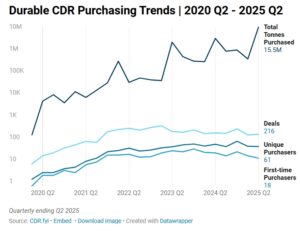
Significantly, CDR.fyi, in its Q2 2025 Durable CDR Market Update, reported the sector’s strongest quarter yet. Contracts reached 15.48 million tonnes of carbon removals—exceeding the combined total of all prior quarters at 13.6 million tonnes.
durable CDR
Source: CDR.fyi

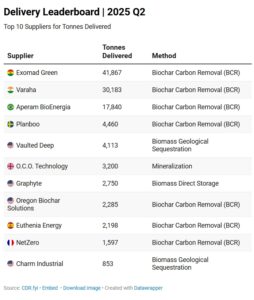
Additionally, deliveries also rose sharply, with 113.7 thousand tonnes supplied in Q2, a 39% jump over Q1 2025 and the second-highest quarterly delivery on record.

Isometric’s role is pivotal in the carbon removal market. By enforcing rigorous protocols and making data public, the registry ensures that credits are trustworthy. Since 2022, its mission has been building confidence in a market that too often suffers from quality questions. And the 100-supplier milestone marks real progress in this sector.

NuScale Power Stock Surges After U.S. Biggest SMR Nuclear Deal

NuScale Power Holdings’ (NYSE: SMR) share price surged after the U.S. made a historic commitment to use its small modular reactor (SMR) technology. The company’s clean-energy credentials are now in the spotlight. This matters not only for investors but also for governments and industry leaders who aim for net-zero goals.

John Hopkins, NuScale’s President and Chief Executive Officer, remarked:

“We are honored that ENTRA1 has selected NuScale’s U.S. NRC-approved SMR technology for this historic deployment in delivering power to the TVA region…Together, we are ready as partners to meet America’s surging demand for reliable, carbon-free baseload power—powering AI data centers, critical mining, semiconductor manufacturing, and the energy-intensive industries that are driving our nation’s economic future.”

Historic Nuclear Deal Drives Stock Rally

NuScale stock has been in the spotlight since its late August surge. Shares rose over 25% after the Tennessee Valley Authority (TVA) made a historic agreement. This deal marks the largest SMR power commitment in U.S. history. 

As of September 4, NuScale stock is up nearly 16% today. This rise shows continued investor confidence and extends its rally.

NuScale stock
Source: Yahoo Finance

The TVA deal sets NuScale up to build the first SMR nuclear power station in the U.S. Many analysts view this as a key moment for nuclear energy in the country. 

Bank of America raised its price target on the stock. They see the TVA agreement as proof of SMRs’ commercial potential. Reports also suggest the planned capacity is more than 5x the size of all existing global SMR projects combined.

Industry watchers note that SMRs have key advantages over traditional nuclear plants. Unlike large reactors, they can be factory-built, modularized, and deployed incrementally. This lowers costs, improves flexibility, and makes SMRs an attractive option for utilities transitioning toward carbon-free energy.

Wall Street Backs Nuclear’s Next Chapter

NuScale’s stock reaction followed nearly immediate upward revisions by Wall Street analysts. Analysts reported the stock jumped when Wells Fargo and other firms raised their ratings. Their new price target is US$4.50, up from about $3. This change shows expected growth in construction contracts and licensing revenue.

The TVA project is expected to cost between US$2–3 billion. It will also generate significant ongoing revenue from operations, maintenance, and long-term fuel services. This financial commitment is seen as a credible revenue pipeline extending into the next decade.

SMRs and ESG: A Green Power Game-Changer

NuScale SMRs provide low-carbon energy. They help grid operators close coal or gas plants, which supports net-zero goals. As mini nuclear reactors with passive safety systems, they offer several environmental and social advantages:

  • Lower emissions: SMRs emit zero CO₂ at the point of generation, with life-cycle emissions similar to renewables.
  • Land efficiency: A single SMR needs only ~32 acres, compared to hundreds for solar or wind projects of similar output.
  • Grid stability: SMRs deliver steady, 24/7 power. Renewables often can’t match this without storage.
  • Local economic impact: SMR sites create hundreds of jobs in construction and operations. They often help communities shift away from fossil fuels.

NuScale SMR power plant view

NuScale’s main plant will generate up to 600 megawatts (MWe). This can power about 500,000 homes. It will also cut emissions by over 1 million metric tons of CO₂ each year, compared to similar coal plants.

These features reinforce ESG portfolios for utilities and investors prioritizing both return and sustainability.

Scaling SMRs: The Outlook for Clean Nuclear Power

NuScale’s move with TVA may be the first of many SMR deployments in the U.S. and abroad. Key dynamics impacting future growth include:

  • Licensing progress: NuScale received NRC approval in 2024 as the first SMR ever, paving the way for future units.
  • Global interest: Countries like Poland, the U.K., and Canada are looking at NuScale-style modular reactors. They want to expand clean energy options.
  • Electric grid synergy: Utilities view SMRs as a partner to solar, wind, and batteries. They help balance variable energy sources with reliable nuclear power.

Several hundred SMRs are proposed worldwide using mirror designs. This places NuScale at the heart of what analysts see as the next wave in nuclear deployment.

SMR globbal map

Small modular reactors could reshape nuclear energy as demand for clean power rises. Current plans target 25 GW of SMR capacity, rising to 40 GW by 2050 under existing policies.

With stronger support, capacity could hit 120 GW—over 1,000 SMRs—requiring investment to grow from $5 billion today to $25 billion by 2030 and $670 billion by 2050. If costs fall to match large reactors, capacity may reach 190 GW, sparking $900 billion in global investment.

NuScale’s Net-Zero Promise for Industry and Grid

NuScale Power’s small modular reactor technology offers clear advantages for ESG-focused investors. It also supports global goals for net-zero emissions, with these facts:

  • First-of-its-kind NRC approval

NuScale’s advanced light-water reactors are the only SMR design certified in the U.S. They help utilities close coal and gas plants. This ensures reliable baseload power, which is vital for deep decarbonization.

  • Low lifecycle carbon:

NuScale’s SMRs produce zero on-site CO₂ and emit carbon on par with renewables when accounting for the full fuel cycle. They provide clean, continuous energy, unlike solar or wind, which require storage to match baseload demand.

  • Multi-sector decarbonization potential:

The SMR modules provide electricity and steam. They can be used for industrial heat, desalination, and hydrogen production. A single 60-MWe module could power ~70,000 fuel-cell vehicles or replace up to 40% of refinery CO₂ emissions.

  • Coal-to-clean transitions:

NuScale enables the repowering of retiring coal plants, preserving jobs and grid infrastructure. Each 12-module plant can create about 1,600 construction jobs and 270 operating jobs. It can also support around $470 million in local economic activity each year.

  • Global decarbonization alignment:

The nuclear company is involved in global clean energy projects. Their SMR deal with Romania’s state utility might cut around 4 million metric tons of CO₂ yearly.

  • Strategic grid services:

SMRs provide flexible load-following, black-start, and dispatchable carbon-free power. These features are key for grids with a lot of renewable energy.

Challenges and What to Watch

While NuScale’s stock momentum is accelerating, several challenges remain. The first TVA plants are not expected to deliver power until the late 2020s, with subsequent units coming online gradually after that.

Even though SMRs are modular, they still need billions in upfront costs. So, support from utilities and government agencies will be crucial. The chart below shows SMR construcion costs in key markets.

SMR construction cost
Source: IEA

NuScale must also show it can grow operations. This means building a reliable supply chain and mastering serial manufacturing. Both steps will help reduce costs over time.

Public perception is still a challenge. Nuclear energy faces local resistance and cautious regulations. This is true even with the passive-safety features in SMR designs.

Investors will be watching closely for several milestones:

  • Final investment decisions from TVA in 2026.
  • NuScale’s ability to deliver 2nd and 3rd units (economies of scale).
  • Expansion into new markets under international SMR tenders.

NuScale at the Forefront of Clean Energy Evolution

NuScale Power’s recent stock surge reflects more than a headline deal—it signals the shifting economics of nuclear energy. SMRs now provide a compact, safe, and ESG-friendly option. They offer a solution for modern grids, especially as traditional SMRs face issues with cost and scale.

The TVA agreement marks a turning point: nuclear power—once considered too slow or expensive—is now viable again, at scale. For investors, NuScale offers exposure to climate-aligned innovation with tangible revenue potential. For utilities and policymakers, it offers a path to deep decarbonization.

Tesla Shifts From EVs to AI: Musk Says Robots Will be 80% of Company Value

Tesla unveiled Master Plan Part 4, its boldest vision yet. Unlike earlier plans that focused on electric vehicles, renewable energy, and autonomous driving, this roadmap shifts Tesla’s center of gravity toward artificial intelligence and humanoid robotics.

Elon Musk, known for bold predictions, said humanoid robots, like the Optimus line, might make up 80% of Tesla’s value.

Optimus Rising: Musk’s Boldest Bet Yet 

Tesla’s past master plans followed a clear logic: build affordable EVs, scale clean energy, and move toward self-driving mobility. Part 4 marks a pivot. Musk calls the new phase “sustainable abundance.” In this future, labor and energy costs could be nearly zero. This happens because robots and AI will handle most of the work.

The star of the plan is Optimus, Tesla’s humanoid robot. Optimus is made for repetitive or dangerous tasks in factories and, soon, in homes. It aims to create a multi-trillion-dollar market.

Tesla has ambitious production goals. The company aims for several thousand units in 2025. In 2026, the target is 50,000 to 100,000 units. By the decade’s end, they might reach 500,000 to 1 million units each year. If achieved, it would dwarf Tesla’s automotive scale-up.

Musk has called Optimus “the largest product opportunity in history.” For Tesla, this is not simply a side project but a claim that the company’s future valuation rests on robots more than cars.

Elon Musk’s long-term vision positions Tesla as a potential $25 trillion company by 2050, with the Optimus humanoid robot at the core of that growth. The company plans to produce around 5,000 Optimus units in 2025.

Each unit will likely cost $20,000 to $30,000. This puts Tesla in the humanoid robotics market. Analysts believe this market could reach $218 billion by the decade’s end.

Reality Check: Roadblocks on the Robotics Path

As with past Tesla ambitions, execution is proving more complicated. By mid-2025, Tesla had reportedly built around 1,000 prototype Optimus units, but production was paused for redesigns. Engineers faced technical limits like overheating, battery life issues, and low payload capacity. These challenges needed supply chain requalification.

The redesign effort is producing Gen-3 prototypes with improved dexterity and more advanced hand articulation. Supporters see this as Tesla’s iterative engineering model at work.

Critics, however, point to Tesla’s long history of overpromising and underdelivering on timelines. Robotaxis and solar roofs, once headline promises, remain incomplete years later.

EV Sales Stall While Robots Take Center Stage

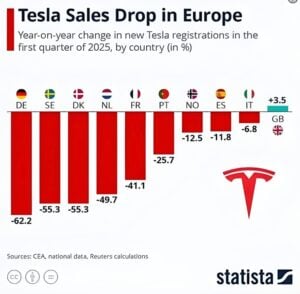
While robots take the spotlight, Tesla’s core electric vehicle business is facing headwinds. Global deliveries fell 13% in the first half of 2025, including a nearly 40% drop in Europe and a 5% dip in China. Competition from Chinese automakers like BYD has eaten into Tesla’s market share.

Tesla EV sales Europe

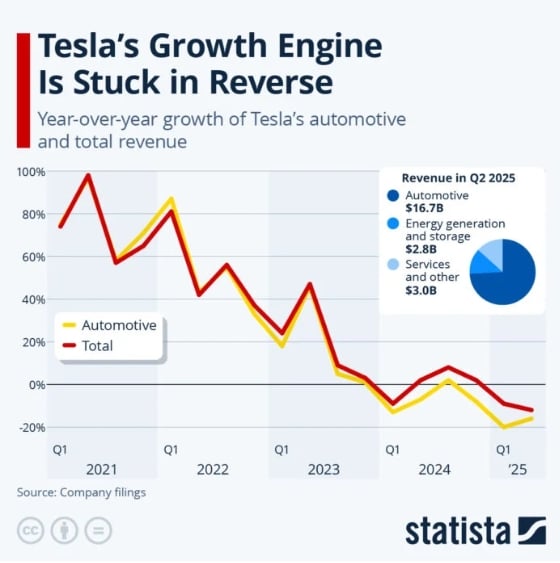
Tesla’s stock has reflected this turbulence, recently falling around 17–20% year-to-date. Analysts cite multiple pressures: the expiration of EV tax credits, a slowdown in consumer demand, and rising competition. At the same time, quarterly revenues slipped to about $22.5 billion, marking a 12% year-over-year decline.

This underscores a reality:

  • While Tesla promotes robots as its future, vehicles and energy still account for nearly all of its current revenue.

TSLA Stock Rebound on AI and Robotics Pivot

Despite earlier declines in 2025, Tesla’s shares have shown signs of recovery following the release of Master Plan Part 4. The company’s focus on AI and robotics has caught investors’ attention. Many view this shift as a way to counter slowing electric vehicle sales.

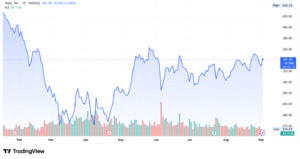
Market analysts say the buzz around the Optimus humanoid robot and Tesla’s AI projects has boosted trading volumes. Some investors see the plan as a chance for long-term growth. They believe Tesla could boost robot production by 2026. Skepticism still exists, but the recent rise in Tesla’s stock price shows more confidence in its AI-driven future.

tesla stock
Source: TradingView

Analysts Weigh In: Vision vs. Execution

The market is split on Tesla’s fourth master plan. Some analysts see it as visionary, believing Tesla could pioneer a robotics revolution that reshapes manufacturing and labor. Some say the roadmap misses key details found in earlier master plans. It lacks clear product rollout timelines and financial pathways.

Key takeaways from analysts and industry watchers include:

  • Tesla’s near-term revenue is still tied to cars and energy storage.
  • The Optimus rollout remains speculative, with initial pricing estimated at $20,000–30,000 per unit.
  • Production setbacks show how far Tesla is from mass manufacturing humanoid robots.
  • Investor patience may wear thin if EV sales continue to falter.

Opportunities and Risks in the Robot Age

Moreover, Tesla’s pivot into robotics carries both transformative potential and serious risks.

Opportunities are:

  • Humanoid robots could disrupt labor-intensive industries, especially manufacturing.
  • Integration of AI into physical tasks could drive cost reductions across the economy.
  • If production scales successfully, Optimus could open a market measured in trillions of dollars.

Challenges include:

  • Scaling from prototypes to millions of units requires breakthroughs in robotics hardware, energy density, and manufacturing efficiency.
  • Tesla’s credibility has been hurt by past delays in delivering on bold promises.
  • EV demand is slowing, raising questions about Tesla’s financial cushion to fund robotics R&D.
  • Technical risks—such as safety, durability, and supply chain bottlenecks—could slow adoption.

Tesla’s Sustainability Commitments Still in Focus

Even as Tesla shifts toward robotics, its sustainability goals remain central to its brand identity. The company continues to emphasize its mission of accelerating the world’s transition to sustainable energy.

  • Tesla reported avoiding over 20 million metric tons of CO₂ emissions through its EV fleet as of 2024.

Notably, energy storage reached a record 14 GWh in 2024. This supports renewable integration on various grids.

The company is dedicated to using 100% renewable energy for its Gigafactories. Facilities in Nevada and Shanghai are already making great strides toward this goal.

Tesla notes that robotics and AI innovations can help with sustainability. They do this by making manufacturing more efficient and cutting down on waste. Musk believes humanoid robots could help with green infrastructure projects. This aligns with Tesla’s goal of achieving net-zero emissions.

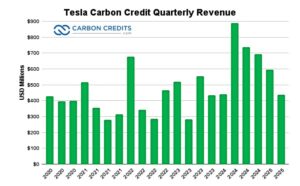
Tesla’s strategic shift toward robotics and AI could also reshape its revenue streams from carbon credits. Historically, the company earned billions by selling regulatory credits linked to zero-emission vehicle sales. As the focus shifts from EVs to AI products and humanoid robots, revenue from carbon credits might decrease.

The Next Big Test: Can Tesla Deliver?

The path forward hinges on Tesla delivering measurable milestones:

  • Factory deployment: The first large-scale use of Optimus robots in Tesla’s Gigafactories will be a crucial proof point.
  • Technical improvements: Advances in battery life, joint durability, and autonomous control will determine whether Optimus is commercially viable.
  • External sales: If robots reach outside customers by 2026, it could validate Tesla’s strategy.
  • EV turnaround: To maintain financial strength, Tesla must also stabilize its vehicle segment.

These milestones will test whether the company can truly transition from being seen primarily as an automaker to a robotics-first company.

Tesla’s Master Plan Part 4 is a radical reimagining of the company’s identity. It places humanoid robotics and AI, not cars, at the heart of its future. Musk promises “sustainable abundance” through mass deployment of Optimus robots, a vision that could transform both Tesla and the global economy.

In the end, Tesla’s future may depend not on how well it sells cars, but on whether it can build—and scale—robots that truly work.

Blue Carbon Credits Hit Record High as Demand Outpaces Supply

Blue carbon markets are gaining momentum, with the latest development marking a significant milestone. According to Platts, the price of blue carbon credits under its DBC-1 benchmark reached a record high in late August 2025. This surge shows strong demand for high-quality carbon credits tied to coastal and marine ecosystems.

Limited supply also plays a role, as project pipelines are still constrained. The event highlights both the potential and the growing challenges in scaling blue carbon as a reliable tool for climate action.

Record High Prices for DBC-1 Credits

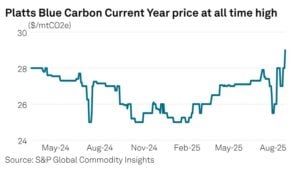
Platts assessed its Blue Carbon (DBC-1) current-year carbon price at $29.30/mtCO₂e on Aug. 28, up $1.30/mtCO₂e day over day. Prices hit a 15-month high in early July, then dropped to a five-month low on Aug. 1 before rebounding 14.9% into late August.

blue carbon credit price by Platts.png
Source: S&P Global

This rebound, fueled by high demand and low supply, has pushed the benchmark close to record levels since its launch in March 2024. The price strength shows how fast demand for blue carbon projects is growing. It is now outpacing the supply of credits.

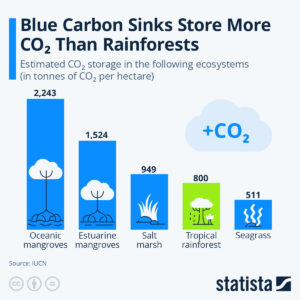
Blue carbon credits come from activities like restoring mangroves, protecting seagrass, and conserving salt marshes. They differ from traditional forest-based carbon offsets. These ecosystems capture and store carbon quickly.

They also provide key benefits. These include preserving biodiversity, boosting coastal resilience, and helping local communities.

What’s Driving Demand: Climate Targets, Policy, and Trust

Several factors explain why demand for blue carbon is spiking:

  • Corporate climate targets: Companies are increasingly seeking high-integrity offsets to complement decarbonization plans. Blue carbon, with its dual climate and ecological benefits, is seen as a premium option.
  • Policy support: Governments in Southeast Asia, Africa, and Latin America have started or grown programs to boost investment in coastal ecosystems. This has added momentum to project development.
  • Market differentiation: In a scrutinized voluntary carbon market, blue carbon projects shine. They offer verifiable, high-quality credits, making them appealing to buyers worried about greenwashing.

Traders and developers say buyers are now paying more for DBC-1 credits than for other nature-based offsets.

Why Blue Carbon Projects Struggle to Scale

Despite demand growth, the supply of blue carbon credits remains limited. Coastal projects can be tricky. Land tenure issues, regulatory uncertainty, and long verification timelines add to the complexity. 

Moreover, countries with big mangrove or seagrass areas often struggle to scale projects. This is due to limited capacity and gaps in funding.

Current blue carbon projects represent only a fraction of the voluntary carbon market. Industry estimates show that fewer than 10 million metric tons of blue carbon credits are issued each year. This is much lower than the hundreds of millions needed to make a real impact on climate change. This structural imbalance between demand and supply is one of the main drivers of the record-high pricing.

Nature’s Superpower: How Coastal Ecosystems Lock Away Carbon

Blue carbon ecosystems, including mangroves, seagrasses, and tidal marshes, are among the most effective natural carbon sinks. The UN Environment Programme says these habitats can capture carbon four times faster than forests. They also store it in sediments for centuries.

blue carbon sequestration
Source: Statista

Blue carbon ecosystems worldwide capture about 0.5 to 1.0 gigatonnes of CO₂ each year. However, coastal degradation leaves much of this potential unused. Restoration and conservation projects are growing, especially in Southeast Asia, Africa, and Latin America. Large areas of mangrove forests are at risk.

Forecasts show that if restoration projects grow as planned, blue carbon initiatives could offset up to 3% of global emissions by 2030. This makes them vital in both voluntary and compliance carbon markets.

Broader Trends: Blue Carbon in the Market Landscape

Blue carbon’s rise comes at a time when the broader VCM is evolving. Demand for higher-quality credits has shifted investment from cheaper offsets to premium options, like blue carbon. This fits into a larger effort to ensure carbon markets help real decarbonization. They shouldn’t let companies skip cutting emissions.

Financial institutions are also entering the space, with specialized funds being established to back blue carbon projects. These funds provide upfront money for restoration or conservation projects.

In return, they receive future credit revenues. This trend reflects the growth of the carbon market. Investors see offsets as both environmental assets and financial instruments with good return potential.

In addition, new methodologies and standards are being developed to improve the credibility of blue carbon credits. Verra and Gold Standard are updating accounting rules. This helps capture the complete climate value of coastal ecosystems.

Also, Article 6 of the Paris Agreement could create opportunities for trading blue carbon credits. This would boost demand in compliance markets

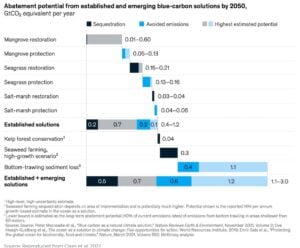
The chart below shows the potential carbon abatement for each type of blue carbon solution by 2050.

blue carbon abatement potential by 2050
Chart sourced from Ecosystem Marketplace report

The co-benefits of blue carbon projects also make them uniquely appealing. Mangrove and seagrass restoration offers unique benefits. They can boost fisheries, lower coastal erosion, and shield vulnerable communities from storm surges.

Blue carbon links climate mitigation, adaptation, and biodiversity protection. This makes it appealing for buyers who want to achieve climate and sustainability goals.

Signals for Investors, Companies, and Policymakers

The record-high DBC-1 price signals several important implications for stakeholders:

  • For investors:
    Blue carbon allows entities to join a fast-growing premium market. However, supply bottlenecks might hold back short-term growth. Early movers could benefit from long-term appreciation in credit values.
  • For companies:
    Buyers should be prepared for higher costs as competition for limited credits intensifies. Securing long-term offtake agreements with project developers may become necessary.
  • For policymakers:
    There is a need to create supportive environments for coastal ecosystem projects. This includes clear rules, land-use plans, and financial incentives.

Blue Carbon’s Defining Moment

Platts’ DBC-1 benchmark shows that blue carbon is shifting from a niche area to a key part of the voluntary carbon market. With prices hitting record highs, the market is sending a strong signal: demand for high-quality, high-impact carbon credits is here to stay.

Without significant supply growth, the imbalance will continue. This will keep prices high and limit access for some buyers.

For now, blue carbon remains a premium and scarce commodity. The sector is set for more growth, thanks to rising interest from governments, investors, and companies. With strong policies and new financing, blue carbon could be key to global climate strategies. It can also provide numerous ecological and social benefits.

Alibaba Stock Climbs as Earnings Beat and Net-Zero Goals Win Over Investors

Alibaba Group Holding Ltd. has seen its stock price strengthen, boosted by stronger-than-expected earnings and renewed investor confidence in its long-term strategy. The company’s environmental, social, and governance (ESG) efforts are also attracting investors. Its focus on net-zero emissions adds to its appeal. Investors now consider sustainability as important as profitability.

Let’s examine the Chinese tech giant’s recent stock increase and what causes it, and the company’s progress in its net-zero pledge.

Earnings Power: Alibaba Surprises Markets With Strong Q2 Growth

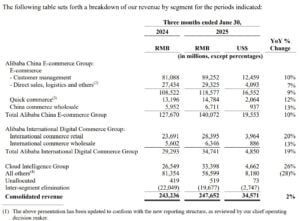
For the quarter ended June 30, 2025, Alibaba reported revenue of RMB 247.65 billion (US $34.57 billion), up 2% year-over-year, or +10% on a like-for-like basis excluding divested units.

Net income attributable to ordinary shareholders soared 76% to RMB 43.12 billion (US $6.02 billion). It is boosted by investment gains and the divestiture of its Trendyol business. Non-GAAP net income, which excludes one-off items, fell 18% to RMB 33.51 billion (US $4.68 billion).

Adjusted earnings, for underlying business performance, declined 14% to RMB 38.84 billion (US $5.42 billion). Meanwhile, income from operations dropped 3% to RMB 34.99 billion (US $4.88 billion). Operating margin slipped slightly from 15% to 14%.

Alibaba q2 financial results
Source: Alibaba

Cloud and Consumption Drive Growth

Two segments stood out. Cloud Intelligence Group revenue grew 26% YoY to RMB 33.40 billion (US $4.66 billion), with adjusted earnings rising 26% to RMB 2.95 billion (US $412 million). For the eighth consecutive quarter, AI-related product revenue saw triple-digit growth.

Alibaba China Commerce Group—which bundles Taobao, Tmall, Cainiao logistics, and Instant Commerce—posted a 10% YoY revenue gain (~RMB 140.07 billion / US $19.55 billion). This is driven by a 12% rise in quick-commerce revenue to RMB 14.78 billion (US $2.06 billion) and a 10% increase in customer management fees. Its adjusted earnings decreased 21%, reflecting investment in Instant Commerce and technology.

International commerce (AIDC) grew 19% to RMB 34.74 billion (US $4.85 billion), and losses narrowed significantly from RMB 3.71 billion to just RMB 59 million.

AI Chip Strategy

To strengthen its competitive edge in AI, Alibaba has doubled down on its in-house chip design unit, T-Head. The company recently launched its new AI inference chips. These chips aim to boost performance for big language models and cloud AI tasks. These chips help cut reliance on foreign semiconductors. They also boost energy efficiency in Alibaba Cloud’s data centers.

Alibaba is combining custom AI chips with its cloud services. This move makes it a leader in technology and sustainability. More efficient chips can reduce power use in data-heavy tasks.

Market Response and Investor Sentiment

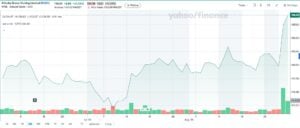
The earnings beat translated into stronger market sentiment. Alibaba’s stock, traded on the Hong Kong Stock Exchange (9988) and the New York Stock Exchange (BABA), jumped nearly 8% in August 2025. This rise outperformed many other Chinese tech companies.

Alibaba stock

The company’s market cap is now over US$190 billion. This increase shows that investors are more confident now. This comes after they faced regulatory pressure and slower growth in China’s e-commerce sector.
Analysts say Alibaba’s diversification in international e-commerce, logistics, and cloud computing helps it handle economic uncertainty. Its global platforms, like Lazada and AliExpress, saw double-digit order growth. This shows their strength beyond the home market.

From E-Commerce Giant to Green Pioneer: Alibaba’s Net-Zero Drive

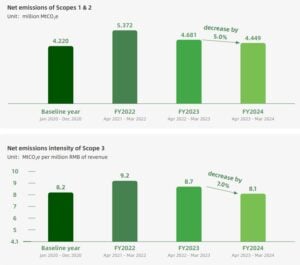
Alibaba has also leaned heavily into sustainability. It has set ambitious climate goals that align with China’s 2060 carbon neutrality pledge. In 2021, the company committed to achieving carbon neutrality by 2030 for its own operations (Scope 1 and 2 emissions).

Alibaba carbon emissions scope 1, 2, 3
Source: Alibaba 2024 ESG Report

More notably, it promised to cut Scope 3 emissions, which make up most of its footprint, by 1.5 gigatons of CO2e by 2035. This goal applies to its merchants, customers, and partners.

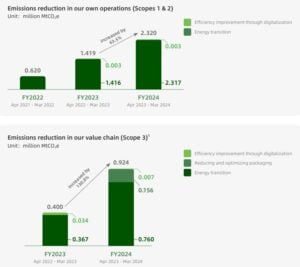
The company has already reported progress. In 2024, Alibaba cut its operational emissions by 12% compared to the previous year. This was helped by using more renewable energy. More than 50% of its data center energy is now sourced from renewable power, including wind and solar.

Alibaba emissions reduction 2024
Source: Alibaba 2024 ESG Report

Key sustainability initiatives include:

  • Green Cloud Infrastructure:

    Alibaba Cloud has launched energy-efficient data centers. Some of these facilities have a PUE (power usage effectiveness) ratio as low as 1.09. This is one of the lowest in the industry. This enables 9.88 Mt CO₂e emission reductions for customers.

  • Circular Economy Projects:

    Through its logistics arm, Cainiao, the company recycled 1.5 billion packaging materials in 2024, cutting emissions and reducing plastic waste. Taobao/Tmall greening tools helped consumers cut over 10 Mt CO₂e.

  • Sustainable Finance:

    In 2023, Alibaba issued US$1 billion in sustainability-linked bonds. These bonds are linked to the company’s goals for renewable energy use and cutting emissions.

Concrete Climate Action: Alibaba’s Green Projects in Motion

Alibaba has made visible progress in aligning business operations with ESG priorities. The company has cut its emissions intensity in recent years. This change comes from using more renewable energy and low-carbon technologies.

Alibaba Cloud uses advanced cooling systems and clean energy to cut energy use in its big data centers. Cainiao is testing smart warehouses at its logistics hubs. These warehouses use renewable energy systems. This helps cut costs and lower emissions.

The company also introduced “green shopping” options on Taobao and Tmall, nudging consumers toward more sustainable products. This reflects an effort to influence consumer behavior as much as internal operations.

Alibaba is boosting transparency in ESG reporting. This is becoming more important for international investors. Sustainability reports now include detailed carbon accounting, energy usage, and progress toward milestones.

Roadblocks Ahead: Tackling Scope 3 and Renewable Gaps

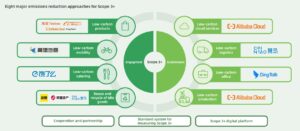
While the company’s climate commitments are ambitious, execution remains complex. Scope 3 emissions—largely tied to suppliers, logistics, and consumer use—account for over 95% of Alibaba’s total carbon footprint. Coordinating across such a vast ecosystem is a significant challenge.

Eight major emissions reduction approaches for Scope 3+ Alibaba
Source: Alibaba 2024 ESG Report

Moreover, China’s slower rollout of renewable energy in certain regions poses risks for meeting 2030 neutrality targets. Industry watchers say the company must speed up investment in green projects at home and abroad to stay on course.

Why Investors Care About Alibaba’s ESG

Alibaba’s financial performance is a major attraction for investors. However, ESG factors are becoming more important, too. Global institutional investors, especially in Europe and North America, are adding sustainability to their portfolio choices.

There are several reasons why investors are paying attention:

  • Resilience: Companies with clear sustainability roadmaps are seen as better prepared for regulatory shifts and market transitions.

  • Market Demand: Consumer preference for greener products aligns with Alibaba’s efforts to feature sustainable goods.

  • Global Standards: Compliance with ESG reporting makes Alibaba more accessible to foreign funds that prioritize sustainability metrics.

Outlook: Blending Growth and Sustainability

Looking ahead, Alibaba’s dual narrative of financial resilience and ESG progress could be a decisive factor for investors. Analysts expect the company’s revenue to grow by 7–8% each year until 2026. This growth will be driven by e-commerce recovery, cloud expansion, and international efforts.

Alibaba’s stock gains reflect more than a short-term earnings rebound. They underscore the company’s broader evolution into a diversified, disciplined, and sustainability-driven enterprise.

The company is showing strong financial results. It focuses on efficiency and is making real progress toward net-zero. This positions the company as a tech leader and a responsible corporate actor in a changing low-carbon economy.

Amazon, X-energy, KHNP, and Doosan Partner on $50B Nuclear Push for AI Data Centers

Amazon is making its boldest move yet into nuclear energy. The tech giant has teamed up with X-energy Reactor Company, Korea Hydro & Nuclear Power Corporation (KHNP), and Doosan Enerbility in a partnership aimed at deploying Xe-100 small modular reactors (SMRs) and TRISO-X fuel across the United States.

The alliance comes at a pivotal moment. Data centers, driven by artificial intelligence (AI), cloud computing, and the digital economy, are pushing energy demand to record highs. Traditional renewables like wind and solar, while critical, can’t always meet the 24/7 power needs of hyperscale computing. Nuclear, with its steady carbon-free output, is emerging as the missing piece.

Aligned with the recent $350 billion U.S.–Korea trade deal, the collaboration spans reactor engineering, supply chain development, construction planning, long-term operations, and global AI-nuclear deployment opportunities. Together, the partners aim to mobilize up to $50 billion in public and private investment to accelerate advanced nuclear adoption in America.

X-energy’s SMRs: Compact Power for a Digital World

X-energy CEO J. Clay Sell, commented on this partnership,

“This partnership brings together proven nuclear leadership and experience from Korean industry and X-energy’s advanced reactor and fuel technology to meet a historic energy challenge. By combining our expertise, we are ensuring that we are best positioned to accelerate the Xe-100 SMR into the marketplace with the unique knowledge and skills developed throughout the South Korea industrial supply chain. Collaboration between the United States and South Korea in this critical sector is vital to preserving American leadership in the AI race and surpassing China as the leader in nuclear development.”

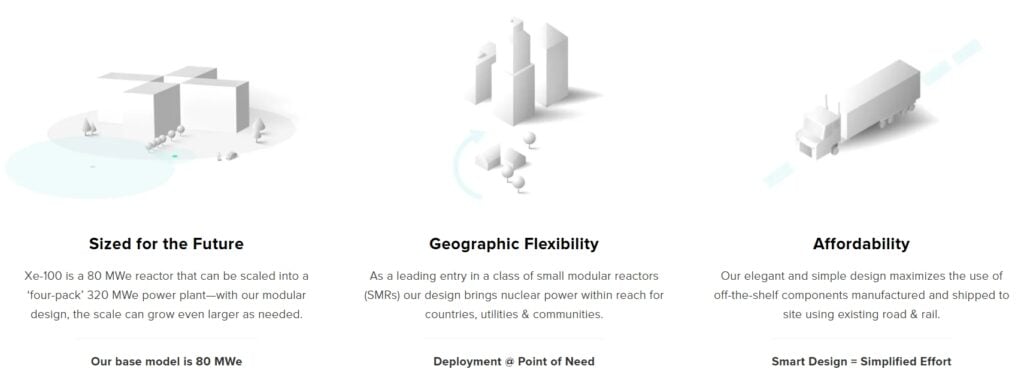
X-energy’s Xe-100, a fourth-generation SMR designed to be modular, cost-effective, and intrinsically safe, is the core of the deal. Unlike traditional reactors, which can take more than a decade to build, the Xe-100’s simplified design shortens construction timelines and reduces upfront capital costs.

Watch the video: 

Key advantages of the Xe-100 include:

  • Scalability – Modular design allows deployment in stages to match demand growth.
  • Enhanced safety – Built with TRISO-X fuel, considered one of the most robust nuclear fuels ever developed.
  • Industrial versatility – Can serve high-demand industries like chemicals, steel, and data centers.

By targeting 960 MW of clean energy capacity to the U.S. grid by 2039, X-energy and its partners are aiming for what would be the largest SMR deployment in the industry to date.

Small Modular Nuclear Reactor: Xe-100

XEnergy nuclear
Source: XEnergy

Amazon’s Clean Energy Ambitions

For Amazon, nuclear energy is part of a larger strategy to meet its net-zero carbon target by 2040, set through The Climate Pledge, which the company co-founded in 2019. The e-commerce and cloud giant is investing heavily in decarbonizing its global operations through four main levers:

  1. Driving efficiency – Optimizing transportation routing, improving packaging, and boosting chip efficiency in data centers.
  2. Deploying low-carbon alternatives – Using lower-carbon concrete and steel, recycled plastics, and greener fuels.
  3. Investing in carbon-free electricity – Expanding its portfolio of wind, solar, battery storage, and now nuclear projects.
  4. Scaling sustainable supply chains – Embedding decarbonization across procurement and product development.

By early 2025, Amazon had committed to 621 renewable energy projects worldwide, including 124 new projects in 2024 alone, representing 34 GW of carbon-free capacity. Nuclear will now complement this mix, providing steady baseload power to balance variable renewable output.

Amazon’s Nuclear Playbook

Amazon’s nuclear investments are already taking shape:

  • In 2024, the company signed multiple agreements to support new SMR development.
  • It partnered with Energy Northwest on a next-gen SMR project.
  • It struck a deal to build a data center near Talen Energy’s nuclear plant in Pennsylvania, linking cloud services directly to carbon-free nuclear power.

With the X-energy deal, Amazon is moving beyond one-off projects toward systematic integration of nuclear into its clean energy roadmap.

Furthermore, Vibhu Kaushik, Head of Worldwide Energy, Amazon Web Services (“AWS”), also said,

“Data centers are the critical infrastructure needed to support AI leadership, and their power needs continue to accelerate to meet the growing needs of our customers. “By forming this partnership with KHNP and Doosan along with X-energy, we’re continuing to pursue innovative carbon-free solutions and technology to help meet the increasing energy demand, and we’re excited that this will help us enable over five gigawatts of new nuclear energy in the U.S.” 

Why AI Needs Nuclear?

Artificial intelligence is reshaping the global economy—but it comes with an insatiable hunger for electricity. Analysts estimate that data centers could consume up to 10% of global electricity by 2030, with AI workloads contributing a growing share.

Unlike traditional corporate facilities, AI data centers operate around the clock and require constant, reliable power to prevent downtime. While solar and wind are critical for decarbonization, their intermittency means they can’t serve as the sole backbone of data infrastructure. Nuclear energy, by contrast, offers stable, carbon-free power at scale, making it ideal for the digital era.

By linking nuclear deployment directly to AI expansion, Amazon and its partners are signaling a new phase in clean energy investment—where tech and nuclear grow hand in hand.

US nuclear

A Global Supply Chain Push

Doosan Enerbility, a leader in heavy industry, and KHNP, South Korea’s nuclear operator, bring critical expertise in supply chain development and project delivery. Their involvement is central to ensuring the Xe-100 can be built quickly, cost-effectively, and at scale.

This collaboration also reflects shifting geopolitics in energy. By tying nuclear deployment to the U.S.–Korea trade agreement, the partnership reinforces energy security and strengthens transpacific clean energy ties. With supply chain bottlenecks affecting global renewables, nuclear offers an alternative path with deeper industrial integration.

Beyond Amazon: A Model for the Private Sector

Perhaps most importantly, this alliance signals a broader shift in nuclear’s role in the private sector. For decades, nuclear was almost entirely government-led, with utilities as the main operators. Now, tech companies are directly investing in nuclear solutions to meet their own decarbonization needs.

If Amazon’s model succeeds, it could set a precedent for other energy-intensive industries, from semiconductors to steel, to adopt SMRs as part of their decarbonization strategies.

Lastly, deploying SMRs at scale won’t be without challenges. Regulatory approvals, financing structures, and public acceptance all remain hurdles. But with Amazon, X-energy, KHNP, and Doosan pooling expertise and capital, the path looks clearer than ever.

By targeting 960 MW of carbon-free nuclear power by 2039, Amazon and its partners are charting a blueprint for how nuclear can fit into the clean energy transition, balancing the intermittency of renewables while enabling the AI-driven digital economy.

In short, this partnership represents more than a corporate energy deal. It’s a signal that advanced nuclear is stepping out of research labs and into the front lines of the energy transition—and that Big Tech may be the key to scaling it.

Tesla’s Europe Sales Crash 40% in July as BYD Surges Ahead Again!

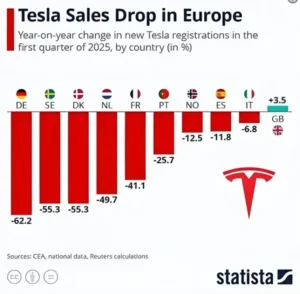
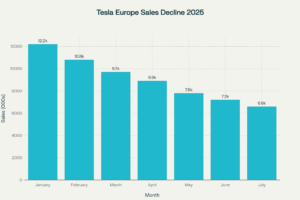
Tesla’s struggles in Europe hit a new low in July 2025, with sales collapsing by 40% year-on-year. According to data from the European Automobile Manufacturers’ Association (ACEA), Tesla (TSLA) registered just 8,837 vehicles across the EU, UK, and EFTA. That marked Tesla’s seventh consecutive month of decline, even as the broader electric vehicle (EV) market expanded.

In stark contrast, Chinese rival BYD posted a 225% surge in registrations, hitting 13,503 units and overtaking Tesla in monthly sales for the first time on European soil. The result highlights how quickly the competitive balance is shifting in one of the world’s most important EV markets.

BYD Edges Out Tesla With Cheaper EVs in Europe

The July numbers were historic. Tesla, once seen as the face of Europe’s EV transition, slid to a mere 0.7% market share, while BYD (BYDDY) climbed to 1.1%. One major issue is Tesla’s aging lineup. The Model 3 and Model Y, once revolutionary, now feel stale compared to fresh, feature-packed EVs from competitors.

Notably, BYD has been expanding its European presence with new showrooms, competitive pricing, and hybrid options that cater to cost-conscious buyers. Its strong growth also reflects Europe’s appetite for affordable EVs, an area where Tesla has yet to deliver fully.

Tesla’s cost cuts don’t match the low prices from BYD and other Chinese EV makers. These rivals have better supply chains, allowing them to sell cheaper cars without damaging their profits as much.

For Tesla, the decline underscores a widening gap between brand prestige and consumer demand. While Musk’s company still dominates in the U.S., Europe has become a tougher battleground.

Tesla Europe Sales, Jan-July 2025
tesla EV sales
Source: Tesla Europe Sales, Jan-July 2025 (Data: European Automobile Manufacturers’ Association; sources: PBS, Yahoo Finance, JATO Dynamics).

Country-Level Trends Show Tesla’s Weakness

Tesla’s slump is evident across major European markets:

  • Germany – Europe’s largest EV market saw rising BEV demand, but Tesla’s share shrank as Volkswagen and BMW expanded their electric lineups.

  • France – National registrations of hybrids and EVs grew, yet Tesla’s numbers fell, reflecting reputational challenges and stronger competition from Renault.

  • Nordic countries (Sweden, Denmark, Norway) – Once core Tesla strongholds, these markets saw double-digit declines as consumers pivoted to newer, more affordable alternatives.

  • Spain and Italy – Plug-in hybrid sales surged in both countries, but Tesla’s BEV registrations didn’t benefit, further highlighting the brand’s challenges.

In each case, Tesla is losing ground not just to BYD but also to legacy automakers that have quickly adjusted to consumer preferences.

Tesla Europe EV

Rivals Gain While Tesla Slips

Tesla’s July decline wasn’t shared by the rest of the market. In fact, overall battery-electric vehicle sales rose 33.6% year-on-year across Europe. Several automakers gained momentum:

  • Volkswagen Group: Sales up 11.6%, with strong demand for its ID. series.

  • BMW: Up 11.6%, boosted by the Mini brand’s 41% jump in registrations.

  • Renault: Continued to grow its EV base, capitalizing on the mid-range market Tesla has largely ignored.

Meanwhile, Stellantis, Hyundai, Toyota, and Suzuki joined Tesla on the losing side, posting year-over-year declines. The divergence shows that while the EV market is still expanding, success depends on fresh offerings and competitive positioning.

In the case of Tesla, it seems to have missed shifting demand trends. European drivers are gravitating toward hybrids and smaller, affordable EVs, while Tesla continues to lean heavily on its premium lineup. This mismatch means Tesla is shrinking while the overall EV market keeps expanding.

The end result: Europe’s EV race is heating up, but Tesla is no longer leading the charge.

TSLA Stock Under Pressure

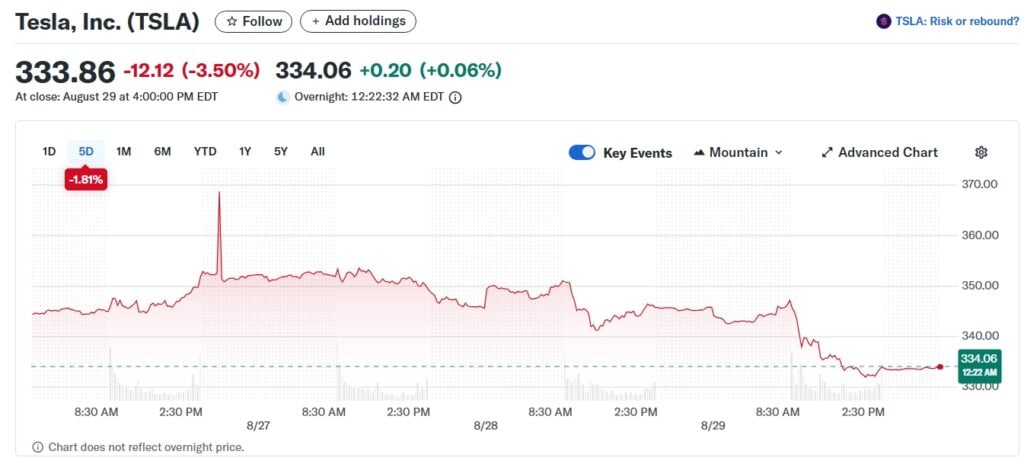
Tesla shares fell 3.5% after a 40% drop in July European EV registrations. The decline underscored tough competition and weakening demand in a critical market.

Analysts see the stock caught in a tight range, with resistance near $350 and support around $330. A breakout higher would need stronger delivery results or product news, while continued sales weakness could drive further losses.

tesla tsla stock
Source: Yahoo Finance

In this context, in Q2 2025, the company reported:

  • Revenue: $22.5 billion, down 12% year-on-year.

  • Net income: $1.17 billion, down 16%, pressured by price cuts and weaker deliveries.

  • Deliveries: 384,122 vehicles, a 14% drop from Q2 2024.

The earnings miss highlighted Tesla’s vulnerability to slowing sales in both Europe and China, where demand also slipped. Even the long-awaited Cybertruck has not met expectations.

tesla

Tesla’s next big drivers could be delivery numbers, regulatory changes, and progress in AI and Full Self-Driving (FSD). These will determine whether TSLA stock moves higher or stays flat.

Right now, analysts see resistance around $348–$350 and support near $330. Market sentiment is divided, with some optimistic about growth while others remain skeptical.

Can Tesla Win Back Europe’s Trust?

Musk has promised a new low-cost EV that could enter volume production in late 2025. If delivered on time, the model could help Tesla regain relevance in Europe’s highly competitive entry-level segment.

However, skepticism remains high. Production delays have plagued Tesla in the past, and with BYD, Volkswagen, and Renault already entrenched in the affordable EV space, Tesla’s late entry may not be enough to reverse its slide.

Furthermore, the brand’s reputation has also taken a hit. Elon Musk’s strong political views had upset many Europeans. Protests, boycotts, and negative headlines have weakened Tesla’s loyal fan base across the continent.

Europe’s EV market is booming, but it’s now evident that Tesla is losing ground. Notably. July drop was its seventh straight monthly decline, pointing to deeper problems with pricing, products, and perception.

To recover, Musk’s EVs need more than AI promises—they must deliver new models, competitive prices, and most importantly, rebuild consumer trust. For now, Europe shows that even an EV pioneer like Tesla can lose momentum.

Africa’s Solar Imports from China Surge 60% in 2025, Pushing Clean Energy Goals

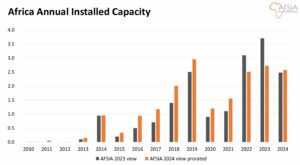
Africa is slowly stepping into the solar spotlight. According to the Africa Solar Industry Association (AFSIA) in 2024, the continent added 2.5 GW of new capacity, taking the total installed solar to 19.2 GWp. Yet, even with this growth, the divide between Africa and the rest of the world is still widening.

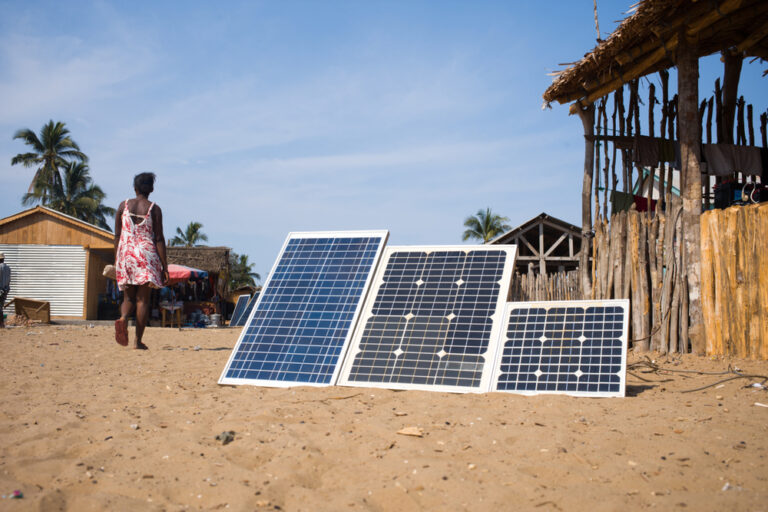
For decades, solar power has played a critical role across Africa—lighting rural homes, powering water pumps, running mini-grids, and keeping hospitals connected. Now, momentum is shifting from small-scale use to large-scale adoption. The question is no longer whether solar will expand, but how fast and how broadly it will spread.

China’s Solar Exports Drive Africa’s Growth

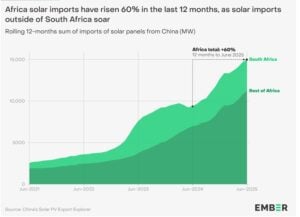
The clearest signal of Africa’s solar rise comes not from domestic capacity figures but from trade flows. According to new research, “The first evidence of a take-off in solar in Africaby energy think tank Ember, in the 12 months ending June 2025, Africa imported 15,032 MW of solar panels from China—a 60% jump from the previous year.

China Africa solar import
Source: Ember

Notably, over the past two years, imports outside South Africa have nearly tripled, soaring from 3,734 MW in 2023 to 11,248 MW in 2025. This marks a structural shift: solar demand is no longer concentrated in a handful of markets but is spreading across the continent.

  • 20 countries set new import records in the last year.

  • 25 countries imported at least 100 MW, up from 15 the year before.

  • Countries such as Algeria, Zambia, Botswana, and Sudan experienced explosive growth, with imports increasing several times over.

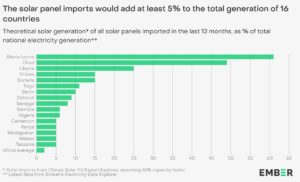
For countries with fragile electricity systems, the implications are enormous. In Sierra Leone, the panels imported in 2024 alone could supply 61% of the nation’s total 2023 electricity generation. In Chad, they could deliver nearly half of the annual demand.

Economics Now Favor Solar Over Diesel

The case for solar in Africa is no longer just environmental—it’s economic. Heavy reliance on diesel imports has left many countries vulnerable to price shocks and soaring fuel bills. Solar is fast becoming the cheaper, more resilient option.

In Nigeria, savings from avoiding diesel imports can pay off the cost of a solar panel in just six months. In several other countries, the payback is even quicker.

Despite the surge in solar imports, fossil fuels still dominate trade balances. In nine of the top ten solar panel importers, the value of imported refined petroleum outweighed solar panels by 30 to 107 times. This mismatch highlights the scale of opportunity: replacing even a fraction of fossil fuel imports with solar would transform energy security and economic resilience across Africa.

Installed Solar Capacity and The Concentration Challenge

While imports are spreading across the continent, installed capacity remains heavily concentrated. AFSIA says that of the 2.5 GW installed in 2024, a staggering 78% came from just two countries—South Africa and Egypt.

  • South Africa accounted for 50%.

  • Egypt added 29%, almost all from two mega-projects in Kom Ombo.

The dominance of these two nations reflects both their stronger policy frameworks and their ability to attract international finance. But it also underscores a challenge: outside of a few hotspots, large-scale solar development is still slow to take root.

Encouragingly, 2025 could change that narrative. A pipeline of landmark projects is now under construction in countries that have not traditionally led the solar charge. If delivered, these could shift the balance of Africa’s solar map in the coming years.

Africa solar
Source: Ember

Utility-Scale Solar Makes a Comeback

After two years where commercial and industrial (C&I) projects led the way, utility-scale solar rebounded strongly in 2024, representing 72% of all new capacity.

This resurgence was powered by large, donor-backed projects, often financed by development finance institutions (DFIs) and built by international developers. National utilities, supported by governments, remain the primary off-takers.

Still, the C&I segment is far from disappearing. In South Africa, C&I accounted for 39% of new solar capacity, driven by both small embedded projects and larger wheeling initiatives that bypass strained grids.

By contrast, in Nigeria, weak transmission infrastructure makes utility-scale projects harder to sustain. Instead, C&I, residential rooftop systems, and mini-grids dominate the solar mix, with private companies and communities driving the transition from below.

Still China Remains Africa’s Solar Lifeline…

Africa’s solar boom would not be possible without China. In 2024, China produced 80% of the world’s solar panels and remains by far the largest exporter. Africa’s dependence on imports is heavy because local manufacturing capacity is still minimal.

  • Morocco has doubled its annual production to 1 GW.

  • South Africa maintains a similar capacity.

  • Egypt and Nigeria host small manufacturing lines, but volumes are limited.

Larger projects are in the works. Egypt will soon add significant capacity through EliTe Solar (3 GW in 2025), Sunrev Solar (2 GW in 2026), and a Masdar plant (4 GW, start date unannounced). These projects could eventually reduce Africa’s reliance on imports, but until then, Chinese exports remain the backbone of growth.

Solar’s Ripple Effects Across Economies

The Ember report further highlights that in 16 African countries, the solar panels imported in just one year could boost electricity generation by more than 5%. That is a game-changer for economies plagued by power shortages.

The shift also has profound fiscal consequences. Every dollar spent on solar reduces exposure to volatile global fuel prices, strengthens local currencies, and frees up budgets for critical investments in health, education, and infrastructure.

At a household and business level, distributed solar is breaking new ground. From small rooftop panels to mini-grids, decentralized systems are enabling energy access where traditional utilities have failed. For rural communities, that means lights in schools, refrigeration in clinics, and power for small businesses—building blocks for broader economic growth.

africa solar
Source: Ember

Is Africa’s Solar at a Crossroads?

The surge in imports shows that solar is no longer a niche or donor-driven sector in Africa. Instead, it is becoming a mainstream energy choice. The question now is whether governments can harness this momentum, ensure fair distribution, and scale up both infrastructure and financing to meet demand.

The risk is that growth remains uneven. If capacity stays concentrated in just a few countries, much of Africa could remain locked into fossil fuel dependence, missing out on the economic and social benefits of clean power.

But the opportunity is vast. With costs falling, technology advancing, and local manufacturing beginning to scale, Africa could leapfrog into a solar-powered future faster than many expect.

Africa renewables
Source: IEA

Yet, despite more than ~20 GW of installed capacity, the region still trails far behind the global curve. Concentration in South Africa and Egypt highlights both progress and fragility. To close the gap, policymakers must support broader adoption, attract investment beyond the usual markets, and accelerate local manufacturing.

If that happens, Africa’s energy future could change a lot. It might move from relying on expensive fossil fuels to a solar-driven system. This new system could provide power, stability, and growth all over the continent.

ChatGPT, Gemini, and DeepSeek Are on an AI Race – But at What Climate Cost? A Comparison

A new report from venture firm a16z highlights a shifting race in generative artificial intelligence (AI). Google’s Gemini, China’s DeepSeek, and even Grok, backed by Elon Musk, are gaining ground on OpenAI’s ChatGPT.

But as these AI rivals advance, there’s an urgent question: how green are their growing footprints? Let’s take a closer look at each of the top three AI’s environmental footprints below.

Competitors Rise: How Google and Grok Are Gaining Ground on ChatGPT

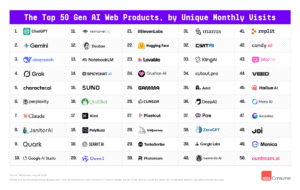
The a16z report maps the top 100 generative AI apps, showing that ChatGPT has strong competition emerging. Google’s Gemini is expanding quickly, and Grok—new but promising—is stepping onto the field, too.

Top 50 AI web products
Source: a16z

Gemini’s strength comes from Google’s massive infrastructure. Its backing allows faster improvements and better integration across services like search, Gmail, and cloud tools. Gemini’s smooth response and deep context give it a competitive edge.

Meanwhile, DeepSeek earns the third spot because it strikes a middle ground between efficiency and emissions. Much of its footprint comes from running on China’s coal-heavy power grid, which raises its carbon intensity compared to peers with greater access to renewable energy.

Meanwhile, ChatGPT stays strong thanks to its large user base and bold partnerships. OpenAI’s alignment with Microsoft means tight integration in Office, Azure, and more. ChatGPT also supports fine-tuning and plugins, making it more flexible for businesses and developers.

AI web visits
Source: a16z

Despite their differences, the report shows all three top models are advancing quickly in user experience, expanding features, and market presence. It marks a growing field, not one dominated by ChatGPT alone anymore.

Watt for Watt: Who’s the Greenest Chatbot? Comparing AI Footprints

As AI usage grows, its environmental impact becomes critical. Let’s compare how these three models fare in energy use and emissions.

OpenAI ChatGPT

ChatGPT sits in the middle of the spectrum. Its exact footprint varies depending on which study you use, but most analyses suggest it consumes more energy and emits more carbon per query than Gemini. 

Part of this comes from heavier model sizes and widespread usage. Improvements in hardware efficiency and energy sourcing are bringing numbers down, but its typical footprint is still higher than Google’s.

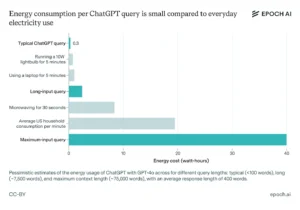
OpenAI’s Sam Altman claims a ChatGPT query uses as much power as running an oven for about one second. Independent estimates align with this level.

Although a single query uses moderate energy, the rapid growth in usage means overall consumption is significant. U.S. data centers—many of which power AI—could account for up to 8% of U.S. electricity use by 2030.

Greenly, a carbon accounting firm, estimates that using ChatGPT-4 to respond to one million emails monthly could generate 7,138 tonnes of CO₂, equating to about 4,300 round-trip flights Paris–New York per year. 

chatGPT energy use
Source: Epoch AI
  • Energy use per prompt: ~3 Wh (can be lower in some estimates, ~0.3 Wh)
  • CO₂ emissions per prompt: ~2–3 g (includes amortized training emissions)

SEE MORE: ChatGPT Hits 700M Weekly Users, But at What Environmental Cost?

Google Gemini

Google has been working to make its AI models more efficient, and Gemini reflects this push. According to Google’s own reporting, text-based queries in Gemini consume very little energy compared to earlier AI systems. 

The company highlights dramatic efficiency gains in both energy use and carbon intensity, making Gemini one of the leaner large models when handling short, text-only prompts.

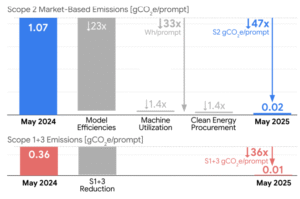
  • According to Google, a median Gemini AI text prompt uses just 0.24 watt-hours, emits 0.03 grams of CO₂, and consumes 0.26 milliliters of water—about five drops. 

Over the past year, Google claims a 33× reduction in energy use per prompt and a 44× reduction in carbon footprint while improving quality.

Google Gemini AI carbon emissions
Source: Google

Experts warn Google’s method may understate environmental cost by excluding indirect water usage (e.g., power plant cooling) and relying on market-based carbon accounting.

  • Energy use per prompt: ~0.24 Wh
  • CO₂ emissions per prompt: ~0.03 g
  • Water use per prompt: ~0.26 mL

READ MORE: Google Reveals the Environmental Cost of Gemini AI Query

DeepSeek R1

DeepSeek’s reasoning models work well with long, complex prompts. This makes them more energy-intensive than regular chat models.

DeepSeek hasn’t shared its exact CO₂ figures. However, benchmarking shows that its energy use per query is much higher than competitors. This is especially true for tasks that require multi-step reasoning or coding. This places DeepSeek at the high end of per-query emissions.

A recent academic study found that models like DeepSeek-R1 use more than 33 Wh per long prompt—over 70× the energy of smaller models like GPT-4.1 Nano. Large-scale inference, with 700 million queries daily, could use as much electricity as 35,000 U.S. homes. It would also need a forest the size of Chicago to offset its carbon emissions.

  • Energy use per long reasoning prompt: >33 Wh
  • CO₂ emissions per prompt: Likely an order of magnitude higher than ChatGPT (depends on grid mix): ~2–4 g

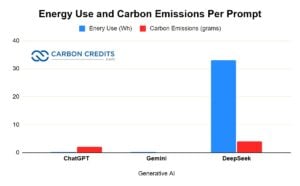
At first glance, Gemini seems the greenest per query (with footprints barely visible in the chart below), while ChatGPT has a moderate impact, and DeepSeek is the least efficient. But real-world AI use involves billions of queries daily. So, even small differences matter.

Generative AI environmental footprint comparison

As AI scales, overall energy and CO₂ use skyrocket unless systems are optimized for efficiency.  

Data Centers or Carbon Centers? The Stakes for Climate

The environmental stakes are real. Experts estimate global data center use could hit 945 terawatt-hours (TWh) by 2030, with AI responsible for 652 TWh—an 80× jump from today.
Generative AI alone may cause 18–246 million tons of CO₂ emissions per year by 2035, similar to entire industries like aviation or shipping.

Without green design, AI growth could claw back efforts to reduce climate impact. Companies need to think beyond speed and accuracy—AI must grow sustainably, too.

AI Growth Meets Climate Responsibility: What Comes Next

The AI competition is intensifying—with ChatGPT, Gemini, and Grok pushing each other forward. Users benefit from better tools, but rising usage means rising environmental costs. To move forward responsibly, analysts suggest these actions:

  • Developers should optimize AI models for energy efficiency, just like Gemini’s leap.
  • Companies should track and reveal full lifecycle impacts—not just inference costs.
  • Cloud providers and AI firms need policies favoring renewable energy and efficient data center cooling.
  • Public policy could reward low-carbon AI, possibly with incentives or carbon pricing.

The a16z report shows that generative AI has entered a new phase—competition among equals, not a single leader. ChatGPT, Gemini, and Grok are all driving innovation in AI. But with growing usage comes growing environmental responsibility.

As the field speeds up, AI’s impact on climate can’t be ignored. Models that combine high performance with low energy use will define the future. If innovators balance progress with sustainability, AI’s value could be even greater—and greener.

Dell’s AI Server Boom Powers Record Earnings and a Net Zero Push

Dell Technologies is riding two big waves: rising demand for AI servers and a strong push for sustainability. Recently, the company announced record second-quarter earnings and raised its revenue forecast for fiscal 2026. AI systems are now key to its growth and climate goals.

Dell’s AI Servers Drive a Big Revenue Jump

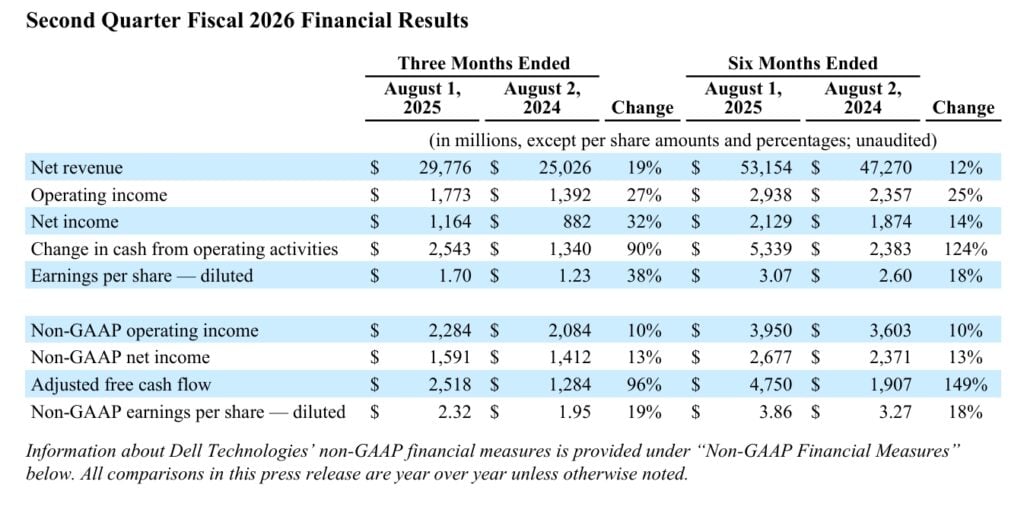
In the second quarter of fiscal 2026, Dell saw rapid growth in its AI sector. Revenue reached a record $29.8 billion, up 19% from last year. Operating income rose to $1.8 billion, a 27% increase. Earnings per share jumped 38% to $1.70, with adjusted EPS hitting a record $2.32.
The standout? AI servers. Built on NVIDIA chips, these systems drove a 44% revenue increase in Dell’s Infrastructure Solutions Group. Sales of servers and networking soared 69% to $12.9 billion. The company shipped $8.2 billion in AI systems, secured $5.6 billion in new orders, and ended the quarter with an $11.7 billion backlog.

This momentum led Dell to raise its AI server sales outlook to $20 billion for fiscal 2026, a 33% increase. The total expected annual revenue is now between $105 billion and $ 109 billion, a 12% increase from last year.

PCs Lag as Enterprise Demand Surges

While AI boosted Dell’s growth, the PC segment lagged. Sales grew only 1%, mainly due to corporate upgrades as support for Windows 10 ends in October. This weak outlook impacted Dell’s near-term forecast, with Q3 EPS projected at $2.45, which fell short of Wall Street’s expectations. Shares dropped nearly 5% after hours.

Even so, a clear trend is emerging. PCs may grow slowly, but enterprise spending on AI and cloud infrastructure is reshaping Dell’s growth story.

dell
Source: Dell

The Sustainability Thread in Dell’s Growth

Dell is aligning its growth with climate goals. The company uses circular economy principles in its supply chain and customer relationships. It aims to reduce waste, enhance resource efficiency, and cut emissions throughout its product lifecycle.

Dell has pledged to achieve net-zero emissions by 2050 across its value chain. Its 2030 goals focus on energy efficiency, renewable power, and responsible sourcing. This shows Dell’s belief that technology can help drive a low-carbon economy.

Tackling Energy and Emissions

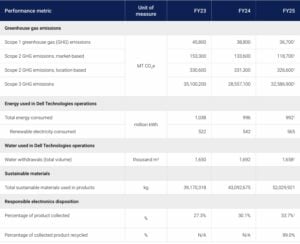
Its sustainability report says that Dell targets Scope 1 emissions, including fuel use from corporate jets and vehicles. The company plans to switch to sustainable aviation fuel (SAF) and work with providers to expand access.

For its fleet, Dell is optimizing vehicle types and numbers while adding more electric options. Electrifying its fleet may raise electricity demand (and Scope 2 emissions), but Dell is balancing this by speeding up its renewable energy transition.

Like many tech firms, Dell’s Scope 2 emissions—from purchased electricity—make up most of its footprint. To address this, Dell invests in renewable power through virtual power purchase agreements (vPPAs), joint PPAs, and renewable energy credits. It is also exploring new on-site solar projects to lessen grid reliance.

It is making significant efficiency improvements in its labs and data centers, where much electricity is consumed. These sites power the servers driving AI growth, making energy efficiency vital for operations and climate goals.

dell emissions
Source: Dell

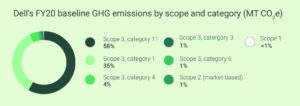
Dell is also tackling Scope 3 emissions throughout its value chain, focusing on two areas: purchased goods and customer product use. Separate targets address both areas.

As it moves toward its 2030 goals, other Scope 3 categories will account for a larger share of emissions. While Categories 1 and 11 are priorities, Dell monitors all Scope 3 sources for meaningful reductions.

Dell scope 3 emissions
Source: Dell

The Role of Carbon Credits in Dell’s Net Zero Goals

Dell knows some emissions will remain, even with aggressive decarbonization. The company plans to offset no more than 10% of its baseline emissions with carbon removals, following best practices from the Integrity Council for the Voluntary Carbon Market (ICVCM).

Currently, Dell is not engaging in large-scale carbon removals, focusing instead on its near-term 2030 decarbonization efforts. As technologies improve, Dell plans to acquire high-quality credits and removals to meet its net-zero target.

Building a Just Transition

Dell insists that the move to net zero must be fair. The company commits to sourcing renewable power only from projects that do not harm underserved communities. It integrates social responsibility into its supplier code, ensuring human rights and fair labor practices.

As a founding member of the Responsible Business Alliance, Dell requires suppliers to commit to decarbonization and respect for vulnerable workers. This involvement ensures its climate ambitions reach throughout its value chain.

Climate Resilience Through Digital Access

Dell views technology access as crucial for climate resilience. Its Solar Community Hub program offers solar-powered internet and computer access to underserved communities worldwide. By promoting digital inclusion, Dell aims to impact one billion lives by 2030, broadening the benefits of the clean energy transition.

Investors Ask: What’s Next?

With its stock outperforming the market this year, investors wonder about Dell’s next steps. According to experts, the answer likely lies in two areas:

  • Earnings trajectory – Analysts will watch if Dell can sustain its AI-driven growth amid weaker PC demand and margin pressures.

  • Sustainability execution – Stakeholders want Dell to show that its booming AI server business can grow without sacrificing climate commitments.

Dell’s guidance of $105–109 billion in annual revenue and $20 billion in AI server sales reflects confidence in growth and demand. Its detailed climate strategy indicates that Dell recognizes investors and customers want progress on emissions, not just profits.