

The artificial intelligence (AI) industry has seen one of its largest energy infrastructure partnerships. Brookfield Asset Management and Bloom Energy have expanded their strategic partnership from $5 billion to $25 billion. The fivefold increase will finance and deploy on-site power systems for AI data centers across the United States.
The companies say the agreement will speed up the delivery of electricity to hyperscale facilities facing long waits for grid connections.
The deal reflects a growing problem across the technology sector. AI data centers are using electricity faster than ever. Utilities are struggling to keep up with the growing need for generation and transmission capacity.
Many tech companies are now skipping long waits for new grid connections. Instead, they are investing in on-site power systems that can be set up quickly. More broadly, the partnership shows how energy infrastructure is becoming a key part of the AI economy.
A Bigger Partnership for AI Infrastructure
The new agreement allows Brookfield and Bloom Energy to finance and deploy up to $25 billion in power projects. This is a big jump from their original $5 billion partnership.
Brookfield’s infrastructure financing skills mix with Bloom Energy’s fuel-cell tech. This helps deliver electricity to large data centers faster than usual utility connections.
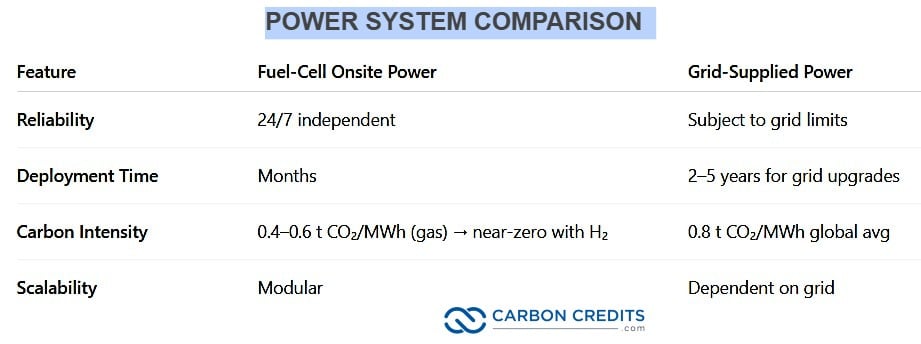
Bloom says its Energy Server systems can be installed within months instead of waiting years for new transmission infrastructure. That speed has become increasingly important as AI developers race to add computing capacity.
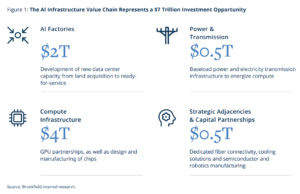
The partnership also supports Brookfield’s broader AI strategy. This year, the company started a $100 billion AI Infrastructure Fund. It will invest in data centers, renewable energy, power generation, transmission, and digital infrastructure.
Sikander Rashid, Head of AI Infrastructure at Brookfield, remarked:
“Scaling this partnership further strengthens Brookfield’s position as one of the leading global AI infrastructure investors, capable of delivering end-to-end solutions, from electrons to tokens, for some of the world’s most sophisticated customers.”
These investments will give customers reliable electricity all day, every day. At the same time, utilities are expanding the grid.
Power Demand Is Reshaping AI Infrastructure
AI is driving a sharp rise in electricity demand, putting growing pressure on power grids worldwide.
The International Energy Agency (IEA) predicts that electricity use in data centers will more than double by 2030. It will reach around 945 terawatt-hours (TWh), mainly due to AI driving this growth.
A United Nations University report says AI data centers might use as much electricity by 2030 as Pakistan, Bangladesh, and Nigeria combined—almost three times their total use. AI now accounts for about 20% of data center electricity demand, and that share could double by the end of the decade.

As demand grows, many utilities find it hard to connect new data centers. This is due to limited transmission capacity, old infrastructure, and lengthy permitting processes. McKinsey estimates that global demand for data center capacity might triple by 2030. This change will need hundreds of billions of dollars in new investment.
Developers face challenges that push them to find faster power solutions. These include on-site generation, battery storage, microgrids, nuclear power, geothermal energy, and fuel cells. The shift is creating new opportunities for companies that can deliver reliable and scalable electricity for AI infrastructure.
Fuel Cells Offer a Faster Solution
Bloom Energy believes its fuel-cell technology can help meet that demand. Unlike conventional power plants, Bloom’s solid oxide fuel cells generate electricity through an electrochemical process instead of combustion.
The systems mainly use natural gas today, but they can also run on biogas. They are designed to support hydrogen as supplies become more common.
Fuel cells provide steady electricity no matter the weather. This makes them ideal for AI data centers that run all day.
Another advantage is speed. New transmission lines and big power plants can take years to build. In contrast, modular fuel-cell systems can be installed much faster. This allows data centers to begin operating while permanent grid upgrades are still underway.
Bloom has grown in the AI market by partnering with companies like Oracle, Equinix, and American Electric Power. These firms need dependable electricity for high-performance computing.
The systems mainly use natural gas, but they create fewer air pollutants than traditional combustion generators. They can also support renewable energy as power grids work to reduce carbon emissions.
Brookfield Is Building AI’s Energy Backbone
The Bloom Energy partnership is part of Brookfield’s broader AI infrastructure strategy.
This year, the company started a $100 billion AI Infrastructure Fund. It will invest in power generation, transmission networks, data centers, fiber infrastructure, and digital connectivity. These investments support the rapid growth of AI while addressing one of its biggest challenges—access to reliable electricity.
Brookfield estimates that AI infrastructure will require trillions of dollars in global investment over the coming decades. As demand grows, electricity has become a key factor in where and how new data centers are built.
The company also owns one of the world’s largest renewable power portfolios through Brookfield Renewable. Its hydroelectric, wind, solar, storage, and distributed energy assets offer over 46 gigawatts (GW) of installed renewable power. Plus, the development pipeline tops 200 GW.
Brookfield has also committed to reaching net-zero greenhouse gas emissions across its operations by 2050. It keeps investing in renewable energy, energy storage, carbon capture, and grid upgrades to support that goal.
Bloom Expands Beyond Fuel Cells
AI has become an increasingly important growth market for Bloom Energy.
The company positions its solid oxide fuel cells as a cleaner alternative to conventional diesel backup generators. Bloom claims its systems create almost no particulate pollution. They also lower nitrogen oxide and sulfur oxide emissions much more than combustion-based technologies.
Beyond AI, Bloom continues expanding its hydrogen and carbon capture businesses. Its fuel cells already operate on biogas and are designed to transition to hydrogen as supplies increase.
The company has made solid oxide electrolyzers. They create hydrogen more efficiently than traditional electrolysis systems. These technologies support broader efforts to reduce industrial emissions while improving long-term energy resilience.
Investors Bet on AI Power Infrastructure
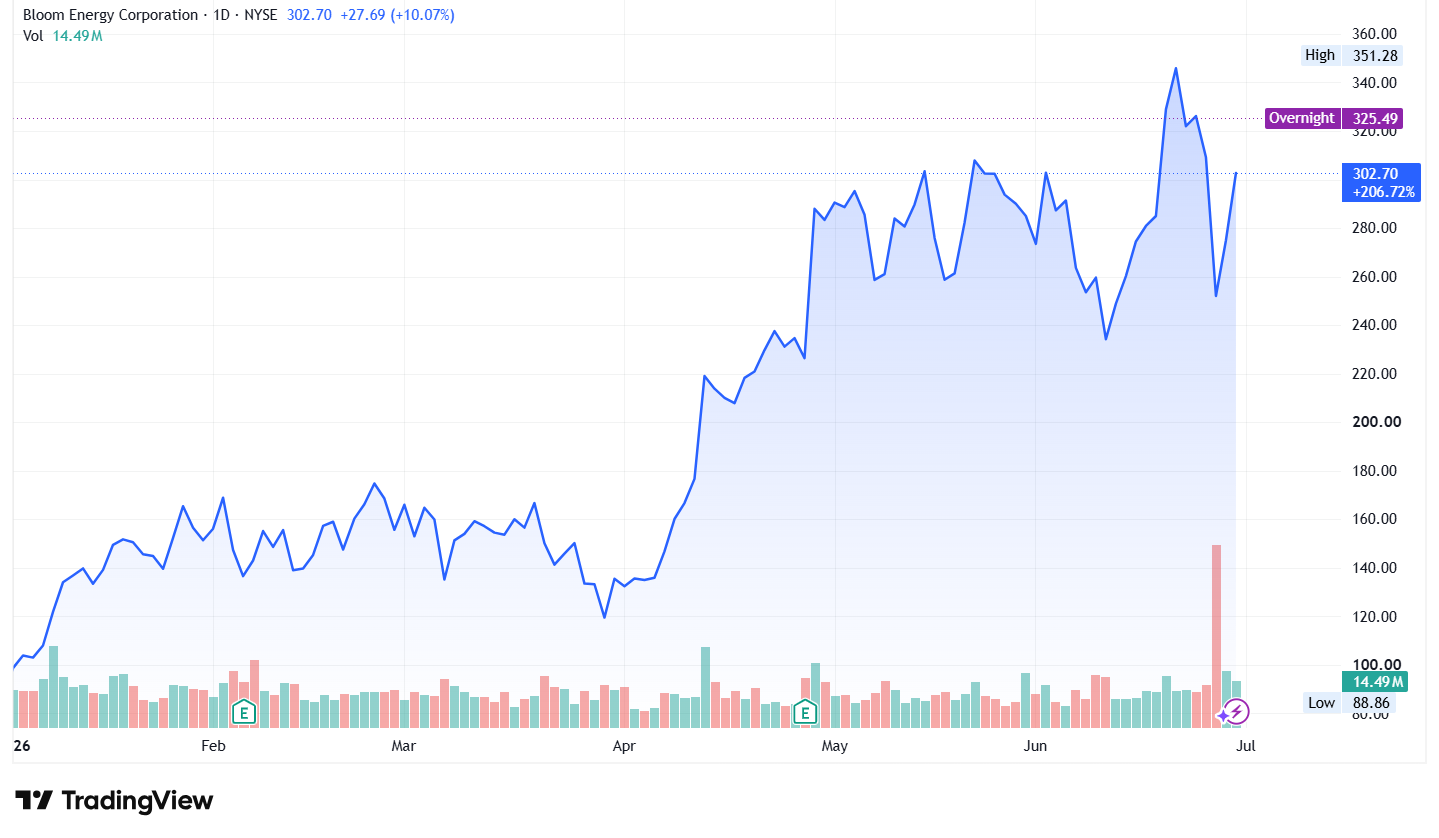
The expanded partnership also drew attention from investors. Bloom Energy’s shares climbed after the announcement. Investors saw the fivefold increase as a clear sign of strong demand for AI power infrastructure.
Analysts noted that the agreement boosts Bloom’s role in a fast-growing energy market. It also gives long-term financing support through Brookfield.
The deal also suggests that distributed power systems will be more important, while developers keep facing delays in getting grid connections.
The Next AI Race Is About Electricity
Artificial intelligence is reshaping not only the technology sector but also global energy markets. Brookfield’s new $25 billion deal with Bloom Energy shows a key trend: reliable electricity is now as crucial as advanced chips and cloud computing.
As AI data centers continue to grow, developers will need power solutions that can be deployed quickly and operate around the clock. Fuel cells, renewable energy, battery storage, and modernized power grids are all expected to play important roles.
For Brookfield, the partnership strengthens its position in one of the fastest-growing infrastructure markets. For Bloom Energy, it expands opportunities in the rapidly growing AI sector.
More broadly, the agreement shows that the next phase of AI growth will depend not only on computing power, but also on the energy infrastructure needed to support it.