

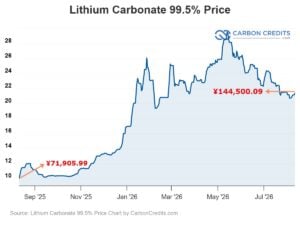
Lithium prices remain above CNY 144,000 per metric ton in China, despite pulling back from their 2026 highs. The latest data shows a market that remains volatile but is still much stronger than a year ago.
That recovery is also reflected in Albemarle’s second-quarter results. The producer reported a sharp increase in revenue and earnings as higher lithium prices lifted margins.
Meanwhile, RBC Capital Markets remains positive on long-term lithium demand. The bank recently lowered its Albemarle price target to $157 from $166 but kept its outperform rating. RBC said electric vehicles (EVs) and energy storage continue to support demand.
Together, the latest price data, Albemarle’s results and the RBC outlook point to a lithium market entering another important phase.
Lithium Price Remains Well Above 2025 Levels
The latest available benchmark data shows lithium at CNY 144,500 ($21,410) per metric ton on August 11 at the time of writing, up 1.23% from the previous session. Lithium was down about 6.2% over the previous month, but remained almost 94% above its level a year earlier. Trading Economics expects the price to reach about CNY 145,238 per ton by the end of the quarter.
SMM’s (Shanghai Metals Market) latest assessment put battery-grade lithium carbonate at about $18,910 per ton on August 10, with a range of roughly $18,580 to $19,240.
Prices have also pulled back significantly from their 2026 peak. Benchmark Minerals reported that Chinese lithium carbonate prices reached CNY 182,500 per ton in May, supported by tighter feedstock availability and lower downstream inventories.
The subsequent decline shows that supply remains a major source of price pressure.
Higher Lithium Prices Power Albemarle’s Q2 Surge
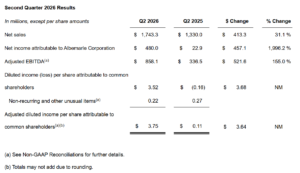
Albemarle’s second-quarter results show how strongly higher lithium prices can affect producer earnings. The company reported $1.74 billion in Q2 2026 net sales, up 31.1% from $1.33 billion a year earlier. Net income attributable to Albemarle reached $480 million, compared with $22.9 million in Q2 2025.
Adjusted EBITDA climbed 155% to $858.1 million, while adjusted diluted earnings reached $3.75 per share, compared with $0.11 a year earlier. Recent market coverage also confirmed that both earnings and revenue exceeded analyst expectations.
Lithium was the main driver.
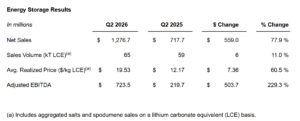
Albemarle’s Energy Storage segment generated $1.28 billion in revenue, up nearly 78% year over year. Sales volumes increased 11% to 65,000 metric tons of lithium carbonate equivalent (LCE).
The average realized lithium price rose to $19.53 per kilogram of LCE, from $12.17 a year earlier. That was a 60.5% increase.
Energy Storage adjusted EBITDA jumped 229% to $723.5 million. The results show the strong operating leverage in lithium production. Even moderate changes in selling prices can have a much larger impact on earnings.
2026 Albemarle Results Remain Highly Sensitive to Lithium Prices
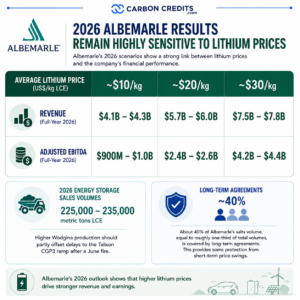
Albemarle’s 2026 scenarios highlight how much its financial performance depends on lithium prices.
- At an average price of about $10/kg LCE, the company estimates full-year revenue of $4.1 billion to $4.3 billion and adjusted EBITDA of $900 million to $1 billion.
- At $20/kg, revenue could reach $5.7 billion to $6 billion, while adjusted EBITDA could rise to $2.4 billion to $2.6 billion.
- At $30/kg, Albemarle’s model points to $7.5 billion to $7.8 billion in revenue and $4.2 billion to $4.4 billion in adjusted EBITDA.
The company expects 2026 Energy Storage sales volumes of 225,000 to 235,000 metric tons LCE. Higher Wodgina production should partly offset delays to the Talison CGP3 ramp after a June fire.
About 40% of Albemarle’s salts volume, equal to roughly one-third of total volumes, is covered by long-term agreements. This provides some protection from short-term price swings.
RBC Stays Bullish on Lithium’s Long-Term Demand
RBC’s latest outlook suggests that weaker prices do not necessarily signal weaker underlying demand. The bank lowered its Albemarle price target to $157 from $166 while keeping an outperform rating. The revision was linked mainly to lower lithium price assumptions rather than a major deterioration in demand.
According to industry analysis, lithium prices cooled during the second quarter as supply concerns returned. However, RBC continues to see support from EVs and energy storage.
That distinction matters for producers. Prices can change quickly, while changes in underlying demand often take longer to appear in sales volumes.
Albemarle’s low-cost operations could also provide an advantage if prices remain under pressure. Its Specialties business offers another source of earnings stability during periods of lithium volatility.
Energy Storage Gives Lithium Demand Another Lift
Energy storage is becoming an increasingly important driver of lithium demand.
Albemarle has forecast global lithium demand of 1.8 million to 2.2 million metric tons in 2026, representing growth of roughly 15% to 40%. EV adoption and stationary energy storage are both expected to contribute.
Albemarle’s Q2 results support that trend. Energy Storage revenue increased nearly 78%, while volumes rose 11%.
This means lithium demand is no longer tied only to passenger EVs. Grid batteries and other stationary storage systems are creating another major source of consumption.
Still, supply remains the key risk. Higher prices can encourage new mines to restart and existing producers to increase output. That can quickly create another surplus.
Albemarle Pushes Lower-Carbon Lithium Growth
Albemarle’s growth strategy also includes environmental targets. The company aspires to achieve net-zero carbon emissions by 2050. It also aims to reduce the combined carbon intensity of its Catalysts and Bromine businesses by 35% by 2030 and grow its lithium business in a carbon-intensity-neutral manner through 2030.
In 2025, 26% of Albemarle’s electricity came from renewable sources, up from 24% in 2024. Its operations in Chile, Kings Mountain and Qinzhou sourced between 95% and 100% of purchased electricity from renewable sources.
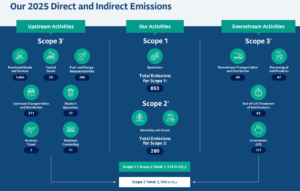
The company reported 1.11 million metric tons of Scope 1 and market-based Scope 2 emissions in 2025, compared with 994,000 tons in 2024. Scope 3 emissions reached 2.71 million tons, bringing total Scope 1, 2 and 3 emissions to about 3.82 million tons.
Albemarle is also testing direct lithium extraction. Its La Negra pilot in Chile achieved more than 94% lithium recovery over 3,000 hours of operation.
Water management is another focus. Albemarle’s Chile and Jordan operations target a 25% reduction in freshwater intensity by 2030, while Chile had already achieved nearly a 47% reduction from its 2019 baseline.
Lithium’s Next Test: Can Demand Outrun New Supply?
Lithium’s recovery has delivered a major boost to producers such as Albemarle, but prices remain volatile. At CNY 144,500 per ton, lithium is still far above its level a year ago. However, the recent monthly decline and retreat from the May peak show that supply remains a major concern.
Albemarle’s Q2 results demonstrate how higher prices can rapidly improve producer earnings. RBC’s outlook, meanwhile, suggests that underlying EV and energy storage demand remains strong enough to support the longer-term market.
The next phase will depend on the balance between demand and supply. Demand must grow fast enough to absorb new production, while producers need to control costs and capital spending.
For Albemarle, the second quarter shows that it is entering this phase from a stronger financial position. Whether that strength continues will depend largely on whether lithium demand can stay ahead of supply growth.