

Japan Airlines (JAL) has signed a carbon removal deal with Climeworks Solutions that the companies describe as the world’s first designed to meet the requirements of the International Civil Aviation Organization’s (ICAO) Carbon Offsetting and Reduction Scheme for International Aviation (CORSIA).
The deal is a new step for carbon removals in aviation. It combines several types of carbon removal with additional direct air capture (DAC) credits from Climeworks.
The companies, however, did not disclose the value or volume of credits covered by the deal. JAL and Climeworks said their research found no earlier purchase agreements of this type.
The deal comes as airlines face growing pressure to cut emissions. Airlines are working on aircraft efficiency, better operations, and sustainable aviation fuel (SAF). Carbon removals can help address emissions that remain after these measures.
JAL Targets CORSIA-Compliant Carbon Removals
Under the agreement, Climeworks Solutions will source a portfolio of carbon removal projects that are selected to meet ICAO requirements for CORSIA Eligible Emissions Units.
The portfolio will include methods such as soil carbon sequestration and biochar. JAL will also buy separate carbon removal credits from Climeworks’ direct air capture operations. This matters because CORSIA has specific rules for which carbon credits airlines can use.
Not every carbon credit in the voluntary carbon market qualifies for CORSIA. ICAO reviews carbon credit programs against requirements covering environmental and social integrity.
Approved programs and eligible unit types can then supply emissions units for specific CORSIA compliance periods. That makes the JAL deal different from a standard corporate carbon removal purchase.
However, the companies’ wording matters. They describe the agreement as a purchase of carbon removal credits designed to meet CORSIA requirements. The announcement does not give a specific number of credits that have already been canceled against a CORSIA obligation.
Why CORSIA Could Reshape Aviation’s Carbon Market
CORSIA is ICAO’s global system for addressing CO₂ emissions from international aviation. The system requires covered airlines to cancel eligible emissions units against their calculated offsetting requirements.
CORSIA began its pilot phase in 2021 and entered its first phase in 2024. Its second phase starts in 2027 and runs through 2035. For 2024–2035, ICAO sets the sector-wide baseline for offsetting at 85% of 2019 emissions from international aviation covered by CORSIA.
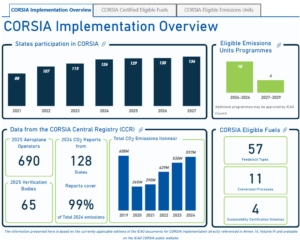
Airlines can reduce their CORSIA obligations through eligible fuels and other measures. They can meet remaining requirements by canceling CORSIA Eligible Emissions Units approved by ICAO. This creates potential demand for carbon credits that meet CORSIA’s eligibility rules.
ICAO currently lists eight programs approved to supply eligible emissions units for the 2024–2026 first phase. They include the American Carbon Registry, Architecture for REDD+ Transactions, Climate Action Reserve, Global Carbon Council, Gold Standard, Isometric, the Premium Thailand Voluntary Emission Reduction Program, and Verra’s Verified Carbon Standard.
However, approval of a program does not mean every credit from that program can be used. Individual credits depend on several factors. These include the program, project activity, methodology, vintage, and other conditions.
Carbon Removals Enter Aviation’s Compliance Pipeline
The JAL-Climeworks agreement also shows how the carbon market is changing. For years, most corporate demand for carbon removals came from the voluntary carbon market. Companies bought removals to address residual emissions or support longer-term climate goals. Regulatory systems are now creating another potential source of demand.
Climeworks launched its compliance-focused Solutions offering in July 2026. The service helps companies find carbon removal portfolios. These portfolios work with frameworks like CORSIA, Article 6.2 of the Paris Agreement, and the EU’s Carbon Removal and Carbon Farming Certification Framework.
The JAL agreement is the first major deal publicly announced by Climeworks under this expanded strategy. For the carbon removal industry, the importance of the deal goes beyond the number of credits sold.
It shows how developers and buyers can build carbon removal portfolios around a specific compliance system. That could become more important as governments and international organizations set clearer rules for which carbon removals can be used in regulated markets.
JAL Pairs Removals With SAF and Efficiency for Net Zero
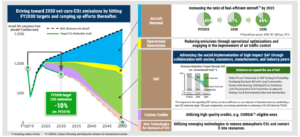
JAL is not using carbon removals as its only way to cut aviation emissions. The airline says aircraft efficiency, operational improvements, and SAF remain priorities.
Noriko Ogawa, Executive Officer and Chairperson, Japan Airlines, noted:
“As the first airline to secure CORSIA-compliant carbon removals, we are proud to lead the industry toward net-zero emissions. While reducing emissions through aircraft renewal, operational innovations and the use of SAF remains our top priority, high-integrity carbon removals are essential to address residual emissions. Through this pioneering partnership with Climeworks, we aim to accelerate the adoption of high-quality solutions across international aviation and contribute to a sustainable future for air travel.”
JAL has set a target of reducing its FY2030 aircraft CO₂ emissions by 10% from FY2019 levels to 8.28 million metric tons. It also targets SAF equal to at least 10% of total fuel use by FY2030. JAL said SAF accounted for 1% of its fuel use in FY2025.
The airline has also used CORSIA-eligible credits.
JAL said in its latest sustainability disclosures that it met its FY2025 target of keeping net aircraft CO₂ emissions below its FY2019 level. The airline used several measures, including more fuel-efficient aircraft, operational improvements, SAF, and carbon credits.
The new agreement, therefore, adds carbon removals to a broader decarbonization strategy. It does not replace direct efforts to reduce aviation emissions.
DAC Adds a Longer-Term Carbon Removal Bet
The second part of the deal focuses on direct air capture. DAC uses machines to remove CO₂ directly from the air. The captured CO₂ can then be permanently stored, depending on the project and its storage method.
Climeworks operates the Mammoth DAC facility in Iceland. The company sees engineered carbon removal as a long-term way to deal with emissions that are difficult to eliminate.
JAL’s decision to buy Climeworks DAC credits alongside the broader CORSIA-focused portfolio gives the deal two different elements. The CORSIA-focused portfolio provides access to carbon removal methods designed around aviation’s compliance system.
The DAC purchases support a commercially scaling engineered carbon removal technology. These approaches, therefore, represent different parts of the growing carbon removal market.

A New Carbon Removal Market Takes Off in Aviation
The JAL-Climeworks deal does not mean that all carbon removals can now be used for CORSIA. Yet, the agreement shows that airlines are starting to look beyond traditional carbon offsets. They are also seeking carbon removal portfolios designed for specific compliance systems.
JAL and Climeworks call this deal the world’s first CORSIA-compliant carbon removal purchase agreement. The announcement does not establish that the credits have already been canceled for a CORSIA obligation. Still, the deal provides an early example of how carbon removals could move from the voluntary market into aviation’s regulated carbon market.
For carbon removal developers, the opportunity is to produce projects that meet increasingly detailed regulatory requirements. Airlines face the challenge of securing enough eligible units and the need to cut emissions. This can be done with more efficient aircraft, improved operations, and sustainable aviation fuel.
As CORSIA enters its second phase in 2027, these requirements could become an increasingly important source of demand for high-integrity carbon removal projects.