


The Philippines is taking a major step toward building a national carbon market. President Ferdinand Marcos Jr. has ordered the government to develop a policy framework to guide carbon credit projects, attract investment, and support the country’s climate goals.
Under Executive Order No. 127, signed on October 13, 2026, the Department of Environment and Natural Resources (DENR) will lead the development of the Philippine Carbon Market Policy Framework. The order also creates an inter-agency committee to guide the process and names the DENR as the country’s main authority for carbon markets.
The framework will set rules for carbon projects, credit trading, monitoring, and benefit-sharing. It will cover both voluntary carbon markets and international trading under Article 6 of the Paris Agreement. The DENR must submit the proposed framework to the committee for review and approval within 30 days after the order takes effect.
The move could help bring more funding to forest protection, clean energy, farming, and other projects that cut or remove greenhouse gas emissions. However, the detailed rules still need to be developed, and the impact will depend on how the system is put into practice.
Marcos Orders National Carbon Market Rules
Executive Order No. 127 aims to give the Philippines a clearer and more coordinated approach to carbon markets. The government wants the framework to support climate goals while opening the door to investment, funding, and technology. The EO read:
“There is a need to formulate a national carbon market framework aligned with international standards, through a whole-of-government approach, to support the achievement of the country’s NDCs (nationally determined contributions).”
Carbon markets allow companies and other buyers to purchase credits from projects that reduce or remove greenhouse gas emissions. One carbon credit usually stands for one metric ton of carbon dioxide equivalent. These credits are based on specific rules and standards.
Selling carbon credits can help fund projects that may struggle to secure enough money through other sources. The new framework will establish rules for:
- Which projects qualify,
- How credits are issued and transferred,
- Accepted carbon standards, and
- How projects report results.
It will also cover environmental and social safeguards and how project benefits should be shared. These rules could support projects in forestry, renewable energy, agriculture, and other sectors.
The order does not create a new carbon tax. Instead, it sets the direction for regulating carbon market activities and developing a more coordinated system for carbon projects.
DENR Takes the Lead as Agencies Join Carbon Market Committee
The order names the DENR as the national authority for carbon markets. It will oversee eligible projects and help ensure they follow national rules and environmental policies.
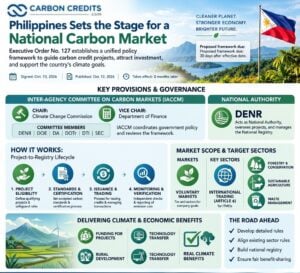
An Inter-Agency Committee on Carbon Markets (IACCM) will coordinate government policy and review the proposed framework. The Climate Change Commission will chair the committee, while the Department of Finance will serve as vice chair. Other members include:
- DENR, Department of Energy, Department of Agriculture, Department of Transportation, Department of Trade and Industry, and the Securities and Exchange Commission.
These agencies cover areas that can affect carbon projects, from climate policy and land use to energy, transport, business, and finance. Their cooperation will be important because projects may need several permits and must meet different technical and reporting requirements.
The committee will review how the framework is applied. It will also approve fair fees for carbon market applications and certifications.
Philippines Plans National Registry to Track Carbon Credits
The government will establish a Philippine National Carbon Registry, which the DENR will manage. The digital system is intended to record carbon credits and related transactions. It should help regulators track credits and reduce the risk of the same emissions reduction being counted more than once.
This matters when credits are sold to different buyers or transferred between countries. If the same emissions reduction is claimed more than once, the climate benefit becomes less reliable.
The framework will also set rules for measuring and checking emissions reductions, approving international transfers, and reporting transactions. These requirements could help buyers assess credits and give project developers a clearer process for selling them in eligible markets.
However, the registry’s value will depend on how well the government checks project data, tracks credits, and enforces the rules.
Opening the Door to International Carbon Trading
The framework will cover both voluntary carbon markets and international trading under Article 6 of the Paris Agreement. In voluntary markets, companies and other organizations buy credits to support their climate goals. Eligible projects may include forest conservation, reforestation, renewable energy, farming, and waste management.
Article 6 allows countries to work together to meet their climate targets. Under Article 6.2, countries can transfer approved emissions reductions or removals, known as internationally transferred mitigation outcomes (ITMOs).
These transfers require government approval and proper accounting. Countries must follow the rules. This stops the same emissions reduction from counting for more than one climate target.
The new framework will set rules for approving international transfers. It will also manage carbon credits. This could help Philippine projects reach international buyers. However, approval under the national framework will not automatically mean that every credit qualifies for every market or buyer.
New National Framework Builds on Existing Sector Rules
The Philippines is not starting from zero. Several government initiatives have already laid the groundwork for carbon market development.
In 2025, the Department of Energy issued a framework for generating, managing, and monitoring carbon credits in the energy sector. It covers issues such as measuring emissions reductions, checking results, credit ownership, and preventing double counting.
The DENR set rules for forest carbon projects. In 2021, they issued an order to measure, verify, and certify forest carbon activities. Executive Order No. 127 creates a national framework. This aims to unite efforts and set broader rules for voluntary and international carbon markets.
The next challenge will be to align existing sector rules with the new framework. Project developers, communities, investors, and buyers will need clear guidance on how the different requirements work together.
Clearer Rules Could Open New Opportunities for Investors and Communities
Clearer rules could make the Philippines more attractive to companies looking to develop carbon projects. Possible areas include forest restoration, forest protection, renewable energy, better farming practices, and waste management. These projects must show that they reduce or remove emissions and meet the relevant standards before they can generate eligible credits.
For investors, clear approval and reporting rules could make it easier to assess project risks. A national registry could also improve transparency by providing a central record of credits and transactions.
Communities and farmers may benefit through project funding, jobs, or a share of revenue. But these benefits are not guaranteed. The final rules and each project’s agreements will help determine how money is shared.
Strong checks will also be important. Projects must prove their claimed emissions cuts or removals, follow environmental and social safeguards, and avoid double counting.
Carbon credits are not guaranteed income. Projects may need upfront funding, technical studies, monitoring, independent checks, and government approval. Revenue will depend on the credits generated, their quality, buyer demand, and the terms of each project.
Will the Philippines’ Carbon Market Gain Momentum?
Executive Order No. 127 gives the Philippines a clearer national plan for developing its carbon markets. It assigns the DENR a leading role, creates an inter-agency committee, and provides for a national registry.
The framework could help attract funding for projects that cut emissions or remove carbon from the atmosphere. It may also create new opportunities for developers, investors, and local communities.
But the order is only the first step. The government still needs to develop the detailed rules and put systems for project approval, verification, reporting, and credit tracking into practice.
The key test will be whether the new framework provides clear rules, attracts investment, and ensures that carbon credits deliver real climate benefits while sharing project gains fairly with local communities.