


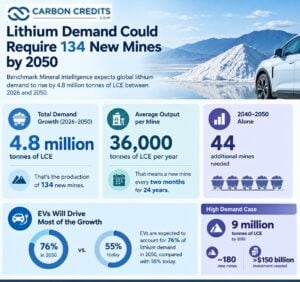
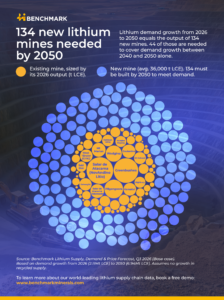
The world may need the equivalent of 134 new lithium mines by 2050 to meet rising demand for electric vehicles (EVs) and battery storage. The projects could require more than $100 billion in investment, before counting the contribution of recycled lithium, according to Benchmark Mineral Intelligence.
The forecast highlights a major challenge for the energy transition. Lithium demand is expected to grow sharply over the next 24 years, but mining companies must secure funding, permits and buyers before they can bring new projects into production.
Benchmark’s base-case forecast puts global lithium demand at about 7 million tonnes of lithium carbonate equivalent (LCE) in 2050, up from 2.11 million tonnes in 2026. However, the amount of new mining needed will depend on future demand, recycling rates, technology, and how quickly projects can be developed.
Lithium Demand Could More Than Triple by 2050
Benchmark expects global lithium demand to increase by about 4.8 million tonnes of LCE between 2026 and 2050. At an average output of 36,000 tonnes of LCE per mine each year, that growth would equal the production of 134 new mines.
In practical terms, the industry would need to bring a mine of that average size online roughly every two months for the next 24 years. Demand growth between 2040 and 2050 alone would require the equivalent of 44 additional mines.
Electric vehicles are expected to drive most of this growth. Benchmark forecasts that EVs will account for 76% of lithium demand in 2050, compared with 55% today.
Battery storage will also contribute as power grids add more renewable energy. Lithium-ion batteries help store electricity from solar and wind projects and supply it when generation falls or demand rises.
The International Energy Agency (IEA) reported that lithium demand rose by 25% in 2025, driven by electric vehicles (EVs), stationary battery storage, and clean energy technologies. These forecasts do not guarantee a particular level of demand. EV sales, government policies, battery technology and economic conditions will all affect how much lithium the market needs.
More Than $100 Billion Must Flow Into New Mines
Meeting the base-case demand forecast will require more than $100 billion in investment for new lithium mining capacity, Benchmark estimates. Its higher-demand scenario raises the challenge further:
- Demand could approach 9 million tonnes of LCE by 2050, requiring the equivalent of around 180 mines and well over $150 billion.
The figures show why securing capital is as important as finding lithium deposits. A mineral resource does not become a producing mine overnight. Developers must complete studies, arrange financing, obtain permits, build processing facilities and connect projects to transport and power infrastructure.
Projects can also face delays from technical problems, environmental reviews and community concerns. These risks can increase costs and push production further into the future.
Benchmark lithium product director Cameron Perks identified another hurdle: keeping investors committed when lithium prices fall. He stated:
“Meeting 2050 demand requires the equivalent of 134 new lithium mines, more than US$100 billion of investment before any contribution from recycling, rising to more than 180 mines in our upside scenario. The biggest challenge is sustaining that investment through price cycles, while competing for capital with AI, defence and the wider energy transition.”
The investment estimate is a forecast, not a record of money already committed. It also depends on Benchmark’s assumptions about average mine size, demand, and future supply. Actual spending could vary by project and region.
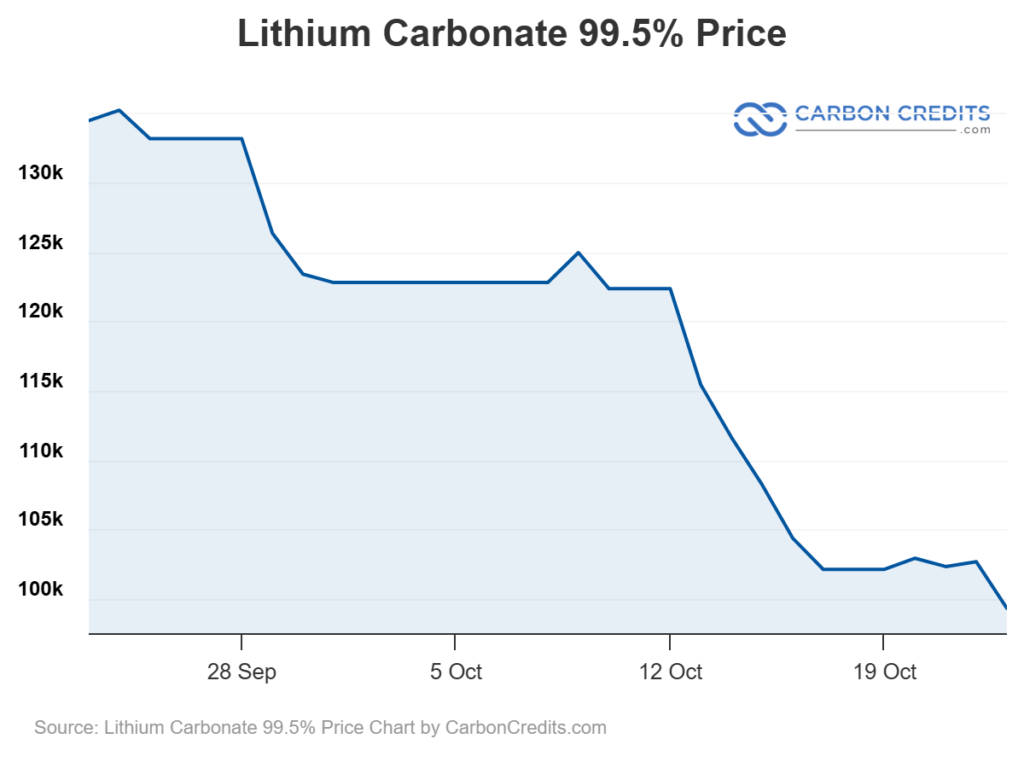
Lithium Prices Show Why Funding Can Be Difficult
The lithium market has already experienced sharp price swings. Benchmark data cited by Investing News Network show that battery-grade lithium carbonate ended the third quarter of 2026 at $19,025 per tonne, down 20.8% from the previous quarter. Spodumene concentrate, a key hard-rock lithium feedstock, fell 23.5% over the same period to $1,780 per tonne.
Lower prices can benefit battery makers and other buyers by reducing raw-material costs. However, they can also make it harder for mining companies to finance new projects, particularly those with high construction costs or more complex deposits.
This creates a difficult cycle. When prices rise, companies have a stronger incentive to expand supply. If many projects enter production around the same time, extra supply can then push prices down. When prices fall, developers may delay or cancel projects, potentially limiting future supply.
The IEA notes a big change in critical minerals. Market ups and downs have led to less capital spending. Following a sharp slowdown in previous years, global investment in critical mineral development declined by 9% in 2025, ending several consecutive years of growth.
The pullback was particularly severe for battery materials, where investment dropped by 20%. Mineral prices hit rock bottom for years. Then, they rebounded in late 2025 and early 2026. This change happened as supply tightened and export controls increased.
A market that appears well supplied today can therefore face a different outlook later. New mines take years to develop, so investment decisions must account for demand well beyond the current price cycle.
- INTERESTING READ: Lithium Prices Up 92% Year Over Year as PLS Group Posts A$526M Profit
Australia, China and North America Face Shifting Supply Roles
The location of new mines will shape the future lithium supply chain. Benchmark forecasts that Australia will remain a major producer, but its share of mined lithium could fall from 29% in 2026 to 20% by 2050.
China’s share of mined supply is expected to remain around 25%, according to the forecast. Its position is stronger in processing, where Benchmark estimates that China controls roughly 70% of refined lithium production.
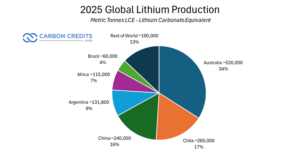
North America could gain a larger role. Benchmark projects that its share of mined lithium will rise from 1.7% in 2026 to 13% by 2050 as the region seeks to meet more of its own demand and reduce reliance on imported materials.
Europe faces a different gap. The region currently produces less than 1% of mined lithium while accounting for 7% of demand from battery-cell production. By 2050, Benchmark expects Europe to supply 5.5% of mined lithium against 8% of cell-production demand.
These projections depend on projects moving forward. New mines in North America and Europe may help diversify supply, but some face higher costs, permitting delays, and environmental or community concerns.
More geographically diverse supply could reduce dependence on a small number of producers. However, building mines and processing facilities in new regions will require long-term funding and reliable demand from battery manufacturers.
Battery Recycling Could Ease Pressure on New Lithium Mines
Mining is not the only way to meet future lithium demand. Recycling used batteries can return lithium to the supply chain and reduce the need for newly mined material.
Benchmark expects recycled material to account for almost half of lithium supply by 2050. Its separate capital-spending analysis estimates that meeting 2040 demand would require around $64 billion in investment, assuming recycling supplies a significant share of future needs.
However, recycling cannot replace new mines immediately. Large volumes of EV batteries must reach the end of their useful lives before recyclers can recover their materials. Collection systems, processing capacity and the cost of recovered lithium will also affect how much material returns to the market.
Battery technology could change the outlook, too. Different battery chemistries use different amounts of lithium and other minerals. Advances in battery design, improved efficiency and changes in EV demand could alter the amount of lithium required for each unit of storage.
For now, Benchmark’s estimates suggest that recycling will help meet future demand but will not remove the need for substantial new mining capacity. If recycled supply falls short of expectations, the industry may need more mines than its base case assumes.
Lithium’s Long-Term Outlook Depends on Investment Today
Benchmark’s forecast puts a clear figure on the scale of the task: 134 mines and more than $100 billion in investment under its base case. Yet, the central issue is not simply whether enough lithium exists in the ground. It is whether the industry can finance, approve and build the projects needed to bring that supply to market.
The IEA’s analysis reinforces the importance of investment, supply chain diversification and recycling across critical minerals. But forecasts remain sensitive to prices, policy decisions, technology and project delays.
For the lithium industry, the next 24 years will require a steady flow of capital through both strong and weak market conditions. Recycling can ease pressure on new supply, while new mining projects will remain important to meeting demand.
The outcome will shape more than the fortunes of mining companies. Lithium is a key material for EV batteries and energy storage, which support the shift toward lower-emission transport and electricity systems. Whether the industry can build enough supply at the right time will be an important factor in how smoothly that transition progresses.