Three US companies – carbon solutions provider Rubicon Carbon, commodity trading firm Freepoint Commodities, and project developer Imperative Global – have teamed up to develop and fund a potential $500 million nature-based carbon offset projects that can create over 100 million carbon credits.
The trio joined forces to bring to the market large-scale nature-based carbon offset projects and create impactful results in the Global South.
A Trio for High-Quality Carbon Offset Projects
TPG Rise-backed Rubicon Carbon aims to help large companies meet their decarbonization targets and the growing demand for high-integrity carbon credits. The company sources and manages diversified carbon credit portfolios while bringing transparency and quality to voluntary carbon markets (VCMs).
Freepoint Commodities is a global commodities merchant with a voluntary carbon business delivering market solutions to VCM market players. Investing in high-quality carbon projects is one of the services that Freepoint provides.
Imperative Global seeks to advance carbon credit project development and the generation of high-quality credits by addressing issues at the source. It has expertise in carbon project execution, conservation projects, and carbon markets, optimizing these projects using advanced technology.
Their collaboration has the main goal of promoting nature-based carbon offset projects that can produce over 100 million credits.
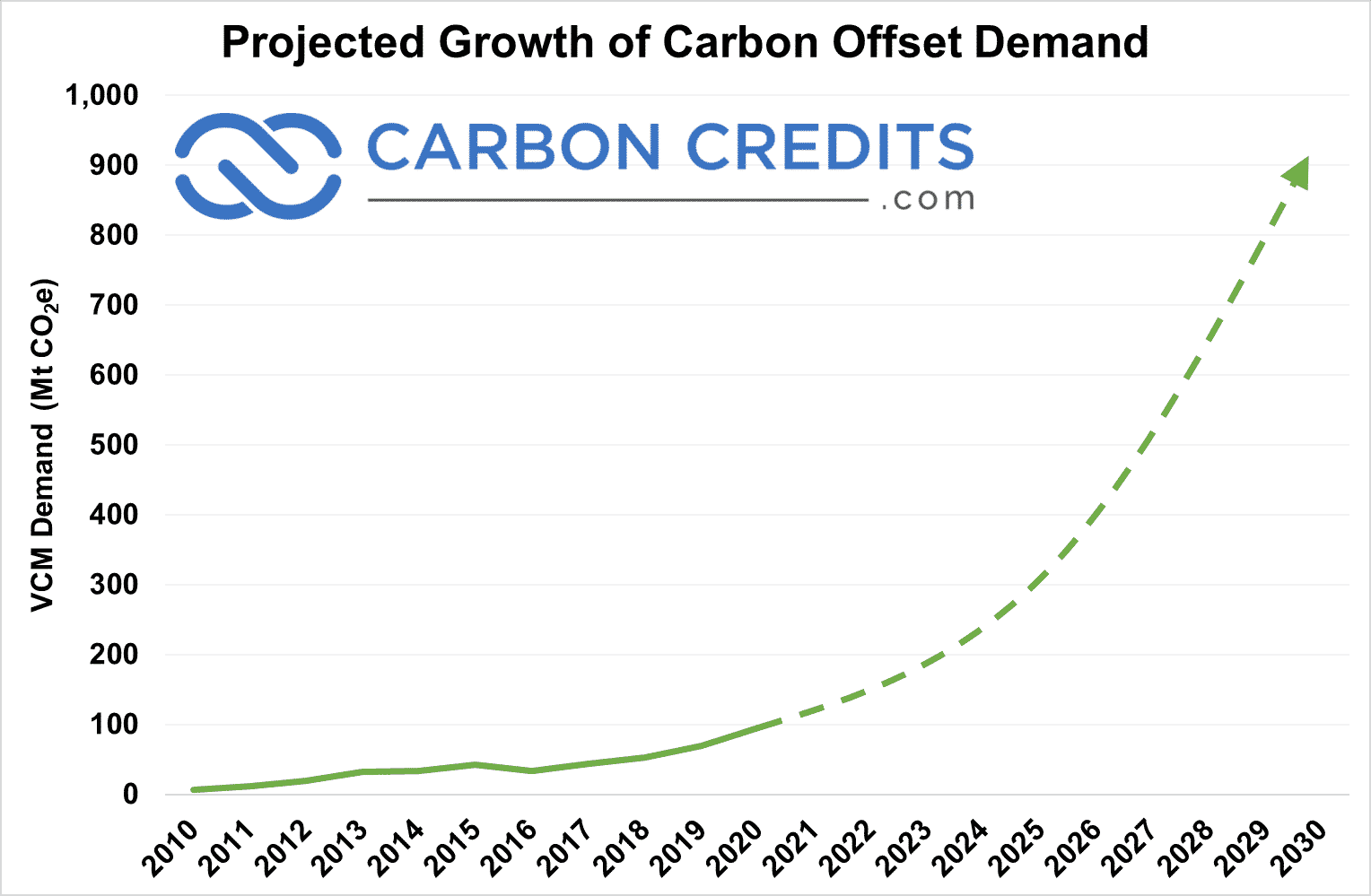
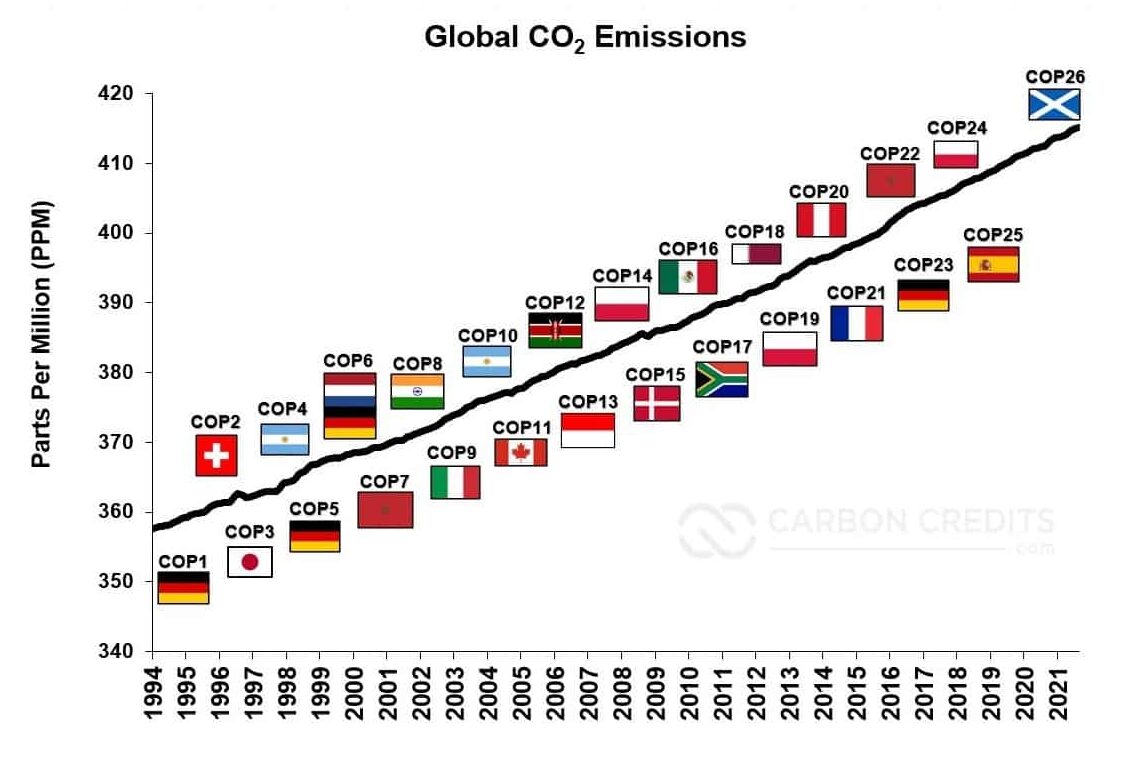
The VCM was valued at $2 billion in 2022 and market projections are bullish, surging to $250 billion by 2050. Demand for voluntary carbon credits, also known as carbon offsets, will grow exponentially as shown below.
One of the biggest problems plaguing the market is the issue of quality. Nature-based carbon offset credits, in particular, have been criticized for being worthless.
The collaboration among the three companies aims to address this concern by driving quality within the VCM and providing capital at the scale necessary to fund large projects.
Generating 100M+ High-Integrity Carbon Credits
Rubicon Carbon has been focusing on working with project developers that implement high-integrity carbon projects. Partnering with Imperative reflects this commitment as their deal centers on promoting quality and setting new market standards.
Commenting on their collaboration, the Head of Rubicon Carbon Capital, Chris Brown said that it enables them to “help progress the VCM through a focus on integrity and quality”.
Freepoint Commodities shared the same viewpoint on their trio partnership. As the commodity trader seeks to expand its global voluntary carbon business, they’ll invest in high-integrity projects and developers.
Freepoint expressed intent “to support Imperative to be a market leader in the space”. They believe that doing so allows them to expand the suite of products and services they offer to customers.
Each dollar these companies invest in Imperative carbon projects aims to produce meaningful climate, biodiversity, and community benefits.
Imperative’s carbon project portfolio covers Latin America, Africa, and Asia, focusing on large-scale agroforestry, mangrove restoration, and native-species reforestation.
Highlighting the significance of their partnership with Rubicon and Freepoint, Imperative CEO Scobie Mackay remarked that:
“…we believe that we can deliver scale and address the issue of quality at the source – on the ground where project activities are occurring…This collaboration with Rubicon Carbon and Freepoint Commodities brings together institutional capital, specialized carbon know-how, and deep, large-scale projects expertise.”
Their strategic alliance seeks to create more than 100 million tons of carbon credits certified by Verra and Gold Standard. These credits won’t only reduce carbon emissions but also deliver substantial co-benefits and sustainable development goals.
By combining their expertise, resources, and commitment to quality and integrity, this collaborative effort seeks to address both the demand for reliable offsets and the critical need for authentic and effective nature-based carbon offset projects.
Deep Sky, a Canadian carbon removal project developer, partnered with carbon capture solutions provider Svante Technologies to study carbon sequestration in Quebec. They tapped Sproule to assess the feasibility of permanent geologic CO2 storage in the province.
This partnership is Deep Sky’s first venture to evaluate carbon capture and storage (CCS) technologies to ramp up the roll-out of this technological climate solution. This carbon dioxide removal (CDR) technology is crucial in achieving the global net zero emissions goal.
CCS can help balance hard-to-abate carbon emissions and help reverse the buildup of carbon pollution that’s already in the air.
The Need for Deep Understanding of CCS
The evolution of CCS technologies is growing rapidly, driven by the urgent need to tackle climate change. With environmental challenges heightening, there’s a growing corporate demand for high-quality carbon removal credits. Thus, developing reliable CCS technologies is critical to meet such demand.
Many of the technologies required to capture carbon from air or water and store it permanently do exist. But they’re mostly in the early stages and to scale them, it’s important to completely understand them, particularly their costs and impacts.
This understanding exacted through a team of expert researchers, scientists, and entrepreneurs allows Deep Sky to scale on a level that has never been seen before. It will enable the carbon removal company to develop CCS technologies and bring them to commercialization through collaborations.
The company’s co-founder, Fred Lalonde, highlighted the importance of working with other major industry players to deliver rapid meaningful changes. Commenting on their partnership with Svante, he said that:
“By combining Deep Sky’s project development expertise with Svante’s ready-to-deploy technology and Sproule’s geology research, we can drive down greenhouse gas emissions and deliver carbon credits to the market at hyper speed.”
Svante has developed innovative carbon removal technology using solid sorbent-coated filters that capture CO2 from industrial sources. These filters can capture up to 95% of the industrial carbon emissions using direct low-pressure steam injection.
The filters are available for point-source capture from hydrogen, cement, steel, aluminum, pulp & paper plants, and refineries, and DAC applications. DAC refers to direct air capture.
Svante’s Point-Source Carbon Capture Technology
Leveraging Deep Sky’s CDR development expertise and Quebec’s unique geology, Svante’s CEO and President Claude Letourneau remarked that:
“For DAC to succeed, it will be critical to find geographical locations that have substantial and safe storage potential…We can leverage the region’s [Quebec] vast renewables and hydroelectric energy needed to safely trap and store CO2 in deep underground saline aquifers.’’
Engineered or tech-based carbon removal using DAC and other carbon capture and sequestration methods is maturing. But the problem is that no one is able to scale these technologies to gigaton levels, yet.
The Deep Sky Solution: Tech-Based, Gigaton-Scale CDR
Deep Sky aims to build gigaton-scale carbon removal and storage infrastructure in Québec and across Canada. As a project developer, the startup is bringing together the most promising CDR technologies to commercialize climate solutions at scale.
Source: Deep Sky website
The CDR company is supported by the government of Québec, a large Ontario pension fund, and renowned private investors. Headquartered in Québec, the early-stage VC company is in an advantageous position to leverage the region’s CCS potential.
Though nature-based CDR approaches are cheaper and are easier to deploy in the short term, tech-based carbon sequestration technologies offer a much greater removal potential and greater scalability. The former is facing land availability constraints.
Forests, for example, can remove about 5 tons of CO2/hectare of land. In contrast, a DAC plant can capture up to 50,000 tCO2 for the same land area. So, in comparison, the tech-based CDR method is about 10,000x more land-efficient than its nature-based CDR counterpart.
There won’t be enough land available to naturally sequester the amount of carbon needed to reach net zero emissions. But engineered CDR technologies also have their own challenges – energy use.
Carbon capture technologies need thousands of kilowatt-hours of energy to capture a ton of CO2. To address this, carbon removal companies like Deep Sky must work with existing energy-efficient carbon capture technologies scalable at gigaton-level. Svante matches this requirement.
Delivering High-Quality Carbon Removal Credits
Technological carbon sequestration methods are known to produce high-quality and reliable carbon removal credits. That’s because they provide durable, scalable, measurable, and verifiable carbon emission reductions.
As the demand for CDR skyrockets, companies, governments, and individuals will seek Deep Sky’s high-quality carbon removal credits. This enables the carbon removal startup to be a key player in the CDR market.
Deep Sky believes that the demand for premium CDR credits will grow exponentially, providing one of the biggest market opportunities.
To leverage this market growth, the company is currently raising a $50M Series A round co-led by WhiteCap Venture Partners and Brightspark. The funding will enable Deep Sky to build its initial pilot facility, Deep Sky Alpha, and to set the ground for its first large-scale facility, Deep Sky One.
The recent developments and announced investments in CDR seem to point to Deep Sky’s bright market projection. CDR credit purchases jumped 437% for the first half of this year versus the full-year 2022. And as corporate net zero commitments continue to grow, so does the demand for these environmental credits.
As Quebec is strategically positioned for the next gigaton-scale carbon removal projects for its ideal geological makeup for carbon storage, renewable resources, and supportive policy, Deep Sky has a unique advantage in delivering high-quality CDR credits. Teaming up with Svante Technologies, their strategic collaboration for an innovative carbon removal project paves the way for a gigaton-scale climate solution.
The U.S. government will give small forest landowners $150 million in grants to allow them to benefit from the carbon credit market and work with corporations seeking to buy carbon offsets.
The grant program was revealed at a conference in coastal Georgia by the Agriculture Secretary Tom Vilsack. The subsidy will give small and underserved forest landowners managing 2,500 acres (1,011 hectares) or less more chances to participate in the growing carbon market.
The ultimate goal is to protect the U.S. forests to help fight climate change.
Funding Nature-Based Climate Solutions
The current global investments in NCS or NBS are at around $154 billion a year. While it sounds plenty, it is still not enough to stir massive efforts to sequester carbon through nature. The UN said that amount has to double to $384 B by 2025 and quadruple to $674 B by 2050.
Closing that nature financing gap is crucial to tackle the climate crisis.
To help close the financing gap, the Agriculture Department will roll out $150 M supporting small forest owners.
Secretary Vilsack highlighted one particular barrier for this group of landowners to participate in carbon markets, saying that:
“In order for those small, privately held forest owners to be able to do what they need and want to do requires a bit of technical help… And sometimes that technical help is not easy to find. And it’s certainly not easy to afford.”
Both technical and financial barriers keep small landowners covering less than 5,000 acres from benefiting in selling carbon credits. And though large companies invest billions into protecting forests via carbon offsets, family landowners don’t satisfy the eligibility criteria.
To be eligible, they need to have inventory, land management plans, and models to determine their land’s carbon value. Doors remain closed for them in the carbon space.
Opening More Doors in Carbon Markets
As carbon markets continue to show promising growth over the past years, more players are joining in. The voluntary carbon market was valued at $2 billion last year and forecasts show it will even grow exponentially.
But the ones benefiting the most from the sales of carbon credits don’t significantly include the small forestland owners. Revenues from carbon offset credits have mostly benefited large forest owners. This is what the government’s $150 M subsidy program will address.
The grant is from the most notable climate law passed by the US Congress in 2022. The funding program targets small landowners with 2,500 acres or less, and the underserved owners like military veterans.
Despite criticisms of the effectiveness of forests in capturing and sequestering carbon, payments for landowners growing and protecting trees increased. Large companies still rely on forest carbon sequestration and pay for the credits to offset their own emissions.
Amid plummeting prices of nature-based carbon offset credits, the UN panel seems to favor nature-based solutions over tech based carbon removals. The UN-backed believes that natural climate solutions (NCS) play a big role in achieving the Paris goals as shown below.
NCS includes forest projects that give landowners incentives not to cut down trees or sell their land to corporate developers.
Earlier this month, Finite Carbon and LandYield partnered in a groundbreaking project that also aimed at breaking barriers to open new opportunities for family forest landowners to benefit from carbon credits. They launched a new platform “CORE Carbon” for landowners with 40-5,000 acres to enroll in a carbon offset program.
Years ago, a similar program was created by the Nature Conservancy and the American Forest Foundation that allowed family landowners to apply for subsidies of up to $25mln. The grant covered considerable costs for these landowners to generate carbon credits and earn from selling them.
Earning Extra Through Carbon Credits
The recent grant was first introduced to the host of the conference where the program was announced. The group called the Sustainable Forestry and African American Land Retention Network represents black forest landowners covering the Southern states. These include Alabama, Arkansas, Georgia, Mississippi, North Carolina, South Carolina, Texas and Virginia.
The group’s leader said that they’ll apply for the subsidy program though they don’t know the actual demand yet. It will depend on how much the smaller forest owners can earn from the carbon offset credits.
The income won’t be that huge, given the smaller acreage involved, but it would be enough to “pay the taxes”. According to the American Forest Foundation, the small landowners under their forest carbon program are earning $10 per acre a year on average.
So for a landowner managing a 1,500-acre forestland, that would be $15,000 a year income. It’s not huge but others could earn more than that. If prices go up, so do their potential earnings.
In a move to empower small forest landowners, the $150 million grant program aims to bridge the gap in the carbon credit market. This initiative not only unlocks income opportunities for smaller, underserved landowners but also fortifies the nation’s fight against climate change through nature-based solutions.
Despite significant opposition from some trading partners, the European Commission has enacted the reporting rules for its carbon pricing tool known as the Carbon Border Adjustment Mechanism or CBAM that will take effect during its transitional phase in October 1, 2023.
CBAM, a key pillar of the EU’s Fit for 55 Agenda, is the bloc’s significant tool to prevent carbon leakage. It’s created to ensure that companies operating inside and outside the region remain on the same page in terms of carbon pricing and environmental impact.
Carbon leakage happens when a company operating in the EU move its production abroad where there’s less stringent climate regulations. It also occurs when products made in the region are substituted by more carbon-intensive import goods.
A study estimates that unchecked carbon leakage can result in a 15% increase in global carbon emissions, hurting climate actions. CBAM seeks to avoid this.
Putting a Fair Price on Carbon
As the EU gradually introduces the mechanism, the Implementing Regulations will initially apply to carbon intensive industries and certain goods. These particularly include iron and steel, cement, electricity, hydrogen, aluminum, and fertilizers.
Once CBAM becomes fully phased in, it can address >50% of the emissions of the sectors under the EU ETS. Its transition phase will run until the end of 2025.
The new rules adopted specify the reporting obligations for importers of CBAM covered goods. It also provide details of the methods how to calculate embedded emissions generated in producing those products.
This guidance is published by the EC to also help third country producers of CBAM goods. The Commission will also provide materials, tutorials, and webinars to help affected companies once the transitional phase starts.
First report, which includes 2023 4th Qtr. data (starting October 1), will be due by January 31 next year. Traders only need to submit their report without having to pay for any financial adjustments. This is to give enough time for companies to get used to it while the methods are adjusted by 2026.
By ensuring that a carbon price has been paid for the embedded emissions of the imported goods and that it’s equal to the carbon price of domestic production, the CBAM is putting a fair price on carbon. The mechanism also aligns with the WTO rules.
Phasing-In of CBAM, Phasing-Out of Free Carbon Allowances
The gradual phase in of the mechanism will coincide with the phase-out of the free carbon allowances under the EU ETS to decarbonize the industry.
The EC forecasts that the carbon allowance market can reach €4.5 billion annually by 2030. CBAM will significantly affect international trade and revenues.
Starting from January 1, 2026, the new permanent system will require importers to report annually on the volume of goods brought into the EU in the previous year and their associated emissions.
Subsequently, they will need to surrender the corresponding number of CBAM certificates. The cost of these certificates will be based on the weekly average auction price of EU ETS allowances, measured in €/tonne of CO2.
Before the definitive CBAM system takes effect, there will be a comprehensive review of its performance during the transitional phase. Then there will be an assessment of the product scope, evaluating the possibility of including more goods from sectors already covered by the EU ETS into the CBAM. The report will outline a schedule for their inclusion by 2030.
Ultimately, here are the key things under the CBAM’s transitional phase to keep in mind:
Reporting timetable: beginning in October, businesses must collect data on embedded carbon emissions of their imported goods. Reporting starts in January 2024 and ends in 2025.
Industries covered: carbon-intensive industries and certain downstream products (e.g. bolts). Specific indirect emissions under certain conditions may also be included.
CBAM certificates: certificates must include information on the product’s CO2 footprint, origin, production/processes, and GHG emissions data (including indirect emissions, e.g. energy use).
Meeting the reporting rules of CBAM might be tough for traders initially. But its advantages will outweigh the challenges in the long-term by creating a fairer carbon price.
Last year, the U.S. also introduced its own version of CBAM, the Clean Competition Act. It aims to make domestic companies in the U.S. more competitive in the global market.
Well-designed carbon pricing like the EU CBAM will help industries adopt less carbon-intensive and more environmentally friendly production processes, contributing to a greener global economy. This is critical as the world is curbing planet-warming emissions to address climate change.
Anybody can say that they’re offsetting their carbon footprint and get financial support for it, which is good. But here’s another version of the story – uncertified carbon credits can’t ensure that the offset project has actually reduced carbon emissions.
In other words, carbon credits that companies use to claim emission reductions must go through a recognized carbon credit certification process. But the question is – who certifies carbon credits?
You’ll know the most renowned companies or standards that certify carbon credits, plus the processes involved in this article.
Who Certifies Carbon Credits?
Carbon credit certification can be done only by accredited organizations and both types of carbon markets – compliance and voluntary – have their own standards to adhere to. These standards are aided by independent verification bodies to ensure that carbon reduction projects follow their strict rules in offsetting.
Given the various carbon credit certification companies and their protocols, it could be quite confusing and you might be thinking why not have one global standard only. We do hope, too, but since that’s not yet the case, here are the names you should be aware of.
The VCS Program developed by Verra is the most widely adopted carbon credit certification program. This program allows certified offset projects to turn their emission reductions or removals into carbon credits.
To date, Verra has more than 1,800 certified VCS projects that collectively reduced or removed over 920 million tons of GHG emissions. The VCS program focuses on GHG reduction attributes only and doesn’t require projects to have additional environmental or social benefits.
The VCS Certification Process
Gold Standard (GS)
The Gold Standard is a voluntary carbon credit certification program unique from others. Unlike Verra, it puts the UN Sustainable Development Goals (SDGs) at the center when certifying offset projects. The crediting program was a collaboration among the World Wildlife Fund (WWF), HELIO International, and SouthSouthNorth.
It focuses on projects that provide lasting social, economic, and environmental benefits such as below. It also applies to both voluntary offset projects and to Clean Development Mechanism (CDM) projects.
Climate Action Reserve (CAR)
The Climate Action Reserve is a certification body or registry for the North American carbon credit market. It aims to encourage companies and other organizations to measure, manage and reduce GHG emissions while ensuring the environmental integrity of emission reduction projects.
While headquartered in the United States, CAR also certifies projects in Canada and Mexico. All carbon credits generated by CAR-certified projects are given a unique serial number which helps track each project effectively.
American Carbon Standard (ACR)
The American Carbon Standard is a pioneer on the voluntary emissions and carbon market in California. It was founded back in 1996 as the first GHG registry and was approved as an Offset Project Registry by the California Air Resources Board (CARB). It’s the regulatory body of the California cap-and-trade offset credit market.
The United Nations’ Clean Development Mechanism is considered by many as a trailblazer in carbon credit certification.
It’s a program under the Kyoto Protocol that allows a country to implement carbon emission reduction projects in other countries and claim the reduced emissions toward its own emission targets. The funded projects can earn tradable certified emission reduction (CER) credits, each equal to one tonne of CO2.
Source: CDM website
The Kyoto Protocol
The Kyoto Protocol operationalizes the United Nations Framework Convention on Climate Change (UNFCCC) and makes regulated carbon credits trading possible. It creates the standards for which the credits from a CDM project becomes certified and tradable within the compliance market.
While voluntary credits are independent of government regulations under the Protocol, they can also be certified using the same standards, as long as a company’s corporate social responsibility is reflected.
So, how do those organizations certify carbon credits?
Carbon Credit Certification: How Does It Work?
The ultimate goal of carbon credits is to reduce the amount of carbon emitted into the atmosphere. Each carbon credit certification gives the owner the right to emit one ton of carbon dioxide or other greenhouse gasses.
A carbon offset credit becomes certified only by going through the specified processes or procedures set by the certifying standard. This is what separates a high-quality and real carbon credit from other credits swarming the market.
Carbon credits are a critical part of the global decarbonization puzzle to prevent catastrophic climate-related disasters. So, projects that generate them must show, from planning to implementation and monitoring, that they are indeed reducing emissions.
The credits don’t just reduce emissions; the extra revenue they generate help improve the life of local communities, create more jobs, and provide economic stability.
They’re traceable, which means their environmental benefits can be claimed only once. This is critical to ensure that they’re counted only once toward carbon reduction goals. As such, certifying them is vital so as not to jeopardize the purpose of why they’re created in the first place.
So, how do those organizations certify carbon credits?
Carbon Credit Certification Process: Getting Started
Let’s get down to the major steps involved and walk you through it.
Project Planning. Same with other projects, as a carbon offset developer, you must estimate the climate impact of your project by planning. Then you should assess it against the standards of the carbon credit certification body.
Get Project Approval. With all the estimates and assessments, your project is now ready for the first review by the certification organization. If all is well with your plans, you’ll get the green light.
Third-Party Project Validation. This time, the carbon credit certification company, e.g. Verra or CDM, will perform an independent assessment of your project. This may include a site visit to validate that your project satisfies their certification standards.
Final Review and Approval. After a successful validation, your project will now be ready for certification and be issued with certified carbon credits. You can then sell these credits via a carbon registry or use it to offset your own emissions.
Project Monitoring. But of course, after getting your carbon credits certified, it doesn’t end there. You need to implement the monitoring plan you designed during project planning. With that, you have to submit monitoring project reports to the carbon credit certification body. This is crucial to ensure that the credits you sell did the job of reducing or removing emissions.
Plus, there will be another validation and verification every 5 years to independently assess your project impact. This is also important to see that your project works in line with the certification standard.
In the complex realm of carbon credit certification, the narrative shifts from mere claims to tangible impact of driving genuine emissions reduction – uncertified credits offer no assurance of actual environmental progress. Acknowledging this distinction, the certifying organizations mentioned earlier play a pivotal role in the credibility of carbon offset projects.
The Amazon Reforestation Fund, formed by Brazilian startup Mombak, received two separate investments worth $35 million in total from Rockefeller Foundation and Canada Pension Plan Investment Board, reaching its $100mln target funding.
Mombak aims to be the world’s biggest carbon removal company generating high-quality carbon credits through reforestation of the Amazon.
The startup’s reforestation project got support from high-profile investors including Byers Capital, Union Square Ventures, and Bain Capital Partnership Strategies. These large partners are recently joined by Rockefeller Foundation and Canada’s largest pension fund, the CPP Investments.
Generating High-Quality Carbon Removal Credits
Mombak’s reforestation project will plant native Brazilian tree species on degraded land, ensuring trees aren’t cut down for timber production.
Mombak’s carbon removal
The project’s activities like selecting land and plant species will use innovative technology and drones to measure carbon baselines. It also utilizes satellite imagery and bioacoustic sensors to assess biodiversity and optimize results.
The Amazon Reforestation Fund was launched in December last year aimed at raising $100 million financing to support reforestation in the region. The fund will enable Mombak to not just remove carbon dioxide but also help improve soil quality and biodiversity.
Carbon removal through nature is one of the sought-after solutions that help mitigate climate change. Forests have been the long-standing ally of the planet in avoiding too much heat by capturing carbon.
The startup’s first project in Northern Brazil will plant 3 million trees with over 100 native species. They include 200 hundred thousand seedlings of endangered species, with over 1 million seedlings to be planted by September.
Mombak will also start multiple projects of this kind before this year ends. The landmark carbon removal project will create jobs in the local community.
Unlike existing forests, reforesting Brazil’s pastureland to rebuild the Amazon forest produces high-quality carbon credits. It does so through additional carbon removed from the atmosphere by the new forests created.
The project’s permanent carbon sequestration will create verified carbon removal credits that are tradable in carbon markets. They can be sold through spot trading as well as offtake agreements with end-buyers.
The additional and permanent carbon removals created by the project attracted large investors. Rockefeller Foundation and Canada’s CPP Investments are just the two recent companies onboard.
Closing the $700B Annual Financing Gap
Canada’s largest pension fund will invest up to $30 million in Mombak’s reforestation fund and another half million in the carbon removal startup itself. Speaking for the CPP Investments, the pension fund’s global head of sustainable energies noted that:
“We expect that the value of high-quality, verifiable, nature-based carbon removal credits such as the ones produced through The Amazon Reforestation Fund will continue to rise.”
CPP, one of the largest pools of investment capital in the world, supports efforts that strengthen carbon credit markets. Investing in the potential of carbon credits is part of CPP’s pathway to net zero emissions.
CPP Investments commits its portfolio and operations to achieve net zero emissions across all scopes by 2050.
The CPP’s $30 million investment, plus a smaller outlay from the Rockefeller Foundation, brings Mombak’s Reforestation Fund to its $100 million goal, according to the company’s CEO and co-founder Peter Fernandez.
The Rockefeller Foundation is making big bets in promoting the well-being of humanity and making opportunity universal and sustainable. Its $5 million investment in Mombak’s reforestation project helps reinforce its integrity where trust is the biggest issue, Fernandez said.
Acknowledging the importance of its small yet impactful investment, senior VP at Rockefeller Foundation Maria Kozloski remarked that nature-based solutions (NbS) play a crucial role in curbing carbon emissions but it remains short of funding. She further said that:
“[Nbs] remain grossly underfunded, with an estimated $700 billion financing gap per year… The Rockefeller Foundation is proud to help close this gap by investing in Mombak’s innovative model that seeks to remove carbon by reforesting the Amazon.”
Part of its efforts to fill in gaps in investable NbS projects, the Foundation provided a grant to Nature Conservancy. The philanthropic company also co-launched 3 other innovative initiatives namely the African Carbon Markets Initiative (ACMI), the Coal to Clean Credit Initiative (CCCI), and the Energy Transition Accelerator.
Raising the Bar for Carbon Removals
Apart from drawing in major investing companies, the carbon removal company is also working closely with leading non-government organizations. Their goal is to raise the bar in the carbon removal credit industry.
A critical part of achieving that aim is ensuring that their reforestation projects meet the most stringent standards and requirements. As such, the startup focuses on selling carbon removal credits to high-end buyers without questioning the quality of carbon removal. These buyers use the credits to offset their own carbon emissions.
The carbon removal industry, also known as carbon dioxide removal (CDR), is booming recently. According to CDR.fyi, CDR purchases have increased 437% in the first half of 2023, a defining moment for CDR. Purchases climbed to about 3.4 million tonnes, showing robust growth of 5.6x versus the full-year 2022.
Leveraging this growth, Mombak has been pre-selling carbon removal credits at over $50 each, which is a premium in voluntary carbon markets.
The carbon removal company will continue to raise more funds for its Amazon reforestation projects. The startup expects to deploy $1 billion in the next 3 to 5 years.
This recent funding not only propels Mombak towards its goal of becoming a prominent carbon removal leader but also highlights the critical role of nature-based solutions. It also underscores the need for innovative models to address the huge financing gap in carbon removal efforts.
Italian supercar maker Lamborghini has revealed its concept EV car Lanzador, which captures and symbolizes its sustainability and carbon emission reduction efforts as part of its “Direzione Cor Tauri” roadmap.
Lamborghini debuted Lanzador at the Monterey Car Week, marking a significant step towards its decarbonization and electrification plans. It is the super sports car brand’s first EV offering, featuring a high ground-clearance GT with 2+2 seats.
Lamborghini’s Sustainability and Carbon Reduction Efforts
Sustainability goes beyond just a buzzword these days and has penetrated all parts of the economy, particularly mobility. Though sports car users have considered electric vehicles unnecessary, supercar manufacturers have joined the global race to net zero emissions.
They have to because of the pressure both from regulators and investors. Lamborghini is the latest to take on the challenge and drive along the road to decarbonization. Under its Cor Tauri strategy launched in 2021, the sports carmaker aims to decarbonize through the following phases:
Going first full electric (second half of the decade)
The Latin term Cor Tauri means “heart of the Bull” and refers to the brightest star of the constellation of Taurus. It shows the direction Lamborghini is taking towards an electrified future, while remaining faithful to the brand’s heart and soul.
The Italian luxury carmaker has been channeling its efforts on reducing its carbon emissions for years. Lamborghini’s production site in Sant’Agata Bolognese has been certified as carbon-neutral since 2015. Emissions generated in this site are responsible for about 90% of the company’s total carbon emissions included in its inventory.
The following table shows Lamborghini’s greenhouse gas or carbon emissions for the past three years.
There’s a slight increase in the carmaker’s Scope 1 and 3 emissions, which was compensated by a decline in Scope 2 emissions (electricity use). Scope 1 represents the majority of emissions – 60%, followed by Scope 2 with 33%.
Overall, total emissions increased by over 2% (>400 tCO2) but emission intensity (emissions/vehicle produced) dropped to 2.7 tCO2. That’s an improvement in reductions by over 15% compared to previous year’s intensity.
The company aims to reduce its product carbon emissions by 50% by 2025 and reach carbon neutrality by 2050 for its entire value chain. It has been implementing internal carbon reduction measures while offsetting unavoidable emissions through carbon credits.
Internal efforts in cutting emissions also resulted in about 44% decrease in 2022 relative to 2014 baseline.
Lamborghini offsets its electricity consumption emissions by purchasing Green Certificates – certifying that energy is from renewable sources. While the remaining emissions are offset by buying carbon credits – each credit representing one tonne of carbon reduction or removal.
These credits are certified and recorded in the Eco2care VER (Verified Emissions Reduction) Registry, managed by CE.Si.S.P. Since 2020, Lamborghini has purchased over 35,600 tCO2 used to offset its emissions.
Now, for its next major decarbonization step, the supercar maker unveiled its first EV concept Lanzador.
Lamborghini’s First EV Concept: Lanzador
The new concept car is part of Lamborghini’s broader strategy to reduce carbon emissions for a more sustainable future. It offers a sneak peek into the carmaker’s future EVs. Remarking on this great milestone, the automaker’s CEO and Chairman, Stephan Winkelmann, said that:
“With this concept, we are ushering in a new car segment, the Ultra GT, which is poised to offer customers a new and unparalleled driving experience, one that’s quintessentially Lamborghini, thanks to groundbreaking technologies.”
The Lanzador embodies its maker’s sustainability efforts, both in its exterior and interior design, performance, and software.
It uses 2 electric motors, one for each axle to ensure permanent all-wheel drive in all conditions and driving styles. Using battery packs instead of burning oil without affecting performance and range is a big plus for the luxury carmaker’s carbon cutting initiatives.
Equipped with all-active control systems, the driver can actively modify the car’s behavior while on the road. Users can personalize their driving profile to best express and suit their driving needs. All thanks to Lamborghini’s “Vision of Smart Aerodynamics” future philosophy, delivering driver requests and range requirements.
Additionally, almost all materials used for the concept car’s interior are sustainable. The use of sustainably sourced leather, 100% renewable wool, and regenerated carbon testifies the automaker’s commitment to reducing its environmental impact without giving up Lamborghini’s brand signature – comfort and luxury.
The plastic materials from recycled fibers used in the seats are 80% more eco-friendly than new plastic made of petroleum. This and the futuristic design of the sports car showcases Lamborghini’s “Feel like a pilot” approach.
The Brighter Road Ahead
Winkelmann also said that their electrification plan is a big part of their goal to reduce their environmental impact. With that, Lamborghini seeks to electrify its entire product range by the end of 2024.
The sports car maker invests almost 2 billion euros over 4 years to transition to hybrid technology. This is, by far, the largest investment in the history of the Italian luxury brand.
The production of Lanzador, Lamborghini’s concept for the fourth model, isn’t a whim of engineers and designers. It is a proof of a concrete electrification plan of the super sports carmaker that it expects to bring to production in 2028.
Though it’s a huge change in Lamborghini’s 6 decades of tradition, it will keep the brand’s DNA while demonstrating where the company is heading – towards a brighter future with EVs.
The Italian brand is not alone in this quest. Its long-standing supercar rival Ferrari has also committed to electrification, whose all-electric GT is rumored to have 4 electric motors and will debut in 2025. Ferrari is, in fact, establishing a factory to build electric motors, inverters, and batteries for its hybrids and EVs.
Lamborghini’s debut of its EV concept car Lanzador signifies a significant stride in their commitment to decarbonization and electrification while embodying a fusion of luxury and environmental responsibility. This milestone doesn’t only underlines Lamborghini’s path toward carbon neutrality but also speaks of the broader transformation in the supercar industry.
The world’s largest private equity firm and asset manager Blackstone Inc.’s $7.1 billion credit fund will help pump capital into assets that propel energy transition such as electric vehicle factories and carbon capture facilities.
The company said that its recently closed Blackstone Green Private Credit Fund III was the biggest fund ever raised to financially support the energy transition.
As per the head of Blackstone Credit’s Sustainable Resources Group, Robert Horn, the transition impacts major sectors of the economy. This further led to more private capital requirements.
Funding the Energy Transition to Decarbonize the Global Economy
Innovative and revolutionary solutions are a must for both clean energy transition and industrial decarbonization.
But these green technologies are still in their early phases and remain uncompetitive with the current carbon-intensive alternatives. Trillions of dollars in capital investments are necessary to fund their R&D and scale them up to commercialization.
As seen below, the IEA estimates that the annual capital investment needed for net zero is over $4 trillion.
Given the high risk and capital-intensive nature of those investments, there has been a shortfall in available financing today. But bridging the funding gap is crucial to decarbonize industries and reach the global net zero targets.
Though most of global carbon emissions are covered by government net zero commitments, the private sector still has a big hole to patch. And the world needs more than $100 trillion through 2050 to decarbonize the global economy as per IEA data.
Blackstone has committed over $15 billion in private investments that align with the broader energy transition. Its $7.1 Green Private Credit Fund III is part of the bigger $2 trillion private credit market. It’s managed by its Credit’s Sustainable Resources Platform.
Horn noted that there has been a rising demand for financing in the natural gas and renewable energy sectors. He added that incoming deals through their energy transition fund would involve sectors like carbon capture, LNG, and residential solar.
Carbon capture (CCS or CCUS), in particular, has taken the spotlight lately, both in terms of private and public investments.
Occidental subsidiary Oxy has acquired a carbon capture innovator startup for over $1 billion. The US government has also been betting huge in the sector and just recently revealed its $1.2 billion investment in two leading carbon capture companies, including Oxy.
Private Funding to Finance the Transition
Leveraging the rising demand for energy transition capital investments, Blackstone expects a $100 billion opportunity over the next decade. The private equity firm’s credit and insurance segment has $295 billion in assets under management.
Its Green Private Credit Fund III includes a wide investor base comprising “sovereign wealth funds, endowments, pensions, and insurance companies”.
As part of its energy transition funding commitment, Blackstone invested $400 million in Xpansiv last year. The asset manager finds Xpansiv, the largest ESG-commodity trader, to have a sweet spot for the energy transition.
The Inflation Reduction Act (IRA) and other government subsidies further amplify the need for private financing such as Blackstone’s fund. In a sense, the more subsidies or government grant programs made available, the more capital investments are needed. And Blackstone will help fill it up through its $7.1 billion private credit fund.
These days, with the importance of furthering the fight against climate change, more and more different options are being explored. Making the transition to clean renewable energy is one of the centerpieces of our net zero future, and one of these potential sources is hydrogen energy.
The International Energy Agency (IEA) projects that from here out to 2050, hydrogen energy will play a small but noticeable role. It accounts for 6% of the cumulative emission reductions needed to hit our net zero targets by mid-century.
But what is hydrogen energy, exactly? And what does it do that other sources of clean energy can’t do right now?
Let’s start with the fundamentals of hydrogen energy: how does it work?
Hydrogen Fuel: The Basics
The first thing to know about hydrogen energy is that hydrogen is a fuel.
What that means is that like other fuels, such as coal or natural gas, we can burn it to create energy.
However, when burned in a fuel cell, the only emission from hydrogen energy is water.
Unlike fossil fuels that emit greenhouse gasses, hydrogen fuel can burn 100% clean – or mostly clean, depending on how it’s done.
In a hydrogen fuel cell EV or FCEV, hydrogen is burned with pure oxygen in specially made cells to create water.
HICEVs are actually very similar to our current, commonly used gas-powered vehicles. Indeed, many HICEV prototypes have simply been modified versions of previously existing vehicles, as shown below:
HICEVs burn hydrogen fuel with air in order to generate energy. Since there’s no carbon in the fuel, no carbon dioxide is emitted in the process.
However, since air contains nitrogen, the byproducts from burning hydrogen in an HICEV include nitrogen oxide (NOx) alongside water. And while NOx isn’t a greenhouse gas, it’s an air pollutant that contributes to smog.
And while traditional gas-powered vehicles produce significantly greater amounts of NOx, the fact that HICEVs produce some as well means that they’re not true zero-emissions vehicles – even if this can be mitigated with catalytic converters much like in a regular car.
Even with that taken into consideration, however, both FCEVs and HICEVs produce zero carbon emissions, which are the main focus of our net zero transition.
As a result, hydrogen is being considered for use in vehicles as a replacement for traditional gas-powered internal combustion engines, alongside electric vehicles (EVs).
Why Hydrogen Fuel?
Now, you’re probably thinking – EVs are everywhere, and chances are pretty good that your local dealership has several on their showroom floor, whether they’re plug-in hybrids or fully electric battery EVs.
But if you’re reading this article, there’s a good chance you’ve never even heard of hydrogen-powered cars. Much less be able to drive one off a lot yourself (unless you happen to live in China, Japan, South Korea, or Germany).
Haven’t EVs already established themselves as the dominant replacement option for gas-powered cars? What could hydrogen bring to the table that EVs can’t offer?
Here are some of the major advantages and disadvantages of FCEVs and HICEVs (referred to as H2-ICEs in this table) vs. traditional EVs, as well as a fourth option: biogas/synthetic fuel:
As you can see, regular EVs and FCEVs share many of the same advantages and disadvantages. But HICEVs are slightly more advantageous on a couple of measures as a trade-off for not being 100% emissions-free vehicles.
One thing not mentioned in the table above is that hydrogen vehicles generally have the same range as their traditional gas-powered counterparts. In contrast, battery EV owners must shell out the big bucks if they want their vehicle to have a range competitive with that of a regular car.
These longer-range EV batteries would weigh more, in turn causing the vehicles to use more energy. Hydrogen fuel’s energy density is significantly higher than that of batteries. As such, a hydrogen vehicle of equivalent range would weigh much less than the battery EV equivalent.
A longer-range battery EV also directly translates to a longer charging time. In contrast, refilling a hydrogen vehicle is essentially identical to how you fill up your car at a gas station.
In summary, hydrogen vehicles, and HICEVs in particular, offer a number of competitive advantages over battery EVs. But they do have their own disadvantages too. Hydrogen fuel is more difficult to store than electricity, for instance.
The main barrier to mass adoption for both EVs and hydrogen vehicles is that they require extensive build-out of refueling infrastructure. But EVs do have an advantage in this regard as many battery EV owners can recharge their vehicles at home, even if the process is slow.
That’s why battery EVs are winning – at least for now.
How Do We Get Hydrogen Fuel?
That battery EVs can be charged at home is perhaps the biggest advantage battery EVs have over hydrogen vehicles right now. Electricity is all around us and part of our daily lives. Hydrogen fuel, however, would require production and distribution facilities just like how gas stations need to get their gas from refineries and bulk storage terminals.
Unlike oil, however, hydrogen doesn’t naturally form in large quantities on Earth. There aren’t any hydrogen formations we can drill down into to start producing from. Instead, hydrogen fuel needs to be produced through manmade processes.
There are two main methods of hydrogen production: from natural gas, and from water.
The former is known as blue hydrogen. This type of production usually combines methane from natural gas with high-temperature, high-pressure steam to form hydrogen and carbon monoxide. This process is known as steam methane reformation.
Currently, this is how the world gets most of its hydrogen. However, since methane contains carbon, inevitably we end up with carbon emissions. That would mean we need some method of capturing and storing the carbon emissions to make this hydrogen a clean energy.
However, hydrogen can also be produced from the electrolysis of water, which is known as green hydrogen.
It’s rather aptly named, as the process uses electricity to split water into hydrogen and oxygen, thus creating zero harmful emissions – it’s as green as it gets.
Now obviously, between the two it’s clear that green hydrogen is the preferred method of production.
The problem, unfortunately, is that green hydrogen is the newer tech of the two. It still needs to solve a major issue before it can take over blue hydrogen’s role as the world’s primary source of hydrogen.
Producing green hydrogen is extremely power-intensive, even much more expensive than blue hydrogen – a bit over 3x. That’s why lowering the cost of green hydrogen is one of the main focuses in the hydrogen industry right now.
In fact, back in June 2021, the U.S. Department of Energy launched its “Hydrogen Shot” program. It aims to reduce the cost of green hydrogen by 80% by the end of the decade.
The U.S. DOE’s “1 1 1” Hydrogen Shot initiative
This puts the cost of green hydrogen production at $1 per kilogram, which would be below even blue hydrogen’s average cost of around $1.50 per kilogram.
Of course, this is an ambitious goal, and it’s uncertain if getting to $1/kg by 2030 is feasible. But any advancements in green hydrogen tech will significantly benefit the adoption of hydrogen energy as a whole. Unsurprisingly, there’s a lot of work going on in this field.
Hydrogen and Carbon Credits
While it’s still early days for the hydrogen energy industry, there are already clear use cases – and clear synergies.
Carbon credits are one of those synergies that perfectly go hand-in-hand with hydrogen fuel. Hydrogen fuel is primarily being advocated for use in vehicles. So, you can look at the electric vehicle industry to see how things work out.
Major EV maker Tesla, for instance, has generated around a billion and a half dollars each year since 2020 from carbon credits resulting from the sales of their vehicles.
It seems logical, then, to expect that hydrogen fuel vehicle makers would benefit the same way as battery EV companies.
On top of this, green hydrogen production would be another potential avenue for carbon credits.
Hydrogen is actually used in many industrial processes, including making fertilizers, refining oil, and manufacturing steel:
The world uses a lot of hydrogen – 95 million tonnes of it in 2022. That’s why there’s a significant case for clean hydrogen production, even before bringing hydrogen vehicles into the picture.
As development continues on transitioning hydrogen consumption towards net zero, whether through the addition of carbon capture and sequestration to blue hydrogen production or further technological advances in green hydrogen production, you can be sure that carbon credits will have a role to play.
The Future of Hydrogen in a Net Zero World
Right now, the hydrogen energy sector is still in its nascent early stages of growth.
Cheap, clean hydrogen production remains one of the primary obstacles the industry must contend with before hydrogen energy can really start seeing widespread adoption.
Luckily, hydrogen is highly in demand in a number of other industries as well. So there’s plenty of incentive behind cleaning up blue hydrogen or lowering the cost of green hydrogen.
In fact, Mckinsey & Company estimated that the total hydrogen production capacity announced by companies by 2030 increased by over 40% to 38 metric tons per annum. This capacity is about half the volume necessary to be on track to net zero (75 Mt p.a.).
Total announced direct investments in hydrogen also grew from $240 billion to a whopping $320 billion to date.
Source: McKinsey & Company Hydrogen Insights
Back in 2021, Swedish steelmaker SSAB built a pilot plant to produce the world’s first fossil fuel-free steel. The facility is using green hydrogen in place of coking coal in the iron ore reduction process.
The company is still in the process of transitioning its steel production. They expect to be able to go fossil-free on most of their steel production by 2030. BUT they’ll need more hydrogen to do it.
Hydrogen vehicles also have competition in the form of battery EVs. They also face the same challenges of requiring the extensive build-out of a distribution and refueling network.
But when it comes to vehicles, there’s one niche hydrogen fuel has where battery EVs have a harder time competing. That niche is heavy industry and long-distance transport. The superior energy density of hydrogen fuel makes it a more attractive solution for this segment.
For instance, trucks that need to drive very long distances with heavy loads and intermittent access to charging – such as many truck routes through the interior of North America – would find hydrogen fuel a perfect fit for their needs.
Some vehicle manufacturers are even hedging their bets by making hybrid hydrogen fuel battery vehicles. They’re much like plug-in hybrid EVs except with hydrogen fuel instead of gas.
Of course, hydrogen refueling infrastructure is still sorely lacking and lagging behind battery charging infrastructure. Unless you live in one of a few countries that made hydrogen energy a central part of their energy transition:
Still, hydrogen fuel will have a major role to play in the coming decades. Currently, hydrogen accounts for around 1.6% of global final energy consumption. The bulk of it is used for refining and industrial purposes as detailed previously.
The IEA’s net zero forecast calls for hydrogen usage to grow sixfold by 2050 to account for 10% of total final energy consumption, all supplied from low-carbon sources.
As of last year, over 30 countries have developed, or started to prepare, national hydrogen strategies, joining France, Japan, and South Korea – the first three countries to do so.
It may still be early, but you can expect lots of development and advancements in the hydrogen energy field in the years to come as governments and corporations alike further work hydrogen into their clean energy transition plans.
A new study led by the University of Massachusetts Amherst suggests that America’s richest people, whose investment income are responsible for the considerable part of the nation’s carbon emissions, should be taxed.
The researchers found that the top 0.1% wealthiest Americans emit 3,000 tons of carbon a year, or equal to over 62x more than what a typical American household emits – 48 tons.
The authors of the study published in PLOS Climate said they aim to get the answer to this question: “What happens when we focus on how emissions create income, rather than how they enable consumption?”
They examined huge datasets covering 30 years to determine how income relates to carbon emissions. Their results call on US lawmakers to reconsider the current carbon taxation to address climate change.
Richest Americans’ Share of The Nation’s Carbon Emissions
The study’s model provided a carbon footprint for every dollar of economic activity in the U.S. The researchers did that by looking at inter-sectoral financial transfers and their associated flow of income and carbon emissions. They then came up with 2 different values for income’s carbon emissions – supplier and producer.
The supplier value refers to emissions from industries/companies that supply fossil fuels while the producer value refers to carbon emitted directly from business operations themselves.
The researchers then linked that information to households using data showing industries where people work and their earnings. They analyze data income from two different sources: active income from employment (wage/salary) and passive income from investments.
As such, their study is the first to link income from financial investments to carbon emitted in generating that earning. Here are the major insights they found out.
The Key Facts:
For 90% of Americans, wages give them the money they need to live and buy things they want. These people are in the lower and middle income households whose carbon emissions are mostly linked with their salaries.
But for the wealthiest 10% (Top 1%+Next 9% income group), they’re getting most of their income passively from investments. And the researchers found that over 40% of the country’s national emissions were from the income of those 10%. These wealthy people earn more than $178,000 annually.
The authors also discovered that the higher income group pollutes more through their investment income. In particular, the top 1% wealthiest Americans are responsible for up to 17% of the country’s total emissions. These extra rich people make more than $550,000 a year.
Most notably, their results also included the top 0.1% or the “super-emitters” as what the authors call them. These extremely wealthy Americans get most of their income from investing in finance, insurance, and mining industries, the report said. Their investment income drives >50% of emissions.
They’re called super-emitters because they’re responsible for producing around 3,000 tons of carbon each year. Compare that with 2.3 tons of carbon per year – the emissions limit for each person to mitigate global warming, and to the typical American household emissions of 48 tons a year.
The authors also shared this insight:
15 days of income of the rich in the top 0.1% pollute as much carbon as a lifetime of income for those in the bottom 10%.
The study further suggests that income size isn’t the only contributor to climate but also the industries that create it.
For instance, a household that earns $980,000 from fossil fuel industries is a super-emitter. However, a household sourcing income from the hospital industry has to earn $11 million to generate the same amount of carbon.
With these facts, the lead author, Jared Starr, noted how relevant their findings are for policymakers, saying that:
“This research gives us insight into the way that income and investments obscure emissions responsibility… An income-based lens helps us focus on exactly who is profiting the most from climate-changing carbon pollution, and design policies to shift their behavior.”
Tax The Rich People’s Income Instead of Consumption
The researchers recommend that governments must rethink how they use carbon taxes. Rather than taxing things that people buy, (consumption-based approach), policymakers should focus instead on making shareholders responsible for the carbon emissions of their investment incomes.
The authors believe that a shareholder-based taxation can help countries achieve the goal of keeping global temperature levels to 1.5C.
According to Starr, consumption-based taxation misses something crucial about limiting carbon emissions and noted that it is rather “regressive”. It means the carbon tax punishes the poor and has little impact on the wealthiest people whose large amount of income is saved or reinvested into stocks. That portion of income is, therefore, not subject to a carbon tax.
Take for instance the case of the top 1% of household earners who’s responsible for 15-17% of national emissions. That carbon pollution is about 2.5x higher than their consumer-related emissions (6%), as per the report.
The trend is exactly the opposite for the bottom 50% of American earners whose share of national emissions is 31%. That’s 2x more than their income-based carbon emissions (14%).
The further the income distribution goes up, from the top 10% to top 0.1%, the more carbon emissions are generated from investments, instead of salaries the households earn.
Thus, carbon taxes focusing on shareholder income linked to carbon emissions seem to be more reasonable, the authors suggest. This can help incentivize the rich people who significantly profit from their carbon-intensive investments such as oil and gas to decarbonize their industries. The government can then use the revenues earned from their taxes to invest in decarbonization initiatives.
To provide the best experiences, we use technologies like cookies to store and/or access device information. Consenting to these technologies will allow us to process data such as browsing behavior or unique IDs on this site. Not consenting or withdrawing consent, may adversely affect certain features and functions.
Functional
Always active
The technical storage or access is strictly necessary for the legitimate purpose of enabling the use of a specific service explicitly requested by the subscriber or user, or for the sole purpose of carrying out the transmission of a communication over an electronic communications network.
Preferences
The technical storage or access is necessary for the legitimate purpose of storing preferences that are not requested by the subscriber or user.
Statistics
The technical storage or access that is used exclusively for statistical purposes.The technical storage or access that is used exclusively for anonymous statistical purposes. Without a subpoena, voluntary compliance on the part of your Internet Service Provider, or additional records from a third party, information stored or retrieved for this purpose alone cannot usually be used to identify you.
Marketing
The technical storage or access is required to create user profiles to send advertising, or to track the user on a website or across several websites for similar marketing purposes.