The Jari Pará REDD+ Project, a corporate conservation initiative in Brazil’s Amazon rainforest, has come under scrutiny for selling carbon credits from publicly-owned land without state authorization.
The project covers around 497,000 hectares, which Verra approved to issue carbon credits. Verra is a leading organization that certifies offsets.
However, a Thomson Reuters Foundation’s company (Context News) investigation found that the project operated on disputed land ownership. This spurs a legal battle and raises concerns about the credibility of offsets from areas with contested land ownership.
The Disputed Jari Pará Project’s Land Ownership
Most of the forestry project area is registered as public land. Yet, the Jari Pará REDD+ project continued to operate on disputed land ownership, according to a Context investigation.
The project began in 2014 with the aim to reduce emissions from deforestation and forest degradation while protecting biodiversity. But a 2012 state court ruling found that the company claiming to own the land, Jari Celulose, did not have the right to do so. This resulted in the cancellation of the land title in 2016.
In 2018, the state registered Fazenda Saracura, a 386,000-hectare land parcel, as public property, renaming it Gleba Arraiolos.
Despite this, the 2019 Jari Pará REDD+ Project description and validation documents listed on Verra’s website link to the land parcel registered under Jari Celulose in Brazil’s Land Management System (SIGEF). It states that the land title was canceled in 2016 and is invalid.
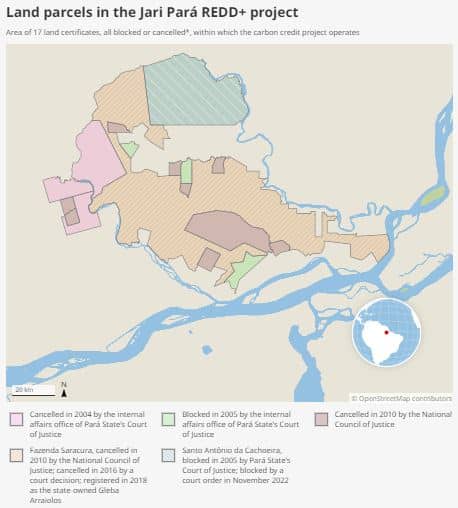
In particular, here is the project’s land parcels according to Context.
Map: Diana Baptista, André Cabette Fábio Source: Verra’s project 1811 registry, Report “Action against land-grabbing in register offices in the state of Pará”, Pará State Prosecution, Brazilian System of Land Management (SIGEF), Monte Alegre Real Estate Register Office
Brazilian law requires private businesses to have state permission to operate in public forests. But Jari Celulose claimed to be the “legitimate owner” of the estate in registration documents submitted to Verra in 2019.
Impact on the Credibility of Carbon Credits from Brazil’s Amazon
The REDD+ project’s sale of carbon credits based on invalid land ownership has raised doubts about the offsets’ credibility. Verra launched a review of the project and suspended the issuance of new carbon credits in response to the investigation.
International firms and domestic companies bought credits from the Jari Pará project to offset their climate-heating emissions while protecting forests. Big names include Janssen, 3M, CNN, and BWM, as well as Globo and Bradesco.
State officials and researchers argue that the registration of Fazenda Saracura as public property questions the REDD+ project’s credibility. The cancellations and blockages against Jari Celulose’s land claims ensure that carbon credits from Brazil’s Amazon cannot be traded, according to Herena Melo, the agrarian prosecutor who led the investigation.
While Jari Celulose claims to have the right to operate a carbon project on the land due to a 2021 Pará state lower court ruling, the case remains undecided.
The Brazil project’s sale of carbon credits from disputed land ownership highlights the unresolved issue of land-grabbing in the Amazon, with carbon credits making the situation more complex.
Verra has launched a review of the project. Still, state officials and researchers argue that land-grabbing remains a significant problem in the region.
The credibility of carbon credits from the Jari Pará REDD+ project in Brazil’s Amazon has come into question. This ultimately casts doubts about the validity of carbon offsets from areas with contested land ownership.
Carbon Neutral Royalty (CNR), a permanent capital vehicle that finances and supports carbon credits generating projects, raised $25 Million CAD ($18M USD) from Beedie Investments.
Founded in 2021, the Vancouver-based firm finances projects in the Voluntary Carbon Market (VCM). CNR aims to build a high-quality, long-life portfolio of projects that generate carbon credits around the world to help companies achieve their climate or net zero pledges.
Beedie Capital is a multi-strategy direct investment platform that manages alternative investments for Beedie, one of the largest private companies in Western Canada. It combines the capabilities of an institutional investment platform with the flexibility and entrepreneurial mindset of a privately owned business.
The Raise
The $25 million raised will be for financing commitments with CNR’s existing partners and upcoming projects. These projects satisfy the company’s investment intentions of mitigating climate change and supporting local communities.
CEO of CNR, Luke Leslie said:
“We’re delighted to have successfully closed this latest round of financing with a partner of Beedie Capital’s calibre. By allocating investment based on our own analysis of the VCM and using innovative structures, CNR seeks to encourage the flow of much needed funding to high impact projects.”
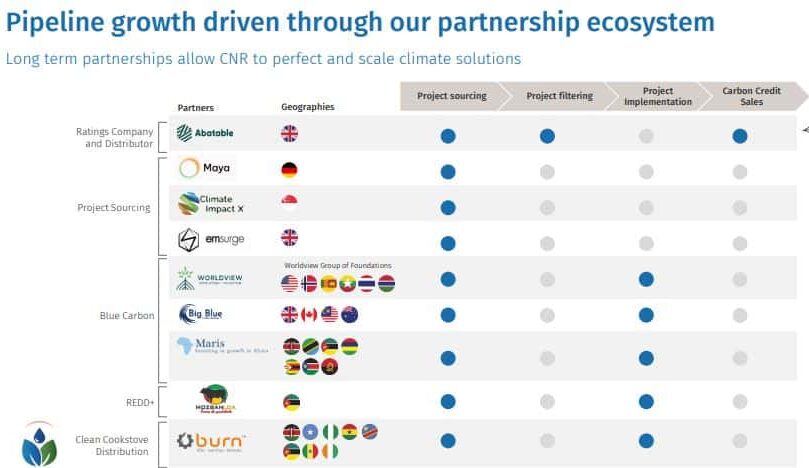
Its long-term partnership agreements enable CNR to have access to high-quality carbon credits.
The company has rapidly scaled its impact in the VCM by partnering with the best project developers working with carbon solutions they prefer.
Source: CNR website
They believe that the market has an important role to play in the world’s race to net zero.
According to a report by BloombergNEF, the total value of carbon credits traded in the VCM to help meet corporate net zero goals can be worth $1 trillion as early as 2037. The analysts also said that more rigorous definitions of quality can help drive demand and solidify confidence in the VCM.
Funding High-Quality Carbon Credits
CNR is working closely with its partners to fund and develop robust and high-integrity projects. They not only contribute to global decarbonization but also deliver benefits to local communities, economies and natural ecosystems.
The company is committed to project and carbon credit integrity. It follows the recommendations of the Integrity Council for the Voluntary Carbon Market (ICVCM) for high-quality carbon credits.
CNR further promotes the responsible use of voluntary carbon credits according to the mitigation hierarchy.
The investing firm also adheres to the guidance of the claim by the Voluntary Carbon Markets Integrity Initiative (VCMI). The Claims Code aimed at standardizing definitions and reducing greenwashing in the VCM.
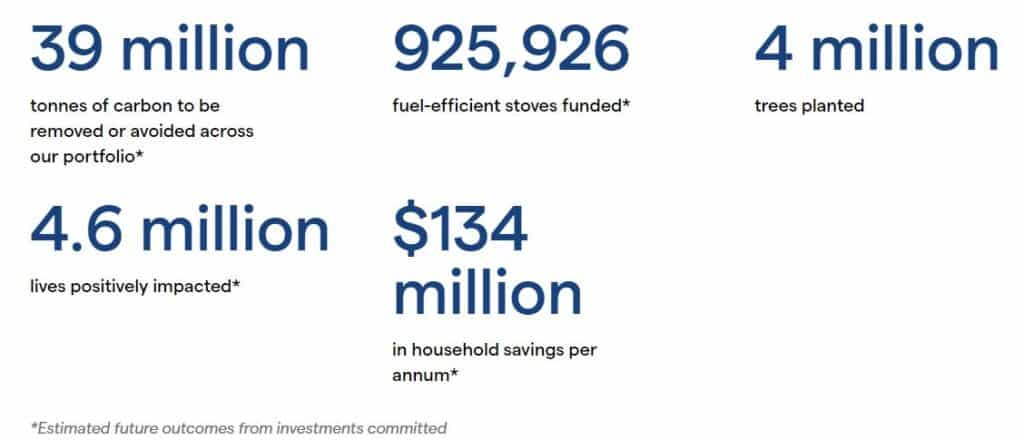
CNR’s portfolio also contributes directly to the advancement of 12 of the 17 UN’s Sustainable Development Goals (SDGs). To date, the company has the following portfolio impact:
The mangroves planted are in Asia while the cookstoves distributed are across 8 countries in Africa.
Meeting Climate Pledges
Managing Director at Beedie Capital, David Bell, said that CNR has a robust pipeline of projects that got their attention. He further added that CNR is capable of providing entities solutions to reach their climate pledges.
CNR has a pipeline of 160 million cookstove credits by 2037 in partnership with Burn. It also has a pipeline of 60 million blue carbon credits by 2047 through Worldview projects.
Entities can either buy or pre-buy carbon credits from CNR’s projects or seek the firm’s assistance in building their own portfolio to meet net zero goals.
Another option is co-investing directly in CNR’s projects and getting a share of the carbon credits they generate. This allows co-investors to take direct action for climate and sustainable development.
GE Gas Power and Svante agreed to develop a carbon capture technology for natural gas power generation applications.
Apart from the joint development agreement, GE had also invested in Svante as part of the latter’s fundraising round in December last year. Chevron led the round, capping the biggest carbon capture fundraising deal in the region.
The Carbon Capture Deal
The partnership between GE and Svante will focus on further development and commercialization of one specific kind of carbon capture technology – solid sorbent. This tech can capture carbon right at the source of the emission, also known as point-source carbon capture. It is also applicable in sucking in carbon directly from the air, otherwise called the direct air capture (DAC) system.
Scott Strazik, CEO of GE Vernova, commented on the deal saying that working with a tech innovator like Svante will advance the development of carbon capture solutions for the energy industry, and “deliver more sustainable, affordable, and reliable electricity for more people”.
Claude Letourneau, President and CEO of Svante said that their carbon capture tech will decarbonize gas-fired turbines cost-effectively. Letourneau added that they have the potential to:
“…open up an entirely new array of opportunities, aiming to provide carbon-free electricity in the future through the deployment of projects across gas-fired power generation facilities.”
GE’s expertise in energy applications is important for Svante as the company scales up to capture millions of tonnes of carbon from various industrial sites worldwide.
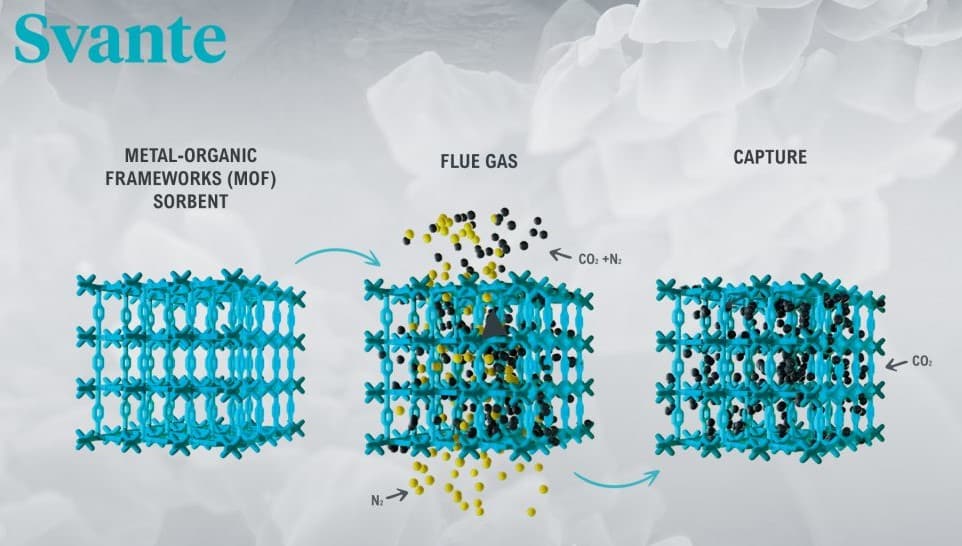
Svante offers a novel approach to carbon capture. It is using unique solid sorbents to coat its CO2 capture filters.
In particular, Svante uses metal-organic frameworks (MOFs) which capture carbon from diluted flue gas streams with high capacity and selectivity. These filters can capture 95% of the total carbon emitted from industrial sources. They adsorbed CO2 using direct low-pressure steam injection for regeneration.
Source: Svante website
The MOFs are thin sheet laminates, stacked together, and made to form Svante’s nano-engineered CO2 capture filters. They have a high porosity and resistance to degradation.
The carbon capture filters have multiple applications for capturing carbon. Heavy industries such as cement, steel, refineries, boilers, aluminum, and more will find the tech useful in abating their emissions.
How Svante’s Point-Source Carbon Capture Works
Source: Svante
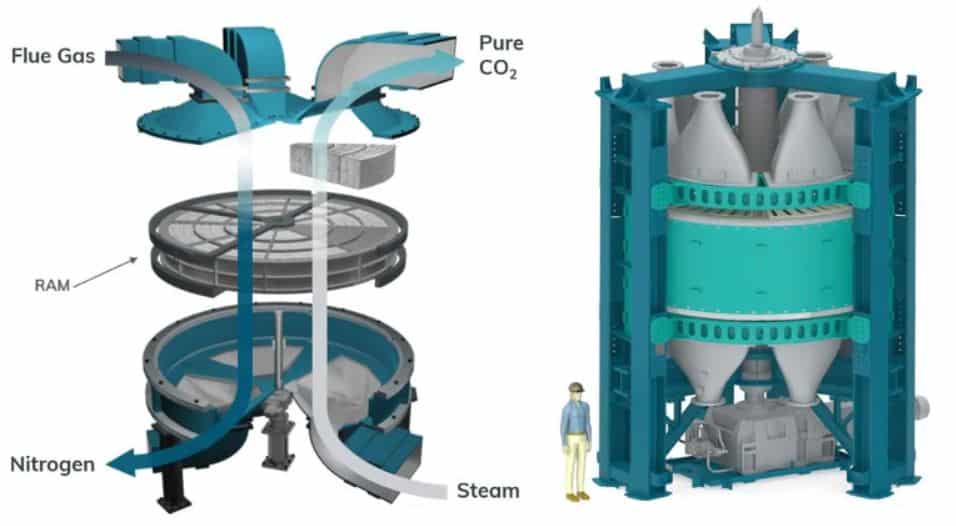
Svante’s modular carbon capture machines can be delivered to industrial sites without requiring any hazardous material or chemical plants. The machines work in three steps.
Step One:
The filters are placed inside the rotary adsorption machine or “RAM”. The RAM then captures diluted CO2 from industrial flue gas using Svante’s patented temperature swing adsorption process, VeloxoThermTM.
Step Two:
As the MOF filters rotate inside the machine, they adsorb diluted CO2 and turn it into pipeline-grade CO2.
Step Three:
The compressed CO2 product can be moved into a pipeline where it can safely be transported and injected deep underground. Or it can also be recycled and used to make new products as what other companies do.
GE Vernova Spin Off and DAC
Supporting Svante’s technology is one of the many efforts GE makes to scale up carbon capture and drive energy transition.
GE believes that the climate crisis calls for investments that can bring significant emissions reductions such as CO2 capture technologies. Driven by that belief, the energy giant decided to make GE Vernova a separate business entity by 2024.
The spin off company will focus on speeding up the transition to renewable energy sources and cutting carbon emissions. To date, GE provides about 30% of the world’s electricity.
One more unit of GE, the Climate Action@GE or CAGE Lab, also revealed that they’re currently working on another technology that can reduce emissions – direct air capture (DAC).
This DAC system uses a unique technical approach, bringing together GE’s competencies in heat exchangers, thermal management, and innovative materials. It works similar to the Defense Advanced Research Projects Agency (DARPA) in capturing clean, potable water from extremely arid, desert-like air.
GE was able to show that its DAC system is effective in removing carbon while hoping that it has the potential for commercialization by next year.
Microsoft has agreed to buy carbon removal credits from California-based startup CarbonCapture, the owner of Project Bison, a direct air capture (DAC) plant in Wyoming.
The DAC facility uses a technology that sucks in carbon from the air and stores it underground, thereby preventing the gas from contributing to global warming. It is projected to start its carbon capture activity in late 2023.
The negotiations for the deal had begun 6 months ago when CarbonCapture announced the project to the public.
Director of Microsoft’s Carbon Removal unit, Phillip Goodman, stated that “purchasing DAC carbon removal credits is important… for Microsoft’s carbon-negative goal” and will help boost the growth of the direct air capture industry.
What does CarbonCapture do?
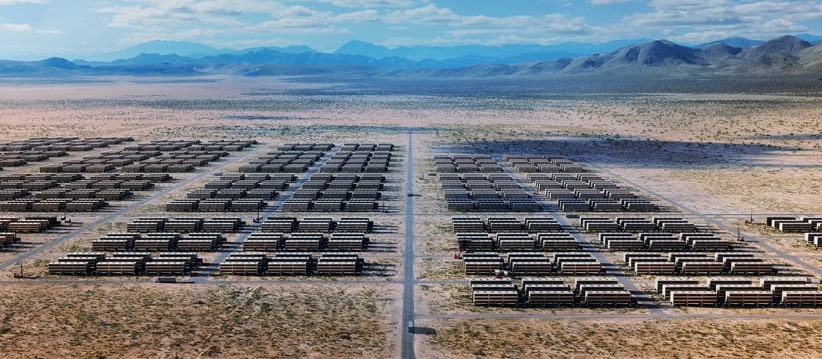
CarbonCapture is a DAC startup company that makes modular DAC machines that can be connected in large arrays to remove huge amounts of CO2 directly from the atmosphere. Its first modules in Wyoming will capture and store around 10,000 metric tons (Mt) of CO2 each year.
CarbonCapture aims to remove 5 million Mt of CO2 annually by 2030 through its phased approach to CO2 removal. It consists of four phases:
1st Phase – 10,000 tons/year in 2023-2024 with GEN-1 technology
2nd Phase – 200,000 tons/year in 2025-2026 with GEN-2 technology
3rd Phase – 1 megaton/year in 2027-2028 with GEN-3 technology
4th Phase – 5 megatons/year in 2029-2030 with GEN-4 technology
If go as planned, this carbon removal goal would be significant because the current annual global capacity for CO2 removal is still only 0.01 million Mt of CO2.
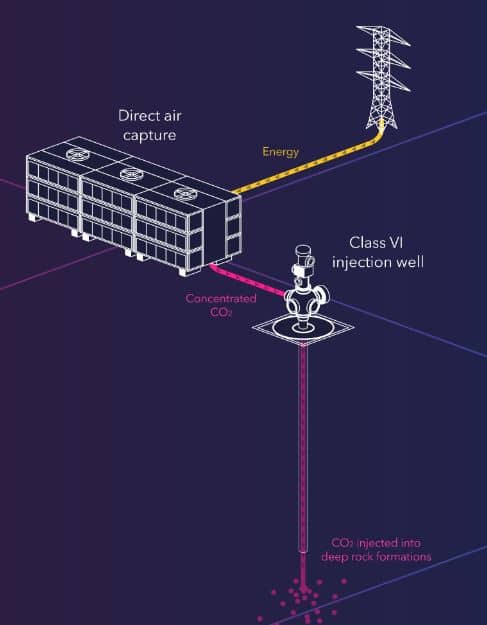
The DAC modules appear like vented shipping containers. They are capable of filtering out 75% of carbon in the air passing through them. The captured CO2 would then be injected 12,000 feet underground into saline aquifers, storing the gas forever.
Source: CarbonCapture website
CarbonCapture’s DAC project is called Project Bison, the first-of-its-kind for the following reasons.
First massively scalable deployment of DAC. It has no practical limits to scaling up to megaton levels. It can develop extensive new renewable energy sources, wind and solar, in the area.
First to use Class VI wells for DAC CO2 storage. The project would be the first to use Class VI injection wells for permanent storage, once approved. Class VI wells is a regulatory designation established by the EPA and managed by the Wyoming Department of Environmental Quality.
Largest single DAC project in the world. If the goal to achieve 5 megatons of annual carbon capture and storage becomes reality by 2030.
How Project Bison Creates Carbon Removal Credits
To date, Project Bison is the largest planned carbon removal project in the U.S. But as the technology begins to mature, more DAC companies will join the competition in the coming years.
CarbonCapture project will generate carbon removal credits by permanently keeping the CO2 away from the atmosphere. Frontier Carbon Solutions will inject that CO2 into deep saline aquifers underground.
Source: CarbonCapture
Once certified and verified, Project Bison generates carbon credits that are sold to organizations with net zero goals. They can use the credits to offset their own unavoidable emissions.
They can either finance carbon capture and storage projects like Project Bison or purchase the credits from the project. The market for CO2 removal credits is growing as more entities look for ways to slash their carbon emissions.
Carbon removal technologies like DAC are still in their early stages, making the cost high. But as more and more investors are putting their trust and money in the sector, it’s poised to grow. Even governments are pouring billions of dollars into the industry to help scale it up.
Large companies are also showing strong support for the sector, pumping capital to startups with innovative carbon removal technologies.
Microsoft’s Support for CO2 Removal
One of those companies committed to advancing carbon removal is Microsoft.
As of 2021, Microsoft’s carbon footprint was 16 million Mt of CO2 equivalent (CO2e). This includes both its operational emissions from data centers, offices, and business travel, and emissions from its supply chain, e.g. manufacturing and product transport.
The tech giant targets to be carbon negative – removing more CO2 than it emits – by 2030. It also aims to remove all its historical emissions since its founding in 1975 by 2050. To achieve that, it’s employing various measures and one of them is investing in carbon removal tech.
Microsoft has scrutinized the CarbonCapture’ plans over the last months.
The DAC company CEO, Adrian Corless, believes that Microsoft buys in the idea that everything is present to make Project Bison a success in Wyoming. Geology, energy strategy, and openness of the public for this kind of projects are some key factors.
The tech company has been investing in various carbon removal projects as part of its $1 billion sector pledge. Last year, Microsoft signed a 10-year carbon removal deal with Climeworks to suck in 10,000 Mt CO2 using DAC.
Bill Gates, a co-founder of Microsoft, also personally supports DAC projects as he trusts the technology and seeks to offset his own carbon footprint. Gates’ other company, TerraPower, will develop an advanced nuclear reactor which supporters consider crucial for reducing the country’s carbon emissions.
Neither Microsoft nor CarbonCapture disclosed any details about their deal such as how much the tech giant agreed to pay for credits or how many tons it will buy.
CarbonCapture attracted other smaller carbon removal credit buyers before closing its deal with Microsoft. The CEO said they’re also talking with other large companies and so more big names will be announced soon.
ByteDance, the company that owns the popular app TikTok, has made an exciting announcement about their efforts to combat climate change.
The Chinese-owned company has set a goal to reach net zero in their business operations by 2030. This means they want to reduce their carbon footprint as much as possible.
To achieve this goal, ByteDance plans to reduce their operational emissions by 90% and use 100% renewable energy sources. They will also use carbon credits to offset any remaining emissions.
TikTok’s Emissions and Climate Commitments
TikTok is a social media platform released as an international version of a video sharing app Douyin.
The internet company ranked #6 among most popular social media networks globally by number of monthly active users as of January 2023. According to Statista, it has over 1 billion (1,051 million) users as of that period, with Facebook still in the lead with almost 3 billion users.
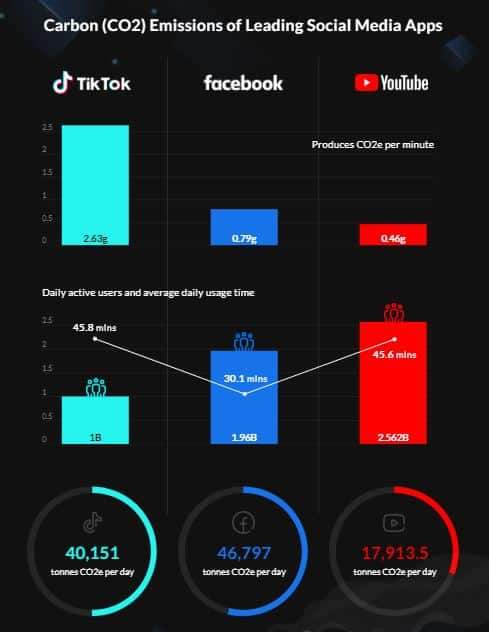
When it comes to carbon emissions, TikTok emits more CO2e per minute of use, 2.63g CO2e, than Facebook (0.79g of CO2e). TikTok’s users has an average daily app use of 45.8 minutes.
If we count a third of its monthly users as daily users, then the social media app will generate over 40 thousand tonnes of CO2e each day.
In comparison, a Facebook (FB) user spends about 30 minutes daily on the platform. Since FB has many more users, FB emits more CO2e per day.
Source: Bankless Times
To put both the social media networks’ emissions together in context, a seat on a flight from London to New York and back needs about 1.7 tCO2e. So, their CO2e emissions per year are more than what it takes to fly the whole population of London to NY and back.
Electricity use by data centers represents much of ByteDance’s carbon emissions. Its current decarbonization priority is to use renewable energy for those data centers.
For instance, ByteDance said last week that its new data center in Norway will run on 100% renewable energy.
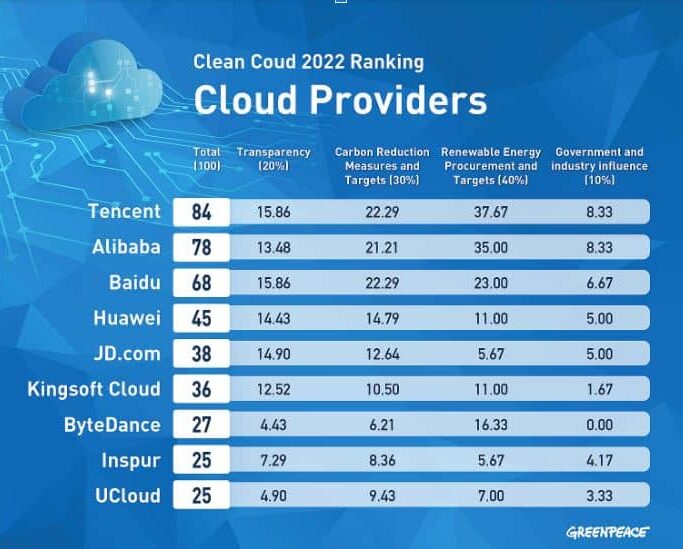
Greenpeace East Asia, which ranks China’s cloud tech providers, reported last year that ByteDance was among the firms that got the lowest score for its climate commitments and use of renewable energy.
As seen below, the social media firm lags behind other Chinese cloud providers in climate disclosures. ByteDance hasn’t yet publicly revealed data on its carbon emissions and energy usage.
The TikTok owner got 7th place among the 9 Chinese companies ranked in terms of climate commitments. The ranking criteria include data transparency, carbon reduction efforts, renewable energy procurement, and government and industry influence.
For many years now, Greenpeace has called for the TikTok owner to commit to 100% renewable energy by 2030. With the company’s recent net zero announcement, Greenpeace East Asia Climate and Energy Project Manager, Ruiqi Ye commented:
“Finally, ByteDance is catching up with peers like Meta and Tencent, and we are thrilled to see a major internet company taking the reins in becoming sustainable. But to come through on this commitment, ByteDance needs to quickly scale up its renewable energy procurement. How ByteDance scales up renewable energy procurement around Asia will be key to its success.”
The previous commitments of ByteDance from last year as seen in the picture above only cover its own operations. It didn’t include its value chain emissions which most likely account for most of its total carbon footprint. It also didn’t fully disclose its emissions data.
So, its recent announcement is a welcome to Greenpeace and other climate campaign organizations.
TikTok Aims Net Zero by 2030
ByteDance will also work on cutting emissions within its value chain. The social networking app owner aims to reveal more on its net zero approach by the end of this year.
It is the latest Chinese tech giant to reveal a net zero pledge in support of China’s national goals of peaking GHG emissions by 2030 and hitting net zero by 2060.
Alibaba, Tencent and Baidu have all pledged to be carbon neutral by 2030.
Apart from TikTok and its Chinese version Douyin, ByteDance also owns various online platforms such as Toutiao and Lark. It also provides cloud services and operates data centers worldwide. The company stated:
“We are mindful of our impact both on and offline. A meaningful sustainability approach is good for business, our communities and the world around us.”
The company is also considering carbon offset credits, not as replacement for direct emissions cuts but for offsetting unavoidable footprint. It’s part of TikTok’s strategy to reach its net zero goals by 2030.
Apart from killing millions of people each year, Big Tobacco’s carbon footprint is destroying the earth in a way not many people know about.
A report released by the World Health Organization (WHO) detailed the damaging impact of the tobacco industry on the planet and people’s health in its report “Tobacco: Poisoning our planet”.
The industry’s actions have a domino effect. Growing, manufacturing, shipping, selling, using, and disposing of tobacco products all degrade the environment and harm health.
Big Tobacco Carbon Footprint
Big Tobacco refers to the four largest companies in the tobacco industry. They include Philip Morris International, British American Tobacco, Imperial Brands, and Japan Tobacco International.
The industry’s main product, tobacco, causes far-reaching damage to the environment.
Each year, the tobacco industry takes more than 8 million human lives, cuts 600 million trees, 200,000 hectares of land, 22 billion tonnes of water, and emits 84 million tonnes of CO2.
It also creates the world’s most littered item – cigarette butts.
Big tobacco’s carbon emissions alone are equal to ⅕ of what is released by the aviation industry. CO2 comes from producing, processing and shipping tobacco products.
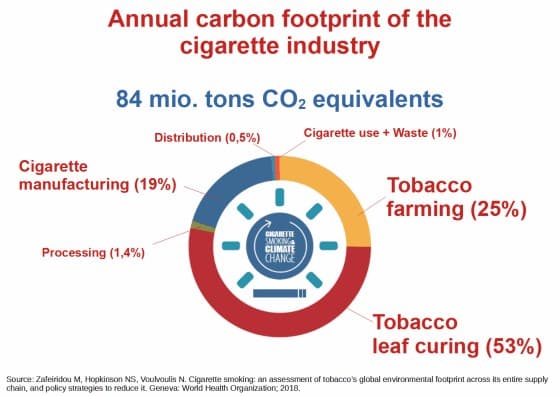
Estimates further say that every cigarette emits about 14 grams of CO2 while tobacco production releases 84 million tonnes of CO2e according to a study by Zafeiridou et al.:
Despite these facts, tobacco companies are still claiming that they’re becoming sustainable.
A lead author in WHO’s report, Andrew Rowell, said that the industry is never held accountable for the environmental effects of its products and their global supply chain.
“In fact, the industry’s ecological impact is roughly equivalent to one of the large oil companies. We need to talk about big tobacco the same way we talk about big oil as a cause of climate change.”
The process of curing tobacco leaves to produce dry tobacco is very energy intensive. The procedure burns wood or uses coal, contributing to GHG emissions as well as deforestation.
Deforestation is another major driver of global warming by being a significant source of carbon emissions. Cutting down trees releases the CO2 they store into the atmosphere.
Studies also show that big tobacco companies together are cutting down 600 million trees each year to make cigarettes. Estimates say that it takes about 1 tree to produce around 15 packets of cigarettes.
Most tobacco crops are cultivated in low or middle-income regions where water and farm are critical to produce food. Yet, they are used to grow the damaging tobacco plants, WHO said. This leads to clearing more and more forests.
Plastic and Chemical Wastes of Cigarettes
Growing tobacco crops to produce cigarettes is not the only concern. Tobacco products are also creating mountains of waste that damage the environment and human health.
A director from WHO noted that:
“Tobacco products are the most littered item on the planet, containing over 7000 toxic chemicals, which leech into our environment when discarded…”
He added that about 4.5 trillioncigarette filters pollute the oceans, rivers, city sidewalks, parks, soil and beaches each year.
Cigarettes contain filters which are made of plastic. Filtered cigarette butts are a part of the plastic pollution problem. And these filters are among the top 10 most common plastics in the world’s oceans.
Worldwide, they are the 2nd largest source of plastic pollution.
Each filter that is littered can pollute up to 100 liters of water.
Adding to this plastic littering issue are other products like e-cigarettes and smokeless tobacco.
The worst case – who pays for the cleanup of tobacco litters?
It’s not the big tobacco companies themselves but the taxpayers.
Every year, cleaning up the litter costs Germany and Brazil over US$ 200 million each; while China spends about US$ 2.6 billion and India US$ 766 million to do the same.
Who Must Pay?
Though it wasn’t in the case of cleaning up the litter, the US Justice Department sought to recover billions of dollars paid for by the government health programs to treat smokers in 1999.
This civil lawsuit was the largest ever brought by the DoJ. It claims that smoking cigarettes causes lung cancer and other diseases, resulting in $25 billion annual health claims.
The case also alleged that the big tobacco companies conspired to hide their products’ health risks and deceive the public.
The lawsuits ended up in the largest settlement in US history at US$ 206 billion. But this amount only ended up being paid for by smokers through higher tobacco prices.
An industry watchdog claimed that alternative cigar products were nothing more than greenwashing. They said that the industry’s public relations messages mislead consumers.
When it comes to reducing tobacco’s carbon footprint, some countries have made a decision.
For instance, the Polluter Pays Principle that some European countries follow seek to make the tobacco industry responsible for paying the cost of their pollution.
Britain also warned big tobacco companies to pay the $55 million annual cost of cleaning up discarded cigarette butts.
The WHO calls for strong tobacco taxes, which may include carbon tax, and more support services to help smokers quit. The health organization even called out to farmers to grow other sustainable crops than tobacco.
Imposing carbon tax on cigarettes will further increase the price while cutting the industry emissions. But it seems that there’s no estimations yet as to how much it can be exactly.
Today, the big oil companies are also in the same position as the big tobacco companies in 1999. Both industries lied about the dangers of their products to the people and the planet.
And like the tobacco industry and its huge carbon emissions, the fossil fuel industry, which is the biggest polluter, is now facing multiple climate lawsuits.
A global carbon markets company, ClearBlue Markets, has secured $8 million in Series A financing round led by Royal Bank of Canada (RBC) to help support the growth of its technology platform.
The Canadian-based climate tech firm’s fundraising will allow it to have more exposure in financial markets. The investment from RBC aligns with the bank’s climate strategy to support its clients transitioning to net zero emissions.
RBC is Canada’s largest bank and one of the biggest in the world based on market capitalization. Apart from Canada, its 17 million clients also come from the U.S. and 27 other countries the bank is serving.
ClearBlue Markets
ClearBlue Markets offers carbon markets services to companies globally through its advisory expertise and AI enabled technology. These services simplify and bring confidence to firms in meeting their carbon compliance requirements or voluntary net zero goals.
Other products and solutions the company offers include:
The company is headquartered in Canada and has a European office in the Netherlands.
Today, it is serving a 200+ client portfolio that spans local, multinational, and blue-chip companies, which include CRH, Mercuria, JD Irving, Bain Capital Partnership Strategies, Mitsubishi, Energir and VARO Energy.
The $8M Funding
Co-founder and CEO of ClearBlueMarkets, Michael Berends noted that:
“We believe that one tonne of carbon dioxide reduced, avoided, or sequestered contributes to the fight against climate change in meaningful and measurable ways. Continued alignment and investments from key players, like RBC, will drive transparency and confidence in compliance and voluntary carbon markets worldwide for more effective emission pricing and reductions…”
RBC invests in ClearBlue Markets believing that its technology platform will provide its own clients with more access to advisory services and technology they need to transition to a more sustainable future. The bank sees the important role of the company in addressing the global challenge on climate change.
The round also has participation from existing investor CRCM Ventures. The funding will further enhance the usability of ClearBlue Markets’ tech platform. It will also help expand the functionality of the company’s carbon market tools.
Overall, the investment will enable the company to serve more clients in more locations.
Remarking on the investment, ClearBlue CTO and Co-Founder Nicolas Girod said:
“Purpose-driven investments, like the one by RBC, are central to ClearBlue Markets as we expand. They extend our reach and scale beyond what we could do alone and this helps our clients succeed in environmental markets… This strategic investment will unlock capital to double down on technology and see more clients confidently achieve their carbon reduction and net zero ambitions.”
One-Stop-Shop for Carbon Market Needs
ClearBlue has received multiple awards for its advisory, market analysis, and offset development services. These include the coveted 2022 Environmental Finance Voluntary Carbon Markets Award for Best Advisor.
The company is able to win those awards by being a one-stop-shop for its clients’ carbon market needs.
ClearBlue is also leveraging its extensive carbon pricing experience worldwide to guide emitters through the ever-evolving carbon markets. This allows the company to gain insights and so provide a holistic approach to carbon markets globally.
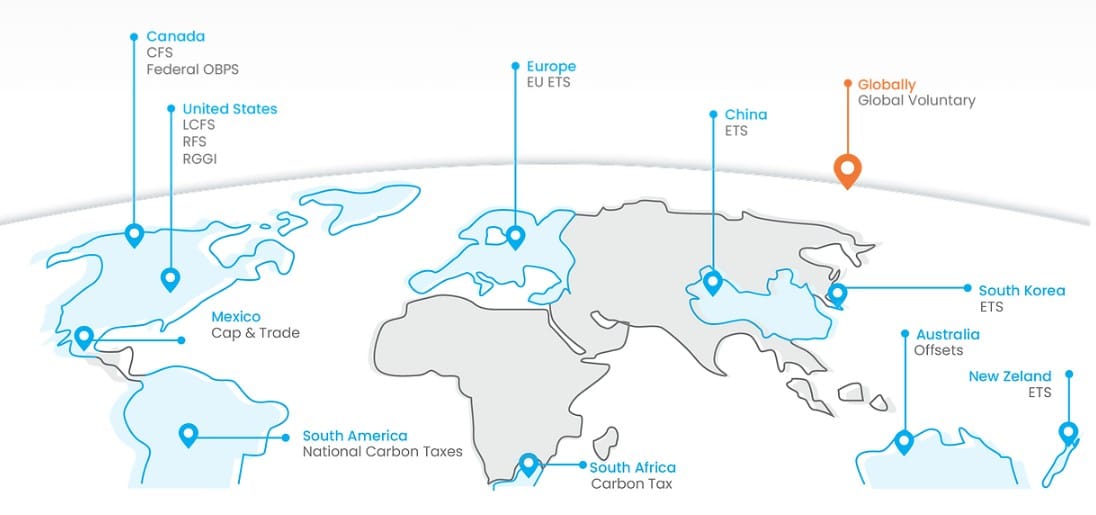
Here’s the global coverage of ClearBlue with the specific services it’s providing each region.
Source: https://www.clearbluemarkets.com/markets
ClearBlue also appointed the former CEO of Accenture Canada and current advisor to the Nature Conservancy of Canada, Mr. Bill Morris to its Board of Directors.
His experience in both environment and carbon markets will be helpful as ClearBlue Markets expands globally.
DevvStream appoints Dr. Michael J. Rensing, former head of the British Columbia Low Carbon Fuel Standard Program (BC LCFS), as its Low Carbon Fuels Advisor.
Dr. Rensing has been instrumental in developing and implementing successful low-carbon fuel policies and legislation, including the BC LCFS. Carbon credits sold into this market are among the world’s highest in value, with 2022 prices ranging over C$440.45 per credit.
He led the BC LCFS program that has been responsible for about 30% of the emission reductions achieved by the province. This makes it one of the most successful low-carbon fuels programs in North America.
In his new role as Low Carbon Fuels Advisor at DevvStream, Rensing will provide strategic guidance and support the development of low-carbon fuel offset and credit programs on behalf of the company to develop and commercialize advanced low-carbon fuel technologies.
Commenting on his new appointment, Dr. Rensing said:
“I am excited to join the team at DevvStream and continue my work towards a more sustainable future.”
The UN Intergovernmental Panel on Climate Change (IPCC) released its 6th Assessment Report with a key message that the planet is running out of time to secure a livable future unless a radical action is taken.
Marking the launch of the IPCC report, UN Secretary General António Guterres said in a statement:
“The climate time-bomb is ticking. Humanity is on thin ice – and that ice is melting fast… Today’s IPCC report is a how-to guide to defuse the bomb. But it will take a quantum leap in climate action.”
IPCC’s AR6 Synthesis Report
The IPCC climate report is the culmination of over 6 years of work by hundreds of scientists. It draws on their findings and offers a detailed assessment of how the climate crisis unfolds.
It is a synthesis report combining 3 working group studies on climate science and special reports on land, oceans, and how to hit the critical 1.5℃.
The main finding is not new; in its previous AR6 report, the IPCC has been clear about this concern. But this recent synthesis report paints a grim picture of what the Earth will look like if humans don’t act now.
The report authors stated that the effects of climate change are worse than had been expected in the panel’s 5th Assessment report released in 2014. These effects include sea level rise, severe flooding around the world, more dangerous heat waves, and extreme drought.
Last year, widespread flooding hit Pakistan, affecting 33 million people and causing $30 billion in damages, the World Bank reported. Heat waves also leave some parts of the U.S., Europe, and China baking.
Scientists blame the burning of fossil fuels for over a century for the rise in global temperatures to 1.1℃ since 1900. Fossil fuels still make over 80% of the world’s energy and 75% of human-related carbon pollution.
Concentrations of carbon pollution are at their highest level for over 2 million years. Meanwhile, the temperature rise rate over the last 50 years is the highest in 2,000 years.
With further warming, climate change risks will be increasingly complex and more difficult to manage, according to the report. Both climate-related and other drivers will increase risks across sectors and regions. For instance, climate-driven food insecurity and supply instability will increase with rising global warming.
The report shows potential risks and impacts of climate change on natural and human systems at different global warming levels.
To limit further worsening of the climate crisis, carbon emissions have to go down by 60% by 2035, the authors noted. That means a radical change in energy supply – moving away from fossil fuels and investing in renewable sources.
The authors further wrote that:
“There is a rapidly closing window of opportunity to secure a liveable and sustainable future for all.”
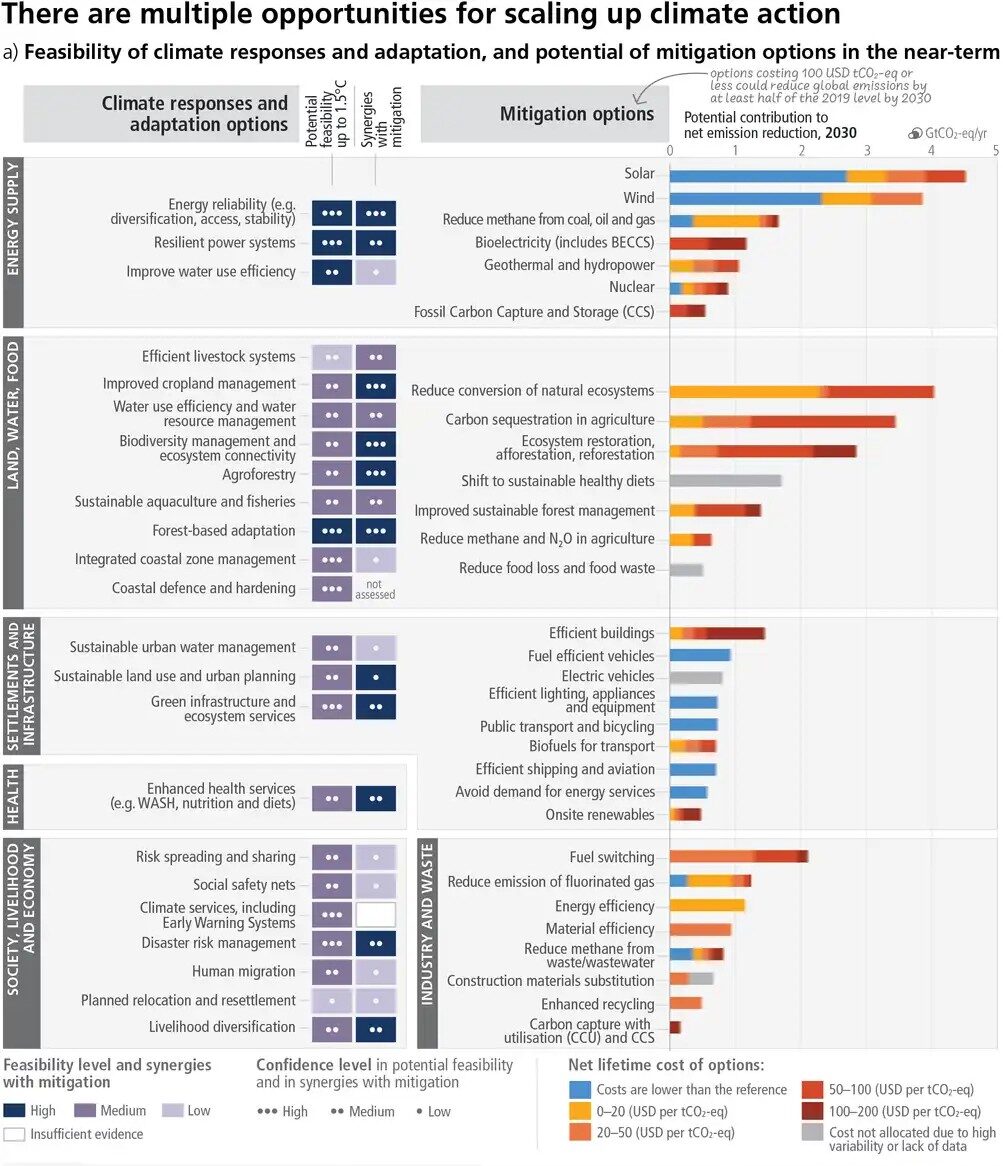
Here are the authors’ insights of the potential contribution to 2030 net emission reduction by those options in the near-term in different sectors.
The report also acknowledges that emissions are hard to cut from some industrial processes and sectors. Aviation, shipping, and agriculture are the most challenging sectors.
In such a case, their emissions have to be counterbalanced by employing carbon removal technologies. These include direct air capture (capturing emissions directly from the air and storing it underground), sucking in CO2 from industrial plants and factories, and drawing in more carbon into the soil.
The impacts of global warming also cause climate injustice. Vulnerable countries that have done least to cause climate change are experiencing the hardest effects.
Nations at the UN climate conference in Egypt last year, COP27, agreed to create a compensation fund called“loss and damage”, worth up to $580 billion annually by 2030. Rich nations who emit the most GHGs must pay poorer countries who suffer the most from climate disasters.
But the parties had yet to know how to define what countries need compensation.
Fast-tracking Net Zero
To top it all off, Guterres called on nations to fast-track their climate actions. Develop countries, in particular, must press the “fast-forward button” of their net zero pledges. They have to remove as much GHGs from the air as they emit.
He stated for the first time that rich nations must hit their net zero goals as soon as 2040 as possible. That’s a decade earlier than what most countries such as the U.S. and the UK promise to achieve – by 2050.
Other large emitters, namely China and India, even have much later targets, 2060 and 2070, respectively.
This latest summary report rounds out the IPCC’s AR6 which comprises 4 installations. The UN group carries out a full assessment cycle every 6 or 7 years. This synthesis report will be presented during the next UN climate conference, COP28, in Dubai at the end of 2023.
Also known as green tag, the use of renewable energy credits (RECs) have been on the rise as entities are looking for ways to lower their carbon footprint.
But as they are somehow similar to carbon credits, many are asking what are renewable energy credits and how they differ from the former. While others are wondering how to buy RECs.
The questions are valid and are, in fact, very important.
Renewable sources are the future of the energy transition. They’re not only a clean and sustainable source of energy but they’re also good for the health of the planet and the people.
This article will explain what renewable energy credits are, how they are different from carbon credits, and how to purchase them.
What Are Renewable Energy Credits?
Formally, RECs stands for renewable energy certificates. They’re a market-based instrument that certifies the holder owns a megawatt-hour (MWh) of electricity from a clean energy source.
The green tag represents the energy generated by renewable sources such as solar, wind, and hydropower facilities.
Buying RECs is not the same as buying electricity… Rather, they represent the clean energy attributes of renewable electricity.
The global market size for RECs was recorded at USD 881.7 billion in 2020. And it’s expected to hit about $2 trillion by 2030, growing at 8.4% from 2022.
Once the power provider has fed the energy into the grid, the corresponding RECs produced can then be sold on the open market as a non-tangible energy commodity. The RECs earned by the certificate holder are tradable.
In other words, they may be sold to other entities that are polluting as a carbon credit to offset their emissions.
Businesses can buy renewable energy credits along with their electricity. And the RECs are proof that a certain amount of the electricity was from a renewable source.
How Are RECs Produced?
RECs are produced when a renewable energy source generates one MWh of electricity and sends it to the grid. For instance, if an onshore solar power facility generates 10 MWh of electricity, they also earn 10 RECs that they can keep or sell to others.
If an entity, either an individual or a company, buys the credits, they’re actually paying for the “renewable” part of the power from the solar farm. The buyer can then say that 10 MWh of their energy or electricity came from a renewable source.
When a renewable energy certificate has been sold, it can’t be bought again. Each REC has a unique serial number and includes information about where it is from, the type of source producing it, the date of generation, etc.
Not to mention that the trading of RECs is also monitored and reported.
How can You Benefit from RECs?
Both investors and consumers are after the green tag your business shows. It means using RECs gives them proof that you are getting your energy from renewable sources. You will get a plus point out of that.
Renewable energy credits also allow you to invest directly in projects like solar farms. This is perfect if your business has stores or locations in different places.
But keep in mind that relying too much on RECs may also be bad for your reputation… because purchasing RECs without actually doing something to slash your energy use or carbon emissions is not a good idea.
You should depend on RECs only if you can’t afford to make direct energy use reductions.
Still, in broader terms, RECs do promote the use and production of renewable energy as it raises the demand for renewables. More supply means cheaper RECs, too. With the threat of climate change continuing to loom, this is surely a win for the planet.
So, how do you purchase RECs?
How Do RECs Purchases Work?
Those who want to buy renewable energy credits can use them the same as how they consume conventional energy. There are four different ways to buy or produce RECs, including:
Buying “unbundled” RECs
Power Purchase Agreements (PPAs)
Options from energy suppliers
Self-generation
1. Unbundled RECs
As the name says, unbundled RECs are not paired with the underlying electricity you consume. These RECs are also not tied to any power purchase agreements.
Instead, they are available at REC retailers at any time, making it the fastest way to access them. Companies often buy them in bulk for their huge electricity use. The credits count only toward your REC goals if they’re produced within the 21-month window for the period you’ll be using them.
If you’re using RECs for compliance purposes, the Environmental Protection Agency suggests that you distribute them evenly across all your business facilities. It means the distribution is proportional so that each facility will have the same share of their energy use offset by RECs.
2. PPAs
A power purchase agreement (PPA) is a contract made between an “off-taker” and the developer of a renewable energy project. Most often, PPAs are long-term contracts that cover 10 to 20 years.
Most banks will only lend to project developers if they have a PPA available. That’s because PPA acts as a safe bet that guarantees the lender a specific amount of revenue.
So, in other words, if you enter into a PPA, you make it possible for your project to be financed and developed.
As opposed to buying unbundled RECs, the investment can be traced to a new project coming online. The amount of CO2 emissions avoided vary depending on where the renewable project is.
3. Energy suppliers
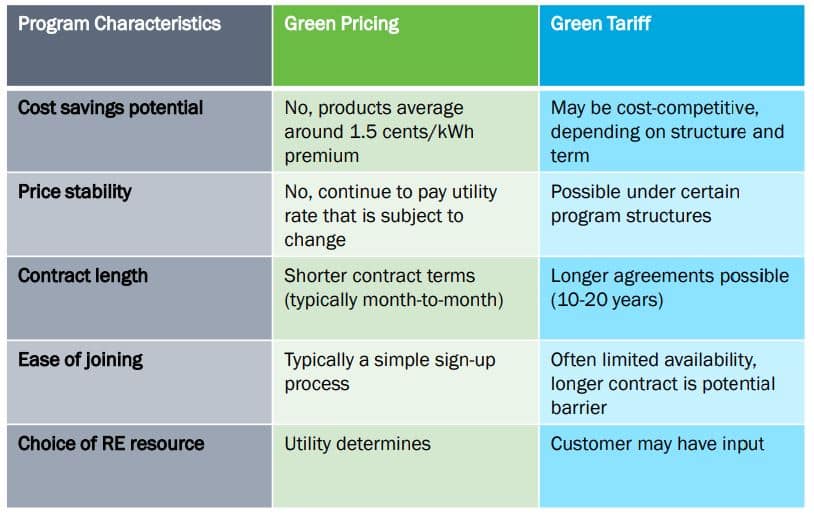
Most electricity providers such as utilities and competitive suppliers provide ways for consumers to get renewable energy credits. Examples of short-term commitments are green power or green pricing programs while examples of long-term contracts are green tariffs.
There are various ways that your property or business facility can generate RECs. These include producing biomass, geothermal heat, wind turbines, and the most common ones are solar panels.
Popular examples of companies that self-generate renewable energy certificates are Apple and Tesla. Their headquarters feature huge onsite rooftop solar panels where they get most of their energy.
Tesla dominates the REC market for clean electric vehicles, which is responsible for the company’s string of quarterly profits. It’s otherwise recognized as regulatory carbon credits in its financial reports. Sales from these credits reached a record $1.78 billion in 2022 alone.
Some firms choose to have on-site PPA where they host an on-site system that’s owned, operated, and maintained by another company. Then they just agree to buy the energy from that renewable system for 10 to 20 years.
While the power doesn’t flow directly to the firm’s outlets but once the on-site system gets online, RECs will be issued in a corresponding amount. In case the RECs generated in this way are more than you use at the location, you can either send them to your other branches or sell them on the voluntary market.
For businesses, the most common purchasing ways may be through purchasing unbundled RECs or self-generation through solar energy projects.
The question this time is whether solar projects generate carbon credits? This also points us out to the last query on what are the key differences between renewable energy credits vs. carbon credits.
Do Solar Projects Generate Carbon Credits?
Yes, they do. Solar projects are one of the common initiatives that companies invest in to produce RECs and these credits are another form of carbon credits.
In particular, solar projects generate solar renewable energy credits (SRECs). They share the same concept as RECs but are solely from solar energy projects. So, if you decide to self-generate RECs through solar projects, you can specifically earn SRECs and trade them for RECs.
In the U.S., there’s a federal solar energy tax credit – a tax credit that is claimable on federal income taxes for a percentage of the cost of a solar PV system paid for.
Solar PV systems installed in 2020 and 2021 are eligible for a 26% tax credit. In 2022, Congress passed an extension of the tax credit, increasing it to 30% for the installation between 2022-2032.
Depending on the state you reside in, the price for SRECs varies and they’re often more expensive than RECs. SRECs price range from $10 to $400 while RECs prices go as low as $1 to $8 for wind energy. In some markets, they can be more than that range.
So, if SRECs are also called carbon credits, what makes the latter different from RECs?
Renewable Energy Credits Vs. Carbon Credits (Key Differences)
In essence, RECs work the same way as carbon credits. They are both tools that can help individuals and organizations alike to reduce their carbon footprint. But while they are often used in the same talks, they’re not interchangeable.
Let’s learn the difference between the two by defining each concept.
What are carbon credits?
Carbon credits are tradable certificates or permits that give entities, including countries the right to emit one tonne or 1,000 kg of CO2 or its equivalent gas.
Carbon credits, also known as carbon offsets in the voluntary carbon market, are a form of climate currency. It means they’re subject to supply and demand and traded in a cap-and-trade market.
This market became established after the Kyoto Protocol set a limit on the amount of GHG emissions, nationally and globally. It is a compliance carbon market that limits how much total carbon dioxide can be released into the air.
Each entity subject to the cap-and-trade scheme is given a certain amount of carbon credits every year. If they go above their emissions limit, they can buy carbon credits from those who have unused or excess credits.
In other words, they’re a market-based mechanism to incentivize carbon emissions reductions. But they are not the only tools available… renewable energy credits also exist.
RECs are another option to slash carbon emissions. They’re also a form of climate currency but are used in the renewables market.
Where carbon credits help offset GHG emissions, renewable energy credits offset electricity use from non-renewable sources.
In a gist, RECs offset kilowatt hours of electricity use instead of carbon emissions.
Yet, using renewables also help cut GHG emissions by favoring energy sources that don’t emit carbon. They act as an accounting mechanism for renewable energies as they’re fed into the power grid.
RECs and Carbon Credits
Both carbon credits and RECs offer ways for polluters to mitigate carbon emissions and so address global warming. But as you now know, they’re also different tools of climate action with different impacts.
So, it’s important to understand their key difference: carbon credits cap CO2 emissions while RECs create new energy from renewable sources.
For most companies, they are using both RECs and carbon credits in their accounting and reporting of emissions. They’re using RECs specifically to offset their energy consumption while they’re buying carbon credits to offset other sources of emissions.
For instance, they use carbon credits to offset their employees’ air travel emissions or the footprint of their business operations.
But they can use RECs to reduce both their energy use and carbon emissions. If you want to do the same, buying RECs is the option you’re looking for.
How To Buy Renewable Energy Credits
Just like buying carbon credits, there are also two types of renewable energy credits purchases – voluntary and compliance.
You can choose to buy RECs voluntarily, even if you’re not compelled to do so.
In most cases, voluntary buyers of RECs are eco-friendly companies driven by their sustainability goals. But individuals can also buy RECs voluntarily to support renewable energy.
In the compliance market, REC buyers are mandated to use renewable energy sources as a way to limit their footprint. Utility companies are largely subject to REC compliance wherein they must meet a certain percentage of their power coming from renewable sources.
Compliance buyers can either buy RECs or produce them through renewable energy projects like solar or wind farms.
Regardless of how you get the RECs, they’re an excellent way to promote low-carbon energy sources and reduce the demand for dirty, fossil-fueled power.
To provide the best experiences, we use technologies like cookies to store and/or access device information. Consenting to these technologies will allow us to process data such as browsing behavior or unique IDs on this site. Not consenting or withdrawing consent, may adversely affect certain features and functions.
Functional
Always active
The technical storage or access is strictly necessary for the legitimate purpose of enabling the use of a specific service explicitly requested by the subscriber or user, or for the sole purpose of carrying out the transmission of a communication over an electronic communications network.
Preferences
The technical storage or access is necessary for the legitimate purpose of storing preferences that are not requested by the subscriber or user.
Statistics
The technical storage or access that is used exclusively for statistical purposes.The technical storage or access that is used exclusively for anonymous statistical purposes. Without a subpoena, voluntary compliance on the part of your Internet Service Provider, or additional records from a third party, information stored or retrieved for this purpose alone cannot usually be used to identify you.
Marketing
The technical storage or access is required to create user profiles to send advertising, or to track the user on a website or across several websites for similar marketing purposes.