In a bid to better address climate change, the United States aims to sanction environmental criminals who contributed to the worsening deforestation in Brazil’s Amazon rainforest.
The U.S. has been imposing various strategies, such as tax incentives and multilateral agreements to combat the climate crisis.
But this recent crackdown on Amazon’s deforesters is a major shift in the second largest emitter’s climate strategy.
U.S.’ Sanction Against Amazon Deforestation
Deforestation in Brazil hit a 15-year record high under outgoing President Jair Bolsonaro. Amazon’s deforestation started to surge in 2019 after Bolsanaro took office and loosened environmental protection.
He pushed for more farming and mining the rainforest, arguing it will reduce poverty in the region.
Deforestation in the Amazon soared to record levels in April this year. It hit a record for the first 4 months of 754 sq. miles, up 69% from the same period last year
What that number means is the clearing of the forest area is more than double the size of New York City.
Environmentalists blamed Bolsonaro. They accuse him of “crimes against humanity” at the International Criminal Court (ICC) for his alleged role in destroying the rainforest.
The formed working group aims to contribute to a major and quantifiable reduction in illegal deforestation in the Amazon each year. That’s part of the larger goal of reaching zero illegal deforestation in 2028.
The joint task force will pay special attention to the fight against domestic and international crime on:
Wildlife trafficking,
Illegal mining,
Illegal timber trade, and
Disincentivizing the use of financial system related to illegal activities with forest products
Any major perpetrators of Amazon’s deforestation and other key environmental crimes will be penalized.
Amazon’s Role in Climate Change
Preservation of the Amazon is vital to reversing the catastrophic effects of global warming. That’s because of the huge amount of carbon dioxide the rainforest sequesters.
It has been dubbed as the “lungs of the planet” and absorbs ¼ of the CO2 absorbed by all the land on Earth. That is 2 billion tons of CO2 yearly (or 5% of annual emissions), making it a vital means to prevent global warming.
But that amount is 30% less today than in the 1990s due to deforestation.
Here’s the annual rate of deforestation in the Amazon rainforest until 2021.
A team of experts estimated the Bolsonaro administration’s contribution to rampant deforestation in the region since 2019. They said that the emissions resulting to it will cause over 180,000 excess heat-related deaths globally this century.
According to the leader of a group fighting environmental destruction:
“What’s happening in Brazil — mass deforestation — we want to understand the causal link to the global climate. It is exactly what the Rome Statute defines as a crime against humanity: the intentional destruction of the environment and environmental defenders…”
Ending Deforestation in the Amazon
Brazil’s incoming president-elect Luiz Inacio Lula de Silva pledged to curb deforestation during the COP27 summit last week. He emphasized to the U.S. officials his focus on abating climate change.
Lula promised to end deforestation in the Amazon by 2030, saying:
“There is no climate security for the world without a protected Amazon.”
Brazil’s environment and justice ministries said in a joint statement that the government was working to fight environmental crimes. And that the authorities in the country were cooperating to combat deforestation.
The joint task force between the two countries seeks to achieve these deforestation reduction goals:
15% per year below previous-year levels from 2022 to 2024,
The Magnitsky Sanctions represent the implementation of multiple legal authorities. Some are in the form of executive orders from the President, while others are public laws by Congress.
The sanctions will punish anybody accused of enabling human rights abuses. They would freeze any U.S. assets and bar all American citizens and firms from dealing with any sanctioned person or entity.
Officials in the U.S. and Brazil have already started identifying and investigating specific targets. Once convicted, their potential punishments range from visa blacklists to Magnitsky sanctions.
Of the nuclear energy reactors that have started construction since 2017, 87 percentwere designed by either China or Russia.
It’s part of a long-term, calculated effort to steal the nuclear export market from the United States.
From the 1960s through the 1990s, the United States had a booming nuclear export business. It financed and provided the technology for dozens of reactors around the world.
But the market has changed. And the two countries capable of massive government-to-government deals—Russia and China—have skillfully taken over.
Though the nuclear export market has primarily been dominated by Russia in the past decade, China is starting to step up in a big way. 67 percent of all reactors to be completed worldwide by 2030 will be from one of the two countries.
Russia’s state-owned Rosatom has $133 billion in reactor export orders—more than fifty reactors in nineteen countries.
China is planning to export thirty of its Hualong One reactors by 2030, netting it $390 billion.
The U.S.? Zero.
Yet the U.S. Department of Commerce predicts the market will be worth between $500 billion and $740 billion over the next decade.
By 2050, the total nuclear energy export opportunity is expected to be as high as $1.9 trillion.
But for Russia and China, this isn’t just about money…
It’s about the century-long, unbreakable geopolitical bond created by building a nuclear plant in another country.
That’s why Russia is strategically exporting to surrounding countries.
The death of American nuclear expertise and the associated exports is having other terrifying consequences, too:
It’s losing its influence on foreign policy…
It’s losing its access to nuclear-powered aircraft carriers and submarines…
And it’s losing the ability to set safety standards for nuclear around the world.
In other words, the war for global nuclear reactor dominance has nothing to do with energy security.
It’s about national and global security.
And that’s something the entire U.S. government takes seriously.
Nuclear Comes Home
Restoring the United States to a position of nuclear supremacy is one of the strongest bipartisan issues in the government today.
In fact, for the first time since Richard Nixon was president, both Democrats and Republicans have nuclear energy development in their platform.
And in the past four years, a flurry of laws have been quietly passed to support American and global nuclear energy development.
The legislation is intended to promote four primary areas:
Existing Infrastructure
Innovation
Exports
Fuel
Redeveloping American capacity for each of those will rapidly bring it back as a massive force on the world stage.
It’s a deliberate move to force the U.S. to restore its nuclear infrastructure and rebuild its nuclear supply chain and workforce.
Four months later, the Inflation Reduction Act of 2022 (IRA) included several key provisions that made it clear that the United States is throwing its full weight behind nuclear energy.
There’s $150 million for the Office of Nuclear Energy to build out R&D.
And there’s $250 billion that can be used to update, repurpose, and revitalize nuclear infrastructure.
But the most significant is a first-ever production tax credit of up to $15 per MWh.
Not only does the credit make nuclear energy far more attractive to investors…
It makes the cost of nuclear $33/kWh lower than offshore wind.
As the subsidies enjoyed by wind and solar are winding down, they’re ramping up for nuclear.
Next, Congress is turning toward developing the next generation of reactors—and the generation after that.
A Different Kind of 5G
Every year, new laws are granting significant funding to nuclear:
Nuclear Energy Innovation Capabilities Act of 2017 – Authorized the creation of the National Reactor Innovation Center.
Consolidated Appropriations Act of 2018 – More than $2.1 billion for Department of Energy and NRC nuclear programs, plus tax credits for new reactors.
Nuclear Energy Innovation and Modernization Act of 2019 – Forced the NRC to streamline the licensing process for advanced reactors.
These laws are all designed to stimulate billions in investment to “help domestic private industry demonstrate advanced nuclear reactors in the United States.”
They even created an “Office of Clean Energy Demonstrations” for that purpose.
The office has already funded an advanced nuclear research group that is building a direct competitor to China’s Fourth-Generation nuclear reactor.
All of this is the exact same template as the ‘60s: quietly fund lots of different types of experimental reactors to see what works.
Then, move full-bore ahead on the ones that do.
Bill Gates says that it’s the only way to optimize new nuclear technology and get “Green Premiums” down.
And it’s working.
More than fifty companies in the U.S. are working to bring advanced nuclear reactor technologies to market.
The first small modular reactor (SMR)—ostensibly the future of nuclear—is targeted to be operational in 2030.
The company running it expects a cost of $58/MWh (compared to ~$70MWh+ for natural gas). And that’s before the new production incentives.
These new reactors will be unlike anything any other country can offer:
The Alternative Is Darkness
In April 2022, it was time for step three: financing exports.
You see, the most unassailable edge that China and Russia have isn’t nuclear technology.
It’s state money.
China knows how powerful it can be to force a country into debt.
When the U.S. exported four AP1000 reactors to China—the only U.S. reactor export since 2000—it offered $5 billion in financial assistance. China refused.
And China doesn’t just extend debt financing at favorable terms; it actively takes equity investment in international nuclear projects.
Eventually, China will be able to fund global nuclear solely from its profits from offshore nuclear energy… enabling it to offer better financing terms than any other country in the world.
In addition to financing, Russia offers turnkey nuclear plant packages—construction, training, and even operations.
It’s a proposition that the United States is completely unequipped to match.
And it’s why, in early 2022, two senators brought back a secret U.S. weapon in the bipartisan International Nuclear Energy Act.
The Act establishes an Executive Office for Nuclear Energy Policy to develop a civil nuclear export strategy.
More importantly, it reopens the floodgates of U.S. nuclear financing.
The U.S. Export-Import Bank (EXIM) is designed to make exports financially available to other countries. Between 1955 and 1965, the bank enabled the U.S. to capture 100 percent of global nuclear exports.
During the ‘70s, EXIM gave out $4.2 billion in grants and $2 billion in guarantees for international nuclear (1975 dollars).
In 1974 alone, the U.S. EXIM bank financed thirty-seven reactors in eleven countries.
And the bank has a sizeable war chest—$135 billion—completely available for spending.
EXIM has already begun funding nuclear exports.
It agreed to finance up to $7 billion for nuclear projects in Romania, including SMRs, after Romania cancelled a reactor order from Russia… and it has signed an agreement with Poland to provide financing for their nuclear program.
It’s all part of a master plan toward renewing American supremacy in nuclear energy, and ensuring no one else catches up.
Now that the infrastructure is being restored, innovation is being accelerated, and financing is available, it’s time for the United States to dominate the final chokepoint of nuclear:
Seafields revealed its plan to tokenize one billion carbon removal credits from a seaweed farm off West Africa in partnership with the blockchain-based carbon company JustCarbon.
Seafields is a UK carbon removal firm that aims to remove billions of tonnes of carbon dioxide from the atmosphere through its seaweed farm. JustCarbon is Seafields’ sister company aiming to create an accountable, transparent, blockchain-based carbon marketplace for Seafields’ credits to be sold.
Seafields director and co-founder, John Auckland remarked that:
“Stopping ongoing carbon emissions isn’t enough. We also need to scrub existing pre-industrial CO2 fast… By sustainably growing sargassum, we will use the vast space available in the ocean to remove billions of tonnes of CO2 from our atmosphere while also meeting the increasing demand for carbon offsets over the next two decades.”
Seafields Carbon Removal Credits
Seafields’ compressed Sargassum bales are natural ‘carbon batteries’. They’re ocean-grown seaweed sunk to the sea floor to lock away the CO2 for hundreds of years.
The carbon removal company plans to build a seaweed farm the size of Portugal – 94,000 sq. km. – off the West African coast. Seafields will grow, harvest, bail, and sink sargassum in the South Atlantic gyre to remove 1 gigatonne of carbon yearly.
This carbon removal project, if fully operational in 2031, will be significant in removing CO2 from the air. The scientists and impact investors supporting it are confident of that.
The certified carbon removal that Seafields will achieve via this project will produce tradable carbon credits called offsets.
Co-benefits refer to the extra benefits that the project delivers apart from emission reduction like biodiversity conservation and job security.
Most often marketing the co-benefits of CO2 removal projects is left in the hands of intermediaries. If brokers and retailers get a hefty margin from the sale of carbon removal credits, project developers like Seafields end up with a smaller share.
On this note, Auckland said that the project is not viable if they “hand over too much of the margin to retailers and other intermediaries”. He further added:
“If hyper-scale projects like Seafields do not get the funding and investment needed, we will not meet the targets for the decarbonisation of the globe and limiting global warming to 1.5⁰C…”
If the price of a carbon credit goes over $75, as predicted by the IMF, Seafields will receive an income of $74.25 billion from generating 1 gigatonne of carbon removal. While JustCarbon can get as much as $750 million or 1% of the total sales as its minting fees.
The 1 billion tonnes that Seafields and JustCarbon will be removing will help boost the carbon removal market.
As per estimates, the value for this market will grow to over $500 billion by 2050.
Source: BNEF Projections
Blockchain-Based Carbon Removal Credits Platform
The JustCarbon platform uses blockchain technology in minting carbon removal credits from Seafields. It directly connects sellers with buyers by removing brokers from the sales process.
Doing so ensures that 99% of the carbon credits value goes back to the developer to support more projects that remove CO2. This allows Seafields to deal with buyers and sell the carbon credits for a fair price.
Co-founder of JustCarbon, Chad Williams, remarked in the announcement that:
“…and we aim to maximize the funding received by these projects. That’s why we take such a small minting fee rather than the typical intermediary fees of retailing carbon credits, which can be as high as 80% of the credit value.”
The firm’s blockchain-powered system will facilitate the direct sale of Seafields’ carbon removal credits to a global market. It enables everyone from individual consumers to large organizations to offset their unavoidable emissions.
The UK company seeks to supply carbon credits early in 2024 after getting a certification from a carbon standards body. Seafields then hopes to scale up its carbon removal capacity to gigatonnes by 2031.
An Israeli company Netafim introduced its landmark carbon credits initiative for global rice farmers with its pioneering drip irrigation technology at the COP27 summit.
Netafim is part of the global conglomerate Orbia and was the first to introduce drip irrigation in the ‘60s. The company says its precision agriculture technology can save water, boost crop yields, and reduce carbon emissions.
“This program marks the first time a carbon credit is being generated based on the application of irrigation technology. In the face of climate change, the only surefire route to sustainable agriculture is to grow more with less — less land, less water and significantly less greenhouse emissions.”
Netafim and Its Drip Irrigation Method
Traditionally, growing rice uses up to 40% of the world’s freshwater. It’s also responsible for 10% to 15% of all methane emissions from human activities.
When the world has to reach net zero emissions by 2050, there’ll be 20% less arable land per person to grow enough calories. The demand for rice will also increase by 28% by that period to feed 10 billion people living on earth, according to Netafim.
Add to that the increasing water scarcity, and so it’s clear why efficient agricultural practice is a must.
This is where Netafim and its drip irrigation fits in, championing a precision agriculture technique.
Drip irrigation is one the most efficient water and nutrient delivery systems for growing crops. That’s because it delivers water and nutrients across the rice field in pipes called ‘dripperlines’. They have smaller units known as ‘drippers’.
Each dripper emits drops containing water and nutrients directly to each plant’s root zone, in the right amounts and at the right time. Each crop gets exactly what it needs and when to grow optimally.
By introducing its pioneering drip irrigation system for rice production, Netafim said it can save 70% of the water used in producing rice.
According to the company, the traditional method of rice irrigation requires about 5,000 liters or 1,320 gallons of water per kilo of rice produced. But with drip irrigation technique, only 1,500 liters or 396 gallons of water is needed.
Plus, Netafim’s method uses 36% less energy and 30% less fertilizer. It also cuts methane emissions to almost zero and arsenic uptake by 90%.
But there’s a catch – the drip equipment will be costly for poor farmers. And it may not be an option if water is cheap and abundant.
But that could change with Netafim’s novel carbon credit program.
Carbon Credits from Drip Irrigation
The firm’s new initiative can enable rice farmers to afford the system. And that’s through the cash from carbon credits its drip irrigation generates.
Carbon credits are tradable permits produced from reducing or removing gasses like CO2 and methane. These credits allow companies to offset and lower their emissions which are hard to fully avoid.
Netafim works with researchers who put flux chambers into the rice fields. These devices measure emissions from the ground to the atmosphere in real-time.
The company also has verifiers to validate that the measurement is done properly. The data is further validated by Verra, one of the top carbon credit verifiers. It checks that the method used to sequester carbon follows international standards.
Miodownik noted that:
“If just 10% of paddy rice farmers switch to drip, the drop in emissions will be equal to taking 40 million cars off the road.”
Rice growers using Netafim’s drip lines can earn 10 carbon credits per hectare of land each year.
Netafim will see that rice growers adhere to its drip irrigation procedures. Then it will submit the data for verification to Verra, who will issue the carbon credits.
Once those credits are bought, the firm will pay the farmers what is due to them.
But there’s one big problem, especially in developing countries. Farmers have to buy the drip equipment upfront, but the carbon credits will be paid later at the end of the rice season.
So Netafim is looking for those willing to pre-purchase the credits to help farmers access the capital they need. It’s also exploring other models for managing carbon credits and payments.
The cash incentive that the credits represent is a game changer. It’s a “win-win for the farmers, the buyers of carbon credits, and the environment.”
Netafim’s carbon credits program and drip irrigation system will be available to farmers worldwide in 2023.
The progress in advancing the global climate change agenda wasn’t only represented in the headlines of this year’s annual UN climate change summit known as COP27. It’s also represented in the efforts of the world leaders behind the scenes.
There were no big decisions due to land at the COP27 conference. But due to multiple crises in 2022, several breakthroughs were reached. Here are some of the key highlights concluded within the two-week summit in Sharm El-Sheikh, Egypt.
COP27 Climate Summit Delivers Several Breakthroughs
The biggest breakthrough came in support for climate victims.
Nations closed the COP27 climate summit with a hard-fought deal to provide financial support from developed countries to poorer ones suffering from climate disasters. They call it compensation for “loss and damage” of the climate crisis. It can be worth up to $1.7 trillion by 2050 according to a study.
This conclusion was seen as a triumph in responding to the disastrous effects of global warming on vulnerable countries. But many nations said this brought a lot of pressure on them to give up tougher pledges to tackle warming for the loss and damage fund to push through.
Developing countries, especially the small islands and other vulnerable nations got the loss and damage fund they have long fought for. The deal is a win for them over the EU and the US, the countries who had long resisted the idea of setting up this fund. But who pays and who benefits remains a battle for COP28.
However, there was little to stop polluters that caused more damage. A proposal to phase out all fossil fuels discussed at last year’s COP26 went nowhere.
And while India decided to turn the heat onto other fossil fuels, along with 80 other countries, Egypt opted out and openly struck gas deals on the sidelines.
Under this new framework, the country will use the proceeds from carbon credits to fund new clean energy projects and help developing nations end their use of fossil fuels. It allows state bodies to earn carbon credits by cutting their power sector’s emissions if they stop using fossil fuels and go for renewable sources instead.
International Trading for Carbon Credits
Carbon credits or offsets allow countries or firms to pay others to cut carbon emissions to make up for their own.
COP negotiators have been discussing how to make international trading of carbon credits work since the 2015 Paris Agreement. In Glasgow’s COP26, they outlined the broad framework for a new global carbon trading scheme. In Egypt’s COP27 climate summit, they filled in some details in a draft text.
By the end of the first week of COP27, negotiators agreed to put off decisions on which projects should be eligible to generate carbon credits. In the second week, they made progress on determining how country-to-country trading would go about.
They also clarified how nations could authorize a project within their jurisdictions to sell those credits outside their borders.
Their agreement creates a two-tier carbon market, specifying the rules on who buys the credits and for what purposes. And though they had finalized most of the guidelines for how the credits under the old trading system can be tied with the new rules, its launch is off as the debate continues into COP28 next year.
According to Dirk Forrister, the chief executive of the International Emissions Trading Association (IETA) said that:
“The texts provide key elements to implement high-integrity carbon markets that can help deliver net-zero ambitions for all countries. We expect further decisions at COP28 and beyond.”
In the new second-tier market, carbon credits are called “mitigation contributions”. An entity can buy credit from another country, and the host doesn’t have to tweak its emissions inventory.
On the Sidelines of COP27 Climate Summit
Some nations have approved at the COP27 climate summit the first-ever voluntary cooperation known as the Internationally Transferred Mitigation Outcome (ITMO). It’s a carbon emissions trading system where nations can buy or trade carbon credits from other countries. This opens doors to creating new carbon markets and more emissions reductions.
Meanwhile, Cambodia agreed to sign deals with international corporate buyers for about 15 million tonnes of carbon credits from the country’s landmark REDD+ projects.
REDD+ is a kind of climate change mitigation strategy. It allows communities and governments to gain payments for emissions reductions achieved through forest protection projects.
COP’s Old-Time Favorites and Late-Comers
The most vulnerable nations hit by climate disasters say the annual COPs focus too much on ways to cut emissions. But they don’t pay enough attention to climate adaptation. Early warning systems for climate disasters are some of the adaptation measures.
This concern has been on the table since the Paris Accord started. COP delegates agreed to double the amount of adaptation financing by $40 billion by 2025 in Glasgow.
And though there is some progress in defining a global goal on adaptation, the decisions still fall short of the funding goal. For the director of the Red Cross Red Crescent Climate Center:
“Too little, too late’ is what developing countries are arguing, as climate change is already exacerbating flood events, drought and sea level rise…”
Instead of reaching a final agreement, nations at COP27 adopted a framework that laid out the questions that need answers at a future COP.
The late-comers to the debate are agriculture and food, which accounted for ⅓ of global GHG emissions. Yet talks on reducing these emissions are quite new in the COP agenda.
At the COP27 climate summit, countries authorized a group’s workshops on how to deal with climate-related agricultural issues for 4 more years. These include best practices in livestock, water use, and soil management, as well as food security.
But apart from conducting workshops, nations must translate them into measures that can be done in practice. Over 100 organizations signed a letter urging COP27 delegates to expand the scope of emissions to waste and food consumption. However, the debate kept its focus on agriculture.
Emissions from the food system have to go down, too, for the world to limit global warming. And as the head of advocacy at World Wildlife Fund (WWF) U.K. said, “you can just phase out fossil fuels, you can’t phase out food”.
Abu Dhabi wealth fund Mubadala Investment Company has acquired a strategic stake in Singapore-based AirCarbon Exchange (ACX), which is establishing a carbon credits trading exchange and trading house in the emirate.
Mubadala, the $284 billion Abu Dhabi sovereign fund, will acquire at least a 20% stake in AirCarbon Exchange. The acquisition supports the plan of the oil-rich OPEC member to enable companies to trade and finance carbon credits.
Mubadala said that the deal with ACX has been successfully done but they didn’t disclose any financial details.
The executive director of UAE Clusters at Mubadala Badr Al Olama said that the UAE is leading the transformation of the financial ecosystem. This recent investment is a testament to its role in contributing to that change.
He further noted that:
“By investing in Air Carbon Exchange and pioneering the future of environmental commodities, we demonstrate our ability to combine impact with investments that support both the decarbonisation and diversification of the UAE economy…”
ACX uses blockchain technology to securitize carbon credits. It will soon begin its first carbon exchange operations in the United Arab Emirates.
Regulating Carbon Credits Trading in Abu Dhabi
Emissions trading schemes in carbon markets are tools to reduce greenhouse gas emissions. They place a cap or limit on the amount countries or firms can emit. If they exceed those limits, they can buy permits in the form of carbon credits from others.
Carbon credits are known as carbon offsets in the voluntary carbon markets. The market for these instruments can grow to over $50 billion by 2030, according to some estimates.
The UAE has been spending billions of dollars to increase oil and gas production. But the Arab’s 2nd largest economy also plans to invest about $165 billion in clean and renewable energy to reach net zero emissions by 2050. Doing so makes it the first nation in the Middle East to have a net zero pledge.
Abu Dhabi’s stake in ACX is part of UAE’s net zero strategies and efforts to offset its emissions. The move is also a preparation for hosting the next climate change summit COP28.
In February this year, ACX partnered with the Abu Dhabi Global Market (ADGM) to set up the first regulated carbon credits trading exchange in the capital. ACX also plans to set up a regulated recognized clearing house called ACX Clearing Corporation for clearing and settling commodities and their derivatives.
ADGM will regulate carbon credits and offsets as emission instruments in the country. It will also issue licenses for exchanges to operate both spot and derivative markets.
“The investment by Mubadala in ACX is a great testament to the commitment towards climate action… which will enable investors and businesses to voluntarily purchase verified emissions reductions in the form of carbon credits within the progressive ecosystem of ADGM.”
Financing the Green Transition in UAE
Governments around the world are pursuing net zero emissions goals. New initiatives have been announced at this year’s COP27 summit in Egypt that just concluded. And a lot of investments are necessary to achieve those net zero targets – about $50 trillion.
Also, the world needs to cut GHG emissions by about 51 billion tonnes each year to reach net zero by 2050.
The International Monetary Fund urges the investment industry to scale up efforts to finance the green transition and mitigate the climate crisis.
Saudi Arabia and other Gulf Arab states have been boosting their green credentials.
Many companies and governments are finding it critical to know how to calculate carbon credits and price them. Carbon credits and offsets are vital components of global emissions trading strategies to lower emissions and reach net zero.
If you’re one of those wondering how carbon credits are calculated, then this article will guide you through from start to finish.
It will help you know the steps detailing how carbon credits are calculated, the importance of accounting them and how to measure the credits you need to offset your emissions. This is even more important if you are so eager to reduce your own carbon footprint and compensate for it well.
How To Calculate Carbon Credits
A carbon credit is a unit of exchange that individuals and firms alike use to offset their greenhouse gas (GHG) emissions.
One carbon credit, or offset in the voluntary carbon market (VCM), is equal to one metric tonne of GHG reduced or avoided from entering the atmosphere.
Carbon credits don’t have the same value. This is mainly because the carbon credit market, like any other voluntary markets, are not regulated. Different factors affect the final value or price of the credit.
Market dynamics or the supply and demand, project costs and location, and the project developer all impact how much is the worth of each credit. So the results of measuring and accounting for carbon credits can vary a lot, depending on those factors.
On the individual level, home energy use, travels, meals, and hotel stays are the key items to factor in when calculating emissions. For businesses, the entire value chain of the products or services offered must be taken into account. Plus, employees’ travel and commute.
The total tonnes of emissions calculated determine the amount of carbon credits you need to offset your footprint.
How Are Carbon Credits Calculated?
There are five easy steps to follow on how to calculate carbon credits you have to buy for offsetting emissions according toDEFRA.
It refers to the Department for Environment, Food and Rural Affairs in the UK. But in general, the steps for calculating carbon footprint to know the corresponding offsets are the same from country to country and here’s how to do that.
Step #1: Determine activities that emit GHGs
The first thing you should do is to identify activities you or your firm do that release GHGs.
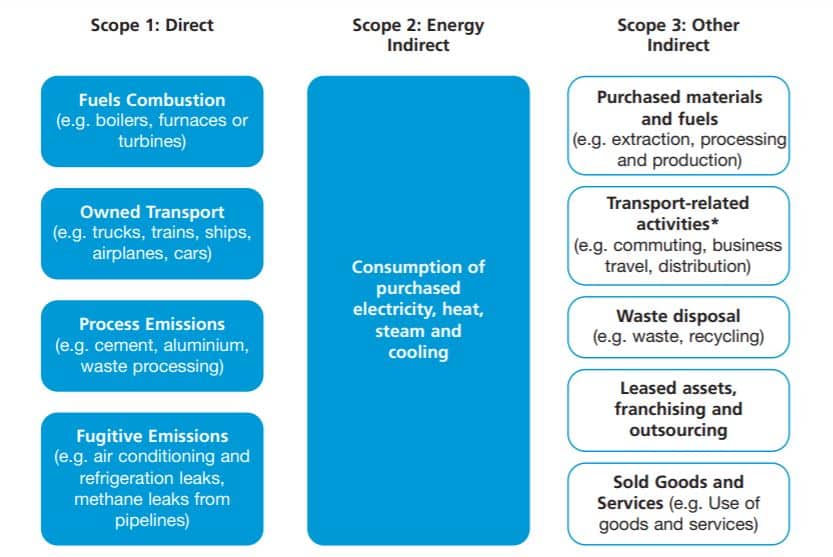
The more complex the structure of your organization, the more difficult it is to identify who or what are the sources of emissions. But most often, doing it involves three different ways based on the following emissions scopes.
The following diagram shows the common types of emissions sources under each scope.
Identifying those activities under each of the 3 scopes will be helpful when targeting the emissions source for later reductions.
Step #2: Quantify polluting activities
The most common approach used to calculate GHG emissions is to apply emission factors to known activity data from your home or organization.
This means getting the quantity of resource use through receipts, invoices, or bills associated with the activities. For instance, calculate the amount of electricity, fuels, goods, and services you paid for.
Activity data can be collected in different units of measurement. For example, weights in the case of food or volume for fuel used and kilowatt hours for electricity consumed.
For water, you quantify emissions in cubic meters while it’s mileage for travel. The costs for each of these polluting activities should be monitored and summed up for each year.
The table below sets out common polluting activities and sources of information to turn the data into GHG emissions.
And if it’s impossible for you to calculate emissions from known activity data, you can estimate. But be transparent of the estimation method used to ensure that results are reasonable.
Step #3: Get the emission factor of major GHGs
This is when things can be quite tricky when you calculate carbon credits. That’s because there’s a formula to get the emissions from all six major GHGs. But keep in mind that your reporting period should be for 12 months.
Your emissions year should also ideally correspond with your financial year. In case they’re different, most of your reporting year must fall within your financial year.
Going back to the DEFRA guide, it notes that different activities or fuels also have different emission factors (EF). That’s to reflect how polluting each of the following GHGs is:
Different activities and fuel can release one or more of them. So, it’s important that you know their corresponding EF. To calculate emissions of each GHG, here’s the formula to follow:
“Activity data x Emission factor = GHG emission”
Activity data refers to total use of a resource in a year. Multiplied that by the EF of all the GHGs generated by that certain activity and you get the emissions.
The Environment Protection Agency (EPA) Greenhouse Emission Inventories provide the EFs for various fuels/resources. These include coal and coke, biomass, electricity, fossil fuels, natural gas, and petroleum.
You can also find the EF of GHGs per type of vehicle that you or your company use and corresponding year.
The EPA also keeps a record of EFs for various industries called AP-42. It contains EFs of over 200 air pollution source categories, industry sectors or groups of similar emitting sources.
For the EFs of the foods and drinks you consume, you can find them in this Intergovernmental Panel on Climate Change (IPCC) Guidelines for National Greenhouse Gas Inventories.
Step #4: Change the EF to carbon dioxide equivalent
One crucial thing to take note is that the 6 major GHGs don’t have equal damage to the planet, also called their Global Warming Potential (GWP).
In other words, one unit of CO2, for instance, has a different warming effect than methane. It’s the same for the other GHGs.
Likewise, one unit of nitrous oxide has a GWP of 298 or equal to 298 units of CO2. It means N2O has the potential to warm the earth 298x more than the same amount of CO2.
That’s why it’s important to convert emissions into CO2 equivalent (CO2e). To do this, multiply the EF of each GHG with its corresponding GWP.
Step #5: Compute total emissions
The last step left to do is to calculate the total emissions of your activities/resource use. Get it by summing up all emissions in CO2e for a year.
For personal emissions, there’s another way to get your carbon footprint. For instance, you can use an online calculator that can generate your total emissions after you provide all the information.
But if you prefer a manual calculation for your organization’s emissions, you can always follow the five easy steps mentioned.
Sample computation to calculate carbon credits
The steps serve as a guide on how carbon credits are calculated. To give you a clearer picture, here’s a sample calculation you can try.
It’s based on electricity use of a household with four persons living in the U.S. The basis is the known 2015 activity data.
Step 1: Electricity use is under Scope 1 emissions
Step 2: Average use of electricity by 1 person in the US is 4,517 kWh/year.
So, it means the household of 4 people uses about 18,068 kWh (kilowatt per hour). That is equal to around 18 MWh of electricity use. 1,000 kWh = 1 megawatt (MWh).
The next step is to calculate the emissions for the activity by getting its EF.
Step 3: Electricity use EF from the EPA Greenhouse Emission Inventories
Get the EFs for electricity from the EPA Greenhouse Emission Inventories. You’ll find three GHGs for this – CO2, CH4, and N2O. Here’s the corresponding EFs for each one of them:
Following the formula provided earlier, multiply the 3 EFs above by 18 MWh of electricity used by the household of 4. The computation to calculate total emissions for a year goes as follows:
650.31 lbs (CO2) x 18 = 11,705.58 lbs of CO2
0.03112 lbs (CH4) x 18 = 0.56016 lbs of CH4
0.00567 lbs (N2O) x 18 = 0.10206 lbs of N2O
Step 4: Converted CO2e for CH4 and N2O
To express all the emissions in CO2e, multiply their GWP specified in the EPA Greenhouse Emission Inventories.
In this case, the methane (25) and nitrous oxide (298) GWPs as explained earlier. The calculation goes like this:
11,705.58 lbs of CO2 x 1 = 11,705.58 lbs of CO2e
0.56016 lbs of CH4 x 25 = 14.00 lbs of CO2e
0.10206 lbs of N2O x 298 = 30.41 lbs of CO2e
Step 5: Total emissions is 11,750 lbs of CO2e
Lastly, sum up all the 3 converted emissions from step 4 above. Then you’ll arrive at around 11,750 lbs of total CO2e emitted in a year for electricity consumption of 4 people.
Carbon emissions often come in tonnes. So 11,750 pounds is equal to about 5.33 tonnes of CO2e.
So, what does that figure mean to calculate the carbon credits you have to buy? It’s pretty simple. Just multiply the total emissions (5.33) with the price of carbon per tonne as per the market’s rate.
For example, if the carbon price in the market that you buy from is at US$15.0/tCO2e, that would be: 5.33 tCO2e x $15.0 = $79.95.
So, the family of four wanting to offset their emission due to electricity use can buy carbon credits worth $79.95. Or it can be lower depending on the certain market they’ll be buying from.
That money is then spent on projects that reduce or avoid carbon from entering the atmosphere.
Accounting For Carbon Credits
High CO2 emitting sectors like the energy, aviation, and automobile are under regulatory or compliance carbon credit schemes. It means they have to meet a certain limit on emissions set by a government regulatory framework.
This is also called the cap-and-trade scheme or Emissions Trading System (ETS). These systems create the Certified Emissions Reduction (CER) credits. Firms with excess CER credits can trade with others who are over their limits.
There are some key international accounting bodies for regulatory carbon credits after the Kyoto Protocol. But since there’s no regulatory guidance yet, some firms made their own emissions accounting policies. But most companies are accounting for their carbon credit transactions using the IASB’s IFRS.
You can also buy carbon credits from a voluntary carbon project, also known as carbon offsets. The steps involved when accounting for carbon credits under VCM are identical, but only without the regulatory approving bodies.
Still, a third-party entity must verify the carbon credits created by the project. This is to ensure that the amount of reductions they claim are verifiable and real or measurable.
How To Assess or Measure Carbon Credits?
A project’s emission reductions represented by carbon credits are measured in tonnes of CO2e reduced or removed from the atmosphere. How to measure these carbon credits involves considering a set of key criteria.
Though each credit represents one tonne of emission reduction, not all carbon credits are created equal and so their prices also vary. In general, there are three criteria that you can use to guide your buying decision – additionality, permanence, and measurability.
Additionality: a carbon reduction or removal is “additional” if it would not have happened without the carbon credit.
Additionality is crucial when evaluating or measuring carbon credits to buy. It affects the quality of a particular carbon credit. This is because buying credits to offset your emissions may only worsen the climate if the reductions are not additional. By definition, most carbon removal credits have high additionality as they rely on carbon credits to work.
Permanence: this refers to the duration and risk of leakage of carbon reduction or removal project.
This criterion considers the fact that most CO2 emitted today will not be 100% removed later. Only 25% of it stays in the air for over a hundred years.
And so, high-quality credits are the ones that go with reductions/removals that are permanent. >100 years is permanent and below that is temporary.
Measurability: this deals with data availability and verification.
The reported emission reductions must be accurate and verifiable. In particular, overestimation of GHG reductions should not occur. Otherwise, the measurability of the data won’t be reliable.
Projects that have no data to verify have poor measurability while those with verified data have good measurability.
Pricing Carbon Credits
In regulated carbon markets like the case of the EU ETS, the regulation influences the price setting. But in the VCM, prices vary based on project location, carbon program, and market conditions.
Carbon credits prices also differ depending on the specific type of projects that generate them.
For instance, carbon credits from wind projects in India (which are abundant) have an average price of $1.2/tonne. In comparison, carbon credits from the same project type in the US (which is not common) cost about $3.7/tonne.
Also, the carbon program Gold Standard often prices carbon credits higher than others. That’s because it includes in the price the social costs of the credits used for offsetting emissions.
How Do You Calculate Carbon Credits? – Key Takeaways
Carbon credits put a price on air pollution. They serve as a currency used by entities to pay for their emissions.
Carbon credits are available either in compliance or voluntary carbon markets. Though prices and standards vary between these markets, carbon credits still play the same vital role in preventing or reducing emissions.
Most importantly, measuring your own emissions to calculate the carbon credits needed to offset them is one way you can help to save the planet from damaging effects of the climate.
So, if you’re ready to do it, you can start by following the 5 easy steps discussed on how to calculate carbon credits. Then you can begin searching for the best carbon offset programs to consider.
At COP27’s talk to end deforestation, Cambodia agreed to sign contracts with international corporate buyers for about 15 million tonnes of Verified Emission Reductions (VERs) or carbon credits from the country’s landmark REDD+ projects.
The announcement from Cambodia shows a groundbreaking collaboration among the government, NGOs, local communities, and large companies, to end deforestation. It represents an effective way to address deforestation while driving investments for sustainable development.
The Royal Government’s Ministry of Environment will be signing agreements with a group of leading corporations that will buy the carbon credits from three of Cambodia’s REDD+ projects developed by the Wildlife Conservation Society and Wildlife Alliance.
Cambodia, REDD+ and Carbon Credits
Deforestation and forest degradation are some of the biggest contributors to the climate crisis, representing over 10% of all emissions. And it will be impossible to achieve the 1.5°C warming goal without ending emissions from forest loss by 2030.
The UN Conference of the Parties (COP) created the REDD+ framework. It refers to Reducing Emissions from Deforestation and Forest Degradation, with the role of conservation, sustainable management of forests, and enhancement of forest carbon stocks in developing countries.
REDD+ is a climate change mitigation strategy that allows communities and governments to gain payments from the voluntary carbon markets for emissions reductions achieved through forest protection projects. These projects tackle the main culprits of deforestation.
REDD+ projects allow stakeholders to get value from protecting and conserving their forestlands. And the government of Cambodia finds REDD+ and the carbon credits the projects generate relevant to their cause.
According to the country’s Minister of Environment, Dr. Say Samal, project-based REDD+ is an essential part of Cambodia’s strategy to achieve its nationally determined contributions (NDCs). The mechanism also ensures that the communities have enough resources to deliver the projects.
He also said that:
“Funds generated from VER sales help Cambodia’s Ministry of Environment enact effective policies that support our country’s efforts to reduce deforestation, including our transition to a nested jurisdictional REDD+ program. At a time when the world is struggling to meet the commitments enshrined in the Glasgow Leaders’ Declaration on Forests and Land Use, Cambodia’s experience demonstrates how project-based REDD+ can help countries like ours, which are ready to preserve its forests, to secure immediate, sustainable, and large-scale financing…”
Protecting Forests With Carbon Credits (VERs)
By closing the deals, the Cambodian government managed to have critical financing to protect its vulnerable forests. It will help support local communities working on the frontline to end deforestation.
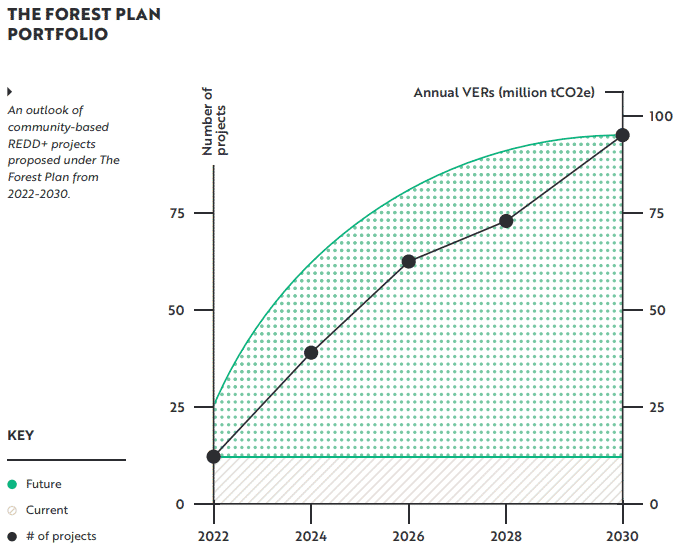
Here’s how the plan will look like for REDD+ projects until 2030.
Those community-based forest projects will protect a total of about 50.5 million hectares. They represent 17% of deforestation in 15 critical forest nations, which include Cambodia. Other countries are Brazil, Indonesia, Papua New Guinea, and the Democratic Republic of the Congo.
The government of Cambodia selected Everland to market the carbon credits from its REDD+ projects with large global corporations as buyers. The offering yielded a total bid of 15 million tonnes of emission reductions.
The corporate buyers will use the VERs as part of their strategy to offset unavoidable emissions. All the while contributing to wildlife protection and community development.
scale up site-based activities within the REDD+ project landscapes,
strengthen local and community-based institutions to govern community-level revenue sharing,
increase access to jobs, education, and healthcare for the local communities, and
secure the long-term financial stability of the projects in Cambodia.
Scaling up REDD+ Programs in Cambodia
Cambodia has been scaling up its REDD+ program by expanding its portfolio of projects. This is done through the help of its major project developer partners, including the Wildlife Conservation Society (WCS) and Wildlife Alliance.
So far, the projects have received around $11.6 million from the sale of carbon credits. The revenues are all reinvested in further environmental conservation.
The ministry is also preparing for an additional REDD+ project on 1.19 million ha. This will bring the total REDD+ project area to over ⅓ of Cambodia’s protected areas.
With these programs, the CEO of Wildlife Alliance Suwanna Gauntlett commented at the COP27 discussion:
“Cambodia’s REDD+ projects adhere to the most rigorous monitoring, evaluation, and independent verification processes. They produce high-quality verified emissions reductions that protect forests, reduce emissions, and safeguard the populations of endangered species in addition to ensuring services and livelihoods for forest communities…”
She also said that those benefits only show the forest nations that they can seek economic growth while preserving the natural beauty of their countries at the same time.
At the end of 2021, the first Fourth-Generation nuclear reactor in the world came online in Shandong, China.
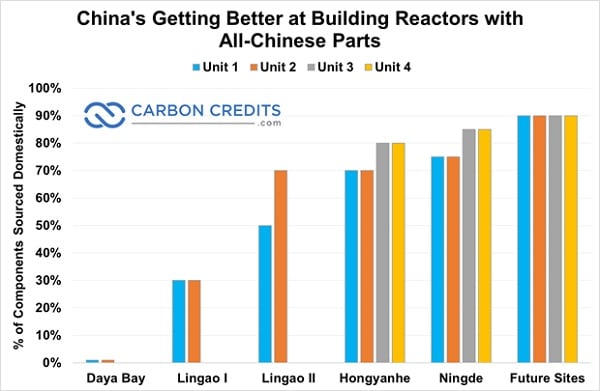
China claims it’s “homegrown,” and more than 90 percent of the equipment is sourced from China.
In reality, the technology was purchased from Germany when they abandoned nuclear a decade ago.
Still, China hopes to use it to demonstrate mastery over Fourth-Generation nuclear—and its evolution from nuclear amateur to pioneer on the world stage.
The reactor is a high-temperature gas-cooled reactor (HTGR), which means it doesn’t need to be built near water or the coast.
And since there’s no need for a containment dome, it’s far more cheaper to build HTGR than ERPs.
In other words, it’s the ideal reactor for exporting globally.
But it’s not the only nuclear reactor China has developed.
China is now the proud owner of four advanced nuclear power plant designs that can be built at scale—all “obtained” from other countries: the EPR (France), the CAP1000 (U.S.), the HTR-PM (Germany), and the VVER-1000 (Russia).
So why is China building every model of reactor it can get its hands on? That’s been proven to be the least cost-efficient and time-efficient way to build nuclear.
It’s because China doesn’t care if these nuclear reactors are over time or over budget. They only want to see what works. They’ll replicate the best, and throw out the rest.
They also want to slowly iterate away from other countries’ intellectual property, ensuring everything is “Made in China”.
China has already integrated everything it’s learned [stolen] from other countries into its own advanced design, the Hualong One.
The Hualong One, which has been called China’s nuclear “calling card,” is fully owned by China—so they can sell it freely around the world.
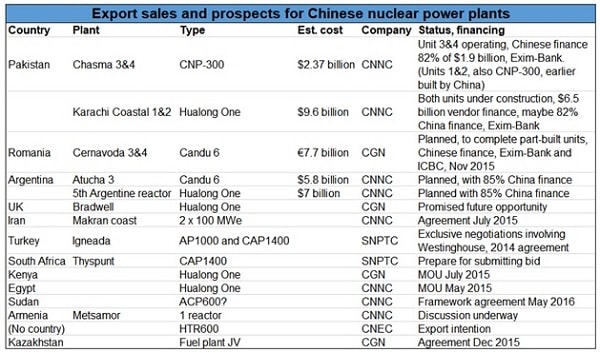
It’s already built two of the reactors in China, two in Pakistan… signed a contract to build one in Argentina… and is seeking approval to build one in the UK.
Of the reactors under construction in China, fully 50 percent are Hualong Ones.
The average construction time is just six years, and construction is $2,600 per kilowatt—less than half of the time and price of France’s EPRs.
China’s “Go Out” Nuclear Strategy
China recently announced an upgraded, simplified version, the Hualong Two. The first one is expected to begin construction in 2024.
Costs are around $2,000 per kilowatt, and the construction time to be an unprecedented four years.
After thirty years of “development”—squirreling intellectual property from other countries— nuclear in China is finally ready to face the world.
“‘Going out’ with nuclear power has already become a state strategy.” – Former CNNC chairman Wang Shoujun
China plans to exert the full weight of its economic and diplomatic influence to go global with nuclear, bringing carbon-free energy to the world.
And their offer will be irresistible.
State-backed banks are loaning about 70 percent of the cost of Chinese reactors—at far lower rates than are available to other nations.
“With nuclear, China is stepping up to the plate with financing.”
– BloombergNEF analyst Chris Gadomski
Other developed countries, like the United States and France, will be unable to compete with ultra-cheap, state-backed funding.
Additionally, the policy of China’s National Development and Reform Commission (NDRC) is to export nuclear technology backed by full fuel cycle capability: China will provide the uranium, and they’ll take the waste.
So buyers won’t even have to worry about the biggest problem with nuclear.
Customers are lining up. The CNNC says that it has already sold reactors to seven countries, and is working on deals with forty more.
China already has a stranglehold on the international nuclear export market.
In 2019, the former chairman of China National Nuclear Corporation told a meeting of China’s political advisory body that China could build thirty overseas reactors that would earn Chinese firms $145 billion by 2030.
“Our goal is for China to lead the global nuclear energy industry by the middle of this century.”
– CNNC President Gu Jun
That’s just a small taste of what’s to come… except suddenly, the other large nuclear powers are realizing China’s master plan.
And they’re not happy.
The Power in Nuclear Power
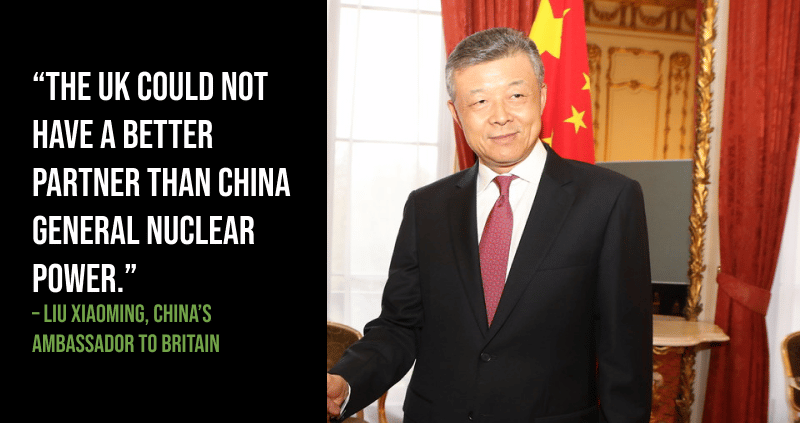
China General Nuclear Power (CGNP) has been on a U.S. government blacklist for three years for attempting to steal nuclear technology.
CGNP is also a partner with EDF, the world’s largest operator of nuclear power stations. But it’s quickly becoming its fiercest rival.
EDF once had plans to build a Hualong One in eastern England—not any more.
And British finance minister George Osborne said that China could build and own a nuclear power plant in Britain—also no longer an option.
The UK has begun to look for ways to squeeze CGNP entirely out of its reactor development.
Even Romania cancelled an order for two CGNP reactors—opting to work with the U.S. instead.
But there’s a much bigger concern for the United States and other developed countries than stolen state secrets.
It’s called “the hundred-year marriage.”
Nuclear energy deals create nearly unbreakable ties between the seller and the host—ties that must last as long as the nuclear plant does.
From first discussions to first operations: ten years.
Unit operation: sixty years.
Decommissioning: thirty years.
That’s a century, start to finish, of strategic operations between countries.
The license for that marriage has been signed once the plant begins operations.
All the fuel, maintenance, waste disposal, training, and even staff are provided by China. So breaking relations with them is to lose power for your country—both political and electrical.
And since China’s providing financing, they’ll have extreme leverage even if countries want to get out.
They’ve already used that kind of debt trap to coerce African nations into giving up strategic properties.
And now, China is intent on using nuclear reactor exports to “marry” United States allies.
In other words, China’s nuclear reactor exports will lead to a guaranteed century of Chinese global dominance.
That’s why other nations are scrambling to boost their own domestic nuclear programs…
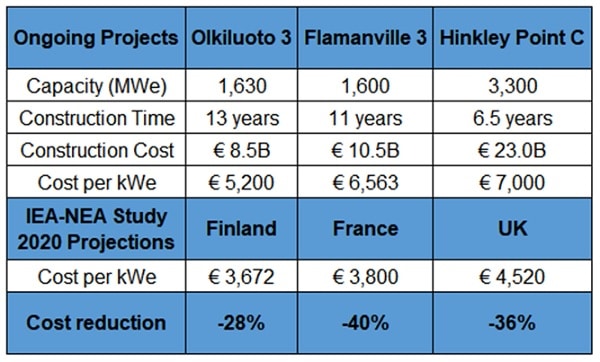
There are three excellent arguments against the development of nuclear power: Olkiluoto 3, Flamanville 3, and Hinkley Point C.
Those are the names of nuclear reactors under construction in Finland, France, and the United Kingdom. On the surface, they look like utter failures.
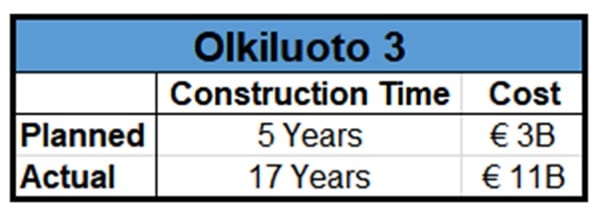
They’ve been subject to repeated delays. Olkiluoto 3 began construction in 2005, and is finally being wrapped up seventeen years later.
The reactors’ total price tag has exploded from $26.5 billion to $55.9 billion over the course of their construction.
All of the reactors are EPRs, which were designed by France, and they’re being built by a French-owned company EDF (Électricité de France).
But eight years ago, France decided to cap energy power from nuclear at 50 percent of electricity generation by 2025. That’s down from its current 70 percent.
So why is a country that wants to reduce its reliance on nuclear… wasting tens of billions of dollars and multiple decades to build more reactors?
It’s not to lower carbon emissions. France already has one of the lowest emissions-per-capita rates in the EU.
And it’s not for energy security. In 2020, France was the largest exporter of electricity in the EU.
No, the real reason is much, much bigger than either of those.
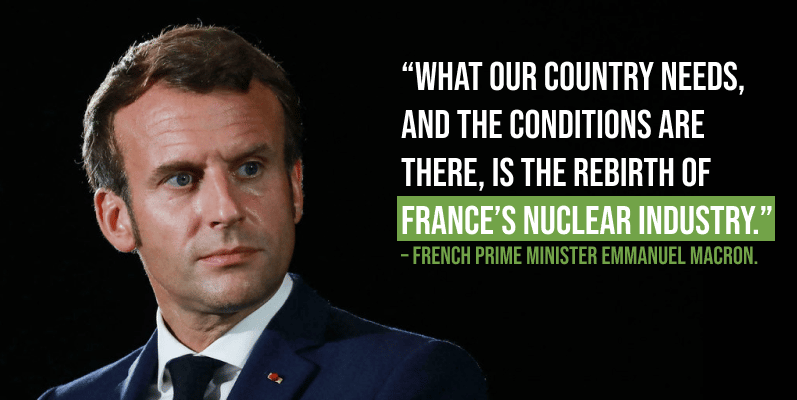
The French government knows that demand for nuclear energy is about to spike. And the first country that can build inexpensive, safe, replicable nuclear reactors will have the most valuable company on earth in short order.
So the reason why France is desperate bid to build nuclear power is simple.
France wants to sell the solution to the greatest danger the planet has ever faced.
Vive La French Nuclear
The reactors being built are prototypes for full-scale, French-style nuclear reactor production.
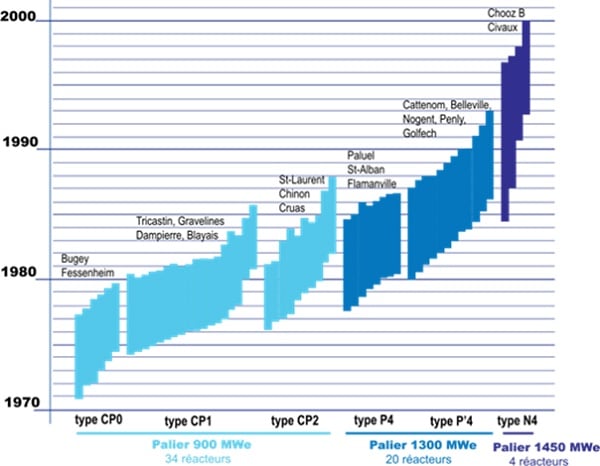
When France built out its nuclear fleet in the ‘80s, its strategy was to achieve a “series effect”—decreasing timelines and lowering costs by building many of the same thing.
It worked. France saw major construction timeline and price reductions for each successive reactor.
And they’re doing it again. The objective with the current buildout is to reduce the costs and construction timeline for future EPRs by 30 percent.
According to the French Nuclear Energy Society, the buildout could go even further, reducing construction and financing costs by up to 50 percent.
It will also serve to revitalize France’s competency in building nuclear reactors.
In building the Flamanville reactor, France has rebuilt an entire European supply chain that is qualified to build nuclear-quality parts for nuclear power reactors.
France already has what it needs to go global with nuclear.
It’s long been a large exporter of nuclear technology, including fuel products and services. And it has experience across the entire market, from uranium mining to reactor design and construction.
According to France’s Atomic Energy Commission, there will be “a real market for EPRs” beginning in 2030.
But France might not have to wait that long. In 2021, the VP of EDF hand-delivered an offer to build the most powerful nuclear energy site in the world—9.6 GWe of EPRs on a single site.
According to leaked communications, India is paying a “high price” for these French reactors.
Which means that every country with the finances, state backing, and nuclear programs to pull this off—China, Russia, the United States, and South Korea—wants to get in on the action.
The payoff for the first country to export nuclear technology at an international scale will be oil-industry huge.
Which is why those countries are already buying… bribing… stealing… doing whatever it takes to win the most valuable market on earth.
The Real China Syndrome
That’s how Maureen Kearney found herself hooded, tied to a chair, gagged, and brutally attacked with a knife in her Paris home.
Maureen was a major union leader at Areva, a French nuclear company.
And in 2012, she had discovered that EDF was preparing to sell French nuclear secrets to a Chinese consortium.
Fearful that cutting-edge technology would be handed over to the Chinese, she decided to become a whistleblower. And she paid the price for it.
But it didn’t matter, because China found another way in.
In 2016, EDF suddenly had a new partner in Hinkley Point C: China General Nuclear Power (CGNP). CGNP now owns 34 percent of the project.
Not quite.
Because at the same time as it purchased a stake in Hinkley Point C, CGNP quietly began building two EPR reactors in China.
It’s obvious where this is going…
The first European Pressurized Reactor (EPR)—the most advanced commercial reactor design on the continent—didn’t start up in Europe.
It started up in China, six years after Maureen was attacked.
Decades of engineering and planning, construction delays, and cost overruns, all borne by France, paid huge dividends for China.
China even poached project managers from Olkiluoto and Flamanville for work on the new reactor. Experience in France meant that engineering teams worked 60 percent fewer hours on the Chinese EPR than on Olkiluoto 3, reducing costs.
A day after the first EPR launched, the most advanced commercial reactor design from the United States, the AP1000, started up for the first time… also in China.
In 2009, American company Westinghouse had agreed to work with China to develop a larger version of their AP1000 model, creatively named the CAP1400.
The agreement gave China full IP rights for all co-developed plants greater than 1350MWe.
So China is only building plants greater than 1350Mwe.
They plan to follow the CAP1400 with a CAP1700… then a CAP2100 design—the largest nuclear reactor in the world by far.
The first two units of the CAP1400, the first “fully native” Chinese nuclear reactor, are currently under construction and expected to come online in 2025.
China has openly bragged that the CAP1400 broke a number of “technological monopolies”. And that all the key materials are designed by and manufactured in China.
The design is being developed for deployment in high numbers across China, as well as for export around the world.
Neither the EPR or the AP1000 is yet online in its home country—the AP1000s in the U.S. were cancelled—but China could care less.
They leeched their technology from France, and now France is actually worse off in its ability to build nuclear power plants.
Meanwhile, China is actively building high numbers of what is possibly the safest production-level reactor there is.
More importantly, they’re rapidly preparing to bring it to the global market at the largest scale in human history.
To provide the best experiences, we use technologies like cookies to store and/or access device information. Consenting to these technologies will allow us to process data such as browsing behavior or unique IDs on this site. Not consenting or withdrawing consent, may adversely affect certain features and functions.
Functional
Always active
The technical storage or access is strictly necessary for the legitimate purpose of enabling the use of a specific service explicitly requested by the subscriber or user, or for the sole purpose of carrying out the transmission of a communication over an electronic communications network.
Preferences
The technical storage or access is necessary for the legitimate purpose of storing preferences that are not requested by the subscriber or user.
Statistics
The technical storage or access that is used exclusively for statistical purposes.The technical storage or access that is used exclusively for anonymous statistical purposes. Without a subpoena, voluntary compliance on the part of your Internet Service Provider, or additional records from a third party, information stored or retrieved for this purpose alone cannot usually be used to identify you.
Marketing
The technical storage or access is required to create user profiles to send advertising, or to track the user on a website or across several websites for similar marketing purposes.