California Sets Precedent with New Corporate Climate Disclosure Laws

California enacts the nationโ€™s first-of-its-kind climate disclosure law that requires companies doing business in the state to report on their carbon emissions and climate-related financial risks.

The new corporate climate legislation – SB 253 and SB 261 – covers companies with annual revenues surpassing $1 billion.ย 

This comes as the U.S. Securities and Exchange Commission finalizes its rules that would mandate large companies to disclose their climate-related emissions. But the California laws require climate disclosures beyond what the SEC proposes.ย 

Californiaโ€™s Climate Accountability Package

California Governor Gavin Newsom signed into law two different legislation collectively called the Climate Accountability Package:

  • SB 253 – Climate Corporate Data Accountability Act
  • SB 261 – Climate-Related Financial Risk Act

Both private and public companies conducting business in the state are covered by the new climate disclosure laws. These include big oil firms like Chevron, tech giants like Apple, Amazon, Disney, Amazon, and 5,300 other corporations.ย 

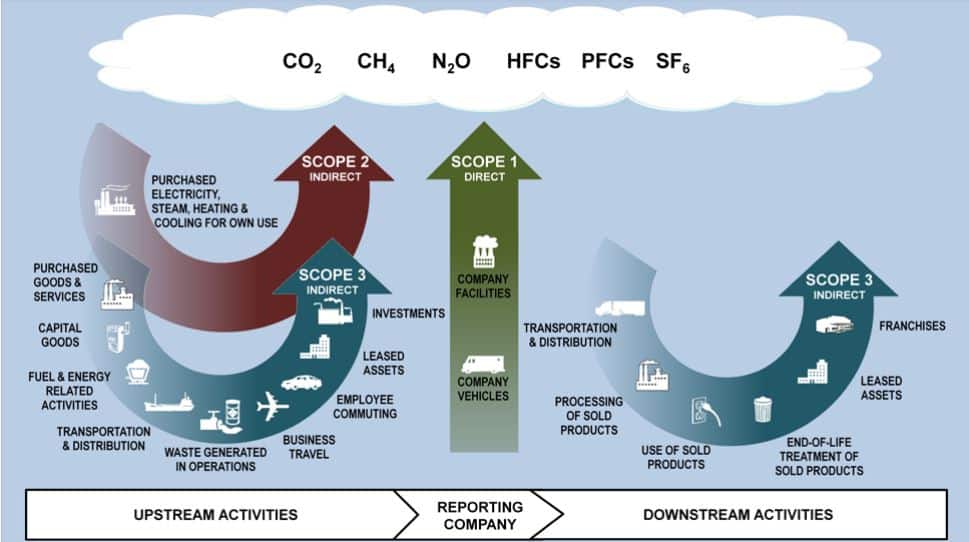
The new laws are broader than the SEC proposed rules, requiring all registrants, regardless of business size.ย SB 253 mandates companies to disclose Scope 1 and 2 emissions starting in 2026 and Scope 3 in 2027. They also must also disclose biennial climate-related financial risk and submit it to the California Air Resources Board (CARB) beginning in 2026 under the SB 261.ย 

scope 3 emissions GHG protocol 15 categoriesGovernor Newsom said this would encourage them to do business avoiding those risks. This is in accordance with the recommendations of the Task Force on Climate-Related Financial Disclosures (TCFD).ย 

The CARB has to establish a new system for reporting carbon emissions by January 1, 2025. The Board is also managing and overseeing California’s cap-and-trade (carbon credit) program. It sets the declining limit on major sources of greenhouse gas emissions throughout the state, central to meeting its climate goals.ย 

Both laws seek to prevent issues on greenwashing – companies falsely marketing their GHG emission reduction efforts to misled the public. For one of the billsโ€™ proponents, avoiding greenwashing would help investors know better the vulnerabilities of various companies they want to support.ย 

With the enactment of SB 253 and SB 261, California now joins others that introduced climate disclosures, particularly the EU. The EU even requires businesses to report on other things such as their climate transition plan and other sustainability matters.ย 

Recently, the EU adopted the Corporate Sustainability Reporting Directive (CSRD) which addresses non-financial reporting requirements. It aims to ensure that companies report relevant information on their environmental impact as well as the risks related to environmental, social, and governance (ESG) issues.

The Caveats

Supporters said that both laws will make new data public beyond the stateโ€™s borders, which would be a game-changer. For an advocate, Hollin Kretzmann, speaking for the Center for Biological Diversity,ย 

โ€œThe disclosure requirements would really pull back the curtain on the biggest climate destroyers in the oil industry and make it harder to greenwash.โ€

However, Governor Newsom said that the new laws came with caveats, noting concerns on reporting deadlines and associated costs.ย 

The climate disclosure laws also faced significant opposition from fossil fuel interests, notably Chevron, Marathon Petroleum, and Western States Petroleum. The California Independent Petroleum Association and the American Chemistry Council also lobbied against the bills.ย 

According to disclosure records, Chevron spent over $1 million in fighting the bill while it cost Western States Petroleum over $2 million.ย 

The opposing interests requested to scrap Scope 3 requirements or weaken the measures. But the Governor hasnโ€™t disclosed intent to do so, but noted to do โ€œsome cleanup on some little languageโ€. For subject experts, tweaking the language used to protect big oil business interests can potentially weaken the legislation.

Opponents further claim that the California climate disclosure rules will cause inaccurate reporting and financial burden.ย 

However, there are also strong supporters of the laws from other businesses, alongside environmental advocates. They notably include tech giants Microsoft, Google, Salesforce, and Adobe, as well as Ikea, Patagonia, and Amalgamated Bank.ย 

A Piece of the Net Zero Puzzle

Failing to comply with the new laws will cost covered entities hefty penalties. Under SB 253, administrative fines may not exceed $500,000 in a reporting year. For SB 261 reporting requirements, imposed penalties should not go beyond $50,000.

Once fully enforced, it sets the national standard for climate disclosures and can potentially tackle a companyโ€™s entire value chain.ย 

The legislation may face legal challenges when applied and administrative rulemaking process may be time-consuming and controversial. However, pressure strengthens to increase transparency in reporting carbon emissions both at the state and federal levels.ย 

Climate-related disclosures are now a hot topic, not just in the U.S. but other parts of the world as efforts to curb planet-warming emissions intensifies. They are an important piece of the puzzle as the world pushes forward to net zero emissions.ย California’s Climate Accountability Package ushers in a new era of climate transparency for corporations.

Chevron Finds Global Carbon Pricing Key for Low-Carbon Investments

US oil company Chevron believes that implementing a global carbon pricing system is the key incentive for driving low-carbon investments and scaling up energy transition technologies. Barbara Harrison, Chevron New Energies vice president, emphasized this perspective during the BloombergNEF Summit 2023 in London.

According to Harrison, establishing a carbon price benchmark would provide consistency in regulations and clear cost elements for companies. This is especially in the context of rising emissions where, she argued, such consistency is vital for the industry.

The Ultimate Incentive to Spur Demand

The second-largest oil company in the U.S. is a proponent of a global carbon price mechanism. Harrison stated that “Chevron supports a global price on carbon.” She further noted that:

โ€œWe think the ultimate demand side incentive that you can put in place is to have a price on carbon that is [established] to the point where markets are linked and becomes globally consistent.โ€

The idea of taxing carbon emissions through a ‘cap-and-trade’ system is widely supported in some major markets like Europe and the UK. But it remains a political controversy in others, notably the United States.

The โ€˜Patchworkโ€™ Issue

The contrasting approaches to carbon pricing in developed markets have led to a “patchwork” of different rulebooks, Harrison added. This fragmentation discourages investments.ย 

This matter is concerning given the fact that the world badly needs huge amounts of capital flowing into initiatives that help combat climate change. Differences in climate policies and incentives can deter significant investments at the scale needed.ย ย ย ย 

With that said, a global system for pricing carbon emissions would provide companies with a clear understanding of the costs associated with emissions and reducing them. This level of carbon price policy and consistency is crucial when attracting large investments from various partnerships.

For Chevron, carbon pricing should be the primary policy tool to achieve carbon emissions reduction targets. The oil major made it clear in its climate change report that like oil price forecasts, information and analysis of carbon price forecasts are important to their net zero strategies as stated in its climate change report.

Chevronโ€™s 2050 Net Zero Aspiration

Chevron net zero 2050 target

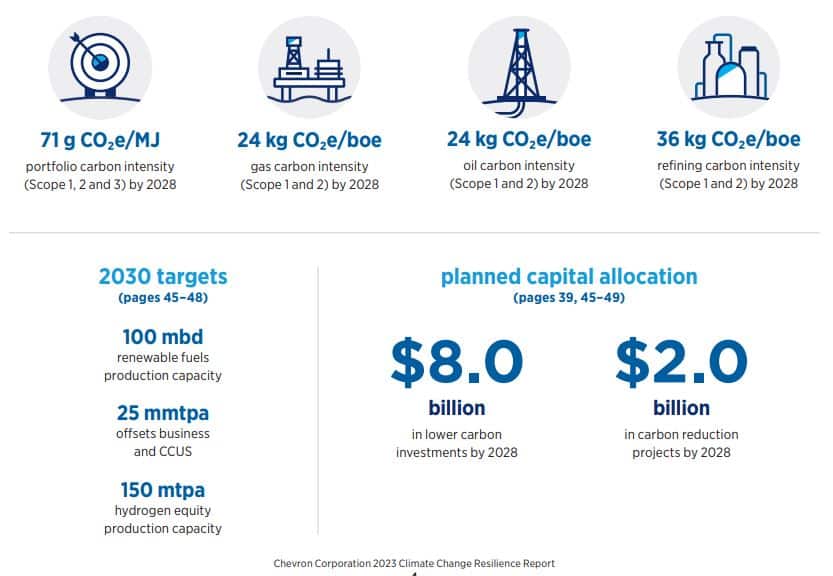
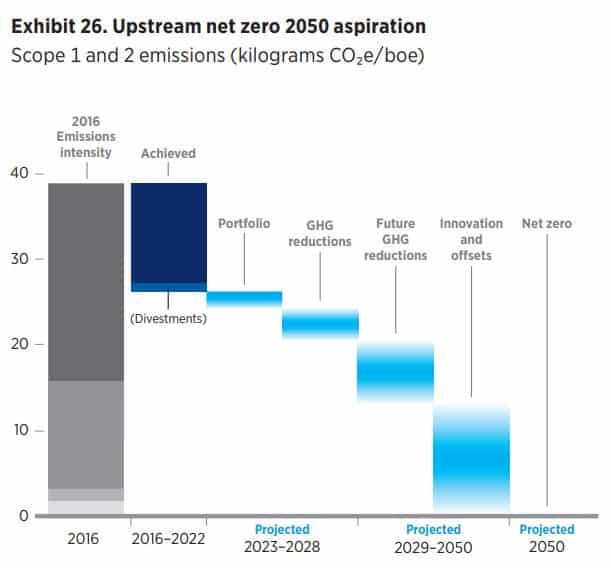
Chevron aims to reach net zero upstream emissions by 2050 by lowering the carbon intensity of their operations. This involves four key business areas – portfolio, gas, oil, and refining, each with its own target as seen below.ย 

  • The emission intensity metrics are equity based, meaning they reflect the share of emissions from assets the firm owns and operates as well as their non-operated joint ventures.

Chevron carbon emission intensity net zeroThe US-based oil giant has tripled its investment to $10 billion into low-carbon business initiatives. The interim goal is to slash its greenhouse gas emissions from oil and gas production by 35% by 2028.

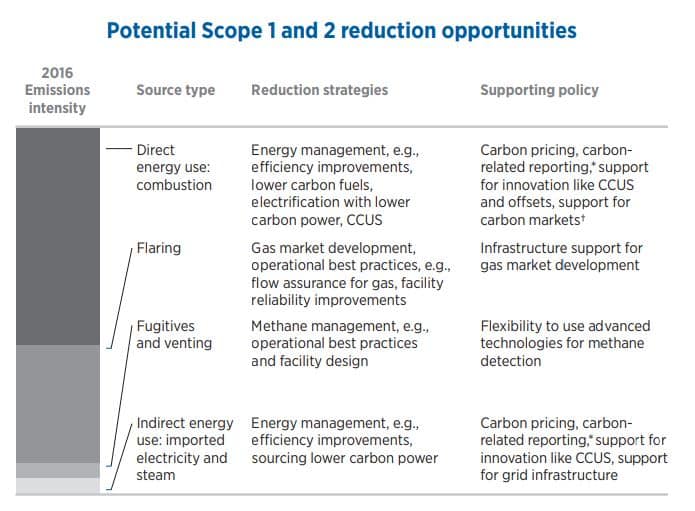
Most of Chevronโ€™s direct emissions (Scope 1) and indirect emissions from purchased energy (Scope 2) are related to energy use. They can be reduced by effective energy management such as efficiency improvements or switching to low-carbon fuel.ย 

The big oil firm manages to lower its total operating emissions from 2018 through to 2022. For instance, it slashed emissions down to 53 million tonnes COโ‚‚e in 2022 from 68 Mt COโ‚‚e in 2018. The same emission source was down in 2021 to 57 Mt COโ‚‚e.

This year, the oil company claimed to have 120+ GHG abatement projects with a budget of over $350 million. Last year, they made progress on 90 projects and had finished 13 of them. They expect to fund about $2 billion on related projects by 2028.ย 

Once all these projects come into fruition, they can deliver approximately 4 million tonnes of emissions reductions annually.

Opportunities for CO2 Emission Reductionsย 

The big oil firm seeks to reduce carbon footprint in three major areas of energy management:

  • Methane management, includes venting, fugitives, and flaring reductions,
  • CCUS – carbon capture, utilization, and storage, and
  • Carbon offsetsย 

Offsetting is done through natural or technological removals, such as nature-based solutions and CCUS, also known as CCS. Again, the oil company emphasizes that these carbon reduction measures can leverage support by policies on carbon pricing.ย 

Chevron has retired or cashed in almost 6 million carbon credits from major voluntary carbon registries between 2020 and 2022. About 50% of its carbon offset programs are linked to hydroelectric dams, mostly found in Columbia.ย 

For its other emission reductions opportunities, Chevron sees potential in the following pathway toward its net zero aspiration.ย 

Chevron emission reductions strategiesChevron’s support for a global carbon pricing mechanism underscores the need for consistency in climate regulations to drive low-carbon investments. With a commitment to reach net zero emissions by 2050, Chevron is tripling low-carbon investments while significantly reducing emissions. Their call for a global carbon price represents a crucial step towards accelerating the energy transition and fueling emissions reductions.

EasyJet & Airbus Strike a Deal: Zero Carbon Flying with Carbon Removal Credits

EasyJet is the first airline in the world that signed a contract with aerospace giant Airbus for its carbon removal initiative that will offset flight emissions with its Direct Air Capture (DAC) technology.ย 

With Airbusโ€™ Carbon Capture Offer, via its Direct Air Carbon Capture and Storage (DACCS), EasyJet can use the carbon removal credits to advance its climate goals, and aviationโ€™s decarbonization targets.

The deal makes the British low-fare airline the first partner of the Airbus carbon removal efforts.ย 

Building a Sustainable Aviation Ecosystem

The aviation industry is responsible for emitting about 3% of global energy-related carbon emissions, per data from last year. And as the world was recovering from the pandemic, aviationโ€™s emissions started to climb again to >1 billion tonnes.ย 

The hard-to-abate industry aimed to reach net zero emissions by 2050, primarily through sustainable aviation fuel (SAF) and carbon capture. DAC is one of the widely available and scalable carbon capture technologies today.

DAC traps and removes carbon directly from the air, often through high powered giant fans. The captured CO2 is then stored safely in underground reservoirs. Or better yet, the gas can be used to make sustainable aviation fuel, further helping the industry cut its footprint.ย 

While carbon emitted during aircraft operations canโ€™t be directly rid of at the source, DAC can extract the same amount from the atmosphere.

EasyJetโ€™s Group Markets Director Thomas Haagensen said that the airline considers carbon removal essential in helping them achieve their net zero goal. That entails investing into relevant projects like DAC to โ€œaccelerate the development of zero carbon emission aircraft technology.โ€

EasyJet Net Zero Roadmap

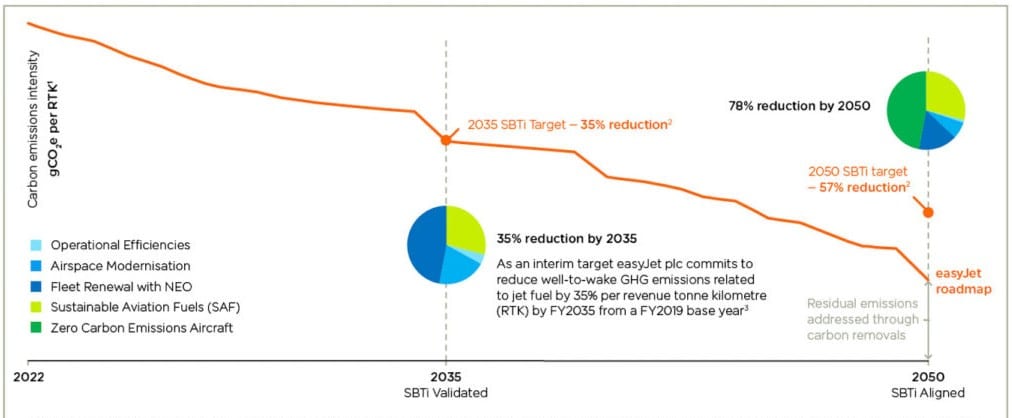
easyjet net zero roadmapThe Swiss airline plans to hit net zero emissions flying by 2050 as outlined in its roadmap published in 2022. The roadmap also says that EasyJet seeks to reduce carbon footprint per passenger by 78% by 2050.ย 

The reduction will be through switching to fuel-efficient aircraft and greener fuels like SAF. The remaining 22% will be through carbon capture technologies.ย 

EasyJet was one of the first major airlines to offset all of its emissions, amounting to 8.7 million tonnes. Itโ€™s also one of the first in the aviation to negotiate with Airbus to possibly pre-purchase durable carbon removal credits.ย 

An executive from Airbus commented on their partnership noting that their deal shows EasyJetโ€™s willingness to extend its environmental commitment. He further added that:

โ€œInitiatives such as this one underline Airbusโ€™ commitment to decarbonizationย solutions for our industry and to, bringing together airlines and industry players from all sectors in order to build a sustainable aviation ecosystem.โ€

Airbus’ Commitment in Decarbonizing Aerospace

Airbusโ€™ carbon removal credits at 400,000 metric tons will be issued by its partner DAC company 1PointFive. The carbon credits will be effective between 2026 – 2029.


1PointFive is a subsidiary of oil major Occidental (Oxy) focusing on carbon capture. The company is currently developing what it says will be the biggest DAC plant in the world – Stratos. The facility is in the Texas Permian Basin aiming to capture 500,000 tonnes of CO2 per year.

Airbus has been at the forefront of the aerospace sector’s decarbonization efforts. It has been consistently refining its products and services to better tackle climate change. The company is an active proponent of various global decarbonization initiatives to help curb the industryโ€™s carbon footprint.ย 

For instance, itโ€™s spearheading innovations in aircraft and aerodynamic design and architecture to reduce the industryโ€™s environmental footprint. Currently, all their units can fly with a SAF blend of 50% maximum, aiming to make it 100% by 2030.

While EasyJet is Airbusโ€™ first partner, there are other operators that inked letters of intent for 1PointFiveโ€™s carbon removal initiative. These include the Virgin Atlantic, Air Canada, Air France-KLM, Lufthansa Group, IAG, and LATAM Airlines Group.

Airbusโ€™ carbon removal credits initiative for the airlines is part of its broader decarbonization strategies.

EasyJet’s partnership with Airbus marks a huge stride toward achieving sustainable aviation and reducing carbon emissions in the industry. Through carbon removal credits with DAC technology, they aim to offset flight emissions and accelerate the development of zero-carbon aircraft technology, contributing to aviation’s net zero aspiration.

ADNOC Spends $17B for World’s First Net Zero Natural Gas Project

ADNOC, the biggest oil producer in the United Arab Emirates, awarded contracts worth around $17 billion for an offshore natural gas project operating with net zero emissions, the first in the world to do so.ย 

The project consists of two engineering, procurement, and construction (EPC) contracts and is part of Abu Dhabiโ€™s Ghasha Concession.ย 

One EPC contract of $8.2 billion went to a joint venture between Italian oilfield services firm Saipem and Abu Dhabiโ€™s National Petroleum Construction Company (NPCC). The other EPC contract worth $8.74 billion was awarded to Milan-based engineering company Maire Tecnimont for onshore projects.

Fast-Tracking ADNOC’s Net Zero Goal

ADNOCโ€™s Hail and Ghasha project will capture 1.5 million tonnes per year (mtpa) of carbon dioxide. This plan brings Adnocโ€™s committed investment for carbon capture capacity to almost 4 million tonnes a year.ย 

ADNOC Hail and Ghasha natural gas projectThe captured CO2 will be transported onshore via ship or pipelines and securely stored underground in geological formations.
Carbon capture, utilization and storage (CCUS, also called CCS) involves the trapping of CO2 emissions from industrial activities and fossil fuel combustion.

The project will also use clean energy from nuclear and renewable sources while producing low-carbon that can replace fuel gas, further reducing emissions.ย 

  • The oil giant plans to double its carbon capture capacity to 10 million tonnes of CO2 per year by 2030.ย 

All these efforts are part of the companyโ€™s move to bring forward its net zero emissions target to 2045. Thatโ€™s 5 years earlier than its previous goal of 2050, making ADNOC the first among its peers to fast-forward its net zero target.ย 

In 2022, ADNOC established a new business division, Low Carbon Solutions & International Growth, in line with its net zero goal. It will focus on CCUS, renewables, and clean hydrogen while helping the company expand internationally in gas and liquefied natural gas.

At the beginning of 2023, ADNOC announced a $15-billion investment in low-carbon projects to tackle emissions and achieve decarbonization targets. Part of this $15B investment is the first-of-its-kind CCUS or CCS project.ย 

The new project also aims to produce over 1.5 billion standard cubic feet per day of gas by 2030. More than 60% of the projectโ€™s investment value will flow back into the UAEโ€™s economy.

Unlocking Natural Gas with Carbon Capture

Speaking for the companyโ€™s giant move, its executive director Abdulmunim Al Kindy remarked that:

“Natural gas is an important transition fuel and ADNOC will continue to responsibly unlock its gas resources to enable gas self-sufficiency for the UAE, grow our export capacity and support global energy security.โ€

The director further said that itโ€™s a major milestone for the oil giant and its partners. They claim it would be the first gas project in the world with net zero emissions.

Moreover, the proponents believe that it will contribute to the countryโ€™s gas self-sufficiency and the companyโ€™s growth and export plans. Theyโ€™re seeking to increase oil production capacity to 5 million barrels a day from 4 million today.

  • ADNOC will decarbonize a portion of its onshore operations through renewables and nuclear power.

Part of that plan is installing a 10 tonne per day carbon capture unit developed by Carbon Clean. As a progress, ADNOC partnered with Occidental to conduct a preliminary study to create the first megaton-scale Direct Air Capture (DAC) facility outside the United States.ย 

The joint study will evaluate the proposed 1 mtpa DAC plant. This facility will be connected to ADNOCโ€™s CO2 infrastructure for injection and permanent storage into saline reservoirs.ย 

The oil producer also inked a separate $615 million deal with oil services company Petrofac. They agreed to develop one of the biggest carbon capture projects in the Mena region, particularly at the Habshan plant.ย ย 

The major energy player added that their CCS plans will help scale-up hydrogen and lower-carbon ammonia production in Abu Dhabi.ย 

All these new targets come as the nation prepares to host the upcoming COP28 climate conference in November. ADNOCโ€™s group CEO Sultan Ahmed Al Jaber will be the summit’s president.

ADNOC’s ambitious move to develop the world’s first offshore net zero emissions natural gas project not only reduces its carbon footprint but also contributes to the UAE’s energy security and export capacity. This initiative aligns with the company’s commitment to reaching net zero emissions by 2045, setting a precedent in the industry as it transitions to cleaner energy production.

Carbon Offsets Ignite Dispute Over Xcel’s Colorado Emissions Reduction Plan

Natural gas becomes a kitchen-table issue in the U.S., literally. In Colorado, the city of Boulder, together with environmental groups oppose the stateโ€™s largest utility, Xcel Energyโ€™s plan to cut greenhouse gas emissions associated with its natural gas distribution.ย 

The Colorado dispute centers around whether utilities can use certified gas and carbon offsets to meet state-mandated climate targets.ย ย 

Certified gas, also called responsibly sourced or differentiated gas, has been tested and verified at the wellhead to meet specific emission intensity requirements and other standards.ย Carbon offsets refer to emissions reductions achieved by investments in projects that remove or sequester GHG emissions such as reforestation.ย 

The โ€œClean Heat Planโ€ Fight

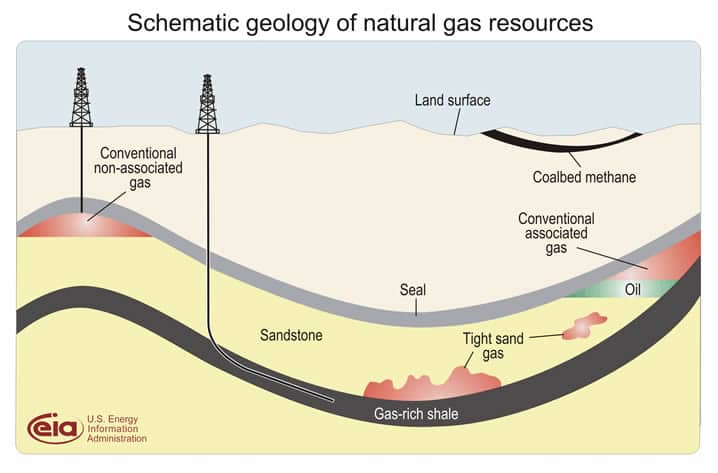
Natural gas is the largest source of electric power generation in the U.S. Its substitution for coal has helped lower the sector emissions to mid-1980 levels. But since 2005, emissions from natural gas combustion have increased about 43% in all sectors.ย 

natural gas resources schematic geology
Source: Energy Information Agency

Just two months after an Xcel Energy subsidiary, Public Service Co. of Colorado, submitted a clean heat plan, a dispute has arisen over the use of certified gas and carbon offsets to achieve emissions reduction.ย 

Coloradoโ€™s largest utility submitted a proposal in August to slash the carbon footprint of its natural gas system. Theyโ€™re currently delivering methane-based fuel to 1.5 million customers across the state.ย 

  • The plan sets out strategies to meet the first-in-the-nation law mandating gas utilities to reduce planet-warming emissions 22% below 2015 levels by 2030.ย ย 

A coalition of climate and renewable energy organizations filed a motion in September to block the plan. They question the inclusion of those two elements in clean heat portfolios, leading to a regulatory showdown.

Xcel Energyโ€™s preferred clean heat plan covers the period from 2024 to 2028. The utility said that certified gas and carbon offsets will enable them to reach their emissions reduction goals more cost-effectively. But this claim has faced strong opposition.ย 

Critics argue that Xcel’s plan shouldnโ€™t be considered because those resources don’t align with the law’s definition of emissions reduction. These strategies focus on emissions reduction upstream and in unrelated sectors, which they say goes against the law’s intent.

The law in question is Senate Bill 21-264, which does allow some indirect emissions reduction measures. But they are primarily limited to recovered methane strategies such as renewable natural gas, excluding certified gas and carbon offsets.ย 

Opponents, thus, seek a legal ruling to exclude them from consideration and to require Xcel Energy to change its plan. The Colorado Public Utilities Commission (PUC) would decide on the final ruling.ย 

Aggravating the coalitionโ€™s concerns, the two tools would be responsible for around 43% of Xcel Energyโ€™s projected emissions reductions target.

What It Means for Other Gas Utilities

The disputeโ€™s outcome could significantly impact other gas utilities, including Atmos Energy Corp., Black Hills Corp., and Summit Utilities Inc.. Theyโ€™re preparing their own clean heat plans to submit.ย 

SB 21-264 mandates utilities to use strategies such as demand-side management, building electrification, and low-carbon fuel blending.

Xcel Energy contends that the opposition misinterprets the law, which they believe allows for the use of “available tools” beyond those explicitly named in the legislation. The utility argues that excluding certified gas and carbon offsets limits the options available to PUC in achieving the stateโ€™s climate goals.

  • The other tools specified in their 5-year clean heat plan include electrification, leak prevention, energy efficiency programs, recovered methane and hydrogen blending.

The Colorado Energy Office and the Colorado Department of Health and Environment’s Air Pollution Control Division agree that Xcel’s preferred portfolio complies with SB 21-264. But they suggest that certified gas and carbon offsets don’t meet the definition of clean heat resources.

Despite criticism, Xcel has garnered support from energy companies like Chevron, Occidental Petroleum, and Williams Cos. Emissions measurement company Project Canary PBC and other stakeholders also agree with Xcel. They argue against rushing to judgment and emphasize the importance of thorough investigation.

From Colorado to New Jersey

Xcel Energy estimates its preferred plan to clean up its natural gas system would cost about $163 million each year. On the other hand, an all-electrification option would cost much more, standing at $472 million annual price tag.

Prior to this Colorado clean heat plan conflict, utilities in New Jersey also have faced a similar situation. The stateโ€™s natural gas distributors noted that policymakers are too focused on building electrification amid the discussion on aligning gas utility regulation with state climate goals.ย 

The companies, along with multi-utility Public Service Enterprise Group Inc., suggested that a clean heat standard like Coloradoโ€™s should be an option for a range of decarbonization solutions for the New Jersey Board of Public Utilities to consider. PSEG noted that utilities should have various options to invest in different solutions and show their emissions reduction potential.ย 

In conclusion, Xcel Energy’s clean heat plan to reduce emissions through certified natural gas and carbon offsets remains a contentious issue. What also remains to be seen is how such strategies can significantly contribute to emissions reduction efforts in the industry.

Singapore Sets Higher Standards for International Carbon Credits

Singapore announced a set of criteria for international carbon credits (ICCs) to ensure that they are of high quality which companies can use to offset their taxable emissions.

The Ministry of Sustainability and the Environment (MSE) and the National Environment Agency (NEA) jointly introduced the Eligibility Criteria under the ICC Framework.

The criteria align with the Paris Agreementโ€™s Article 6, allowing Singapore to work with other nations supporting their climate targets. Theyโ€™re also in line with international standards, such as the Carbon Offsetting and Reduction Scheme for International Aviation (CORSIA).ย 

High-quality international carbon credits will complement Singapore’s emission reduction efforts to achieve net zero emissions by 2050.

The 7 Principles of High Quality Carbon Credits

The eligibility criteria will also help carbon taxpayers as to how they can reduce their carbon tax bills. Under the countryโ€™s Carbon Pricing (Amendment) Bill, tax liable companies will face a 5x increase in carbon tax next year.ย 

  • The carbon tax covers all facilities emitting 25,000 tonnes or more of greenhouse gas each year.ย 

Currently, theyโ€™re paying S$5 (US$3.6) per tonne of carbon emissions which will be at S$25/mtCO2e ($18.2/mtCO2e) in 2024. It will further go up to S$45/tonne from 2026 to 2027, and S$50 – S$80 by 2030.ย 

Taxable companies can use the international carbon credits to offset up to 5% of their carbon emissions. Each credit represents a tonne of carbon removed from or avoided from entering the atmosphere.ย 

To be eligible, the emission reductions or removals must have occurred between January 1, 2021 and December 31, 2030. The corresponding carbon credits can then be used as offsets.ย 

Lifecycle of ICCs

lifecycle of Singapore international carbon credits (ICCs)
Source: NEA website

To guarantee that the credits are of high environmental integrity, the government of Singapore laid out 7 principles that must be followed.

  1. Not double-countedย 

This criterion means the emissions reductions or removals represented by the carbon credits bought by a Singaporean company from another country mustnโ€™t be counted twice as stipulated in the Paris Agreement.ย 

So, a corresponding adjustment is necessary for the host country to make, giving up the purchased credit to Singapore. The country must not use the credit towards its climate targets, also known as Nationally Determined Contributions or NDCs.

  1. Additional

Under a business-as-usual scenario, the project wouldnโ€™t have occurred without financing from the carbon credits revenue. The certified reductions or removals from the credits must surpass reductions or removals legally required in the host country.ย 

  1. Realย 

The removed or avoided emissions represented by carbon credits must be realistically, defensibly, and conservatively quantified.ย 

  1. Quantified and verified

As the criterion suggests, calculating the emission reductions or removals must be transparent and verified by an accredited and independent 3rd-party entity before credit issuance.

  1. Permanentย 

For every carbon credit, the reduced emissions must not be reversible. In cases where thereโ€™s a risk of reversal, measures must be in place to monitor, mitigate and compensate.

  1. No net harm

The carbon credit project must not breach any domestic laws, regulations, or international obligations of the host nation.ย 

  1. No leakage

This last principle means the carbon credit project must not result in a material increase in emissions elsewhere. In cases of material increases, measures must be in place to monitor, mitigate, and compensate for it.

Singapore’s Current Deals and Plans For ICC

The carbon tax regime in Singapore is under the administration of the NEA. The agency will develop processes to decide which ICCs are eligible before companies can use them for offsetting their emissions. Details on this will be provided later this year.

Officials also noted that theyโ€™ll be releasing a list of eligible host countries, programs, and methodologies that meet their criteria.ย 

The NEA has agreements with leading carbon crediting programs – the Gold Standard, Verra’s Verified Carbon Standard, Global Carbon Council, American Carbon Registry and the Architecture for REDD+ Transactions.

In general, the international carbon credits must be from initiatives that Singapore has agreed with the projectโ€™s host countries.ย 

The Asian nation has deals with Ghana and Vietnam on implementation agreements compliant with Article 6 requirements for carbon credits. It has also inked similar agreements with several countries, including Indonesia, Bhutan, Papua New Guinea, Peru, Mongolia, and Sri Lanka.ย 

Singapore also works with Cambodia, Chile, Colombia, Dominican Republic, Kenya, and Morocco, while in discussions with Thailand, Brazil, and Brunei.ย 

The agency further noted that theyโ€™ve set up an International Advisory Panel for Carbon Credits (IAPCC) to advise the government on policies regarding carbon credits. Moreover, theyโ€™re developing a national registry to monitor and account for ICCs that have been surrendered by taxable companies.ย 

Finally, as environmental standards continue to improve and evolve, their eligibility criteria will be reviewed periodically. ACX, a digital exchange in Singapore, plans to offer a standardized contract that sells carbon credits that meet the ICC eligibility criteria.ย 

An IAPCC member said that by creating more demand for high-quality international carbon credits, “Singaporeโ€™s carbon price trajectory can help improve price discovery in the global voluntary carbon markets”.ย 

By aligning with international agreements and standards, Singapore is taking a proactive approach to address carbon emissions by setting rigorous standards for international carbon credits.ย This move not only helps combat climate change but also encourages businesses to adopt sustainable practices.

Revolutionizing Cement With Electrochemistry The Sublime Way

In today’s environmentally-conscious era, industries worldwide are under scrutiny for their carbon footprint. One such industry is cement production, a significant contributor to greenhouse gas (GHG) emissions.ย 

However, a beacon of hope emerges from this scenario: Sublime Systems. This innovative startup is on a mission to redefine cement production, making it greener and more sustainable.

Why is Sublime Systems a Potential Game-Changer?

For those unfamiliar with the environmental impact of cement, it’s worth noting that traditional cement production accounts for about 8% of global GHG emissions. This alarming statistic underscores the urgent need for sustainable solutions.ย 

Enter Sublime Systems, a company that is pioneering a revolutionary method of producing cement using electrochemistry.

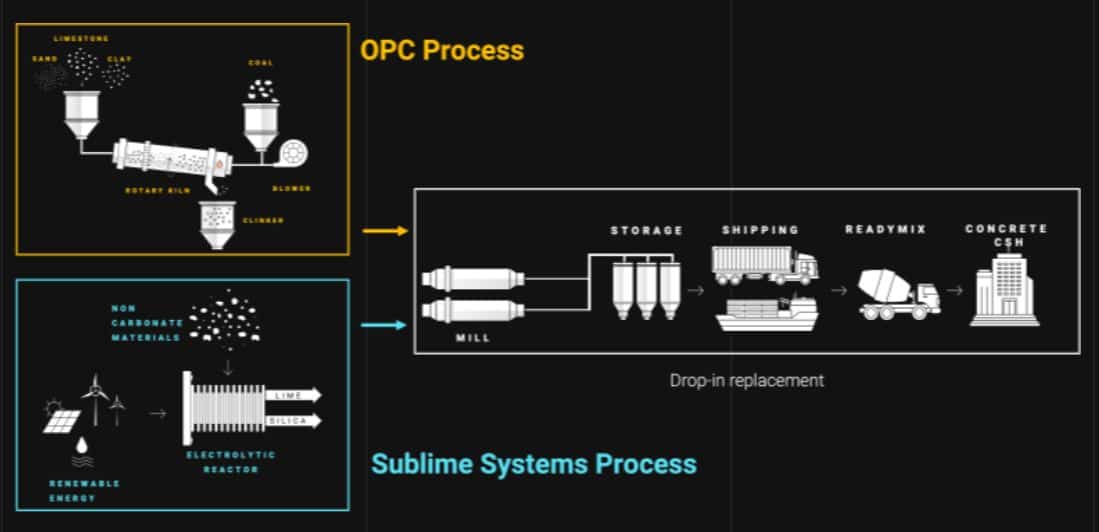
Sublime Systems green cement production
OPC = Ordinary Portland Cement

To appreciate the groundbreaking work of Sublime Systems, it’s essential to understand the conventional cement-making process and its environmental challenge.

Cement, when combined with water, sand, and gravel, forms concrete – the world’s second-most-used substance after water. This process has been unchanged for centuries:

  1. Raw materials, primarily limestone and clay, are heated in kilns to temperatures exceeding 1,400 ยฐC (2,500 ยฐF).
  2. Achieving these temperatures necessitates the burning of coal or other fossil fuels, leading to substantial carbon dioxide emissions.
  3. The chemical reactions in the kilns further release carbon dioxide, which often escapes into the atmosphere, exacerbating the greenhouse effect.

Sublime’s Innovative Approach: A Deep Dive

The Massachusetts-based company is not merely tweaking the existing process; they’re reinventing it. Their method hinges on two primary innovations:

  • Electrochemical Reactions: Instead of relying on high temperatures, Sublime uses electrochemical reactions to produce cement. This approach eliminates the need for burning fossil fuels, significantly reducing carbon emissions.
  • Renewable Energy Integration: By using electricity to fuel these reactions, Sublime’s plants can potentially harness renewable energy sources like solar and wind. This shift not only reduces emissions but also aligns with global renewable energy goals.

While their process is unique, what Sublime produces still adheres to strict industry standards. Theyโ€™re producing high-performance, low-carbon cement that has similar strength, durability, slump, and set time as the cement used today. Their fossil-fuel-free cement has obtained ASTM C1157 designation, a performance-based industry standard.

Because their system avoids carbon emissions altogether, thereโ€™s no extra expense needed. Thereโ€™s also no need for using carbon capture, utilization, and storage (CCUS) technology.

Sublimeโ€™s technology innovations enable them to finally make a true zero-carbon cement for millennia to come. Its environmental benefits cannot be overstated. If successfully scaled, their method could slash cement-related emissions by an impressive 90%.ย 

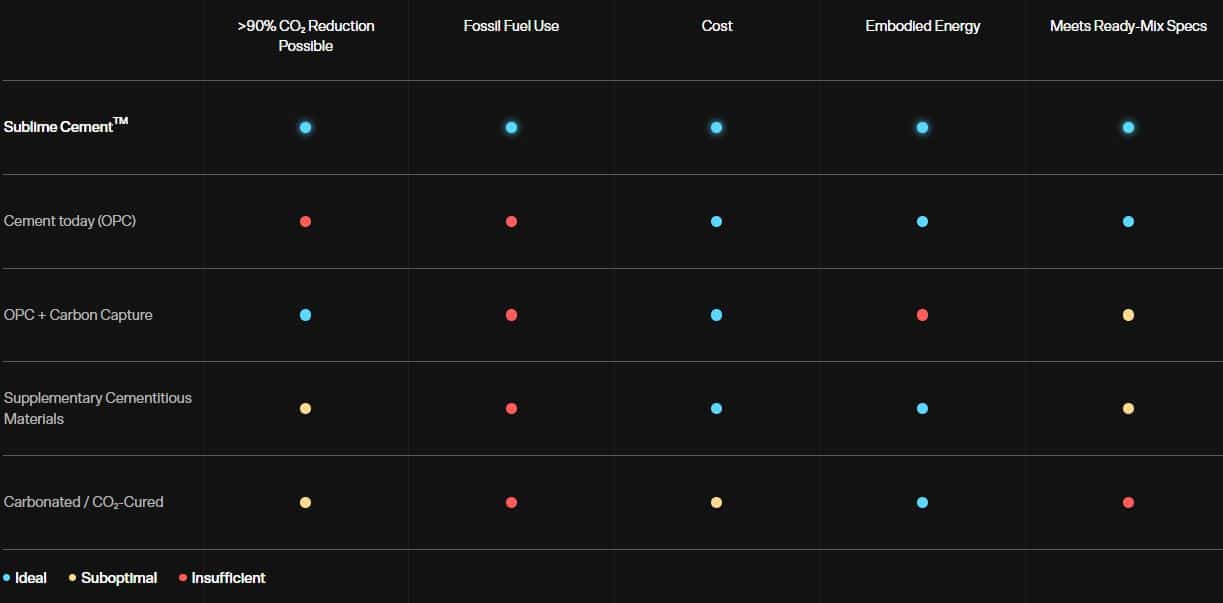
Moreover, by potentially offering cost-competitive solutions, Sublime presents a compelling economic and environmental case for its adoption in the broader industry. Here’s how the startup’s cement product compares to other systems.

Sublime Cement vs other systems

Challenges and Future Prospects

Innovation, while exciting, often comes with hurdles. Sublime’s cement, though functionally similar to traditional cement, has a unique production pathway. This difference might be met with skepticism in the traditionally conservative construction sector.ย 

New materials and technologies face rigorous testing and validation before gaining widespread acceptance.

Additionally, scaling up electrochemical processes is no small feat. It presents potential engineering challenges, from ensuring consistent reactions in larger tanks to procuring the necessary equipment for mass production. These challenges, coupled with the need for substantial capital investment, mean that Sublime’s journey ahead is both promising and demanding.

Despite this, Sublime Systems has showcased remarkable progress. From humble beginnings with small-scale reactions in an MIT lab, they’ve evolved to a pilot facility producing around 100 tons of cement annually.ย Their roadmap is ambitious, with plans for a larger facility by 2026 and a full-scale commercial plant by 2028.

In the interim, Sublime is focused on real-world testing. They aim to construct installations using their cement, from sidewalks to patios, to validate their product’s quality and durability.

Industry estimates show that 70% of the infrastructure needed by 2050 to house the growing population remains unbuilt. This calls for a challenging balance between global construction goals with emissions reductions targets.

A low-carbon innovation like Sublime’s becomes crucial to both meet such infrastructure demand as well as the performance of cement production standards.

Sublime Systems stands at the forefront of a green revolution in cement production. If successful, their innovative approach could set a new industry standard, blending sustainability with functionality. As the world grapples with the pressing challenge of climate change, companies like Sublime Systems offer a glimmer of hope, leading the way towards a more sustainable future.

Trane Technologies Unleashes AI Power to Cut Building Emissions by 30%

Trane Technologies launched its new AI and cloud-based tool that seeks to help building owners and facility managers reduce energy consumption and hasten decarbonization efforts.ย 

Trane Technologies is a global climate innovator that offers efficient and sustainable climate solutions to buildings, homes, and transportation. Its new offering, Trane Autonomous Control Powered by BrainBox AI, uses artificial intelligence to automatically identify and implement optimization actions.ย 

Slashing Building’s Carbon Emissions

The new AI-powered tool is an HVAC optimization solution that connects to existing climate control systems. It sends real-time, optimized control commands that help lower energy use and minimize carbon emissions.ย 

The new technology also features predictive weather data and occupancy trends, improving overall building performance and sustainability.

Buildings are a significant contributor to carbon emissions, representing 15% of global emissions while accounting for about 40% of global energy-related emissions. In the United States, they account for over 30% of all greenhouse gas emissions.ย 

Not to mention that theyโ€™re one of the hardest emission sources to replace, simply due to their nature.ย 

According to the Energy Information Administration (EIA), there are around 6 million buildings in the U.S., not including residential. In Canada, there are 500,000 buildings to take into account.ย 

By contributing significantly to carbon pollution, buildings become a prime target for emission reductions, including Trane Technologies.

Donny Simmons at Trane Technologies emphasized the importance of their new offering, saying:

โ€œ… the demand for more sustainable building solutions grows each day. Leveraging innovative AI-enabled solutions is one of many ways we are helping customers dramatically reduce their carbon footprints, while meeting business goals and doing the right thing for the planet.โ€

The company said that it tested the Autonomous Control in multiple sites with a client in the U.S. The results show significant energy performance improvements and substantial CO2 emissions reductions of over 30% across 100+ facilities.ย 

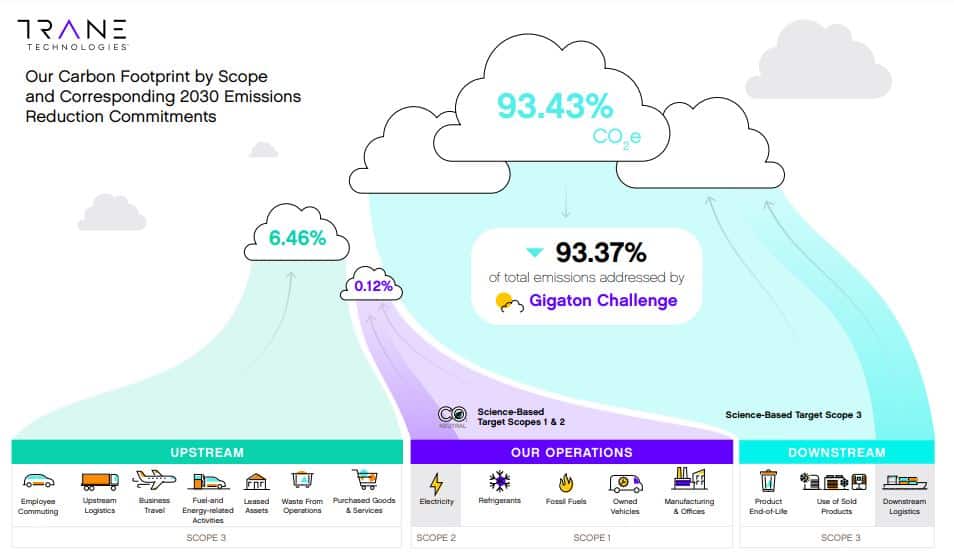
Back In 2019, Trane launched the Gigaton Challenge with the aim to reduce 1 billion metric tons of CO2 from its customersโ€™ footprint by 2030. The company said that the new AI-powered tool will support its Gigaton Challenge as well as its sustainability targets.ย 

Trane Technologies Net Zero Targets

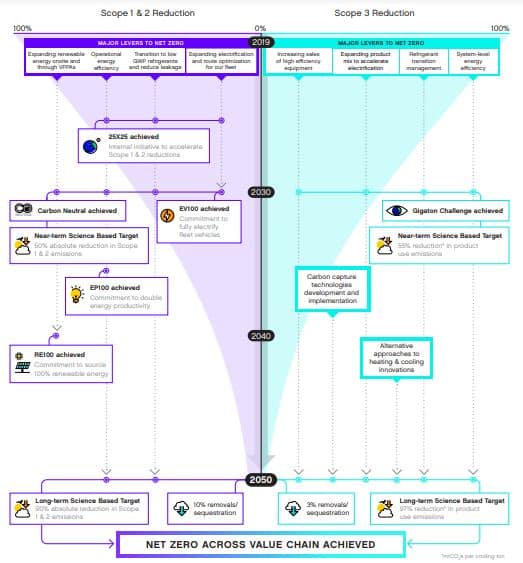
The company committed to reaching net zero emissions by 2050, or a 90% reduction in emissions across its entire operations.ย 

Trane Technologies Net Zero Roadmap

Trane Technologies net zero roadmapIn the near term, the company aims to cut Scope 1 and 2 emissions 50% below 2019 levels by 2030.ย 

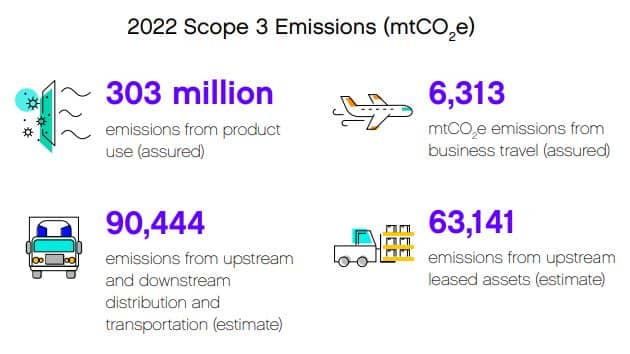
Scope 3 – product use and supply chain – represents the vast majority of the companyโ€™s total carbon emissions. To address this, Trane pledges to reduce Scope 3 emissions by 55% per cooling ton vs. 2019 baseline by 2030. This target increases to 97% by 2050.

Trane scope 3 emissions 2022In 2022, Trane reduced Scope 1 and 2 carbon emissions by over 27,000 metric tons of CO2 versus 2021. The company also achieved a 43% reduction in operational emissions intensity and a 25% reduction in location-based emissions from the 2019 level.ย 

The company has been employing various measures to reach its 2050 net zero targets. And focusing on its Gigaton Challenge is the key to it.ย 

Trane Technologies carbon emissionsLaunching the Autonomous Control in collaboration with BrainBox AI will significantly contribute to Traneโ€™s sustainability and net zero efforts. With over 1 million connected devices, the new tool will provide great insights into building emissions.ย 

The technology developer, BrainBox AI, said that itโ€™s expanding the AI tool for commercial real estate to multi-site retail portfolios. The AI firm was also awarded by Canadaโ€™s largest financier of sustainable (SMEs) businesses, Sustainable Development Technology Canada, with over $6 million.ย 

In summary, Trane Technologies’ new AI and cloud-based tool is designed to enhance energy efficiency, reduce carbon emissions, and contribute to the companyโ€™s sustainability and net zero targets. If more companies in the sector follow the same path, the world will be much closer to decarbonizing buildings and other built environments.

Isometric Launches Groundbreaking Standard for Carbon Removal Credits

Isometric, a fascinating carbon removals startup, launched its new Isometric Standard that outlines the most stringent set of rules for carbon removals.ย 

The London and New York-based company is building the worldโ€™s first independent and transparent registry for durable carbon removal credits. They have pioneered a new, innovative approach that tackles the issues confronting the traditional carbon offset market.

Isometric: Scientific Platform and Registry for CDR

Founded in 2022, Isometric aims to provide the technology necessary to scale up the nascent carbon dioxide removal (CDR) industry. They report data and verification results from a vast network of partners on their science platform and public registry.ย 

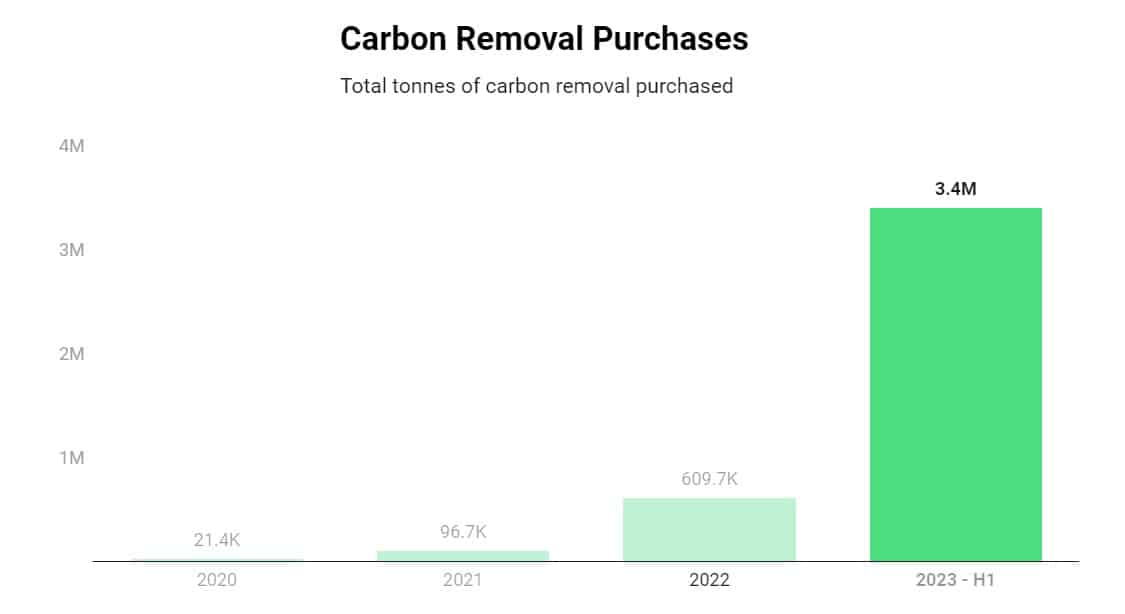
The goal is to bring more confidence in the market and propel buyers to make even bigger purchases. This year’s first half reported purchases show that the industry is poised for growth.

carbon removal credits
Source: CDR.fyi

While Isometric seeks CDR to scale fast, it ensures that the growth is responsible. The company is a team of experts building two products to ensure such growth.ย 

First is the Science Platform: built to help carbon removals scale fast. Here, the scientific experts work together to accelerate alignment with high quality standards.ย 

The platform enables CDR suppliers to host and visualize their removal data and protocols clearly and consistently.

Second is Isometricโ€™s Registry: created to ensure CDR scales responsibly. It allows Isometric to publish verified carbon removal records scientifically, transparently, and in collaboration with the right experts.ย 

The company believes that the CDR industry, though it currently removes only a few kilo tons of CO2, will grow at a pace and rate needed to remove gigatonnes of CO2 each year.

Carbon removals have significant tailwinds. Last year, the Energy Department had pledged $3.7 billion to build the CDR industry in the U.S. Likewise, the UK has plans to amend its Emissions Trading Scheme to welcome engineered or technological carbon removals.

The CDR can be a huge part of the next $1 trillion industry, but with the right rules. This is what the Isometric Standard aims to achieve – providing the right framework for carbon removal credits.ย 

What is The Isometric Standard?

Remarking on the launch of the Standard, Eamon Jubbawy, CEO & Founder of Isometric, said that theyโ€™re raising the bar for carbon credits. He further noted that:

“Rebuilding trust in the Voluntary Carbon Market requires both rigorous science and transparencyโ€ฆThe Isometric Standard represents an opportunity for the carbon removal industry to rise to meet the urgent challenges we face.”

The Isometric Standard recognizes only carbon credits that can prove that they actually have removed CO2 from the atmosphere. The captured CO2 must also be stored permanently and quantifiable through long-duration timelines, mostly for >1,000 years.ย 

The Standard doesnโ€™t include โ€œavoidanceโ€ carbon credits. This type of carbon credit is associated with nature-based climate solutions such as reforestation.ย 

Isometric Standard also does not deal with carbon credits generated by projects that run the risk of temporary CO2 storage. For example, tree-planting initiatives face this risk because of wildfires.ย 

Moreover, the Standard is a product of a collaboration among over 150 expert scientists that follows a trusted approach. The public can investigate fully the calculations behind each carbon removal credit listed on Isometricโ€™s platform.ย 

In other words, the Standard builds on trust and transparency in generating carbon credits.ย 

Fostering Climate Action With Durable CDR

With scientific rigour and radical transparency, the Isometric Standard offers an opportunity for the fast-growing carbon removal industry to prevent issues plaguing the market, particularly greenwashing.

The Standard guides Isometric Crediting Program in two unique ways. First, it provides guidance and transparent infrastructure fostering high quality climate action in the form of durable removals of COโ‚‚. Second, it issues verified credits as proof of the ownership of removal claims and reporting purposes.ย 

It also lists all the requirements which ensure that delivered tonnes have measurable and verifiable climate impact. It also sets out the duties and obligations of stakeholders in relation to the Isometric Registry.ย ย 

The credited tonnes of removal must be durable, additional, and measured using the latest scientific methods. All the requirements and rules for crediting are laid out in the Standard, including issuance, retirement, reversals, and buffer pools.ย 

Offering the foundation of trust in CDR credits, the industry can grow to the scale the world needs to stay within the 1.5C warming threshold. When the stakes are high, the standards need to match.ย 

By focusing on transparency, permanence, and rigorous science, Isometric Standard provides a framework that can help the carbon removal industry flourish while ensuring that carbon credits genuinely contribute to a greener future.

Global Mining Expanding Capex and Committing to Net Zero

The mining industry is emblematic of economic cycles, surging during booms and contracting in busts.ย 

However, it’s important to note that this projection is still significantly below the 2013 peak of $145.7 billion.

Why is this relevant? It illustrates that these giants of industry may yet have considerable runway before reaching their zenith of expansion endeavors.ย 

As the years advance, miners will grapple with mounting inflation, rising interest rates, and decelerating economic activities. This challenging financial landscape might lead to a slight dip in capex, by 1.8% in 2024 and a further 0.7% in 2025.

Global Miners’ Capex and Net Zero Targetsย 

Several pivotal players dominate the scene, including the following mining giants. Each of the miners set their own net zero targets, with increasing commitment to sustainable mining.

BHP Group Ltd.

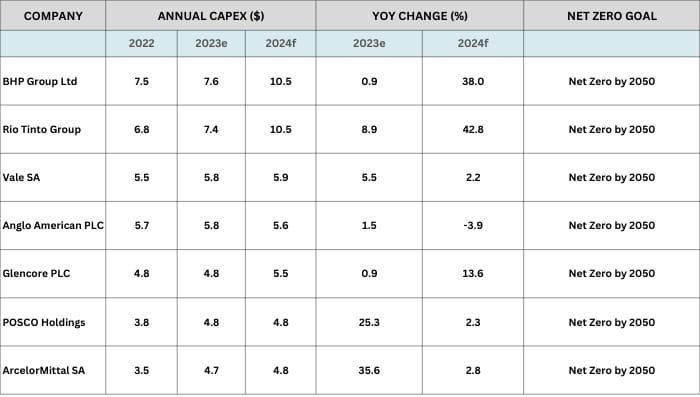
Earmarking $7.6 billion for 2023, the miner particularly focuses on its Jansen mine in Canada. BHP’s long-term strategy integrates operational decarbonization, allocating a sizable budget of $4 billion towards this cause by 2030.ย 

Just like ArcelorMittal, BHP also doesnโ€™t include Scope 3 emissions in its 30% reduction target by 2030 versus 2020 levels. It only covers operational emissions or Scope 1 and 2, including methane emission reductions. BHP aims to achieve net zero emissions by 2050.

Rio Tinto Group

With a capex guidance of $7.4 billion in 2023, Rio Tinto aims to enhance its projects like the Simandou iron ore deposit in Guinea and the Salar del Rincon lithium project in Argentina. Their longer-term vision is growth-centric, targeting a hefty investment of up to $10 billion for 2024 and 2025.

The mining company aimed for net zero emissions by 2050, in alignment with the Paris Agreement. To achieve this goal, the company sets a 15% reduction in direct and indirect emissions by 2025, and 50% by 2030, based on the 2018 levels.ย 

Vale SA

Vale plans to allocate around $6 billion in 2023, distributing funds across a variety of projects, including the Onca Puma mine’s furnace and the ramp-up of the Serra Sul operation.

The mining firm aims to achieve net zero emissions by 2050, while seeking to slash scope 1 and 2 emissions by 33% by 2030. It also plans to reduce scope net emissions by 15% by 2035. Last year, the miner emitted a total of over 486 million tonnes of CO2e, 98% of which accounted for Scope 3 emissions.

Anglo American PLC

The mining giant adjusts its 2023 capex vision to $6.0 billion, with an emphasis on projects like the Woodsmith polyhalite venture in the UK and the ramp-up related to the Quellaveco copper mine in Peru.ย 

Anglo American aims to reduce net GHGs emissions by 30% against the 2016 baseline by 2030. The minerย also has set a lofty goal of becoming carbon neutral, for Scope 1 and 2, across operations by 2040. This climate goal also entails slashing Scope 3 emissions by 50% by the same period.

Glencore PLC

Glencore projects an investment of approximately $4.8 billion in 2023, channeling funds towards diverse projects like the Collahuasi copper joint venture in Chile and the Zhairem zinc project in Kazakhstan.ย 

In the short term, Glencore plans to reduce emissions across all three scopes by 15% by 2026 and 50% by 2035 against its 2019 base year. In the long-term, the mining major aims to reach net zero emissions by 2050 same as most of the others.ย ย 

Posco Holdings Inc.

This giant miner demonstrates a commitment to sustainability, emphasizing eco-friendly ventures. With a projected capex of approximately $4.8 billion in 2023, Posco’s goals include magnifying its production of cathode, anode, and lithium materials by 2030.

Same with Vale, Posco also committed to reach carbon neutrality or net zero by 2050. Its net zero roadmap says it will cut emissions gradually – 10% by 2030, 50% by 2040, and net zero by 2050. The baseline level is total emissions from 2017-2019. Alongside carbon abatement efforts, the mining firm also set a goal to achieve avoided emissions by 10% by 2030.

ArcelorMittal SA

ArcelorMittal commits between $4.5 billion and $5 billion to capex.ย Using various levers, ArcelorMittal seeks to achieve a 25% reduction in CO2 emissions by 2030. That includes Scopes 1 and 2 only, excluding Scope 3 emissions.

Plus, the miner is aiming to be the worldโ€™s first full-scale zero carbon emissions steel plant in Sestao by 2025, and reach net zero by 2050, too.

mining giants capex and net zero
CAPEX data from S & P Global

Profit and Planet in One Mine

The cumulative capex of the top ten mining conglomerates is forecasted to comprise a substantial 50.8% of the overall capex of the top 30 miners in 2023. While projections reveal robust financial performance in 2023, there’s an underlying quandary these titans face.ย 

As global demands evolve, the mainstay for miners will pivot towards critical metals, transition to clean energy, and operational decarbonization. The question remains: can these behemoths navigate these treacherous waters successfully, balancing both profit and planet?

As the mining industry accelerates its capital investments, the terrain becomes increasingly multifaceted. As they dig deep, these global giants must strike a harmonious balance, ensuring sustainable growth, adapting to an ever-evolving market, and fostering a commitment to a greener planet. Only time will reveal if these mountains of industry can unearth a golden future.