Study Finds Carbon Offsets Failing to Deliver Real Climate Impact

A new peer-reviewed study suggests that most carbon offset programs have failed to deliver real reductions in greenhouse gas emissions. The study in the Annual Review of Environment and Resources (2025) finds that offsets, credits companies buy to offset their emissions, haven’t significantly slowed global warming.

The authors, led by climate scientist Joseph Romm, reviewed over ten years of data. They found that most offsets are tied to projects that would have occurred regardless. This means that many credits do not represent genuine emission reductions.

Carbon offsets are a cornerstone of corporate climate strategies. Despite billions in voluntary carbon markets (VCM), global carbon dioxide levels hit a record 424 parts per million in 2024, says the World Meteorological Organization. The study claims that offset systems, as they are now, provide more accounting ease than real benefits to the atmosphere.

Why Most Carbon Credits Miss the Mark

The paper identifies three main reasons why offsets have underperformed.

First, “additionality” — the idea that a project must only exist because of offset funding — is often not met. Many renewable energy and forest conservation projects would likely move forward without carbon credit revenue.

Another research from 2024 shows that about 87% of VCM offsets likely do not provide real and additional emission reductions. This widespread failure mainly comes from project designs that give too much credit to common renewable energy and forest conservation efforts. Many of these would have happened even without the projects.

Second, measurement and permanence are major issues. Forest-based credits account for about 40% of the voluntary carbon market. They can lose stored carbon due to wildfires, drought, or illegal logging. Studies cited in the review show that over 90% of forestry offsets examined failed to guarantee long-term carbon storage.

Third, double-counting remains common. Some emissions reductions are claimed by both the project developer and the host country, undermining integrity.

Some forest offset projects fail to consider leakage. This means emissions may shift to other places, leading to over-crediting. Similar estimates show that more than half of the offsets in different carbon markets may face double-counting or overstatement.

The result, according to Romm’s team, is that less than 10% of offsets on the market deliver genuine, measurable, and lasting emission cuts.

The Scale of the Problem: Billions in Doubt

The voluntary carbon market was once expected to reach $50 billion by 2030, driven by corporate net-zero pledges. But growth has slowed sharply since 2022, as buyers question credit quality and reputational risk increases.

carbon credit market value 2024

Market value fell by more than 60% between 2022 and 2024, according to BloombergNEF. Major companies like Nestlé, Gucci, and EasyJet have reduced offset purchases. Instead, they are focusing on funding direct emission cuts in their operations.

Over 1.5 billion carbon credits are still in circulation. This accounts for over a billion tonnes of claimed emission reductions, despite the slowdown. The study warns that if these credits lack real-world carbon removal, they might delay climate action. This is because they create a false sense of progress.

Rebuild or Retreat? How the Carbon Market Fights for Credibility

The study’s findings have triggered strong reactions across the carbon market. Many organizations see the problems. They argue for reform instead of giving up.

The Integrity Council for the Voluntary Carbon Market (ICVCM) is an independent global group. In 2024, it launched its Core Carbon Principles (CCPs). These rules set minimum standards for quality, transparency, and permanence. ICVCM began approving credits that meet its criteria in 2025, with the goal of restoring buyer confidence.

Similarly, major registries like Verra and Gold Standard have updated their methodologies. Verra now requires projects to provide verified, real-time monitoring data. They must also account for climate risks like fire and deforestation.

Gold Standard has shifted its focus from offsets to “climate contributions.” This change pushes companies to invest more in reducing emissions, not just compensating for them.

Industry experts noted that the industry must “shift from quantity to quality.” They emphasized that strong verification systems and independent audits can help rebuild trust.

Even governments are stepping in. At COP30 in Belém, Brazil (2025), negotiators plan to finalize the global rules for carbon trading under Article 6 of the Paris Agreement. These rules will define how international credits can be traded without double-counting.

Examples of New Approaches

Some initiatives are emerging to fix long-standing issues.

  • Technology-based removals: Startups like Climeworks and Charm Industrial are producing credits based on direct air capture and bio-oil sequestration. These methods store carbon permanently, though they remain costly — up to $600 per tonne.
  • Jurisdictional forest programs: Countries like Indonesia and Gabon are piloting large-scale carbon programs that use satellite monitoring to ensure transparency.
  • Corporate reform: Companies like Microsoft and Delta Air Lines will only buy credits from projects that show real, lasting carbon removal. They won’t focus on avoided emissions anymore.

These changes show a shift from offsetting emissions to removing carbon. This aligns better with science-based targets. The timeline below shows major developments in the carbon offset market. 
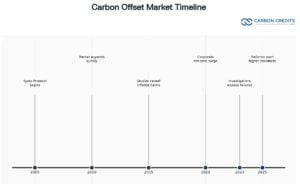
carbon offset market timeline

What the Data Really Says About Climate Accounting

The Annual Review study makes a clear recommendation: carbon offsets should no longer be used as a substitute for direct emission cuts. Instead, they can play a role in funding innovation or supporting communities during the transition.

Romm and his team say that governments need to stop using low-quality offsets. They also want strict global oversight. They warn that without reform, carbon markets may face the same credibility issues. This could lead to public backlash like the one seen in 2023 and 2024.

Still, the authors acknowledge that offset mechanisms can evolve. “Offsets could help if they fund projects that remove carbon permanently and are verified transparently,” the paper notes.

Beyond Offsets: Toward a Stronger and More Honest Market

Despite criticism, few expect the voluntary carbon market to disappear. Instead, it is likely to become smaller but more credible. BloombergNEF analysts estimate that a strong market could hit $30 billion each year by 2035. Also, the MSCI forecasts it could reach up to $35 billion in 2030. This growth will come from verified carbon removals and compliance-linked credits.
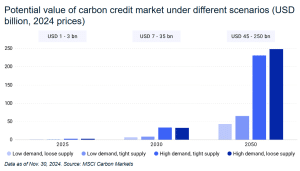
carbon credit market value 2050 MSCI

The broader transition is also creating new demand for accountability. Investors, regulators, and consumers want companies to show how they verify offsets. They also want to see how these offsets fit into long-term plans for reducing carbon emissions.

The Integrity Council’s certification process and the UN’s Article 6 rules are expected to shape the next decade of carbon trading. They could remove low-quality projects and direct funding to real climate solutions.

The study delivers a tough message: the world cannot buy its way out of the climate crisis. Offsets, as they exist today, have not slowed global warming. The new wave of reforms shows that transparency and integrity might make carbon markets part of the solution.

For now, the future of offsets depends on whether companies, investors, and regulators can rebuild trust, shifting from promises on paper to real-world carbon reduction and removal.


Brookfield’s $20B Close Sets Record for Global Clean Energy Funding

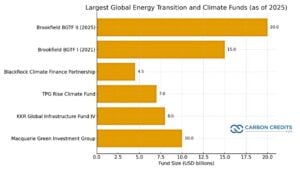
Brookfield Asset Management has raised 20 billion U.S. dollars for its second global energy transition fund. This makes it the largest private fund ever created for clean energy and decarbonization projects.

The fund, called the Brookfield Global Transition Fund II (BGTF II), will invest in renewable energy, carbon capture, nuclear, and other low-carbon solutions worldwide. Brookfield said the fund exceeded its target.

The company will commit about 25 percent of the capital from its own balance sheet, showing strong confidence in the opportunity. More than 200 global investors joined the fund, including major pension funds, sovereign wealth funds, and insurers.

Brookfield also secured 3.5 billion dollars in co-investments from partners that will join in large projects. The firm has already deployed $5 billion from the fund into new projects. This shows a quick start in building clean energy infrastructure on a large scale.

From BGTF I to BGTF II: Bigger, Broader, and More Ambitious

Brookfield’s first transition fund, BGTF I, launched in 2021 with $15 billion. It focused on renewable power, carbon capture, battery storage, sustainable aviation fuel, and nuclear services through Westinghouse.

That first fund achieved strong performance. Brookfield says BGTF II now targets a net internal rate of return (IRR) of about 12%, slightly higher than the goal of the first fund.

BGTF II builds on that experience and scale. It seeks to change carbon-heavy industries, grow clean energy, and back technologies that reduce emissions. The company manages over $850 billion in assets. This gives it the reach and skills to handle a large platform.

Connor Teskey, President of Brookfield Asset Management, remarked:

“Energy demand is growing fast, driven by the growth of artificial intelligence as well as electrification in industry and transportation. Against this backdrop we need an ‘any and all’ approach to energy investment that will continue to favor low carbon resources. Our strategy will succeed by investing in the technologies that will deliver clean, abundant, and low-cost energy and transition solutions that underpin the global economy.”

Where the Money Will Go

BGTF II focuses on three major investment areas:

  • Clean energy expansions, such as wind and solar projects.
  • Transition technologies include battery storage, grid modernization, carbon capture, and next-generation nuclear.
  • Sustainable solutions that cut emissions in industries and transportation.

Early investments already include Neoen in France, Geronimo Power in the United States, and Evren in India. These projects plan to create more than 10 gigawatts of clean energy. They will use wind, solar, and battery storage.

Brookfield plans to deploy capital across North America, South America, Europe, and the Asia-Pacific region. The company is expanding into emerging markets, such as India and Brazil, where energy demand is increasing rapidly. Clean power investments can also make a big social impact.

Brookfield Renewable Partners global operations

Brookfield now oversees over 200 gigawatts of renewable power. This capacity, built or in development, can supply electricity to hundreds of millions of homes worldwide. 

Record Scale in a Fast-Changing Market

The 20-billion-dollar fund comes at a time of record investment in clean energy. The International Energy Agency reports that global renewable power investment hit 680 billion dollars in 2024. Total energy transition funding also exceeded 1.7 trillion dollars.

energy investment 2025 IEA report

Private infrastructure investors can raise over 2 trillion dollars by 2030 for clean energy projects. Brookfield’s new fund shows how private capital is stepping in to meet that demand.

The size of BGTF II sets it apart from rivals. It surpasses other large climate funds managed by firms like BlackRock, KKR, TPG, and Macquarie. Many analysts see it as proof that energy transition investments are moving from a niche market to the financial mainstream.

global energy transition fund brookfield

Some of the world’s biggest investors have backed the fund. Sovereign wealth funds from the Middle East, European pension plans, and large insurers all made multi-billion-dollar commitments. Strong demand allowed Brookfield to close the fund early and above target.

Beyond Returns: ESG with Real-World Results

Brookfield’s first transition fund, BGTF I, helped avoid over 100 million tonnes of CO₂ emissions. This was achieved through the projects it financed. The new fund, BGTF II, is expected to double that impact over the next decade.

The company says its clean energy projects create tens of thousands of skilled jobs. These jobs are in construction, operations, and maintenance worldwide. In emerging markets such as India and Brazil, new renewable projects are creating steady jobs. They are also boosting local economies.

BGTF II boosts Brookfield’s role as a top investor in sustainable infrastructure from an ESG perspective.

  • Environmental: The fund supports renewable generation, energy storage, and industrial decarbonization — key areas for cutting emissions.
  • Social: The projects promote local job creation and responsible sourcing.
  • Governance: Brookfield promises clear ESG reporting. They provide third-party checks on emissions cuts and metrics for investors.

These steps align with global net-zero goals and contribute to keeping global temperature rise below 1.5 degrees Celsius.

Why It Matters: The Private Capital Shift to Clean Power

Brookfield’s new fund is a signal of how the global energy system is changing. The rise of artificial intelligence, data centers, and electric vehicles is driving rapid growth in electricity demand. At the same time, governments are tightening climate policies and pushing for more clean power capacity.

Funds like BGTF II help fill the gap between public targets and real-world project financing. Private capital can move faster than government budgets and can help deliver clean energy solutions at scale.

The fund also shows that investors see climate projects as long-term infrastructure instead of short-term experiments. Stable cash flows from renewables and storage assets attract institutions. They seek both returns and a positive impact.

Building the Next Generation of Clean Energy

Brookfield plans to deploy BGTF II’s capital over the next 5 to 7 years. Early focus areas include North America, Europe, India, and Latin America — regions with clear climate policies and rising energy demand.

If executed well, the fund could help close the global investment gap in clean power and low-carbon infrastructure. It will show that sustainability and profitability can go hand in hand, and it works best with strong management and scale.

Brookfield’s 20-billion-dollar Global Transition Fund raise marks a milestone in global finance. It shows how private capital can drive the shift toward low-carbon growth — helping to build the next generation of clean energy systems, one project at a time.

Solar Now the World’s Cheapest Energy, Powering the Clean Transition

Solar energy has officially claimed the title of the world’s most affordable source of electricity. According to new research from the University of Surrey’s Advanced Technology Institute (ATI), solar power now costs as little as £0.02 per kilowatt-hour in the sunniest regions.

The study, published in Energy and Environmental Materials, highlights how solar photovoltaic (PV) technology has transformed from a niche innovation into the backbone of the global clean energy revolution.

As countries race to cut carbon emissions and combat climate change, the rapidly falling cost of solar power is unlocking access to clean energy on an unprecedented scale.

Solar Becomes the Cornerstone of a Low-Carbon Future

Professor Ravi Silva, co-author of the study and Director of the ATI, emphasized that even in less sunny nations like the UK, solar power has become the most cost-effective option for large-scale generation.

He precisely noted,

“Even here in the UK, a country that sits 50 degrees north of the equator, solar is the cheapest option for large-scale energy generation. Globally, the total amount of solar power installed passed 1.5 terawatts in 2024 – twice as much as in 2020 and enough to power hundreds of millions of homes. Simply put, this technology is no longer a moonshot prospect but a foundational part of the resilient, low-carbon energy future that we all want to bring to reality.” 

This milestone shows that solar energy is no longer experimental. It’s a proven cornerstone of the low-carbon future the world is building toward.
Alongside solar, the cost of lithium-ion batteries—key to storing renewable power—has dropped by a staggering 89% since 2010. This sharp decline has made solar-plus-storage systems a competitive alternative to conventional gas-fired power plants.

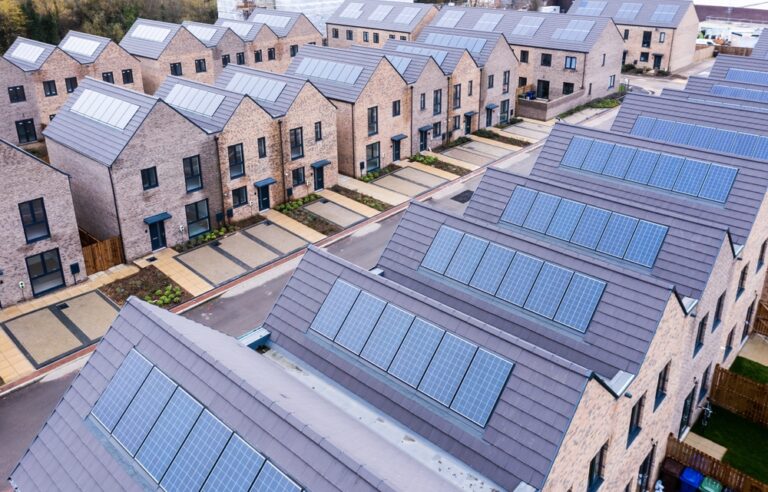
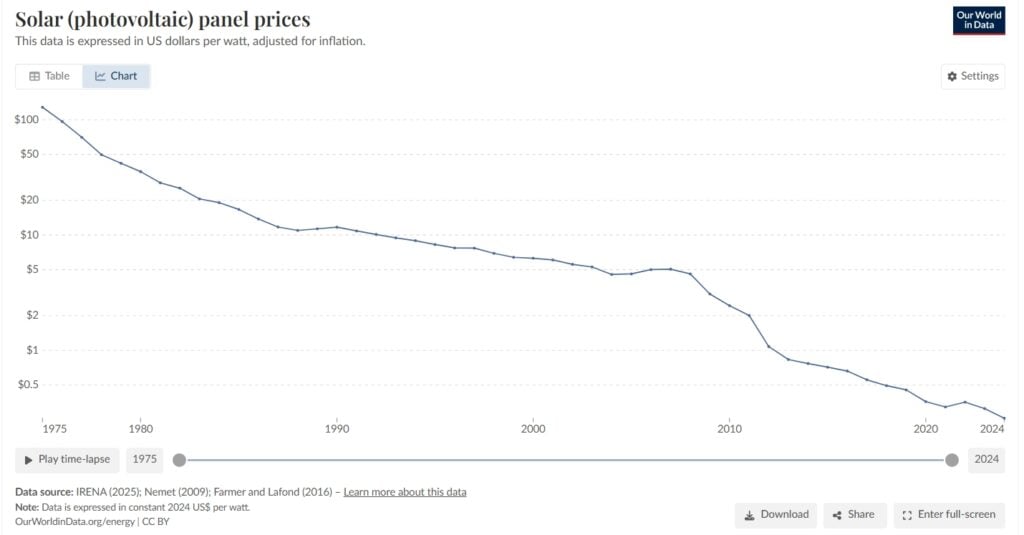
Solar panel price

Global Solar Costs Fall Over 80% in a Decade

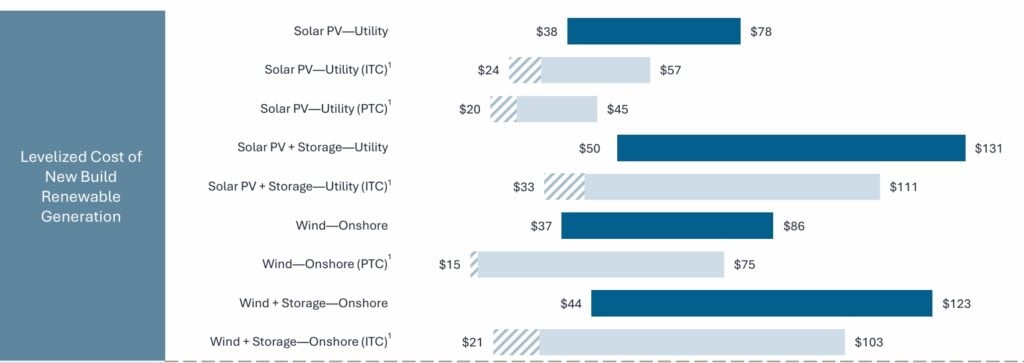
According to the International Renewable Energy Agency (IRENA), the global weighted-average levelized cost of electricity (LCOE) for utility-scale solar PV dropped by over 80% between 2010 and 2023. In sun-rich regions, it now costs as little as $0.03 per kilowatt-hour—making it the cheapest source of new electricity generation worldwide.

This steep decline stems from a mix of technological, economic, and policy factors. Breakthroughs in solar cell efficiency, bifacial modules, and tracking systems have dramatically boosted energy output.

Also, competitive auctions and long-term power purchase agreements (PPAs) have made solar development more transparent and efficient. Industry experience has also cut costs for installation and maintenance.

Today, solar PV is cheaper than coal, gas, and even wind in many markets, shifting the question from “Why choose renewables?” to “How fast can we deploy them?”

Levelized Cost of Energy Comparison—New Build Renewable Generation

Cost of renewable solar
Source: Lazards Report

China’s Role in Falling Clean Energy Costs

Meanwhile, bigger economies, especially from large-scale manufacturing in China, have lowered hardware and installation costs.

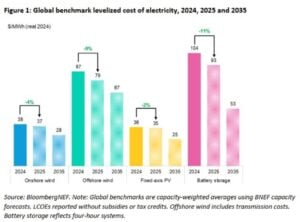
Bloomberg also expects the cost of clean energy technologies, i.e., solar, wind, and battery storage, to drop further in 2025. It could be falling 2–11% and breaking last year’s records. In almost every part of the world, new solar and wind farms are now cheaper to build and operate than new coal or gas plants

Significantly, China’s overcapacity in clean tech has led some countries to impose import tariffs, temporarily slowing cost declines. Still, BNEF expects levelized costs for clean energy to fall 22–49% by 2035, keeping renewables on track for long-term growth.

  • Battery storage costs dropped a third in 2024 to $104/MWh, driven by oversupply from slower EV sales, with prices expected to cross $100/MWh in 2025.
  • Fixed-axis solar farms fell 21% globally, while wind and solar generation costs are projected to decline another 4% and 2%. It ensures clean energy remains cheaper than fossil fuels.
clean energy costs solar
Source: Bloomberg

Storage Revolution: Solar Power Around the Clock

The global energy storage boom has turned solar from an intermittent resource into a 24-hour power solution. It’s because of the massive cost reductions in batteries, solar-plus-storage systems can now compete head-to-head with gas-fired plants.

However, challenges remain in connecting large volumes of solar power to existing grids. Regions like California and China have already experienced energy curtailment due to grid congestion when solar output exceeds demand.

Dr. Ehsan Rezaee, co-author of the University of Surrey study, noted that “smart grids, artificial intelligence forecasting, and stronger regional interconnections will be essential to maintain power system stability as renewable adoption grows.”

Global Policy Boosts vs. U.S. Uncertainty

Supportive policy frameworks are key to sustaining solar’s momentum. In Europe, the Green Deal and RePowerEU initiatives have simplified permitting and set aggressive renewable targets.

India’s Production Linked Incentive (PLI) scheme, meanwhile, is strengthening local solar manufacturing to reduce dependence on imports. These measures are not only cutting carbon emissions but also advancing energy security, job creation, and economic growth.

International partnerships, such as the International Solar Alliance (ISA), continue to drive collaboration, knowledge exchange, and capacity building, particularly in developing nations that stand to benefit most from affordable solar energy.

OBBBA: Dimming the Sunshine 

However, the story is slightly different in the U.S. In July 2025, President Trump signed the One Big Beautiful Bill Act (OBBBA), which speeds up the phase-out or early termination of most renewable energy tax credits and clean energy incentives established under the IRA.

As a result, U.S. clean energy incentives are being rapidly scaled back, with many tax credits set to expire or face new restrictions and deadlines, creating significant uncertainty for investors and project developers.

Breakthrough Technologies Drive the Next Wave

Solar technology innovation is accelerating at record speed. Researchers at the University of Sydney recently achieved a world-first breakthrough with a 16 cm² triple-junction perovskite solar cell delivering 23.3% efficiency for large-area devices. A smaller version reached 27.06% efficiency—the highest globally—and retained 95% performance after 400 hours of continuous operation.

Perovskite solar cells could revolutionize the market by boosting energy output by up to 50% without expanding land use. They can be made as thin, flexible films at lower temperatures than traditional silicon panels, cutting production costs significantly. Over the past decade, perovskite efficiency has soared from 3% to over 25%, with tandem cells poised to exceed 30%. These innovations will further drive down solar costs and expand applications across rooftops, vehicles, and portable systems.

Solar Dominates Future Renewable Growth

The International Energy Agency (IEA) forecasts that global renewable capacity will double by 2030—adding 4,600 gigawatts (GW), equivalent to the combined power generation capacity of China, the EU, and Japan.

  • Solar PV will account for nearly 80% of this growth, followed by wind, hydropower, and bioenergy.
solar energy
Source: IEA

According to DNV’s latest Energy Transition Outlook, global solar capacity is expected to surpass 3,000 GW by the end of 2025, with China holding 47% and Europe 20%. It further highlights:

  • Solar already generates about 10% of the world’s electricity and is projected to reach 20% by 2029 and 40% by 2045.
  • Behind-the-meter (BTM) solar used by households and businesses is also on the rise and is expected to make up 30% of total solar generation by 2060.
  • Wind power is projected to nearly double to over 2,000 GW by 2030, but solar remains the lowest-cost option in most markets.

India is emerging as the second-fastest renewables market after China, advancing its 2030 targets. Expanded auctions and rapid rooftop solar growth contribute to the solar boom.

However, the world still falls short of the COP28 goal to triple renewable capacity by 2030, achieving about a 2.6-fold increase from 2022 levels. Closing this gap will require continued investment, innovation, and political will.
Building a Resilient Solar Future

As solar continues to dominate the global energy landscape, integration challenges must not be ignored. Expanding transmission networks, deploying digital grid management tools, and investing in advanced materials will be crucial.
Professor Silva emphasizes that sustained policy backing and continued innovation will determine how quickly the world transitions to a clean, resilient energy future.

The Renewable Energy Institute applauds solar’s rise as the cheapest source of electricity and continues to provide accredited training to build the skills needed to sustain this momentum.

Thus, from record-low costs to record-breaking efficiency, solar energy is reshaping the global energy system faster than anyone imagined. Its combination of affordability, scalability, and innovation is driving the clean energy transition forward.

The question now isn’t if solar will dominate, but how quickly the world can harness its full potential.

Renewables 2025: How China, the US, Europe, and India Are Leading the World’s Clean Energy Growth

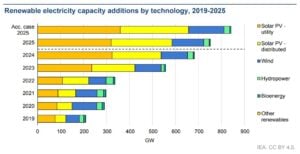
The world’s renewable energy sector has entered a new phase of record growth. According to the International Energy Agency’s Renewables 2025 report, global renewable power capacity grew by more than 510 gigawatts (GW) in 2024 — the fastest increase ever recorded. Another 520 GW is expected to be added in 2025, pushing renewables to account for over 90% of all new global power capacity.

Solar and wind dominate this growth. By 2025, solar will account for nearly three-quarters of new installations. This growth comes from cheaper technology, improved grid integration, and supportive policies. Wind power is also recovering after a slowdown in 2022–2023, supported by new offshore projects in Europe, China, and the United States.

The IEA says the world’s total renewable capacity will reach nearly 5,800 GW by 2025, up from around 4,200 GW in 2023. That means renewables now generate about 30% of global electricity and are on track to reach 42–45% by 2030.

Renewable electricity capacity additions by technology

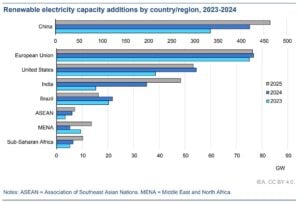
Four regions — China, Europe, the United States, and India — are responsible for almost 90% of this global expansion. Each is moving at a different pace, but together they are transforming how the world produces and consumes energy.

Renewable electricity capacity additions by country

Europe: Accelerating the Energy Transition

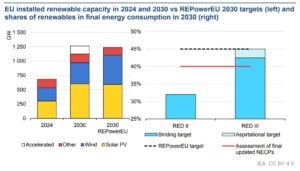
Europe continues to lead in energy policy and innovation. In 2024, the European Union added more than 70 GW of new renewable capacity, driven mainly by solar. This is a record year. It shows the bloc’s goal to cut reliance on imported fossil fuels. They aim to meet their Green Deal target of a 55% emissions reduction by 2030.

Solar capacity across the EU doubled between 2020 and 2024, reaching over 300 GW, while wind capacity passed 220 GW. The IEA predicts that Europe will add 450 GW of renewables from 2025 to 2030. This will raise the total capacity to almost 870 GW by the end of the decade.

EU installed renewable capacity in 2024 and 2030

Much of this growth is tied to the REPowerEU plan, which aims to speed up permitting and expand rooftop solar. Offshore wind is gaining popularity. Countries like Germany, Denmark, and the Netherlands are investing in North Sea projects.

Despite progress, Europe faces challenges. Delays in grid expansion and limited local manufacturing capacity for wind turbines have created supply bottlenecks. Even so, strong policy support and high carbon prices still make renewables the best choice for power generation.

United States: Policy Support and Private Investment Drive Expansion

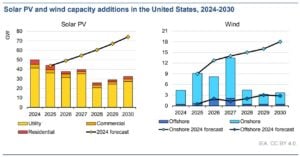
The United States is entering a period of major renewable growth, supported by the Inflation Reduction Act (IRA) and record private investment. The IEA expects the U.S. to add around 400 GW of new renewable capacity by 2030, effectively doubling its current base.

In 2024, U.S. solar installations rose by nearly 40%, reaching 45 GW for the year. Solar now accounts for the largest share of new capacity additions. Wind power also recovered, with onshore and offshore projects expanding in Texas, California, and along the East Coast.

Solar PV and wind capacity additions in US

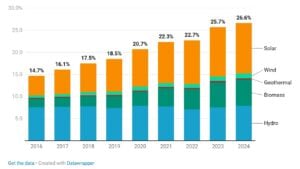
Renewables currently generate about 26% of U.S. electricity, up from 22% in 2022. The IEA projects this share will climb to over 40% by 2030, driven by federal tax incentives and falling technology costs.

Battery storage is another fast-growing sector. Storage capacity doubled between 2023 and 2024, helping stabilize variable solar and wind output. The IRA’s clean energy credits could draw over $400 billion in investments by 2032. This boost will help generate energy and support U.S. manufacturing of solar panels and turbines.

Challenges remain. The U.S. needs to modernize its grid and streamline permitting for transmission lines to connect renewable projects to demand centers. But the direction is clear — renewables are becoming the backbone of America’s energy system.

China: The Global Powerhouse of Renewables

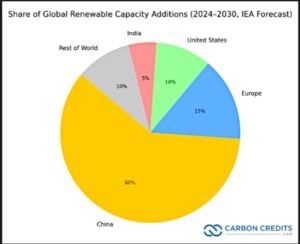
China remains the undisputed leader in renewable energy growth. The IEA projects that China will account for about 60% of all new renewable capacity added worldwide by 2030.

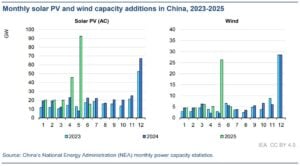
In 2024 alone, China installed more than 260 GW of new renewables — more than the rest of the world combined. Solar made up the majority of this, with over 190 GW of solar capacity added during the year.

Wind power grew by 60 GW. China kept building big onshore and offshore projects in Inner Mongolia, coastal areas, and deserts.

Monthly solar PV and wind capacity additions in China

China now has an estimated 1,400 GW of total renewable capacity, representing about half of the global total. Renewables already supply more than 35% of China’s electricity, up from 27% in 2020.

Government policy is the key driver. China aims to reach 1,200 GW of combined solar and wind capacity by 2030, a target it is likely to achieve five years early. The country’s large manufacturing base keeps equipment prices low globally. This helps other regions grow their clean energy fleets.

Still, integration challenges persist. Some provinces face grid congestion and curtailment — when renewable power can’t be used due to transmission limits. The IEA recommends that China continue to invest in grid upgrades and flexible storage systems to handle its rapid growth.

India: The Fastest-Growing Emerging Market for Renewables

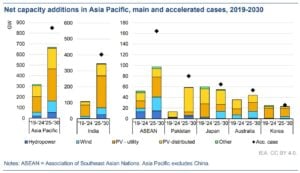
India is now the fastest-growing renewable energy market among developing economies. The IEA expects India’s renewable capacity to nearly double between 2023 and 2030, expanding from around 190 GW to 360–380 GW.

renewable net capacity additions India

Solar energy is leading the charge. In 2024, India added more than 17 GW of solar capacity, supported by large auctions and declining costs. Wind capacity also grew modestly, and new hybrid projects combining solar and wind are improving reliability.

The government’s goal is ambitious: 500 GW of non-fossil capacity by 2030, which would cover about 50% of total power demand. India is also expanding its domestic solar manufacturing base to reduce dependence on imports.

Hydropower and bioenergy continue to play supporting roles, particularly in rural electrification. The IEA reports that renewable energy in India cuts over 250 million tonnes of CO₂ emissions each year. This makes India a major player in global emission reductions, second only to China.

However, financing and grid infrastructure remain key hurdles. The report notes that India needs annual clean energy investments of about $60–70 billion through 2030 to meet its targets.

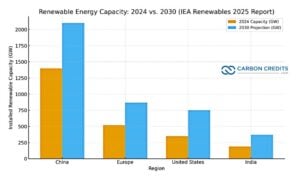
The chart below compares renewable energy capacity in 2024 vs. 2030 projections for the four key regions, based on the IEA Renewables 2025 report.

renewable energy capacity by region IEA report
Data source: IEA Report

It clearly shows China’s dominant position, followed by steady growth in Europe and the U.S., and rapid expansion in India’s renewable capacity by the end of the decade.

The Decade of Clean Power: A Turning Point for Global Energy

The combined momentum of China, Europe, the United States, and India is reshaping global energy markets. Together, these four regions will account for almost 90% of all renewable capacity growth by 2030.

The pie chart shows each region’s share of total global renewable capacity additions from 2024 to 2030, based on the IEA forecast. It also shows how dominant China remains in driving renewable expansion, while Europe, the U.S., and India together account for about one-third of the world’s clean-energy growth.

share of global renewable capacity additions 2030 IEA 2025 report
Data source: IEA Report

Global renewable electricity capacity is expected to surpass 6,200 GW in 2025 and reach 8,300 GW by 2030 — roughly triple the total in 2015. Solar will remain the dominant source, followed by wind and hydropower.

Yet challenges persist. The IEA warns that grid constraints, permitting delays, and uneven financing could slow progress in developing economies. To stay on track for the net-zero pathway, annual renewable additions must rise to around 800 GW per year by 2030.

Still, the direction is clear. The world is entering a decade where clean power becomes the main driver of growth, investment, and energy security. The actions of these four key players will determine how fast the transition happens and how close we come to a truly sustainable global energy system.

Lucid Motors (LCID) Stock Rises on Record Quarter: Growth, Green Goas, and the Road Ahead

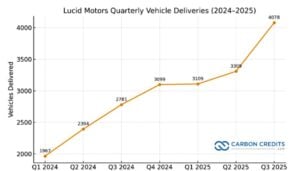
Lucid Motors reached a new milestone in the third quarter of 2025, sending its stock higher. The company delivered 4,078 vehicles, marking its best quarterly performance so far. This was a 46% increase from the same period last year.

Still, the result fell short of expectations. Analysts had forecast around 4,300 deliveries, so the actual number missed the mark by a small but important margin. Lucid also produced 3,891 vehicles during the quarter, below some estimates that predicted over 5,000.

By September 2025, Lucid had produced nearly 10,000 vehicles yea- to-date and delivered over 10,400 units to customers. Earlier this year, the company adjusted its full-year guidance to between 18,000 and 20,000 units, lower than earlier projections.

To meet even the lower end of that range, Lucid would need to produce more than 8,000 vehicles in Q4 — roughly double its previous quarterly output. It’s a tough target that will test Lucid’s ability to scale up production while managing costs and maintaining quality.

What’s Behind Lucid’s Q3 Numbers?

Several factors led to the carmaker’s Q3 achievements:

Tax Credit Surge

One big driver of Lucid’s record quarter was the rush to qualify for the U.S. $7,500 federal EV tax credit, which expired at the end of September. Many customers placed orders to beat the deadline, boosting short-term demand.

Lucid quarterly EV deliveries 2024-2025

Some Lucid models didn’t meet the credit rules for direct purchases. However, buyers accessed the credit through leasing programs. This helped lift deliveries in the months leading up to the credit’s expiry.

New Model Momentum

Lucid’s Gravity SUV, expected to launch soon, helped renew consumer and investor interest. SUVs make up a much larger share of the EV market than luxury sedans, and Lucid’s entry into this segment could expand its customer base.

For now, the Lucid Air sedan remains the company’s main product. It is known for high efficiency, premium design, and long range. But strong SUV demand suggests Lucid’s future growth will depend heavily on Gravity’s success.

Supply and Production Challenges

Lucid still faces production challenges. Key components like permanent magnets and electronic chips remain hard to source. These supply constraints limit how quickly Lucid can ramp up output, even when demand is healthy.

The company added a second production shift in its Arizona plant this year to increase capacity. However, scaling a young EV factory takes time. Quality checks, supplier reliability, and workforce training all affect production rates.

Some of the production shortfall in Q3 came from Lucid’s focus on delivering existing inventory. The company focused on fulfilling customer orders instead of increasing stock. This decision slightly lowered new production figures.

Market Expectations

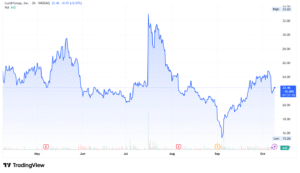
The shortfall also reflects how high investor expectations have become. Lucid is competing in a crowded and fast-moving EV market. When analysts expect more aggressive growth, even a record performance can look underwhelming. Yet, Lucid’s stock climbs up after reporting record growth. 

LUCID lcid stock price

Tariffs, inflation, and higher material costs also weigh on the company’s margins. As global trade changes, the costs of batteries and raw materials like lithium, nickel, and aluminum keep shifting.

Racing with Giants: How Lucid Stacks Up in the EV Arena

Lucid’s Q3 gains came during a strong period for the EV industry overall. Several automakers reported delivery growth in 2025 as consumer confidence in EVs improved and infrastructure expanded.

For comparison, Tesla delivered nearly half a million vehicles in the same quarter. General Motors also set records, delivering over 66,000 EVs across its brands. Lucid’s numbers are far smaller but still show steady progress for a newer company.

What sets Lucid apart is its focus on efficiency and technology. The Lucid Air remains one of the most energy-efficient electric vehicles ever built, capable of traveling over 800 kilometers on a single charge in some models.

That efficiency appeals to luxury buyers and plays into Lucid’s sustainability goals: lower energy use per vehicle helps reduce its carbon footprint and supports net-zero alignment.

Driving Green: How Lucid Builds Efficiency into Every Mile

Lucid Motors positions itself as a sustainability-driven automaker. The company aims to build some of the most efficient EVs in the world while cutting emissions at every stage.

Lower Energy Use and Emissions

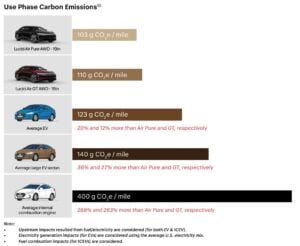
Lucid designs its motors, batteries, and software in-house. This vertical integration allows it to reduce energy losses and improve performance. The Lucid Air has up to 30% lower lifecycle emissions than some other luxury EVs. This is due to its lightweight materials and smart battery management.

Lucid air pure carbon emissions
Source: Lucid

Lucid’s production plant in Casa Grande, Arizona, uses some renewable energy. The company is also looking for more clean energy sources. As production scales, maintaining low emissions per vehicle will be critical.

Transparency and Reporting

Lucid publishes regular sustainability reports outlining its environmental performance and goals. It is a member of the United Nations Global Compact, which promotes corporate responsibility in areas like labor, human rights, and climate action.

Lucid also receives independent ESG risk ratings from firms that measure how well companies manage sustainability challenges. These ratings help investors understand the environmental and social impact of Lucid’s business model.

Circular Design and Materials

The company is working on a circular design approach — recycling and reusing materials wherever possible. For example, battery packs are made for easy disassembly. They can be reused in energy-storage systems after their automotive life ends.

Lucid’s engineers are also researching sustainable materials for interiors, such as plant-based leathers and low-impact textiles. These steps align with the growing demand for environmentally responsible luxury products.

The Roadblocks to Lucid’s Expansion

Lucid’s record quarter is encouraging, but major hurdles remain, including: 

  1. Production Ramp-Up: To meet its 2025 goal of 18,000 to 20,000 vehicles, Lucid must roughly double quarterly production in Q4. That requires stable supply chains, smooth plant operations, and strong workforce coordination.
  2. Post-Incentive Demand: Now that the U.S. EV tax credit has expired, sales may dip temporarily. Lucid will need new marketing and financing options to keep the momentum going.
  3. Cost and Competition: Rising input costs and new EV competition could pressure prices. Established automakers like BMW, Mercedes, and Tesla are expanding their electric lineups. Price wars in the EV market are already common.
  4. Scaling Sustainability: As production grows, Lucid must ensure suppliers meet strict sustainability standards. Mining for battery materials, energy use in manufacturing, and logistics all add to its carbon footprint.

Maintaining ESG credibility will be key as the company expands globally. Investors increasingly favor automakers that combine growth with clear climate strategies.

Can Lucid Stay Luxurious, Profitable, and Green?

Lucid’s third quarter proves that its products are gaining traction. Deliveries are increasing, brand awareness is growing, and the company is gradually expanding its production.

But the missed forecasts show that growth alone isn’t enough. To win investor confidence and compete with larger players, Lucid must show consistent, predictable performance.

At the same time, its sustainability promise remains central to its brand identity. Lucid wants to create vehicles that are both luxurious and eco-friendly. The luxury carmaker focuses on using less energy, reducing emissions, and setting new efficiency standards.

If Lucid keeps a balance between high-end innovation and real-world sustainability, it can secure a lasting spot in the fast-changing EV market. But to succeed, it must show it can turn potential into steady, scalable success while also keeping its environmental promises.

Top Gold ETFs to Watch Now as Gold Prices Break $4,000 — IAU, GLD, and GDX Lead the Pack

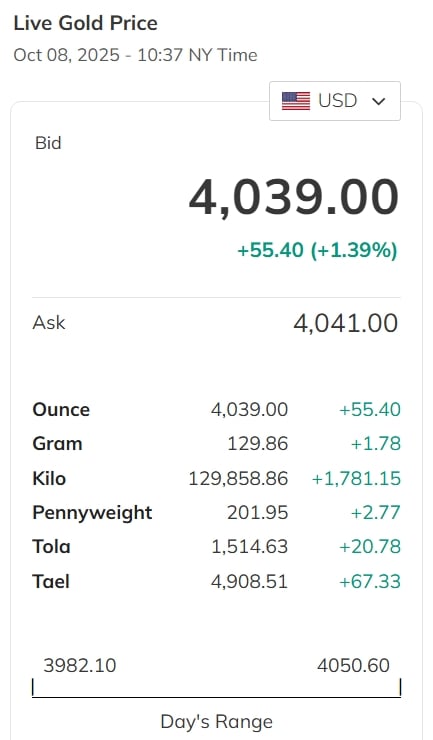
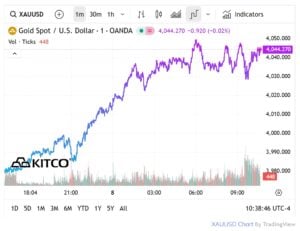
Gold prices climbed to new highs on Monday, with December futures reaching a record $4,014.60 per ounce. The yellow metal stayed strong as investors sought safety amid global uncertainty and a prolonged U.S. government shutdown.

Goldman Sachs raised its December 2026 gold price forecast from $4,300 to $4,900 per ounce, citing steady central bank purchases and renewed investor interest in gold-backed ETFs. Spot gold has surged 52% so far this year, supported by a weaker U.S. dollar and rising geopolitical tensions.

gold prices
Source: KITCO

But first, let’s take a closer look at gold ETFs — what they are and why so many investors are turning to them.

What Are Gold ETFs and Why Are They Popular?

Gold Exchange-Traded Funds (ETFs) mirror the market price of physical gold without requiring investors to hold the metal themselves. Each ETF unit typically represents one gram of 99.5% pure gold, traded on stock exchanges just like shares.

Key features of gold ETFs include:

  • Backed by physical gold stored in secure vaults
  • Real-time pricing and easy trading through Demat accounts
  • No storage or making charges
  • Lower transaction costs and high liquidity
  • Transparent pricing that tracks the spot gold rate

Central Banks and ETFs Fuel the Gold Price Rush

Reports say that China’s central bank has played a major role in driving gold demand. In September, the People’s Bank of China (PBOC) added to its gold reserves for the 11th month in a row, increasing holdings to 74.06 million troy ounces from 74.02 million in August. The value of these reserves also jumped to $283.29 billion, up from $253.84 billion the previous month.

Goldman Sachs expects central banks to keep buying gold, with around 80 tonnes forecast for 2025 and 70 tonnes for 2026, as emerging economies continue to diversify away from the U.S. dollar.

At the same time, strong inflows into gold ETFs are supporting the rally, giving investors an easier and safer way to gain exposure to rising gold prices.

Top Gold ETFs to Watch: IAU, GLD, and GDX

Gold ETFs provide a practical, cost-effective, and transparent way to invest in gold, avoiding the hassle of storage, insurance, and purity verification.

iShares Gold Trust (IAU)

IAU is one of the largest gold ETFs with around $72.7 billion in market capitalization. Each share represents roughly 0.01 ounces of gold, making it affordable for small investors. With a low expense ratio of 0.25%, IAU offers cost-effective access to physical gold.

However, it does not follow a specific ESG (Environmental, Social, and Governance) framework since it directly holds bullion. Any sustainability impact stems from the gold mining and refining practices behind the physical gold it stores.

iShares Gold Trust IAU
Source: Yahoo Finance

SPDR Gold Shares (GLD)

GLD is the world’s largest gold ETF, managing about $129 billion in assets. Each share equals one-tenth of an ounce of gold, stored in vaults in London, New York, and Zurich, backed by custodians like JPMorgan Chase and HSBC. It is known for its high liquidity and tight spreads.

SPDR Gold Shares has removed many barriers to investing in gold, such as buying, storing, and insuring it. The fund provides direct exposure to physical gold, minus expenses, without relying on derivatives that carry extra credit risk.

It allows investors to easily access the gold market and include it in their portfolios, offering a strategic way to diversify risk due to gold’s low or negative correlation with other assets.

Like IAU, GLD does not integrate ESG criteria but depends on the ethical and environmental practices of gold suppliers and refiners.

SPDR Gold Shares (GLD)
Source: Yahoo Finance

VanEck Gold Miners ETF (GDX)

GDX differs from IAU and GLD as it invests in leading gold mining companies instead of holding physical gold. Managing around $22.54 billion in assets, GDX tracks major miners such as Newmont and Barrick Gold.

The fund provides leveraged exposure to gold prices through miner performance. Since it involves mining operations, ESG factors play a more direct role covering carbon reduction, responsible sourcing, labor safety, and community development.

From an investment perspective, GDX is a highly liquid ETF with substantial assets, suited for investors seeking gold exposure and prepared for higher volatility. It benefits from inflation or economic uncertainty, offering exposure to global gold miners.

While mining stocks can be riskier than gold due to company and operational factors, GDX spreads risk across multiple large and mid-sized miners.

gdx gold etf
Source: Yahoo Finance

Sustainability Perspective: Physical Gold vs. Gold Miners

Physical gold ETFs like IAU and GLD mainly reflect the sustainability impact of gold mining through their bullion holdings. They don’t actively engage in ESG initiatives. In contrast, GDX connects investors directly to mining companies that can influence sustainability outcomes through operational decisions.

Investors focused on responsible investing should assess the ESG performance of individual mining companies within funds like GDX. This approach allows for more transparency and accountability in evaluating how sustainable practices affect returns and risk exposure.

Gold’s Shine Isn’t Fading Anytime Soon: A Smart Safe-Haven Investment

It’s now clear that the gold price is hitting record highs due to central banks buying more, strong ETF inflows, and ongoing global uncertainty. Because of this, ETFs like IAU, GLD, and GDX give investors different ways to invest in gold, depending on their needs for liquidity, cost, and even sustainability.

At the same time, the market is watching for possible Federal Reserve rate cuts and dealing with economic uncertainty. Gold’s appeal as a safe-haven asset remains strong. And Goldman Sachs’ higher forecast adds to investor confidence — the gold story is far from over.

gold prices

Also, institutional investors are increasingly using gold ETFs to balance portfolios and protect against stock market swings. Experts recommend investing gradually and diversifying, especially after gold’s sharp price jump. Long-term investors like these ETFs because they are affordable, simple, and easy to manage.

Plus, rising interest in gold is encouraging some investors to explore other commodity ETFs, such as silver and industrial metals, to spread their risk.

In short, gold ETFs are a favorite in 2025 for their simplicity, transparency, and ability to protect against inflation and market ups and downs. Both retail and institutional investors see them as a safe and reliable way to invest in uncertain times.

U.S. Tungsten Revival: Rising Demand, Tight Supply, and Top Stocks to Watch in 2025

Tungsten, a critical mineral with unmatched heat resistance and strength, is gaining global attention. It’s dense, brittle, and grayish-white, with the highest melting point and tensile strength of any pure metal. These traits make it vital for high-performance applications. and industries needing extreme durability.

With China controlling most of the supply, the U.S. and allies are racing to secure domestic sources and diversify supply chains. Let’s deep dive into the complete outlook of the tungsten market below:

Demand Drivers: Why Tungsten Keeps Rising in Importance

The tungsten market expanded from USD 6.04 billion in 2024 to USD 6.50 billion in 2025. It is projected to grow at a CAGR of 7.95%, reaching USD 11.16 billion by 2032.

Its demand is rising due to industrial and defense needs. Key drivers include:

  • Electronics & Semiconductors: Vital for high-performance chips and circuits.
  • Defense & Aerospace: Used in rocket nozzles and armor-piercing ammunition. It also strengthens steel alloys for aerospace and defense.
  • Tungsten is used in turbine blades and as a lead substitute in ammunition.
  • Industrial Tools: Crucial for cutting and drilling in mining, construction, lighting, welding, and manufacturing.
  • Green technology and electrification: Increasing use of tungsten in electric vehicle batteries, energy storage, and renewable energy technologies

Industry experts are indicating that global tungsten demand is expected to rise in 2025 and the next few years. With geopolitical tensions increasing, the U.S. and allies anticipate further growth as supply diversification becomes essential.

China’s Tight Grip on Tungsten Supply

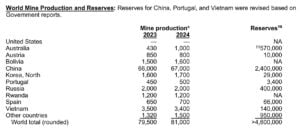
Tungsten is found worldwide, but most supply comes from China. It produces over 80% of global tungsten and holds more than half of the known reserves. Vietnam and Russia follow, contributing only a small share. Other producers like Spain, Austria, Bolivia, and Rwanda account for just 1% to 2% each.

Interestingly, other countries own about 35% of global reserves but produce only 1%. This gap shows growth potential but highlights challenges like high costs and long permitting times.

China also controls production. In late 2024, Beijing introduced new export licensing rules for tungsten, tightening supply further. Analysts view these controls as part of China’s strategy in global trade.

Global Push for Supply Chain Resilience

China’s dominance has raised concerns. Countries are diversifying their tungsten supply chains. New projects in Australia, South Korea, Canada, and Africa show promise, but scaling up will take years.

Vietnam, Russia, and Spain are boosting production. Smaller nations like Rwanda are gaining attention for their resources. However, these efforts face high costs and technical challenges.

China’s market control is expected to last until the early 2030s, but momentum is shifting toward more resilient supply options.

TUNGSTEN supply
Source: USGS

U.S. Tungsten Dependence: A Strategic Risk for Defense

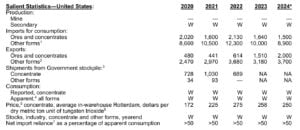
As per the U.S. Geological Survey, the U.S. has not mined/ tungsten since 2015. It relies mostly on imports, especially from China. Notably, in 2023 U.S. imported over 10,000 metric tons of tungsten.

Most U.S. tungsten is used in cemented carbide parts for construction, mining, and drilling. The rest goes to specialty steels, defense alloys, electronics, and chemicals.

This dependence poses serious risks as tungsten is vital for defense applications, including armor-piercing munitions and missile systems. Thus, supply disruptions could threaten U.S. military readiness and high-tech industries.

U.S. tungsten
Source: USGS

DoD’s Big Investments and New Rules

The U.S. Department of Defense (DoD) is boosting efforts to secure tungsten, a critical metal for defense systems. Since last year, it has directed millions toward U.S. and allied projects.

In July 2025, it awarded $6.2 million under the Defense Production Act to Golden Metal Resources for the Pilot Mountain project in Nevada, the largest undeveloped tungsten deposit in the U.S.

The project aims to restore domestic production, reduce reliance on China’s 80% market share, and prepare for the 2027 ban on China- and Russia-sourced tungsten in defense contracts.

Procurement Rules

A new U.S. law prevents the Pentagon from sourcing tungsten, magnets, and other critical materials from adversarial nations like China, Russia, Iran, and North Korea. By January 2027, these rules will also cover the mining stage. This means tungsten mined in these countries can’t enter U.S. defense supply chains.

Thus, the U.S. Department of Defense now views tungsten as a national security issue. In summary, its strategy focuses on:

  • Diversifying supply chains beyond China.
  • Funding domestic exploration and allied projects.
  • Expanding metallurgical testing and engineering studies.
  • Tightening procurement rules to phase out adversarial tungsten by 2027.

This effort demonstrates a strong commitment to boosting domestic tungsten production for new defense systems and advanced manufacturing. Additionally, it also aims to build secure supply partnerships with allies.

Top Tungsten Stocks Gaining Investor Attention

In 2025, tungsten stocks are attracting attention as the metal becomes essential across industries. Rising demand and tight supply make these stocks appealing. Investors value tungsten for its strategic role in technology and its relatively stable prices compared to other critical minerals.

Elemental Altus Royalties Corp. (ELE.V) Rises on Strong Momentum

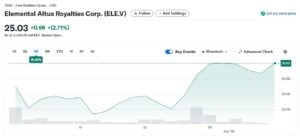
Canada-based Elemental Altus trades around $15.76 USD (OTC) and CAD 24.37 (TSX Venture) as of October 2025. Its shares climbed nearly 47% in six months, outperforming peers, with a market cap of $388 million USD. Analysts set the TSX target price at CAD 25.92, signaling upside potential.

In September 2025, it merged with EMX Royalty to form Elemental Royalty Corp. Tether Investments backed the deal with $100 million USD to buy 75 million shares at CAD 1.84 each. The capital fuels growth, acquisitions, and expansion in tungsten, rare earths, and other critical minerals.

Elemental Altus leads in the critical minerals’ royalty space, with strong stock momentum and strategic investments positioning it for growth.

Elemental Altus Royalties Corp.
Source: Yahoo Finance

American Tungsten (TUNG) Fuels U.S. Supply Revival

American Tungsten Corp. (TUNG) is gaining attention as a pure-play tungsten stock. In February 2025, it hit an all-time high of CA$2.37, reflecting strong investor confidence in the company’s efforts to develop domestic tungsten resources.

Currently, it is trading at around CAD 1.84 per share. Analysts forecast the stock to rise through the rest of 2025 and into 2026.

With a market capitalization of roughly CAD 25.72 million, the stock has experienced some volatility. This was influenced by critical minerals sector trends and tungsten market dynamics.

American Tungsten (TUNG)
Source: Yahoo Finance

However, the company’s performance remains closely tied to progress in U.S. tungsten projects, government support, and global supply-demand trends.

In March, the company announced that its application to join the U.S. Defense Industrial Base Consortium (DIBC) had been approved. The consortium, managed by Advanced Technology International (ATI) for the Department of Defense (DoD), connects private-sector companies with the U.S. Government to strengthen the defense supply chain.

Another key development is the IMA Mine Project in Lemhi County, Idaho, a major step in restoring U.S. tungsten production. This critical mineral supports tank armor, hypersonic weapons, submarine hulls, and semiconductors.

The mine sat idle for nearly 70 years. It is now being redeveloped to meet rising domestic demand. With a few publicly traded tungsten companies existing in North America, American Tungsten is the top choice for investors in U.S. supply chains.

The Rise of Tungsten Juniors

However, this year, several junior mining companies focusing on tungsten in the U.S. are also gaining attention, particularly those developing critical mineral resources to strengthen domestic supply chains.

One such example is Patriot Critical Minerals. It owns100% of the MEGA Deposit in Elko County, Nevada, a strategically located resource that could help close the domestic tungsten supply gap.

The deposit contains approximately 19 million tonnes of mineralized material, with about 32,300 tonnes of contained tungsten trioxide.

Tungsten Prices Stay High Amid Tight Supply

In September 2025, tungsten bar FOB prices held steady at USD 95–97 per kg. Meanwhile, tungsten concentrates (scheelite and wolframite) traded at RMB 284,000 per ton. This marked a 1.1% drop from peak levels but doubled the price from early 2025, showing strong market volatility.

tungsten prices
Source: SMM

However, global prices continue to fluctuate due to Chinese export restrictions, production issues, and rising demand in defense, aerospace, and electronics. At the same time, supply-demand gaps, geopolitical tensions, and stockpiling keep prices elevated.

In conclusion, rising demand, tight global supply, and national security concerns make tungsten a strategic mineral. Consequently, U.S. projects and companies like Elemental Altus, American Tungsten, and Patriot Critical Minerals are actively reducing reliance on China.

As production ramps up, tungsten will play an increasingly vital role in defense, technology, and industrial applications.

TSLA Stock Slides After Tesla Unveils ‘Affordable’ Model Y and Model 3 — Investor Confidence Wavers

Tesla is once again in the spotlight of the EV world with the launch of its most affordable versions of the Model Y SUV and Model 3 sedan. On October 7, 2025, the company unveiled “Standard” trims of its two bestsellers, priced at $39,990 for the Model Y and $36,990 for the Model 3. The move marks Tesla’s latest attempt to reignite demand amid slowing sales, fierce competition, and the loss of the $7,500 U.S. federal EV tax credit.

While the announcement initially stirred excitement, investor sentiment quickly turned cautious. Many had hoped for even deeper price cuts—possibly closer to the long-promised $25,000 Tesla. The unveiling highlighted a strategic shift by Elon Musk: opting for affordability through existing models rather than introducing a completely new low-cost vehicle platform.

Breaking Down Tesla’s New “Standard” Models

The new “Standard” variants are stripped-down versions of Tesla’s premium trims. They feature fewer upgrades and shorter ranges but come with the same core technology, including access to Tesla’s Supercharger network.

Key details:

  • The Model Y Standard is about $5,000 cheaper than previous trims.
  • The Model 3 Standard starts under $37,000, but still well above investor hopes for a sub-$30,000 model.
  • The new models aim to lift sales volumes and defend market share against growing competition from BYD, Rivian, and traditional automakers entering the EV market.
  • Musk’s earlier $25,000 EV project—rumored to be Tesla’s “Model 2”—was scrapped last year in favor of modifying current production lines.

For Tesla, the real challenge is finding the right balance between keeping prices low and staying profitable. The price cuts could boost sales, but at the same time, they might reduce profits since battery materials and shipping costs are still high.

Why TSLA Stock Dipped Despite Pricing Push?

Despite the buzz surrounding the October 7 announcement, Tesla’s stock (TSLA stock) reflected mixed investor emotions. Shares closed down nearly 5% at $433 after spiking briefly ahead of the event. The stock has still gained about 7% in 2025, but it has underperformed the S&P 500 and remains highly sensitive to quarterly delivery numbers and market expectations.

Tesla shares hit $453.25 earlier that day, marking a 12.2% gain year-to-date before the decline. The volatility suggested that while investors welcomed the effort to boost affordability, many were disappointed that prices weren’t slashed further.

Analysts also warned that the new lower-priced versions might hurt sales of Tesla’s more expensive models, which could slow down the company’s overall growth.

tsla stock tesla
Source: Yahoo Finance

Analysts Turn Conservative

Wall Street’s tone toward Tesla has shifted from bullish to cautious. The current analyst consensus rates Tesla as a “Hold,” with an average price target of $342.82—implying potential downside from current trading levels.

Options data also reflect waning enthusiasm. Traders have sold off most October $470 call options, while implied volatility has dropped 27%, signaling a more restrained outlook.

Analysts from Wedbush noted that while the new Standard models could help Tesla maintain its quarterly delivery pace, the pricing left them “relatively disappointed.” The company’s next few quarters will test whether these trims can sustain demand without eroding profitability.

Q3 2025: Record Deliveries but Margin Strain

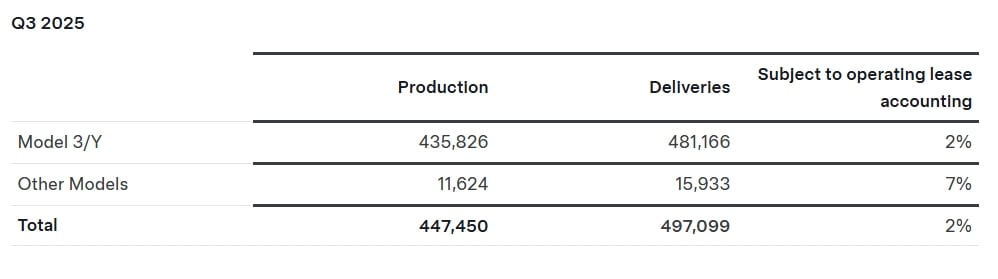
Tesla’s Q3 2025 results gave the company some breathing room. It delivered a record 497,099 vehicles, beating Wall Street expectations and setting a new milestone. Despite this success, financial challenges persist.

tesla Q3
Source: Tesla

Earnings per share are projected at $0.37, a 40% decline compared to the same quarter last year. Furthermore, the expiration of the $7,500 U.S. EV tax credit and ongoing price cuts have put pressure on profitability.

Still, Tesla’s balance sheet remains strong, with $37 billion in cash, easily covering its $30 billion in short-term debt.

Delivery growth suggests Tesla is running efficiently, but analysts remain cautious. Many believe Q3 sales were boosted by customers rushing to buy before the tax credit expired. This front-loading of demand could lead to softer sales in Q4.

Thus, even with strong deliveries, TSLA stock remains sensitive to these financial pressures. Investors are closely watching to see whether Tesla can maintain momentum without further cutting prices and compressing its margins.

Tesla’s Strategic Pivot: From EVs to AI and Robotaxis

Elon Musk has been steering Tesla toward artificial intelligence, robotaxis, and humanoid robots—technologies he believes will drive the company’s next phase of growth. In late 2024, he suggested that the long-awaited affordable car might be used mainly as a robotaxi rather than a regular consumer vehicle.

This approach aligns with Tesla’s broader strategy to prioritize autonomous driving and recurring software revenue. A lower-priced model could help build a future robotaxi fleet and open new ways to earn from Tesla’s self-driving features.

However, investors are split. Some see this as a smart move that could strengthen Tesla’s position in mobility technology. Others worry it could distract from Tesla’s core EV business, which faces shrinking margins, rising competition, and high expectations from the market.

Competition Heats Up Across the EV Market

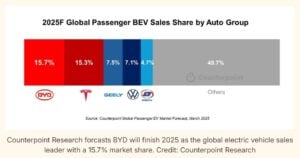
Tesla’s dominance is being tested on all fronts. In China, BYD continues to outpace Tesla in sales volume. In Europe and the U.S., automakers like Volkswagen, Ford, and GM are scaling their EV production lines with aggressive pricing strategies.

The loss of federal incentives further complicates Tesla’s position. Competitors that still qualify for subsidies can offer cheaper, effective prices, eroding Tesla’s competitive edge. The company must rely on its brand power, efficiency, and innovation to sustain growth.

Even though Tesla’s growth story remains compelling, several risks loom large. Industry pundits highlight the following challenges.

  • Competition: Legacy automakers and new startups are closing the innovation gap quickly.
  • Incentive Losses: The expiration of the $7,500 U.S. EV tax credit could dampen sales momentum.
  • Supply Chain Sensitivity: Battery material shortages and global logistics disruptions could slow production.
  • Margin Pressure: Price cuts, cost inflation, and heavy R&D investments are squeezing profits.
  • Valuation Risk: With a valuation above 100x earnings, even small setbacks could trigger sharp stock corrections.

EV sales

RELATED:

Balancing Growth with Sustainability

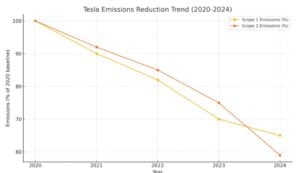
Now talking about sustainability, Tesla is ahead in the game. The company reported a total carbon footprint of 56 million metric tons CO₂e in 2024, including emissions from operations and supply chains.

  • Yet, Tesla’s vehicles helped customers avoid 20 million metric tons of CO₂e that year compared to traditional cars.

Regulatory credits also continue to play a big role in Tesla’s profits. In 2024, the company earned $2.76 billion from selling carbon credits—a 54% jump from 2023. These credits made up nearly 39% of Tesla’s net income, showing just how important carbon markets remain to the company’s bottom line.

tesla emissions
Source: Tesla

Can Tesla’s “Affordable” EVs Sustain Long-Term Growth?

Tesla’s new “Standard” lineup is a tactical reset, not a revolution. It aims to boost demand, defend market share, and protect margins in a crowded EV market.

Still, investors are unsure. Tesla posts record deliveries and holds strong cash reserves, yet its growth depends on balancing affordability, innovation, and profitability.

At the same time, the company is investing heavily in AI and autonomous driving. The big question is: will Tesla succeed by selling more cars or by getting more cars to drive themselves?

These affordable EVs may keep sales steady, but bigger challenges lie ahead. Rising competition, tight margins, and shifting investor sentiment will test Tesla’s ability to stay profitable while driving innovation forward.

Microsoft Expands Japan’s Green Grid with Shizen Energy’s 100 MW Solar Push

In October 2023, Shizen Energy Inc. signed a 20-year virtual power purchase agreement (VPPA) with Microsoft (MSFT stock) to provide renewable energy from a 25 MWac solar farm in Inuyama City, Aichi Prefecture. As with other global deals, this VPPA helped Shizen Energy secure funding for the Inuyama project.

Now the company has recently announced an expanded partnership with Microsoft. It currently has 100 MW in Renewable Energy Purchase Agreements across four solar projects in Japan.

Building on this success, Microsoft signed three additional 20-year agreements for solar plants in Kyushu and Chugoku, further advancing both companies’ renewable energy goals.

Rei Ushikubo, Executive Officer of Shizen Energy, said,

“Following the Inuyama Project, we are honored to have signed long-term agreements with Microsoft for several new projects. We believe that securing financing from domestic and international financial institutions for these projects is proof of the growing presence of Renewable Power Purchase Agreements in the Japanese market. We will continue to prioritize our power purchase agreement business to support our customers’ decarbonization efforts.” 

Shizen Energy Delivers Efficiency Across Four Solar Plants

Shizen Energy has already started operations at one Kyushu plant. The remaining projects are under construction, including its site and wholly-owned EPC subsidiary, Shizen Engineering Inc. All four projects will operate under Shizen Operations Inc., which manages asset operations and maintenance.

The company is also handling project coordination, financing, and asset management, while its subsidiaries manage EPC and O&M. This integrated approach allows the company to deliver large-scale projects efficiently and reliably.

Earlier, it was revealed that the Inuyama Solar Power Plant stands as the largest single-asset solar project in Japan to reach financial close under a VPPA. The project had received ¥10.9 billion in non-recourse financing from Societe Generale, marking the first international funding for a Japanese VPPA-linked renewable project.

Inuyama City Solar Project

solar energy Japan Shizen Energy
Source: Shizen Energy

Global Expansion and Innovation

Shizen Energy aims to accelerate the global shift to renewable energy under the motto “We take action for the blue planet.” The company has expanded projects to Southeast Asia and Brazil and introduced advanced energy technologies, including microgrids, virtual power plants (VPPs), and smart EV charging systems through its proprietary EMS.

It has generated more than 1 GW of renewable energy worldwide and earned recognition as Forbes Japan’s top startup in 2024. With these milestones, the company continues to lead both domestic and international corporate renewable markets.

Boost to Microsoft’s 100% Renewable Energy Goal

This deal is Microsoft’s first renewable energy purchase in Japan. And these REPAs help Microsoft move toward 100% renewable energy for its operations by 2025.

By adding clean energy to Japan’s electricity grid, the tech giant is contributing to both corporate sustainability and grid decarbonization.

Adrian Anderson, General Manager, Renewable and Carbon Free Energy at Microsoft, had said,

“Shizen Energy’s expertise and presence in the Japanese market is enabling our first renewable energy purchase in Japan and it’s great to see near-term supply for our 100% renewable energy goal. A commercial structure like this is important to promoting grid decarbonization in the country.”

Globally, to date, Microsoft has contracted over 34 GW of renewable capacity across 24 countries, up from 1.8 GW in 2020, as highlighted in its 2025 sustainability report.

Last year, it further diversified its portfolio and added 19 GW of new renewable energy across 16 countries. Key expansions included:

  • Brookfield Renewable Energy Framework – Delivering over 10.5 GW in the U.S. and Europe over the next five years.

  • Wisconsin PPA with National Grid Renewables – A 250 MW agreement supporting a growing datacenter region, paired with a $15 million community fund for environmental resilience.

Some other global projects included a 415 MW solar facility in Germany, a 48.8 MW wind project in Ireland, and a 36 MW solar plant in Poland. These projects showcase our commitment to expanding clean energy capacity across diverse markets.

These investments allow Microsoft to expand renewable markets worldwide and support grid decarbonization in all regions where it operates.

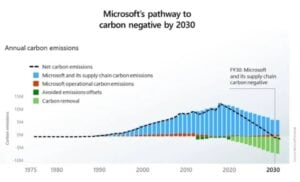
Microsoft emissions
Source: Microsoft

SEE MORE: 

Japan’s Renewable Energy Outlook

Data shows that Japan aims for 36–38% renewables in its electricity mix by 2030, but slower project development and rising electricity demand keep the share below 30%. Nuclear restarts and decommissioning of old thermal plants have helped reduce emissions by nearly 5% from 2023, reaching the lowest levels since 2015.

Most significantly, agri-solar projects, combining solar generation with farmland, are emerging as a key growth area. Japan has solar potential of 1,465–2,380 GW, far above the current installed capacity of 74 GW. Interestingly, local developers are aggregating small projects and securing financing, creating scalable, sustainable solutions for corporate PPAs.

JAPAN RENEWABLE ENERGY

Shizen Energy’s REPAs with Microsoft show the growing impact of corporate renewable procurement. The agreements attract international financing, provide long-term revenue certainty, and accelerate renewable deployment. Corporate PPAs help companies meet energy goals while supporting broader grid decarbonization.

Shizen Energy continues to expand solar, wind, biomass, and innovative energy solutions. Its integrated development, construction, and operations model ensures projects are delivered efficiently and effectively.

Together, Microsoft and Shizen Energy are shaping Japan’s corporate renewable energy market and proving that sustainable, commercially viable solutions are achievable.

Mercedes-Benz and Norsk Hydro Join Forces for Greener EVs

Mercedes-Benz has partnered with Norwegian aluminium producer Norsk Hydro to reduce emissions in the manufacturing of its electric vehicles (EVs). The collaboration centers on using Hydro’s low-carbon aluminum, which is produced with renewable energy and recycled materials.

The deal is part of Mercedes’s plan to make production greener. It aims to reduce the carbon footprint of future EVs. This includes the new electric CLA model, which will be the first vehicle to feature Hydro’s aluminum.

This partnership shows how carmakers are changing materials and energy use. They aim to meet rising climate goals and consumer demand for cleaner cars.

The Partnership: How Green Aluminium Is Recasting Mercedes’ EV Blueprint

Norsk Hydro will supply Mercedes with aluminum that emits far less carbon than standard production. Hydro’s smelting sites in Norway run mostly on hydropower, which helps avoid fossil-fuel emissions.

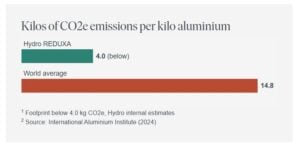
Hydro says its low-carbon aluminum generates just 3 kilograms of CO₂ for every kilogram of metal. In contrast, the global average is 16.7 kilograms. That makes it one of the lowest-carbon aluminum products available today.

Kilos of CO2e emissions per kilo aluminium
Source: Hydro

For Mercedes, this has a direct effect. The company thinks using Hydro’s aluminum in the new CLA will reduce CO₂ emissions by about 40% compared to the old petrol version. This includes emissions from raw materials, manufacturing, and assembly.

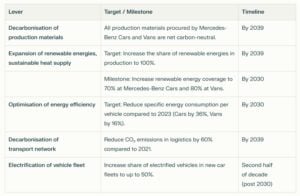
This step supports Mercedes’s long-term goal to make all its passenger cars net carbon neutral by 2039. The target covers the full life cycle — from raw materials and production to driving and recycling.

Aluminum production makes up around 2% of global CO₂ emissions, says the International Energy Agency (IEA). Switching to cleaner aluminum can reduce CO₂ emissions by millions of tonnes annually in global supply chains.

Why Aluminium Defines the EV Climate Race

Aluminum is central to the EV transition because it is light, durable, and improves range by reducing vehicle weight. However, it is also energy-intensive to produce, especially when powered by coal or gas.

Embedded emissions from materials like aluminum — those released before the vehicle is driven — are now a big concern for automakers.

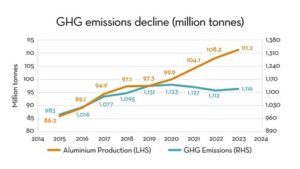
2023-GHG-emissions
Source: International Aluminium Institute

To address this, companies are switching to low-carbon aluminium, which combines renewable electricity and recycled scrap. Recycling is key because it uses only 5% of the energy required for new aluminum production.

In Europe, recycling rates for post-consumer aluminum are about 36%. However, they are expected to double by 2030, based on industry forecasts. If achieved, this could reduce 39 million tonnes of CO₂ emissions per year by 2050 across the region.

Globally, aluminum recycling — including beverage cans — could save 60 million tonnes of CO₂ per year by 2030.

These savings matter. The IEA says that a 10% rise in aluminum recycling around the world could reduce emissions. This is like taking 7 million cars off the road each year.

As global demand for EVs grows, the carbon footprint of materials has become a major focus. Reducing aluminium’s emissions share can make a big difference in the total climate impact of electric mobility.

How Green Materials Are Reshaping Auto Supply Lines

The Mercedes-Hydro deal is part of a wider shift across the automotive sector. Companies feel pressure to decarbonize their supply chains. This helps them meet national and international goals.

In the EU, new rules from the Green Deal and CSRD require automakers to track and report Scope 3 emissions. These are the indirect emissions from materials, suppliers, and logistics. These often make up more than 80% of a car’s total carbon footprint.

Several of Mercedes’s competitors have already joined this transition:

  • Volvo is partnering with SSAB to develop fossil-free steel.
  • Tesla sources aluminum from hydro-powered smelters in Canada.
  • BMW uses recycled aluminum in its i-series vehicles to lower emissions from manufacturing.

Mercedes teams up with Hydro to boost its European supply chain for low-carbon materials. This move also cuts down on high-emission imports from Asia.

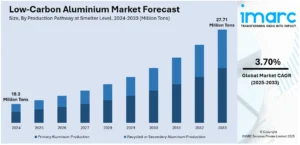
The global low-carbon aluminum market hit 19 million tonnes in 2024. Analysts predict it will grow by 3.7% each year and will reach nearly 28 million tonnes by 2033. Demand for cleaner metals in the automotive, construction, and packaging sectors could rise by more than 30% by 2030.

low carbon aluminum forecast 2033 IMARC
Source: IMARC Group

Moreover, market data shows that low-carbon aluminum carries a price premium ranging from $20 to $150 per tonne, depending on supply and demand. Mercedes executives say these extra costs are acceptable, as they align sustainability with product quality and customer expectations.

Mercedes also faces challenges in logistics and engineering. It must ensure a steady, traceable flow of low-carbon aluminum to all production sites. Engineers also have to test how these new materials affect vehicle structure and performance.

Still, both companies see the partnership as a long-term investment. Governments are tightening emission limits and adding carbon border taxes. So, using cleaner materials can be both good for the environment and beneficial for the economy.

Hydro already uses renewable power for 70% of its smelting. It plans to reach net-zero emissions by 2050, and it aims to cut its operational footprint by 30% by 2030.

Turning ESG Goals Into Action

This collaboration strengthens both companies’ ESG performance — environmental, social, and governance.

  • Environmental: The deal tackles manufacturing emissions — one of the hardest areas to decarbonize. It promotes renewable energy, recycling, and a circular materials model.
  • Social: It supports clean industry jobs and responsible sourcing. Norway’s hydropower-based smelting has lower community and ecological risks compared to coal-based plants in Asia.
  • Governance: Mercedes and Hydro have committed to transparent emissions reporting and third-party audits. These steps support compliance with international ESG standards and investor expectations.

These actions make sustainability goals real. They change policy talk into actual results.

How Low-Carbon Manufacturing Is Steering the Auto Industry’s Future

The Mercedes-Hydro partnership could become a model for others. As EV adoption grows, automakers are looking beyond tailpipe emissions to the entire vehicle life cycle, from raw materials to end-of-life recycling.

Experts see global demand for low-carbon aluminum increasing by over 30% by 2030. This growth is fueled by EV manufacturing and the expansion of renewable energy.

For Mercedes, the deal supports its Ambition 2039 plan — to make its entire value chain carbon-neutral. The company aims to cut supply chain emissions by 50% by 2030, compared with 2020 levels.

Mercedez benz climate
Source: Mercedes-Benz Climate Transition Action Plan-2025

Hydro’s low-carbon aluminum could play a big part in achieving this target. If the low-carbon CLA rollout succeeds, similar materials will likely be used in Mercedes’s future EVs, including SUVs and compact cars.

The impact extends beyond one company. If more car makers join in, the auto industry could reduce CO₂ emissions by millions of tonnes each year. This would help meet global climate goals from the Paris Agreement.

For Hydro, this confirms the value of its years of investment in clean energy and recycling innovation. For the global automotive sector, it sets a new benchmark: sustainability starts with every component.