Microsoft Seals 10-Year Arca Carbon Deal Ahead of Earnings Beat and Record Profits

Microsoft has signed a 10-year carbon removal agreement with Arca, a Canadian startup that turns mine waste into carbon storage. The partnership backs Microsoftโ€™s goal to be carbon negative by 2030. It also helps Arca grow its natural mineralization technology.

The deal came just before Microsoft reported $77.7 billion in revenue for the first quarter of fiscal 2026, an 18% increase from a year earlier. Operating income also rose 24% and net income increased by 12%.

Despite the strong results, Microsoftโ€™s stock fell about 3% after the earnings release. Investors are becoming cautious about spending more on data centers, AI infrastructure, and OpenAI costs.

Yet, Microsoft’s financial strength allows it to support big climate and energy projects, like the Arca deal. This shows how the company connects AI growth with long-term sustainability goals.

Turning Mine Waste into Carbon Storage

Arca uses a process called mineralization, which captures COโ‚‚ by reacting it with magnesium-rich mine waste. This reaction forms stable carbonates, permanently locking carbon in solid rock.

The company works with mining firms that produce waste materials such as nickel, cobalt, and platinum tailings. These minerals naturally react with COโ‚‚, but Arca speeds up the process using technology developed in Canada.

The captured carbon can stay stored for thousands of years, making it one of the most durable forms of carbon removal. The process also helps mining sites lower emissions and improve environmental performance.

Arcaโ€™s CEO, Paul Needham, said the Microsoft deal gives the company long-term stability to grow and reach more industrial partners. It also strengthens Arcaโ€™s position as a global leader in geology-based carbon storage, noting:

โ€œThis agreement with Microsoft validates Industrial Mineralization as a viable pathway for durable carbon removal with the potential to scale and meaningfully contribute to global climate goals.โ€

Microsoftโ€™s Path to Carbon Negativity

Microsoft first pledged in 2020 to become carbon negative by 2030, meaning it will remove more carbon from the air than it emits. By 2050, it aims to erase all historical emissions since its founding in 1975.
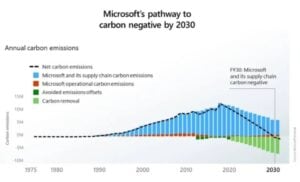
Microsoft emissions
Source: Microsoft

The company is one of the largest corporate buyers of carbon removal. It has signed contracts with companies like Heirloom, Climeworks, and Running Tide. They use a mix of direct air capture (DAC), biomass, and ocean-based methods.

As of 2024, Microsoft reported cutting its Scope 1 and 2 emissions by 22% from 2020 levels. However, Scope 3 emissions โ€” those from supply chains and product use โ€” still make up over 95% of its total footprint.

Microsoft carbon emissions
Source: Microsoft

To meet its targets, Microsoft is combining renewable energy investments with durable carbon removal projects such as Arcaโ€™s. Following this deal, the tech giant reported its Q1 2026 financial results.

Microsoftโ€™s Latest Earnings: Strong Results, But Shares Slip

Microsoft reported strong first-quarter fiscal 2026 results. Revenue rose 18% to $77.7 billion. Operating income grew 24% to $38.0 billion. Net income was $27.7 billion, up 12%. Profit also climbed to $30.8 billion, up 22%.

Microsoft Cloud revenue hit $49.1 billion, up 26%, and Azure and other cloud services grew 40%. The company returned $10.7 billion to shareholders through buybacks and dividends.

Microsoft earnings q1 2026 results
Source: Microsoft

Despite the beats, Microsoftโ€™s shares dropped roughly 3% in extended trading. Traders flagged three main worries.

  • First, Microsoft raised its investment profile โ€” management signalled higher capital spending to build more data centers and AI infrastructure.
  • Second, the company disclosed a $3.1 billion hit related to its OpenAI investments that lowered reported earnings.
  • Third, investors flagged margin pressure and possible capacity limits as cloud demand keeps rising.

These factors tempered the marketโ€™s initial enthusiasm, even as core business metrics beat expectations.

Microsoft stock price

Meeting AIโ€™s Growing Energy Demands

Microsoftโ€™s AI and cloud services require large amounts of energy. As its Azure platform and data centers expand, electricity demand keeps climbing.

Global data centers used about 415 terawatt-hours (TWh) of power in 2024, equal to roughly 1.5% of total global use. By 2030, that number could rise to 945 TWh, more than double current levels. AI computing will likely drive much of that growth.

To balance this, Microsoft is investing in clean and firm power sources such as nuclear, wind, solar, and geothermal. The company is also studying small modular reactors (SMRs) to power future data centers.

The deal with Arca adds another tool to help offset emissions from AI expansion. Microsoft is expanding its climate strategy. Itโ€™s now focusing on permanent carbon removal, not just renewables. It remains the top buyer of durable carbon removal in the second quarter of this year.carbon removal purchaser Leaderboard Top 10
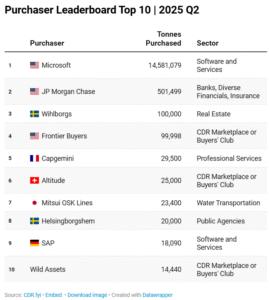
SEE MORE: Microsoft (MSFT Stock) Tops Q2 2025 Record-Breaking Surge in Durable Carbon Removal Credit Purchases

Arcaโ€™s Role in the Growing Carbon Removal Market

The global carbon removal market remains small but is growing fast. Experts say that by 2030, companies will need to remove at least 1 billion tonnes of COโ‚‚ each year to meet climate goals. Today, only about 5 million tonnes of verified removals exist globally โ€” meaning the market must expand hundreds of times.

Arcaโ€™s mineralization process is highly scalable. It uses abundant mining waste instead of new raw materials. Pilot projects in British Columbia and Ontario have shown good results. So, new facilities are planned all over North America.

The Microsoft deal gives Arca both credibility and financial backing to grow faster. Funds will help build larger operations, improve carbon measurement, and expand partnerships with mining companies globally.

Economic and Environmental Impact

For Arca, this deal marks a major step in scaling a once experimental process. It proves that natural mineralization can attract big corporate buyers and investors. It also highlights Canadaโ€™s leadership in carbon management and clean mining innovation.

The Honourable Tim Hodgson, Minister of Energy and Natural Resources, commented:

โ€œThe next generation of clean growth will be built by Canadaโ€™s first-class innovation ecosystem โ€“ companies like Arca, which are turning Canadian ingenuity into global leadership. Carbon removal technologies are not only strategic tools we can use to tackle climate change, they create good jobs and position Canada at the forefront of the global opportunity of a low-carbon economy.โ€

The deal helps Microsoft balance the environmental costs of its AI and cloud growth. It also supports its carbon removal efforts. Every tonne of COโ‚‚ removed will be verified and stored permanently. This follows the Science Based Targets initiative (SBTi) standards.

A Broader Shift Toward Permanent Carbon Removal

Tech giants like Google, Meta, and Shopify have signed similar long-term deals with carbon removal startups. These contracts give small companies predictable income, helping them scale and lower costs over time.

Analysts think the carbon removal market might reach $50โ€“100 billion a year by 2030. This growth will depend on policy support and corporate buyer demand.ย 

Both companies see this partnership as a model for combining technology, industry, and nature to fight climate change. For Microsoft, it is a key step in cleaning up emissions from its fast-growing AI business. For Arca, it provides a launchpad for global expansion and further innovation.

As more companies race toward net-zero goals, the demand for reliable and permanent carbon removal will keep rising. The Microsoftโ€“Arca deal shows that tackling climate change can also drive new business opportunities where sustainability and growth can work hand in hand.

Pony.ai and WeRide File Hong Kong IPOs as Chinaโ€™s Robotaxi Market Takes Off

Two of Chinaโ€™s top driverless car companies, Pony.ai and WeRide, have applied to list their shares in Hong Kong. This marks a major step for Chinaโ€™s autonomous vehicle (AV) industry as it seeks global recognition and funding. The twin IPO filings show how far the countryโ€™s robotaxi and self-driving technologies have advanced, and how investors are beginning to take them seriously.

IPO Details and Plans: Billions at Stake in the Driverless Race

Pony.ai, based in Guangzhou, plans to offer around 42 million Class A shares in its global offering, including a small portion to Hong Kong retail investors. The companyโ€™s maximum offer price is about HK$180 (roughly US$23) per share, which could value it at more than US$10 billion.

WeRide, also based in Guangzhou, aims to issue about 88 million shares at up to HK$35 each. Its total valuation could reach several billion dollars, depending on final pricing. Both listings are expected to take place on the Hong Kong Stock Exchange in early November 2025.

The filings follow regulatory approval from Chinaโ€™s securities regulator, which has been cautious about allowing tech companies to list abroad. Both firms are among the first autonomous-driving startups to receive the green light for an overseas IPO since 2023.

Why These IPOs Matter

The twin listings mark a turning point for Chinaโ€™s driverless tech sector. For years, companies like Pony.ai and WeRide relied on venture capital to fund expensive research and testing. Going public gives them access to new capital to expand fleets, build partnerships, and improve AI systems.

The move also reflects Chinaโ€™s growing ambition to lead in driverless mobility. While U.S. players like Waymo and Cruise have faced setbacks, Chinese developers are pushing ahead with pilot robotaxi services in major cities. Both Pony.ai and WeRide already hold licenses to operate driverless rides in parts of Beijing, Guangzhou, and Shanghai.

Public listings also help build transparency and investor confidence. For a young industry that has long been seen as futuristic and risky, IPOs show that companies believe they are close to commercial scale.

By the Numbers: Key IPO Metrics

Some of the main data points from the filings include:

  • Pony.aiโ€™s estimated valuation: Over US$10 billion.
  • Pony.ai shares offered: 42 million Class A shares.
  • WeRide shares offered: About 88 million shares.
  • WeRideโ€™s Q2 2025 revenue: ยฅ127 million (about US$18 million).
  • WeRideโ€™s Q2 2025 net loss: ยฅ406 million (about US$57 million).

While both firms continue to post losses, their revenue growth shows increasing demand for pilot robotaxi services and partnerships with automakers.

Company Background and Performance

Pony.ai was founded in 2016 and quickly became one of Chinaโ€™s most valuable AV startups. It operates driverless taxis, freight trucks, and test vehicles in China, the United States, and several other regions.

The company plans to expand its fleet from about 250 vehicles to over 1,000 by 2025. It has received investment from Toyota and other global carmakers.

WeRide was founded in 2017 and focuses on robotaxis, robobuses, and self-driving vans. It has already completed more than 30 million autonomous kilometers in testing and public operations.

In the second quarter of 2025, WeRide reported revenue of around ยฅ127 million (about US$18 million), up 60 percent from the same period last year. Despite the growth, it posted a net loss of about ยฅ406 million as it continues to invest in development.

Both companies face heavy competition from domestic rivals like Baiduโ€™s Apollo Go and international peers such as Waymo, Motional, and Cruise. The key challenge for all is finding a clear path to profitability in a market where hardware, mapping, and AI costs remain high.

Robotaxis on the Rise: Market Forecasts and Growth Drivers

The global robotaxi market is still young but growing quickly. Analysts estimate that the total market value for autonomous driving services could reach US$60 billion to US$70 billion by 2030.

robotaxi market forecast 2030
Source: Grand View Research

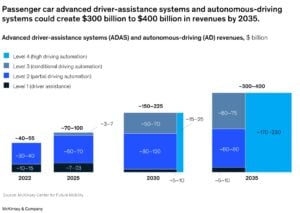
McKinsey estimates that advanced driving (AD) and driver-assistance (ADAS) systems could bring in US$300โ€“400 billion each year by 2035. Vehicles with Level 2+ automation typically include US$1,500โ€“2,000 in component costs, while Level 3 and Level 4 systems cost even more.

Moreover, consumer demand for smart driving features is rising. More commercial models are adopting them. So, the market for autonomous technology is on track to be one of the auto industry’s biggest growth areas.

autonomous driving revenue 2035

China could lead this growth. The countryโ€™s large cities, dense traffic, and strong government support for AI testing make it an ideal environment for scaling driverless fleets. Industry data shows that more than 20 Chinese cities now allow robotaxi testing or limited paid rides.

By 2030, Chinaโ€™s robotaxi sector could handle hundreds of millions of rides per year, potentially replacing a portion of traditional ride-hailing services. Consultancy forecasts suggest that robotaxis could account for 5% to 10% of all urban rides in major Chinese cities by the end of the decade.

Global automakers and tech companies are also watching closely. Toyota, Volkswagen, and Hyundai have all invested in autonomous-driving startups.

The rise of AI and electric vehicles is driving convergence between the auto and tech industries. This makes driverless transport one of the next big technology frontiers.

The chart below indicates that early growth will be slow as companies complete testing, secure permits, and scale their fleets. Once safety records improve and regulations ease, adoption will speed up, driven by cost savings, AI advancements, and public acceptance. After this rapid expansion, growth is likely to level off as the market matures and competition increases.

Robotaxi Market Forecast to 2030, China vs Global

The Roadblocks Ahead

Amid rapid progress, driverless mobility still faces big challenges. The technology is expensive, requiring advanced sensors, lidar systems, and high-precision maps. Safety remains a concern, with each incident drawing public scrutiny and slowing adoption.

Regulation also varies by region. Some Chinese cities allow fully autonomous operation, while others limit it to specific zones or hours. International expansion adds more complexity, as each country has its own testing rules and data-sharing policies.

Another major hurdle is profitability. Many experts say it could take until the late 2020s before most robotaxi operators achieve positive margins. Until then, they will need continued investment to cover R&D and fleet expansion.

Industry Outlook: Why Investors Are Watching Closely

For investors, Pony.ai and WeRideโ€™s IPOs offer an early opportunity to enter the driverless-car market through publicly traded shares. The listings also set a benchmark for valuing future AV firms.ย 

For the industry, these IPOs symbolize maturity. They show that Chinaโ€™s autonomous-driving sector is confident enough to open its books and attract global investors. Success could encourage more companies โ€” in lidar, battery tech, or mobility software โ€” to follow suit.

Investors will closely watch how quickly Pony.ai and WeRide can scale their fleets, control losses, and turn pilot projects into profitable transport networks.ย 

Pony.ai and WeRideโ€™s Hong Kong IPO filings signal a new phase for Chinaโ€™s driverless vehicle industry. The twin listings bring visibility and funding to two of the worldโ€™s most advanced AV developers.

They also highlight Chinaโ€™s ambition to lead in autonomous mobility โ€” a field that blends artificial intelligence, clean energy, and smart transport.ย While profitability may still be years away, this progress shows that the race toward self-driving transportation is no longer science fiction. It is an industry preparing to enter the next stage of real-world growth.

After $102B Quarter Revenue and Record Stock, Google Turns to Nuclear to Power the AI Boom

Google and NextEra Energy are joining forces to bring back the Duane Arnold Energy Center in Iowa. The electricity from this plant will power Googleโ€™s growing AI systems and data centers, helping the company reach its clean energy goals.

The partnership comes as Alphabet Inc., Googleโ€™s parent company, reported strong third-quarter earnings and a rise in stock value following better-than-expected results. Alphabetโ€™s revenue grew, driven by gains in cloud services and AI investments. The company raised its capital spending forecast to over $90 billion for 2025. This shows its commitment to expanding clean, reliable energy for its growing data network.

The project gives the U.S. nuclear industry a fresh boost at a time when demand for reliable, low-carbon electricity is rising sharply. As data and AI grow, companies are racing to get enough clean energy. They need it to power their technology all day and night.

Googleโ€™s Nuclear Comeback: Powering AI the Clean Way

The Duane Arnold Energy Center is located near Cedar Rapids, Iowa. It stopped operating in 2020 after more than 45 years of service. Now, NextEra Energy, one of the largest renewable energy companies in the U.S., plans to restart the plant by 2029.

Once operational, the reactor will generate about 615 megawatts (MW) of power, enough to supply hundreds of thousands of homes. Under a 25-year agreement, Google will purchase most of the plantโ€™s output to run its expanding network of cloud and AI data centers.

The restart could create hundreds of construction jobs and dozens of permanent roles when the plant reopens. Local suppliers, engineering firms, and service companies will also benefit. State officials expect the project to increase tax revenue and economic activity across eastern Iowa.

Just after this deal, Alphabet reported its 3rd Quarter financial results.

Alphabetโ€™s Q3 Earnings Fuel the Next Energy Push

Alphabet announced its third-quarter 2025 earnings. Total revenue reached $102.3 billion. This marks a 16% rise compared to last year. Net income rose to $27.6 billion, driven by strong ad sales, continued growth in Google Cloud, and higher demand for AI-powered services.

Google Cloud generated $15.16 billion in quarterly revenue, up 26% year over year. Its core Search and โ€œOtherโ€ businesses brought in $56.57 billion, while YouTube ads contributed another $8.8 billion.

Alphabet increased its annual capital spending forecast to $91โ€“93 billion. This change reflects investments in data centers, AI infrastructure, and clean energy projects, including the Duane Arnold restart.

The results highlight how Googleโ€™s financial strength supports its climate commitments. The company is investing heavily in clean power, energy storage, and long-term sustainability as AI models and data operations grow.

Following the release, Googleโ€™s stock broke a record with the price surging to its highest level.

Google stock price

AIโ€™s Growing Appetite for Electricity

Artificial intelligence and large-scale data centers are transforming the energy landscape. Training advanced AI models and handling billions of searches requires a lot of computing power. So, they also need constant electricity.

data centers nuclear
Source: BloomEnergy

In 2024, data centers worldwide consumed about 415 terawatt-hours (TWh) of electricity, or roughly 1.5% of global demand. The International Energy Agency (IEA) projects that number could rise to 945 TWh by 2030, more than doubling in just six years.

data center electricity use 2035

A report from Goldman Sachs suggests that total data center power demand could increase 160% by 2030 compared with 2023 levels. In the U.S. alone, data centers could account for 8% of national electricity use by the end of the decade.

That surge makes always-on, low-carbon energy essential. Unlike solar and wind, nuclear power provides a steady output regardless of the weather. For Google and other AI companies, stability is vital. It helps them keep their networks online 24/7 and cut emissions.

Google data center energy use

Why Tech Giants Are Turning to Nuclear Power

Tech giants are now among the most active investors in advanced nuclear energy. Companies such as Google, Microsoft, and Amazon are pursuing nuclear deals to meet both AI expansion and climate goals.

Their reasons are straightforward:

  • Reliability: Nuclear reactors generate power 24/7, supporting constant digital workloads.
  • Low-carbon: They produce almost no greenhouse gas emissions.
  • Cost stability: Uranium fuel costs are predictable over long timeframes.
  • Grid support: Nuclear power balances variable renewables like solar and wind.
For Google, using nuclear power aligns with its plan to run all operations on clean energy every hour of every day by 2030. NextEra and other utilities can reach new markets. They supply low-carbon electricity directly to data centers and tech campuses.

Engineering a Second Life for Duane Arnold

Restarting a nuclear plant is not easy. The U.S. Nuclear Regulatory Commission (NRC) must approve the restart first. They will review safety systems and environmental impact.

NextEra must rebuild cooling towers, replace old parts, and update digital controls before operations can start again. The company will also train a new workforce to operate the plant under updated safety rules.

Experts estimate that reviving an older reactor can be 30โ€“40% cheaper than building a new one. Even so, the project includes billions in upgrades. It also faces complex licensing and global supply-chain challenges.

Still, the economic payoff could be significant. Restarting Duane Arnold boosts local energy reliability and supports federal clean power goals. It shows how old infrastructure can meet todayโ€™s climate needs.

Googleโ€™s Carbon-Free Energy Goal

Google has matched 100% of its annual electricity use with renewable power purchases since 2017. But its next milestone is far tougherโ€”running entirely on carbon-free energy at all times by 2030.

The company already sources solar, wind, and geothermal power across multiple continents. Yet, because these sources are intermittent, nuclear can play an important balancing role.

The Duane Arnold partnership ensures a steady supply when the grid fluctuates. Google is exploring small modular reactors (SMRs), geothermal wells, and long-duration energy storage. These are key parts of its clean power strategy.

Google wants to diversify its clean energy sources. This will help its AI infrastructure stay strong against climate change and keep costs stable. The chart below shows 6how t6he tech giant’s clean energy avoided emissions.

Google clean energy emission reductions

Powering the Digital Future

The Googleโ€“NextEra deal marks a new chapter in how technology companies think about power. For Google, it guarantees access to reliable, low-carbon electricity for decades. NextEra builds a profitable model. It supplies the data economy and extends the lifespan of nuclear infrastructure.

If successful, the project could serve as a blueprint for reviving other shuttered U.S. reactors. It demonstrates how legacy assets can be modernized to meet todayโ€™s energy and AI needs without adding new carbon emissions.

More broadly, it highlights a turning point in the clean energy transition. As AI use grows worldwide, the demand for โ€œfirm clean powerโ€ increases too. This includes reliable sources like nuclear, hydro, and geothermal energy. Federal tax incentives from the Inflation Reduction Act make projects more appealing to private investors.

Rebuilding and restarting the Duane Arnold Energy Center will take several years of engineering work, testing, and regulatory review. If the process stays on schedule, the plant could be back online by 2029.

For Google, this partnership is more than an energy deal. It also reflects how the company is linking its financial strength to its climate and AI goals. After posting strong third-quarter earnings and a solid rise in revenue, the company has shown that its investments in AI and cloud services are not only profitable but also shaping its long-term sustainability plans.

The Duane Arnold project fits into that vision by ensuring that Googleโ€™s expanding data operations are powered by clean, reliable energy. This collaboration shows that the future of AI depends as much on clean, continuous power as it does on computing power. Nuclear energy, once seen as outdated, is now becoming one of the key engines driving the digital and energy economy forward.

Nissan Partners with BYD to Meet EU 2025 Carbon Rules and Avoid Hefty Fines

Nissan has struck a new emissions-pooling deal with BYD, a Chinese electric vehicle maker. This partnership aims to help meet the European Unionโ€™s tough carbon dioxide limits for carmakers set for 2025. Nissan’s partnership with BYD lets it combine its European fleet emissions with BYDโ€™s low-emission record. This helps Nissan avoid penalties while it shifts to electric mobility.
The move shows how traditional automakers are adapting to quick climate rules. They are forming strategic partnerships to stay compliant and grow their electric lineups.

Understanding EU Emission Rules

The European Union enforces some of the toughest vehicle emission standards in the world. Starting in 2025, carmakers must limit their average emissions to about 93.6 grams of COโ‚‚ per kilometer. This is measured using the Worldwide Harmonised Light Vehicle Test Procedure (WLTP). The rule applies to every automaker based on the average emissions of the new cars they sell in the EU each year.

If a companyโ€™s average exceeds its target, it faces a fine of โ‚ฌ95 for each gram per kilometer above the limit multiplied by the number of cars sold. For large manufacturers, this can easily translate to hundreds of millions, or even billions, of euros in penalties.

EU emissions standard for vehicles
Source: ICCT

Analysts say the combined risk for the industry could reach over โ‚ฌ10 billion if several automakers fail to meet the new limits.

The EU wants to speed up the shift to electric vehicles (EVs) and plug-in hybrids. They aim to stop selling new petrol and diesel cars by 2035. While many automakers have increased EV output, the pace of change remains uneven across brands and regions.

Pooling 101: How Automakers Share Emissions to Survive

To give companies flexibility, EU rules allow them to form โ€œemissions pools.โ€ This system lets manufacturers combine their vehicle fleets and calculate an average COโ‚‚ figure together.

If one company has a cleaner fleetโ€”such as an EV producerโ€”it can offset the higher emissions of another. The combined average determines whether the group meets the EU target.

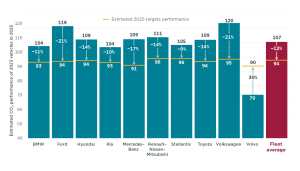
2025 Manufacturer CO2 targets versus 2023 fleet performance
Source: ICCT

Pooling has become a common compliance tool in Europe. Tesla made hundreds of millions of euros by teaming up with legacy automakers like Fiat Chrysler and Honda. They used Teslaโ€™s zero-emission cars to meet their emissions goals. Nissanโ€™s new agreement with BYD follows the same principle.

By linking with BYD, Nissan can count a share of BYDโ€™s low-carbon vehicle sales toward its own compliance calculation. This partnership will lower Nissanโ€™s average emissions in Europe by 2025. This move helps the company steer clear of hefty fines.

Why Nissan Turned to BYD

Nissan had previously joined an emissions pool with Renault as part of their long-time alliance. Nissan has decided to partner with BYD, one of the largest EV makers. This choice comes as the Renaultโ€“Nissan partnership operates more independently and EU rules get stricter.

BYDโ€™s growing success in Europe made it an attractive partner. The company has quickly grown its market share. This is thanks to all-electric and plug-in models that create almost no tailpipe emissions.

Nissan’s strong performance helps offset the higher emissions from its petrol and hybrid models. These models still account for a large part of its sales in Europe.

Industry analysts say this decision reflects both opportunity and necessity. It gives Nissan breathing room as it works to increase its electric lineup in Europe. The company plans to sell only fully electric cars in Europe by 2030. For now, pooling provides a temporary solution to stay compliant as EV production increases.

The Debate: Compliance Shortcut or Climate Setback?

The deal benefits both companies in different ways. For Nissan, the partnership avoids immediate financial penalties and protects its market position during a challenging transition.

For BYD, it could provide a new revenue stream, as the company may receive payment or carbon credits for its contribution to the pooled fleet. It also strengthens BYDโ€™s presence in Europe, where competition in the EV market is intensifying.

However, not everyone sees pooling as a long-term solution. Environmental groups and some policymakers say these deals can slow real emission cuts. High-emission automakers rely on cleaner partners rather than fully changing their production lines. These strategies might meet legal rules, but they do little to speed up the actual drop in transport emissions.

Still, the system remains a legal and effective compliance method under EU law. Most experts agree that pooling will last until electric vehicle production and sales are strong. This strength will make partnerships between automakers unnecessary.

A Growing Trend in the Auto Industry

Nissan and BYDโ€™s collaboration is part of a wider trend among carmakers facing tighter environmental rules. Over the past few years, multiple manufacturers have entered pooling agreements with EV specialists to avoid penalties.

According to industry data, nearly a dozen major automakers are now part of emissions pools across Europe. These arrangements are likely to increase in the short term.

EV sales are rising fast, but challenges remain. Traditional carmakers struggle to switch to electric models due to:

  • Infrastructure gaps
  • High battery costs
  • Supply-chain issues

Pooling provides short-term relief. It helps the industry sell vehicles in Europe and stay within emissions limits.

From Pooling to Full Electrification

For Nissan, this agreement marks another step in its broader electrification plan. The company will launch more all-electric and hybrid vehicles. This plan is backed by new EV production hubs in the UK and Spain. By 2028, Nissan plans to launch several next-gen models. These will help reduce average emissions without depending much on pooling, which is important in its net-zero goal.

Nissanโ€™s Roadmap to Net Zero

Nissan has set a long-term goal to achieve carbon neutrality across its entire business by 2050. This includes not only vehicle emissions but also their manufacturing, supply chain, and end-of-life processes. The companyโ€™s climate strategy focuses on electrifying its lineup, cutting factory emissions, and using more recycled and low-carbon materials.

  • Long-Term Goal: Carbon Neutral by 2050

Nissanโ€™s 2050 vision aims for zero emissions across the full lifecycle of its vehiclesโ€”from production to use and recycling. The company wants every car it sells, and every factory it operates, to be carbon neutral by mid-century. This goal aligns with global climate efforts to limit warming to 1.5ยฐC.

  • Mid-Term Targets Under Nissan Green Program 2030

To reach this long-term target, Nissan launched the โ€œGreen Program 2030,โ€ a set of mid-term goals that guide its transition over the next decade. The plan includes cutting emissions in both manufacturing and vehicle use.

Nissan 2030 emission reduction goal
Source: Nissan

In Europe, Nissan has set an ambitious goal for all its new cars to be fully electric by 2030. In Asia, the carmaker is also investing in EV supply chains and battery development.

Back in its home, Japan, Nissan has introduced new technologies to reduce factory emissions and is promoting renewable energy use across its facilities. In North America, the company is launching new hybrid and electric models to meet rising consumer demand for cleaner vehicles.

Nissan 2030 carbon emissions regional
Source: Nissan

The company plans to reach carbon neutrality through three main strategies:

  • Electrification of vehicles
  • Cleaner manufacturing
  • Circular supply chain

Nissanโ€™s decision to pool emissions with BYD in Europe fits within its broader decarbonization strategy. The deal gives Nissan temporary flexibility as it ramps up production of electric models and upgrades its European operations to lower carbon intensity.

For BYD, the partnership supports its strategy of expanding into European markets. The company continues to grow its sales network across the continent, with production plans in Hungary and potential sites in France. Its role as a compliance partner shows its strength as a global EV leader. It can influence industry trends beyond just its own brand.

Pooling remains a practical tool for now, giving Nissan and others time to adjust. Yet, as regulations tighten and public expectations rise, long-term success will depend on how quickly these companies can shift from depending on emission credits to producing truly zero-emission vehicles of their own.

Project Matador: Americaโ€™s $90B Nuclear Power Solution for AI, Semiconductors, and Data Centers

Disseminated on behalf of Uranium Royalty Corp.

The United States is entering a new phase in clean energy. It now combines artificial intelligence (AI), advanced data centers, and nuclear power in one system. At the center of this shift is Project Matador, aka Donald J. Trump Generating Plant, a plan to build an 11-gigawatt (GW) energy and data campus in Texas.

The project aims to become one of the largest clean energy and computing developments in the world. Led by Fermi America LLC, it could change how data centers get their power. Its mix of nuclear, solar, natural gas, and battery storage is designed to provide steady, low-carbon energy for the growing AI and chip industries.

The Vision Behind Project Matador

Project Matador is one of the most ambitious U.S. energy projects in decades. It will cover about 5,855 acres in Carson County, Texas, under a 99-year lease with Texas Tech University.

project matador location map
Source: Fermi America

The site will host four Westinghouse AP1000 nuclear reactors, along with solar panels, batteries, and natural gas plants. Together, these systems will generate up to 11 GW of reliable power for large data centers and chip factories built on the same campus.

Fermi America plans to begin construction in 2026. The first nuclear reactor could start running by 2031, with all 4 completed by 2038. The total cost could reach $70โ€“90 billion.

The nuclear reactors will use the proven AP1000 design, known for its strong safety features. The site near Amarillo was chosen for its stable geology, existing infrastructure, and strong power connections. The area also sits next to a long-standing federal facility, which helps with environmental and safety approvals.

Building the AI Energy Campus of the Future

Project Matador is more than a power plant – itโ€™s a purpose-built, vertically integrated energy campus designed to power Americaโ€™s next wave of digital industries: hyperscale AI data centers and advanced semiconductor manufacturing. By combining four Westinghouse AP1000 nuclear reactors, large-scale battery storage, combined-cycle natural gas, and on-site solar, Matador delivers round-the-clock, zero-carbon electricity within a single, secured perimeter.

data center electricity demand due AI 2030

This model solves major challenges for high-tech facilities. AI systems and chip fabs demand continuous, multi-gigawatt power – often beyond what traditional grids can supply. Matadorโ€™s behind-the-meter setup keeps energy onsite, delivering reliable power directly to data centers and manufacturing plants. Its nuclear generators supply up to 4.4 GW of steady baseload, while batteries provide backup and frequency control, guarding sensitive compute clusters from outages. Natural gas and solar add further resilience, keeping operations stable even during grid stress.

For data centers, this means 24/7 uptime and low-carbon power for demanding AI, cloud, and security workloads. Hyperscale operations can use over 3 GW each, so every minute of reliable energy protects millions in value and supports technology leadership. Google, Meta, and Nvidia benefit directly from Matadorโ€™s self-sustaining grid, bypassing public utility risks.

Semiconductor manufacturing is also strengthened. Chip fabs are North Americaโ€™s most power-sensitive assets – a single disruption can halt modernization and risk supply chains. By hosting robust, secure energy onsite, Matador drives U.S. onshoring under the CHIPS Act, boosting sector growth and jobs.

Alongside these benefits, the campus reduces grid strain, lowers emissions, and creates thousands of jobs. Fermi Americaโ€™s initiative sets a new standard for strategic nuclear and hybrid energy infrastructure, anchoring Americaโ€™s future in clean, resilient, and tech-driven power. With 11 GW of clean electricity, Matador reduces foreign dependence and supports federal goals for secure compute and chip operations – driving over 50,000 jobs and future-proof growth. Its integrated model establishes a global benchmark for sustainable, strategic industrial power.

Building Global Partnerships: South Koreaโ€™s Role in the U.S. Nuclear Comeback

The company signed important deals in South Korea for nuclear technology and component production. It signed a FEED (front-end engineering design) deal with Hyundai Engineering & Construction. This deal will kick off the engineering of four AP1000 reactors.

Also, it reached a deal with Doosan Enerbility. This agreement secures long-lead components, such as reactor pressure vessels and steam generators. These moves lock in key suppliers and help protect the projectโ€™s timeline and cost estimates.

Toby Neugebauer, Co-founder & CEO of Fermi America, stated:

“Doosan Enerbility and Hyundai E&C have been waiting for an American company to stop power pointing about nuclear and start building it. Their firm commitment to Fermi America positions us for action, leveraging their track record of success to build clean, new nuclear power at the velocity and scale the President demands and the U.S. requires.”ย 

Fermi notes that it was the first company to file a combined operating license that the NRC accepted for review in September 2025. The company thanked Texas leaders. It also highlighted the stateโ€™s new $350 million funding for the Texas Advanced Nuclear Energy Office (TANEO) to support the build.

These partnerships will boost the AP1000 reactor supply chain. They will also strengthen connections between the U.S. and Korea in advanced energy development.

The AP1000, built by Westinghouse Electric Company, is one of the worldโ€™s safest and most efficient nuclear reactor designs. It uses passive safety systems that can cool the reactor without human action or external power. This makes it ideal for modern, high-security facilities like Project Matador.

Fermi America will fund construction through a mix of private equity, REITs, and federal loan guarantees. This method shares financial risk. It also makes sure the project follows strict safety and environmental rules.

Nuclear Powerโ€™s Return and How UROY Stands to Gain From It

Projects like Matador show that nuclear power is making a comeback in the U.S. After years of slow progress, nuclear energy is now viewed as essential for clean power and energy security. The rise of AI, cloud computing, and electric vehicles has sharply increased demand for dependable electricity.

For investors, this creates new opportunities in uranium and nuclear development. Uranium Royalty Corp (UROY) is one company well-positioned to benefit. Based in Canada, UROY owns royalties and streams linked to uranium mines around the world. This means it earns a share of revenue from uranium production without operating the mines itself.

UROY also holds physical uranium reserves, giving it direct exposure to fuel price increases. As new reactors like those at Matador move closer to construction, demand for uranium will rise. UROYโ€™s business model allows investors to gain from this trend without the high costs or risks of running a mining company.

UROY benefits when uranium prices climb or when more nuclear power plants sign fuel contracts. The U.S. currently produces less than 10% of the uranium it needs and depends heavily on imports. To fix this, the government is supporting efforts to rebuild the domestic uranium supply chain.

uranium concentrate production in the US 2025
Source: EIA

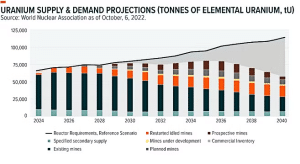
As new U.S. nuclear projects start – including Matador, TerraPowerโ€™s Natrium reactor, and Okloโ€™s advanced fission systems – the need for uranium fuel will grow. That means higher demand for UROYโ€™s royalty partners and assets.

uranium supply and demand projections 2040

Even though UROY is not tied to a single project, its portfolio rises in value as the global nuclear market expands. If the U.S. adds dozens of gigawatts of nuclear capacity by 2040, UROY could see major growth in both royalty revenue and asset value.

The Bigger Picture: Clean Power for the Digital Era

Project Matador shows how the energy transition and the digital economy are coming together. AI and chip manufacturing need clean, steady power โ€” and nuclear energy can deliver it.

For the U.S., this kind of project also supports national security, ensuring that data and computing systems run on domestic, reliable energy.

For investors, companies like UROY offer a simple way to invest in the nuclear revival. They benefit as more projects move forward and uranium demand increases.

The next generation of clean energy will go beyond solar and wind. It will combine nuclear stability, renewable flexibility, and digital intelligence, all working together to power the AI age.


Disclosure: Owners, members, directors, and employees of carboncredits.com have/may have stock or option positions in any of the companies mentioned: None.

Carboncredits.com receives compensation for this publication and has a business relationship with any company whose stock(s) is/are mentioned in this article.

Additional disclosure: This communication serves the sole purpose of adding value to the research process and is for information only. Please do your own due diligence. Every investment in securities mentioned in publications of carboncredits.com involves risks that could lead to a total loss of the invested capital.

Please read our Full RISKS and DISCLOSURE here.

Oil Giants Under Fire: ExxonMobil Fights Climate Laws as TotalEnergies Found Guilty of Greenwashing

Two of the worldโ€™s largest oil companies, ExxonMobil and TotalEnergies, are in the spotlight for very different reasons. Exxon is fighting new climate-reporting laws in California. Meanwhile, TotalEnergies was found guilty of greenwashing or misleading the public about its climate claims. These changes show the rising tension among fossil fuel producers, governments, and regulators as climate rules get stricter around the world.

ExxonMobil Takes California to Court Over Climate Rules

ExxonMobil filed a lawsuit to block Californiaโ€™s new climate-reporting requirements. The company claims the laws breach its constitutional rights, particularly its First Amendment free speech rights. It also says they unfairly target large businesses in the state.

The case focuses on two key laws:

  • Senate Bill 253 requires companies that make over $1 billion a year to report their greenhouse gas emissions. This includes indirect โ€œScope 3โ€ emissions.
  • Senate Bill 261 requires companies to share how climate risks might impact their finances and operations.

Exxon says the laws force companies to โ€œspeakโ€ in a way that aligns with Californiaโ€™s view on climate change. The oil giant says the regulations will bring high costs and unreliable data. Also, tracking emissions in global supply chains is tricky.

California officials, however, say the lawsuit is an attempt to avoid transparency. They argue that companies must be open about the full impact of their activities if the world is to meet climate goals.

If the court sides with Exxon, the decision could delay the rollout of similar laws in other U.S. states. But if California wins, it would mark one of the most ambitious climate-reporting mandates in the world.

TotalEnergies Faces Penalty for Misleading Climate Claims

In France, TotalEnergies faced a very different kind of scrutiny. A Paris court decided on October 23 that the company misled consumers with its public statements about climate goals.

The court decided that TotalEnergies’ 2021 marketing messages were misleading under its greenwashing laws. They claimed to be โ€œa major actor in the energy transitionโ€ and aimed for net zero by 2050. However, the court noted the company’s ongoing investment in oil and gas projects.

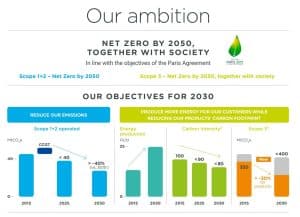
TotalEnergies net zero 2050 ambition

As a result, TotalEnergies must remove or revise the disputed statements from its website within one month or face daily fines of up to โ‚ฌ20,000. The company was also ordered to pay damages and legal fees to three environmental groups that filed the lawsuit.

TotalEnergies accepted the ruling. However, it noted that most claims by the plaintiffs were dismissed. The company also insisted that its low-carbon investments are real.

The TotalEnergies case marks one of the first successful โ€œgreenwashingโ€ rulings in Europe against a major fossil fuel producer. It sends a clear message: companies must align their advertising with measurable action, not just promises.

A Global Shift Toward Accountability

The twin cases reveal a major shift in how governments and courts are handling corporate climate claims. Oil and gas companies have pushed for long-term net-zero goals for years. Yet, they keep expanding fossil fuel production. That approach is now under heavy scrutiny.

Across the world, regulators are moving from voluntary to mandatory climate reporting. Investors and consumers are also demanding more proof that companies are reducing emissions in real terms, not just on paper.

The International Energy Agency (IEA) reports that the global oil and gas industry accounts for about 15% of total energy-related emissions. This includes methane leaks and refining. The IEA says these emissions must fall by at least 60% by 2030 to stay on track for net-zero goals.

But progress remains slow. In 2024, the biggest oil companies put over $400 billion into new fossil fuel projects. In contrast, they invested less than $80 billion in renewables. This imbalance fuels criticism that public climate statements often do not match actual spending.

Final investment decisions in US LNG 2025 IEA
Source: IEA

Why Climate Disclosure Laws Are Game-Changers

Transparent emissions reporting is a critical step toward accountability. California laws in Exxonโ€™s lawsuit require big companies to report their total emissions. This includes emissions from direct operations, supply chains, and product use.

Supporters say these rules will:

  • Create a level playing field for all large firms.
  • Help investors and consumers compare climate performance.
  • Push companies to reduce emissions more aggressively.

For example, Scope 3 emissions, those from customers using a companyโ€™s products, often make up more than 80% of an oil companyโ€™s carbon footprint. Without such disclosures, the true impact of fossil fuels remains hidden.

Opponents, however, say the costs and technical challenges could be high. They warn that requiring thousands of global companies to track every step of their carbon footprint could lead to inconsistent or unverifiable results.

Still, many analysts believe the trend toward mandatory disclosure is irreversible. Similar frameworks are being considered in the European Union, Japan, and Canada.

Rising Legal and Market Risks for Oil Majors

The cases involving ExxonMobil and TotalEnergies are part of a growing wave of climate-related lawsuits. The Grantham Research Institute reports that almost 3,000 climate cases have been filed globally. About 230 of these focus directly on companies.

Many involve accusations of greenwashing, misleading investors, or failing to disclose climate-related financial risks.

The potential costs are high. Penalties, legal fees, and damaged reputation can all hurt a companyโ€™s market value. For investors, it adds a new layer of risk in an already volatile energy sector.

Meanwhile, clean energy investment continues to rise. BloombergNEF estimates that in 2024, spending reached over $2 trillion. This includes renewable energy, electric vehicles, and carbon capture technology. This is more than double what was invested in fossil fuels.

This global capital shift pressures oil companies. They need to show they are adapting to the energy transition, not resisting it.

The Bigger Picture: Transition or Tension?

These two high-profile cases capture a crossroads moment for the oil industry. Governments aim for quicker decarbonization. However, companies still depend on fossil fuels for profit.

ExxonMobilโ€™s lawsuit represents resistance โ€” a pushback against state regulation. TotalEnergiesโ€™ court case shows what happens when public messaging gets ahead of actual progress.

Yet, both cases show that climate accountability is no longer optional. The industry is under pressure to show clear results. This comes from courts, disclosure laws, and investors.

To stay competitive, oil majors must boost low-carbon investments. They should also improve transparency and align operations with credible climate targets.

If Exxon loses its challenge, it could open the door to a wave of state and federal disclosure rules in the U.S. If more courts follow Franceโ€™s lead, companies could face lawsuits for greenwashing worldwide.

Either way, fossil fuel companies are under pressure to back their climate claims with action. The age of unchecked promises is ending, replaced by a future of measured accountability.

Beyond Meatโ€™s Comeback: 600% BYND Stock Surge Fuels Its Climate Revival

Beyond Meat is back in the spotlight. The plant-based meat company has seen a sharp rise in its share price after announcing a major U.S. retail expansion. It revealed that its products would now be sold in more than 2,000 Walmart stores. The company also launched a new Beyond Burger 6-Pack, giving shoppers a more affordable way to buy plant-based meat.

But this comeback is about more than business. Beyond Meatโ€™s biggest story lies in its climate and sustainability record, which continues to set it apart from traditional meat producers.

A Massive Stock Rebound

Beyond Meat price chart
Source: Yahoo Finance

Beyond Meatโ€™s stock surge surprised both analysts and investors. The sharp jump came after months of slow trading and declining confidence in plant-based food stocks.

Over a three-day trading period, Beyond Meat experienced a remarkable surge of nearly 600%, with its share price increasing from $0.52 on October 16 to a peak of $3.62 on October 21. By October 27, the stock had settled at $1.81, reflecting ongoing volatility and heightened market interest.

Analysts say the rally reflects renewed trust in Beyond Meatโ€™s growth strategy, especially its partnership with Walmart and the introduction of lower-priced products. The move shows how the company plans to reach more households and expand in a challenging grocery market.

Market data show Beyond Meatโ€™s market capitalization climbed by billions of dollars in less than a week. The rally also sparked fresh interest from institutional investors looking at sustainability-driven food companies.

Even after the rapid rise, analysts note that Beyond Meat remains a volatile stock. Still, its recovery highlights how strong sustainability credentials and affordable innovation can reignite investor enthusiasm.

Huge Reductions in Emissions and Resource Use

Beyond Meatโ€™s latest life cycle assessments (LCAs) show how much cleaner its products are compared to beef.

  • Making a Beyond Burger creates 90% fewer greenhouse gas emissions than a beef burger of the same size.
  • It uses 97% less water, 93โ€“97% less land, and up to 65% less energy.
  • One Beyond Burger has a carbon footprint of 0.68 kilograms of COโ‚‚e, about 38 times smaller than beef.
Beyond burger carbon footprint vs meat
Source: Heller, M. and Keoleian, G. paper (https://hdl.handle.net/2027.42/192044)

These results come from studies done by the University of Michigan and reviewed by independent experts. The reason for the low impact is simple.

Beyond Meatโ€™s ingredients โ€” such as peas, rice, and canola โ€” take far fewer resources to grow than raising cattle. Cows also release methane, a gas far more powerful than COโ‚‚, which plants do not produce.

Steak Without the Guilt: Cutting Emissions by 84%

Beyond Meatโ€™s new Beyond Steak also shows strong environmental performance. The product emits 84% less greenhouse gas and uses 93% less water than a beef steak.

The company says if every American swapped one beef meal a week for a Beyond Meat product, it could cut emissions equal to taking 12 million cars off the road each year.

Beyond steak LCA
Source: Beyond Meat ESG Report

Food production creates about 1/3 of global greenhouse gas emissions, according to the United Nations. Plant-based meat helps lower that total, making a diet change one of the fastest ways to fight climate change.

Below is the chart showing the carbon footprint of different food products per kilogram:

food ghg or carbon emissions per kilo
Source: UN

How Beyond Meat Builds Its ESG Strategy

Beyond Meatโ€™s commitment to sustainability goes beyond its products. The companyโ€™s ESG plan focuses on clean operations, better packaging, and responsible sourcing.

  • Renewable power: Some of its factories already run on clean electricity. The company plans to expand this each year.
  • Sustainable sourcing: Ingredients come from farms that use less water and fewer fertilizers.
  • Greener packaging: Beyond Meat has reduced plastic use and added more recyclable materials.
  • Water savings: Compared to beef, its products need only a small fraction of the water to produce.

In its latest ESG report, Beyond Meat said it had cut its operational carbon footprint by over 20% in just two years. Its total GHG emissions reached about 193,700 metric tons of COโ‚‚e across all scopes. This includes 7,999 tCOโ‚‚e from Scope 1, 9,065 tCOโ‚‚e from Scope 2 (market-based), and 176,654 tCOโ‚‚e from Scope 3 activities such as purchased goods and services.

Beyond Meat carbon emissions footprint
Source: Beyond Meat report

Helping Global Climate Goals

Beyond Meatโ€™s model supports the Paris Agreementโ€™s goal to limit global warming to 1.5ยฐC. Livestock farming creates nearly 15% of global emissions, mostly from methane. Replacing even part of the global meat market with alternatives would have a big impact.

Analysts at Boston Consulting Group (BCG) estimate that if 10% of all meat sold by 2030 were plant-based, it could cut 0.5 gigatons of COโ‚‚e each year.

By expanding through Walmart, Target, and other retailers, Beyond Meat is helping make climate-friendly food more common and affordable.

Business Growth and Climate Impact

Beyond Meatโ€™s recent recovery also matches a growing global market for sustainable food. Plant-based food sales hit $52 billion in 2024 and could reach over $160 billion by 2030, according to Bloomberg Intelligence.

plant-based food market 2030 BNEF

Investors are increasingly focused on ESG performance. Beyond Meatโ€™s verified environmental data makes it attractive for both climate-conscious investors and everyday consumers.

The companyโ€™s new six-pack burger is a big part of that effort. It offers lower prices during a time when food inflation is high, helping more people choose climate-friendly protein without paying extra.

Setting Standards in Sustainability Reporting

Beyond Meat stands out for being open about its environmental data. It reports its progress through international standards like the Sustainability Accounting Standards Board (SASB) and the Carbon Disclosure Project (CDP).

In 2024, it ranked among the top 5% of food companies worldwide for sustainability transparency, according to Corporate Knights. The company also works with industry groups and governments to improve standards for labeling and emissions reporting.

Beyond Meatโ€™s supply chain data show how its focus on transparency helps build trust with retailers and regulators. Investors view this as a sign of long-term stability and accountability.

New Challenges, Same Mission

Beyond Meatโ€™s journey has not been easy. The plant-based meat market is becoming more competitive, and consumer demand has been uneven in recent years. Some shoppers still prefer the taste or texture of beef.

To respond, Beyond Meat is improving its recipes and investing in research. It is also testing regenerative farming methods to grow its crops in ways that store carbon and improve soil health. These efforts could make its ingredients even more climate-friendly.

Price remains another challenge. Plant-based meat often costs more than beef. However, the new value-sized burger pack and wider retail reach aim to close that gap and attract new buyers.

Beyond Meatโ€™s stock surge marks more than a financial rebound; it signals renewed faith in sustainable food innovation. As global emissions rise, Beyond Meat shows how small choices, like swapping one meal, can add up to real change.

Every Beyond Burger or Beyond Steak sold saves water, reduces land use, and lowers carbon pollution. The company proves that business growth and sustainability can go hand in hand and that the future of food can be both profitable and planet-friendly.

Indonesia Aims to Sell 13.4 Billion Tonnes of Carbon Credits to Global Buyers

Indonesia plans to sell 13.4 billion tonnes of carbon-dioxide equivalent (COโ‚‚e) credits to global buyers. This is one of the biggest carbon market plans in the world. The government says the move could bring in billions of dollars in investment while helping the country meet its climate goals.

The forestry minister’s announcement comes as more countries and companies look to buy verified carbon credits to offset emissions. Experts estimate the global carbon market could grow to $35 billion by 2030, more than five times its current size. With its large forests and renewable energy projects, Indonesia could become a major supplier of these credits.

Building a Global Carbon Market

The 13.4 billion tonnes of COโ‚‚e credits will come from projects that cut or remove carbon emissions. These include forest protection, peatland restoration, renewable energy, and carbon capture programs.

Indonesia has about 125 million hectares of tropical forest, which absorbs over 25 billion tonnes of COโ‚‚e every year. The government sees carbon trading as a way to earn money while protecting the environment.

Officials say this plan could create tens of thousands of green jobs. It will also attract private funding for conservation and clean energy projects.

The credits will be traded through Indonesiaโ€™s national carbon registry, the Sistem Registri Nasional (SRN). This system tracks emissions and removals across industries and projects.

The Rise of Carbon Trading at Home

Indonesia launched its own carbon exchange in 2023 through the Indonesia Stock Exchange (IDX). During its first year, it traded about 500,000 tonnes of COโ‚‚e, worth around $5 million.

By 2024, the country had registered more than 2,000 carbon projects, covering areas like energy, forestry, and manufacturing. The government also started a carbon-pricing system for power plants. Large emitters must now report their emissions and offset some of them through credits.

In 2025, Indonesia reopened carbon trading with other countries under new rules aligned with the Paris Agreement. These rules prevent double-counting of emission cuts and make trading more transparent.

However, local carbon prices remain lower than international ones. Indonesiaโ€™s credits often sell for under $20 per tonne, while high-quality global credits range from $40 to $80 per tonne. Officials hope international demand will help raise prices closer to global levels.

The Economic and Climate Impact

If Indonesia sells all 13.4 billion tonnes of credits, they could be worth between $130 billion and $670 billion, depending on the market price. Even selling a fraction of this amount would make Indonesia one of the worldโ€™s biggest carbon credit exporters.

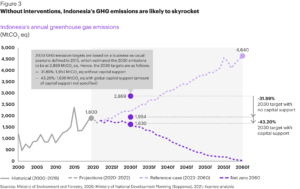
The program supports the countryโ€™s pledge to cut emissions by almost 32% on its own or 43% with global support by 2030. Indonesia also aims to reach net-zero emissions by 2060.

Indonesias-pathway-to-net-zero-2060
Source: Kearney

Moreover, the country aims to cut emissions by up to 43% by 2030 with international support. Indonesiaโ€™s forests and peatlands store large amounts of carbon; protecting them and trading carbon credits can turn this natural resource into income.

At the same time, the country still burns coal for much of its power, so these credits help raise funds for cleaner energy. Revenue from carbon credit sales will support:

  • Forest protection: Deforestation, which once exceeded 1 million hectares per year, has already declined and could fall further.
  • Renewable energy projects: Solar, hydro, and geothermal sources now supply about 14% of Indonesiaโ€™s power.
  • Local communities: Landowners who protect forests and wetlands will earn income instead of clearing them for crops.

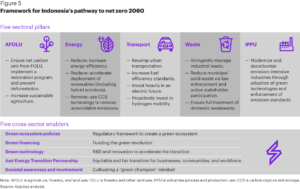
These projects link environmental goals with economic growth. They help rural areas gain from the green economy. The Southeast Asian nation has the following pillars in cutting emissions.ย 

Indonesia net zero pathway
Source: Kearney

Big Buyers, Bigger Ambitions

Many large companies are eager to buy reliable carbon credits. Firms like Microsoft, Shell, and Delta Air Lines have pledged to offset emissions through verified carbon projects.

According to BloombergNEF, demand for nature-based credits could rise from 165 million tonnes in 2024 to over 1 billion tonnes by 2030. If Indonesia supplies even 10% of that, it could sell 100 million tonnes each year and earn around $5 billion annually at moderate prices.

Indonesiaโ€™s participation will also help balance global supply, which currently depends mostly on Latin America and Africa. A more diverse carbon market could make prices fairer and more stable worldwide.

Per Sylvera’s report, nature-based credits (ARR) price hit a record high in late 2025.ย  The report shows that buyers are looking for projects that have a verified impact and deliver real results.

carbon credit prices ARR sylvera

Challenges and Verification

Indonesiaโ€™s plan faces some key challenges. Experts warn that buyers need strong proof that credits represent real, lasting carbon reductions.

The government is working with certification bodies such as Verra and Gold Standard to verify projects and meet international standards. It will also use digital systems to track every project and transaction.

Some environmental groups worry about โ€œreversal risk.โ€ This happens when forest-based carbon savings are lost later through fires or illegal logging. To prevent this, Indonesia plans to set up a buffer system โ€” keeping some credits in reserve in case of future losses.

The country will also use โ€œcorresponding adjustmentโ€ rules to ensure every exported credit is subtracted from Indonesiaโ€™s national inventory. This keeps its reporting aligned with global accounting standards.

Asiaโ€™s Race for Carbon Leadership

The International Energy Agency (IEA) says the world needs to remove or offset 5 to 10 billion tonnes of COโ‚‚ each year by 2050 to meet climate targets. At present, global carbon markets cover less than 1% of that need.

Countries like Indonesia can help fill this gap. The World Bank estimates Southeast Asia could earn $10 billion a year from carbon trading by 2030 if systems are transparent and credible.

Countries like Vietnam and Malaysia are also creating carbon registries. They might open their markets to foreign buyers soon.

Carbon credit exports could make Indonesia a leader in the global green economy. The country could use this income to fund renewable energy, restore ecosystems, and support local livelihoods.

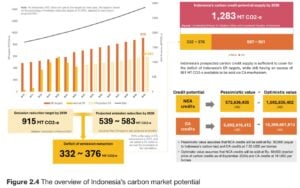
Indonesiaโ€™s carbon market potential
Source: PwC

Under government rules, at least 30% of carbon credit revenue must go to local communities and regional governments. This helps support reforestation, sustainable farming, and eco-tourism.

If the plan works, experts say Indonesia could cut up to 2 billion tonnes of COโ‚‚e by 2030. Thatโ€™s like taking 400 million cars off the road for a whole year.

Promise and Proof: Making Every Credit Count

Indonesiaโ€™s offer to sell 13.4 billion carbon credits shows how climate policy and economic growth can work together. The opportunity is huge, but success will depend on strong verification, fair pricing, and transparent reporting.

If done right, the plan could turn Indonesia into one of the top players in the global carbon market. It could also help meet global climate goals while bringing new income to rural areas.

As more nations look for trustworthy carbon credits, Indonesiaโ€™s forests and renewables could become valuable global assets. The challenge now is to make sure every credit sold represents real, lasting progress for the planet.

Canada Goes Nuclear Again: This Time Itโ€™s a C$3 Billion Bet on SMR

Canada has taken a major step toward becoming a global leader in nuclear innovation. Prime Minister Mark Carney announced a C$3 billion joint federal-provincial investment to advance small modular reactor (SMR) technology at Ontario Power Generationโ€™s (OPG) Darlington New Nuclear Project (DNNP).

When finished, Canada will be the first G7 nation to launch an SMR. This milestone could change how countries power their economies and reduce emissions. PM Carney remarked:

โ€œThe Darlington New Nuclear Project will create thousands of high-paying careers and power thousands of Ontario homes with clean energy. This is a generational investment that will build lasting security, prosperity and opportunities. Weโ€™re building big things to build Canada Strong.โ€

A C$3 Billion Spark for Canadaโ€™s Nuclear Comeback

The investment includes $2 billion from the Canada Growth Fund and $1 billion from Ontarioโ€™s Building Ontario Fund. Together, they will finance four GE Hitachi BWRX-300 reactors at the Darlington site east of Toronto.

The first reactor is scheduled to start operating by late 2029. When all four are built, the facility will provide 1,200 megawatts (MW) of clean electricity โ€” enough to power 1.2 million homes. Over its lifetime, the project could avoid up to 2.3 million tonnes of COโ‚‚ each year between 2029 and 2050.

The Darlington SMR project can create 18,000 construction jobs and 3,700 permanent positions in operations and supply. It will also inject around $500 million annually into Ontarioโ€™s nuclear supply chain once it reaches full capacity.

Government officials say this initiative supports three goals at once: economic growth, energy security, and emissions reduction. Canada aims to boost its power grid through modular nuclear technology. This also supports clean tech manufacturing and export opportunities.

Canadaโ€™s SMR Action Plan sets out a national path to develop and deploy small modular reactors across the country. It unites federal and provincial governments, industry, Indigenous communities, research institutions, and utilities under one framework.

The plan aims to help Canada reach net-zero emissions by 2050, decarbonize industry and power generation, and create jobs. It aims to build trust in the community, ensure safe waste management, and boost exports of Canadian SMR technology worldwide.

Why Small Reactors Are a Big Deal

Small modular reactors represent the next generation of nuclear power. Each unit is smaller and easier to build than traditional reactors. The BWRX-300 design, created by GE Hitachi Nuclear Energy, features advanced safety systems. It can be built in factories and then shipped to a site for installation.

SMRs offer several advantages:

  • Lower capital cost: Each module can be built and added in stages.
  • Faster deployment: Factory assembly reduces on-site construction time.
  • Grid flexibility: SMRs can supply remote areas or industrial zones that large plants cannot easily serve.
  • Clean power: They generate consistent electricity without carbon emissions.

READ MORE: What is SMR? The Ultimate Guide to Small Modular Reactors

The Darlington reactors will serve as the flagship for this new model. Experts see it as a test case for how nuclear can complement renewables like wind and solar, especially during periods of low generation.

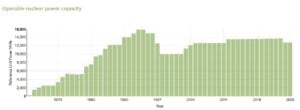
canada Operable nuclear power capacity
Source: World Nuclear Association

Nicolle Butcher, OPG (the majority owner and operator of DNNP) president and CEO, stated:

โ€œThe Darlington New Nuclear Project will help meet growing demand for low-carbon energy, and provide significant economic benefits for Ontarians and Canadians, creating jobs and securing contracts across the provinceโ€™s robust nuclear supply chain.โ€ย 

Strengthening Energy Security and Supply

Electricity demand in Canada is rising quickly. The Canadian Electricity Association estimates that power demand may rise by 40 percent by 2050. This increase is due to electric vehicles, heat pumps, and the growing needs of data centers.

Ontario, in particular, will need more reliable, low-carbon energy as old reactors and natural gas plants close. The province gets about 60% of its electricity from nuclear power. SMRs will help replace this capacity and support net-zero goals.

Federal and provincial leaders say nuclear power is key to balancing the grid. This is especially important as more renewable sources, which vary in output, are added. Unlike solar or wind, SMRs can run 24 hours a day, providing what grid planners call โ€œbaseloadโ€ or โ€œfirmโ€ power.

Economic and Industrial Ripple Effects

Beyond electricity, SMR development supports a broad industrial base. The project will use Canadian engineering, fabrication, and construction skills. These have been developed over six decades of nuclear operations.

The Canadian Nuclear Association states that the nuclear sector supports around 76,000 jobs. It also contributes $17 billion to the GDP every year. The Darlington expansion might boost those numbers even more. It could create a lasting supply chain for SMR parts, fuel, and maintenance.

The new reactors will also use low-enriched uranium fuel sourced and processed domestically. This matches Ottawa’s aim to boost independence in critical minerals and fuels. This is important due to global supply chain risks.

Canadaโ€™s Nuclear Edge in a Global Race

Canadaโ€™s SMR plan positions it ahead of other major economies. In the United States, NuScale Power is still working on SMR projects. However, cost overruns and cancellations have pushed back its deployment.

Canada reactor plans and proposals
Source: World Nuclear Association

The U.K. is funding a competition to build the first domestic SMR fleet, but commercial operations are not expected before the early 2030s.

If Darlingtonโ€™s first reactor enters service on schedule in 2029, it will be the first grid-connected SMR in the developed world. Analysts believe that Canadaโ€™s early-mover advantage may help it export SMR technology and expertise. This is especially true for countries with smaller or remote grids.

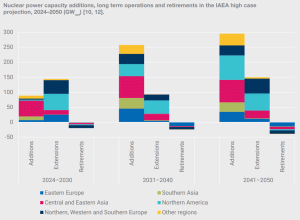
The International Atomic Energy Agency (IAEA) predicts that global nuclear capacity needs to double by 2050. This is essential to reach net-zero targets. SMRs are set to drive significant growth. By 2040, their market value could hit US$120 billion, based on Allied Market Research data. nuclear power capacity additions IAEA projection 2024 to 2050

The Darlington project could help Canada play a major role in the global clean energy market.

Cleaner Power, Smaller Footprint

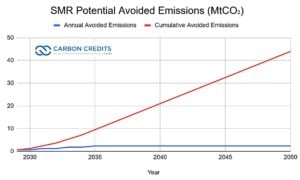
Each SMR at Darlington will reduce greenhouse gas emissions by replacing fossil fuel generation. When all four reactors are running, the country can save 2.3 million tonnes of COโ‚‚ each year. That’s like taking about 500,000 cars off the road annually.

Canada SMR avoided emissions
Data from IAEA SMR Lifecycle Emissions Benchmarks and OPG Assessments

Unlike large hydro or coal plants, SMRs use much less land and water. Their modular design allows units to be added without major ecosystem disruption. The reactors have passive safety features. This means they can cool themselves in emergencies without needing external power or human help.

From an ESG viewpoint, Canadaโ€™s investment shows that nuclear energy is key to reaching net-zero goals. Many international financial institutions now see advanced nuclear as a sustainable asset. This gives investors more confidence to fund new projects.

Industry and Market Reactions

Market analysts and clean energy experts see the Darlington announcement as a sign that nuclear is gaining global attention again. The World Nuclear Association says that over 80 SMR designs are in development globally. More than 30 projects are already being built or are in advanced planning.

Canadaโ€™s commitment could attract private capital and accelerate partnerships with firms in the U.S., Europe, and Asia. GE Hitachi has teamed up with Ontario Power Generation, SaskPower, and TVA. They aim to commercialize the BWRX-300 model worldwide.

Economic analysts say success at Darlington could help regional manufacturing hubs in Ontario and Saskatchewan. These areas are also studying new SMR sites.

A Defining Step for Canadaโ€™s Clean Energy Future

Investors and regulators will be closely watching the success of this first-of-its-kind SMR. The projectโ€™s modular approach means later units could be built faster and at a lower cost. If the model works well, Canada might use it in other provinces. This could boost industrial hubs and clean hydrogen production.

The Darlington SMR investment marks a turning point for Canadaโ€™s energy policy. It merges technology, sustainability, and economic growth in a single strategy.

If it works, this initiative could change how countries decarbonize power grids. As the first G7 nation to bring SMRs to market, Canada is both following the clean energy transition and it is helping lead it.

Americaโ€™s Lithium Gap: How Surge Battery Metals Could Bridge the Supply Shortfall

Disseminated on behalf of Surge Battery Metals Inc.

Electric vehicles (EVs), energy storage systems (BESS), and clean energy technologies depend heavily on lithium. Yet even with fast-rising demand, the United States still produces far less lithium than it needs.ย 

In 2024, U.S. production reached only about 25,000 tonnes of lithium carbonate equivalent (LCE) – roughly 2% of global supply, which totaled around 1.2 million tonnes. That output is enough for only about 158,000 Tesla Model 3 battery packs per year.ย 

The gap between national demand and domestic production keeps widening. Most lithium used in the U.S. comes from imports, mainly from Chile, Australia, and China. This dependency exposes the country to supply disruptions, trade restrictions, and price volatility. If imports are interrupted, the U.S. battery and EV industries could face serious setbacks.

Growing Demand Creates a Structural Deficit

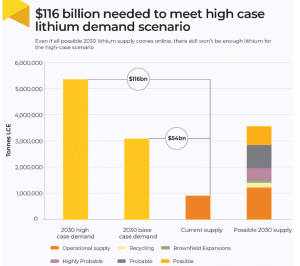
Global demand for lithium is growing quickly. Analysts expect it to quadruple by 2030 as more countries adopt EVs and build large-scale battery storage.ย 

investment needed for high case lithium demand scenario

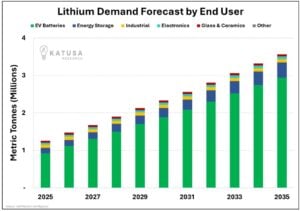
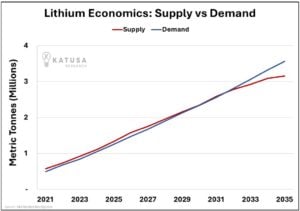
According to Katusa Research (2025), global lithium demand is projected to climb from 1.04 million tonnes in 2024 to 3.56 million tonnes by 2035 โ€” a 3.5ร— increase. About 83% of that demand will come from EV batteries, while energy storage will account for another 11%.

lithium demand forecast 2035 KR
Source: Katusa Research

Per the International Energy Agency, the U.S. alone may need over 625,000 tonnes of LCE per year by 2030, compared with only a small fraction produced domestically today.

Building new mines takes time – often 10 to 15 years from exploration to commercial production. This long timeline makes it difficult to ramp up supply fast enough to meet demand. Therefore, a lasting shortage is forming. If the U.S. does not accelerate new projects soon, it may depend on imports for decades.

Each EV battery pack uses large amounts of lithium. On average, an EV requires about 60 kilograms of LCE – or 8 to 10 kilograms per kilowatt-hour (kWh) of battery capacity. As automakers build more gigafactories, that adds up quickly.ย 

Katusaโ€™s data also shows that global EV sales jumped from 2 million in 2020 to 11 million in 2024, a 450% surge โ€” and could exceed 60 million units per year by 2040, more than half of all cars sold globally.

annual EV sales projection KR
Source: Katusa Research

The U.S. is expected to have 440 gigawatt-hours (GWh) of battery manufacturing capacity by 2025 and more than 1,000 GWh by 2030. That growth alone could double or triple national lithium demand.

Introducing the Nevada North Lithium Project

One company aiming to help close this gap is Surge Battery Metals. Its flagship asset, the Nevada North Lithium Project (NNLP) in Elko County, Nevada, is one of the few high-grade lithium clay deposits in the United States.ย 

The project has an inferred resource of 11.24 million tonnes of LCE, grading about 3,010 ppm lithium, making it the highest-grade lithium clay resource in the country.

NNLP 2024 resource estimate
Source: Surge Battery Metals

Surgeโ€™s Preliminary Economic Assessment (PEA) shows strong project fundamentals:

  • Post-tax NPV (8%) of US$9.21 billion
  • IRR of 22.8%
  • Operating cost โ‰ˆ US$5,243/t LCE
  • Mine life of 42 years

The project benefits from ideal logistics. NNLP is only 13 kilometers from major power lines and close to all-season roads. The Bureau of Land Management (BLM) has issued a Record of Decision and a Finding of No Significant Impact (FONSI), allowing expanded exploration over 250 acres. These factors make NNLP a leading U.S. candidate for large-scale lithium development.

How NNLP Helps Close the Supply Gap

Surge Battery Metalsโ€™ Nevada North project has features that position it well to help close Americaโ€™s lithium gap. Its high grade and large resource size suggest it could deliver significant output once in production. Higher-grade deposits typically allow lower extraction costs and shorter payback periods.

Because NNLP already has key permits and environmental clearance, it may reach production faster than many early-stage peers. That speed is critical as EV demand accelerates and the U.S. targets more domestic battery manufacturing.

Just as important, NNLP supports U.S. policy goals for supply chain security. Producing lithium domestically reduces reliance on imports, helping stabilize supply and pricing for American automakers. It also supports the Inflation Reduction Act, which requires that most EV battery minerals come from North America or allied countries by 2027.

In March 2025, the U.S. government took direct equity stakes in several lithium ventures, including Lithium Americasโ€™ Thacker Pass, signaling a strong federal commitment to reshoring critical mineral production. This policy backdrop reinforces projects like NNLP as part of a national security priority.

Strengthening NNLP Through Strategic Partnership

Moreover, Surge Battery Metals signed a joint venture letter of intent (LOI) with Evolution Mining (ASX: EVN), allowing Evolution to earn up to 32.5% ownership by funding C$10 million toward the Preliminary Feasibility Study (PFS) for the Nevada North Lithium Project (NNLP). Surge retains majority control and project management, keeping its long-term vision and stakeholder priorities front and center.

This partnership delivers big strategic value. By merging Surgeโ€™s lithium expertise and mineral rights with Evolutionโ€™s 75% stake in 880 acres of private land – and over 21,000 added acres nearby – the deal significantly increases the JVโ€™s land position. The expanded acreage boosts the overall exploration area and brings in mineral rights in key southern zones, possible clay unit extensions to the north, and territory in historic mining districts and key drainage areas.

Importantly, Evolutionโ€™s staged funding speeds up completion of the PFS and helps NNLP reach development milestones while lowering capital risk for Surge shareholders. If Evolution completes its full commitment, it will own 32.5% of the JV, but Surge remains the lead partner. This setup means Surge still directs the project, while using Evolutionโ€™s operations know-how and resources. With a larger land package and a joint operating committee, NNLP is well on its way to Tier 1 status and is strengthening its spot in North Americaโ€™s battery metals supply chain – vital for clean energy and EV growth.

Lithium Market Volatility and Project Risks

Like any mining venture, NNLP faces challenges. Lithium pricesย fell nearly 90% from their 2022 peak, but from June to September 2025, they rebounded 24%, showing early signs of recovery.

battery grade lithium price KR

This cyclical pattern reflects Katusaโ€™s โ€œcost floorโ€ concept โ€” production costs in China and Australia now average around $5,000โ€“6,000 per tonne LCE, while South American and U.S. projects need about $8,000/t to stay profitable. If prices fall near those levels, high-cost mines pause output, tightening supply again and stabilizing prices.

Another factor is resource expansion. NNLPโ€™s current resource is inferred, but the company expects to complete its current drilling program at NNLP by the end of October 2025. Once the results are released, the lithium resource will be upgraded from Inferred to Indicated and Measured categories. This step will strengthen confidence in the depositโ€™s scale and quality, supporting the upcoming Pre-Feasibility Study (PFS).

Permitting and community engagement also remain important; even in a mining-friendly state like Nevada, water use and land reclamation practices must meet strict environmental standards.ย 

Surge Battery Metals has emphasized sustainable practices, including water recycling and progressive site reclamation, as part of its exploration and development plan.

Competition is growing, too. Lithium projects across South America, Australia, and Canada are advancing quickly. Still, Nevadaโ€™s combination of stable governance, established mining laws, and proximity to major battery plants gives U.S. projects like NNLP a strong advantage.

A National View: U.S. Lithium Resources and Reserves

The U.S. is home to some of the worldโ€™s largest lithium reserves, but it still underdevelops them. According to the U.S. Geological Survey, global lithium reserves total around 21 million tonnes, with the U.S. holding roughly 12%. Nevada alone hosts the countryโ€™s biggest lithium resources, concentrated in the Thacker Pass region and the northern claystone belts – where NNLP is located.

washington's lithium push

Unlocking these resources is vital. Every new project that moves forward strengthens the domestic supply chain and supports national goals to lead in clean energy technology.

MUST READ: Every Lithium Stock Just Woke Up From a 3-Year Coma

What to Watch in 2025 and Beyond

Surge Battery Metals plans to continue advancing NNLP through new drilling campaigns and metallurgical studies in 2025. These programs aim to expand and upgrade resources, optimize extraction processes, and confirm the potential to produce battery-grade lithium carbonate with 99% purity. The company is also evaluating potential offtake partnerships with battery and automotive manufacturers.

Analysts and investors will be watching for:

  • Updated resource estimates and grade expansion
  • Progress toward pre-feasibility studies
  • Partnerships or funding deals with strategic investors
  • Regulatory updates supporting U.S. critical mineral development

Positive results in these areas could accelerate NNLPโ€™s move toward construction and help it become one of the first next-generation lithium clay projects to enter U.S. production.

Powering the U.S. Energy Future

The U.S. faces a widening gap between lithium supply and demand that could slow its clean-energy transition. Katusa Research projects a 400,000-tonne global supply shortfall by 2035, roughly the worldโ€™s entire 2020 output – a deficit that could keep prices elevated long term.

lithium supply and demand forecast KR
Source: Katusa Research

Surge Battery Metalsโ€™ Nevada North Lithium Project provides a realistic and timely opportunity to help close that divide. With its high-grade resource, strong economics, strategic location, and environmental focus, NNLP could play a central role in building a stable, self-sufficient lithium supply for the United States.

As the nation races to electrify transportation and decarbonize energy, projects like NNLP will be critical. They are not only about producing lithium – they are about powering the next chapter of American industry and ensuring that the clean-energy future is built on secure, sustainable ground.

DISCLAIMERย 

New Era Publishing Inc. and/or CarbonCredits.com (โ€œWeโ€ or โ€œUsโ€) are not securities dealers or brokers, investment advisers, or financial advisers, and you should not rely on the information herein as investment advice. Surge Battery Metals Inc. (โ€œCompanyโ€) made a one-time payment of $50,000 to provide marketing services for a term of two months. None of the owners, members, directors, or employees of New Era Publishing Inc. and/or CarbonCredits.com currently hold, or have any beneficial ownership in, any shares, stocks, or options of the companies mentioned.

This article is informational only and is solely for use by prospective investors in determining whether to seek additional information. It does not constitute an offer to sell or a solicitation of an offer to buy any securities. Examples that we provide of share price increases pertaining to a particular issuer from one referenced date to another represent arbitrarily chosen time periods and are no indication whatsoever of future stock prices for that issuer and are of no predictive value.

Our stock profiles are intended to highlight certain companies for your further investigation; they are not stock recommendations or an offer or sale of the referenced securities. The securities issued by the companies we profile should be considered high-risk; if you do invest despite these warnings, you may lose your entire investment. Please do your own research before investing, including reviewing the companiesโ€™ SEDAR+ and SEC filings, press releases, and risk disclosures.

It is our policy that information contained in this profile was provided by the company, extracted from SEDAR+ and SEC filings, company websites, and other publicly available sources. We believe the sources and information are accurate and reliable but we cannot guarantee them.

CAUTIONARY STATEMENT AND FORWARD-LOOKING INFORMATION

Certain statements contained in this news release may constitute โ€œforward-looking informationโ€ within the meaning of applicable securities laws. Forward-looking information generally can be identified by words such as โ€œanticipate,โ€ โ€œexpect,โ€ โ€œestimate,โ€ โ€œforecast,โ€ โ€œplan,โ€ and similar expressions suggesting future outcomes or events. Forward-looking information is based on current expectations of management; however, it is subject to known and unknown risks, uncertainties, and other factors that may cause actual results to differ materially from those anticipated.

These factors include, without limitation, statements relating to the Companyโ€™s exploration and development plans, the potential of its mineral projects, financing activities, regulatory approvals, market conditions, and future objectives. Forward-looking information involves numerous risks and uncertainties and actual results might differ materially from results suggested in any forward-looking information. These risks and uncertainties include, among other things, market volatility, the state of financial markets for the Companyโ€™s securities, fluctuations in commodity prices, operational challenges, and changes in business plans.

Forward-looking information is based on several key expectations and assumptions, including, without limitation, that the Company will continue with its stated business objectives and will be able to raise additional capital as required. Although management of the Company has attempted to identify important factors that could cause actual results to differ materially, there may be other factors that cause results not to be as anticipated, estimated, or intended.

There can be no assurance that such forward-looking information will prove to be accurate, as actual results and future events could differ materially. Accordingly, readers should not place undue reliance on forward-looking information. Additional information about risks and uncertainties is contained in the Companyโ€™s managementโ€™s discussion and analysis and annual information form for the year ended December 31, 2024, copies of which are available on SEDAR+ at www.sedarplus.ca.

The forward-looking information contained herein is expressly qualified in its entirety by this cautionary statement. Forward-looking information reflects managementโ€™s current beliefs and is based on information currently available to the Company. The forward-looking information is made as of the date of this news release, and the Company assumes no obligation to update or revise such information to reflect new events or circumstances except as may be required by applicable law.

For more information on the Company, investors should review the Companyโ€™s continuous disclosure filings available on SEDAR+ at www.sedarplus.ca.


Disclosure: Owners, members, directors, and employees of carboncredits.com have/may have stock or option positions in any of the companies mentioned: None.

Carboncredits.com receives compensation for this publication and has a business relationship with any company whose stock(s) is/are mentioned in this article.

Additional disclosure: This communication serves the sole purpose of adding value to the research process and is for information only. Please do your own due diligence. Every investment in securities mentioned in publications of carboncredits.com involves risks that could lead to a total loss of the invested capital.

Please read our Full RISKS and DISCLOSURE here.