

Lithium prices have fallen sharply in recent months, raising concerns about the battery metal’s outlook. However, some analysts say the market remains tight, with supply disruptions and growing demand still posing risks. The sharp swings have also made prices harder to predict.
At a conference in Shanghai on November 11, Roy Zhang, assistant to the president of China’s Ganfeng Lithium, said lithium price movements have become more extreme and market cycles shorter. He added that no one has a clear view of where lithium prices will go over the next six to 12 months.
His comments came as China’s lithium carbonate prices traded well below their May peak. At the same time, Benchmark Mineral Intelligence expects the global market to remain in deficit through 2027, despite recent price weakness.
The gap between falling prices and tight supply forecasts shows how quickly sentiment can change in the lithium market. It also highlights the challenges facing producers, battery makers, and investors as the energy storage and electric vehicle industries expand.
Lithium Prices Drop 23% From This Year’s Highs
China’s spot lithium carbonate prices have fallen about 23% this year to around 91,500 yuan (US$13,700) per tonne, according to figures cited by Bloomberg. The decline follows a strong rally earlier in the year. Prices climbed above 200,000 yuan per tonne in May before falling for several weeks as concerns about future demand grew.
The latest drop is part of a wider cycle of sharp price changes. Benchmark Mineral Intelligence data presented at Benchmark Week 2026 in Shanghai showed lithium prices reaching US$71,000 per tonne in January 2023. They then fell to US$8,100 in June 2025 before recovering to US$22,250 in early 2026. Prices had eased to US$16,200 by July.
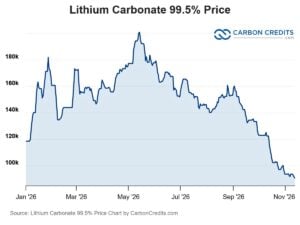
These figures reflect different price points and market assessments, so they should not be treated as one continuous spot-price series. However, they show the scale of the market’s recent swings.
Zhang said lithium had already gone through a full price cycle since the start of 2026, an unusual development for the industry. He also warned that price movements have become harder to forecast as supply, demand, and trading activity grow.
The comments point to a market where short-term expectations can change quickly, even when longer-term demand remains strong.
Mine Restarts and Futures Trading Add Pressure to Lithium Prices
Several factors have weighed on lithium prices. According to Benchmark’s Head of Prices Daisy Jennings-Gray, these include speculative selling on China’s Guangzhou Futures Exchange (GFEX), concerns about high battery-cell inventories, and expectations of more supply entering the market.
Futures trading can influence prices by shaping expectations about future supply and demand. However, price movements in the futures market do not always reflect changes in physical supply or actual consumption.
The outlook for new supply has also affected market sentiment. Some Australian mines, including Mineral Resources’ Bald Hill and Core Lithium’s Finniss operation, have restarted and are shipping inventory. Stronger ore flows from Zimbabwe have added to expectations of higher supply.
Market participants are also watching developments at CATL’s Jianxiawo lithium mine in China. The possibility of a restart has added to expectations that more domestic supply could reach the market.
These developments have made buyers more cautious. If producers bring more material to market while battery makers reduce stockpiles, prices could face further pressure.
However, expected supply does not always become actual supply. Mine restarts, new projects, and expansions depend on operating conditions, costs, permits, and market prices. If prices fall too far, some higher-cost operations may delay production or become uneconomic.
Benchmark Sees Lithium Deficits Through 2027
Despite the recent price decline, Benchmark expects the lithium market to remain in deficit over the next two years. Jennings-Gray presented a forecast for a supply shortfall of 171,000 tonnes in 2026 and 44,000 tonnes in 2027. The market is then expected to move into surplus in 2028.
- Benchmark expects that surplus to reach 452,000 tonnes in 2031 before the market returns to balance in 2035.
These projections suggest that current price weakness may not reflect the full supply outlook. They also depend on enough new production coming online to meet future demand. If prices remain too low to support investment, some planned supply may not materialize on schedule.
Still, other market forecasts point to a less tight outlook. A S&P Global Energy report said many Chinese market participants expected slower demand growth and rising supply to push the market toward a surplus in 2027.
S&P Global Energy cited a forecast that global lithium raw material supply could rise 26.8% year-over-year to about 2.5 million tonnes of lithium carbonate equivalent in 2027. It also reported expectations that China’s energy storage battery demand growth could slow to around 10% to 20% next year, after a much stronger expansion in 2026.

The different outlooks show why lithium prices remain difficult to predict. Supply estimates, demand assumptions, and the timing of new projects can produce very different market balances.
EVs and Energy Storage Keep Demand Growing
Electric vehicles remain the main source of lithium demand. Lithium is a key material in rechargeable batteries used in electric cars, buses, and other vehicles.
However, battery energy storage systems (BESS) are becoming another major source of demand. These systems store electricity for later use and help balance power supply from renewable sources such as solar and wind.
Ganfeng’s Zhang said lithium demand is growing about 40% this year, while supply is also catching up quickly. He described the market balance as fragile, warning that a major disruption at even one mine could quickly change the supply outlook.
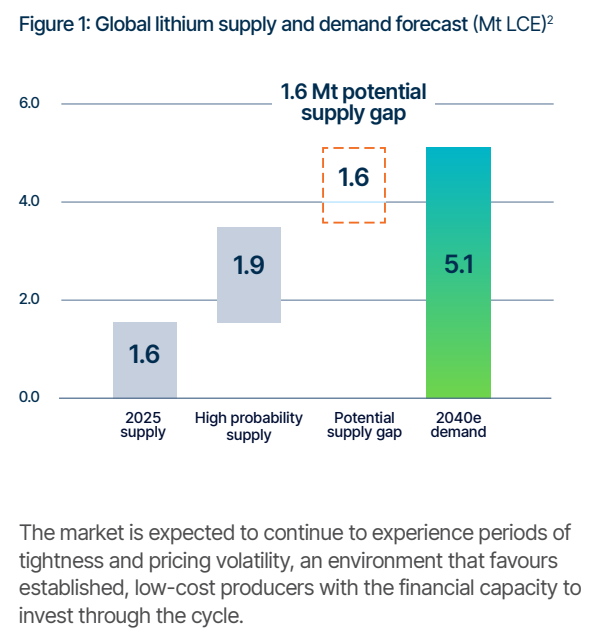
The International Energy Agency (IEA) also sees strong long-term demand. Its Global Critical Minerals Outlook 2026 projects that lithium demand will more than triple by 2040 under its Stated Policies Scenario. The agency identifies electric vehicles, battery storage, renewable energy, and electricity networks as major drivers of critical mineral demand.
Benchmark expects EVs to remain the largest source of lithium demand through 2035, even as energy storage grows. China will remain central to this trend. Its demand for EV materials is expected to exceed that of the rest of the world through 2035, according to Benchmark’s analysis.
This makes developments in China especially important for global lithium prices. Changes in Chinese battery production, inventories, and EV sales can influence expectations across the supply chain.
Supply Disruptions Could Quickly Change the Market
The lithium market remains exposed to supply risks. Zimbabwe’s export restrictions, changes in mine output, and the possible restart of CATL’s Jianxiawo operation are among the developments that could affect prices in the coming months.
A disruption at a major mine could tighten supply, especially if inventories are already low. On the other hand, a faster recovery in production or a wave of new supply could increase pressure on prices.
The market’s growing dependence on China also adds to the uncertainty. The country plays a major role in lithium processing and battery production, so changes in its industrial activity can affect both supply and demand expectations.
For producers, the current market creates a difficult investment environment. Higher prices can support new mines and expansions, but sharp declines make it harder to plan projects and secure financing. Lower prices may also force higher-cost producers to reduce output.
Battery makers and EV companies face a different challenge. Lower lithium prices can reduce input costs, but sudden price increases can raise battery production expenses. The IEA has noted that lithium and other battery material prices can affect battery costs, even as manufacturers work to improve efficiency and lower overall production costs.
Lithium Market Outlook Remains Uncertain
Lithium’s latest price decline does not necessarily signal a lasting drop in demand. Instead, it reflects a mix of futures-market activity, inventory concerns, expectations of new supply, and uncertainty about future battery production.
Benchmark’s deficit forecast suggests that the market could remain tight through 2027. However, other analysts expect supply growth and slower demand expansion to create a surplus sooner.
For now, the market faces competing forces. EV adoption and energy storage continue to support long-term demand, while mine restarts and new projects could increase supply. Any major disruption could quickly change that balance.
As Ganfeng’s Zhang noted, predicting lithium prices over the next six to 12 months has become increasingly difficult. The market’s next move will depend on how quickly supply grows, how strongly battery demand holds up, and whether new production arrives as expected.
The outlook remains uncertain, but one point is clear: lithium price swings will continue to matter for miners, battery manufacturers, and the wider clean energy supply chain.