

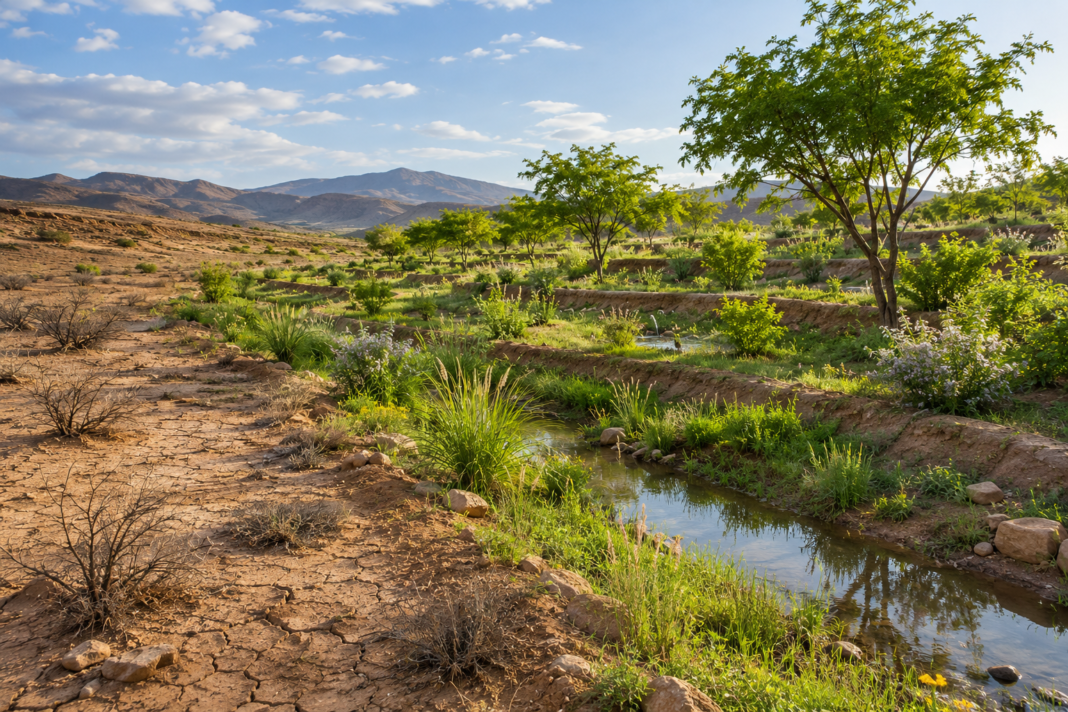
As the world looks for ways to restore degraded land and remove carbon dioxide (CO2) from the atmosphere, oasification offers another approach to nature-based restoration. It focuses on improving how drylands capture and retain water, allowing vegetation to recover and ecosystems to become healthier.
Beyond its environmental benefits, oasification could also create opportunities for carbon removal projects and nature-based finance. But how does it work, and can it become part of the growing carbon market?
What Is Oasification? Understanding the Concept
Oasification is a land-restoration approach that aims to reverse desertification by improving how degraded land captures and retains water. It focuses on restoring the natural conditions needed for vegetation to grow, particularly in arid and semi-arid regions where water is limited.
The concept was developed by Spanish researchers Andrés Martínez de Azagra, Jorge Mongil, and J. Rojo. Their 2004 paper, Oasification: A Forest Solution to Many Problems of Desertification, describes how small earth structures can collect and infiltrate rainwater and surface runoff, improving soil moisture and supporting vegetation growth.
Oasification is closely linked to the fight against desertification, which occurs when land in dry regions loses its productivity due to climate conditions and human activities such as deforestation, overgrazing, and unsustainable farming.
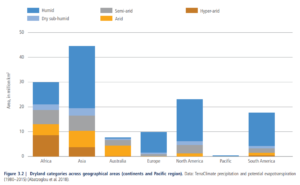
The scale of this challenge is significant. According to the United Nations Convention to Combat Desertification (UNCCD), drylands cover approximately 40.6% of Earth’s land area, excluding Antarctica. The UN also reported that 77.6% of the world’s land experienced drier conditions between 1990 and 2020 than during the previous 30 years.
Unlike approaches that focus mainly on planting trees, oasification first addresses the land’s ability to capture and retain available water. It can complement reforestation by creating better conditions for vegetation to establish and survive.
How Does Oasification Work? Restoring Land by Making Better Use of Water
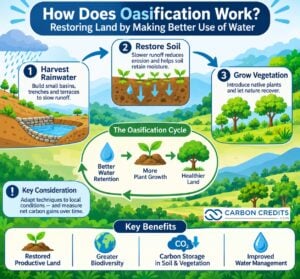
Oasification works by improving how degraded land collects, absorbs, and retains rainwater. Rather than relying on large irrigation systems, it uses relatively small structures and land-management techniques to direct available water toward areas where vegetation can grow.
One common technique is rainwater harvesting. Small basins, trenches, terraces, and contour barriers are built along slopes to slow down surface runoff. These structures collect rainwater that would otherwise flow downhill and carry away valuable topsoil. The captured water can then seep into the ground, increasing soil moisture and supporting plant growth.
Another important part is soil restoration. By slowing water runoff, oasification helps reduce erosion and allows soil particles and nutrients to settle. This can improve soil conditions and create a better environment for seeds, roots, and microorganisms.
Vegetation is then introduced or allowed to recover naturally. Native trees, shrubs, grasses, and other suitable plants help stabilize the soil, provide ground cover, and support local biodiversity. Their roots also help improve soil structure and water infiltration.
The process works as a cycle. Better water retention supports plant growth, while growing vegetation protects the soil and adds organic matter. Over time, these improvements can help degraded land recover its productive capacity.
However, oasification must be adapted to local conditions. Rainfall, soil type, slope, and available water all influence which techniques will work. It is not a one-size-fits-all solution, but an approach that combines water management, soil protection, and vegetation recovery.
Not all carbon added to the soil remains stored permanently. Some organic matter decomposes and releases CO2 back into the atmosphere. Projects must, therefore, measure net changes in carbon stocks over time.
Oasification and Carbon Sequestration: How Restored Land Can Capture CO2
Beyond restoring degraded land, oasification could also contribute to climate change mitigation by increasing the amount of carbon stored in vegetation and soil. This is where the approach becomes particularly relevant to nature-based carbon removal and carbon markets.
Plants absorb carbon dioxide (CO2) from the atmosphere through photosynthesis and store carbon in their trunks, branches, leaves, and roots. When oasification improves soil moisture and supports vegetation growth, it can create better conditions for increasing this natural carbon storage. As trees and other plants grow, they can accumulate more carbon in their biomass.
Soil also plays an important role. Fallen leaves, dead roots, and other organic materials break down and add carbon to the soil. Greater vegetation cover can help protect this organic matter from erosion and support the long-term buildup of soil organic carbon.
The scale of the opportunity is significant. The IPCC estimates that approximately 20–30 billion tonnes of carbon have been released into the atmosphere through desertification-related processes, including deforestation, overgrazing, and conventional tillage. This highlights the climate value of protecting and restoring degraded land.
However, carbon storage does not happen immediately. Vegetation needs time to establish, while soil carbon gains can take years or even decades to become measurable. Results also depend on rainfall, soil conditions, plant species, and long-term land management.
The IPCC identifies natural vegetation restoration and tree planting on degraded land as activities that can enrich carbon in topsoil and subsoil over time. It also recognizes that measures to combat desertification can support soil carbon sequestration.
For oasification projects, this means carbon benefits could come from two main sources:
- increased carbon in growing vegetation, and
- additional organic carbon stored in the soil.
Both need measurements and monitoring to establish how much carbon the restoration work actually removes from the atmosphere.
A useful distinction for carbon market readers: More vegetation or healthier soil does not automatically mean a project has generated carbon credits. Developers must establish the additional carbon stored against a credible baseline and account for potential losses over time.
Can Oasification Generate Carbon Credits? Connecting Land Restoration to Carbon Markets
Oasification could create opportunities in the voluntary carbon market (VCM) by supporting projects that remove carbon dioxide from the atmosphere through vegetation growth and soil restoration. As more companies seek nature-based carbon removal solutions, restoring degraded drylands could become an additional area for climate investment.
However, oasification is not currently a standalone carbon-crediting methodology. Projects using this approach would need to qualify under an existing carbon standard and follow an approved methodology that covers their restoration activities and carbon benefits.
Two existing Verra methodologies offer potential pathways.
Afforestation, Reforestation, and Revegetation (VM0047) covers projects that establish, increase, or restore vegetation. It measures carbon removals as trees and other woody plants grow and store carbon. This could be relevant to oasification projects that establish or restore eligible vegetation on degraded land.
Another possible route is Improved Agricultural Land Management (VM0042). This methodology measures greenhouse gas reductions and soil organic carbon removals resulting from changes in agricultural practices. These include improved water management, cover cropping, grazing practices, and management of crop residues. It could be relevant where oasification forms part of a broader agricultural land-restoration project.
Both methodologies show how land-restoration activities can potentially connect with carbon finance. Verra’s VM0047, Version 1.1, was also approved by the Integrity Council for the Voluntary Carbon Market (ICVCM) under its Core Carbon Principles in October 2025. This provides an example of how carbon-crediting frameworks are strengthening quality requirements for nature-based removals.
Nevertheless, using these methodologies does not guarantee that an oasification project will qualify for credits.
Developers must meet several requirements, namely:
- Additionality: Projects must demonstrate that their carbon benefits would not have occurred without the intervention.
- Baseline measurement: Developers must establish existing land conditions and carbon stocks before restoration begins.
- Carbon measurement: Projects must quantify additional carbon stored in vegetation and soil.
- Permanence: Carbon storage must be protected over time, with risks such as drought, wildfire, and vegetation loss addressed.
- Leakage: Developers must consider whether project activities cause emissions or land degradation elsewhere.
- Monitoring, Reporting, and Verification (MRV): Carbon gains must be monitored, documented, and independently verified.
These requirements are particularly important in drylands, where rainfall variability, drought, and changing land conditions can affect vegetation growth and soil carbon storage.
There are also financial challenges. Building water-harvesting structures, restoring soil, establishing vegetation, and monitoring carbon stocks require upfront investment. Soil carbon measurement can be especially demanding because changes may take years to become detectable.
For investors and project developers, the opportunity lies in combining restoration activities with credible carbon accounting. If projects can demonstrate additional and lasting carbon removals, carbon-credit revenue could help finance restoration and long-term land management.
Ultimately, oasification could become part of the nature-based carbon economy, but its success will depend on the quality of the restoration work and the credibility of the carbon credits it generates.
The Wider Economic and Climate Benefits of Oasification
The value of oasification extends beyond carbon removal. By restoring degraded land, improving water retention, and supporting vegetation growth, it could deliver environmental and economic benefits to local communities.
Water security and climate resilience are among its main potential benefits. Capturing rainwater and reducing surface runoff can help retain moisture in the soil. This can improve growing conditions and support vegetation during dry periods. Healthier land can also become more resilient to drought and soil erosion, although results depend on local water availability and project design.
Oasification may also support biodiversity and ecosystem recovery. Restoring native trees, shrubs, and other vegetation can create habitats for wildlife and improve local ecosystems. Better soil conditions can encourage plant growth and help restore ecological functions that were lost through land degradation.
There may also be benefits for agriculture and rural livelihoods. Improved soil moisture and reduced erosion can support farming and suitable forms of agroforestry. Restoration activities can create local employment in planting, land management, monitoring, and maintenance.
The economic case for land restoration is also gaining attention. According to the United Nations Convention to Combat Desertification (UNCCD), every US$1 invested in land restoration can generate between US$7 and US$30 in economic returns through improved ecosystem services. These benefits can include better soil productivity, water regulation, and ecosystem health.
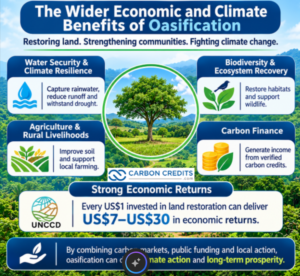
Carbon finance could provide another source of funding.
Revenue from verified carbon credits may help cover restoration costs and support long-term project management. Combining carbon markets with public funding, development finance, and private investment could make larger restoration programs more financially viable.
However, successful projects must also protect local communities and ecosystems. Developers should respect land rights, involve local stakeholders, and use native or climate-appropriate plant species. Water-harvesting activities must also consider the needs of downstream communities and surrounding ecosystems.
Ultimately, oasification offers an opportunity to connect climate action with land restoration, economic development, and community resilience. Its value may extend well beyond the carbon stored in trees and soil.
Conclusion: Oasification’s Potential in the Growing Nature-Based Carbon Market
Oasification offers a promising approach to restoring degraded drylands by improving water retention, rebuilding soil conditions, and supporting vegetation growth. Beyond helping reverse land degradation, it could contribute to climate change mitigation by increasing carbon storage in plants and soils.
As demand for nature-based carbon removal grows, oasification-based restoration could create new opportunities for carbon finance. However, its potential will depend on measurable carbon gains, credible verification, and long-term ecosystem protection.
While carbon credits could help fund these efforts, the wider benefits are equally important. Restoring degraded land can support biodiversity, improve water security, strengthen rural livelihoods, and help communities adapt to a changing climate.
Ultimately, oasification highlights how better land management can connect ecosystem restoration with climate action and the emerging carbon economy.