


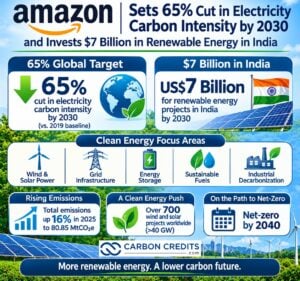
Amazon has announced a new target to cut the carbon intensity of electricity used across its global operations by 65% by 2030. The company also plans to invest an additional US$7 billion in renewable energy projects in India by the same year.
Both announcements highlight Amazon’s efforts to secure more clean power as its business and electricity needs continue to grow. The India investment will expand its wind and solar portfolio, while the new global target sets a clearer measure for reducing emissions linked to electricity use.
However, the challenge remains significant. Amazon’s total carbon footprint rose in 2025, with emissions from purchased electricity increasing by more than a third. The new target will need to deliver real emissions cuts as the company expands its cloud computing and artificial intelligence (AI) infrastructure.
Amazon Sets 65% Cut in Electricity Carbon Intensity by 2030
Amazon aims to reduce the carbon intensity of electricity used by its global operations by 65% by 2030, compared with a 2019 baseline. The company said the target follows the International Energy Agency’s (IEA) Net Zero by 2050 pathway.
Carbon intensity measures the greenhouse gas emissions linked to each unit of electricity consumed. In simple terms, Amazon wants every unit of electricity powering its business to carry 65% fewer carbon emissions by the end of the decade.
The goal is designed to address emissions even as the company’s electricity demand increases. Amazon said it will use a mix of energy sources and technologies, including utility-scale wind and solar, on-site renewable power, power purchase agreements (PPAs), advanced nuclear energy and geothermal power.
The new target supports Amazon’s wider Climate Pledge commitment to reach net-zero carbon emissions across its operations by 2040. Amazon co-founded the initiative in 2019.
Importantly, the 65% goal is an electricity carbon-intensity target, not a commitment to cut total company emissions by the same amount. If electricity demand rises sharply, Amazon’s overall emissions could still increase even as the carbon intensity of its power supply falls.
Amazon Plans $7 Billion Renewable Energy Investment in India
Alongside its global climate target, Amazon announced plans to invest an additional $7 billion in renewable energy projects in India by 2030.
The planned investment comes on top of $4 billion in renewable energy projects that the company has already contracted in the country. This raises the current and planned investment pipeline to $11 billion. However, the extra $7 billion is a future investment plan, not money already spent.
Amazon also announced four new utility-scale wind and solar projects with a combined capacity of 934 megawatts (MW). They include:
- A 234 MW wind farm in Bijapur, Karnataka, developed by Sunsure Energy.
- A 200 MW hybrid wind and solar project in Tumkur, Karnataka, also developed by Sunsure.
- A 300 MW solar project in Madhya Pradesh, developed by Waaree.
- A 200 MW solar project in Rajasthan, developed by ReNew.
The four projects are covered by power purchase agreements. They are part of Amazon’s existing $4 billion renewable energy portfolio in India, which is secured through contracts. They are not additional capacity on top of that portfolio.
Once the contracted projects become operational, Amazon expects its renewable energy portfolio in India to exceed 2 gigawatts (GW). The tech giant estimates that this could generate enough electricity to meet the annual needs of more than 3.5 million Indian households.
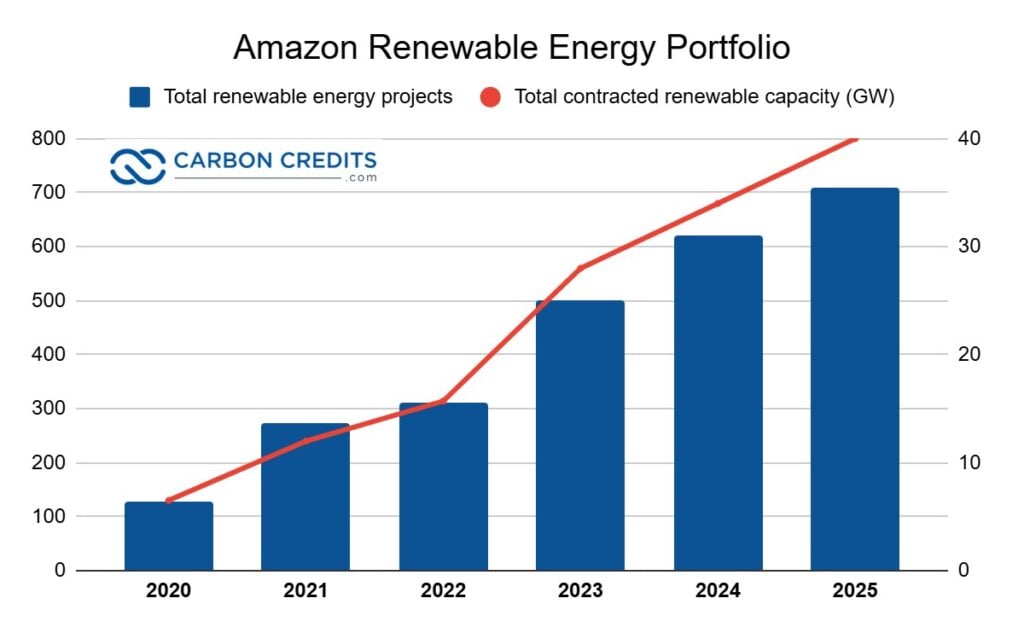
Amazon’s existing India portfolio includes 14 utility-scale wind and solar projects and 43 on-site solar installations across its facilities. Together, these 57 projects support the company’s efforts to add more carbon-free electricity to the grid.
The investment also supports India’s wider energy transition. The country plans to achieve 500 GW of non-fossil fuel electricity by 2030. This goal needs big investments in renewable energy and grid infrastructure.
- READ MORE On AMAZON:
Rising Emissions Put Amazon’s Climate Goals to the Test
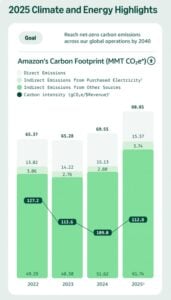
Amazon’s new target comes as its environmental footprint continues to grow. According to its 2025 Sustainability Report, the company’s total carbon emissions reached 80.85 million metric tons of carbon dioxide equivalent (MtCO2e) in 2025. That was a 16% increase from 69.55 MtCO2e in 2024.
Emissions from purchased electricity, known as Scope 2, rose 34% to 3.74 MtCO2e from 2.80 MtCO2e a year earlier. This increase highlights the pressure that growing electricity demand can place on the company’s climate goals.
Amazon’s Scope 3 emissions, which cover indirect emissions across its value chain, also increased by 20% to 61.74 MtCO2e. These emissions include activities such as manufacturing, transportation, and other parts of its supply chain.
- The company’s direct Scope 1 emissions reached 15.37 MtCO2e, up 2% from 2024.
The retail giant said it added more data center capacity in 2025 than any other company globally. Growing demand for cloud computing and AI services has increased the need for data centers, servers and other equipment. Building these facilities also creates emissions through the production and transport of materials such as steel, concrete and computer hardware.
The figures show why clean electricity is becoming a bigger part of Amazon’s climate strategy. But renewable power alone will not address the company’s wider footprint, particularly emissions from its suppliers, construction and transportation networks.
Renewable Energy and Efficiency Drive Amazon’s Climate Strategy
Amazon has expanded its clean energy investments over several years. The company says it has invested in more than 700 wind and solar projects worldwide, with a combined capacity of more than 40 GW.
It also matched 100% of the electricity consumed by its global operations with renewable energy for the third consecutive year in 2025. However, this matching approach does not mean that every facility runs on renewable electricity every hour. It relies on energy purchases and environmental certificates linked to renewable generation.
The company is also working to improve energy efficiency in its data centers. Its Sustainability Report says its data centers are 4.1 times more energy-efficient than traditional on-premises computing. Amazon also reported that its data centers were seven times more water-efficient than the industry average.
In India, its sustainability efforts extend beyond electricity. Amazon said it had deployed more than 15,000 electric vehicles across over 500 cities. It is also working with Tata Motors to deploy 3,000 electric trucks.
The company reported that it became water-positive in India in 2025, ahead of its 2027 target. It said it returned more than 120% of the water used across its direct operations to local communities and watersheds. Its water projects are expected to replenish more than 4 billion liters annually.
Amazon is also working to reduce packaging waste. More than half of its customer orders in India now ship in reduced or original packaging, according to the company.
Amazon’s 2040 Net-Zero Pledge Faces a Growing Energy Challenge
Amazon’s latest announcements show how the company plans to balance business growth with its climate commitments. The new 65% electricity carbon-intensity target marks an important milestone. Moreover, the planned $7 billion investment in India may boost renewable energy supply in this growing market.
However, the rise in Amazon’s 2025 emissions shows that progress remains uneven. Its Scope 2 emissions increased by 34%, while total emissions climbed 16% as the company expanded its operations and data center capacity.
The key test will be whether Amazon can cut the emissions linked to each unit of electricity while also managing its growing power demand. It will also need to address emissions across its supply chain, construction projects and transport operations to make progress toward its 2040 net-zero goal.
The India projects could help add more renewable electricity to the grid, but their climate impact will depend on when they become operational and how much clean power they deliver. For Amazon, the next few years will show whether its expanding clean energy portfolio can keep pace with the energy needs of its growing business.
- FURTHER READING: Amazon Stock Slips on Q3 Earnings Amid $220B AI Spending Push