Alphabet, Microsoft, and Salesforce collectively committed $500 million to a carbon removal program as members of the First Movers Coalition.
The three tech giants are a part of the First Movers Coalition, a technology coalition that aims to decarbonize industry and transport.
During the World Economic Forum in Davos, the coalition added carbon dioxide removal (CDR) to their programs.
The WEF partnered with the US Special Presidential Envoy for Climate John Kerry and over 50 global firms. These companies pledge to invest in innovative green technologies.
In particular, Alphabet, Microsoft, and Salesforce pledged to buy $500 million in carbon removal by 2030. Whereas Boston Consulting Group has promised to remove 100,000 tonnes of carbon by 2030.
Meanwhile, AES, Mitsui O.S.K. Lines, and Swiss Re have each committed to 50,000 tons (worth $25 million) of carbon removal.
The governments of India, Japan, Sweden, Denmark, Italy, Norway, Singapore, and Britain have also joined the group.
The First Movers Coalition Carbon Removal Program
Since its formation at COP26, First Movers brought together firms across carbon-intensive sectors. They range from big businesses that transport goods to renewable energy firms that use steel to build structures.
The coalition seeks to commercialize clean technologies using advanced purchase commitments for commodities. It provides a platform for various companies to make such commitments in this decade.
This then sends the strongest demand signal in history for technologies needed for reaching net zero emissions by 2050.
The coalition has committed to delivering impact in six major sectors by 2030:
These hard-to-abate sectors are responsible for about 30% of global emissions. And this figure can even rise to 50% of emissions by 2050 if the world won’t do anything about it.
This is where the First Movers Coalition comes in to do something about it.
Børge Brende, President of the World Economic Forum said:
“The coalition’s members are truly the ‘First Movers’ who are focused on scaling disruptive innovations that pave the way for long-term transformation… rather than the lower-hanging fruit of short-term process efficiency gains.”
The Coalition now has more than 50 members with a total market cap of $8.5 trillion (10% of the value of the Fortune 500). So far, it has committed around $10 billion already, or about 1% of its members’ value.
Under the First Movers’ carbon removal program, firms are making pledges to buy carbon removal, either by the ton or putting up certain sums of money.
The carbon removed must be verified and members must show that it can be stored for over 1,000 years.
Scaling Up Carbon Removal Technologies
According to the group’s press release:
“If enough global companies commit a certain percentage of their future purchasing to clean technologies in this decade, this will create a market tipping point that will speed up their affordability… It will also drive long-term, net-zero transformation across industrial value chains.”
John Kerry echoed the coalition’s point saying:
“The purchasing commitments made by the First Movers Coalition represent the highest-leverage climate action that companies can take… This is because creating the early markets to scale advanced technologies materially reduces the whole world’s emissions, not just any company’s own footprint.”
He further said that the addition of the First Movers carbon removal program will tackle the biggest challenge of the climate crisis.
That’s cutting the emissions from sectors where there’s no toolkit available yet to replace fossil fuels.
The latest IPCC report says that with very slow progress on emissions efforts, limiting warming to 1.5⁰C will now depend on carbon removal schemes.
First Movers CDR program is an effort to help abate rising temperature.
Through the Coalition, the tech giants work with many other private sector members. These include Mærsk, Amazon, Apple, Bank of America, FedEx, Ford Motor, Trafigura, Vattenfall, Volvo Group, Western Digital, and a lot more.
Other supporting partners include Breakthrough Catalyst, Carbon Direct, Frontier, and the South Pole.
Right now, a handful of startups are removing carbon from the atmosphere using various techniques. Paying these firms to do the job is currently quite pricey, costing hundreds of dollars per ton.
And that adds up fast when talking about a company that emits millions of tons of carbon each year into the air.
But Alphabet, Salesforce, and Microsoft’s early investments could help bring prices down by signaling there’s going to be a market for CDR.
Last April, the Frontier Group also made a similar but bigger commitment that Alphabet is also a part of. The scheme will be buying $925 million of carbon removal. Frontier includes other tech giants like Meta and Shopify as well as McKinsey.
Flowcarbon, a blockchain-enabled carbon credits trading firm, has raised $70 million.
Flowcarbon is an NYC-based climate tech company that operates at the intersection of carbon and crypto. Its main goal is to help speed up climate change solutions by tokenizing carbon credits. And by leveraging Web3, it aims to protect the earth’s natural carbon sinks.
The former WeWork CEO Adam Neumann co-founded the blockchain startup. Its first major funding round is for building market infrastructure in the voluntary carbon market (VCM).
The $70M funding consists of two parts.
The $32 million is from the funding round led by venture capital giant Andreessen Horowitz (a16z) – Other major contributors are Samsung Next and Invesco.
The other $38 million is from the firm’s sale of its “Goddess Nature Token” (GNT).
Flowcarbon’s Blockchain Technology for Carbon Credits
The climate tech firms will tap into the growing VCM to help companies offset their GHG emissions to fight against climate change.
In particular, the funding is for developing a protocol that tokenizes carbon credits. The aim is to drive investment in projects that remove carbon from the air.
Flowcarbon’s blockchain technology seeks to bring carbon credits on-chain. It will democratize access to offsets and incentivize high-impact climate change projects.
The current VCM is criticized for a couple of things. It’s fragmented, not transparent, hard to access, and there are doubts over the quality of some carbon credits.
Critics said that traders are converting older, lower-quality carbon credits into virtual assets.
And to help address the issues, Flowcarbon tokenized carbon credits through its two-way bridge, allowing credits to be on and off-chain.
By tokenizing credits, developers will gain cheaper financing earlier in their project’s life. It allows them to sell their credits forward to buyers who’ll enjoy more transparency.
Also, buyers from all backgrounds can join the Flowcarbon blockchain-backed market of carbon credits. The firm’s CEO, Dana Gibber said:
“Our mission is to provide the financing necessary to scale projects that reduce or remove carbon from the atmosphere… In particular nature-based projects.”
Nature-based projects may include reforestation, conservation, or nature restoration efforts.
Flowcarbon’s Goddess Nature Token
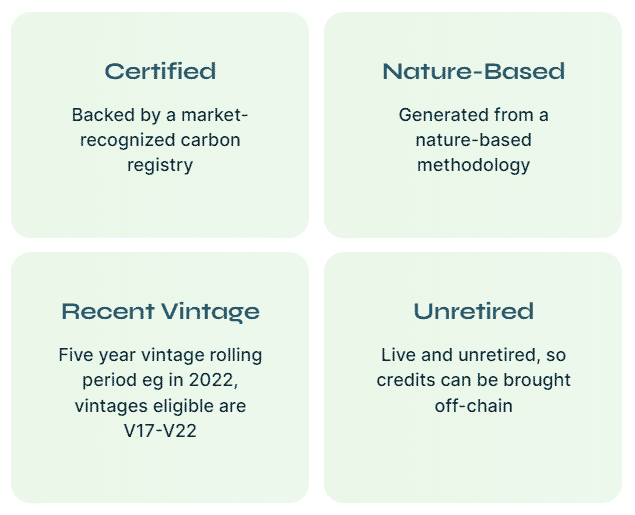
The firm’s flagship token GNT is a bundle token. This means it’s fungible and can be retired, redeemed, or unwrapped. Each carbon credit in Flowcarbon’s GNT is:
Bundling credits can help in liquidity and will allow for greater trading volumes than in a traditional carbon trading platform. This reduces the trading risks.
Also, renowned registries pre-certify all carbon credits before they become tokens. They include Verra, Gold Standard, Climate Action Reserve, and the American Carbon Registry.
The bundling process of GNT also enables token holders to unwrap and remove a credit from the bundle. They can then choose to sell the unwrapped credit off-chain for physical delivery.
The analysts said that the more expensive nature-based credits will soon be all that is left. And they trade between 2 and 4 times the price of energy credits.
Lastly, a little 2% fee for Flowcarbon’s blockchain tech for carbon credits will help developers save money. The cost of selling credits via the traditional offtake agreement is around 30%.
Blockchain-enabled carbon credits by Flowcarbon are a part of a wider movement where other companies are also active. It joins other players in the carbon-to-crypto world.
IBM also worked with Veridium Labs four years ago on a carbon credit-related token.
Toucan, Regen, and Moss also aim to improve transparency and accessibility to the carbon credit market.
Bloomberg, the global information and news company, had pledged to reduce its carbon emissions and become net zero by 2025.
While it focuses on emissions reductions, it also plans to make more investments in projects that produce carbon credits on the road to net zero.
In 2021, Bloomberg began buying and retiring carbon credits to offset its business travel emissions. But starting in 2025, it will expand this effort to cover all remaining carbon emissions.
Bloomberg Net Zero Carbon Emissions Targets
Bloomberg’s target emissions reductions follow the science-based approach by SBTi (Science-Based Targets initiative).
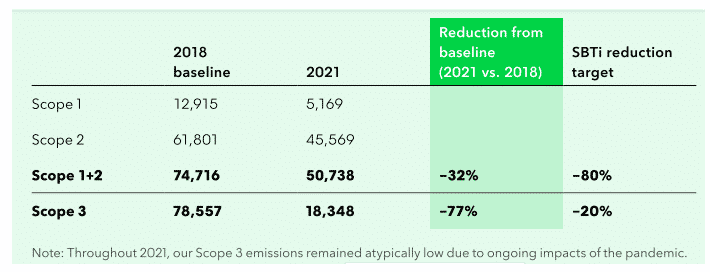
Its short-term targets aim for an 80% reduction in its Scope 1 and 2 emissions. At the same time, it targets to reach a 20% reduction in its Scope 3 emissions by 2030 from a 2018 baseline.
Here’s Bloomberg’s progress toward its net zero carbon emissions goals as seen in its 2021 Impact Report.
Bloomberg’s science-based targets aim to reduce:
Scope 1: Direct GHG emissions from direct use of fuel, including natural gas, generator oil, refrigerants, and aircraft fuel.
Scope 2: Indirect GHG emissions associated with consumption of purchased electricity and steam.
Bloomberg’s Scope 3 emissions refer to all other indirect GHG emissions. These include: business travel, publishing operations, global logistics, paper usage, and landfill waste generation.
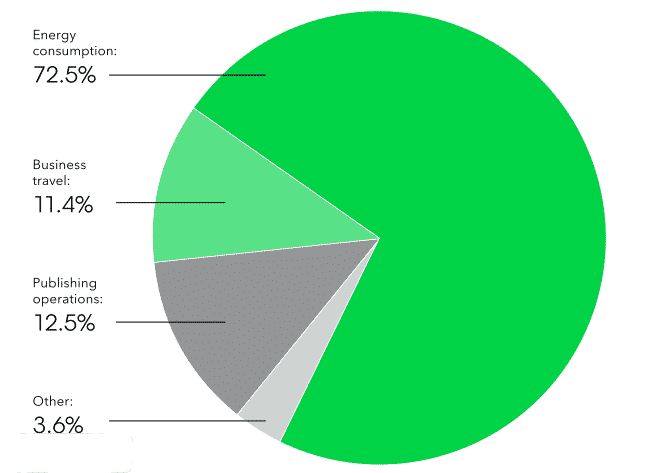
Bloomberg emissions by activity
Energy consumption generates most of Bloomberg’s emissions (72.5%) as shown in the chart.
In 2021, energy consumption accounted for an even greater share of the firm’s total emissions. While emissions from publishing operations fell and business travel remained lower.
Bloomberg Carbon Emissions by Activity
With that, Bloomberg’s top priority with its net zero emissions is reducing its energy use. It keeps track of the kWh consumption per employee as a measure of its energy efficiency.
Bloomberg is a member of RE100. It’s a global initiative of influential businesses committed to using 100% renewable electricity.
The media company pledged to get 100% of its electricity from renewable sources by 2025.
In 2021, Bloomberg secured 176 million kWh of renewable energy, an increase of 10 percent from 2020. This amount is from its 9 on-and off-site solar, wind, and hydropower projects.
This sourced renewable energy represents 51.2% of the firm’s purchased energy.
To date, Bloomberg’s renewable projects have generated 592 million kWh of energy.
Moreover, part of Bloomberg’s path to net zero emissions is to cut the environmental impact of its facilities. In particular, it includes its buildings and data centers.
The company invests in green-certified office spaces. 80% of its employees work in offices certified by Leadership in Energy and Environmental Design (LEED) or BREEAM standards.
In 2021, Bloomberg had 36 certified projects on six continents, with 5 more in progress.
When it comes to its data centers, the firm has a goal to have a 5% improvement in energy efficiency across its data centers versus a 2018 baseline.
In 2021, it managed to achieve a 2% improvement in energy efficiency based on Power Usage Effectiveness (PUE). It’s a measure of how efficiently a data center uses energy.
PUE is the ratio of the energy used by the facility to the energy delivered to the computer equipment. And a lower PUE value is better.
Carbon credits: A means toward net zero emissions
Business travel has represented a significant part of Bloomberg’s total emissions. But the pandemic restrictions lowered business travel.
In 2021, Bloomberg traveled 31% fewer miles than in 2020 and its associated emissions fell by about 20%. The firm’s 2021 travel activity was 86% lower than its pre-pandemic level in 2019.
But as the pandemic diminishes and regular business dynamics resume, business travel will be up. And so, it will be a key area of focus as Bloomberg work to reach its 2030 net zero emissions reduction targets.
The firm worked with climate solutions company the South Pole to buy carbon credits. These credits will support climate action projects in Brazil, Cambodia, and the Democratic Republic of Congo.
The number of credits will cover all of Bloomberg’s travel emissions for the next 3 years. The selected projects have co-benefits that align with the UN Sustainable Development Goals.
Plus, it offers the following carbon credits benefits:
Water filters in Cambodia:
This project supports locally-made Ceramic Water Purifiers that provide clean water to communities. With a filter in their home, families no longer need to boil their water to make it safe to drink.
Forest conservation in Brazil:
This refers to the Envira Amazonia Tropical Forest Conservation project in Brazil’s Amazon basin. It protects 39,300 hectares of tropical forest from logging and cattle ranches.
Forest conservation in the Democratic Republic of Congo:
This one is the Isangi Forest Conservation project in the Democratic Republic of Congo. It protects over 187,000 hectares of one of the Earth’s most biodiverse rainforests from deforestation.
Finally, Bloomberg’s publishing operations are one of its major carbon emitters. It accounted for 13% of total company emissions.
In 2021, it published three magazines that consumed 5 million pounds of paper. This generated 8,647 metric tons of CO2e. This represents a 33% reduction versus 2020 due to reducing the total number of print magazines by 46%.
To mitigate this emission, Bloomberg is employing these strategies:
Recycled paper: printing on 100% recycled-content paper
FSC certification: Forest Stewardship Council or FSC-certified paper for all magazines
Efficient printing: improve processes to limit paper waste during production
Regional printing and distribution: to reduce emissions
Digital publishing: most impactful to reduce publishing activities emissions.
Ripple announced its commitment to help ramp up carbon markets for $100 million using blockchain and crypto.
Ripple is a technology company that acts as both a digital payment network for financial transactions and a cryptocurrency.
Its $100 million pledge to carbon markets is to help speed up carbon removal and ramp up carbon markets. In particular, the funding will be for investing in innovative carbon removal companies and climate fintech.
Brad Garlinghouse, CEO of Ripple, said:
“Our $100 million commitment is a direct response to the global call to action for companies to help address climate change… While reducing emissions are paramount, carbon markets are also an important tool for meeting climate goals.”
He further said that blockchain and crypto can play a catalytic role in allowing carbon markets to reach their full potential. They’ll bring more liquidity and traceability to a fragmented, complex market.
Moreover, Ripple will also build a portfolio of carbon credits to meet its own commitment to reach net zero emissions by 2030. This commitment will help promote global climate goals to limit temperature rise to 1.5℃.
Ripple’s $100M Commitment to Carbon Markets
In 2020, Ripple declared its target to be carbon neutral by 2030 and is on track to do so by 2028. It works with other organizations to achieve its climate goals and helped XRP Ledger (XRPL) decarbonize in 2020.
To further its commitment to making carbon markets sustainable, Ripple’s $100M will fund these efforts:
Build a portfolio of high-quality carbon credits:
This is to help capitalize on the most impactful and scalable carbon removal methods and projects.
Invest in innovative carbon removal technologies:
By using blockchain and crypto, Ripple will speed up the supply in carbon markets and unlock value for buyers and sellers.
Support new functionality and developer tools:
This initiative will help creators and developers that focus on carbon market solutions. It will also enable carbon credit tokenization as core non-fungible tokens or NFTs on XRPL.
Partner with the world’s leading climate and conservation organizations:
This is to develop new methodologies for carbon removal and distributed governance models. The results would be greater fairness, revenue, and equity for suppliers.
The Role of Blockchain and Crypto in Carbon Markets
Carbon markets are toiling to keep up with soaring demand and a lack of high-quality, verifiable products. Add to this the problems with supply bottlenecks and slow time to market.
But the pressing climate goals need the market to scale up. And this entails improved mechanisms for project verification and certification. It also recalls for more transparency in pricing, market data, and infrastructure for buyers and sellers.
This is where blockchain and crypto come in to fill in the gap.
These digital technologies can help fix the market’s key barriers to growth and efficacy. They have innate qualities of transparency, verification, and scalability.
And so, tokenizing carbon credits will have a crucial role in scaling up carbon markets and meeting rising demand. In fact, plenty of carbon removal projects are betting on the XRPL to offer new climate solutions.
As per the General Manager of RippleX, Monica Long:
“By bringing blockchain to global climate initiatives, the industry can more quickly verify and certify NFT carbon credits… It will also rid the potential for fraud and even guarantee the offset is actually removing carbon for the long term.”
Carbon Market Makers and Partners of Ripple
Ripple partners with leading carbon removal companies and carbon market makers. These include the following:
Robert Niven, Chair and CEO of CarbonCure Technologies said:
“To address the climate crisis, we need all hands on deck. Growing the market for high-quality carbon removal and reductions is a key part of the solution.”
He added that Ripple’s commitment to carbon markets will have a big impact on advancing carbon removal innovations. The $100 million will also improve carbon credit delivery and its tools and solutions.
Xange.com:
A climate-focused fintech (backed by the UN) offering solutions that help the development of projects. It also helps in the measurement of ecological benefits and the registration of carbon credits. It’s building its carbon credit verification, tokenization, and exchange functionality on XRPL.
Steven Witte, COO & Co-Founder at Xange.com said:
“As efforts to decarbonize the global economy increase, demand for carbon credits will only increase… The industry needs to evolve its infrastructure and verification methods to address our climate needs.”
Carbon trading has become extremely popular today among individuals and organizations and carbon exchanges are starting to emerge.
It’s all happening for a simple reason: Reducing carbon emissions is a global initiative and the carbon market offers great options for entities looking to cut emissions.
A polluter can purchase credits to cover the emissions they release into the air. Each credit equals one ton of CO2 equivalent (CO2e).
So, when an entity buys a carbon credit, it can now offset one ton of its own CO2 emissions.
On the other hand, companies with negative emissions that actively reduce the amount of carbon in the atmosphere (like reforestation projects) instead create carbon credits and sell them.
Individuals and companies alike on both sides of the market are looking for the top carbon exchanges to trade carbon credits. And if you’re wondering which exchanges those are, we’re going to identify the top 4 carbon credit exchanges for 2024.
But before that, we’ll first define what carbon trading is, and then explain the two different carbon markets in place.
What is Carbon Trading?
Carbon trading is the process of buying and selling carbon credits. Some of these credits are permits that allow a company or other entity to emit CO2, and some of these credits represent one ton of CO2 emissions that’s already been offset. Together, they form a market-based system aimed at reducing CO2 emissions that cause global warming.
Carbon exchanges are the vehicle of this task.
Carbon trading is also called carbon emissions trading. The first were based on the cap-and-trade regulations that introduced market-based incentives to reduce pollution.
So, instead of imposing certain laws and hard limits, cap-and-trade programs rewards entities that cut their emissions, while charging penalties to those that can’t. This is done through the issuance of carbon allowances – the type of carbon credit that permits its holders to emit one ton of CO2.
The idea behind this framework for CO2 emissions came from the Kyoto Protocol in 2005. In particular, it aimed to reduce CO2 emissions by about 5% below 1990 levels by 2012. The Paris Agreement continued the work in 2015.
Emitters can buy these allowance credits from others in the same program to offset their emissions. But it’s important to note here that allowances don’t actually reduce emissions, but merely limit them.
Carbon Offset Credits
Carbon offset credits, on the other hand, are a type of credit that represent one ton of CO2 actually removed from the atmosphere. This removal can be achieved in a number of ways – the planting of trees, direct capture from a source of emission or the atmosphere, and so on.
Those with projects that can remove some of this carbon that would otherwise end up in the atmosphere can sell these CO2 reductions as carbon credits.
Many claim that carbon trading is a cost-effective solution to the climate crisis. While others say that it’s just a distraction and can’t help resolve global warming.
But despite criticisms, carbon trading remains a central idea in many proposals to combat the effects of climate change.
There’s no unified global marketplace for carbon trading that exists yet. But there are several regional markets created where cap-and-trade programs exist, as well as various trading platforms. Trading carbon credits in the former is usually regulated, while the latter is for the voluntary market.
Compliance vs. Voluntary Carbon Market
The compliance or regulated carbon market is born out of the laws mandating emissions reductions. Examples of these include the E.U.’s Emissions Trading System (EU ETS), or California’s cap-and-trade program.
Governments assign maximum emission limits for each company, sometimes known as “allowances” or “credits”. Emitters can then buy or sell carbon credits based on emissions they’ve generated in relation to their allowance limits.
Conversely, the voluntary carbon market (VCM) operates without government regulation. However, it has grown explosively in recent years due to the Paris Agreement calling for drastic corporate net zero goals.
Entities can buy carbon credits to offset the amount of CO2 emissions they’re releasing. Some of them buy directly from developers who sell credits granted to their carbon projects.
But now, many buyers and sellers of carbon credits are transacting their trades via digital carbon exchanges. Many of them even prefer to do it using carbon tokens enabled by blockchain technology.
As the crypto world matures, developers have begun to apply blockchain to one of the other hot markets today: carbon credits.
Tokenization of Carbon Credits
Carbon credits can also be traded as tokens on a digital exchange just like how they can be traded on traditional trading platforms.
A pool of carbon credits from a project can be tokenized. And like each carbon credit, a token also represents one ton of carbon offset.
The tokenization of carbon credits helps the transparency and liquidity of the market. Blockchain technology can create secure, standardized, and real-time carbon credit exchanges.
This is because the token stores all the information related to the carbon credit. These include third-party certification details, auditing, transaction records, and project monitoring.
Carbon tokens minted to the same blockchain will follow the same standard. This allows for their integration into the Decentralized Finance (DeFi) markets.
DeFi markets, such as Decentralized Exchanges (DEXs), offer financial instruments without relying on intermediaries by using smart contracts on a blockchain.
In essence, cryptographic tokens are a set of information and regulations encoded into a smart contract. This contract is a program that’s executed after meeting certain criteria and kept on a blockchain.
After taking possession of the contract, a third-party body can easily verify it due to the nature of blockchain networks. Verification is crucial to confirm ownership of the carbon credits in a contract.
The automatic execution of the agreement gets rid of any intermediaries. This eliminates the time-consuming processes involved in traditional exchanges.
Also, tokenization promotes transparency of the transactions in digital carbon exchanges. This is vital for the growth of the voluntary carbon market.
With all that said, here are the top carbon exchanges that are helping to scale up carbon markets right now.
The Top 4 Carbon Exchanges
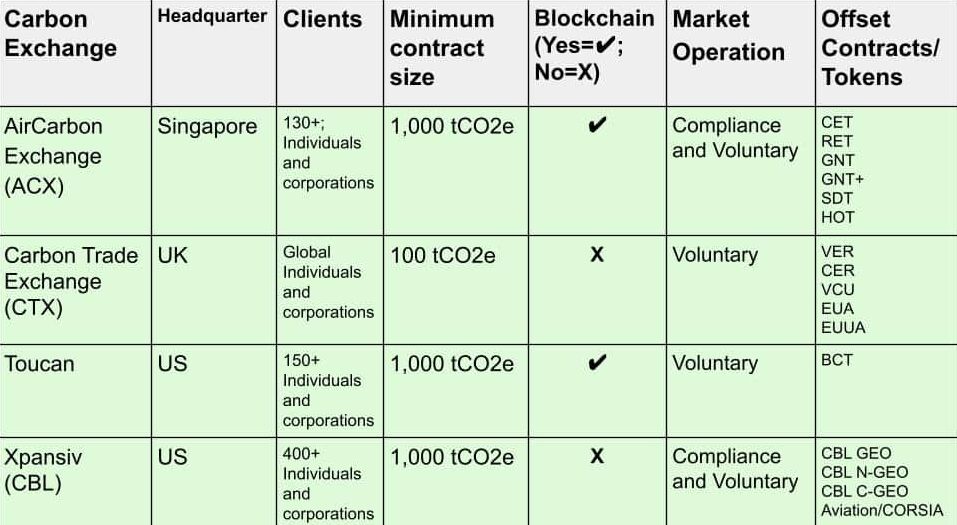
Among the different carbon credit exchanges available, we’ve identified the top four that are worthy to consider. Let’s discuss each one of them in detail to inform you better.
AirCarbon Exchange (ACX): The easiest and most streamlined platform
AirCarbon Exchange was launched in Singapore in 2019 as a digital exchange platform for airlines to trade carbon credits.
The firm has raised a total of $3.6M in funding over 3 rounds. This carbon exchange is funded by Deutsche Borse.
ACX has a client base of more than 130 organizations. They consist of corporate entities, financial traders, carbon project developers, and other stakeholders.
This carbon exchange uses distributed ledger technology (DLT) in a traditional commodities trading architecture. It also leverages recent blockchain technology to create securitized carbon credits.
It takes advantage of the speed and efficiency of blockchain technology. One of the goals of using it is to have instantaneous T-0 trade execution, clearing, and settlement.
ACX initially based its DLT exchange on the aviation industry through CORSIA, the global Carbon Offsetting and Reduction Scheme for International Aviation.
Moreover, ACX seeks to securitize carbon credits around market demand, enabling more traders to gain exposure to this asset class. This is contrary to the traditional carbon market’s organization around credits sourced from individual projects.
The bid/offer exchange functions like a commodities trading exchange, creating price transparency. Moreover, it allows market participants to Mark-to-Market the value of carbon in their portfolios.
It uses a digital warehouse that lets investors easily manage assets within their portfolios.
Over 62% of ACX’s client volume comes from Singapore/SEA, while >55% of projects originate from Australia.
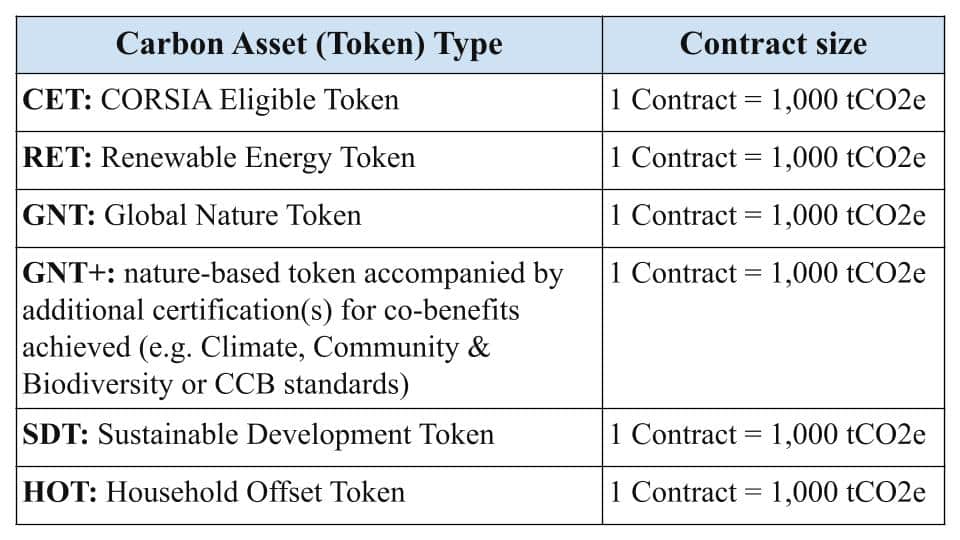
ACX currently has six different tradable carbon asset classes. These include the following:
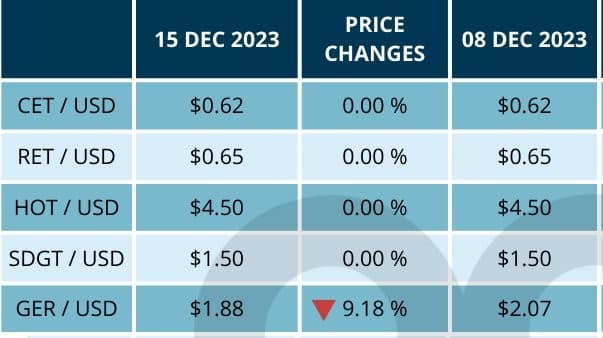
The table below shows the recent price for each carbon asset.
The platform’s token is currently the easiest and most streamlined instrument for carbon credits trading.
Carbon Trade Exchange (CTX): The most cost-effective spot trading exchange
Carbon Trade Exchange (CTX) is one of the earliest players in the global carbon market, dating back to 2009.
Unlike other carbon exchanges, CTX is a member-based spot exchange with various participants. They range from individual brokers and project developers to big corporations.
They can list their credits directly to CTX from their Registry account and then trading digitally from anywhere.
CTX allows for trading credits from several different industry standards including Gold Standard, Verra’s Verified Carbon Standard, and the United Nations’ Clean Development Mechanism (UNFCCC). The BioCarbon Registry is a recent addition, as of April 2022.
The credits that are tradable on CTX include these five major ones:
Voluntary Emission Reduction (VER)
Certified Emission Reduction (CER)
Verified Carbon Units (VCU)
EUA (EU Allowance)
EUAA (EU Aviation Allowance)
Apart from facilitating carbon exchanges, CTX also offers other services. These are carbon footprint calculation, carbon offsetting, and carbon project development.
Carbon credit exchanges in CTX credits are available in four currencies: GBP, AUD, USD, and EUR.
Buyers can buy and retire credits in lots of 100 tons of CO2e, which is CTX’s minimum trading volume. Other carbon exchanges have minimums of at least 1,000 tons equivalent, or 1,000 credits.
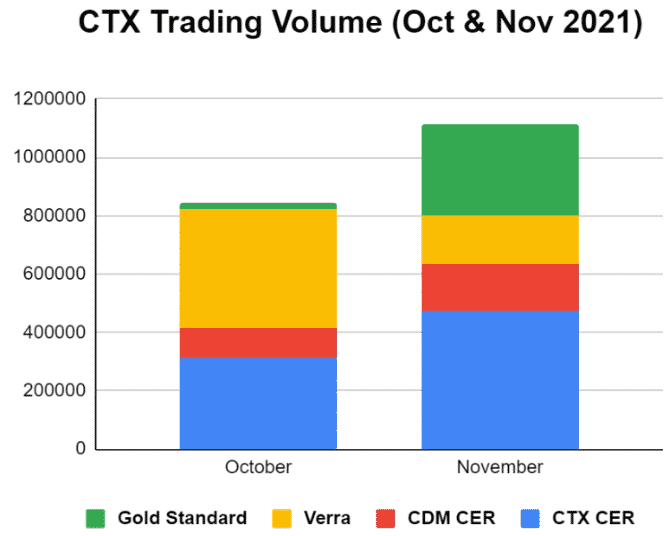
CTX has traded hundreds of millions of tons of C02e offsets since its first trading activity in 2017. The top two most traded credits are Verra certified credits and CTX CERs. The chart below illustrates CTX’s trading volume for October and November 2021.
CTX is expanding fast with current locations in the UK, Australia, Europe, and Asia. It covers projects in Africa, Asia, Europe, and North and South America.
Toucan Protocol: Creator of the most liquid carbon-to-crypto market
Toucan Protocol builds infrastructure for carbon markets to finance climate crisis solutions. It’s raised a total of $7.5 million in funding over 2 rounds.
Its mission is to make DeFi (decentralized finance) work by introducing a new currency: programmable carbon.
In essence, it turns Verified Carbon Units or VCUs into crypto via its own proprietary Toucan Bridge. It’s the first generalized bridge to tokenize carbon credits. It allows anybody to tokenize their carbon offsets and make them available in the world of DeFi.
Each Toucan tokenized CO2 or TCO2 represents one verified, real-world carbon credit.
TCO2s are semi-fungible, with unique information about each project encoded on-chain.
The Toucan Carbon Bridge can connect to any source of offsets, starting from renowned registries like Verra and Gold Standard. But not all carbon offsets are equal as they come from different projects.
So Toucan created its own so-called Carbon Pool or liquidity pool. It turns carbon offsets into more liquid carbon index tokens. This allows buyers to discover prices for different classes of carbon assets and creates a useful Web3 building block.
Once bridged, the TCO2 tokens can be deposited in a Carbon Pool. Each offset in the Carbon Pool creates a carbon reference token. TCO2 is backed by one of the carbon offsets with the necessary attributes.
And as the offsets are on public blockchains in smart contracts, each TCO2 is verifiable. Verification is straightforward all the way down to the offset’s source registry.
And “retiring” an on-chain credit on the parent registry prevents double-counting of the offset. It means this is done by “burning”, locking it away in a blockchain address that no one has access to.
Toucan’s first carbon pool was the BCT or the Base Carbon Tonnes. It’s a reference token created by the KlimaDAO organization that represents one ton of carbon. These tokens are back by credits from the Verra Verified Carbon Unit (VCU) registry dating from 2008 or later.
Carbon pools are gated. This means each TCO2 token must have specific attributes to pass the gating criteria. Toucan and members can set the parameters for gating.
The pool’s BCT token is highly liquid. It trades around the average price of BCT-qualifying carbon credits sold off-chain.
The price of Toucan’s BCT was initially at an average of $8 but has now fallen to $3. This is around the average of $3 for off-chain carbon credits.
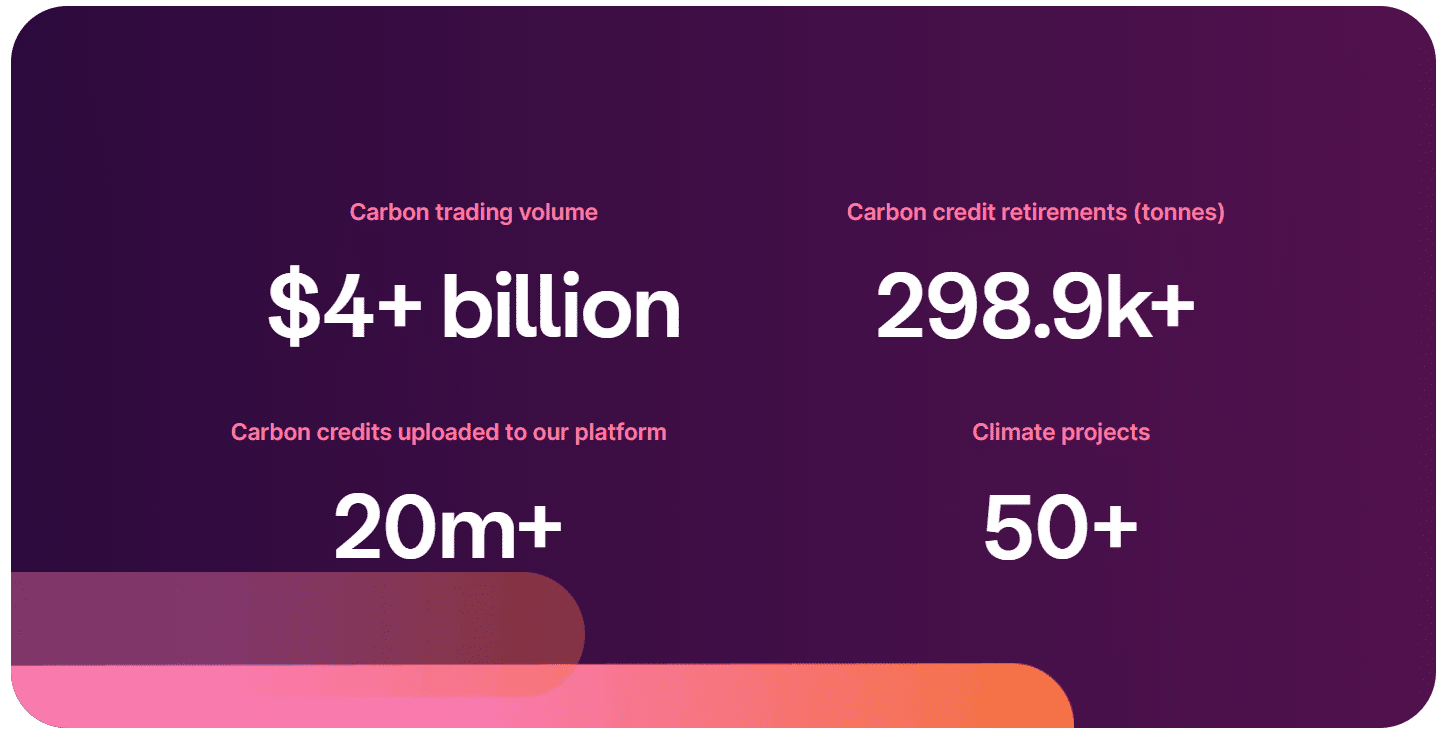
To date, here are what Toucan had achieved so far:
Xpansiv: The most intelligent exchange for ESG-inclusive commodities
U.S.-based Xpansiv was born out of wedlock between itself and Aussie platform CBL in 2019. This firm had proven wildly popular with investors, having raised $178.5M in total funding over 7 rounds.
Xpansiv is the global marketplace to trade various data-driven, ESG-inclusive commodities. The exchange prices carbon, energy, and water-based transactions. And the company does this in an intuitive, user-friendly environment based on deeper data.
One of its main business units is the CBL, the largest spot exchange for ESG commodities. These include carbon, renewable energy certificates, and Digital Natural Gas.
On Xpansiv’s CBL platform, clients can trade a broad range of carbon offset projects from major registries around the world. The long list of customers includes big organizations like airlines and major financial institutions.
By hosting around 90% of all voluntary carbon credit transactions worldwide, Xpansiv is currently the dominant player in the market.
Xpansiv’s flagship offset contracts are all designed to provide high-quality carbon credits. With their partner, Chicago Mercantile Exchange (CME Group), they’ve launched these three offset contracts:
CBL N-GEO: Nature-Based Global Emissions Offset, and
CBL C-GEO: Core Global Emissions Offset
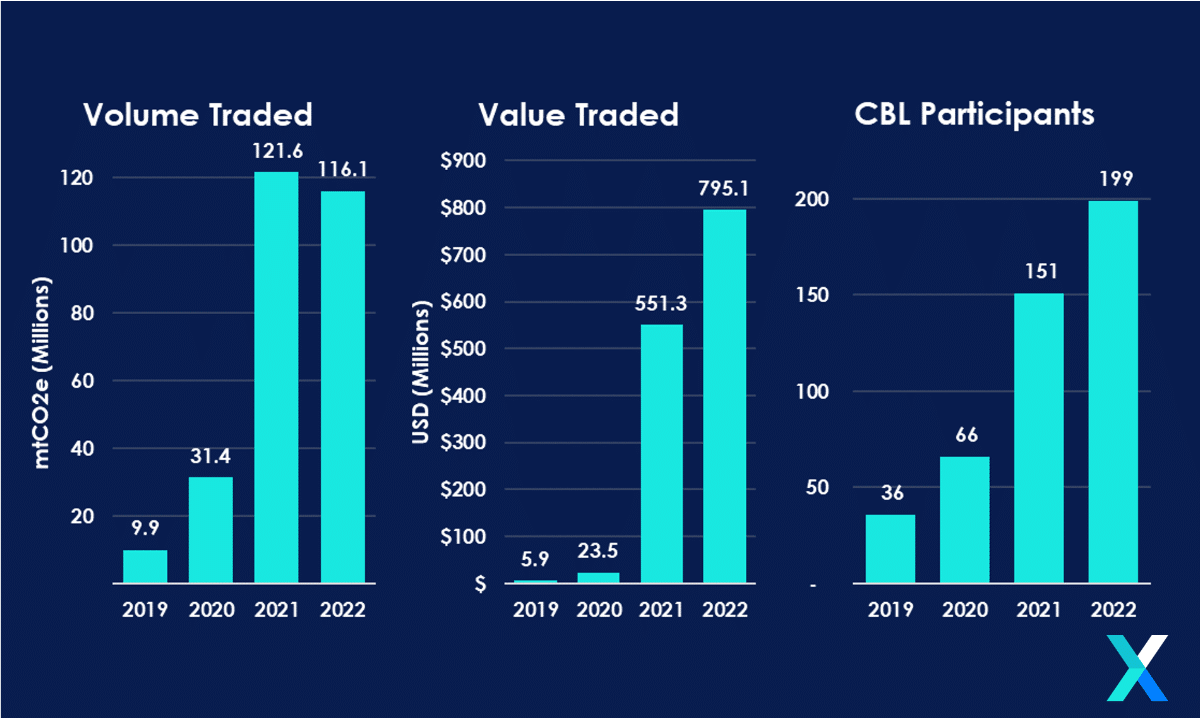
The total carbon offset volume traded on Xpansiv’s CBL exchange platform was over 116.1M tons of CO2e in 2022. This is 6% less than 2021 and represented about 35% total market share.
There are over 400 market participants that are active in CBL’s carbon market. Its transparent order book enables these participants to see live pricing. They can also gain full market depth for individual carbon offset projects.
In fact, project-level information is available via Xpansiv’s order book. This is integrated with leading registries such as the American Carbon Registry, Climate Action Reserve, Gold Standard, and Verra.
The below chart shows the Xpansiv CBL’s carbon exchange’s volume, value, and trading firms from 2019 to 2022. There is a strong trend of very rapid growth across all three metrics.
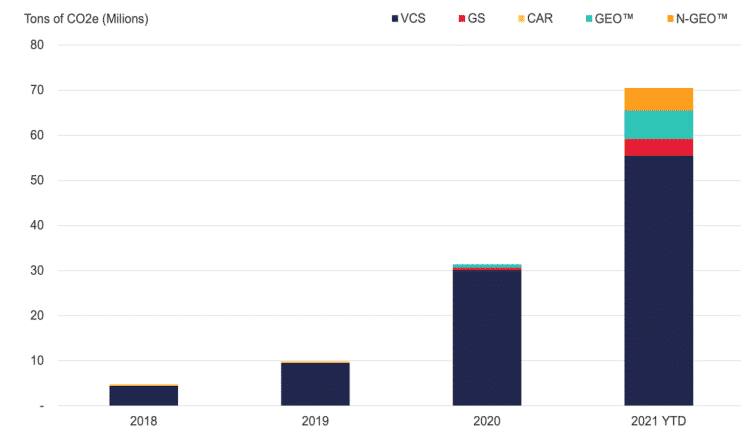
Here’s the annual transactional volume via CBL for voluntary carbon credits from 2018 to 2021.
Moreover, Xpansiv also pioneered the CBL GEO and CBL N-GEO futures contracts, with the CME Group. These futures contracts saw total trading volume of over 47.1M tons in December last year.
Another thing that makes Xpansiv the leading exchange is its centralized and intelligent trading platform.
Conclusion: What’s the verdict?
Overall, all the carbon exchanges have the same goal of enabling the trade of carbon credits.
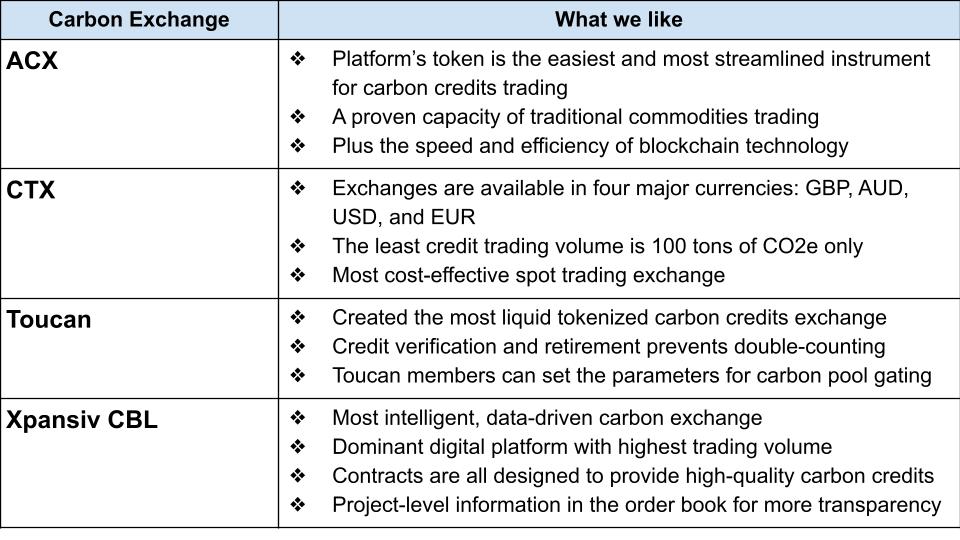
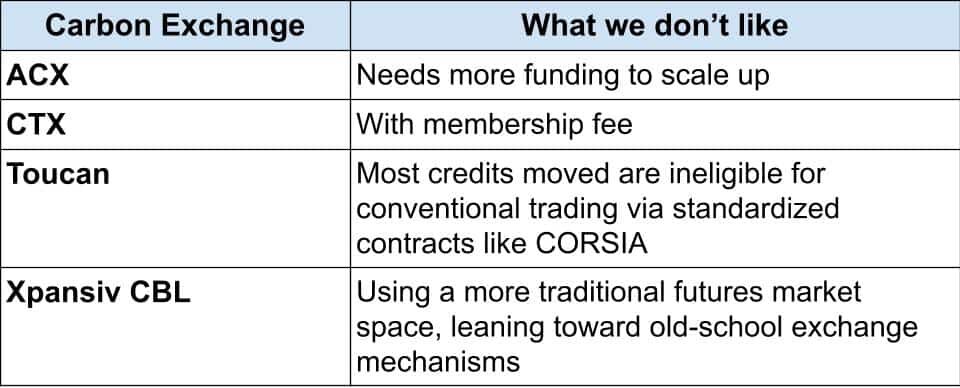
But not all carbon exchanges are equal and there are certain things that you may want or not want from each platform. Here’s what we can say about what we like and don’t like about each of them.
Carbon Exchanges: What We Like:
Carbon Exchanges: What We Don’t Like:
So, we’ve given an assessment of the top 4 carbon exchanges for 2023 based on the currently available information.
You can also check out our news page to stay on top of relevant events involving these carbon credit exchanges.
Soil carbon platform Perennial secured an $18M investment from investors including, Bloomberg, Microsoft Climate Innovation Fund, Temasek and SineWave Ventures.
Perennial is a soil carbon platform that focuses on measurement, reporting, and verification (MRV). The firm’s previous name is Cloud Agronomics with the vision to make the soil the world’s biggest carbon sink.
The firm can detect carbon and other nutrients in soil via its machine learning, ground observation, and remote sensing tech. Thus, its system can bypass the need for the lengthy and costly process of physical soil sampling.
The $18 million soil carbon investment will be for Perennial’s MRV platform ramp-up. In particular, it will help companies meet their net zero emissions plans with better insetting and offsetting.
Co-founder and CEO of Perennial stated that:
“What’s needed is an accurate and cost-effective way to measure and report carbon stored in soil everywhere, all the time. That’s the key to unlocking the huge market potential for trusted soil carbon offset credits.”
Perennial’s MRV Platform
Today, the voluntary carbon market is supply constrained. There’s more demand for carbon credits to offset emissions than the supply of verified credits.
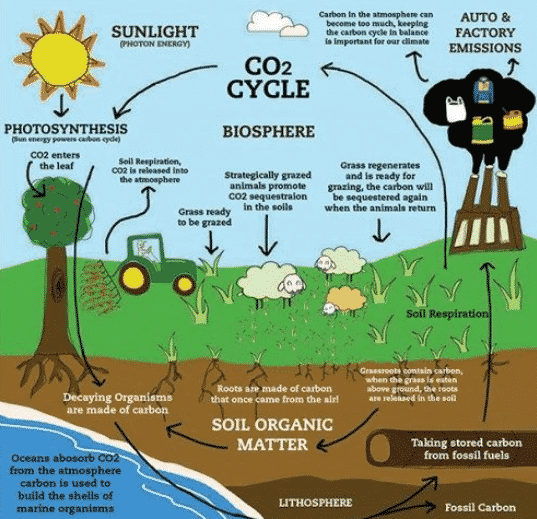
Agricultural soils can remove and store billions of tons of CO2. And with the right incentives in place like carbon credits, agriculture can be a key solution to fight climate change. The image shows how soil carbon sequestration works.
In 2021, the firm created the highest-ever resolution map of soil organic carbon for the USA.
Perennial’s chief scientist, James Kellner, said:
“Our technology reduces or eliminates the need for physical soil sampling… Reducing the sampling burden will drive down the cost of generating carbon offsets in agricultural land.”
The Perennial team has made great progress in developing its soil carbon MRV platform. It had done several market validation projects in the U.S. and Australia.
Its technology brings accuracy, detail, and scalability to soil carbon measurement. In fact, each measurement contains hundreds to thousands of individual predictions. Thus, it captures the unique carbon fingerprint of each field.
Agricultural companies can use Perennial’s technology to measure and reduce their emissions in the food supply chain. While project developers can work with the firm to verify the carbon credits they’re selling to corporate emitters.
Both of these are crucial to meeting net zero emissions goals.
The company partners with top registries to help landowners create carbon offset credits much easier.
The investment will help speed up Perennial’s soil carbon platform and build its team.
Better yet, farmers will receive a steady stream of income via carbon credits that managing their lands generate.
This new investment into Perennial’s soil carbon technology comes right on time.
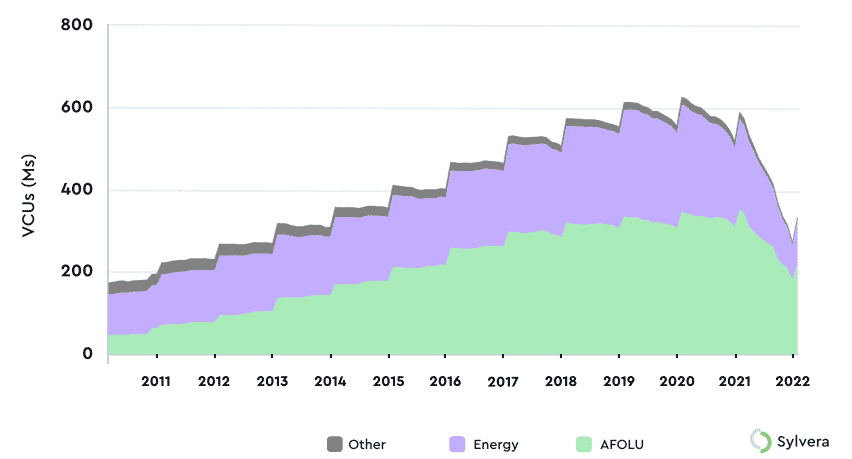
According to a report by Sylvera, nature-based carbon credits will be soon all that’s left. And the chart below shows that. VCUs refer to verified carbon unit credits.
Source: Sylvera 2022 carbon credit crunch report
And so, buyers will rely on carbon credits from agriculture, forestry, and other land use (AFOLU) projects. They’re the so-called nature-based carbon credits, which is Perennial’s domain.
Offsetting emissions is the main goal of carbon credits and The Walt Disney Company has been consistent in showing its pledge toward net zero emissions.
More and more companies had hopped on board the global trend of cutting carbon footprint. They’re investing in environmental projects with the ultimate aim of reducing GHG emissions.
The Walt Disney Company has established itself as a major player in the voluntary carbon market. It plans to extend its carbon offset program to include indirect emissions.
With Disney’s high internal carbon prices, it’s paying more than average prices for its carbon offset projects. And by the end of this year, the firm commits to having a science-based reduction goal in Scope 3 emissions. This includes emissions generated by its products, service manufacturing, and delivery.
Net Zero GHG Emissions
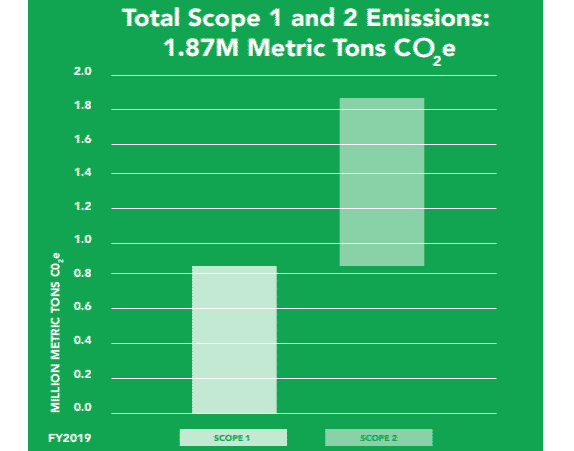
Disney has been operating with the goal to reach net zero GHG emissions since 2009. The following chart is the company’s 2019 Scope 1 and Scope 2 emissions.
Disney addresses its carbon footprint through avoided emissions and emission reductions. These include investments in low carbon innovation and using zero-carbon energy to power its operations.
The company plans to offset its emissions by investing in high-quality carbon credits. It focuses on nature-based projects like reforestation and natural ecosystem restoration.
In a nutshell, Disney will hit its net zero emissions goal by focusing on these four key areas:
Net zero emissions for direct operations by 2030
100% zero-carbon electricity by 2030
Innovation for low carbon fuels
Invest in natural climate solutions
Disney’s strategies to avoid and reduce its Scope 1 and 2 emissions are:
Implementing sustainability requirements for the design and construction of new assets
Investing in projects and renovations that drive greater efficiency in existing operations
Catalyzing innovation in low-carbon fuels to help speed up the transition to sustainable energy
Buying carbon-free electricity through on-site generation, partnerships with local utilities, and other mechanisms
100% Zero-Carbon Electricity for All Direct Operations by 2030
To achieve this climate goal, Disney will:
Invest in on-site renewable electricity generation
Maximize utilities and electricity partnerships
Supplement renewable energy use with physical and virtual Power Purchase Agreements (PPAs)
Buy unbundled renewable energy credits or RECs if the above tactics are not possible
Disney Cruise Line operations take the most of the firm’s fuel use. And here are what the firm had achieved so far under this goal:
Plug-in power used by its cruise ship while docked, reducing fuel consumption
Battery and solar-powered generators piloted by Disney tv and film productions
EV chargers installed for guest and staff parking in Walt Disney World, Disneyland Resort, & Disneyland Paris
Geothermal used to displace natural gas
New cruise ships will be powered by LNG with lower emissions than traditional fuel
To expand on those efforts and drive fuel innovation, Disney plans to do two major things. First, it will dedicate funding to innovate low carbon fuel pilots and infrastructure. Second, it will join industry collaborations like the Cruise Lines International Association.
Invest in Natural Climate Solutions (NCS) as Needed
Disney’s NCS investments are from its internal fee on carbon emissions. This fee applies to all its business units based on their emissions profile. This is to incentivize reductions at the source and reach Disney’s net zero emissions goal.
The company is selective in choosing the projects it supports. It also works with experienced partners to ensure the quality of the projects.
Its best practices in this area include:
Detailed reviews of project design
Management
Overall impacts
Ongoing follow-up on project progress
Other Net Zero Emissions Initiatives of Disney
Disney invested a lot of effort toward its direct emissions reduction goal. Still, the company also has other measures as part of its environmental goals.
Zero waste to landfill sites
To date, Disney had 80K+ tons of operational waste diverted from landfills in 2021. It will continue this initiative by:
Reducing food waste
Maximizing food waste diversion (meeting at least 50% of diversion)
Committing to EPA’s Food Loss and Waste 2030 Challenge
Use sustainable paper, wood, and palm oil
In its most recent environmental goal whitepaper, the company listed these aims for 2030:
All Paper & wood used as primary packaging and product material will be from 100% recycled content or be from a verified or certified sustainable source.
All palm oil and palm kernel oil used as an ingredient in Disney-branded products will be from certified sustainable sources by 2030.
Use sustainable textiles
To have 100% branded product textiles that contain recycled or sustainably sourced content by 2030.
Reduce plastics footprint across the business
So far, Disney’s efforts in reducing its plastic footprint gave it significant results. It has eliminated over 200 million plastic straws and stirrers and removed polystyrene cups.
The firm was also able to reduce plastics in over 15,000 of its guest rooms by 80%. This was done by replacing all disposable toiletries with bulk amenities. It also reduced plastic merchandise bags.
By 2030, its goal is for all plastic in Disney branded products and packaging to contain 30% or higher recycled content.
Moreover, Disney Cruise Lines committed to reducing 80% of single-use, guest-facing items on board by end of 2022.
Finally, Disney is also committed to pursuing sustainable manufacturing facilities. The aim is to minimize the carbon footprint of facilities where Disney-branded products are made.
And so by 2030, its goal is for all facilities to partake in the Higg index or maintain a sustainable manufacturing certification.
With all its initiatives and goals, Disney will contribute big to the world’s race to net zero emissions.
The cost of the Securities and Exchange Commission’s (SEC) proposed rule on climate disclosure is becoming a battlefield for businesses and politicians.
The SEC says that demanding firms to report environmental impact and risks due to climate change will raise the cost to businesses. It will be up from $3.9 billion to $10.2 billion.
The costs are only rough estimations. They’re high because companies need to disclose data that some haven’t measured and reported before.
Proponents of the new SEC rules said that many firms are already reporting the required data. And that standardizing the numbers will help investors save some money.
But critics of the proposed law argued that the associated costs are too burdensome.
SEC Climate Disclosure Rule’s Estimated Cost
Under the SEC’s new rule, businesses have to report their GHG emissions which may include those from suppliers and customers. This is otherwise known as Scope 3 emissions.
Some of the reported climate data will need an independent audit.
Firms will also have to report the impact of climate risks they’re facing on their financial statements. These include things like flooding and drought.
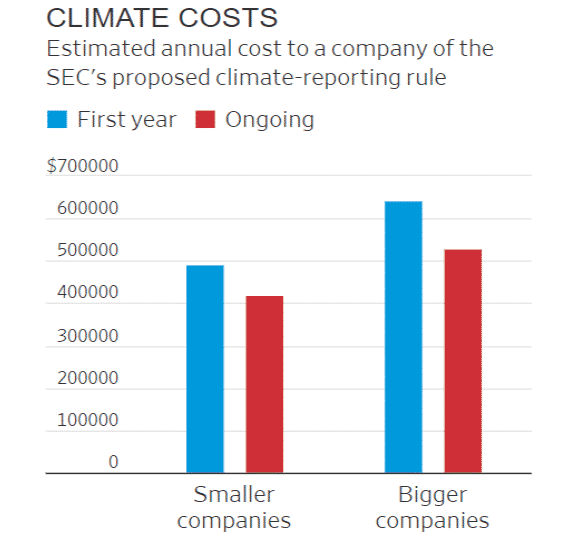
The required reporting will cost a small publicly listed firm about $420,000 a year on average. While it will be $530,000 a year for a bigger firm, according to SEC.
The chart shows the estimated annual cost to a company with SEC’s climate disclosure rule.
Source: U.S. Securities and Exchange Commission
Various stakeholders took different positions during the SEC proposal’s consultation. It will extend until mid-June.
What The Opponents Think
Critics of the new rule say that actual costs could be more expensive for firms that are new to reporting climate data than what SEC estimates.
That’s because it will include a lot of new expense items. These include developing new systems for collecting, analyzing, and reporting data. It may also involve costs to hire new staff, consultants, and auditors.
As per David Lynn, former SEC official and current law firm partner in Morrison & Foerster:
“This climate rule-making is unlike anything I’ve seen in my 25-year career in securities law, in the breadth and scope of the proposals.”
Likewise, the trade and industry groups raised their concern about the costs of the new rule. In particular, the National Mining Association told the SEC that:
“Its incredibly consequential and complicated rule would impose substantial administrative burdens on companies.”
Republicans who go against the SEC’s move to rule over climate disclosure are flagging the cost as a major issue, too. In fact, 19 senators told the agency that its proposal comes with huge costs for employers.
They wrote that the billions in new compliance costs would decrease shareholder returns. They also added that the extra costs could lead to fewer firms becoming publicly traded.
These senators said that many large companies have been disclosing climate data due to investor pressure. The majority of them (4 out 5) had reported their GHG emissions (Scopes 1 and 2) as per Refinitiv’s analysis. So, the SEC should not impose rules on this but rather allow such voluntary reporting to continue.
What The Proponents Say
But large investors think that the present voluntary climate disclosures are a mess. This takes more time and is hard for them to decide which company to invest in.
Other stakeholders also believe that investors need clear and consistent data to aid in their decisions. They’ll be guided if climate change will or will not impact their returns.
Also, researchers who analyzed the effects of the cost of the SEC climate disclosure rule said that saying it will hurt the market may be too much.
According to a finance professor,
“These are meaningful [cost] numbers but our research suggests that the costs are unlikely to have a significant impact on the numbers of firms going public or private.”
Take for instance the case of some investors surveyed. They said they spent about $1.4 million a year on average on climate data reporting. And that the most costly item amounting to $487,000 went to rating firms, consultants, and data providers.
Meanwhile, surveyed firms said that reporting the information required under SEC’s new rule cost them about $533,000 a year. This figure is very close to what the agency estimated to be the cost ($530,000) of the proposed rule for bigger firms.
Linda-Eling Lee from MSCI Inc. said that other countries are requiring businesses for similar climate data that SEC will ask from US companies. She also noted that:
The carbon credits market faced restrictions when two nations with large rainforests cut back on forest carbon credits.
Indonesia and Papua New Guinea are limiting the credits produced by preserving their rainforests. Last month, both countries released official statements about this matter.
PNG suspended new carbon credit deals after a watchdog group raised red flags on a deal in the Oro province. Its government decided to make a stronger legal framework governing voluntary carbon credits.
PNG’s environment ministry said that the temporary ban is to ensure proper stock take. It’ll also give time to audit the existing carbon projects in the country.
Indonesia is home to some of the world’s largest forest-preservation carbon projects. In fact, it has been the biggest supplier of forestry and land management producing carbon credits in Verra.
Verra is one of the two major carbon registries in the sector.
Why Set Forest Carbon Credits Limitations?
Developers of carbon credits buy the rights to endangered rainforests and pay locals to protect them. The locals’ preservation efforts reduce the carbon emitted into the air.
The reduced emissions produce carbon credits. These credits are then sold to overseas businesses to offset their own GHG emissions.
The idea behind this scheme is to incentivize the local people with rights to the forest to earn revenue from preserving it and not destroying it. It’s one way to fight climate change and help reverse its damaging effects.
But both countries decided to place new restrictions on generating forest carbon credits. One factor leading to this decision is the concern of who gets the credit for reducing emissions.
Under the climate accords, nations commit to cutting each of their GHG emissions. But to avoid double counting emission reductions, those who sell credits can’t count them in their own climate targets.
In particular, Indonesia worries about the growing private carbon projects in the country. It may seem that they’re losing control of their rainforest’s ability to store carbon.
Rainforests have become one of Indonesia’s major commodities.
In fact, under the nation’s law, it’s illegal to take something from the forests if it violates the rules. So, all carbon projects are under evaluation by the forestry management to ensure they don’t break Indonesia’s laws.
The government has been tightening regulations and says stricter rules are coming.
Indonesia’s restrictions on forest carbon credits are also mirroring the carbon markets worldwide.
Meanwhile, PNG is also home to the world’s 3rd biggest tropical rainforest. It keeps 7% of the earth’s biodiversity, making it so enticing to carbon financiers.
Moreover, protecting the forests is vital to PNG’s climate goals. But, more than 70% of timber production in the country is illegal.
And so, having some restrictions on PNG’s forest carbon credits generation is important. It’s to ensure that there’s proper oversight of the carbon market from the government.
Carbon Projects Affected by Restrictions
This affects large carbon credit producing projects such as the Indonesian Rimba Raya REDD+ project on the island of Borneo.
Also affected is the Katingan Mentaya Project which is under the PT Rimba Makmur Utama, which claims to be the biggest emission-reduction forest project globally.
The project gives local people jobs to preserve the thick forest as home to many species. The project developer had sold the remaining carbon credits to French and Japanese businesses.
Permian Global, which also develops forest protection projects and finances the Katingan Project said:
“Keeping a close eye on developments across the Indonesian carbon market, not least to ensure the project’s continued compliance with any new legislation.”
Some climate activists are positive about government restrictions on forest carbon credits. They say that private carbon credits projects are not doing enough to reduce deforestation.
They also said that project developers can easily overstate the damage to the forest in the absence of the project. This, in turn, allows them to overestimate the reduction in emissions.
Carbon Clean, a carbon capture tech startup raised $150 million to ramp up its climate tech solutions for heavy industry.
UK-based Carbon Clean is a climate tech solutions provider that helps industries achieve their net zero goals.
They provide carbon capture, utilization, and storage (CCUS) technologies to heavy industries. These include steel, cement, refinery, energy from waste, and biogas.
The recent Series C investment round bagged the largest equity investment for a point source carbon capture. This is a major step for the firm’s goal of industrial decarbonization on a gigaton scale by the mid-2030s.
Chevron led the funding round for Carbon Clean, along with other new big investors. They include Samsung Ventures, Saudi Aramco Energy Ventures, and AXA Investment Managers.
Other investors are the CEMEX Ventures, Marubeni Corporation, and WAVE Equity Partners.
Carbon Clean’s $150M Carbon Capture Investment
The investment will support the startup’s goal of becoming the world’s leading provider of carbon capture solutions.
Aniruddha Sharma, Chair and CEO of Carbon Clean, said:
“Carbon Clean’s vision is to deliver global industrial decarbonization on a gigaton scale, and we are now on track to do this by the mid-2030s. Today’s funding round is a testament to the confidence of industry and global investors in our technology… And its importance to reach net zero goals.”
In particular, the firm focuses on the heavy industry which accounts for around 30% of global emissions.
To achieve its aim, Carbon Clean will collaborate with industrial partners and governments.
The $150m funding will be for creating hundreds of the firm’s patented carbon capture units for industrial facilities.
The company called its carbon capture technology “CycloneCC”. It’s a fully modular technology designed to fix the two key obstacles to adopting CCUS: cost and scale.
Carbon Clean’s Modular Solution: CycloneCC
CycloneCC is a breakthrough combination of two proven technologies:
Carbon Clean’s advanced, proprietary amine-promoted buffer salt solvent (APBS-CDRMax®), and
A process technology – rotating packed beds (RPBs).
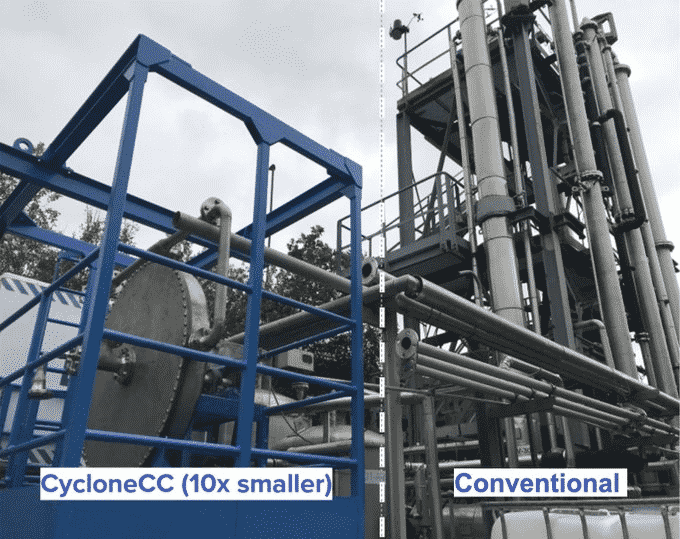
It’s considered the world’s smallest industrial carbon capture technology. It has a 10x smaller footprint than conventional carbon capture technology. It’s also deployable in less than 8 weeks.
Carbon Clean said that its fully engineered and standardized design promotes scalability. It can also reduce the size and total cost of carbon capture by up to 50%.
Best of all, it can drive down carbon capture costs to $30/ton only on average. The storage of captured carbon on a large scale is at around $80 to $90 per ton.
And so, the firm considers its CycloneCC a game-changer for hard-to-abate sectors.
As part of the new funding made for this carbon capture tech, Carbon Clean and Chevron seek to test it at one of the oil giant plants in California.
Chris Powers, Vice President, CCUS for Chevron New Energies said,
“Chevron is proud to lead Carbon Clean’s record Series C funding round… And we’re especially excited about the potential for CycloneCC to revolutionize the industrial carbon capture sector.”
The startup’s latest carbon capture investment follows its $22M Series B round in 2020. It comes as investments into CCUS tech had increased significantly.
Market analysts expect investments in CCUS startups to be more than triple in 2021.
To provide the best experiences, we use technologies like cookies to store and/or access device information. Consenting to these technologies will allow us to process data such as browsing behavior or unique IDs on this site. Not consenting or withdrawing consent, may adversely affect certain features and functions.
Functional
Always active
The technical storage or access is strictly necessary for the legitimate purpose of enabling the use of a specific service explicitly requested by the subscriber or user, or for the sole purpose of carrying out the transmission of a communication over an electronic communications network.
Preferences
The technical storage or access is necessary for the legitimate purpose of storing preferences that are not requested by the subscriber or user.
Statistics
The technical storage or access that is used exclusively for statistical purposes.The technical storage or access that is used exclusively for anonymous statistical purposes. Without a subpoena, voluntary compliance on the part of your Internet Service Provider, or additional records from a third party, information stored or retrieved for this purpose alone cannot usually be used to identify you.
Marketing
The technical storage or access is required to create user profiles to send advertising, or to track the user on a website or across several websites for similar marketing purposes.