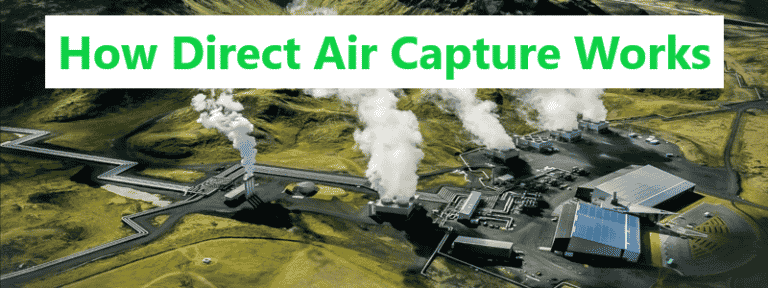
Direct Air Capture (DAC) is one of the key technologies that governments and businesses use in fighting climate change.
The latest IPCC report on climate change says that apart from carbon emissions efforts, limiting global warming to the critical 1.5⁰C will depend on DAC technology.
So how does it work, what are the top 3 Direct Air Capture companies, and what’s the role of DAC in reducing emissions?
This guide will help you know how direct air capture works. It will also explain the four important things to know about DAC in the fight for climate change.
DAC: A Carbon Dioxide Removal Technology
You can think about the CO2 in the Earth’s atmosphere like a bucket and that bucket is now almost full. To prevent that bucket from overflowing (or staying below the global warming limit), we have to cut back our GHG emissions.
For many climate activists, carbon dioxide removal (CDR) seems to be the last hope to keep the CO2 bucket full. This, along with huge emissions reduction efforts, will help materialize the Paris Agreement.
Carbon removal pathways particularly include the development of direct air capture technology. Though DAC won’t keep the world below the 1.5⁰C limit alone, it can help drain out some of the emissions dumped in the air.
This CDR technology is gaining traction and receiving the spotlight as this decade is the key to reaching net zero emissions. So, you’re more likely hearing DAC most often and wondering how it functions and what it’s all about.
How Direct Air Capture Works (Solid vs. Liquid DAC)
Simply put, direct air capture technology sucks in air through a fan. It is then passed through a material that absorbs the carbon dioxide from the air.
There are two technology approaches that are currently used to capture CO2 from the air: solid and liquid DAC. Climeworks, the largest DAC operating company so far, uses a solid filter.
-
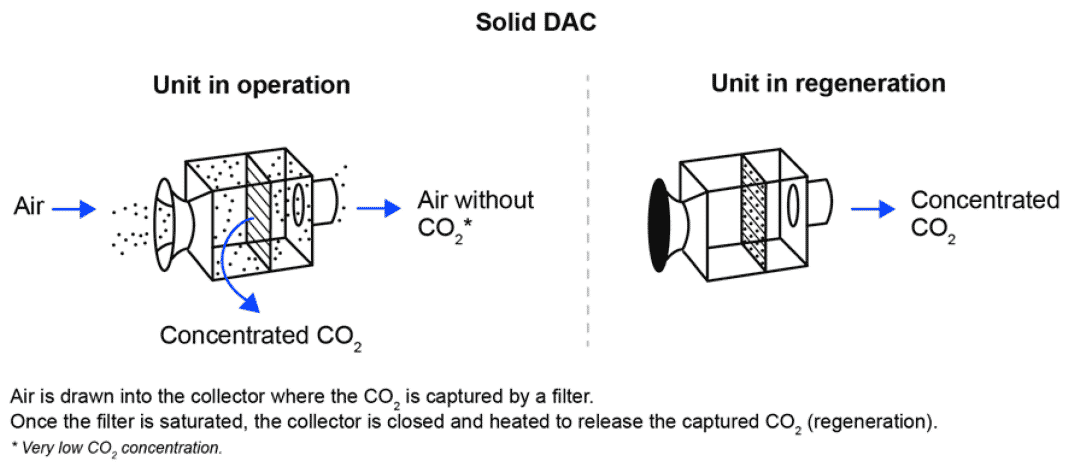
Solid DAC technology (S-DAC) uses solid sorbent filters that bind with CO2. When these filters are full of air, the units that house the fans are closed and then heated. Once heated, the filters release the concentrated CO2 which can be captured for storage or use.
An S-DAC plant comes in modular design and may include as many units as needed. For instance, the biggest operating S-DAC plant captures 4,000 tons of CO2 a year. The image below shows how the solid direct air capture process works.
On the other hand, liquid DAC technology (L-DAC) uses a chemical solution like potassium hydroxide to draw in CO2. L-DAC is based on two closed chemical loops.
The first loop occurs in the contactor unit which brings the air into contact with potassium hydroxide. The second loop releases the captured CO2 from the solution in a series of units operating at high temperatures (300°C – 900°C).
The following picture illustrates how L-DAC technology operates.
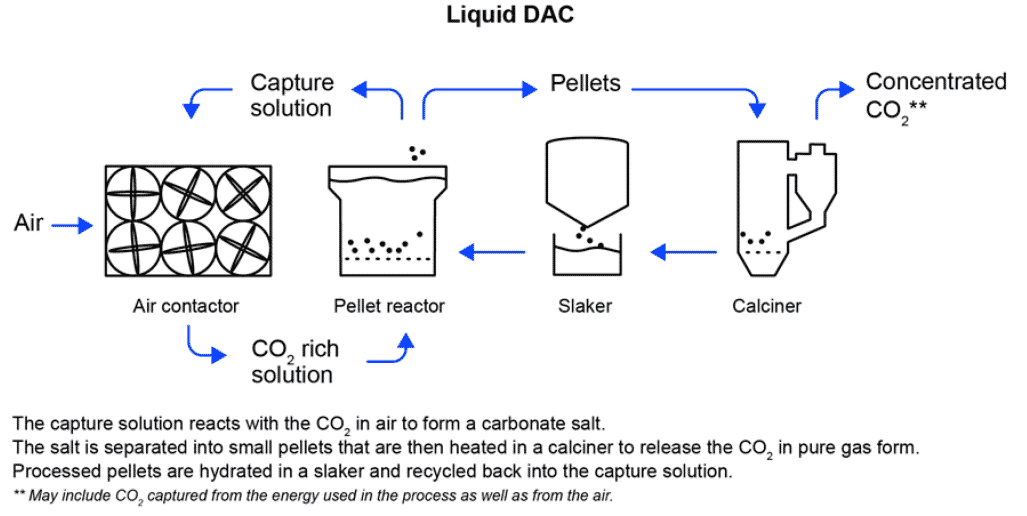
An L-DAC plant can capture around 1 MtCO2 a year. Carbon Engineering is using this kind of direct air capture process.
- While each DAC technology has its distinct features, both have the potential to remove CO2 from the air. The captured CO2 can be stored permanently or can be a raw material for carbon neutral products.
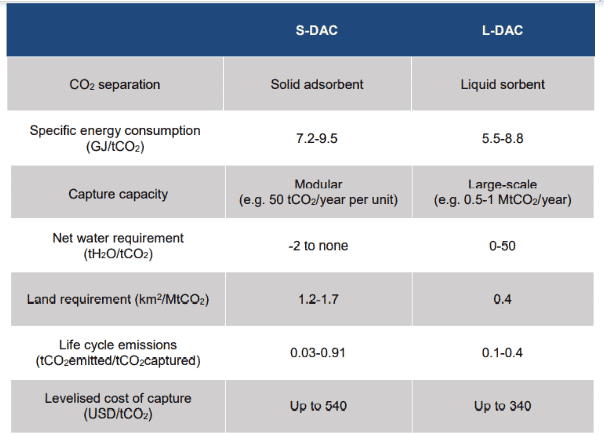
Moreover, both DAC options don’t need vast land to operate and they work at different temperatures. They’re fit for large-scale operations (L-DAC), as well as small-scale but modular and scalable operations (S-DAC).
The table distinguishes the key features between the two DAC technology approaches.
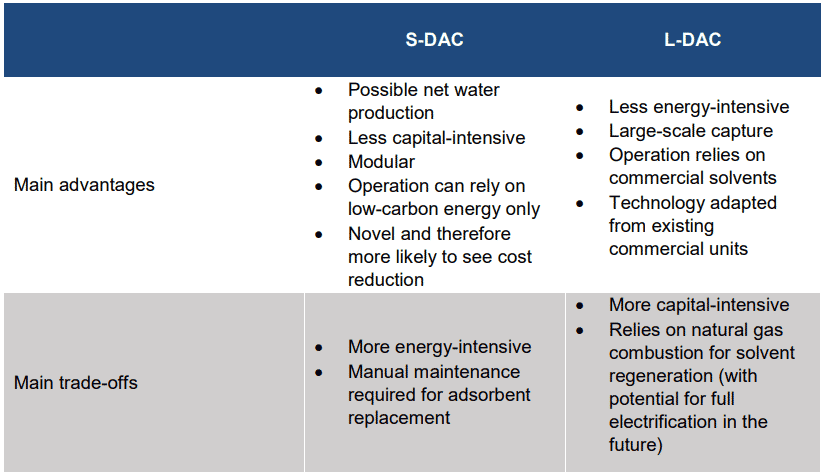
While the table below compares the major advantages and trade-offs of using these DAC technologies.
4 Essential Things to Know About DAC
With the expected rise in carbon dioxide removal schemes, more and more people are also asking for other important things about DAC.
For instance, how expensive is direct air capture? What are the leading direct air capture companies? What’s the role of DAC in meeting net zero emissions goals and who is investing in DAC?
Let’s address each question one by one.
Direct Air Capture Cost
Capturing CO2 from the air costs more than capturing it from a point source.
This is because the atmospheric CO2 is much more dilute than the flue gas of a power station, for instance. This results in the higher energy need and cost of DAC relative to other CDR technologies.
Here’s the direct air capture cost in USD for every ton of CO2, as per CO2 concentrations.

As DAC technology has yet to be demonstrated on a large scale, its costs are uncertain. Capture cost estimates range anywhere from $200/t – $700/t.
While cost estimates from the top DAC technology companies varies: $95 to $230/tCO2 for L-DAC and $100 to $600/tCO2 for S-DAC. The actual DAC cost depends on a couple of things such as:
- Technology choice,
- CAPEX (capital expense) for DAC plant
- Energy source,
- Carbon price, and
- Scale of DAC deployment
All these factors affect the regional cost of carbon removal via direct air capture.
On a regional level, CAPEX is likely to be lower in China, the Middle East, Russia, and North Africa than in Europe and the US. This is because of the cheaper materials and lower gas prices in those parts of the world.
Whereas CO2 prices will be higher in Europe, the US, and Japan (up to $250/tCO2) than in other regions.
But DAC costs will likely drop by 31-43% during 2020-2030 and by 10-24% during 2030-2050 as shown in the graphs. This is due to the considerable cost reduction potential of DAC.
In particular, its potential for performance improvement is also high. Plus, there’ll be massive DAC deployment as a policy response to the climate crisis.
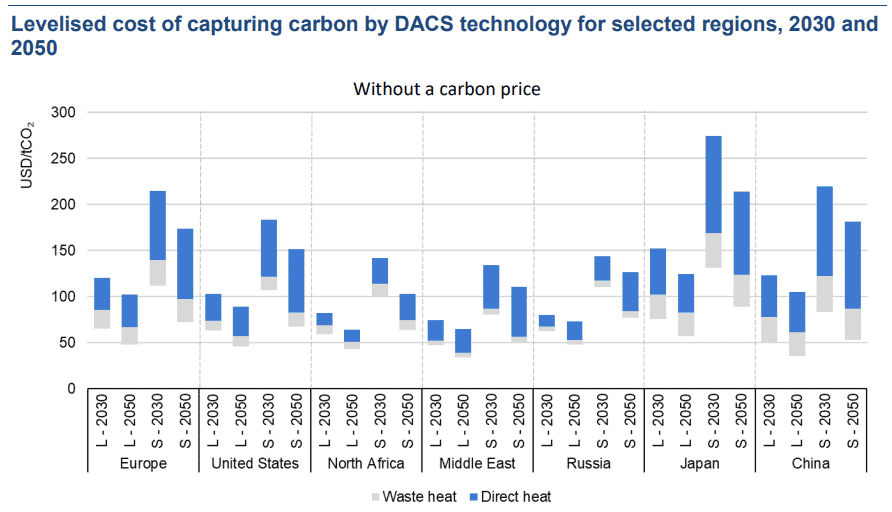
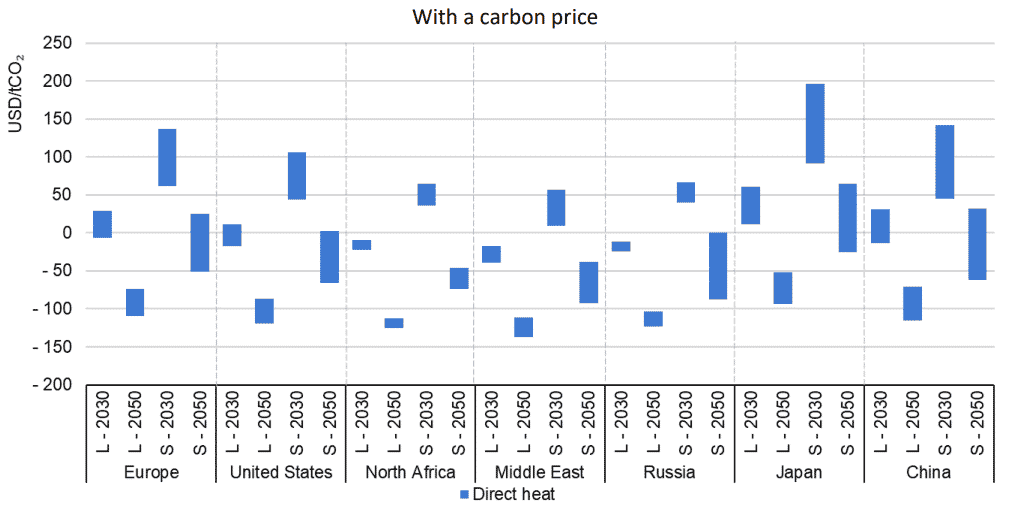
Without a carbon price like a tax, all the regions can capture CO2 directly from the air for less than $100/tCO2. Not surprisingly, the Middle East can enjoy a DAC cost below $50/tCO2. Thanks to its low CAPEX, low natural gas prices, and low electricity prices.
Meanwhile, a carbon price of USD 250/tCO2 in 2050 allows DAC to be profitable in all regions. That’s when a DAC plant sources power from heat and renewable energy (solar PV, or onshore and offshore wind).
In a global DAC scale deployment, the CAPEX cost in line with the Net Zero scenario can decrease a lot, up to 49-65% lower in 2030 and 65-80% lower in 2050.
-
So, high renewable energy sources and the best DAC technologies for electricity and heat can reduce total direct air capture costs.
Top 3 Direct Air Capture Companies
The top 3 in the sector are Climeworks, Carbon Engineering, and Global Thermostat.
Climeworks:
Zurich-based Climeworks is a DAC company founded in 2009 as a spin-off of the research university ETH Zurich.
As mentioned, Climeworks uses S-DAC with a solid filter that absorbs CO2. The image below shows how Climeworks’ direct air capture technology works.
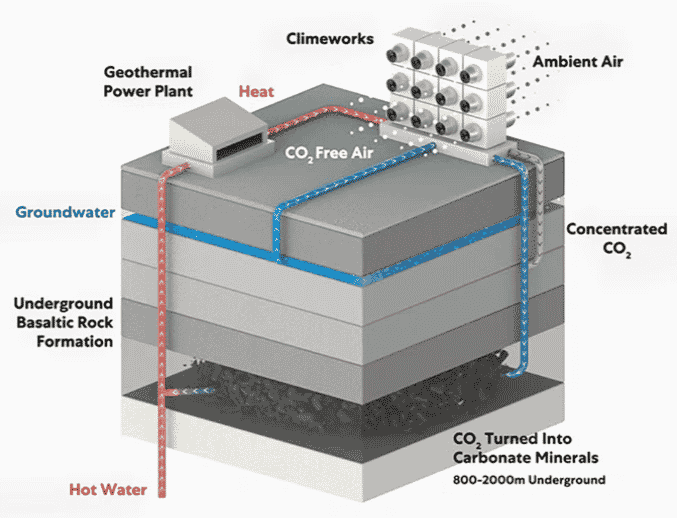
To date, it has constructed a total of 15 DAC plants worldwide. It built the $15 million Orca DAC plant in Iceland that sucks CO2 out of the air and pumped it deep underground for permanent storage.
Orca is the first industrial-scale direct air capture and storage plant, capturing about 4,000 tons of CO2 a year. This corresponds to a yearly emission of about 600 people residing in Europe.
Climeworks’ Orca is built next to a geothermal plant, a ready-made source of renewable energy to heat the CO2. While its other DAC plants get energy solely from renewable sources or from burning waste.
About 10 tons of CO2 are emitted for every 100 tons sequestered by DAC.
Right now, Climeworks continues to scale up. It was a Venture Kick winner in 2010, a Venture Leader in 2017, and one of the TOP 100 Swiss Startups from 2011 to 2014.
Carbon Engineering:
Vancouver-based Carbon Engineering Ltd. has a direct air capture pilot plant in British Columbia. It was also founded in 2009 from academic work on carbon management technologies at the University of Calgary and Carnegie Mellon University.
Carbon Engineering (CE) licensed its technology to 1PointFive (a joint venture between Oxy Low Carbon Ventures and Rusheen Capital Management). It aims to build a DAC plant capable of capturing 1 million tons of CO2 a year in 2024.
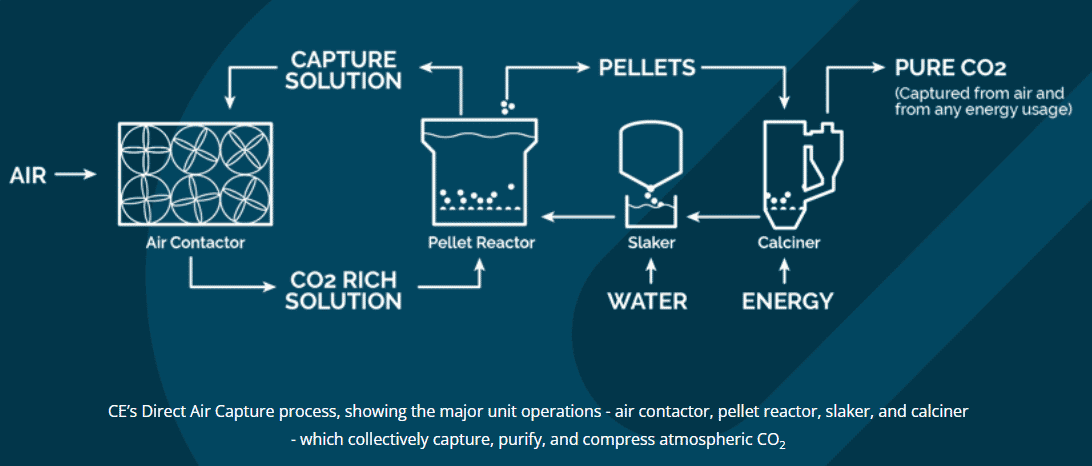
CE’s DAC technology sucks in atmospheric air with a fan. It uses potassium hydroxide solution (L-DAC) to bind the captured CO2 molecules. Then it extracts pure CO2 in gas form through a series of chemical reactions while returning the rest of the air back to the environment.
Here’s how CE’s liquid direct air capture process works:
CE started its pre-FEED (front-end engineering and design) with Pale Blue Dot Energy on the development of a DAC plant in Scotland, U.K.
This DAC company also recently started engineering an air-to-fuel plant that will be operational in Canada in 2026.
Global Thermostat:
This DAC company is founded in the United States in 2010 by two academics from Columbia University.
Same as Climeworks, Global Thermostat (GT) is also using its patented solid sorbent material that captures CO2. The image below demonstrates how GT direct air capture technology functions.
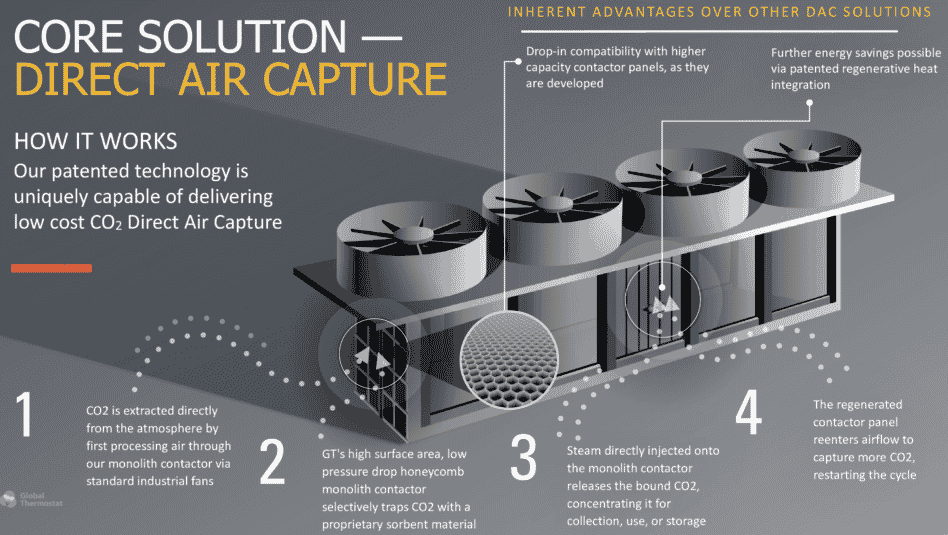
GT has so far commissioned two DAC pilot plants. It’s currently collaborating with ExxonMobil to advance and scale up its DAC technology.
It has also supplied its DAC equipment to the Haru Oni eFuels pilot plant in Chile. This DAC plant will use captured CO2 blended with hydrogen to produce synthetic gasoline.
The project will capture up to 250 kg of CO2 per hour, which is equal to around 2,000 tCO2/year.
It’s essential to note that DAC contributes to one of the very few solutions available to reduce emissions in the aviation sector. It remains one of the most challenging energy sectors to decarbonize. Using captured CO2 enables synthetic fuels (used by airlines) to be carbon neutral over their life cycle.
Other smaller direct air capture companies include:
- CarbonCapture: captures CO2 using molecular sieves
- Heirloom: proposes a hybrid DAC approach based on carbon mineralization
- Hydrocell: captures CO2 and recovers heat from exhaust air
- Infinitree: provides CO2 enrichment solutions for enclosed agricultural applications
- Skytree: focuses on air quality management for electric vehicles
- Soletair Power: combines ventilation with CO2 capture for buildings
Direct Air Capture’s Role in Meeting Net Zero Emissions
DAC plays an important role in meeting net zero emissions targets. And that’s by being a key CDR approach and a source of captured CO2 needed to produce carbon neutral products.
- Net zero emissions mean reaching a point where CO2 emitted into the air by human activities is balanced by the amount of CO2 removed from the atmosphere.
There is a range of CDR approaches available for use today. These include nature-based solutions (reforestation/afforestation), enhanced natural processes, and technology-based approaches. DAC is a technology-based CDR approach that’s getting much attention and growing interest right now.
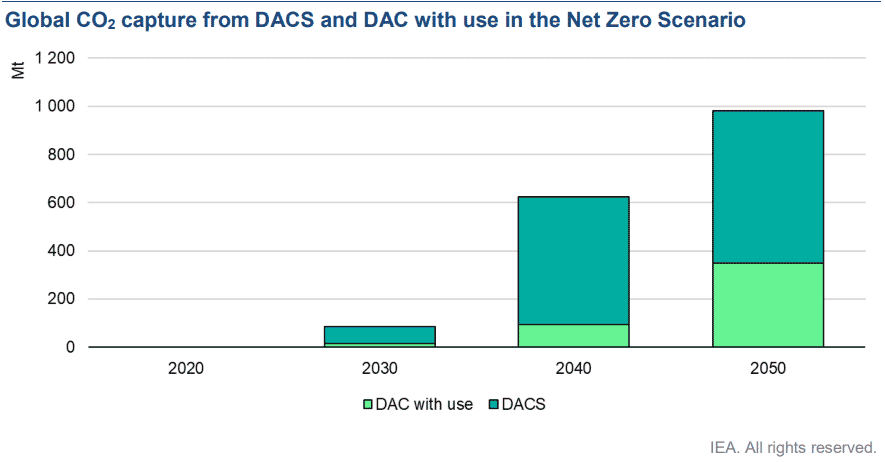
In fact, the world needs DAC to steer the global energy system to net zero emissions by 2050. The projections in the graph below show the potential of DAC in reaching net zero emissions by 2050.
Investments in DAC Technology
Growing recognition of DAC technologies as a CDR approach to cut down emissions is translating to more policy support and investment.
Since the start of 2020, almost $4 billion in public funding has been invested for DAC research, development, and deployment (RD&D). Likewise, leading direct air capture companies have raised more than one billion investments for scaling up their CO2 capture technologies.
The private-sector support for and investment in DAC has also expanded in recent years. Major organizations like Breakthrough Energy Ventures, Prelude, and Lower Carbon Capital are investing in DAC companies.
Fortune 500 companies are also putting their money to help ramp up DAC technologies.
In April this year, five of the world’s biggest companies committed to invest $925 million in CDR technologies. Stripe, Alphabet, Shopify, Meta, and McKinsey provide the funding for it. Shopify is also supporting DAC through its Sustainability Fund.
So far, Climeworks raised $650 million in equity funding to scale up its DAC technology. It’s the biggest amount ever raised by a carbon removal company.
Further support for DAC comes from programs like the XPRIZE (offering up to $100 million for innovative carbon removal projects including DAC). Also, the Breakthrough Energy’s Catalyst Program raises money from various sources to invest in CDR technologies like DAC.
-
Investors have one common goal in putting their money into scaling up CDR and DAC approaches: to reduce or offset their emissions.
Most carbon offsets offer credits for claiming to prevent a new emission elsewhere. Carbon credits work like permits for entities or companies to emit CO2. One credit equals one ton of CO2 emission.
Along with the rising interest in DAC, investing through carbon credits is also getting traction right now. Countries and businesses are in an urgent state to cut down emissions as early as 2030 and as late as 2050.
Carbon credits are one of those market tools that help individuals and organizations alike to reduce their emissions. When combined with direct emission reductions, carbon credits generated by DAC programs can tackle organizations’ unavoidable emissions, making net zero achievable.
Together, they also offer a mechanism to address emissions from the past. Hence, they provide a chance to achieve not just net zero, but also eventually help reverse climate change effects.
You can learn more about how this scheme works through our several guides. It helps to start by knowing the difference between carbon offsets and carbon credits here.
You can also check out our in-depth articles on carbon credits and carbon offsets for a closer look at how they work in helping companies reach net zero carbon emissions.