

Nvidia has reported record quarterly revenue of US$115.8 billion, more than doubling its sales from a year earlier as demand for artificial intelligence (AI) chips continues to grow. The results beat Wall Street estimates and came with a stronger outlook for the next quarter, showing that spending on AI infrastructure remains strong.
However, the earnings report also arrives during a major leadership crisis. Co-founder Jensen Huang resigned as CEO and board member on November 12. During its November 17 earnings call, Nvidia’s board confirmed that it does not intend to reinstate him.
Beyond its financial growth, Nvidia faces another challenge: managing the rising environmental impact of AI. Its latest sustainability report shows a sharp increase in supply chain emissions, even as the company matches all its operational electricity use with clean energy. This raises questions about whether its climate targets can keep pace with the rapid expansion of AI computing.
Nvidia Revenue More Than Doubles as Data Center Sales Surge
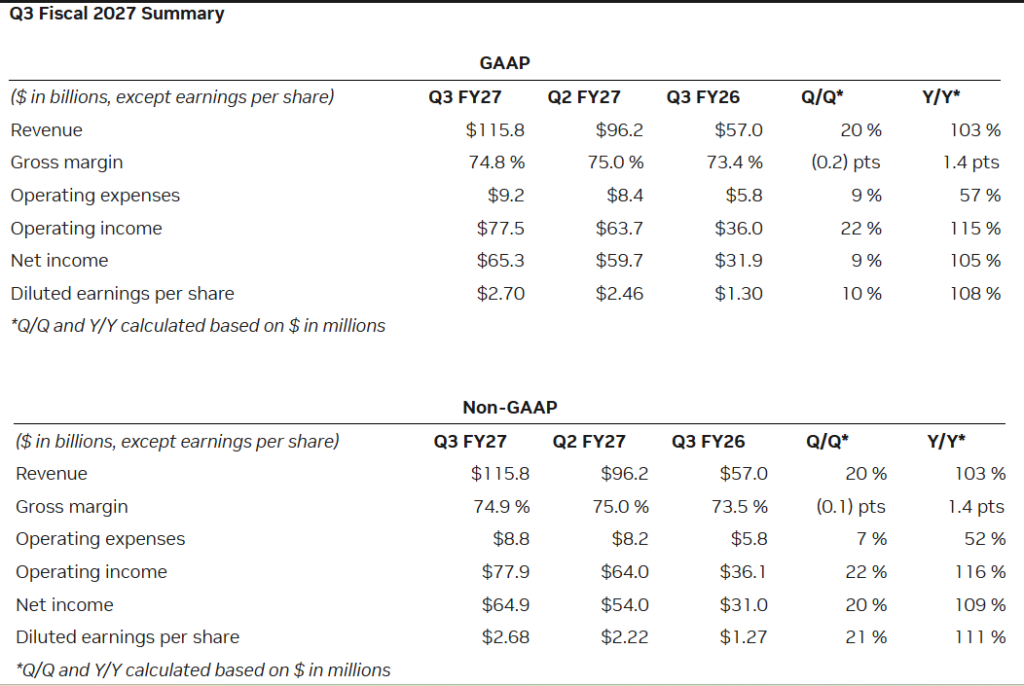
Nvidia reported revenue of $115.8 billion for the third quarter of fiscal 2027, which ended October 25. This was a 103% increase from $57 billion a year earlier and 20% higher than the previous quarter.
Net income rose 105% year-over-year to $65.3 billion. Earnings per diluted share reached $2.70 on a GAAP basis, up 108% from $1.30 in the same quarter last year. Non-GAAP earnings per share climbed 111% to $2.68.
The company’s data center business remained the main growth driver. Revenue from this segment reached $107.6 billion, up 110% from a year earlier. It accounted for about 93% of total quarterly sales, reflecting strong demand for AI processors and computing systems.
Nvidia also reported a gross margin of 74.8% on a GAAP basis. This was slightly below the 75% recorded in the previous quarter but above the 73.4% reported a year earlier.
The company returned $28.1 billion to shareholders through share buybacks and dividends during the quarter. It also had $227.3 billion remaining under its share repurchase authorization at the end of the period.
These results show how quickly Nvidia has grown as companies invest in AI data centers and computing infrastructure. However, the scale of its dependence on data center demand also makes the company sensitive to any slowdown in AI spending.
Colette Kress, interim CEO and Executive VP and CFO of Nvidia, remarked:
“Our momentum is real. NVIDIA is an exceptional technology leader, powered by the relentless innovation of our people. Vera Rubin is off to an explosive start, our roadmap is on track, and our ambition has never been greater.”
Nvidia Raises Revenue Outlook Despite Leadership Crisis
Nvidia expects fourth-quarter fiscal 2027 revenue to reach $130 billion, with a possible range of $126.1 billion to $133.9 billion. This is above the market’s average forecast of just over $125 billion.
The outlook is notable because Nvidia said it does not expect any data center computing revenue from China during the quarter. This suggests that demand from other markets could support its growth even without sales to China.
Interim CEO and CFO Colette Kress also told investors that Nvidia expects revenue to grow 75% in fiscal 2028. The company has begun shipping its new Vera Rubin NVL72 computing systems, which it described as the fastest product ramp in its history.
Still, investors must consider the leadership change. Huang resigned on November 12 after the company disclosed that his personal conduct was inconsistent with its code of conduct and workplace standards. The board unanimously accepted his resignation and appointed Kress as interim CEO while it searches for a permanent replacement.
The issue became more significant on November 17, when Huang publicly said he would be honored to return if the board believed it was in the company’s best interest. However, board chair Harvey C. Jones said during the earnings call that the board does not intend to reinstate him.
Nvidia also said it would not take questions about Huang’s resignation during the call. The board has formed a committee to oversee national security and export-control issues, adding another layer of scrutiny to the company’s governance.
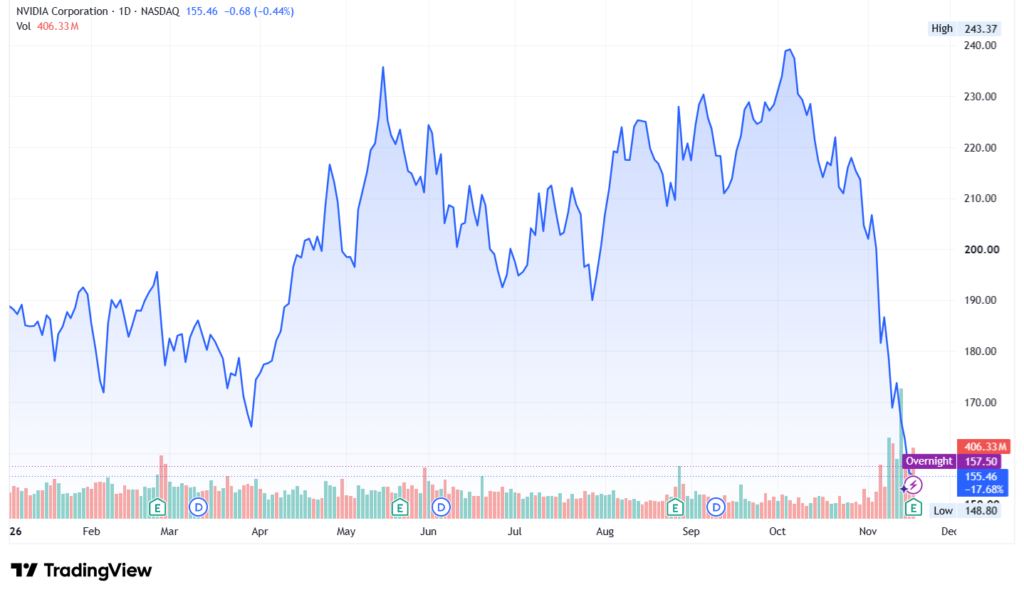
Nvidia (NVDA) stock gained about 5% in after-hours trading on November 17 following the earnings release, as investors welcomed the stronger-than-expected revenue forecast and improved growth outlook. The rebound came after the stock had fallen roughly 10% since Huang’s resignation, reflecting concerns about the leadership change and its potential impact on the company.
Despite the leadership turmoil, Nvidia’s results suggest that its business remains strong. However, the search for a permanent CEO will test whether the company can maintain its product roadmap, customer relationships, and growth without its longtime leader.
AI Expansion Drives Nvidia’s Scope 3 Emissions Higher
Nvidia’s financial growth reflects the rapid expansion of AI infrastructure. Still, more powerful computing systems also require more electricity, cooling, and materials.
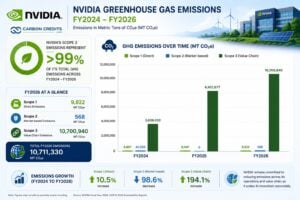
The company’s fiscal 2026 sustainability report shows that its total reported Scope 3 emissions reached 10.7 million tonnes of carbon dioxide equivalent (MtCO2e). This was about 55% higher than the 6.9 MtCO2e reported in FY2025 and nearly three times the 3.6 MtCO2e recorded in FY2024.
Purchased goods and services accounted for the largest share, at 9.3 MtCO2e. Capital goods added another 955,000 tonnes. These figures highlight the emissions linked to manufacturing chips, servers, and other equipment across Nvidia’s supply chain.
Nvidia also reported 308,891 tonnes of location-based Scope 2 emissions in FY2026, up from 228,378 tonnes a year earlier. This measures emissions linked to the electricity mix in the regions where the company operates.
The figures need some context. Nvidia is a fabless chip company, meaning it does not own the manufacturing plants that produce its chips. Much of its environmental footprint therefore comes from suppliers and other parts of its value chain.
The Scope 3 total in its published emissions table covers categories 1 to 8. It should not be confused with a complete estimate of all emissions linked to the use of its sold products.
Clean Energy and Efficiency Are Central to Nvidia’s Climate Strategy
Nvidia says it matched 100% of its global electricity consumption with clean electricity for sites under its operational control in FY2026. It used on-site solar, power purchase agreements, renewable electricity tariffs, and energy attribute certificates to meet this goal. However, this does not mean all its facilities physically run on renewable power at all times.
The company has also adopted two emissions targets validated by the Science Based Targets initiative (SBTi). From a fiscal 2023 baseline, it aims to:
- Cut absolute Scope 1 and Scope 2 emissions by 50% by fiscal 2030.
- Reduce Scope 3 emissions intensity from the use of sold GPU products by 75% per petaflop of computing performance by fiscal 2030.
Nvidia is also promoting liquid cooling and more efficient data center designs. These technologies can reduce cooling needs and improve computing performance per unit of energy. However, total electricity demand may still rise as AI use expands.
The company reported about 1.05 million megawatt-hours of energy consumption in FY2026, up from 816,000 MWh a year earlier. It also reported 451,297 cubic meters of water withdrawal, although changes in data collection limit comparisons with previous years.
The International Energy Agency has warned that growing data center demand will put more pressure on power systems. This makes cleaner electricity, stronger grids, and better energy efficiency increasingly important.
Can Nvidia Balance AI Growth With Its Climate Targets?
Nvidia’s latest earnings show that the AI boom continues to generate exceptional revenue and profits. Its strong outlook also suggests that demand for AI chips and data center systems could remain high.
However, rising Scope 3 emissions show the environmental cost of this growth. Matching operational electricity use with clean energy and improving chip efficiency are important steps, but they do not fully address emissions from manufacturing and the wider AI supply chain.
Nvidia’s FY2030 targets provide a framework for tracking progress. The bigger test will be whether the company and its suppliers can reduce emissions as production and AI infrastructure continue to expand. Its leadership transition adds another challenge as the company works to maintain its growth and manage the environmental impact of the AI industry it helps power.
READ MORE on NVIDIA: