Cambodia to Sell 15 Million Tonnes of REDD+ Carbon Credits

At COP27โ€™s talk to end deforestation, Cambodia agreed to sign contracts with international corporate buyers for about 15 million tonnes of Verified Emission Reductions (VERs) or carbon credits from the countryโ€™s landmark REDD+ projects.

The announcement from Cambodia shows a groundbreaking collaboration among the government, NGOs, local communities, and large companies, to end deforestation. It represents an effective way to address deforestation while driving investments for sustainable development.

The Royal Governmentโ€™s Ministry of Environment will be signing agreements with a group of leading corporations that will buy the carbon credits from three of Cambodiaโ€™s REDD+ projects developed by the Wildlife Conservation Society and Wildlife Alliance.

Cambodia, REDD+ and Carbon Credits

Deforestation and forest degradation are some of the biggest contributors to the climate crisis, representing over 10%ย of all emissions. And it will be impossible to achieve the 1.5ยฐC warming goal without ending emissions from forest loss by 2030.

  • The UN Conference of the Parties (COP) created the REDD+ framework. It refers to Reducing Emissions from Deforestation and Forest Degradation, with the role of conservation, sustainable management of forests, and enhancement of forest carbon stocks in developing countries.

REDD+ is a climate change mitigation strategy that allows communities and governments to gain payments from the voluntary carbon markets for emissions reductions achieved through forest protection projects. These projects tackle the main culprits of deforestation.

REDD+ projects allow stakeholders to get value from protecting and conserving their forestlands. And the government of Cambodia finds REDD+ and the carbon credits the projects generate relevant to their cause.

According to the countryโ€™s Minister of Environment, Dr. Say Samal, project-based REDD+ is an essential part of Cambodia’s strategy to achieve its nationally determined contributions (NDCs). The mechanism also ensures that the communities have enough resources to deliver the projects.

He also said that:

โ€œFunds generated from VER sales help Cambodia’s Ministry of Environment enact effective policies that support our country’s efforts to reduce deforestation, including our transition to a nested jurisdictional REDD+ program. At a time when the world is struggling to meet the commitments enshrined in the Glasgow Leaders’ Declaration on Forests and Land Use, Cambodia’s experience demonstrates how project-based REDD+ can help countries like ours, which are ready to preserve its forests, to secure immediate, sustainable, and large-scale financing…โ€

Protecting Forests With Carbon Credits (VERs)

By closing the deals, the Cambodian government managed to have critical financing to protect its vulnerable forests. It will help support local communities working on the frontline to end deforestation.

The sales from REDD+ carbon credits were part of Everlandโ€™s offering. Last June, the forest conservation company revealed its โ€œForest Planโ€. Itโ€™s an action plan by Everland to end deforestation by developing up to 75 REDD+ projects worldwide.

Hereโ€™s how the plan will look like for REDD+ projects until 2030.
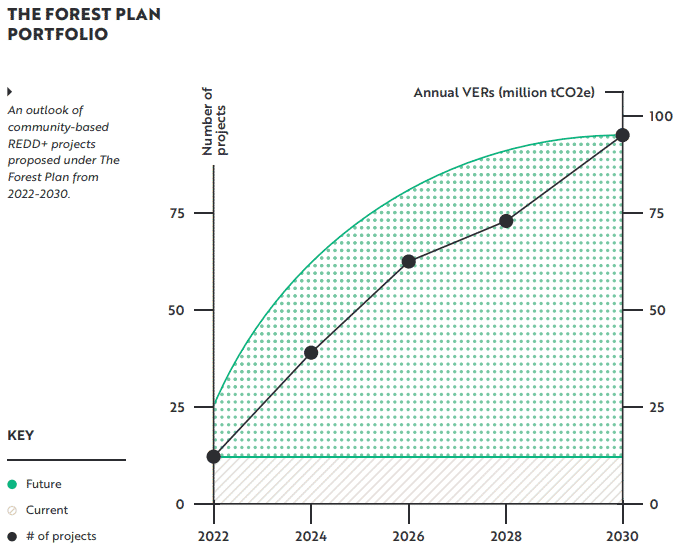
everland forest plan portfolio

Those community-based forest projects will protect a total of about 50.5 million hectares. They represent 17% of deforestation in 15 critical forest nations, which include Cambodia. Other countries are Brazil, Indonesia, Papua New Guinea, and the Democratic Republic of the Congo.

The government of Cambodia selected Everland to market the carbon credits from its REDD+ projects with large global corporations as buyers. The offering yielded a total bid of 15 million tonnes of emission reductions.

The corporate buyers will use the VERs as part of their strategy to offset unavoidable emissions. All the while contributing to wildlife protection and community development.

Proceeds from the carbon credit sales will be used to:

  • scale up site-based activities within the REDD+ project landscapes,
  • strengthen local and community-based institutions to govern community-level revenue sharing,
  • increase access to jobs, education, and healthcare for the local communities, and
  • secure the long-term financial stability of the projects in Cambodia.

Scaling up REDD+ Programs in Cambodia

Cambodia has been scaling up its REDD+ program by expanding its portfolio of projects. This is done through the help of its major project developer partners, including the Wildlife Conservation Society (WCS) and Wildlife Alliance.

The Ministry of Environment has implemented three REDD+ projects since 2016. These projects are in Keo Seima, the South Cardamoms and Prey Lang, covering an area of 1.27 million hectares.

So far, the projects have received around $11.6 million from the sale of carbon credits. The revenues are all reinvested in further environmental conservation.

The ministry is also preparing for an additional REDD+ project on 1.19 million ha. This will bring the total REDD+ project area to over โ…“ of Cambodiaโ€™s protected areas.

With these programs, the CEO of Wildlife Alliance Suwanna Gauntlett commented at the COP27 discussion:

โ€œCambodia’s REDD+ projects adhere to the most rigorous monitoring, evaluation, and independent verification processes. They produce high-quality verified emissions reductions that protect forests, reduce emissions, and safeguard the populations of endangered species in addition to ensuring services and livelihoods for forest communities…โ€

She also said that those benefits only show the forest nations that they can seek economic growth while preserving the natural beauty of their countries at the same time.
Imagine Radioactive Dragons

0
At the end of 2021, the first Fourth-Generation nuclear reactor in the world came online in Shandong, China. 

China claims itโ€™s โ€œhomegrown,โ€ and more than 90 percent of the equipment is sourced from China.

In reality, the technology was purchased from Germany when they abandoned nuclear a decade ago.

Still, China hopes to use it to demonstrate mastery over Fourth-Generation nuclearโ€”and its evolution from nuclear amateur to pioneer on the world stage.

The reactor is a high-temperature gas-cooled reactor (HTGR), which means it doesnโ€™t need to be built near water or the coast.

And since thereโ€™s no need for a containment dome, it’s far more cheaper to build HTGR than ERPs.

In other words, itโ€™s the ideal reactor for exporting globally.

But itโ€™s not the only nuclear reactor China has developed.

China is now the proud owner of four advanced nuclear power plant designs that can be built at scaleโ€”all โ€œobtainedโ€ from other countries: the EPR (France), the CAP1000 (U.S.), the HTR-PM (Germany), and the VVER-1000 (Russia).

So why is China building every model of reactor it can get its hands on? Thatโ€™s been proven to be the least cost-efficient and time-efficient way to build nuclear.

Itโ€™s because China doesnโ€™t care if these nuclear reactors are over time or over budget. They only want to see what works. Theyโ€™ll replicate the best, and throw out the rest.

They also want to slowly iterate away from other countriesโ€™ intellectual property, ensuring everything is “Made in China”.

  • China has already integrated everything itโ€™s learned [stolen] from other countries into its own advanced design, the Hualong One.

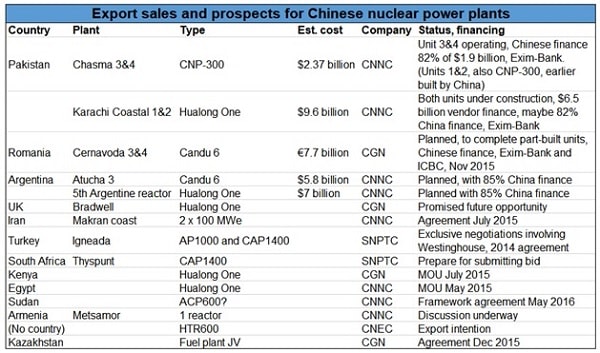
The Hualong One, which has been called Chinaโ€™s nuclear โ€œcalling card,โ€ is fully owned by Chinaโ€”so they can sell it freely around the world.

Itโ€™s already built two of the reactors in China, two in Pakistan… signed a contract to build one in Argentina… and is seeking approval to build one in the UK.

Of the reactors under construction in China, fully 50 percent are Hualong Ones.

The average construction time is just six years, and construction is $2,600 per kilowattโ€”less than half of the time and price of Franceโ€™s EPRs.

Chinaโ€™s โ€œGo Outโ€ Nuclear Strategy

China recently announced an upgraded, simplified version, the Hualong Two. The first one is expected to begin construction in 2024.

Costs are around $2,000 per kilowatt, and the construction time to be an unprecedented four years.

After thirty years of โ€œdevelopmentโ€โ€”squirreling intellectual property from other countriesโ€” nuclear in China is finally ready to face the world.

โ€œโ€˜Going outโ€™ with nuclear power has already become a state strategy.โ€
โ€“ย Former CNNC chairman Wang Shoujun

China plans to exert the full weight of its economic and diplomatic influence to go global with nuclear, bringing carbon-free energy to the world.

And their offer will be irresistible.

State-backed banks are loaning about 70 percent of the cost of Chinese reactorsโ€”at far lower rates than are available to other nations.

โ€œWith nuclear, China is stepping up to the plate with financing.โ€
โ€“ BloombergNEF analyst Chris Gadomski

Other developed countries, like the United States and France, will be unable to compete with ultra-cheap, state-backed funding.

Additionally, the policy of Chinaโ€™s National Development and Reform Commission (NDRC) is to export nuclear technology backed by full fuel cycle capability: China will provide the uranium, and theyโ€™ll take the waste.

So buyers wonโ€™t even have to worry about the biggest problem with nuclear.

Customers are lining up. The CNNC says that it has already sold reactors to seven countries, and is working on deals with forty more.

China already has a stranglehold on the international nuclear export market.

In 2019, the former chairman of China National Nuclear Corporation told a meeting of Chinaโ€™s political advisory body that China could build thirty overseas reactors that would earn Chinese firms $145 billion by 2030.

Our goal is for China to lead the global nuclear energy industry by the middle of this century.”
โ€“ย CNNC President Gu Jun

Thatโ€™s just a small taste of whatโ€™s to come… except suddenly, the other large nuclear powers are realizing Chinaโ€™s master plan.

And theyโ€™re not happy.

The Power in Nuclear Power

China General Nuclear Power (CGNP) has been on a U.S. government blacklist for three years for attempting to steal nuclear technology.

CGNP is also a partner with EDF, the worldโ€™s largest operator of nuclear power stations. But itโ€™s quickly becoming its fiercest rival.

EDF once had plans to build a Hualong One in eastern Englandโ€”not any more.

And British finance minister George Osborne said that China could build and own a nuclear power plant in Britainโ€”also no longer an option.

The UK has begun to look for ways to squeeze CGNP entirely out of its reactor development.

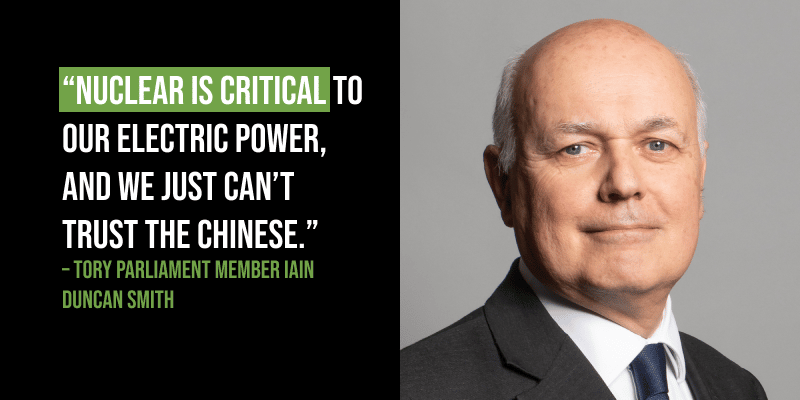
iain duncan smith

Even Romania cancelled an order for two CGNP reactorsโ€”opting to work with the U.S. instead.

But thereโ€™s a much bigger concern for the United States and other developed countries than stolen state secrets.

Itโ€™s called โ€œthe hundred-year marriage.โ€

Nuclear energy deals create nearly unbreakable ties between the seller and the hostโ€”ties that must last as long as the nuclear plant does.

  • From first discussions to first operations: ten years.
  • Unit operation: sixty years.
  • Decommissioning: thirty years.

Thatโ€™s a century, start to finish, of strategic operations between countries.

The license for that marriage has been signed once the plant begins operations.

All the fuel, maintenance, waste disposal, training, and even staff are provided by China. So breaking relations with them is to lose power for your countryโ€”both political and electrical.

And since Chinaโ€™s providing financing, theyโ€™ll have extreme leverage even if countries want to get out.

Theyโ€™ve already used that kind of debt trap to coerce African nations into giving up strategic properties.

And now, China is intent on using nuclear reactor exports to โ€œmarryโ€ United States allies.

  • In other words, Chinaโ€™s nuclear reactor exports will lead to a guaranteed century of Chinese global dominance.

Thatโ€™s why other nations are scrambling to boost their own domestic nuclear programs…

… starting with the United States of America.

Go to next chapter >

France Refuses to Surrender Nuclear Power

0
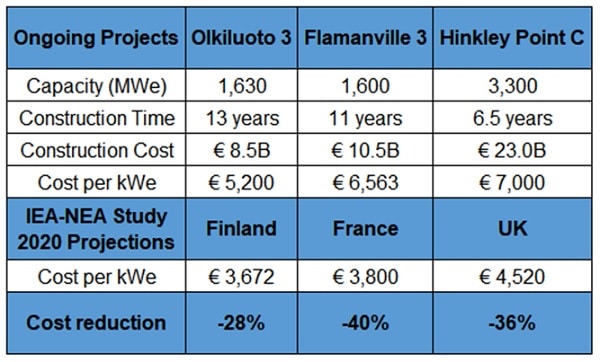
There are three excellent arguments against the development of nuclear power: Olkiluoto 3, Flamanville 3, and Hinkley Point C.ย 
 

Those are the names of nuclear reactors under construction in Finland, France, and the United Kingdom. On the surface, they look like utter failures.

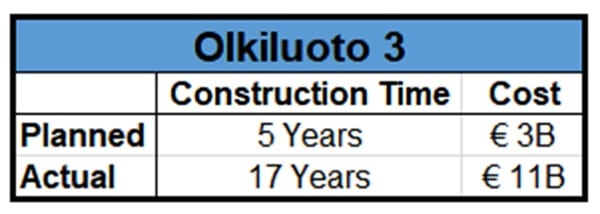
Theyโ€™ve been subject to repeated delays. Olkiluoto 3 began construction in 2005, and is finally being wrapped up seventeen years later.

The reactorsโ€™ total price tag has exploded from $26.5 billion to $55.9 billion over the course of their construction.

All of the reactors are EPRs, which were designed by France, and theyโ€™re being built by a French-owned company EDF (ร‰lectricitรฉ de France).

But eight years ago, France decided to cap energy power from nuclear at 50 percent of electricity generation by 2025. That’s down from its current 70 percent.

So why is a country that wants to reduce its reliance on nuclear… wasting tens of billions of dollars and multiple decades to build more reactors?

  • Itโ€™s not to lower carbon emissions. France already has one of the lowest emissions-per-capita rates in the EU.
  • And itโ€™s not for energy security. In 2020, France was the largest exporter of electricity in the EU.

No, the real reason is much, much bigger than either of those.

The French government knows that demand for nuclear energy is about to spike. And the first country that can build inexpensive, safe, replicable nuclear reactors will have the most valuable company on earth in short order.

So the reason why France is desperate bid to build nuclear power is simple.

France wants to sell the solution to the greatest danger the planet has ever faced.

Vive La French Nuclear

The reactors being built are prototypes for full-scale, French-style nuclear reactor production.

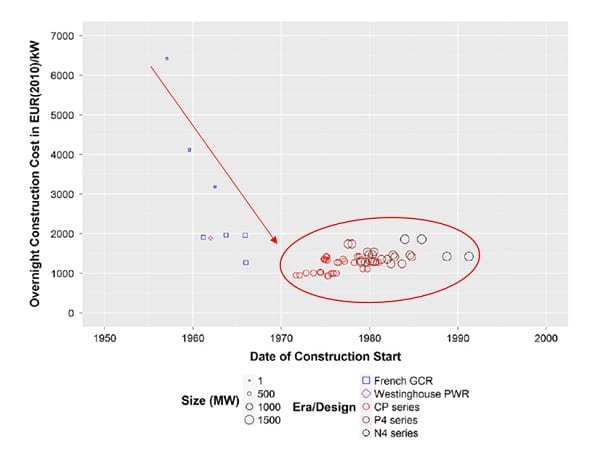
When France built out its nuclear fleet in the โ€˜80s, its strategy was to achieve a โ€œseries effectโ€โ€”decreasing timelines and lowering costs by building many of the same thing.

It worked. France saw major construction timeline and price reductions for each successive reactor.

cost of building nuclear power reactor in France

And theyโ€™re doing it again. The objective with the current buildout is to reduce the costs and construction timeline for future EPRs by 30 percent.

According to the French Nuclear Energy Society, the buildout could go even further, reducing construction and financing costs by up to 50 percent.

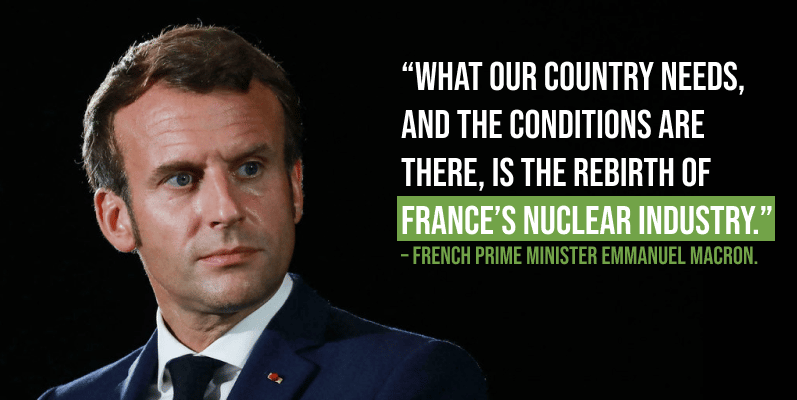
It will also serve to revitalize Franceโ€™s competency in building nuclear reactors.

emmanuel macron on France nuclear power industry
In building the Flamanville reactor, France has rebuilt an entire European supply chain that is qualified to build nuclear-quality parts for nuclear power reactors.

France already has what it needs to go global with nuclear.

Itโ€™s long been a large exporter of nuclear technology, including fuel products and services. And it has experience across the entire market, from uranium mining to reactor design and construction.

According to Franceโ€™s Atomic Energy Commission, there will be โ€œa real market for EPRsโ€ beginning in 2030.

But France might not have to wait that long. In 2021, the VP of EDF hand-delivered an offer to build the most powerful nuclear energy site in the worldโ€”9.6 GWe of EPRs on a single site.ย 

According to leaked communications, India is paying a โ€œhigh priceโ€ for these French reactors.

Which means that every country with the finances, state backing, and nuclear programs to pull this offโ€”China, Russia, the United States, and South Koreaโ€”wants to get in on the action.

The payoff for the first country to export nuclear technology at an international scale will be oil-industry huge.

Which is why those countries are already buying… bribing… stealing… doing whatever it takes to win the most valuable market on earth.

The Real China Syndrome

Thatโ€™s how Maureen Kearney found herself hooded, tied to a chair, gagged, and brutally attacked with a knife in her Paris home.

Maureen was a major union leader at Areva, a French nuclear company.

And in 2012, she had discovered that EDF was preparing to sell French nuclear secrets to a Chinese consortium.

Fearful that cutting-edge technology would be handed over to the Chinese, she decided to become a whistleblower. And she paid the price for it.

But it didnโ€™t matter, because China found another way in.

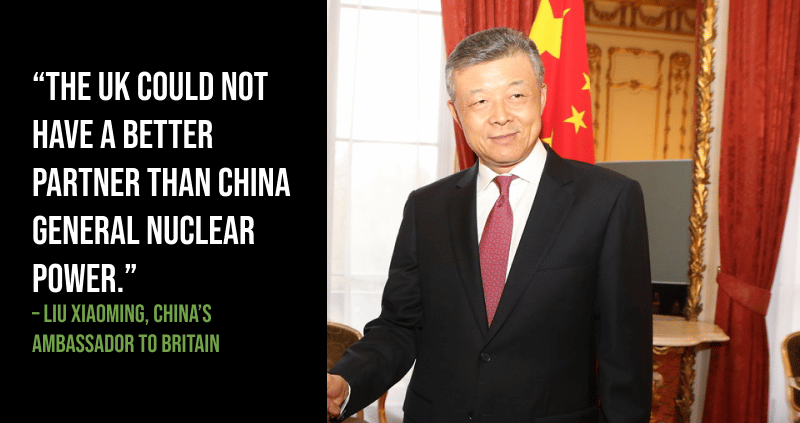
In 2016, EDF suddenly had a new partner in Hinkley Point C: China General Nuclear Power (CGNP). CGNP now owns 34 percent of the project.

liu xiaoming

Not quite.

Because at the same time as it purchased a stake in Hinkley Point C, CGNP quietly began building two EPR reactors in China.

Itโ€™s obvious where this is going…

The first European Pressurized Reactor (EPR)โ€”the most advanced commercial reactor design on the continentโ€”didnโ€™t start up in Europe.

It started up in China, six years after Maureen was attacked.

Decades of engineering and planning, construction delays, and cost overruns, all borne by France, paid huge dividends for China.

China even poached project managers from Olkiluoto and Flamanville for work on the new reactor. Experience in France meant that engineering teams worked 60 percent fewer hours on the Chinese EPR than on Olkiluoto 3, reducing costs.

A day after the first EPR launched, the most advanced commercial reactor design from the United States, the AP1000, started up for the first time… also in China.

In 2009, American company Westinghouse had agreed to work with China to develop a larger version of their AP1000 model, creatively named the CAP1400.

The agreement gave China full IP rights for all co-developed plants greater than 1350MWe.

So China is only building plants greater than 1350Mwe.

They plan to follow the CAP1400 with a CAP1700… then a CAP2100 designโ€”the largest nuclear reactor in the world by far.

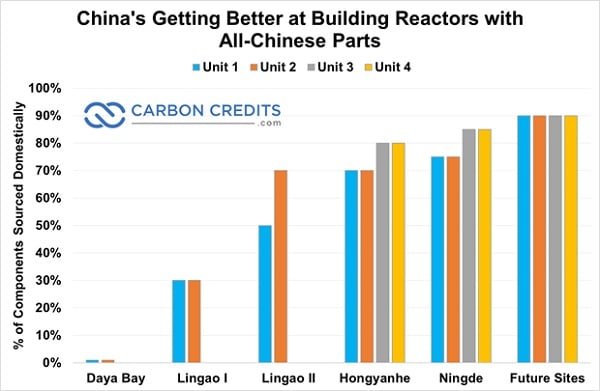
The first two units of the CAP1400, the first โ€œfully nativeโ€ Chinese nuclear reactor, are currently under construction and expected to come online in 2025.

China has openly bragged that the CAP1400 broke a number of โ€œtechnological monopoliesโ€. And that all the key materials are designed by and manufactured in China.

China getting better at building reactors with all-Chinese parts

The design is being developed for deployment in high numbers across China, as well as for export around the world.

Neither the EPR or the AP1000 is yet online in its home countryโ€”the AP1000s in the U.S. were cancelledโ€”but China could care less.

They leeched their technology from France, and now France is actually worse off in its ability to build nuclear power plants.

Meanwhile, China is actively building high numbers of what is possibly the safest production-level reactor there is.

More importantly, theyโ€™re rapidly preparing to bring it to the global market at the largest scale in human history.

Go to next chapter >

The Nuclear Winter Is Thawing

0
In 2012, the Japanese government announced the country was going โ€œnuclear free.โ€ โ€œA strategy to create a new future,โ€ they called it. 

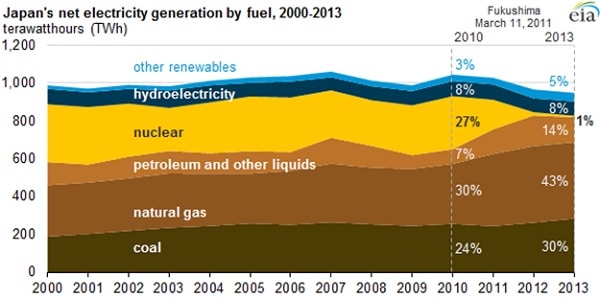
A year earlier, Japan had been the worldโ€™s third-largest producer of nuclear energy. Nuclear supplied more than a quarter of the nationโ€™s electricity.

Thenโ€ฆ nothing. Zero reactors in operation, and not a single kilowatt of energy from nuclear.

Japan net electricity generation by fuel

It was a knee-jerk reaction to the Fukushima disaster, fully supported by a vast majority of Japanese citizens. And it shot Japan in the foot.

Because it quickly discovered that shutting down nuclear required paying an extra $37 billion a year for imported fossil fuels…

… which led to spiraling electricity prices, extreme government debt, and rising emissions.

In fact, emissions increased 30 percent from 2011 to 2012. And in 2013, Japanese emissions hit an all-time high.

Japanโ€™s climate change goal had been to reduce emissions from electricity production by 25 percent by 2020.

But without nuclear, Japanโ€™s Minister of the Environment was forced to revise that figure… to a 3.1 percent increase.

In early 2021, amidst historic power shortages, Japanโ€™s Energy Minister finally reversed course on the nuclear-free policy. โ€œNuclear power will be indispensable,โ€ he said.

A new future, indeed.

A year later, the Prime Minister of Japan called for the โ€œmaximum useโ€ of nuclear. And he ordered the government to restart idled nuclear plants at an accelerated rate.

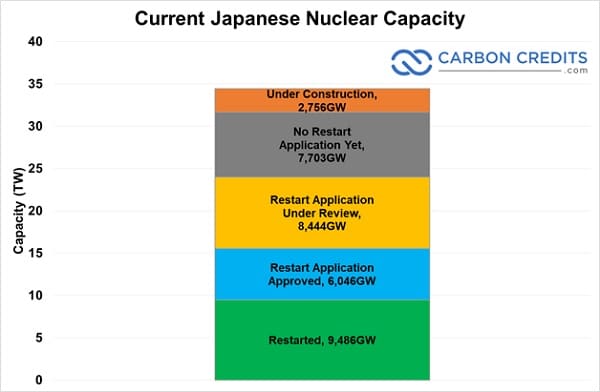
Out of Japanโ€™s thirty-three operable nuclear reactors, ten have already been restarted. Sixteen more are slated to be restarted by the end of 2023, and two new reactors will be brought online.

Japan current nuclear capacity

  • Not only that, but Japan has begun developing next-generation nuclear reactors.

Itโ€™s a momentous policy shift for a country that swore off of nuclear energy just a decade ago.

And itโ€™s a common theme in every country with a major nuclear energy program.

From Japan to Germany to the UK to the U.S., closed nuclear plants are being recommissioned โ€”and those scheduled for closure are remaining open.

But many countries are going even further…

They are transforming from hell-bent on shutting down nuclear to accelerating and even incentivizing the development of new nuclear programs.

Sweden Drinks the Radioactive Kool-Aid

For the last thirty years, Sweden has deliberately created the worst possible environment for nuclear.

In the โ€˜80s, it made plans to phase out nuclear power generation by 2010.

Then it outright banned nuclear research.

Then it banned restarting closed reactors.

And then it imposed a $0.30/kWh tax on nuclear energy.

In 2006, that tax was doubled… and increased another 25 percent in 2008.

One study put the tax at 60 percent of the operating cost of nuclear reactors in Sweden.

The tax forced two reactors, Ringhals 1 and 2, to close in 2019โ€“2020.

And it was on track to close all three nuclear power plants in Sweden, which provide 30 percent of its electricity.

Vattenfall, a state-owned energy company, said abolishing the tax would decrease its generating costs to $20/MWh by 2021.

In 2022, the average wholesale electricity price in Sweden was $112/MWh.

Thatโ€™s why 2022 polls showed that 60 percent of the population didnโ€™t just want nuclear to stayโ€”they wanted new reactors to be built.

But the political risk and uncertainty surrounding nuclear investments prevented any company from ever wanting to touch it again.

So when the new government came into power, it released a policy called the โ€œTidรถ Agreement.โ€

The agreement says that nuclear plants must be guaranteed the right to produce carbon-free electricity.

  • And if Sweden forces a plant to close, โ€œthe owners must be entitled to compensation.โ€

Then, the government pivoted from taxing nuclear reactors out of existence… to subsidizing them.

The document pledged $40 billion in loan guarantees for nuclear power constructionโ€”making it far easier for nuclear developers to get commercial funding.

It also called for:

  • A removal of the ban on restarting closed reactors.
  • Restarting Ringhals 1 and 2.
  • A shorter permit process and a fast track for new nuclear power.
  • A highly reduced application fee for new nuclear reactors.

None of this is hypothetical. Vattenfall, the previously mentioned major nuclear power company, has already been asked to identify suitable locations for additional nuclear reactors.

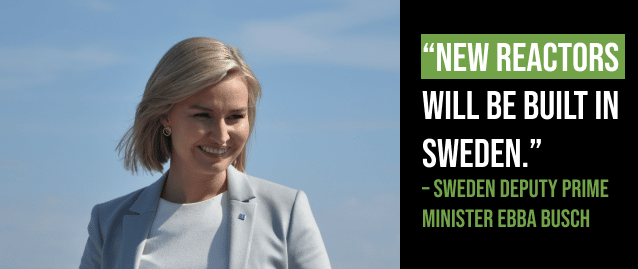
ebba busch

China: First in Emissions, First in Nuclear

Sweden is one of only thirty-three countries that currently produce nuclear energy. Thirty more are considering, planning, or starting their own nuclear energy programs.

Belarus, Bangladesh, and Turkey are all building their first nuclear reactors.

A single reactor coming online in Finland will provide 28 percent of its electricity.

But the real demand wonโ€™t come from small or developing nations. In fact, nuclear plants produce too much energy for them; if they are taken offline for refueling or maintenance, it could cause blackouts.

Thatโ€™s why Slovenia and Croatia literally share a nuclear power plant on their border.

  • The real demand for nuclear energy will come from rapidly developing countries with high carbon emissions and huge populations.

That makes China, which has the largest and fastest-growing group of energy-consuming humans in history, the perfect candidate for nuclear.

In 2021, Chinaโ€™s electricity demand jumped 10 percent. For context, thatโ€™s equal to the total electricity demand of all of Africa.

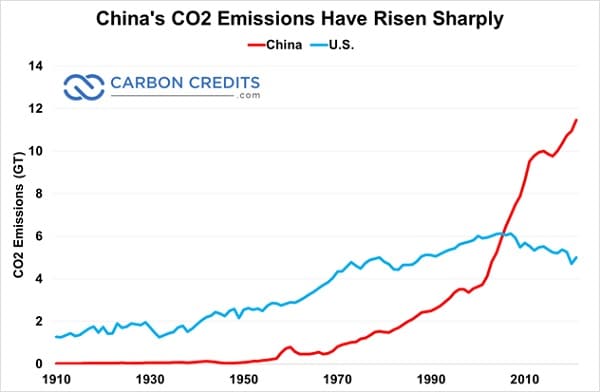
Which means emissions are exploding. While every other developed country is trying to cut their emissions, Chinaโ€™s have risen by more than 300 percent in the past twenty years.

China carbon emissions rising sharply

Right now, more than a third of global CO2 emissions come from China.

They are building out solar and wind, but their real focus is on nuclear.

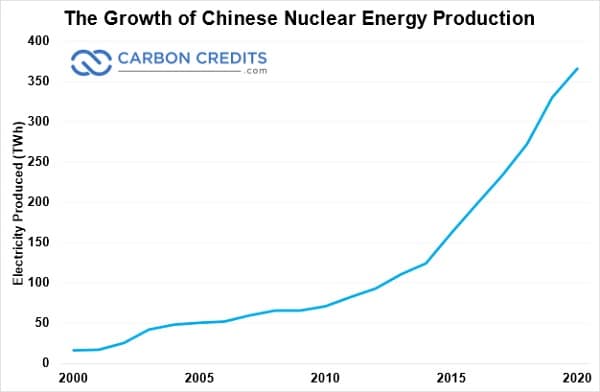
Thirty years ago, China had zero nuclear power. In 2002, China was 15th in nuclear production in the world.

  • 10th in 2007.
  • 3rd in 2016.
  • 2nd in 2020.

Fitch analysts now predict that Chinaโ€™s nuclear power capacity will overtake the U.S. by 2026.

growth of Chinese nuclear energy production

Nuclear energy capacity in China is precisely following its emissions trajectoryโ€”only about a decade later. Which means it wonโ€™t stop when itโ€™s #1 in the world.

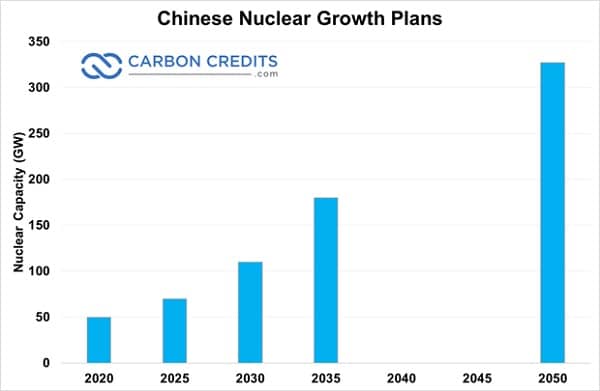
In just fifteen years, China plans to build 150 nuclear plants, which is more than the U.S. has builtโ€”ever.

CNNC, a Chinese nuclear power company, is urging the government to approve a new nuclear project every two months for the next decade.

China plans to get up to 327 GWe by 2050, or more than three times the United States.

Chinaโ€™s population twin, India, is facing the same problem with growing emissionโ€”and seeking the same solution.

India Goes Fleet Mode

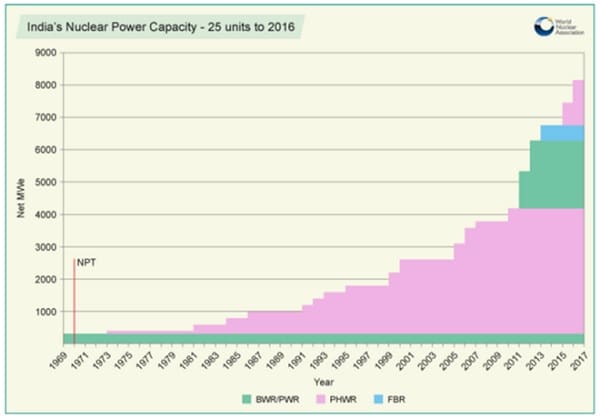
For its 1.4 billion peopleโ€”18 percent of the worldโ€™s populationโ€”India has a measly 6.8 GW of capacity across seven nuclear plants.

Itโ€™s an embarrassing 1.7 percent of the countryโ€™s total power generation capacity.

Even so, Prime Minister Modi is intent on scaling up nuclear energy as fast as is humanly possible.

In the past fifteen years, nuclear power generation in India has already risen more than 300 percent.

Indiaโ€™s building another 6.6 GW of capacity right nowโ€”the most after China.

It has already approved another 8.4 GW of capacityโ€”twelve more reactorsโ€”to begin construction in the next three years.

And it has a staggering 31 GW of nuclear builds planned.

Modi plans to triple nuclear capacity again over the next decade. Thatโ€™s nearly seventy new reactors coming online.

How big could it really get?

  • India plans to supply 25 percent of its electricity from nuclear power by 2050.

That would require 100 GW of nuclearโ€”again, more than the U.S.

To facilitate this, India is setting up five massive โ€œNuclear Energy Parks,โ€ which can handle 10GW at a single location.

By 2032, five of these parks are planned to potentially provide between 40 and 45 GW of carbon-free energy.

Once it gets going, this is hockey-stick growth.

Thereโ€™s only one problem: India has very little nuclear technology of its own. For that matter, most developed countries donโ€™tโ€”even those with nuclear reactors.

Only five countries on the planet actually have the skills, materials, and supply chain to build nuclear reactors.

And they are all preparing to wage a full-scale war to be able to deliver the worldโ€™s most valuable energy to the rest of the planet.

Go to next chapter >

How Germany Lost Another World War

0
The largest energy experiment in history began in France in the early 1970s. It wasnโ€™t voluntary. 

France was heavily dependent on fossil fuels for electricityโ€”but had no reserves of its own. So when OPEC pushed up the price of oil by 400 percent, it threatened to destroy the country.

With little domestic coal or gas, France had zero energy security.

But it did have something else: substantial heavy engineering expertise.

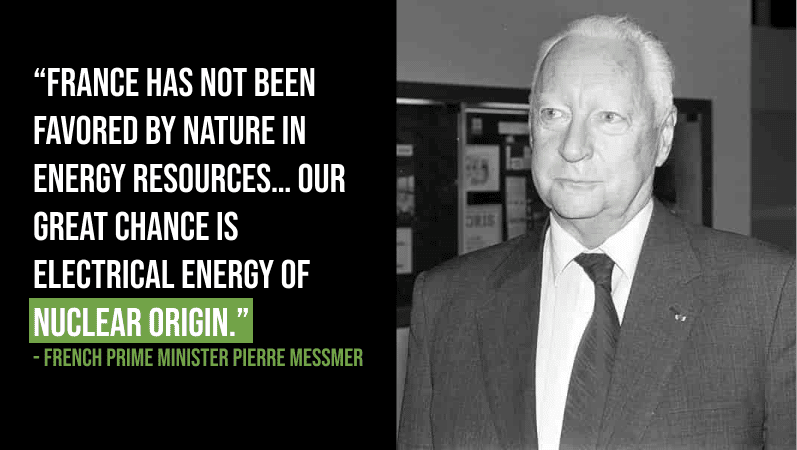
So in 1974, French Prime Minister Pierre Messmer made a speech on national TV, declaring a new direction for French energy:

pierre messmer on nuclear in FranceHe called for France to go โ€œall nuclear, all electric.โ€

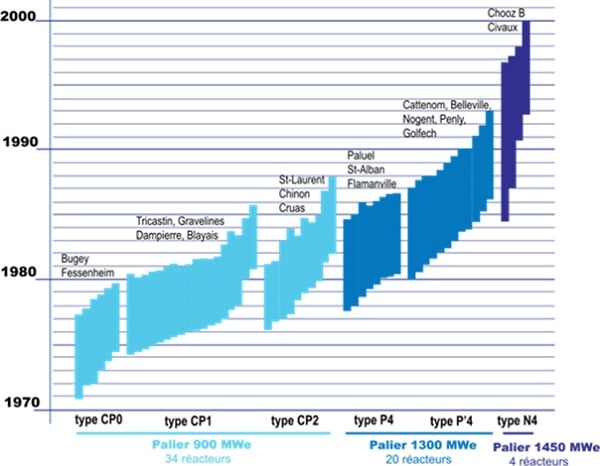
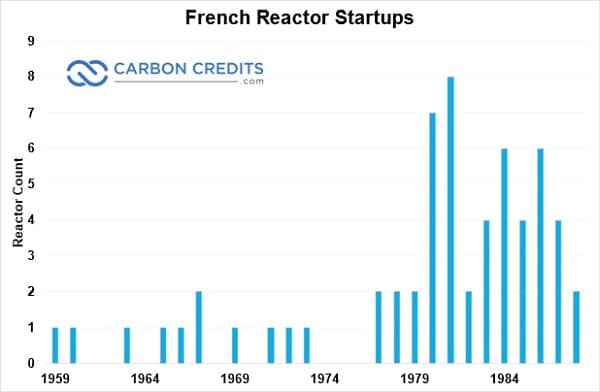
Construction of the first three nuclear plants under the โ€œMessmer Planโ€ started in December 1974. They were completed six years later.

  • And in just fifteen years, France went from breaking ground to producing electricity at forty-eight nuclear reactors.

French reactor startups

France built reactors that quickly by making two smart decisions:

  • The forty-eight reactors were made from just five designs.
  • They were built at only twelve plants.

That meant standardized processes and greater efficiencies, keeping the price of construction low.

Then France ran into a snag. Messmerโ€™s original plan called for constructing 170 plants by 2000.

  • But by 1990, less than fifty nuclear reactors were providing more than 75 percent of Franceโ€™s energy needs.

France simply had too much power from nuclear, and its nuclear units had to operate at a capacity of only 61 percent.

EDF, the French electricity company, began trying to stimulate electricity demand to soak up spare capacity.

To this day, nuclear power generation in France remains so high that nuclear plants occasionally close for the weekends.

Itโ€™s an unbeatable level of energy security.

Not only that, but it accidentally gave France an incredible head-start in the race to net zero.

Because the year Messmer gave his speech, per-capita emissions in France peakedโ€”and they have fallen by 60 percent since then.

France is beating climate change without even trying.

Meanwhile, in Germany…

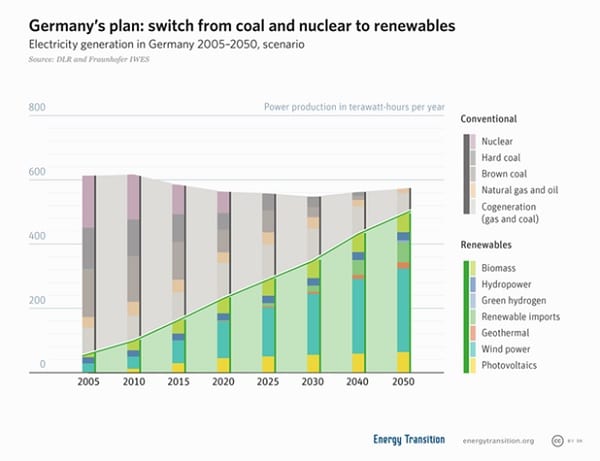
In 2009, Germany unveiled a plan of its own: the International Climate Initiative. It laid out how the country would switch entirely to renewable energy by 2050.

As with everything German, they came up with a new word for the conversion: โ€œEnergiewende.โ€

The goals for Energiewende were ambitious, including emissions reductions of 80โ€“95 percent and a renewable energy target of 60 percent by 2050.

Energiewende was passed into law in 2010. Germany was celebrated as โ€œThe Worldโ€™s First Major Renewable Energy Economy,โ€ and Germans were proud.

โ€œItโ€™s a gift to the world!โ€ a German analyst bragged to the New York Times.

Curiously, the first source of energy to be eliminated was nuclearโ€”which has zero emissions.

Germany's plan to switch from coal and nuclear to renewables

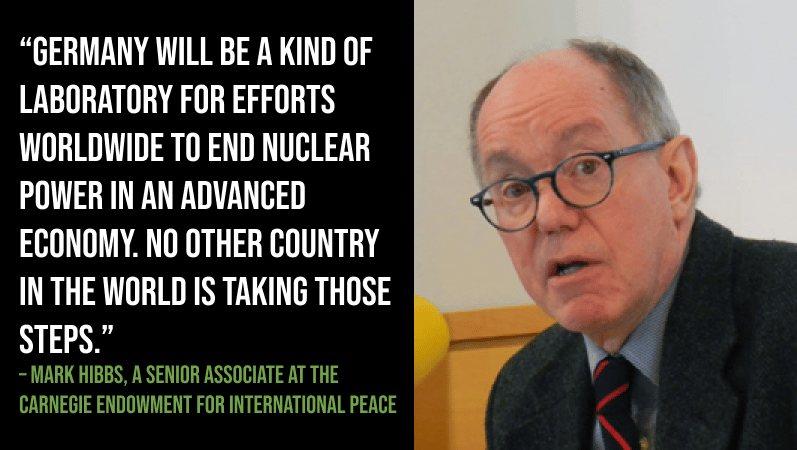
In other words, Energiewende was a perfect counterpoint to the Messmer Plan. It would demonstrate whether energy security and a carbon-free economy could be achieved through renewables alone.

mark hibbs

A year later, Fukushima happened. Frightened by the incident, the German government decided to permanently close all nuclear reactors by 2022.

โ€œIt’s definite. The latest end for the last three nuclear power plants is 2022. There will be no clause for revision.โ€
โ€“ย German Environment Minister Norbert Rรถttgen

The decision, spearheaded by former German Environment Minister and former nuclear proponent Angela Merkel, was not without its detractors.

In 2011, the New York Times reported predictions that eliminating nuclear could:

  • force Germany to import nuclear power from France, or even
  • inflate the cost of energy across the continent.

If only they knew…

How It Started Versus How Itโ€™s Going

Germanyโ€™s renewables costsโ€”for solar panels and wind turbines and biogas plantsโ€”were rapidly forced onto consumers.

A study by the OECD found that the cost of household electricity in Germany increased by 50 percent from 2006โ€“2017. And the report came to a surprising conclusion:

  • Electricity prices will continue to increase as long as Germany keeps building solar and wind.

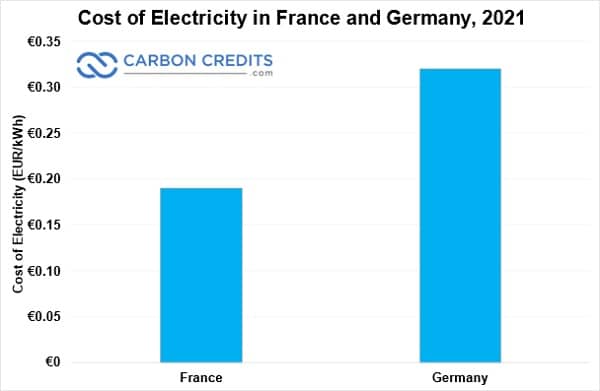
Meanwhile, Franceโ€™s electricity costs are 40 percent lower than Germanyโ€™s.

Cost of electricity in France & Germany, 2021

But thatโ€™s just because clean energy is more expensive, right?

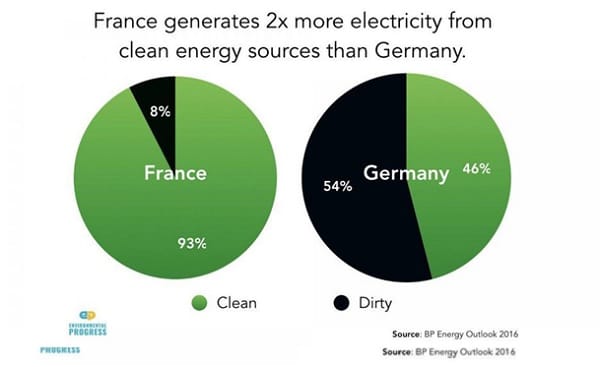
Wrong. France also produces twice as much of its electricity from clean energy sources as Germany…

France clean energy generation vs Germany

… while producing one-fifth the carbon emissions from electricity per capita.

In factโ€”thanks to Energiewendeโ€”German carbon emissions are rising.

  • Germany saw its largest rise in CO2 emissions in thirty years last year.

Why? Because as German nuclear was phased out, it was primarily replaced by two electricity sources: coal and imported gas.

In fact, closed coal plants are being restarted to compensate for shuttered nuclear. And Germany is scheduled to open a half-dozen new fossil fuel facilities by the end of 2023.

Thatโ€™s right.

The nation that Bloomberg says โ€œdid more than any other to unleash the modern renewable-energy industryโ€ is actively building CO2 factories.

Meanwhile, the deployment of renewables is falling off a cliff. Wind turbine installation dropped by nearly 60 percent from 2017โ€“2018.

  • In 2021, Germany barely installed more wind than in 2000.

It was an echo of solar: Installations of solar panels fell by 85 percent from 2010โ€“2014, and have still not recovered.

But itโ€™s too late: the money has been spent.

Three years ago, Germanyโ€™s Federal Court of Auditors found that Energiewende had cost $160 billion over the last five yearsโ€”an expense that was โ€œin extreme disproportion to results.โ€

โ€œTheย Energiewendeย โ€” the biggest political project since reunification โ€” threatens to fail.โ€ โ€“ Der Spiegel

Back to the Nuclear

By 2025, Germany will have spent $580 billion on renewables and related infrastructure.

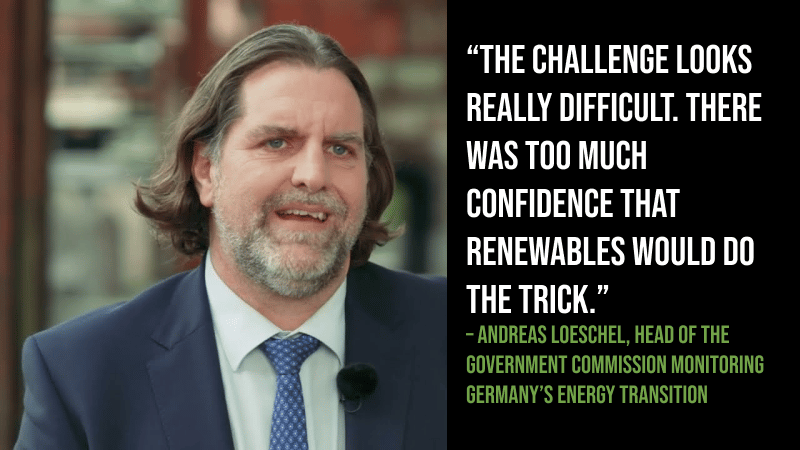
Yet CO2 emissions in Germany have dropped by less than two percent a year since 2010. They need to drop by six percent every year now to reach the countryโ€™s 2030 goals.

andreas loeschel

So Germany is already setting aside $300 million a year to pay EU emissions fines. At the same time…

France is making $3 billion a year from selling nuclear electricity to other countries.

And itโ€™s ready to double down on nuclear. At COP26, French president Emmanuel Macron made it clear: France would โ€œrelaunch the construction of nuclear reactorsโ€ to โ€œguarantee our country’s electricity supply.โ€

In February 2022, Macron announced that France was planning to build six more nuclear reactors… and considering building eight more after that.

It will also extend the life of existing reactors deemed safe and suitable past fifty years.

French electricity company EDF called it the โ€œfastest and most certain path to achieve carbon neutrality.โ€

Germany has no choice but to follow suit.

In October 2022, it announced that its three remaining nuclear plants would extend operations until April 2023.

Economy and Energy Minister Robert Habeck said it was a โ€œnecessaryโ€ step to avoid power grid shortages.

Some lawmakers in Germany are going furtherโ€”suggesting that decommissioned plants be reopened and new reactors built.

Because reducing carbon emissions is good. But since the Messner Plan, this has always been about one thing: energy security.

And in its quest to gain independence from nuclear, Germany found itself with a new dependencyโ€”on Russia.

The โ€œpartnershipโ€ with Russia was supposed to provide a โ€œmutual dependency intelligently for the future.โ€ It has not looked intelligent thus far.

The results of the trillion-dollar, half-century energy experiment are in: Nuclear won.

And now every country that wants to remain energy independent and go low-carbon is turning toward the only viable solution on the planet: nuclear.

Go to next chapter >

When Sustainable Energy Becomes Unsustainable

0
Renewables are supposed to be saving the planet.
Instead, theyโ€™re making the problem worse. Hereโ€™s why: 

Installing wind and solar increases CO2 emissions.

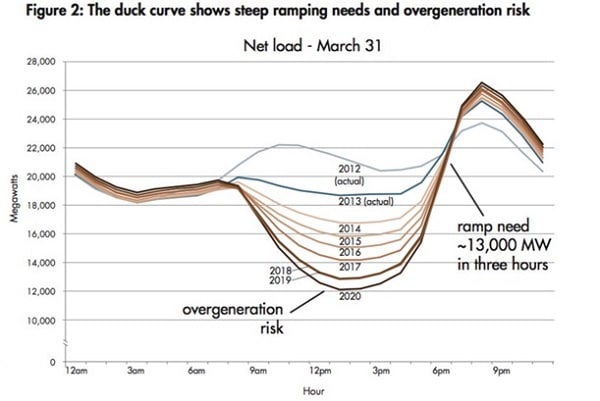
Itโ€™s due in part to something called โ€œThe Duck Curve.โ€

This graph shows how much power California needed from everything except solar, by hour of day, for the last decade:

During the day, solar generates so much electricity that nearly all other sources have to shut down. Otherwise, it risks blowing out the grid.

In the evening, when everyone comes home and needs to use power just as the sun is setting, demand for other sources of power spikes off the charts.

Ordinarily, nuclear would provide a consistent source of power throughout the course of the day.

But nuclear canโ€™t just be shut off during the day when solar takes over, and turned back on at night when the sky goes dark.

So coal, oil, and gas plants have to be used to handle the spike.

  • Which means that every solar panel erected requires a fossil fuel plant to work.

Note: Oil and gas companies arenโ€™t stupid. This is exactly why theyโ€™re lobbying so heavily for solar and wind.

California is not the only place emissions are rising because renewables are installed. In Germany, the Hambacher Forest is on the verge of being destroyed. Why?

Because itโ€™s sitting on a ton of coal. And since Germany is shutting down nuclear and turning to renewables, it needs to burn more coal to account for peaks in demand.

Sweden thought about replacing its nuclear with wind. It found that every gigawatt of nuclear replaced by wind would require an additional gigawatt of gas-based electricity.

And the buildout would cause Swedenโ€™s CO2 emissions to double.

As renewable energy increases around the world, nuclear plants are forced to shut down…

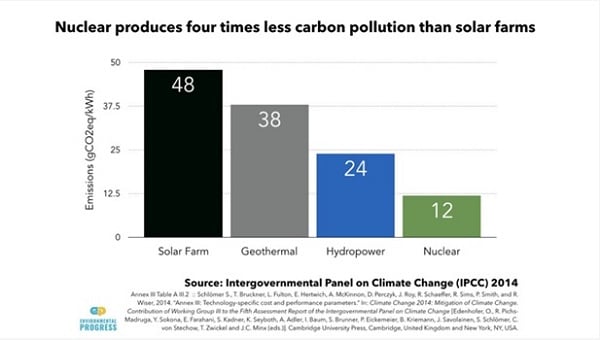
The same nuclear plants that emit 75 percent less CO2 than solar and 99 percent less than coal.

nuclear produces four times less carbon pollution than solar farms - uranium clean energy

Oh, and as a bonusโ€”nuclear plants require zero fossil fuel plants in order to run.

Nuclear with uranium doesnโ€™t just win the clean energy and emissions contest with renewables.

In every category that matters to stopping climate change and saving the environment, renewables lose.

Renewables Donโ€™t Hold a Candle to Nuclear

A nuclear reactor can produce about 1 GW of electricity. But thatโ€™s not equivalent to 1 GW of installed wind or solar.

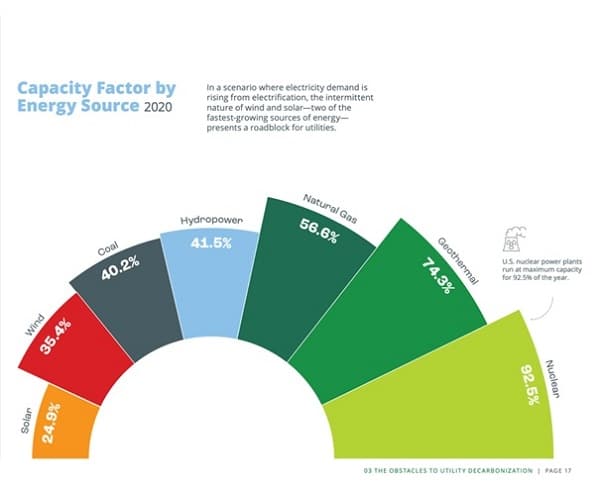
Nuclear plants produce energy more than 90 percent of the time. Wind only runs about 35 percent of the time, and solar a measly 25 percent of the time.
Capacity factor by energy source 2020

That means that three to four times as much wind and solar has to be installed just to produce the same amount of energy as nuclear. Hereโ€™s what that difference looks like in real life:

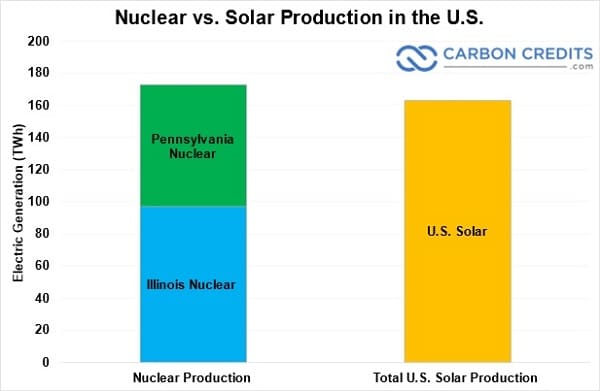
  • Eleven nuclear plants in Illinois and Pennsylvania produced more power than all solar in the U.S. in 2021.

nuclear vs. solar production in the US

In both land and waste, that makes a huge difference for the environment.

Those eleven plants cover about 25 square miles of land total.

Generating the same amount of electricity via solar requires more than 775 square milesโ€”all of it deforested to make room for solar panels.

And wind? It would take more than 4,000 square miles.

In fact, solar and wind require so much land that countries like Japan would need to cover every last square inch of free land with solar to fully power the country.

But thatโ€™s not wind and solarโ€™s biggest problem. Because unlike their name, renewables donโ€™t last forever.

Solar panels have to be replaced every thirty years, resulting in staggering amounts of waste.

The International Renewable Energy Agency expects that by 2050, the world will have accumulated 78 million tons of solar power waste.

  • Solar will generate 300 times as much waste by 2050 as nuclear has since 1950.

Wind is no better. More than 720,000 tons of 150-foot blades are expected to be dumped in landfills in the next two decades.

The high material requirements and low capacity of renewables present a little life-threatening problem:

They can never be built fast enough to save the earth.

Rising Tides Sink All Boats

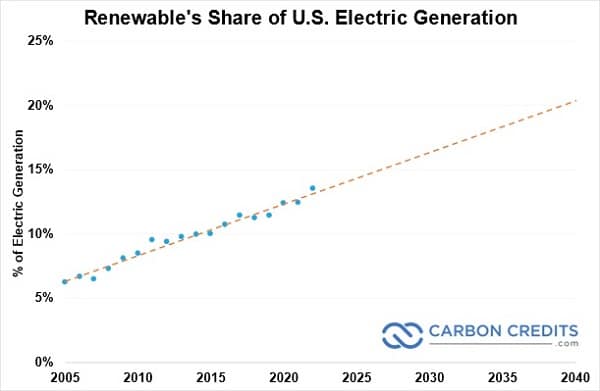
In 1995, 7.2 percent of electricity in the U.S. was generated by renewables. A quarter century later, that had risen to… just 12.4 percent.

It took a twenty-five years to increase renewables as a portion of electricity by five percent.

For the record, it took three years for nuclear to make a similar move, from โ€™74-โ€™77.

On its current trajectory, it will take renewables another twenty years to catch up to nuclear as a percentage of electricity generation.

renewable's share of US electric generation

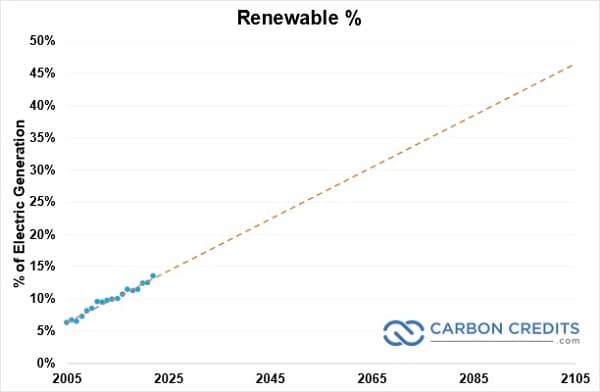
And it would take a century for the U.S. to get to 50 percent renewables.

renewable % of electric generation

In fact, renewables arenโ€™t even covering increases in demand right now.

  • Global energy demand increased by 600 percent more than renewable energy consumption in 2021.

In an open letter, professors at MIT, Columbia, and the Carnegie Institution wrote:

Renewables… cannot scale up fast enough to deliver cheap and reliable power at the scale the global economy requires….
In the real world, there is no credible path to climate stabilization that does not include a substantial role for nuclear power.

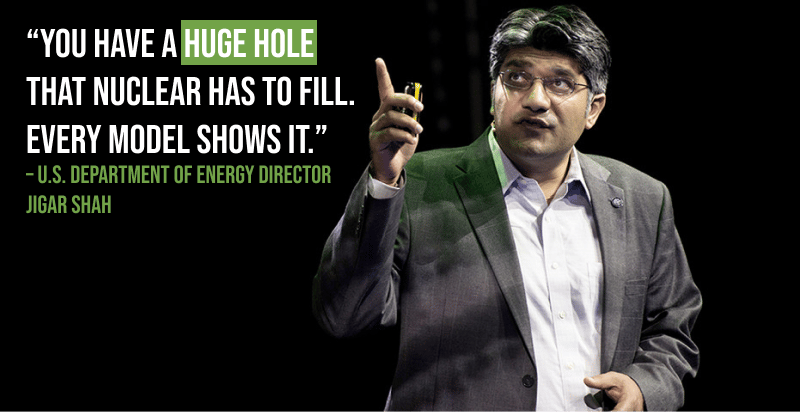
The OECD agrees. It projects that to meet emissions goals, nuclear needs to produce 9,000 TWh a year by 2050, which will cost about $8 trillion.

Thatโ€™s assuming wind and solar can produce about the same amount of energy by then…ย at a cost of about $20 trillion.

The world would save $12 trillion by using nuclear instead of renewables.

jigar shah on nuclear, uranium clean energy
It doesnโ€™t matter what angle it is… emissions, waste, land, cost…

In the fight against climate change, nuclear is the only renewable worth a watt.

Our Newest Renewable

Yes, nuclear is a renewableโ€”arguably the only real renewable other than hydro.

Unlike wind and solar, nuclear generates the only waste from electricity production that is safely contained.

And used nuclear fuel still has about a hundred times more energy than was extracted from it. Reprocessing that fuel enables it to be used again… and again.

France, Russia, and Japan already re-use their nuclear fuel, getting more energy out of it each time.
As additional reactors that can use reprocessed fuel come online, nuclear waste will become worth billions of dollars.

Fourth-generation nuclear reactors called โ€œbreedersโ€ could extract almost all of the energy from uraniumโ€”99x more than is currently usedโ€”without the fuel ever leaving the reactor.

There are also about 4.5 billion tons of uranium floating in the ocean.

When uranium is extracted from seawater for clean energy production, more uranium is leached from rocks to replace it to the same concentration.

And those rocks hold 100 trillion tons of uranium, a super massive source of clean energy.

  • So if nuclear provided 100 percent of earthโ€™s energy for a billion years…ย uranium wouldnโ€™t run out.

That makes it roughly as renewable as solar and wind.

Only with minimal waste, small land requirements, and zero additional CO2 emissions.

Governments are already recognizing that uranium is a clean, renewable source of energy.

The EU has taken the first step, stating that nuclear power will qualify as a green investment starting in 2023.

The state of Utah passed their Renewable Energy Development Act, which defined nuclear power as a form of renewable energy.

As nuclear gains renewable status, utilities will be able to use it to meet their renewable electricity regulations.

Policies will change, and massive tax incentives will be rolled out to build nuclear power plants. Uranium will be on top of the clean energy options.

And soonโ€”unlike with wind and solarโ€”the worldโ€™s CO2 emissions will begin to fall.

Go to next chapter >

The Fault in Our Air

0
Anti-nuclear activists love to complain that thereโ€™s no known solution for nuclear waste. 

Hereโ€™s what theyโ€™re not considering: fossil fuels produce two-thirds of electricity in the world.

And it has waste, too. Only itโ€™s not measured in mere tons, like nuclear waste.

  • The waste from coal and oil electricity is measured in giga tonsโ€” thatโ€™s billions of tons.

And its waste is far more harmful to the environment on a mass scale than nuclear waste.

In fact, the waste from oil and coal is causing the single greatest existential threat of our time: climate change.

CO2 emissions have turned our earth into a hothouseโ€”one from which we might not escape.

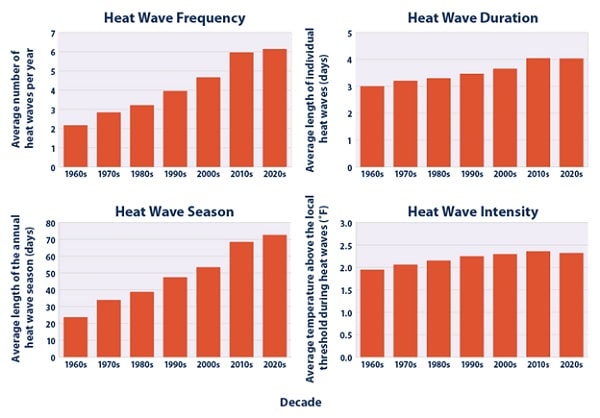
Heat waves are hotter, happen more often, and last longer than they used to.

heat wave

Fires are roaring across countries… rivers are drying up… hurricanes and floods are levelling cities.

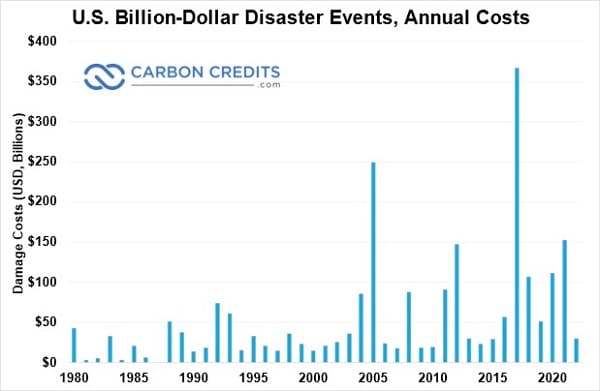
This climate change crisis will lead to the loss of lives and is costing trillions.

US billion dollar disaster events, annual costs

To avoid the worst effects of climate change, like the disappearance of sea ice, the collapse of ecosystems, and global weather refugees, itโ€™s going to take more than just a decrease in emissions.

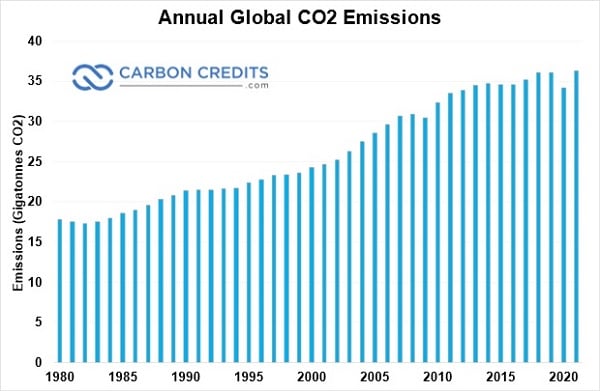
We must fully decarbonize the entire global electricity sector, eliminating the 36 GT of CO2 spewed into the atmosphere every year.

And weโ€™ve got less than three decades to do it before a reversal becomes impossible.

To achieve complete decarbonization, countries have spent the last decade โ€œgoing greenโ€, targeting โ€œnet zeroโ€ and slashing carbon-emitting sources.

Yet despite the efforts of most of the developed world, CO2 emissions have stubbornly kept increasing.

Emissions By Any Other Name

In fact, in the past forty years, weโ€™ve only seen three years with emissions decreases:

  • once during the Global Financial Crisis,
  • once during COVID,
  • and a tiny 0.1 GT decrease in 2015.

annual global carbon emissions

In 2021, immediately following the pandemic, global CO2 emissions snapped back to their highest level in history… with the biggest emissions increase in history.

Scenarios from the Intergovernmental Panel on Climate Change (IPCC)ย show that the chances of limiting the global temperature increase to 1.5 degrees are getting extremely slim.

How did we get so far off track? One simple reason:

  • The world is playing a massive cup-and-balls trick that nets the world zero gains in the fight on climate change.

Take California, for example.

Itโ€™s requiring 100 percent of all energy sold to be clean by 2045. And to get there, and to a net zero target, itโ€™s cutting a perfectly good carbon-free source of energy: nuclear.

In fact, itโ€™s cut nuclear power by 50 percent over the past decade. Guess what made up a large chunk of the difference…

Natural gas.

Nowโ€”by its own estimateโ€”California needs to deploy wind and solar at five times its average pace… for the next twenty years straight, just to meet its 2045 goal.

Hereโ€™s the thing. Nuclear electricity production is already emissions free. So even if California successfully replaced all of its carbon-free nuclear energy with wind and solar, there would be zero emissions reduction.

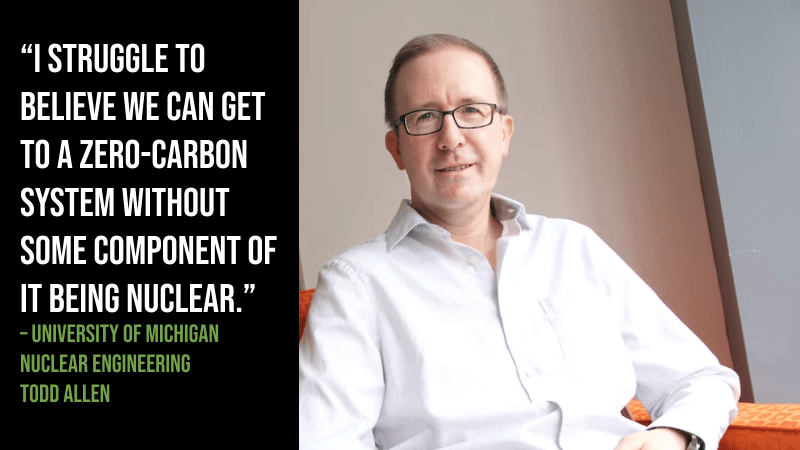
Itโ€™s not just California. Michigan shuttered a huge nuclear plant, killing with it the hopes of a net zero or zero-carbon state economy by 2050.

todd allen achieving net zero with nuclear
Itโ€™s a trend around the world, spurred on by Fukushima in 2011.

Before the incident, Japan planned to reduce its emissions by 20 percent from 1990โ€“2020.

Instead, it nearly doubled its use of coal and natural gas from 2009โ€“2013โ€”using it for more than 90 percent of its electricity generation. As a result, Japanโ€™s CO2 emissions shot up 15 percent.

Germany followed Japanโ€™s lead, announcing in 2011 that it would shut down all of its nuclear plants and replace them with renewables.

It was a lie. Germanyโ€™s nuclear power has been almost entirely replaced by natural gas.

And thatโ€™s why emissions refuse to fall…

โ€œWeโ€™re Cookedโ€

Far from reducing emissionsโ€”or even keeping them the sameโ€”for every reactor that is forced to shut down, CO2 emissions rise by 5.8 MT a year.

  • Thatโ€™s the equivalent of filling an NFL stadium to the brim with gas, and setting it on fire.

Weโ€™d need to install solar panels on one million homes just to make up for shuttering a single reactor.

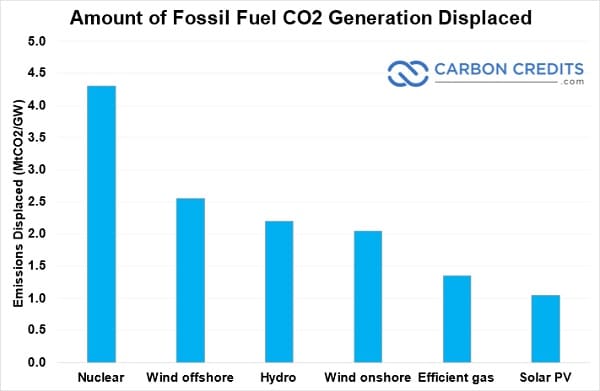
Nuclear reactors are extremely efficient, low-carbon sources of energy. In fact, it doesnโ€™t matter whether itโ€™s replacing coal or natural gas…

  • Nuclear is nearly 100 percent more effective than any other energy technology at reducing CO2 emissions.

amount of fossil fuel CO2 generation displaced

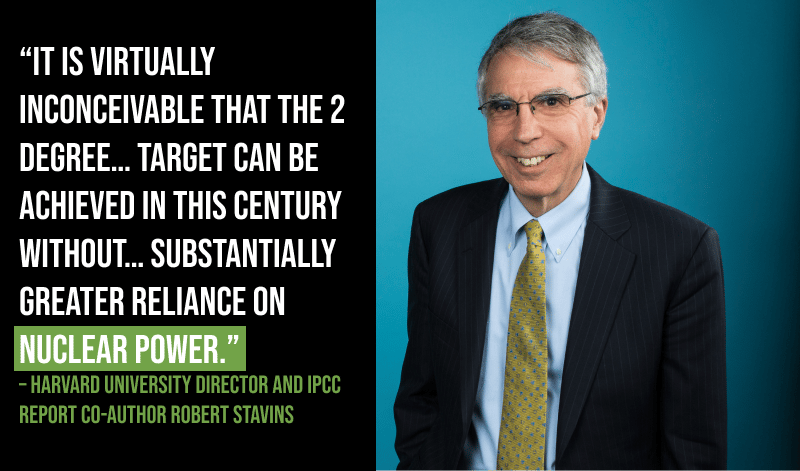
There is simply no achieving net zero without nuclear.

robert stavins
Thatโ€™s why a letter from scientists at Carnegie, MIT, and Columbia said:

โ€œContinued opposition to nuclear power threatens humanityโ€™s ability to avoid dangerous climate change.โ€

Or MIT scientists and NASA researchers…

Nuclear โ€œwill make the difference between the world missing crucial climate targetsย or achieving them.โ€

A report from the United Nations Economic Commission for Europe made it as clear as possible:

โ€œInternational climate objectives will not be met if nuclear power is excluded.โ€

Hereโ€™s the reality:

  • The only countries in the world that have broken the fossil fuel addiction and transitioned to low-carbon power have done so with the aid of nuclear.

Thatโ€™s why more than a dozen countries have said that nuclear power will play a crucial role in reducing their emissions.

Right now, a giant U-turn is happening around the world to add nuclearโ€”fastโ€”to achieve net zero by 2050.

The question is: How much nuclear does the world need to stay alive?

Nuclear Civilization, or No Civilization

The International Energy Agency says global nuclear capacity needs to increase by 130 percent by 2050 to meet climate change goals.

Their net-zero emissions scenario sees one new plant being added every ten days within a decade.

โ€œIn todayโ€™s context . . . nuclear power has a unique opportunity to stage a comeback.โ€
โ€“ IEA Executive Director Fatih Birol

The IPCC goes even further. In the eighty-nine scenarios they considered, nuclear generation increases by an average of 250 percent.

That means roughly 1,000 new nuclear plants built in the next twenty-five years.

The Harmony Programme proposes about 1,250 new nuclear plants, to allow for retirements. That would provide 25 percent of electricity around the world, all carbon-free.

Some say we donโ€™t have time for nuclear anymoreโ€””It takes too long to build.โ€ Theyโ€™re wrong.

South Korea is building plants in four years, and theyโ€™ve got eight under construction right now.

If a tiny country can do that, imagine what a mobilization of the entire world would bring about.

An average of twenty reactors per year started up globally from 1975โ€“1985.

A single nuclear reactor produces about 9 TWh of energy a year, and the world uses about 24,000 TWh of energy a year.

  • That means if we had kept building the same old plants at the same old pace . . . we would have hit net-zero around 2000.

As it stands, we have thirty years left. And right now, fifty-six reactors are under construction.

For context, thatโ€™s more than the net addition of nuclear power since 1985.

More than 300 reactors are plannedโ€”and counting.

Avoiding a total climate meltdown is the hardest challenge the world has ever faced.

But with nuclear, weโ€™ll beat it.

Go to next chapter >

Canada Launches Carbon Pricing Initiative at COP27

Canada is challenging all countries during the COP27 summit to adopt carbon pricing as the key element of their climate strategies.

Pricing emissions is widely known as the most efficient way to reduce greenhouse gas (GHG) emissions. Carbon pricing is putting a cost on pollution while adding value to desirable things such as clean air and clean energy.

Canada is recognized as a climate leader, mainly due to its robust domestic carbon pricing. The government approach allows jurisdictions to implement their own carbon pricing systems that best meet their needs while aligning with national standards.

Canada is one of the few countries to set a long-term carbon price trajectory up to 2030. This sends a strong signal to pursue low-carbon investments and help reach net zero emissions by 2050.

The Global Carbon Pricing Challenge by Canada

According to the World Bank, 68 carbon pricing initiatives are currently in place across the globe. These initiatives cover 23% of global GHG emissions.

Canadian Prime Minister Trudeau issued a challenge to triple the global coverage of carbon pricing by 2030 at COP26 last year. But in the year since, the total emissions covered by a carbon price have not changed.

At COP27, the Global Carbon Pricing Challenge was launched. Itโ€™s an initiative led by Canada calling on all nations to expand the use of pollution pricing in fighting climate change. Guilbeault said that:

“Countries around the world are realizing that pricing carbon pollution can reduce emissions and fight climate change at the lowest cost while also spurring clean innovation. Working together with like-minded nations, we can triple the global coverage of carbon pricing as an important step toward achieving net zero by 2050…”

8 other countries and the European Commission are already on board the challenge. Yet, most of them already have carbon pricing in place or have a program planned.

Joining the panel discussion at COP27 are the U.K., New Zealand, and Sweden. These carbon pricing champions will strengthen existing systems and support new ones.

The Global Carbon Pricing Challenge will create a forum for dialogue and coordination to make pricing systems more effective and support other nations when adopting carbon pricing. It aims to cover 60% of global emissions by 2030.

Each year, the participants will come together to track their progress toward meeting the goals of the Challenge. Theyโ€™ll also report new actions and share best practices. By cooperating internationally, they can signal to investors that pollution canโ€™t be free.

How Carbon Pricing Works

Basically, carbon pricing works because there is a financial incentive for entities to pollute less. Its purpose is to send a clear message that carbon-intensive products are costly. It also gives consumers and industries the flexibility they need to look for the lowest-cost solutions.

  • Carbon pricing holds the biggest emitters accountable for their pollution. Thatโ€™s because the more they pollute the air, the more it will cost them.

Pollution pricing varies based on the regions, businesses and individuals covered. So there are different types of carbon pricing.

For instance, a cap-and-trade system sets a cap on emissions for high emitters while allowing low emitters to sell their extra emissions allowances, also known as carbon credits. Last July, Canada explored options to cap oil and gas industry emissions.

The most common type of this pricing is a carbon tax. It charges a direct price per unit of GHG emissions. Some carbon pricing systems combine elements of both cap-and-trade systems and carbon taxes.

Canadaโ€™s carbon pricing system is a mix of federal and provincial policies. Together, they cover over 80% of the countryโ€™s total emissions but at varying costs per tonne.

Canada continues to be a global innovator in effective carbon pricing. Its recent initiative on establishing carbon contracts will ensure that entities can plan for their long-term decarbonization and clean technologies investments. And that becomes possible with a predictable price on pollution and carbon credits.

This Ain’t Your Grandpa’s Nuclear

0
Imagine using computer knowledge from 1978 to argue that streaming video could never work. 

The internet didnโ€™t exist back then.

Even computer screens had barely been invented.

The instant you began arguing, Netflixโ€™s massive multi-billion market cap would laugh you out of the room.

Yet thatโ€™s precisely the situation today for nuclear.

When a researcher at The Breakthrough Instituteย started investigating arguments against nuclear based on price, she discovered something interesting.

The majority of the research was based on nuclear construction… from the โ€˜70s.

So she decided to do her own studyโ€”and unsurprisingly found that construction costs are extremely different now.

Same goes for safety and waste figures. The numbers used to argue against nuclear are all from the โ€˜70sโ€”with predictably inaccurate results.

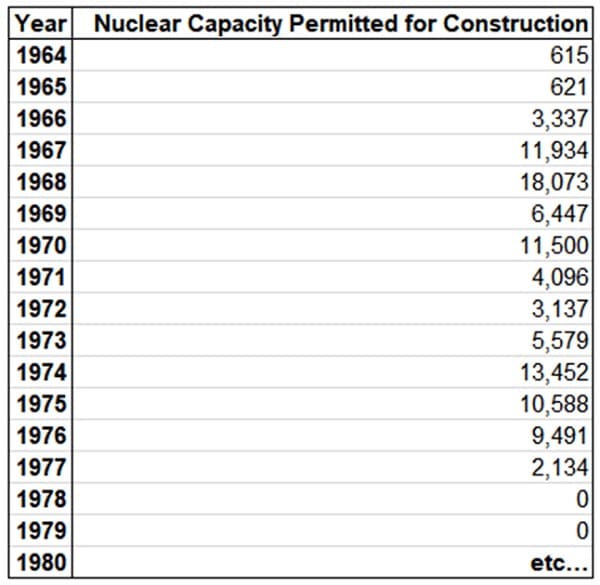
Hereโ€™s the problem: a grand total of zero nuclear reactors currently operating in the U.S. started construction after 1978.

Meanwhile, nuclear has evolved just as much as computers have in the past fifty years.

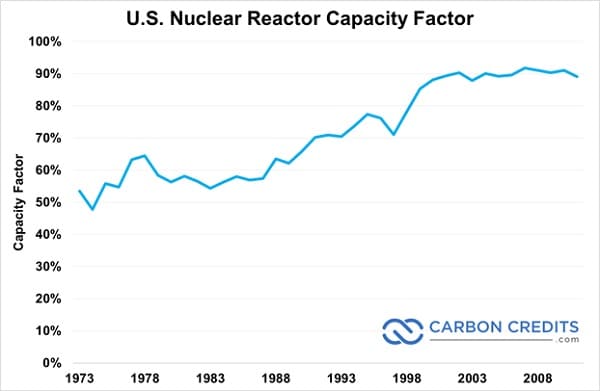
Take something called โ€œcapacity factor,โ€ for example. It measures uptime for energy sources.

A capacity factor of 100 percent means a nuclear plant is generating energy 24/7.

In the โ€˜70s, nuclear was just starting up. Operational difficulties that caused unplanned outages were common.

The capacity factor was about 50 percentโ€”so thatโ€™s the number often used to compare nuclear to energy sources like wind and solar.

Guess what it is now…

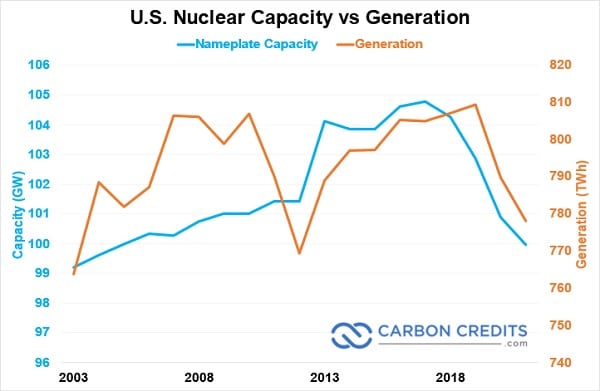
  • In 2021, U.S. nuclear capacity factor was 93 percent.

nearly double what it was thirty years ago.

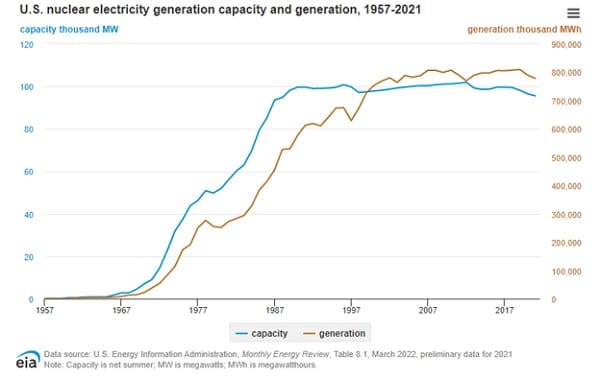
In fact, the capacity factor has increased so much over the past thirty years, that even though fifteen nuclear reactors have shut down in the U.S….

The total power produced annually by nuclear has increased by nearly 25 percent.

The other contributor to total power generated from nuclear is โ€œupratingโ€โ€”adding additional capacity to existing reactors.

Hereโ€™s how powerful that can be:

  • Two reactors in Finland started in 1978 and 1980 at 660 MWe.
  • Thirty years later, they were rated at 880 MWeโ€”a 30 percent increase.
  • The operator, TVO, is planning to uprate them again, this time to 1,000 MWe.

In fact, TVO uses uprating to always have forty years of remaining lifetime on their plants.

And thatโ€™s another major evolution of nuclear power no one saw coming…

Rise of the Planet of the Octogenarians

When nuclear reactors were just getting traction in the โ€˜60s, they needed investors. And investors needed to know how long these plants would be pumping out energy.

So for amortization purposes, they chose… say, forty years.

Around the turn of the century, nuclear plants started to hit their fortieth birthdays.

And in March 2000, the Calvert Cliffs plant received the first twenty-year license extension.

Since then, 96 percent of the fleet in the U.S. has been granted extensions to operate sixty years.

Now theyโ€™re hitting the sixty-year mark… and they arenโ€™t slowing down.

So in 2021, the Nuclear Regulatory Commission (NRC) approved a second twenty-year extension for the Surry plant in Virginia built in 1972.

It will now be able to operate until 2052โ€”a lifetime of eighty years.

Fifteen more reactors have applied for extensions, with more expected.

  • Extremely long-term nuclear plant operations are not the exception. Theyโ€™re the norm.

Thereโ€™s no limit to the number of times a license can be extended, provided the NRC decides the reactor is safe to continue operations.

And the NRC is now preparing to authorize nuclear plants for up to 100 years.

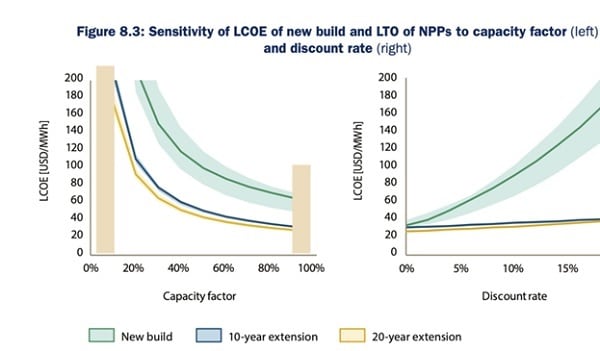
Why are license extensions so important? Itโ€™s because nuclear is compared to other forms of energy using a levelized cost of energy (LCOE).

  • Since the costs of nuclear power are front-loaded, a mere twenty-year extension means the LCOE of nuclear drops 50 percent.

Add in capacity factor increases…

And the LCOE drop is more like 65 percent.

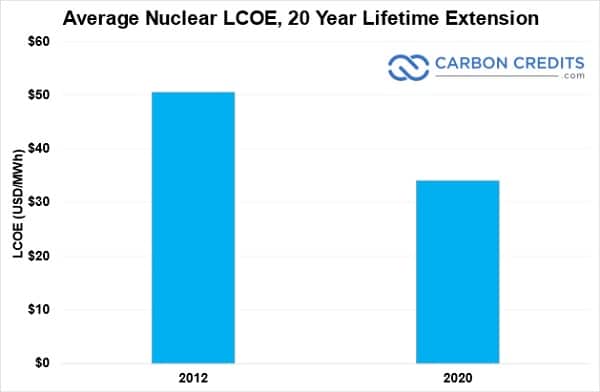
The past ten years have brought another 35 percent drop in nuclear LCOE for a twenty-year extension:

That brings the LCOE down to near $30/MWh.

  • In other words, nuclear operations in the U.S. are 30 percent cheaper than wind is now.

Hereโ€™s the thing:

The increased capacity, the increased output, and the increased longevity is all on Generation II reactors.

And those arenโ€™t the ones being built today.

Gen 2 Nuclear

The Gen III Max Plus

In the late โ€˜90s, Japan built the first Generation III reactor, beginning a new era for nuclear.

Gen III reactors carefully incorporate lessons from Fukushima, Three Mile Island, and Chernobyl. That makes them safer, stronger, cleaner, less expensive, and easier to build than Gen II reactors.

For example, if a station completely blacks out, โ€œpassive nuclear safetyโ€ takes over, ensuring the fuel remains cooled.

These improvements make Gen IIIs 1,600 times less likely to experience a severe accident than previous reactors.

Another technology turns potentially explosive gases into water without using electricityโ€”which helps keep radioactivity in the reactor in case of a meltdown.

So even if there is core damage, the probability of a severe radioactivity release is 10 times less than it used to be…

  • Studies have found that Gen III nuclear reactors are so strong that they could withstand being rammed into by a fully fueled Boeing 767.

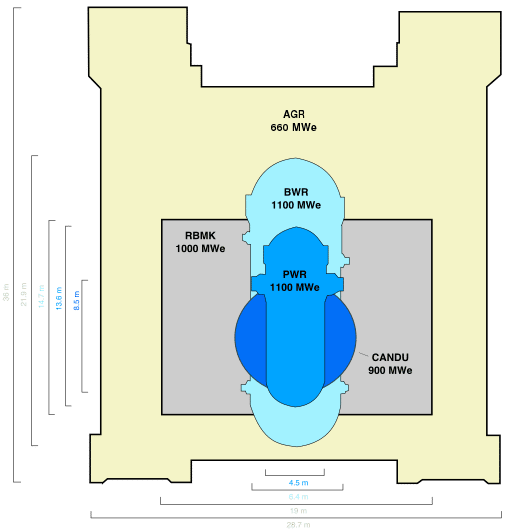
European manufacturers have now created a reactor design called the EPRโ€”or Evolutionary Power Reactor.

Itโ€™s one of the first Generation III+ designs, and itโ€™s built to be indestructible.

It has:

  • F that can provide cooling for up to three years after shutdown.
  • A โ€œcore catcherโ€ that traps and cools the hot core if it escapes the reactor.
  • Two layers of concrete walls that are a total of eight feet thick.

EPRs are hugeโ€”output is up to 1,650 MWe, or 70 percent more than most U.S. reactors.

Oh, and they use nearly 20 percent less uranium per MW than older reactors.

The first Gen III+ started up operations in 2017, followed in rapid succession by reactors in China, Finland, France, and the UK.

From Evolution to Revolution

A group of fourteen countries around the world are already developing advanced Gen IV reactors.

If Gen III+ reactors are evolutionary, Gen IV reactors are nothing short of revolutionary.

For example, American companies are working on โ€œwalk awayโ€ safety: nuclear reactors that need zero backup power or external cooling in case of an accident.

And Gen IV isnโ€™t a pipe dream.

Chinaโ€™s already started up the first Gen IV reactorโ€”a model that canโ€™t melt down.

More than a dozen other large reactor designs are being developed.

More importantly, more than seventy reactor designs are under development for SMRsโ€”Small Modular Reactors.

โ€œModularโ€ means that the components can be built in a factory, instead of on-site.

  • SMR production is easily scalable, and costs plummet as production rises.

In the future, SMRs could be produced at the same scale as airplanes.

The reactor is small enough to be brought to the nuclear plant on a truck.

They produce about ยผ as much power as a regular reactor, and some are designed to operate for thirty years before refueling.

  • A 300 MWe SMR plant can be built in under four years.

Once built, it can follow electricity demand, cutting from 100 percent power to 40 percent in just twenty minutes.

SMRs are currently being licensed or constructed in five of the six top nuclear-producing countries in the world.

TerraPower, a company founded by Bill Gates, is installing its first SMR in a small Wyoming coal town.

Why there?

Because it can use the existing infrastructure and workforce of the coal plant thatโ€™s retiring in 2025. The same land, the same connections, the same office buildingsโ€”saving up to 35 percent of the cost.

  • In just a couple years, that single SMR is set to provide enough carbon-free energy to power 345 small towns.

Todayโ€™s nuclear is worlds apart from the nuclear of fifty years ago.

Old plants have improved. New designs have been built. New moonshot approaches are actually working.

Waste is dropping, reactors are becoming safer, and the price is going down.

Around the world, rapid learning is taking place that will enable nuclear to radically expand.

All the industry needs to blow up is a catalyst.

And that catalyst…

Itโ€™s here.

Go to next module >

The World’s Shrinking Wasteline

0
Contrary to how itโ€™s portrayed by the Simpsons, nuclear waste is not a highly toxic, neon-green sludge. It doesnโ€™t ooze out of leaky barrels stashed on playground slides and in public parks…

… and itโ€™s not haphazardly stored or tossed into rivers because thereโ€™s no other place to put it. The truth is, thereโ€™s not even that much of it.

The amount of nuclear waste generated in the entire U.S. each year is less than half the volume of an Olympic swimming pool. And that fuel provides power to more than seventy million homes while avoiding 400 million tonnes of CO2 emissions.
 

Even long-term, thereโ€™s just not much radioactive waste to worry aboutโ€”especially compared with other forms of electricity generation.

  • All civilian nuclear waste produced in the U.S. since 1950 would fit on a football field at a depth of thirty feet.

The coal used by the U.S. would fill that same space 2.5 times, every day.

The world generates about 8,000 tons of nuclear waste annually. Thatโ€™s only 1/10 the weight of the Washington Monument.

As little as there is however, it still needs a safe, long-term solution.

You see, high-level nuclear wasteโ€”the really dangerous stuffโ€”is extremely hot and radioactive. And the only way it becomes harmless to humans is time. Lots of time.

Which means countries need to take their time to get waste storage rightโ€”the first time.
rodney mccullum
Thatโ€™s why countries like China, Finland, Sweden, and the U.S. have spent the last forty years studying disposal methods. And theyโ€™ve figured it out.
Waste Not, Want Not

The first problem with nuclear waste is cooling it down and keeping it away from people.

Spent nuclear fuel comes conveniently in the form of thin, solid rods that are relatively easy to store.

After being removed from a reactor, these rods are placed in giant, steel-lined concrete pools that provide cooling and shielding. A few years later, much of the heat and radioactivity has dissipated.

The used fuel can then be moved to dry storage in welded, steel-reinforced concrete above-ground canisters.

After about fifty years thereโ€”by which time the radioactivity has declinedโ€”the canisters can be easily transferred to a permanent storage site.

Dry storage in the U.S. did not begin until 1986.

That means it has another fifteen years or so until a permanent solution needs to be ready.

  • Fortunately, the country found the solution has already been found: in the earth itself.

In the far, far north of Canada lies the Athabasca Basin. Itโ€™s one of the biggest and highest-grade uranium deposits known to man.

Most of it is UO2โ€”uranium dioxideโ€”which serves as nuclear reactor fuel. The ultra-high-grade ore is safe from water by a โ€œdomeโ€ of clay.

Even though the deposit has been in permeable sandstone for more than 100,000 years… itโ€™s gone nowhere.

Multiple ice ages, continental drift, and even mountain formation have come and gone.

Its chemical or radioactive signature is undetectable from the surface.

In other words, itโ€™s the perfect solution for long-term waste disposal: a deep geological repository (DGR). Already, more than a dozen countries have chosen it as their nuclear waste management solution.

The First Reverse Mine

Onkaloโ€”meaning โ€œpitโ€ in Finnishโ€”is scheduled to begin operations in Finland in 2024.

It will be the first permanent disposal site for high-level civilian nuclear waste in the world.

Tunnels got dig one-third of a mile into the earthโ€™s surface, all the way down to the bedrock.

  • The used fuel are in boron steel canisters.
  • Those canisters will be enclosed in copper capsules.
  • The copper capsules will be buried in the tunnel floor.
  • The holes dug will be plugged with a water-absorbing clay.
  • Then the tunnels will be filled with bentonite and sealed with concrete.

Come global warming or another ice age, it will be the fuelโ€™s final resting place.

Now you might be thinking…

Easy for Finlandโ€”they must have only a small amount of waste!

  • But Finland will get 60% of their power from nuclearโ€”second only to France.

Even so, the single new DGR is not expected to be filled until 2120, a century after operations begin.

Sweden is next in line, and theyโ€™re following the exact pattern set by Finland.

8,000 tonnes of nuclear wasteโ€”everything Sweden has generated since the 1970โ€”will be underground, one-third of a mile into the earth.

The final project will cost only $2 billion.

โ€œThis is the result of 40 years of research and it will be safe for 100,000 years.โ€
โ€“ Sweden Environment Minister Annika Strandhall

Just like how a large company would do it, Sweden let communities compete for the chance at the jobs and money that follow large construction projects.

France has already selected a suitable site for a DGR, and the UK and Canada are in the process of doing so.

The United States, however, is a different story.

Reduce, Reuse, Recycle Nuclear Waste

Most of the spent fuel in the United States is in dry casks or pools at more than seventy nuclear reactors across the country.

The Department of Energy is considering consolidating all of it into a federal short-term storage facility.

Theyโ€™d use consent-based siting, just like Sweden.

In late 2021, the Office of Nuclear Energy took a first step toward establishing such a repository.

The NRC found that either nuclear reactors or a federal facility will provide safe storage for waste for at least the next century.

The Department of Energy found that a permanent nuclear waste disposal facility would cost a staggering $31 billion.

Fortunately, the government has been collecting money from consumers just for thatโ€”since the โ€˜80s. And so far, theyโ€™ve got $44 billion.

Now itโ€™s just a matter of identifying a place. But they might not have to, because there might not be any waste remains to store.

Hereโ€™s why…

Current nuclear facilities use only about 1 percent of the energy stored in the uranium.

  • Reprocessing the fuel enables it to be used again. And again.

That means much of the used fuel currently in storage is not actually waste.

Canadian reactors, for example, can actually burn spent fuel from U.S. reactors. And once used, fuel from the Canadian reactors is only dangerous for about a thousand yearsโ€”not 100,000.

France has taken it a step further, and nearly closed the fuel cycle. Their reprocessing of spent fuel results in only 4 percent waste.

The other 96% is reused in the reactor.

Anti-nuclear activists love to say that nuclear has no long-term solution to its waste.

In fact, nuclear may be the only energy technology on the planet with a complete long-term solution for every. last. molecule.

Go to next chapter >