The Safest Deadly Poison in the World

0

Fukushima is the BEST Possible Advertisement for Nuclear Power and its Safety.

About a decade ago, the Union of Concerned Scientists broadcasted an urgent request to U.S. citizens.

They were to write their governors and congress people to demand one thing: improved nuclear safety.

Sounds like a noble pursuit, in theory.

Except that in all of U.S. history…

The recorded number of deaths due to nuclear power is zero.

In fact, nuclear is the safest industry in the entire United States. Working in a nuclear plant is safer than working in a library.

Thatโ€™s not particularly easy to improve on.

Yet there remains a widespread misconception that nuclear plants are ticking time bombs, just waiting to level an entire city.

Nothing could be further from the truth.

Large-scale nuclear accidents generally involve a nuclear meltdown, which safety is simply due to damage to a nuclear reactor core from overheating.

Two really improbable things have to happen for a meltdown to occur:

  • A loss of coolant or coolant pressure to the core, allowing it to heat up.
  • A complete failure of both Emergency Core Cooling Systems (ECCS).

In the nearly 20,000 years of combined nuclear operations, there have only been three core meltdowns.

When a meltdown occurs, the danger is not from the core itself. No, itโ€™s not going to melt all the way through to China.

The real danger is from radioactive particles escaping from the reactor.

Fortunately, the release of radioactive matter is generally reduced by the nuclear infrastructure that remains after the meltdown. Except, of course, if the infrastructure that should be there – isnโ€™t.

Thatโ€™s exactly what happened at the most famous (and worst) nuclear meltdown in history: Chernobyl.

A Rocket without a Windshield

In early 1986, inexperienced personnel attempted an experiment at the Chernobyl nuclear plant in Ukraine.

The plant itself was a particularly cheap, shoddy design.

All other reactor types have a crucial containment dome. Itโ€™s a massive, thick steel-and-concrete โ€œlidโ€ that keeps radioactive material inside the nuclear plant if anything goes wrong.

Not having one is like building a rocket that doesnโ€™t have seatbelts, or a windshield.

The perfect combination of untrained personnel, shoddy design, and deliberate violation of safety rules meant that the nuclear experiment went very, very wrong.

The meltdown it triggered caused a chain of explosionsโ€”then a massive fire. The fire spewed at least five percent of the reactor core into the surrounding countryside.

It was the largest uncontrolled civilian release of radioactive material in history.

Unlike the nuclear plant, the Soviet Union kept a tight lid on what was happening.

It wasnโ€™t until nuclear workers all the way in Sweden identified high levels of radiation that the Soviet Union was forced to admit the accident had happened.

By then, ten days had passed.

  • By every measure, it was the worst possible handling of a nuclear accident.

While what happened was horrible, the official number of deaths directly attributed to the accident is about thirty.

But what about radiation exposure for people near the plant?

More than 200,000 โ€œliquidators,โ€ Soviet citizens, helped with recovery and cleanup of the accident site.

Those who were exposed to 100 millisieverts of radiationโ€”the average for a Chernobyl liquidatorโ€”saw their mortality risk increase by 0.4 percent.

If you live with someone who smokes cigarettes, you increase your mortality risk by 1.7 percent.

unsc

Even today, the people living around Chernobyl get about as much radiation exposure as people in Colorado, where thereโ€™s low-level radiation from granite.

โ€œWhere Probability Says We Shouldn’t Beโ€

A quarter-century after Chernobyl, an 8.9 earthquake struck off the coast of Japan, shifting the entire country a dozen feet east.

Many Japanese nuclear plants had only been built to handle an earthquake with only one-fifth of that magnitude.

Yet none of the eleven reactors in the region suffered any damage.

And in Fukushima, Japan, everything functioned perfectly as planned. Systems detected the earthquake and shut down the reactors. When the power went out, diesel generators kicked in to keep the cores cool.

Soon after the earthquake, a forty-two-foot wave slammed into the coast of Japan. It swept over the sea wall in front of Daiichi, killing the emergency generators… and the backup generators.

A second tsunami hit eight minutes later.

Fortunately, the battery-powered backup of backup generators at Fukushima kicked in, and the cores remained coolโ€”all according to plan.

Eventually, they also failed, resulting in the first and only triple nuclear meltdown in history: All three cores rapidly overheated.

Due to the containment domes, fallout from the accident remained limited.

  • There were no reported deaths or cases of radiation sickness in the immediate aftermath of Fukushima.

And of the more than 200 workers who continued to mitigate damages on the site, not a single one died from radiation.

Overall, the loss of life expectancy in the town most affected by Fukushimaโ€ฆ was less than that experienced by a London resident from air pollution.

To Sum It All Upโ€ฆ

A crumbling, outdated nuclear plant with poor safety features was hit by the fourth-largest recorded earthquake, then a forty-foot wall of water.

  • The electricity supply
  • The cooling system stopped functioning.
  • The reactors melted down and exploded.

And it killed fewer people than operations at an average coal plant does every single yearโ€”when everything goes according to plan.

Fukushima is the best possible advertisement for nuclear power.

Scrams Go Away

The only civilian nuclear meltdown on U.S. soil was at Three Mile Island in Pennsylvania in early 1979. The ECCS was turned off, which led to a partial melting of the coreโ€”almost no radioactive material escaped.

While the accident destroyed a billion-dollar reactor, it did not harm people nearby, either during the incident or in the aftermath.

  • Total number of deaths from Three Mile Island: zero.

More than a dozen studies conducted since the accident have shown that the amount of radiation released was too small to even measure the health effects.

But just to be safe, the Nuclear Regulatory Commission (NRC) quickly established the Institute of Nuclear Power Operations (INPO). Its job was to help provide training for nuclear plant operators.

The efforts of the INPO have steadily made nuclear energy safer and more reliable for the past forty years.

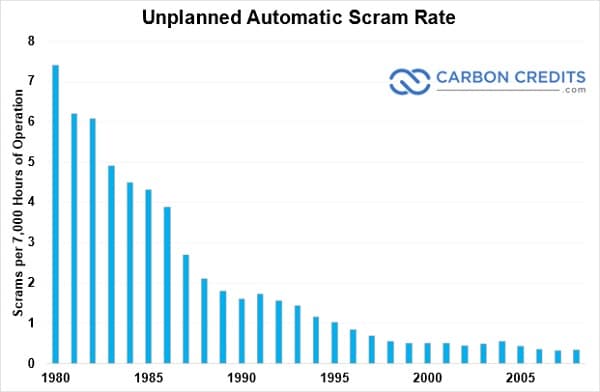
One of the best measures of nuclear safety is called a โ€œscram.โ€ A scram is an automated shutdown that occurs if necessary to prevent damage to the core.

Control rods are inserted into the core, causing all nuclear reactions to stop.

A scram takes a total of about three seconds.

In 1985, there were 530 scrams in U.S. nuclear reactors.

By 2021, there were only 37โ€”a 93 percent decrease.

unplanned automatic scram rate

Nuclear By Any Other Name

But thatโ€™s not important. Because the question is not whether nuclear reactors have a perfect safety record.

Like every source of energy, nuclear is dangerous, and it can cause injury or death.

But are other sources of energy safer?

When Japan halted nuclear production after Fukushima, guess what replaced it.

Not renewables.

Mostly coal and gas.
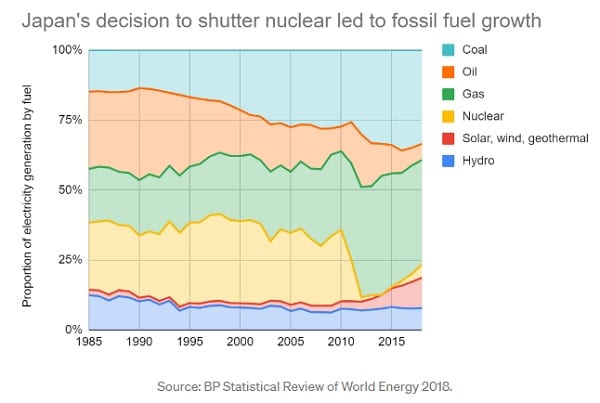
Japan shutter nuclear led to fossil fuel growth

In two years, Japan started eight new coal-fired power plants, with plans for the biggest coal-power expansion in any developed nation.

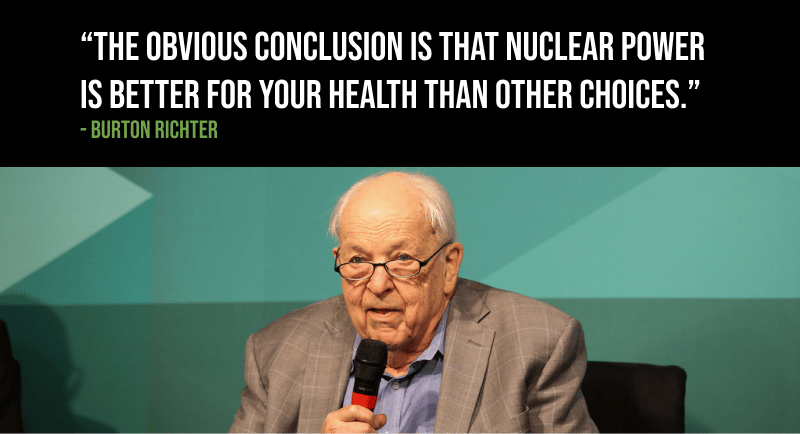
Nobel Prize physicist Burton Richter estimated t he years of life lost due to energy sources in Japan.

For nuclearโ€”including the losses attributed to the Fukushima accidentโ€”itโ€™s 30 years per TWh.

For coal? 142.

Burton Richter on nuclear safety
About 20,000 premature deaths are expected over the seventy years following Chernobyl. Compare that to the estimated number of deaths each year from fossil fuel pollution, as identified by Harvard researchers: 8 million.

  • Burning fossil fuels creates another Chernobylโ€”every single day ad. space

The fact is that even first-generation nuclear reactors are an order of magnitude safer than every other fuel source.

Americans will write their congress people, certainly.

But theyโ€™ll be begging for nuclear.

Go to next chapter >

The Nail in the Nuclear Coffin

0
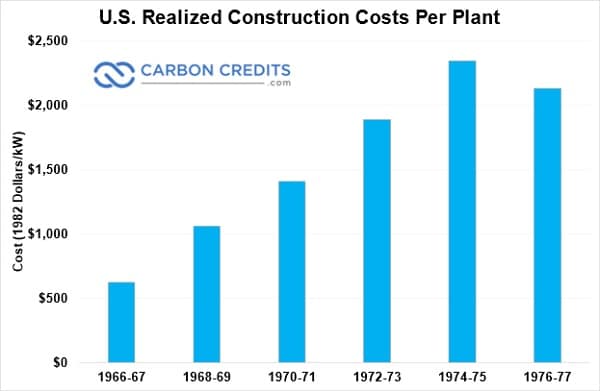
Many people believe that Three Mile Island is what killed nuclear in the United States. It may have dealt the fatal blow, but nuclear was dying years before the accident occurred. And for a reason that had nothing to do with nuclear itself.
ย 
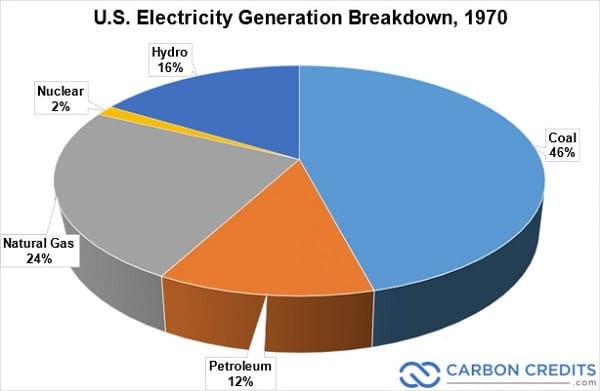
You see, it doesnโ€™t matter how expensive nuclear is;ย it matters how cheap other energy is. When the oil crisis of the early 1970s hit, 82% of electricity was generated using either fossil fuels such as coal.US electricity generation breakdown, 1970Overnight, the price of both oil and coal increased by 100 percent.The new kid on the block, nuclear, was suddenly far cheaper than gas- and coal-powered electricity and other clean energy sources. 
Utilities eagerly placed orders for turnkey nuclear plants.

It seemed to be the answer to all their problems.

And it was, for a while.

When fossil fuel prices were sky-high, nations were rationing oil, and coal was outrageously expensive, the nuclear power buildouts paid off handsomely.

Only the utilities didnโ€™t count on the oil crisis causing electricity demand growth to slow sharply. At the same time they had to increase prices, no one wanted their product.

Thatโ€™s the same time as when nuclear construction prices started to spiral out of control due to new regulations and ways looking for clean energy. Utilities found themselves stuck between a rock and a very hard place:

  • Go bankrupt due to high fuel prices, or
  • Go bankrupt due to high nuclear construction costs.

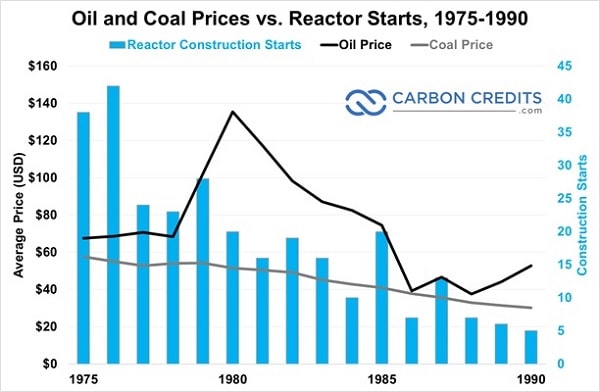
Then the prices of oil and coal started to fall, and fall some moreโ€”from 1980 all the way through 1985.

oil and coal prices vs. reactor starts, 1975-1990

Utilities quickly switched to building fossil fuel plants again.

Not a single new reactor began construction in the United States from 1980โ€“2010.

Instead, coal and natural gas dominatedโ€”and CO2 emissions were off the charts and the option for a clean energy like nuclear melts into thin air.

The world built a decades-long addiction to cheap, dirty energy that became nearly impossible to break.

Freaking Fracking

In the mid-2000s, natural gas prices were rising. Popular opinion held that the U.S. was going to severely limit CO2 emissions.

And all those nuclear plants built in the โ€˜70s suddenly looked appetizing again.

Their operating costs averaged only $0.02/kWh.

An efficient combined-cycle plant was running four to five times as much… just for the fuel.

In that market, nuclear was king.

  • Every GW of capacityโ€”about the size of a single reactorโ€”was spinning out up to half a billion every year.

That lasted for four glorious years, from 2004โ€“2008.

Utilities took note.

From 2007โ€“2009, thirteen companies applied to the Nuclear Regulatory Commission for construction and operating licenses to build twenty-six new nuclear reactors.

For context, thatโ€™s 25 percent of the U.S. current nuclear reactor base in just two years.

Then it was de ja vu all over again. The Global Financial Crisis reduced the demand for natural gas, causing prices to plummet.

Then in the early 2010s, a new technology called โ€œfrackingโ€ made natural gas much cheaper than nuclear. This forced plants offline.

By 2013, most of the new nuclear applications had been abandoned. Natural gas electricity was about 4 cents per kwh, versus 10 cents for nuclear.

In the northeastern United States, electricity prices fell more than 50 percent from 2008โ€“2016.

A study by MIT in 2015 showed that the current price trajectory of electricity made about two-thirds of nuclear power in the U.S. uneconomicalโ€”forcing about 20 percent into early retirement.

In 2019, Exelon announced that it would close one of its nuclear reactors in Pennsylvania unless it received subsidies. Why?

Because cheap natural gas sliced regional electricity prices in half. That meant Pennsylvaniaโ€™s nine nuclear reactors (which power 33 percent of the state) were quickly becoming unprofitable.

Natural Gas Is Out; Nuclear Is In

The subsidy request is not far-fetched.

Wind and solar already received massive federal subsidies, which is part of what makes them competitive with nuclear.

Nuclear is the only form of energy that is not being valued by the market for its low emissions and extreme reliability. Fortunatelyโ€”despite the best attempts of oil and gas companies at stopping themโ€”politicians in several states are rewriting the rules.

  • โ€œZero-emission creditsโ€ are being created so the market accounts for the value of carbon-free, clean energy like nuclear.

And the federal government created a $6 billion Civil Nuclear Credit Program last year to help preserve the existing nuclear infrastructure in the U.S.

In the end, the subsidies might not even be necessary.

In the last three years, natural gas has spiked 400%โ€”most of that before 2022. Itโ€™s at its highest level in thirteen years.

It was at $8 when all those applications were filed, then dropped as low as $2 in 2019.

Now natural gas is back at $8.

Meanwhile, coal has risen from $50 a ton to $400 a ton in just two years.

Energy prices in the EU are already far beyond extremely expensive nuclear plants.

In fact, natural gas increases have pushed prices in the UK to $225 per MWh for the first time in fifteen years. And thatโ€™s in the summer, when energy demand is about 50 percent lower than the winter.

Thatโ€™s about double the price the UK government guaranteed to pay a French company building a reactor in England.

  • In other words, theyโ€™d get an immediate discount on energy just by building more nuclear reactors.

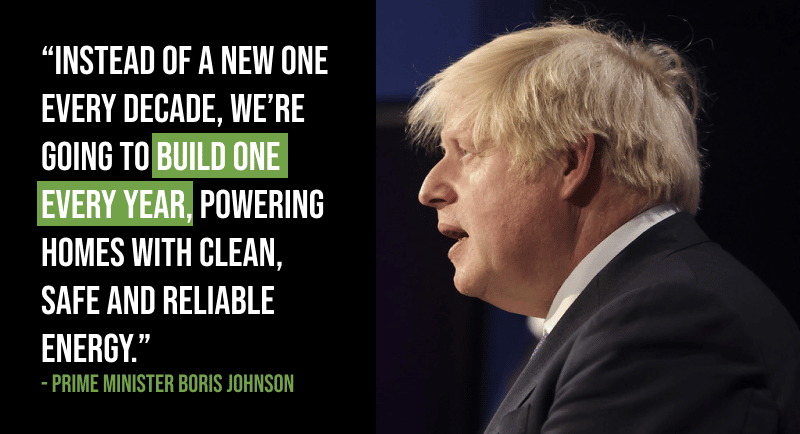
So thatโ€™s exactly what theyโ€™re going to do.

Boris Johnson on clean energy nuclear
In 2000, nuclear power supplied about 10% of the U.K.โ€™s electricity. It was 20% in 2020 and theyโ€™re going to take it to 25%.

Theyโ€™ve set up a new organization called Great British Nuclear. Its purpose is to ensure every new nuclear plant is built faster than the last.

In the future, it wonโ€™t matter how cheap other energy is.

Nuclear will be even cheaper than any clean energy.

And best of all, it will be carbon-free.

Go to next chapter >

Why the Great Nuclear Bandwagon Crashed and Burned

0
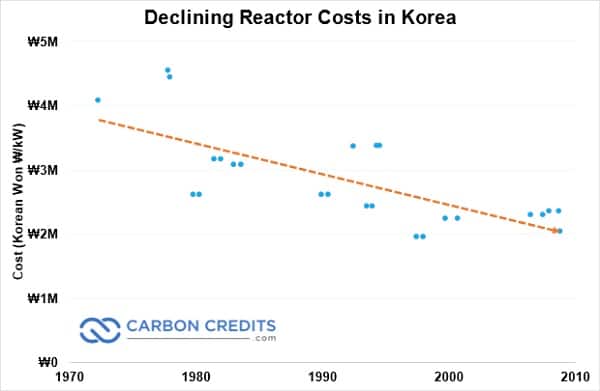
Most people know that nuclear power is extremely expensive to developโ€”and getting worse. And most people are flat-out wrong. In South Korea, prices have constantly dropped for nearly fifty years.

  • Over the course of building twenty-eight reactors from 1971โ€“2008, the average cost decreased by 50 percent.
In fact, that decline is similar to Germanyโ€™s experience with solar panel pricing over the same period.

France experienced a similar performance, with nuclear construction costs dropping from 1960โ€“1970.

After that, costs remained relatively level as they built out a nuclear fleet that powers more than 70 percent of the country.

So the United Statesโ€”the nuclear power pioneerโ€”should be building nuclear plants cheaper than anyone else, right? Also wrong.

In fact, a few years ago, two reactors in South Carolina were cancelled after their estimated price tag skyrocketed from $9.8 billion to $25 billion.

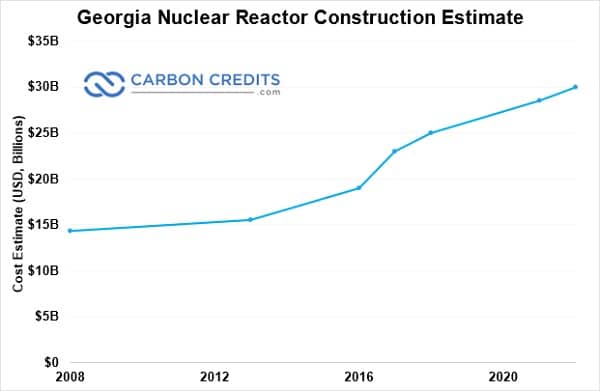
This year, two reactors under construction in Georgia saw their expected costs pushed once againโ€”this time, to $30.3 billion.

The massive amounts of carbon-free electricity generated by nuclear power is coveted by utilities, just not with massive price tags attached. They believe that nuclear energy and net zero are so compatible. And they seemed to be right.

But hereโ€™s the thing: even the starting price tags on those U.S. nuclear reactors have risen by hundreds of percent over the past few decades.

Now, nuclear is not expensive on its own. And most of the plants that are in operation now were relatively cheap when they were built. In fact, in the early days of nuclear, prices were on a steady downward trend similar to that of wind and solar.

As each successive nuclear reactor was built, the price naturally dropped.

Thatโ€™s due to a natural phenomenon known as the โ€œlearning rate.โ€

First-Mover Disadvantage

A learning rate is the rate at which a technology decreases in cost as it increases in use.

For example, a learning rate of 10% means that every time installed capacity doubles, the price drops by 10%.

Until 1970, the learning rate for nuclear in the United States was a fantastic 23 percent. In other countries, it was high as 35%.
  • If those learning rates had continued through 2015, nuclear reactors would be less than one-tenth of their current cost.

And if the accelerated deployment of nuclear through the mid-โ€˜70s had continuedโ€ฆ

  • Nuclear would have replaced the U.S.โ€™s entire coal and gas-powered electricity by 2015 and help the country’s race to net zero.

It also would have avoided more than 150 GT of CO2 emissions, as well as about ten million deaths from that pollution.

Only it didnโ€™t. Because sometime around 1970, the learning rate broke. And the price started to rise for every additional reactor built.

Suddenly, learning rates around the world became negativeโ€”the United States dropped to โ€“ 94%.

Part of the problem was that too many nuclear plants were being built at once.

Demand for nuclear plants skyrocketed in the late โ€˜60s, causing supply chain issues for both skilled craftsmen and huge, complex nuclear reactor components.

Prices on even simple parts and labor skyrocketed.

More importantly, if a part or worker was unavailable when they were needed, construction was delayed. And since utilities were financing the debt, every additional day meant additional millions of dollars in interest.

But thatโ€™s only part of the picture.

A New Expensive Point of View

In the early days of nuclear, every project was โ€œFirst of a Kindโ€โ€”or FOAK.

No manufacturer or developer had experience building new nuclear reactors.

  • In fact, the first nuclear reactors in Israel and Pakistan were built by a manufacturer of bowling equipment.

So with dozens of plants being brought online all at once, it was a time of learning the wrong way to do things. Then implementing insanely expensive fixes to plants still under construction.

For example, tectonic plates werenโ€™t even discovered until 1967. Suddenly, dozens of plants under construction had to be retroactively earthquake-proofed.

Reactors being built in the 1970s in the U.S. were in an environment of constant change that made controlling or even knowing costs impossible.

Each new snag or accident at an operating reactor introduced a new regulation or standard.

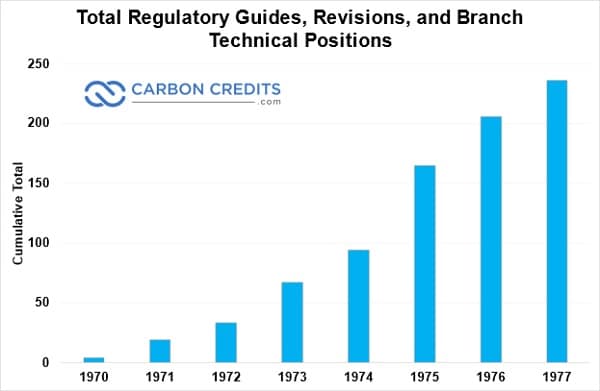
  • Between 1970 and 1978, the number of engineering standards nuclear plants had to abide by soared from 400 to more than 1,800.
  • During the same time period, regulatory guides and positions from the Nuclear Regulatory Commission increased from 4 to… 304.

Every time a new guide or standard was released, every reactor under construction had to be brought up to code.

And every minor change risked a โ€œripple effectโ€ that could force an overhaul of entire related systems.

For example, the David-Besse reactor was budgeted for $136 million when construction started in 1967; when it was finished a decade later, the price tag was $650 million.

A study found that modifications (and their chain effects) forced by the Nuclear Regulatory Commission were responsible for more than $400 million of that cost.

While the learning curve may have broken, this was the system working.

As operating experience built up, reactors became insanely safeโ€”in fact, the safest form of energy on the planet.

The Nuclear Bomb for Nuclear Power

Then the real bomb dropped.

A partial meltdown of a reactor at the Three-Mile Island (TMI) plant in 1979 threw the entire nuclear industry and its net zero potential into disarray.

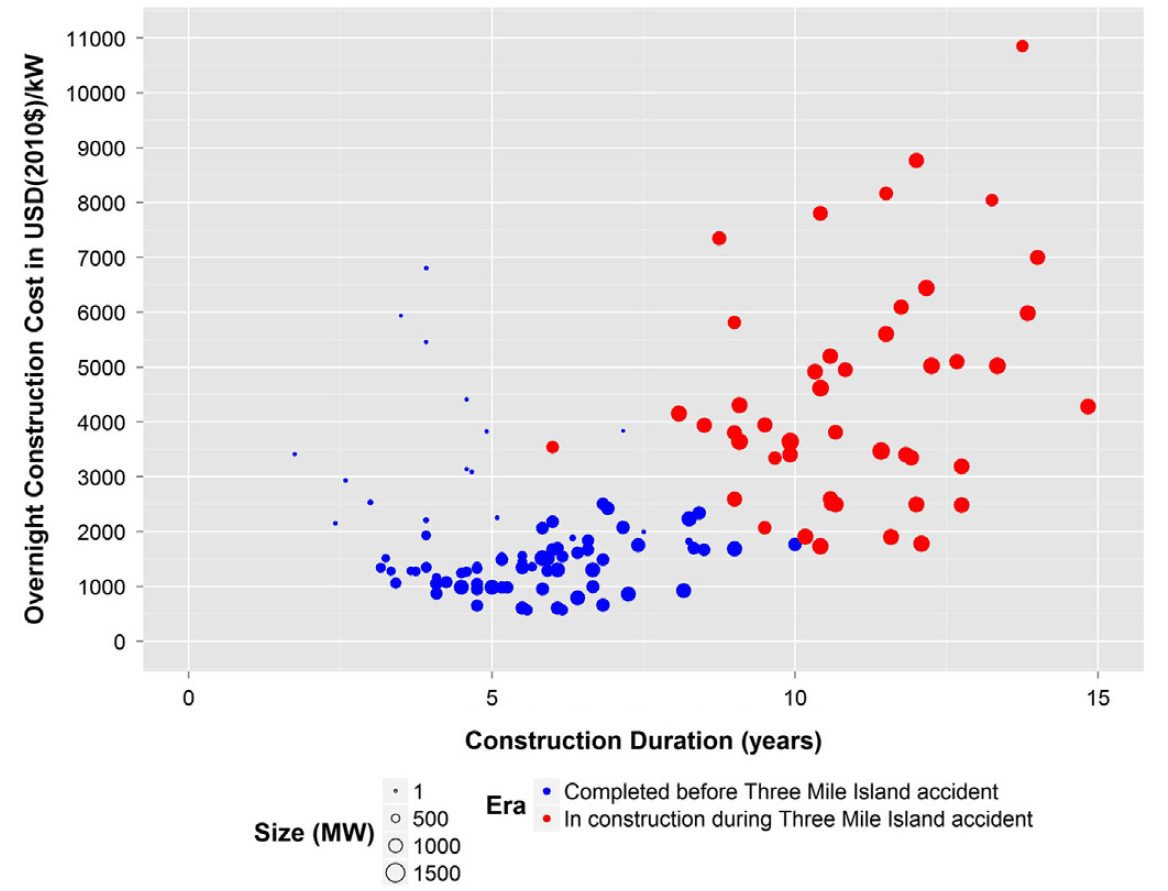
Overnight, the construction costs and timelines of nuclear plants spiraled out of control.

nuclear reactor construction cost and duration

For the fifty-one reactors under construction when TMI occurred, regulatory delays and retrofit requirements were everywhere.

Median costs soared nearly 300 percentโ€”more than $7,000/kW for some reactors.

Applications for new nuclear reactors evaporated instantly.

And more than 120 reactor orders were cancelledโ€”more than the entire current U.S. nuclear fleet.

With no new reactors being built, the learning rate was completely dead.

And the price of nuclear construction had no way of going down.

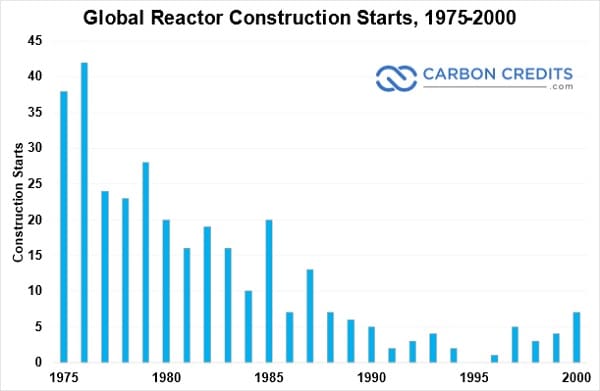
From the mid-โ€˜80s until now, every nuclear project has been another ultra-high-cost FOAK.

But hereโ€™s the good news: The United States is beginning to return to its pre-disruption deployment and learning rates.

  • And the learning curve is quickly restarting in the United States.

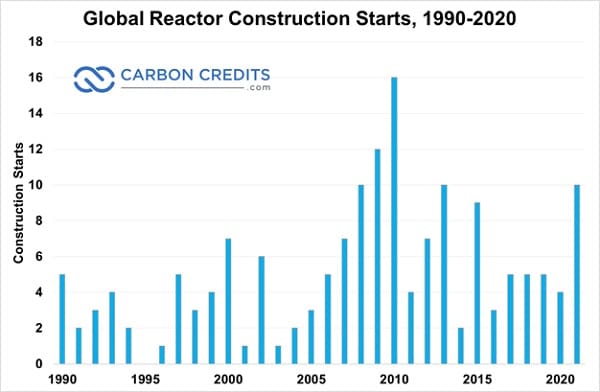
Global nuclear reaction construction starts

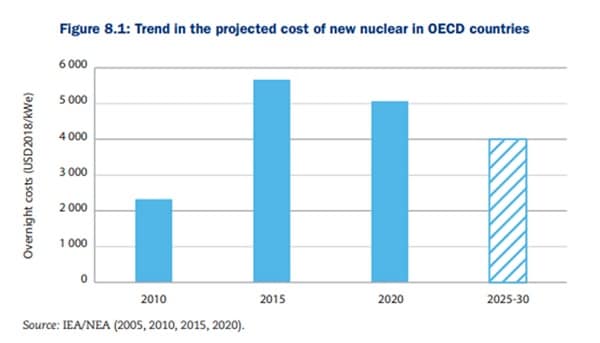
As new constructions rise, the cost is already dropping and is set to drop more than 30 percent from 2015โ€“2030.

If the U.S. invests about $1 trillion into nuclear energy by 2050, it could supply more than 3,500TWh of energy per year.

  • Nuclear would provide 85 percent of current energy consumptionโ€”all carbon-freeโ€”for less than half of the CARES Act stimulus.

And the cost of nuclear per MWh would drop by about 60 percent, which would have been great for the clean energy and net zero transition.

Projected cost of new nuclear in OECD countries

Studies have found that there is nothing inherently expensive about nuclear.

And as the learning curve comes alive again, nuclear is set to get much, much cheaper.

Go to next chapter >

The Anti-Human Environmentalist Who Nearly Exterminated Nuclear

0
On May 7, 1966, Martin Litton voted against the construction of a nuclear plant in Diablo Canyon, California.

Martin was on the board of directors of the Sierra Club, an influential environmentalist group. And although no one knew it that day, his vote marked the beginning of the end for nuclear power. 

Most of the Sierra Club board voted for the nuclear plant. After all, nuclear was (and still is) the safest, cleanest, most reliable energy on the planet. Environmentalists and lobbyists at the time gave full-throated endorsements of the new technology:

โ€œNuclear energy is the only practical alternative that we have to destroying the environment with oil and coal.โ€
โ€“ Sierra Club Director Ansel Adams


But Martin was hell-bent on making sure that plant wasnโ€™t built…

You see, he believed that California didnโ€™t need any new power plantsโ€”period.

โ€œYou donโ€™t need powerโ€ฆ you can go back to using a spear and picking berries.โ€ โ€“ย Martin Litton

In fact, California didnโ€™t need any more people.

You see, for Martin and two other directors of the Sierra Club, nuclear plants presented a problem:

They brought humans with them.

And Martin wanted a drastic reduction in population to keep California wild. โ€œThere are too many people anyway,โ€ he said.

Along with two other directors of the Sierra Club, he fought for yearsโ€”tooth and nailโ€”against the construction of the Diablo Canyon nuclear plant.

They quickly decided playing fair was optional. Theyโ€™d lie, cheat, and steal to keep nuclear from blowing up.

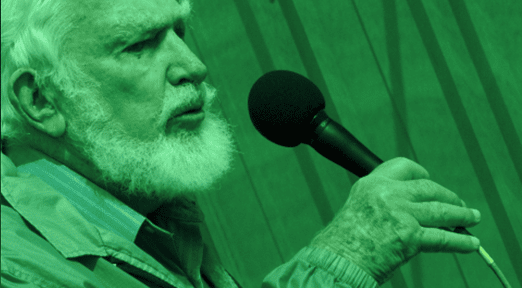
martin litton

But their radical anti-growth, anti-human message was never going to work on Californians.

So these environmentalists and other anti-nuclear activists changed their tactics.

Instead of persuading the public, they would prey on their ignoranceโ€”and scare the fire out of them.

The Day Nuclear Died

Their first objective became to get people to confuse nuclear energy with nuclear bombs.

Since atomic energy had first been used to level cities at the end of World War II, it was childโ€™s play. Millions became convinced that a nuclear meltdown was the same as a nuclear bomb.

Then, they fed generations of people the lie that radioactivity from nuclear energy could kill them.

The logic was sound: When people thought nuclear was a threat to their lives, theyโ€™d regulate it out of existence.

โ€œOur campaign stressing the hazards of nuclear power will supply a rationale for increasing regulationโ€ฆ and add to the cost of the industry.โ€

โ€“ Sierra Club Executive Director Michael McCloskey, 1974

The campaign was wildly effective. Due to new regulations, parts of plants that had already been built had to be ripped out and rebuiltโ€”leading to absurd cost increases.

The DC Circuit Court handed the environmentalists a gift on a silver platter. They opened the door for citizen lawsuits to intervene in the licensing and construction process.

That slowed construction even further, causing costs to skyrocket and nuclear plans to be abandoned.

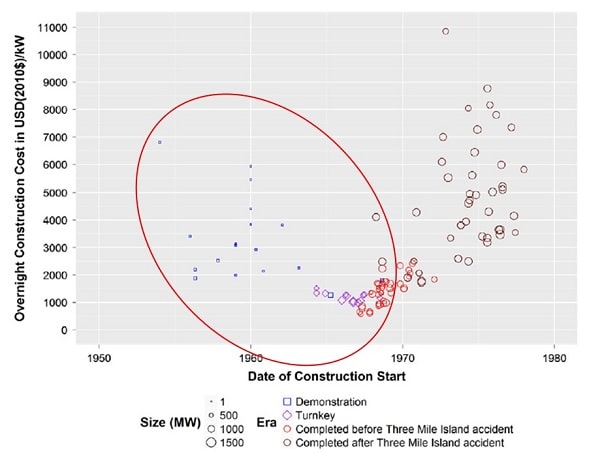
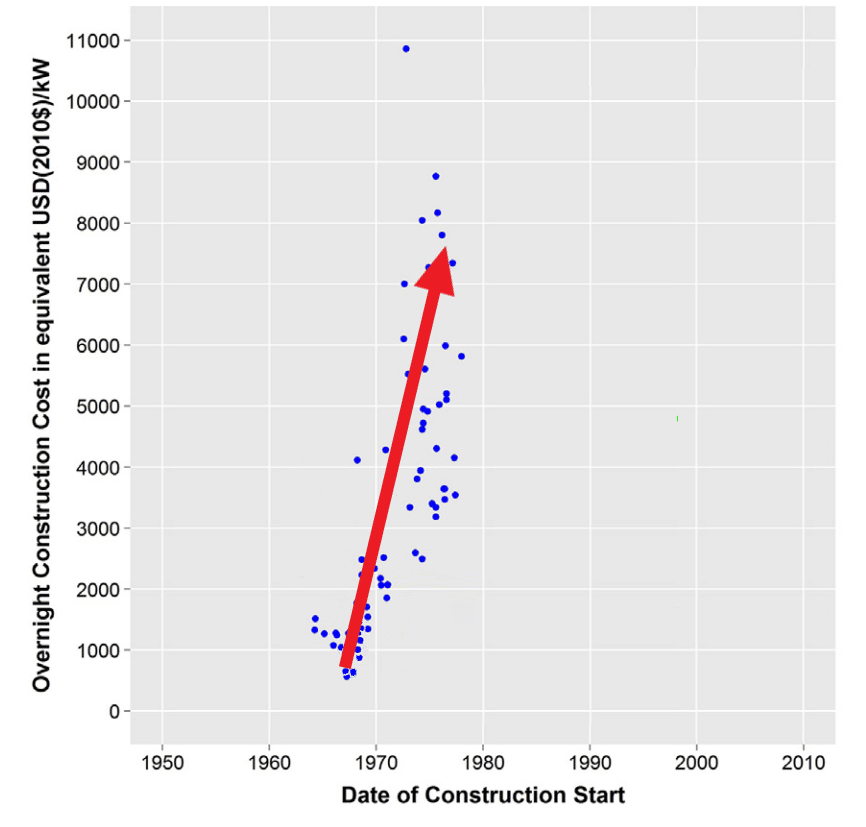
For any nuclear plant started in the U.S. in the early โ€˜70s, the price of construction skyrocketed.

Date of construction start of nuclear power plant

Two nuclear reactors, Vogtle 1 and 2, were proposed in 1971 for $660 million. They opened in 1987 and 1989 for a total cost of nearly $9 billion.

In 1974, activists were successful in getting the Atomic Energy Commission abolished.

It was replaced by the Nuclear Regulatory Commission (NRC), which became responsible for licensing new nuclear reactors.

  • Since the NRC was formed, the number of new nuclear plants that have broken ground in the United States is zero.

Two years later, the California Energy Commission decided it only approve nuclear plants if the developers could give precise fuel and waste disposal costs for the lifetime of the plantโ€”a deliberately impossible task.

As goes California, so goes the nation. And more than 30 states followed suit.

In 1978, Kern County voters rejected a nuclear power plant for the first time in U.S. historyโ€”with 70 percent voting against. It would have been the highest-capacity nuclear plant in the world.

  • Radical regulations, rising costs and a scared public caused more than 60 nuclear units to be canceled between 1975 and 1980.

Thanks to the help of Martin Litton and the Sierra Club, nuclear was dead on arrival.

When the Rubber Meets the Rolling Blackouts

Two plants, Diablo Canyon and San Onofre, barely made it out alive.

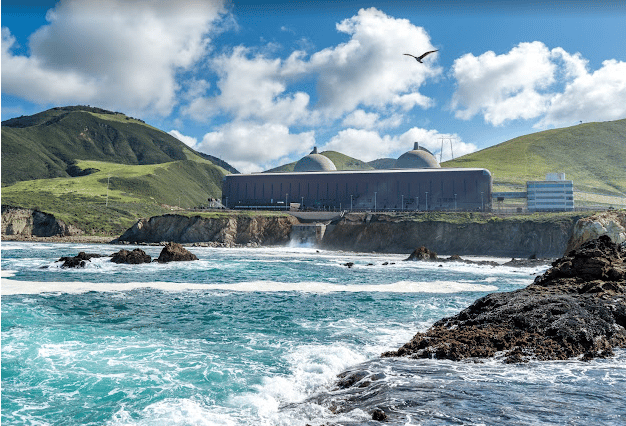
Diablo Canyon nuclear plant
Diablo Canyon

For decades, they provided more than 20 percent of Californiaโ€™s energy consumption.

In other words, just 8 more plants would provide California with 100 percent carbon-free energy for the entire 21st century.

It was exactly that massive amount of clean energy from nuclear that became its undoing.

You see, figuring out how to shut down nuclear would create a profitable billion-dollar business for solar, wind, and natural gas companies overnight.

When renewable lobbyists caught wind of the opportunity, they went into hyperdrive. No need to play clean for this round, either.

And they very nearly succeeded in killing off nuclear for good.

They started with San Onofre, which was forced to close in 2012.

Its main energy replacement? Carbon-heavy natural gas.

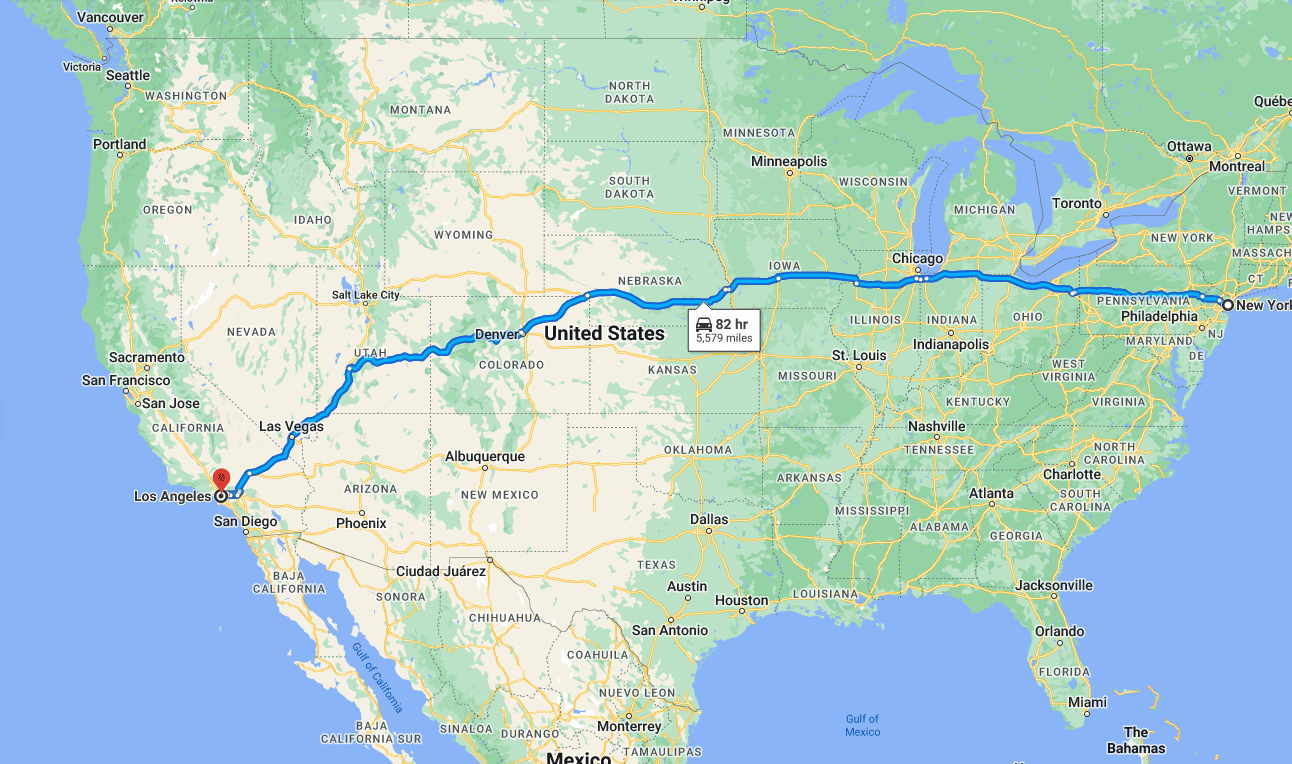
  • Shutting down San Onofre was the equivalent of putting two million cars on the road.

Those two million cars lined end to end would make a convoy from Los Angeles to NYC (and back again).

LA to NYC

Then the lobbyists moved on to Diablo Canyon, forcing PG&E to agree to shut it down by 2025.

They claimed it would be cheaper to shut it down and replace it with other sources of energy than to continue operations.

Hereโ€™s the kicker.

That claim is based on a single study, funded by Friends of the Earthโ€”whose founder was the executive director of the Sierra Club.

And it flat out lies about everything . . . ย from fuel costs to capital costs to the cost of energy.

In fact, a report from MIT and Stanford says that keeping Diablo Canyon running until 2035 would reduce Californiaโ€™s carbon emissions by 11 percent.

It would also save the state $2.6 billionโ€”or $21 billion if it stays open until 2045.

(Or they could decommission the plant, which would cost nearly $4 billion.)

Fortunately, the side playing dirty is going to lose this time.

Because hundreds of thousands of Californians are already experiencing rolling blackoutsโ€”during triple-digit heat waves.

โ€œWe are in a very bad situation compared to even the worst case that we anticipated.โ€
โ€“ California Energy Commission vice chair Siva Gunda

One politician put it simply: If the plant gets decommissioned, โ€œwe donโ€™t have enough juice to keep the lights on and keep air conditioners working and keep peopleโ€™s EVs charged.โ€

Shutting down the cleanest, most readily available form of energy is political suicide.

The last time widespread outages occurred, the governor was kicked out of office.

And everyone knows it.

So at 1 a.m. on the last day of session, the state legislature voted to keep Diablo Canyon open.

For a half-century, Diablo Canyon has predicted the fate of nuclear.

And now, itโ€™s a signal of a broad revival of nuclear power across the country.

Go to next chapter >

The True Story of Nixon’s Nucleargate

0
In 1973, President Nixon seized on the nuclear frenzy with a new program he dubbed โ€œProject Independence”.

Calling to mind the Manhattan Project, Nixon wanted 1,000 nuclear plants to be built by 2000.

  • Those 1,000 plants would have provided 200% of the U.S.โ€™s power needs… in 2022.

No coal, no wind, no solar, no natural gas, no hydro. No carbon emissions. Just 100-percent-clean, made-in-America nuclear power.

Like others of his time, President Nixon saw the incredible promise held in the atom.

Nuclear power plants use tiny amounts of uranium, an abundant natural resource, as fuel. That means they only have to be refueled every 1.5 years.

And because uranium is extremely energy-dense, the mining impacts are minimal compared to coal, oilโ€ฆ even wind power.

Nuclear produces zero pollution from operations. It doesnโ€™t care if itโ€™s windy or sunny or rainy. It just goesโ€”operating more than 90 percent of the time.

Best of all, nuclear provides massive amounts of baseload powerโ€”about 1GW per reactor. That makes a single two-reactor plant capable of powering more than one million homes.

By every possible metric, nuclear is the best, most reliable source of carbon-free energy on the planet.

It should be powering much more of the planet. But it isnโ€™t.

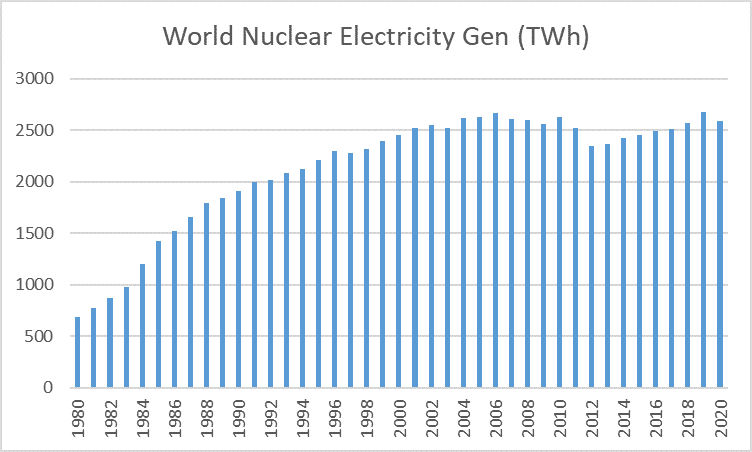
In fact, nuclear power has been stagnant for the past thirty yearsโ€ฆ and declining for the past decade.

World Nuclear Electricity Gen TWh

In the United States, zero nuclear power plants ordered since 1972 have been completed. And nuclear provides only 20 percent of electricity in the United States.

As nuclear power plants reach the end of their forty-year lifespans, one by one, the lights are going out all around the world.

Which begs two questions:

  • If nuclear power is so star-spangled awesome, then how exactly did it end up on life support? And whenโ€”if everโ€”is that going to change?

The Nuclear Boom That Went Out with a Bang

Twenty-five years before Nixon famous speech, the Atomic Energy Commission (AEC) had funded four different types of โ€œatomic piles,โ€ as experimental nuclear reactors were then called.

Their purpose was not to generate massive amounts of power. The AEC was just throwing atoms at the wall to see what would stick.

Because of World War II, AEC worked mostly in secretโ€”few in the outside world had even heard of nuclear power.

That changed suddenly in 1953. President Eisenhower decided the world needed to know the vast energy potential held by the atom.

It was time for the U.S. to reorient its research efforts from using atomic energy for destructive purposes and toward generating electricity.

So Eisenhower went before the United Nations in New York City and delivered a powerful speech titled โ€œAtoms for Peace.โ€

When he finished, the entire chamber leapt to its feet, giving Eisenhower a 10-minute standing ovation.

  • In just a few moments, the President had set in motion decades of civil nuclear energy development in the U.S.

It was an Atomic Race of sorts, with the U.S. vying with other countries to create a civilian nuclear power sector as quickly as possible.

The following year, the AEC announced a government-sponsored five-year plan to explore various types of commercial nuclear reactors to find the best one. Every configuration of coolant and fuel and system had to be tried in order to identify a safe, economical nuclear system.

Early projects were extremely expensive.

But within a decade, GE and Westinghouse, figured out how to build giant, economical light water reactors (LWRs).

That move kicked off what is now known as โ€œThe Great Nuclear Bandwagon.โ€

GE and Westinghouse sold dozens of turnkey plants in just four yearsโ€”without any subsidy from the government.

It was a daring effort to jumpstart a global commercial nuclear power market.

And it worked.

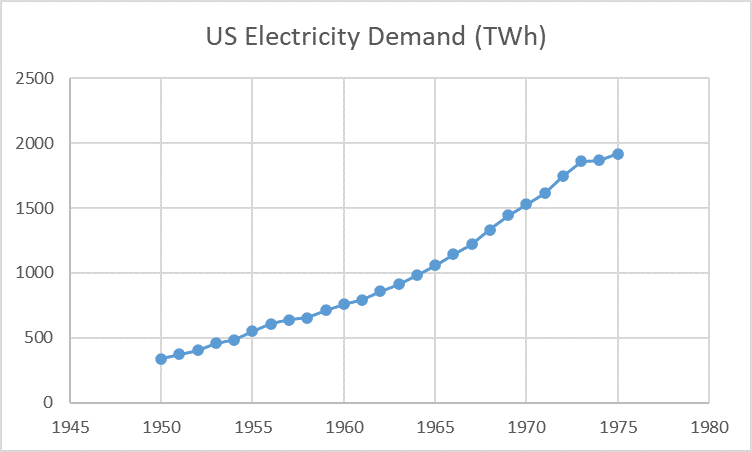
More than 100 reactor orders were placed to meet the growing electricity demand.

US Electricity Demand TWh

And two years later, nuclear power plants were being sold at costs that were competitive with fossil-fuel plants.

Construction costs for new reactors dropped to $600โ€“$900/kW in todayโ€™s dollars.

  • For context, thatโ€™s cheaper than modern gas plants.

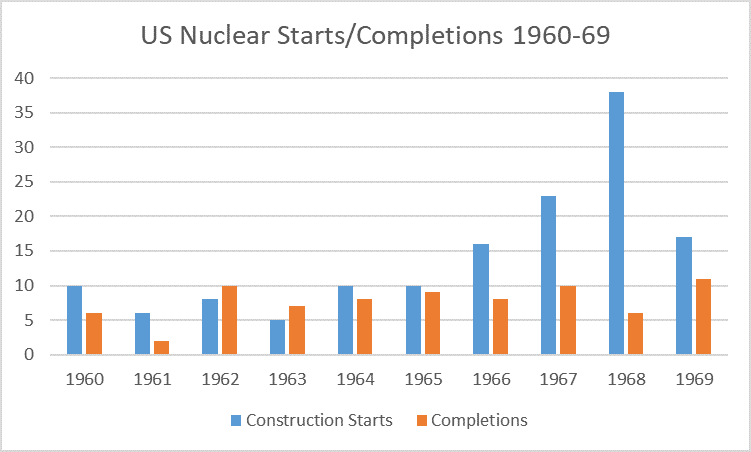
With energy that cheap, nuclear business boomed, spreading across the U.S.โ€”and the worldโ€”like wildfire.

US Nuclear Starts Completions 1960

Just as soon as it started, it was over. By the early โ€˜70s, many utilities stopped ordering new reactors and cancelling in-progress projects.

By 1980, nuclear plant orders had come to a dead halt.

The Four Bogeymen of the Nuclear Boom

On its rocket-ship trajectory from Eisenhowerโ€™s speech to executing Nixonโ€™s Project Independence, nuclear power faced five major problems.

The first of those was public perception. Nuclearโ€™s initial downfall was orchestrated by radical environmentalists who stirred up hysteria against nuclear plants.

Starting in the โ€˜60s, they waged a well-funded, well-organized War on Nuclear.

Their work caused strict regulations to be passed. The resulting high pricesโ€”especially compared to other forms of energyโ€”caused nuclear projects to be cancelled or decommissioned.

They were benefited by declining energy costs from other forms of energy like coal and gas, which made nuclear uneconomical.

Then there was the problem of waste management. There was no federal program for storing the small amounts of radioactive waste created by nuclear power.

Then, two high-profile nuclear accidentsโ€”Three Mile Island and Chernobylโ€”confirmed the publicโ€™s safety concerns with nuclear energy.

With public support plummeting, countries like Austria made nuclear power illegal.

But over the past few decades, the real horseman of the apocalypse has come riding in: climate change.

While countries like Austria and Germany are struggling to meet carbon emissions reduction targets with intermittent wind and solar, the wind is shifting in another direction.

  • Public perception toward nuclear is rising just as fast as the temperature
  • The price of new nuclear reactors is dropping thanks to modular innovations
  • The price of natural gas has more than quadrupled in one year
  • Several countries have figured out efficient, long-term waste storage solutions
  • And nuclear reactors have become the safest form of energy on the planet.

Itโ€™s not a moment too soon.

The International Energy Agency says that the nuclear industry will need to double in size over the next two decades for us to meet net zero emissions targets.

There are just over 400 nuclear reactors in operation around the world right now.

Looks like Eisenhower made the right move.

And Nixon might have been ahead of his time when it comes to nuclear power.

Go to next chapter >ย 

Carboncredits.com receives compensation for this publication and has a business relationship with any company whose stock(s) is/are mentioned in this article.

Additional disclosure: This communication serves the sole purpose of adding value to the research process and is for information only. Please do your own due diligence. Every investment in securities mentioned in publications of carboncredits.com involves risks that could lead to a total loss of the invested capital.

Please read our Full RISKS and DISCLOSURE here.

India Unveils Long-Term Strategy to Reach Net Zero at COP27

0

India submitted its long-term climate strategy at the COP27 summit underway in Egypt, joining a selected list of countries that have clear pathways on how to achieve their net zero goals.

Under the Paris Agreement, all countries have to submit by 2020 a climate strategy to the UN Framework Convention on Climate Change (UNFCCC) detailing how theyโ€™ll help fight global warming. These plans are called the Long-Term Low Emissions and Development Strategies (LT-LEDS).

So far, only 57 nations have submitted their LT-LEDS and India is the last of the biggest emitters to do so.

Unlike Nationally Determined Contributions (NDCs), LT-LEDS focus on a longer time horizon. Countries donโ€™t have to report progress on their long-term climate plans as the case with NDCs.

The worldโ€™s second-largest consumer of coal aims to prioritize a phased transition to cleaner fuels. It will also reduce household consumption to reach net zero emissions by 2070, according to its 100-page low-carbon strategy.

Minister for Environment, Forest and Climate Change Bhupender Yadav launched the countryโ€™s LT-LEDS, saying that:

โ€œThis is an important milestone. Once again, India has demonstrated that it walks the talk on climate change… Indiaโ€™s LT-LEDS articulates Indiaโ€™s vision and action plan for achieving its NDC goals and the target of net zero emissions by 2070. And we are placing before all, the key elements of Indiaโ€™s transition to a low-carbon development pathway.โ€

What’s New in India’s Climate Plan?

India updated its NDC last Augustย with these two major climate goals:

  • Slash emissions intensity of its Gross Domestic Product (GDP) by 45% from 2005 levels by the year 2030
  • Achieve about 50% cumulative electric power installed capacity from non-fossil fuel-based energy resources by 2030

The countryโ€™s updated climate plan said India is on track to meeting its NDC commitment. That involves 2.5 – 3 billion tonnes of carbon sequestration in forest and tree cover by 2030.

The document also noted that the update will help the nation achieve its long-term decarbonization. It further states that climate finance estimates needed to hit net zero vary. But for India, itโ€™s โ€œin the order of tens of billions of dollars by 2050 and around โ‚น85.6 trillion ($1B) by 2030โ€.

Noting this, the Indian delegate at COP27 summit raised the issue of climate finance once again. Yadav said that the provision of climate finance by developed countries will play a very significant role and that:

“needs to be considerably enhanced, in the form of grants and concessional loans, ensuring scale, scope, and speed, predominantly from public sources, in accordance with the principles of the UNFCCC.”

The 3rd largest emitter has been pledging to phase down coal use. It has also become a big consumer of renewable energy such as solar.

  • It achieved its goal of having 40% of its electricity capacity come from renewable energy in 2021.ย 

But whatโ€™s new in Indiaโ€™s climate strategy is its focus on slashing consumption at the household level and the inclusion of carbon capture, use and storage (CCUS).

CCUS includes technology that can capture carbon from polluting industries so it never enters the atmosphere. The Indian government will focus on the economic, technical, and political feasibility of CCUS while advancing its technologies.

Focus Areas of Indiaโ€™s Net Zero Strategy

Indiaโ€™s long-term low-carbon strategy is based on four key considerations.

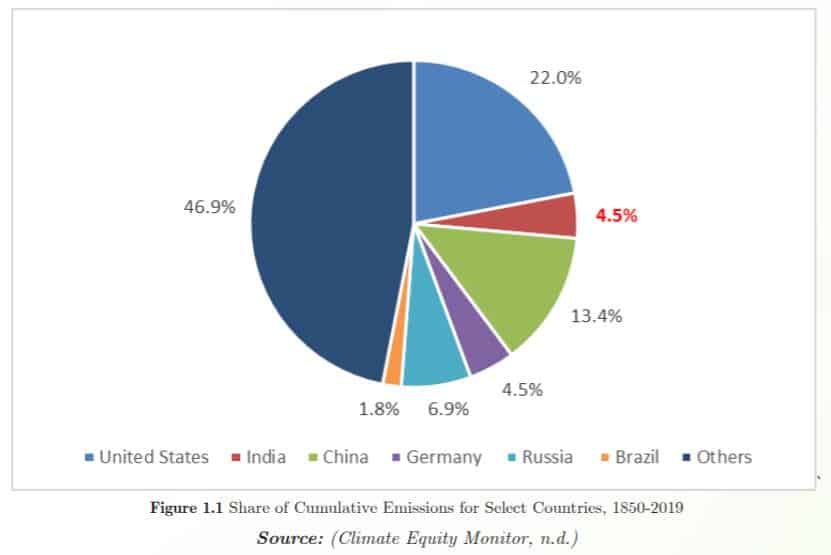
  • The country has contributed little to global warming, as shown in the chart.

India emissions global contribution

  • It has significant energy needs for development.
  • It commits to pursuing low-carbon strategies for development.
  • India needs to build climate resilience.

The nationโ€™s LT-LEDS zooms in on 6 key areas to reduce emissions: electricity, urbanization, transport, forests, finance, and industry.

For instance, the government plans to increase the use of biofuels, particularly ethanol blending in petrol. This will help boost the number of electric vehicles in the country. This aligns with Indiaโ€™s aim to expand public transport networks and use more green hydrogen fuel.

In particular, India seeks to maximize the use of EVs and ethanol blending to be at 20% by 2025. Its net zero strategy also aims to achieve a 3x increase in nuclear capacity by 2032 to boost the power sector.

The government also announced a push on industrial development, aiming for energy efficiency improvements. These are especially in the sectors of steel, cement, and aluminum.

More importantly, the net zero strategies of India will center on the rational use of national resources with regard to energy security.

While its LT-LEDS outlines an ambitious plan, the COP27 delegate said the nation could not โ€œhave a situation where the energy security of developing countries is ignored in the name of urgent mitigation.โ€

On top of it all, the transition from fossil fuels will be done in a just, smooth, sustainable, and all-inclusive manner, Indiaโ€™s long-term plan said.

BeZero Carbon Closes $50M for Expanding Carbon Rating Platform

London-based climate tech startup BeZero Carbon secured $50 million (about โ‚ฌ48M) in a Series B round to scale its carbon rating platform and expand into the US and Asia.

BeZero Carbon is a ratings agency founded in 2020 for the voluntary carbon market (VCM). Its ratings are determined by scientists, earth observation specialists, and financial analysts.

BeZero’s users include major energy institutions, commodities, and the financial sector. The firmโ€™s platform also supports credit buyers, investors, project developers, brokers, carbon marketplaces, and top exchanges.

For Scale Up & Expansion

BeZeroโ€™s latest $50 million funding round is the largest Series B raise in UK climate tech this year. The company raised a total capital of over $70 million.

The firm’s CEO Tommy Ricketts said:

โ€œ… Starting with carbon, effective ecosystem markets have huge potential to accelerate the Net Zero transition and generate economic prosperity. Developing the information infrastructure that allows these markets to take off is fundamental to their growth. The raise will ensure we can continue to invest in our ratings, risk and analytics tools to make this vision a reality.โ€

US-based investment firm Quantum Energy Partners led the round, with more investments from old and new partners:

  • Molten Ventures
  • Norrsken VC
  • Illuminate Financial
  • Qima
  • Contrarian Ventures
  • EDF Pulse Ventures
  • Hitachi Ventures
  • Intercontinental Exchange (ICE).

The startup said it would use the funds to drive innovation in the VCM. And thatโ€™s through developing ratings, risk and analytics tools, and opening offices in New York and Singapore.

The funding will also be for investing in creating risk-based products for other markets. BeZero will further use it to develop its proprietary toolkit, deepen its earth observation capabilities, and expand the team.

The BeZero Carbon Rating Methodology

The BeZero Carbon Rating (BCR) gives users a risk based assessment for understanding and evaluating carbon credit of any type, in any sector and country.

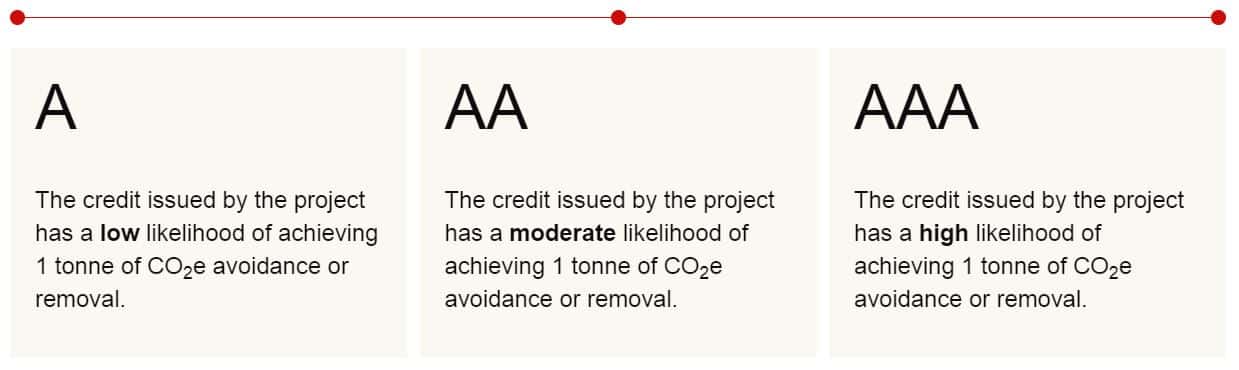
The BCR of carbon credits represents the firm’s opinion on the likelihood that a given credit achieves a tonne of CO2e avoided or removed. It uses a 7 point scale across 3 categories: A, AA, AAA.

BeZero carbon ratings categories

BCR Qualifying Criteria:

Projects must meet these 3 key criteria to be eligible for a BeZero Carbon Rating.

  • Applied an additionality test or provide enough information on how it is additional
  • Audited by a recognized independent auditor to ensure the credibility of data and information
  • Information on project design and ongoing monitoring must be available in the public domain at all times

BCR Analytical Framework:

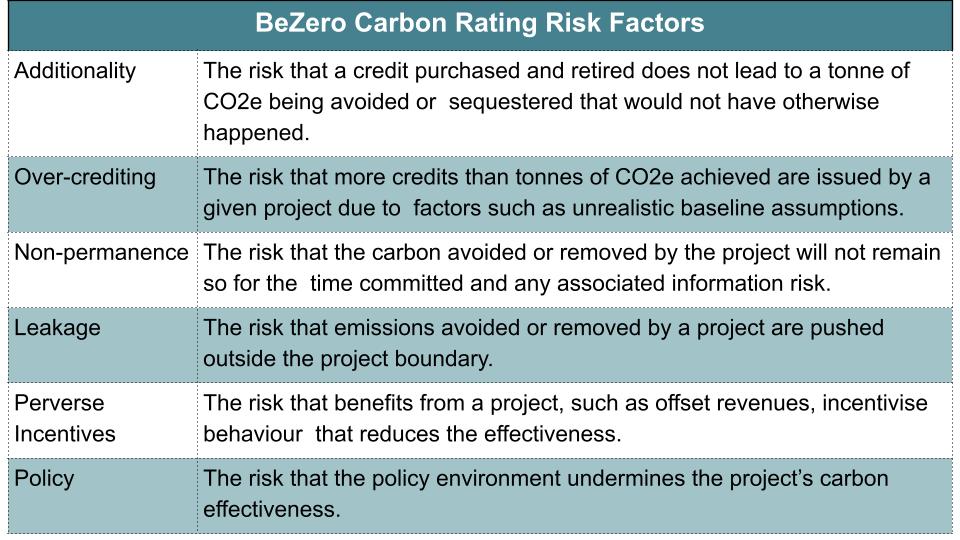
The BCR follows a robust analytical framework with detailed assessment of the following 6 critical risk factors. They significantly affect the quality of carbon credits issued by the project.

BeZero Carbon Rating Risk Factors (1)

The BCR Process:

BeZero rates a projectโ€™s carbon credits in a 4-stage process.

#1. Macro factor assessment: making top-down assessment of the credits based on country-specific risks, sector, and accreditation methodology.

#2. Project specific assessment: assessing project-specific risks based on all publicly available information on projectโ€™s credits.

#3. Risk factor weighting: summing up all the specific weighting for each risk factor, according to these percentage.

bezero risk factor weighting

#4. BCR committee review: The Rating Committee reviews all ratings and must approve them before assigning final BCR to the carbon credits.

Ensuring Transparent Growth of VCM

All BeZero Carbon Ratings are valid at all times and are tracked on an ongoing basis. The monitoring process involves reviewing all new information about the project, sector, and methodology.

Thatโ€™s to ensure that the VCM grows in a transparent way, delivering a real impact on the planet.ย 

Jeffrey Harrisย from Quantum Energy Partners noted that:

โ€œSet to reach $50bn by 2030, the Voluntary Carbon Market will play a central role in the transition to Net Zero. BeZero Carbon has built the biggest ratings agency in the market, with an incredible team of experts that are leaders in their fields. We are excited to be supporting them with their next stage of growth to help build a new climate economy.โ€

All headline ratings are available on the firmโ€™s website, making it the only carbon ratings agency to do so.

With more information readily available to assess a carbon creditโ€™s quality, the more confidence investors and buyers can have that itโ€™s achieving its claim towards a net zero emissions.

Paying clients can access full project assessments, research insights and risk tools via its platform. And by integrating its API, carbon credit marketplaces and exchanges can also host the BeZero Carbon ratings.

Nations Strike First-Ever “ITMO” Emissions Trading

Ghana and Switzerland, along with Vanuatu, have approved at COP27 the first-ever voluntary cooperation under Article 6.2 of the Paris Agreement called the Internationally Transferred Mitigation Outcome (ITMO).

ITMO is a carbon emissions trading system where countries can purchase or trade carbon credits from other countries. This can open the door to creating new carbon markets and larger reductions in global GHG emissions.

The countries showed during the summit how the pioneering ITMO transaction will enable the reduction of greenhouse gas (GHG) emissions while promoting the Sustainable Development Goals (SDGs) in developing nations.

According to the United Nations Development Programme, commenting on this collaboration, UNDP Administrator said that:

โ€œThis initiative is an example of UNDPโ€™s ‘future-smart’ approach to development, which aims to use innovative financial mechanisms and partnerships with governments and the private sector to empower countries to follow a sustainable development pathway, leaving no one behind…โ€

The First-Ever Approved ITMO

Article 6 of the Paris Agreement replaces previous forms of international carbon credits.

It recognizes that some countries may enter voluntary cooperation in implementing their Nationally Determined Contributions (NDCs) to allow for higher climate mitigation ambition and actions and promote sustainable development.

Apart from cutting emissions, climate mitigation projects can also deliver many development benefits. These include gender empowerment, food security, access to energy, livelihood support, job creation, and more.

  • ITMO trading allows countries in under-compliance to buy ITMOs from countries in over-compliance.

At COP27, Ghana presented the landmark bilateral authorized project under ITMO deal with Switzerland. Meanwhile, Vanuatu also did the same for the first-ever unilateral ITMO projects.

By entering into bilateral agreements with Ghana and Vanuatu, Switzerland will reduce its GHG emissions by using ITMOs. Doing so will help the implementation of projects with development benefits.

The project in Ghana will help thousands of rice farmers practice sustainable agriculture to cut methane emissions. These farmers cover about 80% of Ghanaโ€™s rice production.

Via the ITMO deal, those farmers will also get extra income with carbon revenues for increased resilience and more efficient water use.

A representative from Ghana, Dr. Kwaku Afriyie, remarked that:

โ€œGhanaโ€™s leadership in Africa on carbon finance with the landmark bilateral agreement with Switzerland is something we are proud of. We want to leverage this collaborative approach to crowd in more carbon revenue to accelerate the implementation of our national climate plan for the benefits of many communities…โ€

While the deal with Vanuatu will provide access to electricity to those who donโ€™t have it through renewable energy sources. Vanuatu is a small Island Developing State (SIDS).

Creating Demand for ITMOs

The UN Development Programme (UNDP) is among the first to create strong demand for ITMOs via its Carbon Payment for Development facility. Through this initiative, the UNDP will help design and implement mitigation projects.

The goal is to leverage carbon markets to enable private investments to support SDGs. New projects can help reduce up to 2.3 million tCO2 equivalents. To amplify the impact of these projects, UNDP will focus on the ones supported by the private sector.

It will channel payments for ITMOs to project proponents who invest in low-carbon solutions that create additional revenue for investors.

  • Under this payment-for-result scheme, investments from the private sector will be up to 4x the carbon payments from the ITMOs.

UNDP launched at COP27 a new digital platform called Carbon Cooperation to help developing countries build capacity, enhance ITMO workflows, and improve their carbon market readiness. It will also make their ITMO projects become more efficient and transparent.

In partnership with UNFCCC, UNDP also introduced its Article 6.2 capacity development online course.

The course seeks to equip participants in making decisions related to cooperative approaches such as the first-ever ITMO agreement between Ghana and Switzerland. It will also help policymakers understand the vital components of executing this new carbon market mechanism in their country.

Fossil Fuels and Coral Reefs: 4 Key Takeaways From COP27 Summit

0

The COPs are the most important annual climate conferences but this yearโ€™s 27th annual summit or COP27 is different from the previous ones.

Itโ€™s all about moving from mere negotiations and planning for the net zero pledges to implementing promises to protect forests and provide climate finance.

During the first three days, talks center on carbon credits and compensating developing nations for โ€˜losses and damagesโ€™ caused by climate change. The UN had also made clear its zero tolerance for greenwashing.

But thereโ€™s a lot more to expect and learn from COP27 and here are the four key takeaways.

#1. Emissions from fossil fuels are 3x higher than what producers claim.

Climate TRACE, an NGO tracking emissions, released a report at COP27 that analyzed 72,612 individual sources of CO2.

Their study revealed that fossil fuel emissions could be up to 3x higher than what oil and gas companies claim.

The authors found that half of the biggest polluters are oil and gas fields. They used satellite technology to detect unreported emissions such as methane leakage.

  • The top sources of global emissions represent less than 1% of total facilities reported in Climate TRACEโ€™s dataset. But they account for 14% of total emissions in 2021.

The Permian Basin, an oil and gas field in the USA, is the most polluting project in the world as per the report. It has emitted 471 million MT of CO2e in the last 20 years. A Russian oil and gas field, Urengoyskoye, came second, emitting 317 million MT of CO2e for the same period.

Understating emissions from fossil fuels by oil and gas firms is โ€œgreenwashing and cheatingโ€, according to UN Secretary General Antรณnio Guterres. He further remarked that:

โ€œThe climate crisis is in front of our eyes – but also hidden in plain sight. We have huge emissions gaps, finance gaps, adaptation gapsโ€ฆ But those gaps cannot be effectively addressed without plugging the data gaps. After all, it is impossible to effectively manage and control what we cannot measure.โ€

Al Gore, former US vice president and a founding member of Climate TRACE, also said at COP27 that:

โ€œThe climate crisis can, at times, feel like an intractable challenge – in large part because weโ€™ve had a limited understanding of precisely where emissions are coming from.โ€

Gore further noted that accurate and detailed data on emissions sources help us prioritize efforts to reduce planet warming gasses significantly.

#2. Africa needs up to $41.6 trillion to tackle the climate crisis.

The COP27 summit has been dubbed as the โ€œAfrican COPโ€. What the African countries have to say takes center stage at the talks.

Africa is so vulnerable to climate change. NGOs in the continent said that staple crops and fish harvests will decline in the coming years. Plus, the 116 million people in Africa will experience issues with rising sea levels.

Investment opportunities are very important for the continent, especially when it comes to water, cooling, and coast protection, according to the International Finance Corporation analysis.

  • In fact, the Minister of Environment for Egypt Yasmine Fouad told COP27 that Africa needs up to $41.6 trillion (โ‚ฌ41.4 trillion) by 2030 to deal with the damaging effects of climate change.

She also added that funding was a key challenge but is a must to โ€œbridge the gaps between the needs and climate fundingโ€ for African nations.

Unfortunately, the worldโ€™s richest nations failed to deliver their $100 billion funding per year pledge for developing countries. And while there have been hunches of support, African nations have yet to see if COP27 can help them find the right investors.

#3. Finance giants with net zero pledges still invest in firms causing deforestation.

Large banks and financiers form the Glasgow Financial Alliance for Net Zero (GFANZ). They pledged to hit net zero by 2050 before COP26 last year, knowing that protecting forests is vital to achieving it.

  • To date, the alliance members achieved only a 3% cut in investments associated with deforestation.

But a report launched at COP27 summit by Global Witness found that the finance giants still invest around $8.5 billion in firms at risk of causing deforestation. The NGO stated that:

โ€œA year on from COP26, GFANZ membership is at risk of becoming little more than a badge to be worn by banks and financiers, who continue to plough money into practices that are destroying our forests.โ€

The report found that GFANZ members have investments in agricultural businesses accused of deforestation. Examples include the Brazilian firm JBS where members of the group have acquired shares since COP26. Their investments in similar firms have also gone up.

So key leaders of the alliance such as Mark Carney, the former Bank of England Governor, urged members to end financing deforestation. They warned that โ€œthe world will not reach net zero by 2050 unless we halt and reverse deforestation within a decadeโ€.

And in October GFANZ announced it was dropping out of the โ€˜Race to Net Zeroโ€™. That came after the UN-backed campaign upped its standards and threatened to kick out non-performers.

#4. U.S. Agency pledges $15 million to protect coral reefs.

Coral reefs have long drawn tourists to the Red Sea peninsula and the COP27 venue in Sharm El Sheikh. But these diverse marine ecosystems are more than just a backdrop to the climate summit. They are home to over a thousand various species of fish and corals.

coral reefs in red sea

Yet more importantly, Egyptโ€™s coral reefs act as โ€˜coral refugiaโ€™ that can withstand the increasing impacts of climate change.

As such, they offer the global community the chance to protect marine ecosystems. And they also act as seed banks that can help restore degraded reefs.

Mindful of their global importance, the United States Agency for International Development (USAID) announced a major new fund to support this local ecosystem. At COP27 summit, USAID pledged $15 million to the Global Fund for Coral Reefs (GFCR).

  • This funding from USAID makes the total money raised by the GFCR to protect reefs to $187 million.

There will be more โ€˜blue carbon financingโ€™ announcements in the coming days at COP27 summit. They include financing mangroves and seagrass.

What is Carbon Financing And How to Participate in It?

In the simplest sense, carbon financing is the process of putting money to entities or activities that most need them or can put them to the most productive use. While there are all sorts of financing for personal or business use, thereโ€™s one type that often makes head turns – carbon financing.

You may also be raising your eyebrows if itโ€™s the first time you to hear it or if you want to know more about it. Thereโ€™s no need to wonder about it though because this article will explore carbon financing.

It will help you know the tools of this financing and walk you through the world of carbon credits and carbon markets. Youโ€™ll also learn how the government and the private sector works under a carbon financing scheme. Then youโ€™ll get to discover how you can also partake in this exciting space of carbon.

What is Carbon Financing?

Carbon finance supports an asset thatโ€™s the main culprit of global warming and climate change – carbon dioxide or its equivalent. Its sole purpose is to reduce global carbon emissions by offering opportunities to mitigate the effects of climate change through emissions reduction projects.

Carbon financing creates climate systems that make it possible to measure carbon and incentivizes both firms and individuals to reduce their carbon footprint. It often takes the form of annual payment to a project partner, be it an NGO, private, or public entity, for the emission reductions delivered by the project.

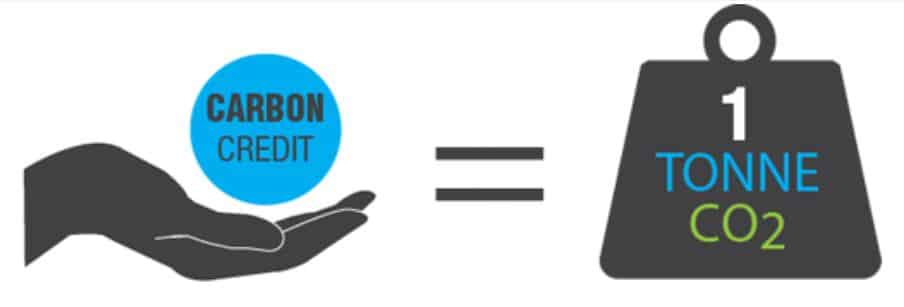
  • The emission reductions are typically measured in tonnes of carbon dioxide equivalent (tCO2e) and are represented by carbon credits. One carbon credit is equal to 1 tonne of tCO2e removed or avoided.

As such, carbon financing improves the financial viability of projects while creating additional revenue streams for developers and beneficiaries. It also enables the transfer of technologies and knowledge in the industry.

Best of all, carbon finance provides various means to leverage investments in projects that reduce GHG emissions in countries where theyโ€™re most viable. All the while helping the world to transition to a low-carbon economy.

But what makes this kind of financing possible and feasible? A carbon bank.

What is a Carbon Bank?

Carbon financing can only be effective in spurring the transition if the challenges associated with it are addressed. This is where the role of a carbon bank comes into play.

It seeks to sustain confidence in the system and ensure compliance by managing and minimizing carbon pricing volatility. It can choose how to manage the price, using some of the cost-containment mechanisms available.

A carbon bank can also help tackle some of the underlying factors of price volatility, such as market expectations and investor activities. Plus, it can also react to volatility due to external drivers like fuel prices and weather conditions.

The bank will not only be charged with price management, but would perform a range of market oversight and management functions. These include:

  • Professional forecasting: judgments or assessments with regards to emissions and carbon prices
  • Allowance management: allocating and tracking allowances as well as conducting auctions
  • Monitoring emissions: ensuring compliance and evaluating progress towards emissions reductions
  • Cost containment: buying and selling allowances and approving offset projects
  • Coordinating with different government bodies

Many jurisdictions, including Australia, Canada, and the United States, have explored the possibility of using a carbon bank as a potential tool to manage their carbon pricing as part of the overall policy objectives of the government.

What Are the Tools of Carbon Financing?

While there are a range of tools of carbon finance, the creation or allowance of carbon credits that can be traded in compliance or voluntary carbon markets, has been the top option.

That could be because this kind of financial mechanism places value on the reduction of carbon itself, which makes it a tradable asset. Turning emission reductions into carbon credits that can be traded in various exchanges and markets help stimulate the economy as the world fights climate change.

For carbon finance to work, carbon credits are essential. So, letโ€™s dig deeper into this carbon financing tool and the markets the credits trade.

What Are Carbon Credits and How Are They Created?

Carbon credits are tradable assets that represent one tonne of carbon avoided/removed from the atmosphere.

creating credits in carbon financing

They are created through projects that reduce carbon emissions. These projects vary a lot, from nature-based solutions to carbon removal technologies.

The types of carbon credits also vary, depending on what project creates them. So far, there are 170+ types of credits available in the market.

There are two ways to produce these credits:

  1. Development and operation of projects that remove and reduce carbon from the air
  2. Adopting practices or initiatives that purposefully reduce business-as-usual emissions

Under the first method, project developers document, report, and verify that their activities did remove and sequester or prevent a tonne of carbon from entering the atmosphere. Upon successful verification, a corresponding amount of carbon credits are created.

Itโ€™s the funds from carbon financing that support the emissions reduction projects. Common examples of these projects include forest management and protection, wind or solar power generation, and gas capture from landfills, mines or farms. The project developer can then sell the carbon credits they generate.

Under the second option, companies that alter their practices and verify the reduction in their business-as-usual emissions create carbon credits. For every tonne of carbon reduced, the entity gets a credit that it can trade in the market.

Both methods of creating carbon credits differ but they share one common goal – reduce emission levels. The ultimate aim is to reverse the effects of global warming.

Trading Credits in Carbon Markets: Voluntary vs. Compliance

Carbon credits in the voluntary carbon market (VCM) are known as carbon offsets of offset credits. Within the VCM, offset credits are exchanged horizontally between companies.

If one company removes one unit of carbon by improving their normal business activity, they generate a carbon offset credit. Other firms can then buy that credit to offset or compensate for their own emissions.

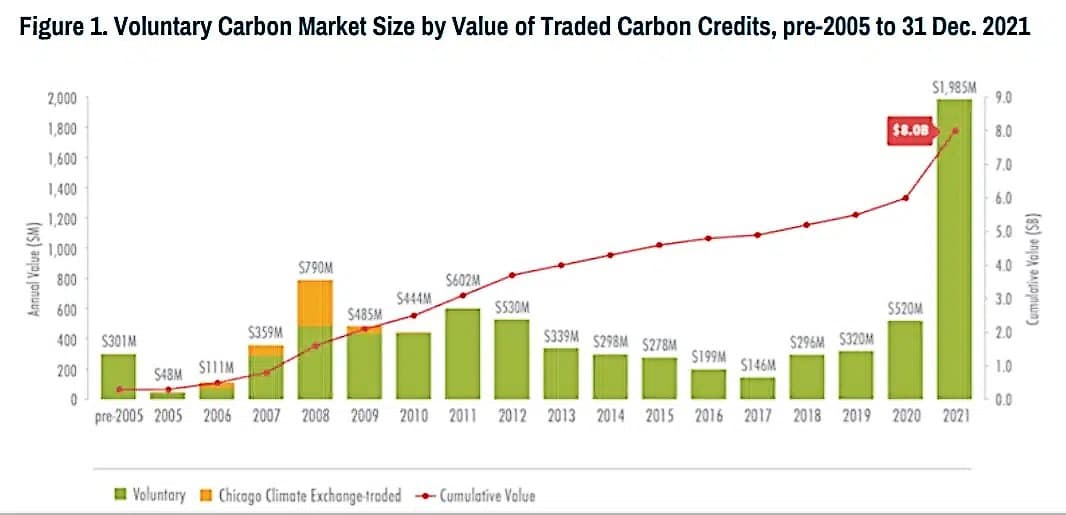
Here’s how the carbon offset credits trading performs over the years. The marketโ€™s total or cumulative value reaches $8 billion until 2021.

VCM market value 2021

Individuals and corporations can decide to buy carbon offset credits at any time they choose. Part of the revenue from the sale of the credits is put back into the projects to maintain them or invested into new projects. As such, carbon credits bolster the positive effects of this form of carbon financing.

Within the compliance or regulatory markets, carbon credits are called carbon allowances or certificates. They work like permission slips to emit carbon and other GHGs. The credits represent the number of emissions theyโ€™re allowed for a given year.

In a sense, money from carbon financing flows vertically from entities to regulators inside the compliance market. But companies who have excess credits (emit less than their allowance) can sell them to other firms who go beyond their allowed emissions level.

But since players in this carbon market are business entities from the same sector, the impact of the carbon credit finance is industry-wide.

The Role of Governments and Private Sectors in Carbon Finance

Carbon financing often involves government programs on compliance and how the private sector responds to carbon regulations. Climate policies that promote carbon finance in compliance markets can reduce the impacts large businesses have on climate change.

But it’s not only about companies changing their business models to comply with policies. Some entities in the private sector have also started to capitalize on carbon finance opportunities that compliance markets bring.

Letโ€™s consider some instances of how governments and the private sector affect carbon financing.

Green Credits and Bonds:

There are plenty of incentives present for businesses looking to create green projects. Green bonds and loans, for example, that cater to green project firms do a great job of creating these opportunities.

Most governments worldwide have portfolios in banks consisting of loans dedicated to green projects.

Likewise, green bonds offer an opportunity for investors to support projects that reduce global emissions. They often come with tax incentives as they fall under the category of environmental, social, and governance or ESG investing.

Carbon Taxes:

The purpose of a carbon tax is to change how entities do business to reduce their emissions. Carbon taxes apply to an entityโ€™s direct emissions as well as goods that emit CO2.

Taxing corporate emissions and goods like fossil fuels will prompt polluters to cut their carbon footprints. However, not all countries impose carbon taxes. Yet, some of them do such as in the case of EU states, some parts of the U.S. and Canada, too.

Cap and Trade Systems:

A cap and trade system works within the compliance carbon market. It sets a cap or limit on the level of carbon an entity can emit over a period of time. The cap decreases over time, so total emissions drop.

This scheme is also known as the Emissions Trading System (ETS). As mentioned earlier some industries emissions, particularly the heavy emitters like steel and iron, are heavily regulated.

Firms can sell their carbon credit allowances to others who need them to cover their cap to avoid fines. The carbon credits then become another revenue stream for the seller under this system.

ETS has been proven to reduce CO2 emissions significantly. For instance, the European Unionโ€™s ETS had reduced emissions by 29% in 2018 from 2005 levels. The California cap and trade program was also able to reduce covered entitiesโ€™ emissions by 10% in 5 years.

You can find the real-time prices for carbon credits traded in different ETS here.

How to Participate in Carbon Financing?

It’s undeniable that government regulations on emissions have significantly reduced carbon levels. Still, even more are possible with the help of individuals and businesses who seek to voluntarily slash their footprints.

This is where the voluntary carbon market becomes so important. When entities feel responsible to offset their emissions, they can work together and pool funds to finance carbon projects.

That resource is critical to help support new innovative climate solutions that are emerging today. If scaled, they may cut carbon emissions at a much faster rate than entities under the compliance markets alone.

So, how can you partake in carbon financing in the VCM?

The best way is to invest in emissions reduction projects by buying carbon offset credits they generate. You can choose from various carbon credit marketplaces online that sell those credits or directly from the project developers platform.

  • The amount of credits to buy depends on how much you want to voluntarily offset your personal or corporate emissions.

Carbon credit providers offer various options to suit different offsetting needs, from individual to big businesses.

You can even bet your money on carbon credits in spot exchanges and earn some profits. Blockchain-based or tokenized carbon credits are now emerging, giving market players a more transparent transaction.

Just see to it that the offset credits meet carbon standards to ensure they represent a real CO2 reduction.

Overall, whether it’s the VCM or compliance market, carbon financing creates essential opportunities to tackle emissions. More remarkably, the VCM enables individuals and companies to be part of the key financing that make carbon markets alive and grow.