Tesla (TSLA) Stock Slips After Q3 Results as Carbon Credit Revenue Plunges 44%

Tesla today released its third-quarter 2025 results. The company posted $28.1 billion in revenue, up 12 % compared with a year ago. Net income narrowed sharply to $1.4 billion, down roughly 37 % from the same quarter in 2024. The gross margin stood at about 18 %, down from 19.8 % a year earlier.

Vehicle deliveries reached a record 497,099 units, driven largely by strong demand ahead of the U.S. federal EV tax-credit expiration. Energy storage deployments grew, but Tesla reported a revenue drop.

More notably, sales from regulatory credits, also known as carbon credits, fell to $417 million, down 44% from last year.

Tesla highlighted operational strength in production and clean energy expansion. It also recognized outside pressures. These included falling carbon credit sales, higher costs, and a more competitive EV market. All of these factors affected profit margins.

CEO Elon Musk said Tesla is “staying focused on cost control and scaling clean energy.” He added that the company is improving factory automation and AI systems while expanding into new markets.

Carbon Credits Lose Power

Tesla’s carbon credit sales fell again in Q3. The company earned $417 million from selling credits, down 44% compared with $739 million a year earlier.

Tesla carbon credit quarterly revenue

For years, these credits have provided Tesla with extra income. The company makes money by selling zero-emission vehicles. Then, it sells the credits to automakers that don’t meet emission standards.

Major buyers include Stellantis (formerly Fiat Chrysler) and General Motors. They use Tesla’s credits to reduce higher fleet emissions. In Europe, Toyota, Ford, Mazda, and Subaru have joined pooling arrangements linked to Tesla and other EV makers. These credit deals remain a key income source for Tesla, even as rival automakers expand their own EV lineups.

Between 2019 and 2024, Tesla made more than $11.8 billion in credit sales. But as other automakers launch more electric models, demand for Tesla’s credits is declining. Analysts say this trend will continue as the EV market matures and countries tighten credit systems.

However, expected revenues will gradually decline. This will happen as global manufacturers meet stricter carbon standards and depend less on external credits.

Tesla’s CFO noted that while carbon credit income still helps overall results, it is now a smaller part of the company’s total revenue. The company’s goal is to rely on vehicle and energy product sales instead of external credits in the long run.

ESG Edge: Tesla’s Ongoing Climate Impact

Tesla continues to lead in cutting transportation-related emissions through its EVs and renewable energy systems. In 2025, the company estimated that its global fleet helped avoid more than 20 million tons of CO₂ compared with gas-powered vehicles.

Its Gigafactories use renewable power where possible. For example:

  • The Nevada Gigafactory sources most of its electricity from solar panels and nearby renewables.
  • The Texas Gigafactory plans to reach 100% renewable electricity by 2026.
  • The Berlin-Brandenburg Gigafactory uses energy from wind and solar farms in Germany.

In 2024, Tesla said its operations emitted around 1.6 million tons of CO₂-equivalent, mostly from manufacturing. However, it aims to reach net-zero operations by 2030, partly through on-site renewables and energy efficiency upgrades.

The company’s battery recycling program also expanded this year. Tesla said it processed over 10,000 tons of battery materials in 2025, recovering more than 90% of key metals such as nickel, lithium, and cobalt. This helps reduce both mining demand and production costs.

Market Reaction and Stock Outlook

Tesla’s stock traded lower after the Q3 results. Investors focused on shrinking profit margins and weaker credit income. Shares fell about 4% in after-hours trading following the announcement.

Tesla TSLA stock price

However, analysts noted that Tesla’s strong vehicle deliveries and growing energy business remain long-term positives. The company still holds about $29 billion in cash, giving it flexibility for new factory investments and product launches.

Tesla is also developing new products that could shape its next growth phase:

  • Cybertruck deliveries are ramping up, with full-scale production expected in 2026.
  • The next-generation “Redwood” compact EV is under development, targeting a lower-price market.
  • The Dojo AI supercomputer continues to expand to improve autonomous-driving systems.

Analysts project that Tesla’s annual deliveries could reach 1.9 million units in 2025, up from 1.8 million in 2024. But the company must maintain cost control and increase battery supply to stay competitive.

Tesla remains the top global EV brand, but its market share is shrinking. Companies like BYD, Hyundai, Volkswagen, and GM are expanding fast. BYD alone sold over 3 million EVs in 2024, close to Tesla’s total deliveries.

BYD vs Tesla EV sales

Costs are another challenge. Prices for lithium and nickel, key battery metals, have been volatile. Benchmark Mineral Intelligence reported that lithium carbonate prices rose nearly 25% in early 2025 after a sharp fall in 2024.

Tesla is working to reduce these risks through in-house battery production and supply deals. It is also developing its “Optimus” robot and expanding its Full Self-Driving (FSD) software, which could bring new recurring revenue in the future.

Policy Shifts and the Carbon Economy

Tesla’s position in carbon markets is also tied to global climate policy trends. The federal EV tax credits ended in 2025 after new legislation. The change removed the $7,500 credit for many new EV buyers and the $4,000 used-EV credit.

This shift reduces a key buyer incentive in the U.S. and may affect EV demand and pricing going forward. Meanwhile, in Europe, new carbon border taxes could make manufacturing outside the region more costly.

Globally, voluntary carbon markets are growing by about 20% each year. However, regulators are pushing for stricter verification standards.

Tesla’s carbon credit decline fits a broader pattern—many automakers are now earning their own credits instead of buying them. The shift signals progress toward wider EV adoption but also limits a once-steady source of profit for Tesla.

Beyond Cars: Tesla’s Clean Energy Expansion

Beyond cars, Tesla’s energy division remains a major growth area. The company is scaling up battery-storage products like Powerwall for homes and Megapack for utilities.

In 2025, global installations of Tesla’s energy storage exceeded 40 GWh, up 16% year over year. These systems help stabilize power grids and integrate renewable energy.

Tesla energy storage deployment Q3 2025
Source: Tesla

Tesla also said its solar installations reached 280 MW in the quarter, a 9% increase. Although still a small part of total revenue, solar and storage help diversify the business as the company moves closer to its clean-energy mission.

Looking forward, Tesla plans to:

  • Increase battery recycling capacity by 50% by 2026.
  • Expand Megapack production in California and China.
  • Develop lower-cost energy products for homes and small businesses.

These steps aim to make Tesla not just an automaker but a full-scale clean energy company.

Bottom Line: Growth Meets Reality

Tesla’s Q3 2025 results show solid growth but shrinking profits. Vehicle deliveries set a new record, and the energy business expanded. Yet, weaker margins and falling carbon credit sales highlight growing challenges for Tesla.

From an ESG perspective, Tesla remains a major player in global decarbonization. Its EVs and clean energy systems continue to reduce emissions worldwide. But maintaining that leadership will depend on cost discipline, stable policies, and innovation in both batteries and AI systems.

As the company enters the final quarter of 2025, investors will watch closely for signs of margin recovery and progress on new product lines. The next few quarters will show whether Tesla can balance fast growth with profitability, while staying true to its sustainability mission.

FURTHER READINGS: 

BlackRock, ExxonMobil Lead New Global Coalition to Fix Carbon Accounting

A new coalition of major global companies has launched an effort to fix how the world measures and reports carbon emissions. The group, called Carbon Measures, includes BlackRock’s Global Infrastructure Partners (GIP), ExxonMobil, and Banco Santander. They aim to build a clear and dependable global system. It will track carbon emissions in various industries and supply chains.

The coalition wants to solve the long-standing issue of “double counting.” This happens when several organizations claim the same emissions or reductions. It will also create new standards for measuring carbon intensity at the product level, from electricity and steel to cement and fuels.

The Need for Better Carbon Accounting

Carbon accounting measures greenhouse gas emissions. It’s essential for corporate climate action. Yet, many experts say current systems are weak and inconsistent.

Recent studies show that most corporate carbon data lacks accuracy. Less than 16% of carbon credits show real emission cuts, based on multiple independent reviews. Other reports show that over half of companies misreport or underreport their Scope 3 emissions. These emissions come from suppliers, customers, and logistics.

Even with growing corporate climate pledges, global emissions hit a record 37.4 billion metric tons in 2024, up 1.1% from the previous year. The gap between reported progress and real emissions continues to widen. This makes reliable data more important than ever.

Carbon Measures wants to address this problem by using verified data and financial-style rules. If it works, the coalition might change how companies, investors, and regulators see carbon performance.

How Carbon Measures Works

The coalition plans to design a ledger-based accounting system modeled on financial reporting. Each emission entry will be tracked and verified to prevent overlap or duplication. The approach takes ideas from finance. It uses consistent documentation, audits, and clear transparency standards.

Amy Brachio, the CEO and former global sustainability head at EY, says the new system will make carbon data clear, comparable, and precise. Her leadership brings over 30 years of experience in corporate sustainability and accounting systems. She said:

“For decades, precise and comparable data has been something of a holy grail in emissions tracking. Carbon Measures wants to build a system that unleashes competition, investment, and faster emissions reduction.”

The organization will start by developing standards for carbon intensity in major industrial sectors, such as:

  • Electricity and energy generation

  • Steel and cement production

  • Chemicals and fuels

These sectors are major greenhouse gas emitters. They account for nearly 70% of global industrial emissions. Consistent metrics could greatly impact the world’s decarbonization goals.

Industry Leaders Join Forces: Who’s Backing the Plan

Carbon Measures has attracted companies from across energy, finance, and manufacturing. Founding members are ADNOC, Air Liquide, BASF, Bayer, Honeywell, Linde, Mitsubishi Heavy Industries, NextEra Energy, Nucor, and Vale.

ExxonMobil CEO Darren Woods said that better data will help the industry manage emissions more effectively, saying:

“If you can’t measure it, you can’t manage it. A standard carbon accounting system will create a foundation for fair competition and effective climate action.”

Banco Santander’s Executive Chair Ana Botín added that the framework aims to make carbon reporting globally comparable.

The group includes both financial institutions and industrial companies. This mix shows how broad the impact of carbon measurement has grown.

For investors, accurate emissions data is now part of assessing financial risk. Manufacturers may face market access issues. More countries are adding carbon border taxes and product labeling rules.

A Booming Market for Carbon Truth

Carbon Measures launches at a time when both regulation and demand for transparency are rising. The carbon accounting software market is set to rise from $18 billion in 2024 to over $100 billion by 2032. This growth shows how companies feel the pressure to track and report accurately.

Carbon-Accounting-Software-Market

The compliance carbon credit market, which has government regulations, was valued at around $113 billion in 2024. It could grow to over $500 billion by 2030, based on industry estimates.

global carbon credit market size 2030
Source: Industry reports; BloombergNEF

Despite these investments, inconsistencies in carbon tracking have limited real progress. Many offsets used by firms have failed verification tests. For example, research found that only about 11% of forestry offsets delivered the emission cuts they claimed. Such findings have weakened confidence in voluntary carbon markets.

Carbon Measures seeks to rebuild that trust. The group aims to help investors and regulators by blending financial accuracy with science-based metrics. This way, they can tell real emission reductions from exaggerated claims.

The Hard Road to a Global Carbon Standard

Building a global standard will not be easy. Carbon data is complex, and each company collects it differently. Many developing countries also lack the technology or infrastructure for detailed measurement.

To succeed, Carbon Measures must:

  • Align with existing frameworks like the Greenhouse Gas Protocol and the Science-Based Targets initiative.

  • Ensure independent verification to maintain data credibility.

  • Encourage participation from both the private and public sectors to avoid fragmented systems.

The group is expected to release its first set of draft standards in 2026, starting with the power and steel industries. Analysts say regulators will closely watch the coalition’s progress. They are preparing new climate disclosure laws.

Another challenge lies in data integration. Companies must track emissions throughout long global supply chains. These chains often include hundreds of smaller suppliers. This requires advanced digital tools, including blockchain systems and artificial intelligence. They ensure traceability from raw materials to finished products.

Toward Transparent and Comparable Carbon Data

If Carbon Measures succeeds, it could redefine how the world values carbon performance. Clear, verifiable data could direct trillions of dollars toward clean technologies and efficient production.

Reliable accounting helps companies avoid accusations of “greenwashing.” This means they won’t make false or exaggerated environmental claims. It may also enable regulators to design better carbon pricing systems, linking policy and data more effectively.

Experts believe this kind of market transparency could speed up the global energy transition. The International Energy Agency says we need over $4 trillion each year for clean energy to hit net zero by 2050. Accurate carbon data can help guide where that money goes.

IEA new net zero roadmap 2050
Source: IEA

As global supply chains decarbonize, accurate tracking will become a competitive advantage. Investors and consumers increasingly prefer companies that can show measurable and verified progress.

Carbon Measures, backed by some of the world’s largest firms, signals that carbon accounting is moving from theory to execution. It shows that data — not just pledges — will define the next phase of corporate climate action.

Microsoft (MSFT) Buys 28,900 Tonnes of CO₂ Removal from UNDO in Landmark Multi-Million-Dollar Deal

Microsoft (NASDAQ: MSFT) has taken another major step toward its 2030 carbon-negative goal by expanding its partnership with carbon removal company UNDO. The tech giant has agreed to purchase 28,900 tonnes of permanent CO₂ removals, backed by an innovative financing structure from Inlandsis, a Canadian climate fund managed by Fondaction Asset Management.

The deal—estimated to be worth over $5 million based on current Enhanced Rock Weathering (ERW) credit prices—marks Microsoft’s third and largest purchase from UNDO to date.

It follows earlier commitments in 2023 and 2024, bringing the company’s total removals with UNDO to nearly 49,000 tonnes.

carbon removal ERW
Data Source: Allied Offsets Q1 2025 Carbon Dioxide Removal (CDR) Market Update

Financing the Next Frontier of Carbon Removal

To keep global warming below 1.5°C, the world must remove billions of tonnes of CO₂ from the atmosphere by mid-century. But achieving that scale requires more than promising technology. It demands financing structures that can fund large-scale deployment and reward verified results.

That’s where Inlandsis plays a crucial role. The fund has developed a first-of-its-kind debt financing model to fully support UNDO’s latest ERW project. The structure ensures that capital is deployed in sync with verified progress, effectively tying funding to real-world delivery.

UNDO’s CEO Jim Mann described the model as a turning point for the industry:

“Innovative financing is the catalyst for unlocking gigatonne-scale carbon removal. The support of Inlandsis shows how financial backers can help transform carbon removal into a genuine asset class, one that is scalable, tradable, and investable. By combining financial innovation, strategic partnerships and bleeding-edge science, UNDO is accelerating deployment and delivering both climate and agricultural benefits in Ontario and beyond.” 

By blending financial innovation, strategic partnerships, and rigorous science, UNDO is proving that enhanced rock weathering can be both a credible carbon removal method and an investable business model.

Additionally, the company’s focus on transparent MRV (measurement, reporting, and verification) ensures that every credit sold is backed by evidence and durability.

Microsoft’s Evidence-Backed Commitment

Microsoft’s partnership with UNDO has evolved gradually but strategically—each stage built on verified outcomes and increasing scientific confidence.

  • 2023: Microsoft made its first-ever ERW purchase with a 5,000-tonne agreement.
  • 2024: The company followed up with 15,000 tonnes and additional funding to strengthen scientific measurement and monitoring.
  • 2025: This latest deal for 28,900 tonnes represents the company’s largest ERW investment yet.

The steady growth signals Microsoft’s confidence in the integrity and scalability of enhanced rock weathering. It also reflects a shift in the carbon removal market, where buyers are moving from pilot projects to multi-year, performance-based partnerships.

Phillip Goodman, Director of Microsoft’s Carbon Removal Portfolio, underscored the importance of science-led delivery,

“Enhanced rock weathering is a promising pathway to gigatonne-scale carbon removal. UNDO’s commitment to scientific rigour gives us confidence in both the durability of these credits and their role in helping Microsoft achieve its goal of being carbon negative by 2030.”

For Microsoft, this approach ensures that every tonne purchased represents verified, durable removal—not speculative offsets. The company’s portfolio strategy emphasizes transparency, permanence, and continuous improvement.

READ MORE:

Backing UNDO: Insurance-Enabled, Bankable Carbon Solutions

For Inlandsis, the UNDO deal marks two significant milestones: it is the fund’s first ERW investment and its first Canadian project under its second climate fund. These achievements underscore how carbon finance is evolving—shifting from traditional offset models to evidence-backed removal financing.

David Moffat, Managing Director at Inlandsis, said the project highlights a new direction for climate investment:

“This strategic and innovative deal strengthens the growing relationship between Microsoft and UNDO while advancing the critical fight against climate change. It also reflects our commitment to financing credible, scalable carbon solutions in Canada and beyond.”

Adding another layer of security, the deal is underwritten by CFC, a specialized insurance provider for the carbon markets. CFC’s involvement de-risks the transaction by ensuring compensation if project milestones aren’t met—an emerging best practice in carbon finance.

Such insurance-backed financing is becoming a cornerstone for scaling carbon removal. It gives both investors and lenders the confidence to fund long-term projects, accelerating deployment and making climate solutions bankable.

A Replicable Model for the Carbon Market

This financing structure is designed to meet the needs of all players in the carbon ecosystem:

  • Buyers like Microsoft get verified, durable credits with transparent evidence.
  • Lenders gain confidence through milestone-based repayment tied to credit issuance.
  • Farmers benefit from predictable, low-disruption operations that align with agricultural cycles.

By ensuring that capital flows only after verified results, the model turns projected tonnes into measured, issued removals. It’s a practical, transparent framework that can be replicated across regions and scales.

UNDO’s growing list of partners—Microsoft, Barclays, British Airways, and McLaren—illustrates strong corporate demand for high-integrity removals. Each new deal builds capacity for UNDO’s operations, allowing it to scale faster while maintaining scientific rigor.

Ground-Level Action: Every Rock, Every Acre, Every Record

Under the new agreement, UNDO will deploy 90,000 tonnes of crushed wollastonite, a calcium silicate rock, across 30,000 acres of Canadian farmland. The operation is designed to fit seamlessly within normal farming practices, using existing machinery and scheduled around planting and harvest.

The delivery process is transparent and data-rich:

  • Equipment is calibrated and GPS-tracked.
  • Every load of rock is logged and verified.
  • Soil and porewater samples are collected at multiple intervals and analyzed in accredited labs.
  • Each sample follows a strict chain of custody from field to lab to final data report.

These steps ensure that every credit issued represents real, measured carbon removal. UNDO’s system links field operations with verified outcomes, providing partners with full traceability from quarry to credit.

UNDO’s ERW process

Science-Led, Evidence-Based Removals

Enhanced rock weathering accelerates a natural process where CO₂ reacts with silicate minerals in rock, forming stable carbonates that lock away carbon for thousands of years.

UNDO’s science-first approach ensures that every aspect—from sampling design to lab analysis—is statistically sound and auditable. Sampling plans are written in advance for accuracy, include control plots, and specify precise locations and timing for collection.

Once samples are analyzed, results go through multiple quality control checks, and data are tied to GPS coordinates and timestamps. Life-cycle emissions from quarrying, transportation, and spreading are subtracted, and uncertainty margins are conservatively applied before credits are issued.

Issuance happens only after independent verification, meaning each credit represents net carbon removed, not just projected outcomes. This evidence-led methodology helps ensure transparency and credibility, both essential for scaling trust in the carbon market.

A Blueprint for Scalable Carbon Removal

This partnership between Microsoft, UNDO, and Inlandsis represents a powerful new model for how the carbon removal sector can grow. It combines long-term purchasing commitments, performance-linked finance, scientific validation, and insurance-backed assurance into one scalable framework.

The collaboration also offers a clear path for other companies and investors: pair proven carbon removal science with structured, delivery-based finance to accelerate real climate impact.

As UNDO expands operations, its combination of practical field deployment, scientific transparency, and financial accountability will serve as a blueprint for scaling carbon removal across geographies.

The next phase is focused on steady execution—planning rock supply, coordinating farm deployments, and sharing verified progress through public reporting. Each season adds data, strengthens methodologies, and builds confidence in the durability of ERW as a global climate tool.

The Surge in Verified Removals Signals Market Maturity

Microsoft’s (MSFT stock) $5 million partnership with UNDO is a signal of market maturity. It shows how science-based removal, innovative finance, and transparent delivery can work together to build a credible, investable carbon market.

Allied Offsets data showed that in the first quarter of 2025, around 780,000 CDR credits were contracted — a surge of 122% compared to the same period in 2024.

Additionally, 16 million credits were sold in the first six months of 2025 – marking it the strongest start to a year so far. The momentum is fueled by major buyers like Microsoft, aiming to be carbon negative by 2030. Also rise in biomass-based removal methods that are reshaping corporate offset strategies is contributing to the growth.

Market Highlights 

carbon removal Microsoft
Source: Allied offsets

As the world races to reach net zero, this deal stands out as a real-world example of progress: a partnership that delivers measured, permanent carbon removal, financed and verified with integrity.

ALSO READ:

Waymo Eyes London Launch in 2026 as Alphabet’s Q3 Momentum Boosts Global Robotaxi Race

Alphabet’s, Google’s parent company, self-driving car division, Waymo, has announced plans to launch its autonomous ride-hailing service in London in 2026. This marks the company’s first expansion into Europe and a major milestone for the global robotaxi industry.

The service will use all-electric Jaguar I-Pace vehicles equipped with Waymo’s self-driving technology. Public road testing will begin in the coming weeks, with human safety drivers behind the wheel. Pending regulatory approval, commercial operations are expected to begin next year.

A Major Step in Autonomous Mobility

Waymo’s move into London shows its growing trust in the safety and reliability of self-driving cars. The company has driven over 20 million miles fully autonomously. This includes public roads in cities like Phoenix, San Francisco, and Los Angeles.

In the U.S., Waymo currently provides more than 250,000 paid rides each week across five major cities. These services run on their own. They use artificial intelligence, sensors, and detailed maps.

The company is launching its driverless ride-hailing model in London. This city has one of the most complex traffic systems in the world. London’s narrow streets and busy pedestrian areas make it great for testing self-driving cars. Its unpredictable weather adds to the challenge.

UK Opens Fast Lane for Driverless Innovation

Waymo’s announcement follows the UK government’s push to fast-track autonomous vehicle deployment. In June 2025, Transport Secretary Heidi Alexander confirmed that pilot programs for robotaxis would start in spring 2026. This is a year earlier than planned.

This move matches the Automated Vehicles Act of 2024. This law says self-driving cars must meet or beat human safety standards. Full implementation of the law is expected by 2027, but early pilots will allow companies like Waymo to start operations sooner.

The UK government thinks the autonomous vehicle sector could bring 38,000 new jobs and add £42 billion to the economy by 2035. London, Manchester, and Birmingham are expected to be early hubs for testing and commercial deployment.

Alexander stated that the government wants the UK to be “a global leader in self-driving technology.” This will help improve accessibility, cut emissions, and draw in private investment.

Growing Competition in London’s Ride-Hailing Market

Waymo will not enter London’s market alone. In June, Uber teamed up with Wayve, a British AI startup supported by Microsoft and Nvidia. They plan to launch their own self-driving taxi service in the capital.

Wayve’s vehicles are already testing in central London, where traffic conditions are among the most challenging in the world. Wayve CEO Alex Kendall remarked:

“If you prove this technology works here, you can literally drive anywhere. It’s one of the hardest proving grounds.”

For its UK operations, Waymo will partner with Moove, the fleet management company it already works with in Phoenix and Miami. Moove will handle charging infrastructure, vehicle maintenance, and fleet operations in London.

This partnership supports Waymo’s plan to expand its global footprint. In addition to London, the company is testing robotaxis in Tokyo, where it began trials in April 2025.

A Trillion-Dollar Mobility Revolution

The global autonomous vehicle (AV) market is expanding rapidly. Research says the global AV industry is worth around $207 billion in 2024. It’s expected to grow to $4,450 billion by 2034.

AV market size

Europe alone could see over 30 million autonomous vehicles on the road by 2040, with cities like London, Paris, and Berlin leading adoption. The UK government expects 40% of new vehicles sold domestically to have self-driving features by 2035.

Robotaxi services like Waymo’s are part of a broader shift toward shared, electric, and autonomous mobility (SEAM). Analysts say the global robotaxi market might top $45 billion by 2030. This growth is due to lower operating costs, high demand for ride-sharing, and better vehicle sensors and AI.

Waymo’s parent, Alphabet, views robotaxis as a long-term bet on mobility services. They could one day compete with traditional ride-hailing.

Driving Toward Net-Zero: Waymo’s Green Advantage

Waymo’s all-electric Jaguar I-Pace vehicles help the UK reach its net-zero target by 2050. They also support Alphabet’s sustainability goals. The company gets its energy for vehicle charging from renewable sources when it can. It also designs its operations to reduce carbon emissions.

The International Energy Agency (IEA) says that changing from gasoline cars to electric self-driving vehicles can cut lifecycle emissions by up to 50%. This is true when they use clean energy.

Studies show electric robotaxis emit up to 94% less greenhouse gases than gasoline cars. If 5% of U.S. vehicle sales by 2030 were autonomous EVs, they could save 7 million barrels of oil and cut about 2.4 million metric tons of CO₂ each year.

In London, transportation adds about 25% to local CO₂ emissions. This change could significantly improve air quality. Self-driving fleets can also reduce traffic jams and boost energy efficiency. They do this by optimizing routes and cutting down idle time.

A McKinsey report shows that shared self-driving electric cars can cut pollution a lot. They produce about 85% to 98% less emissions per passenger mile than private diesel cars. If factories and supply chains also get cleaner, total emissions from these vehicles could drop by around 71% compared to today’s electric cars.

shared AV emission reduction potential

Waymo’s partnership model boosts sustainable infrastructure. It focuses on installing fast-charging hubs and upgrading urban energy grids for clean transport.

Speed Bumps Before the Finish Line

Despite the progress, challenges remain. London’s streets are dense, unpredictable, and filled with both old infrastructure and new regulations. Public trust in autonomous vehicles is still growing. Recent surveys show that over 60% of UK residents are cautious about self-driving cars.

Waymo will need to prove that its vehicles can operate safely and reliably under the UK’s strict rules. The company’s technology must meet or exceed safety standards set by the government. It also needs approval from the Vehicle Certification Agency (VCA) before starting commercial operations.

Additionally, high costs remain a concern. Developing autonomous systems requires billions in investment, and profitability may take years. Analysts think early entrants like Waymo will gain from strong brand recognition and good regulatory ties as markets grow.

A Turning Point for Urban Mobility

Waymo’s London launch represents a defining moment for both the company and the autonomous vehicle industry. It shows how self-driving technology is maturing. Major cities are now ready to test large-scale deployment.

If successful, the London project could become a blueprint for future robotaxi services across Europe. It would show how autonomous mobility can help reduce emissions, improve transport access, and support economic growth.

Waymo’s action boosts the UK’s goal to lead in clean, AI-driven mobility. It balances innovation, safety, and sustainability.

As the world moves toward smarter, greener transportation, London’s roads could soon be home to the next generation of driverless vehicles—quiet, electric, and guided entirely by artificial intelligence.

Billions at Stake: UN Panel’s Article 6.4 Recommendation Could Transform Global Carbon Trading

Corrected and updated: An earlier version of this article incorrectly stated that the Supervisory Body had adopted the methodology. It has been updated to clarify that the expert panel (MEP) has only recommended the methodology, and the Supervisory Body has not yet adopted it.

The United Nations has taken a major step in global carbon markets. A UN panel has recommended the first methodology under Article 6.4 of the Paris Agreement. This marks the start of a new era in international carbon trading. The system will help countries and companies offset emissions under one global standard.

A New Chapter for Global Carbon Markets

Article 6.4, also known as the Paris Agreement Crediting Mechanism (PACM), aims to build a global market where countries can trade verified emission reductions. It replaces the old Clean Development Mechanism (CDM) from the Kyoto Protocol, which registered more than 7,800 projects between 2006 and 2020. This new system makes sure carbon credits come from real and measurable emission cuts.

The UNFCCC Supervisory Body met in mid-October 2025 to review new market methods. Their approval of the first one marks a major step for climate finance projects around the world.

The first approved method supports waste sector methodology, specifically the methodology for flaring or the use of landfill gas. Meanwhile, the renewable electricity methodology is still under development by the MEP.

The International Energy Agency (IEA) says renewable energy in developing economies must triple by 2030 to reach global net-zero goals.

What Article 6.4 Means

Article 6.4 is part of the Paris Agreement’s cooperation plan. It lets one country fund emission reduction projects in another country and count those reductions toward its own climate goals. The system aims to:

  • Stop double-counting of emission reductions.
  • Improve transparency through strict monitoring.
  • Build trust between developing and developed nations. 
article 6.4 PACM
Source: UNFCCC

This system will help countries meet their Nationally Determined Contributions (NDCs) faster. The World Bank estimates that NDC cooperation could cut up to 5 billion tonnes of emissions annually by 2030. It could also unlock around $250 billion in climate finance each year, giving investors a clear way to support credible carbon projects.

At COP29 in Baku, world governments agreed on a new global climate finance goal for after 2025. They pledged to scale up funding for developing countries to at least $1.3 trillion per year by 2035 from public and private sources.

Developed nations will lead by mobilizing $300 billion annually, expanding on the earlier $100 billion target. The agreement allows developing countries to count their own contributions voluntarily. It also includes all multilateral development bank (MDB) climate finance. This aligns with expert estimates that developing nations need $3.1–3.5 trillion yearly by 2035 to meet climate investment and adaptation goals.

300 billion climate finance goal
Source: NRDC

From Rules to Real Markets

Until now, discussions around Article 6.4 have focused mainly on rules and design. The panel’s decision moves the system from theory to action. It shows that global carbon trading is ready to begin.

Experts predict global demand for carbon credits could reach 2 billion tonnes by 2030, and as high as 13 billion tonnes by 2050. The UN wants to make sure only verified, high-quality credits enter this fast-growing market.

Developing nations stand to benefit the most. Many have strong potential for renewable energy, reforestation, and methane reduction projects. Africa alone could supply up to 30% of the world’s high-quality carbon credits by 2030. These projects could create billions in new revenue for clean growth.

The new methodology allows these projects to earn credits that can be sold internationally, helping communities build clean energy and adapt to climate change.

Ensuring Integrity and Transparency

Old carbon markets faced criticism for weak integrity and unclear reporting. Article 6.4 aims to fix that. Every project must pass strict checks by independent auditors before earning credits. Credits will only be issued if real emission cuts are proven.

The Supervisory Body’s framework includes steps for:

  • Setting clear baselines for emissions.
  • Measuring reductions over time.
  • Monitoring performance using standard tools.

This process will help rebuild trust and attract new investors. Each credit will have a digital record, allowing buyers to trace where it came from and what impact it had.

Countries and companies with net-zero targets will finally have a credible tool to meet their goals. Over 160 nations now have net-zero pledges. Around 60% of global companies already use or plan to use carbon credits to reach their climate goals.

How Business and Finance Are Responding

The approval of the first methodology will draw major interest from the energy and finance sectors. Many firms have been waiting for a reliable, UN-backed system.

The voluntary carbon market was worth about $2 billion in 2023, according to McKinsey. It could grow to more than $100 billion by 2030 as Article 6.4 trading begins. The new system will also pressure companies to buy only verified and transparent credits, cutting down on “greenwashing.”

voluntary carbon credit demand growth
Source: McKinsey & Company

Regional exchanges and carbon registries are preparing to include Article 6.4 credits once the market launches. Exchanges in Asia, Europe, and Latin America are already aligning with UN rules. This will help stabilize global carbon prices, which currently range from under $5 per tonne in voluntary markets to more than $90 per tonne in the EU system.

More stable prices could encourage long-term investments in clean energy and climate projects. Experts expect Article 6.4 credits to trade at a premium once investors recognize their higher quality.

ESG and Environmental Impact

The new UN system supports Environmental, Social, and Governance (ESG) goals worldwide. Companies that buy Article 6.4 credits can cut their carbon footprint while funding sustainable projects in vulnerable regions.

Renewable energy projects such as solar and wind farms in Africa and Asia create jobs, cleaner air, and better access to power. The International Renewable Energy Agency (IRENA) reports that renewable energy jobs reached 13.7 million in 2024, with strong growth expected in developing countries. These social benefits align with the UN Sustainable Development Goals (SDGs) for clean energy and climate action.

With stronger oversight, the UN aims to stop misuse and deliver real results. As carbon markets expand, credit integrity will define success. A 2024 study found that up to 40% of older offset credits lacked verifiable emission savings. Article 6.4 aims to close that gap.

Toward a Fair, Transparent, and Unified Carbon Future

Challenges remain before the new system reaches full scale. The next step is to approve more methods for areas like forestry, agriculture, and industry. These sectors are complex and need careful rules to avoid overstating emission cuts.

Negotiations between countries will also continue. Some worry that carbon trading may let others delay domestic cuts. Others believe it will open new funding for clean energy and climate adaptation.

The UN says developing countries will need about $4.3 trillion each year by 2030 to meet climate and energy goals. Article 6.4 could help fill that funding gap.

The Supervisory Body will meet again before COP30 in Belém, Brazil, where it may approve more methodologies. They will meet virtually between 29 to 30 October to consider the methodology and the associated public input received. Governments and investors are watching closely as the system expands.

The UN system promises a fair and transparent market for everyone. As carbon prices become more consistent, the focus will shift to ensuring projects deliver real benefits for people and the planet.

TSMC Posts Record Q3 2025 Earnings as AI Chip Demand Soars 39% and Sustainability Strengthens

Taiwan Semiconductor Manufacturing Company (TSMC), the world’s largest contract chipmaker, reported record results in the third quarter of 2025. Driven by soaring demand for artificial intelligence (AI) chips, the company’s profit jumped 39% year-on-year to NT$452.3 billion ($14.77 billion).

Revenue rose 30.3% to NT$989.9 billion ($33.1 billion), beating analyst forecasts and setting a new quarterly record. TSMC’s strong performance shows that it is the backbone of global AI and high-performance computing.

Chief Executive C.C. Wei said AI demand is growing faster than expected, noting: 

“AI demand continues to be very strong — stronger than we thought three months ago.” 

TSMC raised its 2025 revenue growth forecast to the mid-30% range. This shows confidence that the AI boom will stay strong in the coming years. How about the company’s sustainability and net zero aims? Let’s find out. 

AI and HPC Fuel Record-Breaking Quarter

tsmc profit and revenue growth

The main growth driver came from high-performance computing (HPC), which includes AI, 5G, and data center chips. This segment made up 57% of TSMC’s total quarterly sales. It shows how AI infrastructure spending is changing the semiconductor market.

Most of TSMC’s production now focuses on its most advanced technologies:

  • 3-nanometer chips: 23% of total wafer revenue
  • 5-nanometer chips: 37%
  • 7-nanometer chips: 14%

Together, these advanced nodes made up 74% of total wafer sales. Smaller and more efficient chips are key for training AI models. They also power cloud computing and support next-gen mobile devices.

TSMC supplies chips to many of the world’s biggest tech firms, including NVIDIA, Apple, and AMD. Each company is growing its data center capacity. They need this to support AI systems that use thousands of processors. These processors must run all day and night.

Industry analysts estimate that global AI infrastructure spending will exceed $1 trillion within the next few years. McKinsey estimates companies will cumulatively invest $5.2 trillion into AI-related data center capacity by 2030. As the leading manufacturer of advanced AI chips, TSMC is positioned to capture a major share of that investment.

investments for AI-related data center capacity 2030

TSMC’s share price has surged nearly 48% year-to-date, reaching around $298 per share in late October 2025. The stock briefly hit a high of $311, marking its strongest performance in over two years.

Investor optimism is rising. This is due to record profits, strong demand for AI chips, and growing global manufacturing capacity. The chart shows steady growth since April. That’s when AI infrastructure spending picked up among major clients like Nvidia and Apple.

TSMC stock price

Record Expansion Amid Global Competition

TSMC is investing heavily to keep up with soaring demand. The company increased its 2025 capital expenditure to $40–42 billion, slightly higher than previous guidance. Much of this spending supports expansion in both Taiwan and the United States.

The chipmaker is already building two major factories in Arizona, part of a long-term plan to invest over $100 billion in U.S. manufacturing. These sites will produce advanced 3- and 4-nanometer chips for American customers such as Apple and NVIDIA.

This expansion also helps TSMC reduce geopolitical risks amid U.S.–China trade tensions. The company is confident in its Chinese business. However, it is diversifying production. This helps protect against possible export restrictions or tariff changes.

TSMC’s strong performance has boosted its stock price significantly. Shares have gained about 38% year-to-date, reaching record highs as investors bet on sustained growth from AI and high-performance computing.

Managing Challenges in a Shifting Global Landscape

Despite its success, TSMC faces several headwinds. The global semiconductor supply chain remains fragile, with persistent material shortages and high equipment costs. Rising labor expenses in the United States could also affect profit margins for new facilities.

In addition, competition is intensifying. Samsung Electronics and Intel are making advanced 2-nanometer chips. They want to compete directly with TSMC. Each is seeking partnerships with major tech companies to secure long-term contracts.

Still, TSMC maintains a strong technological lead. Its 3-nanometer process is already in mass production, while its 2-nanometer chips are expected to enter commercial use in 2026. These chips provide better performance and use less power. This is crucial for AI workloads that run non-stop in data centers.

TSMC’s Net-Zero Push Strengthens Its Global Reputation

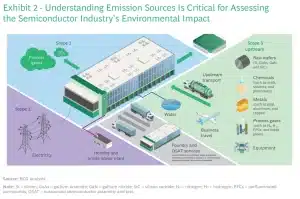
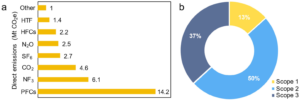
Beyond financial results, TSMC is also expanding its efforts to reduce environmental impact. Making computer chips uses a lot of energy. Between 2015 and 2023, the industry’s power use more than doubled — from about 58,000 GWh to 131,000 GWh.

Some chip factories use as much electricity as a small town. In 2024, chip production emitted about 185 million metric tons of CO₂ equivalent from making integrated circuits. The entire semiconductor sector’s emissions were close to 500 million metric tons CO₂e. This accounts for about 0.5% to 1.3% of global carbon emissions. This shows a mix of growing industry output and continuing efficiency gains.

semiconductor industry carbon emissions
Source: Interface

Because of this, many chipmakers plan to reach net-zero emissions by 2040 to 2050. They are also switching to renewable energy and improving efficiency to lower their environmental impact.

tsmc emissions
Source: TSMC

TSMC is switching to cleaner and more efficient methods. Key sustainability goals and actions include:

  • Net-zero emissions by 2050: TSMC has pledged to reach full carbon neutrality across its operations.
  • Renewable energy target: The company aims to use 100% renewable electricity by 2040.
  • Energy efficiency improvements: Over the past five years, TSMC has cut energy intensity by about 15%, according to its latest ESG report.
  • Water recycling: Its plants now recycle more than 85% of water used in production, a vital step in water-scarce regions like southern Taiwan.
  • Supplier collaboration: TSMC works with its global partners to develop low-carbon manufacturing materials and reduce waste.

The company is on the Dow Jones Sustainability Indices and the CDP Climate Change A List. This shows its leadership in corporate climate action.

TSMC’s environmental strategy also aligns with customer expectations. Many of its clients, like Apple, NVIDIA, and AMD, aim for net-zero. They prefer suppliers who can show clear carbon reductions. This alignment helps the company secure long-term contracts while supporting the broader clean energy transition in tech manufacturing.

The Future: AI Chips and Green Tech Shape the Next Decade

The global semiconductor industry continues to expand rapidly, fueled by AI, electric vehicles, and digital infrastructure. According to the World Semiconductor Trade Statistics (WSTS) organization, worldwide chip sales could grow 15.4% in 2025, reaching nearly US $728 billion.

For TSMC, most of that growth will come from:

  • AI and data-center chips used in training large language models.
  • Automotive semiconductors for self-driving and electric vehicles.
  • 5G and IoT technologies, which connect billions of smart devices.

As more countries invest in digital and AI ecosystems, the need for efficient, low-carbon chip production will rise. TSMC’s focus on sustainability gives it a competitive edge as a responsible manufacturer adapting to global climate goals.

By 2030, analysts expect AI chips to make up more than 25% of TSMC’s total revenue, compared with less than 10% in 2020. The combination of strong AI demand, ongoing capacity expansion, and environmental innovation positions TSMC to remain the world’s leading semiconductor foundry well into the next decade.

TSMC’s record-breaking third-quarter profit confirms its role at the center of the global AI revolution. With AI and high-performance computing driving over half its sales, the company is expanding aggressively while balancing sustainability goals.

Fentanyl – A National Security Crisis Demanding Prevention

0

* Disseminated on behalf of ARMR Sciences Inc.
* For Accredited Investors Only. Offered pursuant to Rule 506(c). Reasonable steps to verify accreditation will be taken before any sale.
PAID ADVERTISEMENT – SPONSORED CONTENT

Fentanyl is no longer just another opioid – it has become the single most lethal synthetic drug in the United States. Since 2000, it is estimated that more than 20 million nonfatal overdoses have occurred in the U.S.- surpassing deaths from COVID-19, HIV/AIDS, and even major wars.

Today, fentanyl is the leading cause of death for adults aged 18–45, claiming an estimated 220 lives every single day.

A Silent, Rapid Killer

A minuscule amount – equivalent in size to just a few grains of salt – can be fatal. Fentanyl is fast-acting and often hidden in counterfeit pills or laced into drugs without the user’s knowledge. 

Fentanyl is cheap to manufacture and covertly laced with counterfeit pills and recreational drugs. This stealth factor explains why the vast majority of overdose victims never intended to take fentanyl.

The financial toll is also staggering: the opioid epidemic costs the U.S. economy an estimated $2.7 trillion in 2023 alone, with cumulative losses exceeding $10 trillion over the past two decades.

Why Current Defenses Fall Short

Tools like naloxone (Narcan) have saved lives but remain purely reactive. They only work after an overdose begins and often fail against emerging analogs such as xylazine, nitazenes, or medetomidine, which Narcan cannot reverse. First responders, military personnel, and even families are left without effective long-term defenses.

ARMR’s Preventive Approach

ARMR Sciences is advancing its novel immunotherapy, ARMR-100, designed to train the immune system to block fentanyl before it reaches the brain. In preclinical (animal) studies, ARMR-100 blocked 92% of fentanyl’s entry into the brain and eliminated its addictive behavioral effects (at this stage ARMR-100 is not FDA-approved, human safety and efficacy have not been established, and preclinical results may not predict clinical outcomes). 

Unlike reactive antidotes, this would provide months of protection – functioning like a biochemical shield.

The program is building on seven years of U.S. Department of Defense–funded research and is working to leverage proven vaccine components, such as carrier proteins already approved in licensed products and adjuvants tested in hundreds of clinical trials. 

The Market and ARMR’s Mission

The potential reach is vast: 2.7 million Americans with opioid use disorder, over 2 million first responders and law enforcement officers, more than 18 million military personnel and veterans who experience higher rates of opioid use, chronic pain, and post-traumatic stress disorder, and more than 30 million high-risk young people.

A once or twice annual preventive shot could help transform national defense against fentanyl, making protection scalable across households, schools, hospitals, and security agencies.

The fentanyl crisis is no longer just a health issue – it’s a national security emergency. And we believe prevention, not rescue, may be the only path to saving a generation.
Why Investors Should Pay Attention

ARMR is more than a biotech startup – it is working to tackle America’s most urgent social and health crisis. This is a mission-driven company focused on building a preventive defense platform that could save thousands of lives each year:

  • $30M private raise launched
  • Seven years of DoD-backed research form the foundation
  • Lead candidate ARMR-100 blocked 92% of fentanyl from entering the brain in preclinical studies
  • A targeted exchange listing in the future

By investing in this round, investors have a chance to back a company whose mission is as much about impact as it is about growth potential. 

Invest now to help support ARMR’s efforts to build the nation’s first line of defense against fentanyl and other synthetic threats.

For Accredited Investors Only. This offering is made pursuant to Rule 506(c) of Regulation D. All purchasers must be accredited investors, and the issuer will take reasonable steps to verify accredited status before any sale. Investing involves high risk, including the potential loss of your entire investment.

This is a paid advertisement for ARMR’s private offering. Please read the details of the offering at InvestARMR.com for additional information on the company and the risk factors related to the offering.

For investors from Canada: This advertisement forms part of the issuer’s marketing materials and is incorporated by reference into the issuer’s Offering Memorandum/Private Placement Memorandum under NI 45-106. Investors must receive and review the OM/PPM and execute the prescribed Form 45-106F4 Risk Acknowledgement before subscribing.

DISCLOSURES & DISCLAIMERS

CLIENT CONTENT: Carboncredits.com is not responsible for any content hosted on ARMR Sciences’ sites; it is ARMR Sciences’ responsibility to ensure compliance with applicable laws.

NOT INVESTMENT ADVICE: Content is for educational, informational, and advertising purposes only and should NOT be construed as securities-related offers or solicitations. All content should be considered promotional and subject to disclosed conflicts of interest. 

Do NOT rely on this as personalized investment advice. Do your own due diligence.

Carboncredits.com strongly recommends you consult a licensed or registered professional before making any investment decision.
REGULATORY STATUS: Neither Carboncredits.com nor any of its owners or employees is registered as a securities broker-dealer, broker, investment advisor, or IA representative with the U.S. Securities and Exchange Commission, any state securities regulatory authority, or any self-regulatory organization.
CONTENT & COMPENSATION DISCLOSURE: Carboncredits.com has received compensation of thirty thousand dollars from ARMR Sciences for this sponsored content. You should assume we receive compensation as indicated for any purchases through links in this article via affiliate relationships, direct/indirect payments from companies or third parties who may own stock in or have other interests in promoted companies. We may purchase, sell, or hold long or short positions without notice in securities mentioned in this communication.
RESULTS NOT TYPICAL: Past performance and results are unverified and NOT indicative of future results. Results presented are NOT guaranteed as TYPICAL. Market conditions and individual circumstances vary significantly. Actual results will vary widely. Investing in securities is speculative and carries high risk; you may lose some, all, or possibly more than your original investment.
HIGH-RISK: Securities discussed may be highly speculative investments subject to extreme volatility, limited liquidity, and potential total loss. The Securities are suitable only for persons who can afford to lose their entire investment. Furthermore, investors must understand that such investment could be illiquid for an indefinite period of time. No public market currently exists for the securities, and if a public market develops, it may not continue.

CAUTIONARY STATEMENT: Certain statements in this presentation (the “Presentation”) may be deemed to be “forward-looking statements” within the meaning of Section 27A of the 1933 Securities Act and Section 21E of the Exchange Act of 1934, as amended, and are intended to be covered by the safe harbor provisions for forward-looking statements. Such forward-looking statements can be identified by the use of words such as ”should,” ”may,” ”intends,” ”anticipates,” ”believes,” ”estimates,” ”projects,” ”forecasts,” ”expects,” ”plans,” and ”proposes.” Forward-looking statements, which are based on the current plans, forecasts and expectations of management of ARMR Sciences Inc. (the “Company” or “ARMR Sciences”), are inherently less reliable than historical information. Forward-looking statements are subject to risks and uncertainties, including events and circumstances that may be outside our control.

Although management believes that the expectations reflected in these forward-looking statements are based on reasonable assumptions, there are a number of risks and uncertainties that could cause actual results to differ materially from such forward-looking statements. Risks and uncertainties that could cause actual results to differ materially include, without limitation, those risks identified in the Private Placement Memorandum. Forward-looking statements speak only as of the date of the document in which they are contained, and ARMR Sciences Inc. does not undertake any duty to update any forward-looking statements except as may be required by law.

Any forward-looking financial forecasts contained in this Presentation are subject to a number of risks and uncertainties, and actual results may differ materially. You are cautioned not to place undue reliance on such forecasts. No assurances can be given that the future results indicated, whether expressed or implied, will be achieved. While sometimes presented with numerical specificity, all such forecasts are based upon a variety of assumptions that may not be realized, and which are highly variable. Because of the number and range of the assumptions underlying any such forecasts, many of which are subject to significant uncertainties and contingencies that are beyond the reasonable control of the issuing company, many of the assumptions inevitably will not materialize and unanticipated events and circumstances may occur subsequent to the date of any financial forecast.


Disclosure: Owners, members, directors, and employees of carboncredits.com have/may have stock or option positions in any of the companies mentioned: None.

Carboncredits.com receives compensation for this publication and has a business relationship with any company whose stock(s) is/are mentioned in this article.

Additional disclosure: This communication serves the sole purpose of adding value to the research process and is for information only. Please do your own due diligence. Every investment in securities mentioned in publications of carboncredits.com involves risks that could lead to a total loss of the invested capital.

Please read our Full RISKS and DISCLOSURE here.

AI and Biodefense – Working to Stay Ahead of Synthetic Drug Threats

* Disseminated on behalf of ARMR Sciences Inc.
* For Accredited Investors Only. Offered pursuant to Rule 506(c). Reasonable steps to verify accreditation will be taken before any sale.
PAID ADVERTISEMENT – SPONSORED CONTENT

Artificial intelligence (AI) is helping transform medicine, finance, and logistics. But experts warn it could also be turned against us. With advanced modeling, AI can now generate chemical blueprints at a substantially faster rate than previously available processes. As a result, National security leaders and AI thought leaders (including OpenAI’s Sam Altman), have voiced concerns that adversaries could weaponize AI to design new bioweapons.

The New Threat Landscape

Fentanyl already stands as the deadliest synthetic opioid in U.S. history, responsible for more than 220 deaths every day. But fentanyl itself is only the beginning. 

Analogs like carfentanil (100x stronger), xylazine (non-opioid threat), and nitazenes (40x stronger) are beginning to spread, many of which are not reversible with Narcan. 

The drug supply is becoming a testing ground for increasingly lethal compounds, some of which could be accelerated by AI-driven chemistry.

This dual challenge – lethal analogs on the street and the potential for AI-designed agents – has led federal agencies, including the Department of Defense and Homeland Security, to classify fentanyl and its cousins as chemical weapons of mass destruction. 

The crisis is no longer just a health issue; it is a national security emergency.

ARMR’s Defense Labs Approach

ARMR Sciences is working to position itself to confront this next phase. Its Defense Labs initiative combines AI-powered drug discovery with seven years of Department of Defense–funded science with the goal of building a scalable biodefense platform.

The company’s lead candidate, ARMR-100, designed to train the immune system to block fentanyl before it reaches the brain. In preclinical (animal) studies, ARMR-100 blocked 92% of fentanyl’s entry into the brain and eliminated its addictive behavioral effects (at this stage ARMR-100 is not FDA-approved, human safety and efficacy have not been established, and preclinical results may not predict clinical outcomes).

Unlike reactive tools such as naloxone, ARMR-100 is designed to provide months of protection – a biochemical shield against fentanyl and, eventually, other engineered analogs.

Beyond fentanyl, ARMR plans to develop additional immunotherapies for xylazine, nitazenes, and other emerging threats, creating a portfolio that evolves alongside the risks. 

By leveraging AI in its own labs, ARMR seeks to stay ahead of adversaries who might misuse the same technology. And in the battle between innovation and misuse, its proactive biodefense may prove to be America’s strongest shield.

The Scale and the Urgency 

With more than 130 million people in the U.S. considered high-risk – from opioid use disorder patients to first responders and military personnel – the potential market is vast. 

For policymakers, the message is clear: synthetic opioids are no longer only a health crisis, but a recognized national security threat. Classified alongside terrorism and cyberwarfare, fentanyl and its analogs demand rapid action. 

This urgency is creating bipartisan momentum for federal funding, regulatory fast-tracking, and stockpiling of new countermeasures. 

Why Investors Should Pay Attention

For investors, we believe that ARMR represents an opportunity to back a company that combines social impact with growth potential. Its model combines biotechnology, AI, and biodefense – a convergence few companies are addressing:

  • Seven years of DoD-backed research formed the platform’s foundation
  • Lead candidate ARMR-100 blocked 92% of fentanyl from entering the brain in preclinical studies
  • A $30M private raise is now open
  • A targeted exchange listing in the future

By investing in this round, investors have a chance to support ARMR as it works to build a category-defining role in AI-powered biodefense.

Invest now to help support ARMR’s efforts to build the nation’s first line of defense against fentanyl and other synthetic threats.

* For Accredited Investors Only. This offering is made pursuant to Rule 506(c) of Regulation D. All purchasers must be accredited investors, and the issuer will take reasonable steps to verify accredited status before any sale. Investing involves high risk, including the potential loss of your entire investment.

* This is a paid advertisement for ARMR’s private offering. Please read the details of the offering at InvestARMR.com for additional information on the company and the risk factors related to the offering.

* For investors from Canada: This advertisement forms part of the issuer’s marketing materials and is incorporated by reference into the issuer’s Offering Memorandum/Private Placement Memorandum under NI 45-106. Investors must receive and review the OM/PPM and execute the prescribed Form 45-106F4 Risk Acknowledgement before subscribing.

DISCLOSURES & DISCLAIMERS

CLIENT CONTENT: Carboncredits.com is not responsible for any content hosted on ARMR Sciences’ sites; it is ARMR Sciences’ responsibility to ensure compliance with applicable laws.

NOT INVESTMENT ADVICE: Content is for educational, informational, and advertising purposes only and should NOT be construed as securities-related offers or solicitations. All content should be considered promotional and subject to disclosed conflicts of interest. 

Do NOT rely on this as personalized investment advice. Do your own due diligence.

Carboncredits.com strongly recommends you consult a licensed or registered professional before making any investment decision.

REGULATORY STATUS: Neither Carboncredits.com nor any of its owners or employees is registered as a securities broker-dealer, broker, investment advisor, or IA representative with the U.S. Securities and Exchange Commission, any state securities regulatory authority, or any self-regulatory organization.

CONTENT & COMPENSATION DISCLOSURE: Carboncredits.com has received compensation of thirty thousand dollars from ARMR Sciences for this sponsored content. You should assume we receive compensation as indicated for any purchases through links in this email via affiliate relationships, direct/indirect payments from companies or third parties who may own stock in or have other interests in promoted companies. We may purchase, sell, or hold long or short positions without notice in securities mentioned in this communication.

RESULTS NOT TYPICAL: Past performance and results are unverified and NOT indicative of future results. Results presented are NOT guaranteed as TYPICAL. Market conditions and individual circumstances vary significantly. Actual results will vary widely. Investing in securities is speculative and carries high risk; you may lose some, all, or possibly more than your original investment.

HIGH-RISK: Securities discussed may be highly speculative investments subject to extreme volatility, limited liquidity, and potential total loss. The Securities are suitable only for persons who can afford to lose their entire investment. Furthermore, investors must understand that such investment could be illiquid for an indefinite period of time. No public market currently exists for the securities, and if a public market develops, it may not continue.

DISCLAIMERS & CAUTIONARY STATEMENT: Certain statements in this presentation (the “Presentation”) may be deemed to be “forward-looking statements” within the meaning of Section 27A of the 1933 Securities Act and Section 21E of the Exchange Act of 1934, as amended, and are intended to be covered by the safe harbor provisions for forward-looking statements. Such forward-looking statements can be identified by the use of words such as ”should,” ”may,” ”intends,” ”anticipates,” ”believes,” ”estimates,” ”projects,” ”forecasts,” ”expects,” ”plans,” and ”proposes.” Forward-looking statements, which are based on the current plans, forecasts and expectations of management of ARMR Sciences Inc. (the “Company” or “ARMR Sciences”), are inherently less reliable than historical information. Forward-looking statements are subject to risks and uncertainties, including events and circumstances that may be outside our control.

Although management believes that the expectations reflected in these forward-looking statements are based on reasonable assumptions, there are a number of risks and uncertainties that could cause actual results to differ materially from such forward-looking statements. Risks and uncertainties that could cause actual results to differ materially include, without limitation, those risks identified in the Private Placement Memorandum. Forward-looking statements speak only as of the date of the document in which they are contained, and ARMR Sciences Inc. does not undertake any duty to update any forward-looking statements except as may be required by law.

Any forward-looking financial forecasts contained in this Presentation are subject to a number of risks and uncertainties, and actual results may differ materially. You are cautioned not to place undue reliance on such forecasts. No assurances can be given that the future results indicated, whether expressed or implied, will be achieved. While sometimes presented with numerical specificity, all such forecasts are based upon a variety of assumptions that may not be realized, and which are highly variable. Because of the number and range of the assumptions underlying any such forecasts, many of which are subject to significant uncertainties and contingencies that are beyond the reasonable control of the issuing company, many of the assumptions inevitably will not materialize and unanticipated events and circumstances may occur subsequent to the date of any financial forecast.

ARMR Sciences Inc. takes no responsibility for any forecasts contained within the Presentation. None of the information contained in any offering materials should be regarded as a representation by ARMR Sciences Inc. The Company’s forecasts have not been prepared with a view toward public disclosure or compliance with the guidelines of the SEC, the American Institute of Certified Public Accountants or the Public Company Accounting Oversight Board. Independent public accountants have not examined nor compiled any forecasts and have not expressed an opinion or assurance with respect to the figures.

This Presentation also contains estimates and other statistical data made by independent parties and by management relating to market size and other data about our industry. This data involves a number of assumptions and limitations, and you are cautioned not to give undue weight to such estimates.

ARMR Sciences Inc. is currently undertaking a private placement offering of Offered Shares pursuant to Section 4(a)(2) of the 1933 Act and/or Rule 506(c) of Regulation D promulgated thereunder. Investors should consider the investment objectives, risks, and investment time horizon of the Company carefully before investing. The private placement memorandum relating to the offering of Securities will contain this and other information concerning the Company, including risk factors, which should be read carefully before investing.

The Securities are being offered and sold in reliance on exemptions from registration under the 1933 Act. In accordance therewith, you should be aware that (i) the Securities may be sold only to “accredited investors,” as defined in Rule 501 of Regulation D; (ii) the Securities will only be offered in reliance on an exemption from the registration requirements of the Securities Act and will not be required to comply with specific disclosure requirements that apply to registration under the Securities Act; (iii) the United States Securities and Exchange Commission (the “SEC”) will not pass upon the merits of or give its approval to the terms of the Securities or the offering, or the accuracy or completeness of any offering materials; (iv) the Securities will be subject to legal restrictions on transfer and resale and investors should not assume they will be able to resell their securities; and (v) investing in these Securities involves a high degree of risk, and investors should be able to bear the loss of their entire investment. Furthermore, investors must understand that such investment could be illiquid for an indefinite period of time.

The Company is “Testing the Waters” under Regulation A under the Securities Act of 1933. The Company is not under any obligation to make an offering under Regulation A. No money or other consideration is being solicited in connection with the information provided, and if sent in response, will not be accepted. No offer to buy the securities can be accepted and no part of the purchase price can be received until an offering statement on Form 1-A has been filed and until the offering statement is qualified pursuant to Regulation A of the Securities Act of 1933, as amended, and any such offer may be withdrawn or revoked, without obligation or commitment of any kind, at any time before notice of its acceptance given after the qualification date.   
 
The securities offered using Regulation A are highly speculative and involve significant risks. The investment is suitable only for persons who can afford to lose their entire investment. Furthermore, investors must understand that such investment could be illiquid for an indefinite period of time. No public market currently exists for the securities, and if a public market develops following the offering, it may not continue. The Company intends to list its securities on a national exchange and doing so entails significant ongoing corporate obligations including but not limited to disclosure, filing and notification requirements, as well compliance with applicable continued quantitative and qualitative listing standards.

Tesla Rides High Before Q3 Earnings With (TSLA) Stock Rising, Record Deliveries, Gigafactory Growth, and Green Goals

Tesla, Inc. continues to show strong performance in 2025. In the third quarter alone, the company delivered 497,099 vehicles, close to half a million units. This figure is one of Tesla’s highest quarterly delivery totals on record. At the same time, its Austin Gigafactory reached a key production milestone — more than 500,000 vehicles built since opening in 2022.

These achievements confirm Tesla’s steady expansion of its manufacturing network. The company now runs major factories in California, Texas, Nevada, Germany, and China. Each plant contributes to a growing global supply chain that supports its Model Y, Model 3, and the new Cybertruck.

Tesla’s steady ramp-up shows how far it has come since its early production struggles. The company aims to reach 20 million vehicles a year by 2030. This plan is ambitious, but this quarter’s numbers show steady progress toward that goal.

Gigafactory Texas Reaches a Key Milestone

Gigafactory Texas, near Austin, is Tesla’s biggest and most advanced U.S. facility. It makes the Model Y and is ramping up Cybertruck production. Hitting 500,000 vehicles in roughly three and a half years shows faster growth compared to Tesla’s earlier plants.

Reports say around 100,000 vehicles were made from April to mid-October 2025. This strong pace helps meet annual growth targets. The plant uses Giga Presses, which are massive casting machines that replace dozens of smaller parts. This automation speeds up production, reduces costs, and minimizes material waste.

The Texas facility also plays a central role in Tesla’s sustainability strategy. Much of its electricity comes from renewable energy, and its design reduces water use and waste. Over time, Tesla aims for all Gigafactories to operate with 100% clean energy.

Q3 Earnings Outlook: Revenue Growth, Margin Pressure

Analysts expect Tesla to post around $26.3 billion in revenue for Q3 2025, up about 4–5% year-over-year. However, earnings per share (EPS) are projected to fall about 24%, to roughly $0.55 per share from $0.72 in the same quarter last year.

The decline is mainly due to lower vehicle prices and smaller contributions from carbon redit sales. These credits have been providing a huge revenue stream to the EV giant by selling it to its peers that don’t meet regulatory emission reductions.

Also, Tesla has cut prices on its main models in several markets to stay competitive, especially against Chinese EV makers. Those price cuts attract new buyers but reduce profit margins.

Tesla’s operating margin averaged 9.2% in Q2 2025, down from 11.4% a year earlier. Automotive gross margin, excluding credits, was about 18%, compared to over 25% in 2022. Even with tighter margins, Tesla continues to benefit from software revenue through Full Self-Driving (FSD) packages and connectivity subscriptions.

The company’s results will likely depend on several key factors:

  • Vehicle deliveries – nearly half a million this quarter.
  • Energy storage deployments – reaching a new record of 12.5 GWh.
  • Software and services – providing recurring, higher-margin income.
  • Production costs – influenced by logistics and raw material expenses.

Despite margin pressure, Tesla’s growth in energy storage and software could offset some of the decline in car profits.

The Global EV Race Accelerates

The global electric vehicle (EV) market continues to expand rapidly. The International Energy Agency (IEA) reports that global EV sales rose over 30% in 2024. They reached almost 14 million units. In 2025, sales could hit 17 million. Electric cars could represent about 22% of all vehicle sales globally by the end of this year.

global EV sales 2030 BNEF

Tesla remains a market leader, holding around 16% of global EV market share, but it faces rising competition. Chinese brands like BYD, NIO, and XPeng are growing in Asia and Europe. At the same time, Volkswagen, Ford, GM, and Hyundai are speeding up EV production.

Elon Musk’s company defends its position by improving efficiency and cutting costs. Its 4680 battery cells are key, aiming to lower production costs by up to 50%. They also enhance range and durability.

The company also benefits from the U.S. Inflation Reduction Act (IRA), which offers tax credits for EV buyers and incentives for battery production. However, these credits will gradually phase out, which could affect demand after 2026.

According to BloombergNEF, the average price of lithium-ion batteries dropped to $115 per kWh in 2024, down 20% from 2023. This decline helps Tesla maintain affordability while protecting margins.

battery grade lithium prices

Wall Street Takes the Wheel: Tesla Stock Gains on Big Deliveries

Tesla’s stock rose modestly after its Q3 delivery report. On Monday, shares gained, surpassing $444, which doubled in six months. The rise reflects investor confidence in Tesla’s production capacity and delivery strength, even with profit pressure.

Tesla TSLA stock price

Analysts remain split: some expect stronger earnings in 2026 as new models roll out, while others warn that price cuts and competition could slow growth.

Still, Tesla’s ability to maintain high output while scaling its energy business supports its long-term outlook. The company is a top choice for big investors like BlackRock and Vanguard. They both focus on sustainability in their investment strategies.

Driving Clean: Tesla’s Growing Role in a Net-Zero World

Tesla’s business model directly supports global emission-reduction goals. Tesla’s 2024 Impact Report shows that customers avoided almost 32 million metric tons of CO₂e emissions. This is a 60% increase from last year. This figure includes emissions avoided by Tesla’s vehicles as well as its solar and energy storage products globally.

Since 2012, Tesla’s fleet has avoided many millions of metric tons of CO₂e. Each vehicle saves about 52 metric tons of CO₂e compared to similar gasoline cars over an average lifespan of 17 years.

lifecycle emissions of gas cars vs EV

Tesla also focuses on sustainable manufacturing:

  • Gigafactory Nevada recycles more than 92% of production waste and reduces its water use intensity by 12% year-over-year.
  • The company sources lithium and aluminum from suppliers following responsible mining and low-carbon standards.
  • Its battery recycling program recovers up to 95% of nickel, cobalt, and lithium for reuse.

Beyond vehicles, Tesla’s energy business is expanding fast. In 2024, the company deployed 15 GWh of energy storage through its Megapack and Powerwall systems — enough to power over 4 million homes for one hour. These systems help utilities store renewable energy, stabilize grids, and reduce fossil fuel reliance.

Tesla aims to reach net-zero emissions across its value chain by 2040, covering factories, logistics, and product lifecycles. Investments in solar, wind, and carbon reduction projects are key to that goal.

Roadblocks and Roadmaps: What’s Next for Tesla

Amid its strong momentum, Tesla still faces several challenges that could affect future growth:

  • Competition: Rivals are narrowing the gap in technology and cost.
  • Price pressure: Discounts to boost demand reduce profitability.
  • Regulatory risks: Autopilot and FSD remain under scrutiny in some markets.
  • Supply chain: Securing critical minerals like lithium and nickel remains essential.

To adapt, Tesla is diversifying. The company plans to launch a low-cost compact vehicle, often referred to as the Model 2, expected to be priced under $27,000 and launched in late 2026.

It’s also developing a robotaxi platform, codenamed CyberCab, expected to begin pilot operations in 2026 with Level 4 autonomy. Plus, Tesla Energy could exceed $10 billion in annual revenue by 2026, supported by growing Megapack demand in the U.S. and Europe.

Tesla’s Q3 2025 milestones highlight both progress and pressure. Delivering nearly 500,000 vehicles and producing 500,000 at its Texas plant shows major strides in sustainable mobility. Revenue continues to grow even as profits tighten.

As Tesla prepares to announce its Q3 earnings, investors will look for signs of balance — growth, profitability, and sustainability. If the company keeps expanding responsibly and investing in cleaner technologies, it will remain a central player in the global transition toward a zero-emission economy.

Fentanyl Threats, AI, and National Security – ARMR Sciences’ Unified Approach

0

* Disseminated on behalf of ARMR Sciences Inc.
* For Accredited Investors Only. Offered pursuant to Rule 506(c). Reasonable steps to verify accreditation will be taken before any sale.
PAID ADVERTISEMENT – SPONSORED CONTENT

Fentanyl is devastating American communities at a record pace, with more than 220 deaths every day. Synthetic opioids accounted for over 70,000 U.S. fatalities in 2023, and their impact now extends beyond public health into national security. 

At the same time, artificial intelligence (AI) is advancing in ways that could allow adversaries to design new synthetic drugs or bioweapons faster than regulators and security agencies can respond. Coupled with the political weight fentanyl carries in Washington, the U.S. faces a multidimensional challenge. 

ARMR Sciences underscores why prevention, innovation, and leadership can align to shield America from this emerging and evolving threat.

Escalating National Security Concerns

Fentanyl’s extraordinary potency – up to 50 times stronger than heroin – makes even trace exposure lethal. Its supply chains cross borders, complicating law enforcement and fueling instability at home. 

ARMR Sciences emphasizes that enforcement alone cannot resolve the crisis. Without proactive prevention strategies, the nation risks a deepening cycle of addiction, death, and weakened resilience.

Technology at the Crossroads

AI has the potential to transform healthcare and logistics, but also carries risks of misuse. Researchers showed that advanced AI models could generate tens of thousands of psychoactive compound blueprints in just hours – a dangerous acceleration of synthetic chemistry. 

National security leaders, including AI pioneers, warn that adversaries could exploit these tools. ARMR Sciences argues for robust biodefense strategies that include strict controls on sensitive algorithms, enhanced detection systems, and proactive investment in prevention technologies.

Political Pressure and Policy Response

The fentanyl crisis has become a defining issue in U.S. politics, shaping debates on border security, healthcare, and law enforcement funding. Deaths have risen by more than 20% annually since 2019, amplifying public and political demands for action. 

ARMR Sciences emphasizes that bipartisan cooperation and evidence-based policymaking are essential to prevent partisan gridlock. Recognizing fentanyl as both a health and security issue can unite leaders behind more effective prevention measures.

ARMR Sciences – A Prevention-Focused Framework

Across each dimension – fentanyl’s deadly toll, AI’s potential misuse, and the political battle for solutions – ARMR Sciences underscores a common theme: prevention is the most effective defense. This means deploying early warning systems, advancing detection capabilities, integrating data-driven tools, and strengthening community resilience before crises escalate. 

It also means ensuring that AI innovation develops with responsible guardrails, while national security agencies adapt to evolving synthetic threats. Prevention is not passive; it requires deliberate action, investment, and leadership.

So, Why Should Investors Pay Attention to ARMR’s Solution?

For investors, ARMR represents an opportunity to back a company working to address the convergence of fentanyl’s deadly impact, AI’s potential misuse, and the urgent need for prevention. 

Its platform is built on years of defense-backed research and is advancing innovative biotechnology programs:

  • Seven years of DoD-supported science established the foundation of ARMR’s platform
  • Lead candidate ARMR-100 blocked 92% of fentanyl from entering the brain in preclinical (animal) studies
  • A $30M private raise is currently underway
  • Plans for a targeted exchange listing in 2026 are in place, subject to market conditions

By investing in this round, investors have a chance to support ARMR as it works to build a potentially category-defining role in AI-powered biodefense.


* This is a paid advertisement for ARMR’s private offering. Please read the details of the offering at InvestARMR.com for additional information on the company and the risk factors related to the offering.

* For Accredited Investors Only. This offering is made pursuant to Rule 506(c) of Regulation D. All purchasers must be accredited investors, and the issuer will take reasonable steps to verify accredited status before any sale. Investing involves high risk, including the potential loss of your entire investment.

* For investors from Canada: This advertisement forms part of the issuer’s marketing materials and is incorporated by reference into the issuer’s Offering Memorandum/Private Placement Memorandum under NI 45-106. Investors must receive and review the OM/PPM and execute the prescribed Form 45-106F4 Risk Acknowledgement before subscribing.


DISCLOSURES & DISCLAIMERS

CLIENT CONTENT: Carboncredits.com is not responsible for any content hosted on ARMR Sciences’ sites; it is ARMR Sciences’ responsibility to ensure compliance with applicable laws.

NOT INVESTMENT ADVICE: Content is for educational, informational, and advertising purposes only and should NOT be construed as securities-related offers or solicitations. All content should be considered promotional and subject to disclosed conflicts of interest. 

Do NOT rely on this as personalized investment advice. Do your own due diligence.

Carboncredits.com strongly recommends you consult a licensed or registered professional before making any investment decision.

REGULATORY STATUS: Neither Carboncredits.com nor any of its owners or employees is registered as a securities broker-dealer, broker, investment advisor, or IA representative with the U.S. Securities and Exchange Commission, any state securities regulatory authority, or any self-regulatory organization.

CONTENT & COMPENSATION DISCLOSURE: Carboncredits.com has received compensation of thirty thousand dollars from ARMR Sciences for this sponsored content. You should assume we receive compensation as indicated for any purchases through links in this email via affiliate relationships, direct/indirect payments from companies or third parties who may own stock in or have other interests in promoted companies. We may purchase, sell, or hold long or short positions without notice in securities mentioned in this communication.

RESULTS NOT TYPICAL: Past performance and results are unverified and NOT indicative of future results. Results presented are NOT guaranteed as TYPICAL. Market conditions and individual circumstances vary significantly. Actual results will vary widely. Investing in securities is speculative and carries high risk; you may lose some, all, or possibly more than your original investment.

HIGH-RISK: Securities discussed may be highly speculative investments subject to extreme volatility, limited liquidity, and potential total loss. The Securities are suitable only for persons who can afford to lose their entire investment. Furthermore, investors must understand that such investment could be illiquid for an indefinite period of time. No public market currently exists for the securities, and if a public market develops, it may not continue.

CAUTIONARY STATEMENT: Certain statements in this presentation (the “Presentation”) may be deemed to be “forward-looking statements” within the meaning of Section 27A of the 1933 Securities Act and Section 21E of the Exchange Act of 1934, as amended, and are intended to be covered by the safe harbor provisions for forward-looking statements. Such forward-looking statements can be identified by the use of words such as ”should,” ”may,” ”intends,” ”anticipates,” ”believes,” ”estimates,” ”projects,” ”forecasts,” ”expects,” ”plans,” and ”proposes.” Forward-looking statements, which are based on the current plans, forecasts and expectations of management of ARMR Sciences Inc. (the “Company” or “ARMR Sciences”), are inherently less reliable than historical information. Forward-looking statements are subject to risks and uncertainties, including events and circumstances that may be outside our control.

Although management believes that the expectations reflected in these forward-looking statements are based on reasonable assumptions, there are a number of risks and uncertainties that could cause actual results to differ materially from such forward-looking statements. Risks and uncertainties that could cause actual results to differ materially include, without limitation, those risks identified in the Private Placement Memorandum. Forward-looking statements speak only as of the date of the document in which they are contained, and ARMR Sciences Inc. does not undertake any duty to update any forward-looking statements except as may be required by law.

Any forward-looking financial forecasts contained in this Presentation are subject to a number of risks and uncertainties, and actual results may differ materially. You are cautioned not to place undue reliance on such forecasts. No assurances can be given that the future results indicated, whether expressed or implied, will be achieved. While sometimes presented with numerical specificity, all such forecasts are based upon a variety of assumptions that may not be realized, and which are highly variable. Because of the number and range of the assumptions underlying any such forecasts, many of which are subject to significant uncertainties and contingencies that are beyond the reasonable control of the issuing company, many of the assumptions inevitably will not materialize and unanticipated events and circumstances may occur subsequent to the date of any financial forecast.

ARMR Sciences Inc. takes no responsibility for any forecasts contained within the Presentation. None of the information contained in any offering materials should be regarded as a representation by ARMR Sciences Inc. The Company’s forecasts have not been prepared with a view toward public disclosure or compliance with the guidelines of the SEC, the American Institute of Certified Public Accountants or the Public Company Accounting Oversight Board. Independent public accountants have not examined nor compiled any forecasts and have not expressed an opinion or assurance with respect to the figures.

This Presentation also contains estimates and other statistical data made by independent parties and by management relating to market size and other data about our industry. This data involves a number of assumptions and limitations, and you are cautioned not to give undue weight to such estimates.

ARMR Sciences Inc. is currently undertaking a private placement offering of Offered Shares pursuant to Section 4(a)(2) of the 1933 Act and/or Rule 506(c) of Regulation D promulgated thereunder. Investors should consider the investment objectives, risks, and investment time horizon of the Company carefully before investing. The private placement memorandum relating to the offering of Securities will contain this and other information concerning the Company, including risk factors, which should be read carefully before investing.

The Securities are being offered and sold in reliance on exemptions from registration under the 1933 Act. In accordance therewith, you should be aware that (i) the Securities may be sold only to “accredited investors,” as defined in Rule 501 of Regulation D; (ii) the Securities will only be offered in reliance on an exemption from the registration requirements of the Securities Act and will not be required to comply with specific disclosure requirements that apply to registration under the Securities Act; (iii) the United States Securities and Exchange Commission (the “SEC”) will not pass upon the merits of or give its approval to the terms of the Securities or the offering, or the accuracy or completeness of any offering materials; (iv) the Securities will be subject to legal restrictions on transfer and resale and investors should not assume they will be able to resell their securities; and (v) investing in these Securities involves a high degree of risk, and investors should be able to bear the loss of their entire investment. Furthermore, investors must understand that such investment could be illiquid for an indefinite period of time.

The Company is “Testing the Waters” under Regulation A under the Securities Act of 1933. The Company is not under any obligation to make an offering under Regulation A. No money or other consideration is being solicited in connection with the information provided, and if sent in response, will not be accepted. No offer to buy the securities can be accepted and no part of the purchase price can be received until an offering statement on Form 1-A has been filed and until the offering statement is qualified pursuant to Regulation A of the Securities Act of 1933, as amended, and any such offer may be withdrawn or revoked, without obligation or commitment of any kind, at any time before notice of its acceptance given after the qualification date.   
 
The securities offered using Regulation A are highly speculative and involve significant risks. The investment is suitable only for persons who can afford to lose their entire investment. Furthermore, investors must understand that such investment could be illiquid for an indefinite period of time. No public market currently exists for the securities, and if a public market develops following the offering, it may not continue. The Company intends to list its securities on a national exchange and doing so entails significant ongoing corporate obligations including but not limited to disclosure, filing and notification requirements, as well compliance with applicable continued quantitative and qualitative listing standards.


Disclosure: Owners, members, directors, and employees of carboncredits.com have/may have stock or option positions in any of the companies mentioned: None.

Carboncredits.com receives compensation for this publication and has a business relationship with any company whose stock(s) is/are mentioned in this article.

Additional disclosure: This communication serves the sole purpose of adding value to the research process and is for information only. Please do your own due diligence. Every investment in securities mentioned in publications of carboncredits.com involves risks that could lead to a total loss of the invested capital.

Please read our Full RISKS and DISCLOSURE here.