DOE and Amazon Partner to Secure Critical Minerals Through AI-Driven Recycling

The U.S. Department of Energy is intensifying efforts to secure critical minerals as global supply risks rise. In a new collaboration, the DOEโ€™s Ames National Laboratory and the Critical Materials Innovation Hub have joined hands with Amazon to recover high-value materials from waste.

The partnership focuses on extracting battery-grade graphite and key minerals from discarded textiles and electronic waste. This move reflects a broader U.S. strategyโ€”reduce import dependence, build domestic capacity, and create a circular supply chain for critical materials.

Assistant Secretary of Energy (EERE) Audrey Robertson, leading DOE’s Office of Critical Materials and Energy Innovation, said:

โ€œAt scale, the recovery of critical minerals from end-of-life technologies and textile waste has the potential to transform our domestic critical materials supply chains. This pioneering work, made possible by an exciting new partnership with Amazon, supports the Trump Administrationโ€™s efforts to reduce our reliance on foreign imports and strengthen our national security.โ€

U.S. Aims for Domestic Graphite Supply

The collaboration combines materials science with artificial intelligence. Ames Lab and CMI bring decades of expertise in metals refining and advanced materials. Amazon contributes AI, logistics, and large-scale supply chain capabilities.

Ames Laboratory Director Karl Mueller also noted,

“This is an excellent match for Ames National Laboratory’s deep expertise in materials science. For decades, Ames Lab has led the nation in metals refining, purification, and critical materials researchโ€”and applying that strength to real-world challenges.”

Turning Textiles into Battery-Grade Graphiteย 

A major project aims to convert discarded textiles into battery-grade graphite. This is significant because graphite is essential for lithium-ion batteries used in electric vehicles (EVs) and energy storage systems.

Today, the U.S. remains heavily dependent on imports for graphite. In fact, more than 90% of global battery-grade graphite processing is concentrated in China, creating a major supply risk.

  • As of 2024, the U.S. imported aboutย 60,000 metric tons of natural graphite, down from roughly 84,000 tons in 2023.
  • China remained the largest supplier, accounting for aroundย 67.6% of all natural graphite imports by value.

This is worth roughly $375 million. It representsย a slight decrease in volume but still a dominant share of the market.

US graphite

By extracting graphite from waste, the U.S. can reduce both landfill pressure and foreign dependence. This approach aligns with the DOEโ€™s push to secure materials from โ€œsecondary sourcesโ€ such as waste streams.

AWS Powers AI-Driven Mineral Recovery

A second initiative focuses on recovering minerals like gallium from end-of-life IT hardware. Gallium is a critical input for semiconductors, power electronics, and defense technologies.

The importance of this effort is clear. In recent years, China has restricted exports of gallium and germanium, disrupting global supply. These restrictions effectively removed up to 90% of global gallium supply from international markets, exposing major vulnerabilities.

Here, Amazon Web Services will deploy AI tools to map supply chains, identify recovery opportunities, and assess economic feasibility. At the same time, CMI researchers will develop efficient extraction and refining methods.

This fusion of AI and materials science could transform recycling. Instead of being discarded, old electronics could become a reliable domestic source of critical minerals.

A Fragile Supply Chain: Why the U.S. Is Acting Now

Critical minerals are the core of modern industriesโ€”from EVs and renewable energy to semiconductors and defense systems. However, U.S. supply chains remain highly vulnerable.

According to recent industry analysis:

  • The U.S. is 100% import-reliant for at least 13 critical minerals
  • Over 20 additional minerals have an import dependence above 50%
  • The country exports much of its raw materials for processing overseas due to limited domestic capacity

China dominates refining and processing, backed by decades of industrial policy. This concentration creates risks of supply disruptions, price spikes, and geopolitical leverage.

us critical minerals imports

To address this, the U.S. government is mobilizing large-scale investments. In 2025, the DOE announced nearly $1 billion in funding to strengthen domestic critical mineral supply chains, with a strong focus on battery materials processing and recycling.

Additionally, new initiatives such as strategic stockpiles and international partnerships are being developed to secure long-term supply.

CMI Hub Leads the Shift to Circular Supply Chains

The Amazonโ€“DOE partnership reflects a major shift in strategy. Traditionally, supply security depended on mining new resources. Now, recycling and โ€œurban miningโ€ are becoming equally important.

The CMI Hub is leading this transition through research in:

  • Expanding material supply sources
  • Developing substitutes for scarce minerals
  • Recovering materials from waste
  • Accelerating the commercialization of new technologies

Recycling offers several advantages. It is faster to deploy than mining, less environmentally damaging, and often more cost-effective in the long run. For example, the U.S. has already committed funding to advanced graphite recycling projects to build domestic battery supply chains.

CMI Hub Director Tom Lograsso

“This collaboration is a natural extension of the expertise that CMI Hub was created to deliver. CMI’s mission is to move breakthrough materials technologies from the laboratory into real-world applications on timelines that meet industry’s needs. Working with Amazon gives us the opportunity to apply our capabilities at scaleโ€”combining CMI’s materials science expertise with Amazon’s AI to turn innovations into practical solutions that strengthen the nation’s critical materials supply chains.”ย 

Publicโ€“Private Partnerships Drive Scale

This collaboration also highlights a broader trendโ€”closer ties between government research institutions and private companies.

Amazon brings AI, data analytics, and global logistics. Ames Lab and CMI contribute scientific expertise and research infrastructure. Together, they aim to move solutions from the lab to real-world deployment at scale.

Such partnerships are critical because the challenge is not just technical. It also involves economics, infrastructure, and supply chain coordination. By combining strengths, these collaborations can accelerate innovation and reduce risks.

Conclusion: A Strategic Shift With Global Impact

The U.S. is clearly redefining its critical minerals strategy. Instead of relying only on mining, it is tapping into waste as a new resource base.

This approach offers strong advantages:

  • Waste streams are abundant and underutilized
  • Recycling reduces environmental impact
  • Domestic recovery improves supply security

However, challenges remain. Domestic processing capacity is still limited, and scaling recycling technologies will require sustained investment and policy support.

At the same time, AI is emerging as a key enabler. It can optimize recovery processes, improve efficiency, and reduce costs. As adoption grows, it could become a critical tool in securing mineral supply chains.

And the partnership between the DOE, Ames Lab, CMI, and Amazon marks a turning point in how the U.S. approaches critical minerals.

Google Expands SAF Strategy with Amex GBT and Shell Aviation to Cut Aviation Emissions

Google is stepping up its climate strategy with a deeper commitment to sustainable aviation fuel (SAF). In a new long-term agreement with American Express Global Business Travel and Shell Aviation, the tech giant will source SAF environmental attribute data through the Avelia registry.

This move highlights a bigger trend. Corporations are no longer just offsetting emissionsโ€”they are actively shaping clean fuel markets. For Google, SAF is becoming a critical tool to cut emissions from business travel, one of the hardest sectors to decarbonize.

Vrushali Gaud, Global Director of Climate Operations, Google, said:

โ€œSustainable aviation fuel represents a critical unlock for decarbonizing the hard-to-abate aviation sector and we recognize the importance of long-term agreements to increase demand and expand its availability. We view this as a key opportunity to support the broader ecosystem through this book and claim effort, while making progress towards reducing our own aviation emissions.โ€

How โ€œBook and Claimโ€ Is Changing the Future of Aviation Fuel

SAF offers a clear advantage. It can reduce lifecycle greenhouse gas emissions by up to 80% compared to traditional jet fuel. That makes it one of the most promising solutions for aviation, a sector with limited low-carbon alternatives.

Googleโ€™s participation in the Avelia platform shows how corporate demand can drive supply. Avelia uses a โ€œbook and claimโ€ system, allowing companies to claim emissions reductions even if SAF is not physically used on their specific flight. Instead, SAF is added elsewhere in the fuel network, and the environmental benefits are tracked digitally using blockchain.

This system solves a major problemโ€”limited fuel availability. SAF supply is still concentrated in a few locations, while demand is global. By separating physical fuel use from emissions accounting, Avelia expands access and encourages broader adoption.

The platform has already made measurable progress:

  • Over 64 million gallons of SAF have been supplied globally
  • More than 590,000 tonnes of COโ‚‚ emissions avoided
  • Participation from 66 companies and airlines

These numbers signal growing momentum. More importantly, they show how digital infrastructure can accelerate climate solutions in traditional industries.

Beyond Flights: Googleโ€™s Broader Transport Strategy to Achieve Carbon-Neutral by 2030

Googleโ€™s SAF investment is only one part of a larger plan to cut transport emissions. The company is actively reducing the carbon footprint of both employee commuting and logistics.

Low-Carbon Commutes with EVsย 

It promotes low-carbon commuting by offering shuttle services, encouraging carpooling, and supporting public transit, cycling, and walking. At its campuses, Google is also investing heavily in electric mobility. By 2024, it had installed over 6,000 EV charging ports across the U.S. and Canada. In India, electric vehicles already make up nearly a quarter of its internal commuter fleet.

Greening Global Shipping with SAF

The company is also tackling emissions from shipping. In 2023, Google partnered with DHL through its GoGreen Plus program. This initiative used SAF to transport devices across major global markets. After a successful pilot, the partnership expanded into a long-term agreement.

At the same time, Google is investing directly in SAF production. In 2024, it joined the United Airlines Ventures Sustainable Flight Fund, a $200+ million initiative supporting next-generation fuel technologies. The fund backs companies like Viridos and Svante, which are working on advanced fuel and carbon capture solutions.

Google is also a member of the Sustainable Aviation Buyers Alliance, further strengthening its role in shaping demand for cleaner aviation fuels.

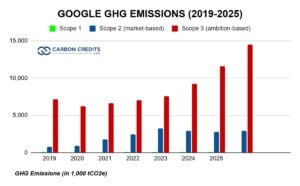
google emissions
Source: GOOGLE

The Reality Check: SAF Growth Faces Real Barriers

Despite strong corporate interest, SAF still faces significant challenges. Global production is rising fast, but not fast enough.

Production increased 24 times since 2021 and is expected to reach around 713 million gallons by the end of 2025. However, this still represents less than 1% of total jet fuel demand.

Even more concerning, growth may slow in 2026. According to the International Air Transport Association (IATA), production is expected to rise only modestly, reaching about 2.4 million metric tons. At the same time, costs remain highโ€”SAF can be two to five times more expensive than conventional fuel.

This price gap creates a major burden for airlines. In 2025 alone, SAF-related costs could reach $3.6 billion globally. Without stronger policy support, scaling production will remain difficult.

Policy and Market Shifts: A Fragmented Landscape

Policy support plays a crucial role in SAF growth, but global approaches remain uneven.

In the U.S., incentives are weakening. The Clean Fuel Production Tax Credit (45Z) will drop significantly in 2026, reducing financial support for SAF producers. This could slow investment and limit supply growth.

In contrast, Europe is pushing ahead. The ReFuelEU Aviation mandate requires a 2% SAF blend, while countries in Asia, including Singapore and Thailand, are introducing their own mandates starting in 2026.

This divergence creates uncertainty. Companies and producers must navigate different regulations across regions, making long-term planning more complex.

The Feedstock Challenge: The Biggest Bottleneck

Analysts say technology is not the main constraint for SAFโ€”feedstock is.

SAF relies on low-carbon raw materials such as waste oils, agricultural residues, and synthetic fuels. These resources are limited and already in demand from other sectors like renewable diesel and bioenergy.

As competition intensifies, sustainability standards are also becoming stricter. Producers must prove that their feedstocks are traceable and truly low-carbon. This means rapid expansion is unlikely in the short term. Instead, companies are expected to focus on gradual capacity growth and flexible production strategies.

Considering all the above factors, 2026 will not deliver a breakthrough but it will test the foundation of the SAF market. Three factors will define progress:

  • Policy credibility: Governments must provide stable, long-term incentives
  • Feedstock strategy: Companies need reliable and sustainable supply chains
  • Procurement innovation: Airlines and corporations must adopt smarter purchasing models

Momentum is building, but it remains selective. Only companies that align these elements will succeed as the market evolves.

Looking Ahead: Strong Demand Signals for 2030 and Beyond

Despite the challenges, SkyNRGโ€™s SAF Market Outlook gives optimistic long-term projections. It highlights that the demand could reach 15.5 million metric tons by 2030 under current trends.

By 2050, SAF could supply up to 16% of global aviation fuel demand. It is equivalent to roughly 72 million tonnes (24 billion gallons)โ€”even without the introduction of new policy measures.

SAF
Source: SkyNRG

These numbers highlight one key point: demand is not the problem. The challenge lies in scaling supply efficiently and affordably. Nonetheless, sustainable aviation fuel holds real promise. It offers one of the few viable paths to reduce emissions in aviation without redesigning aircraft.

Googleโ€™s latest move shows how large corporations can accelerate this transition. But the road ahead remains complex. High costs, limited supply, and policy uncertainty continue to slow progress.

The bottom line is clear: SAF is not scaling overnight. But with the right mix of corporate demand, policy support, and innovation, it could become a cornerstone of clean aviation in the decades ahead.

History Repeating Itself: Why Middle East Conflict at the Pump Should Be a Wake-Up Call for North America

Disseminated on behalf of Surge Battery Metals.

Every time instability erupts in the Middle East, North Americans feel it where it hurts mostโ€”at the gas pump. It happened in 1979, when the Iranian Revolution sent shockwaves through global energy markets. Oil supplies tightened. Prices surged, and inflation followed.ย  Entire economies slowed under the pressure.ย 

For millions of households, the crisisโ€™s impact was personal. It showed up in longer lines at gas stations and rising costs across daily life.

Nearly five decades later, the pattern is repeating.

Renewed tensions across key oil-producing regions are once again tightening global supply. Prices are rising. Consumers are feeling the impact. And once again, events unfolding thousands of miles away are shaping the cost of energy at home.

This pattern suggests a persistent structural vulnerability in North Americaโ€™s exposure to global oilโ€‘supply shocks. The region still depends heavily on global oil markets. That means supply disruptions, no matter where they occur, can quickly ripple through the system.ย 

The result is a familiar cycle: geopolitical instability leads to supply concerns, which drive up prices, which then feed directly into the cost of living.

A Cycle Consumers Know All Too Well

When prices spike, households adjust. Commuters rethink travel. Businesses absorb higher costs or pass them on. Inflation pressures build. The impact spreads far beyond the energy sector.

With average gasoline prices currently around $4 per gallon in the US ($5.50 in California), or roughly $1.05 US per liter ($1.45 in California), the connection between global events and local fuel prices is no longer theoretical โ€“ it is a lived experience.ย This is why energy security is increasingly framed as both a policy concern and a kitchenโ€‘table issue.ย 

The events of 1979 were a warning. Todayโ€™s rising prices are another. The difference is that North America now has more options than it did back then.

Electric vehicles, battery storage, and renewable power systems are no longer future concepts. They are already part of the energy mix. And for those who have made the shift, the experience is very different, and the transition is already complete.

Instead of watching fuel prices climb, they are plugging in.

Graham Harris, Chairman of Surge Battery Metals, has spoken openly about this shift in practical terms. While rising oil prices create uncertainty at the pump, he charges his electric vehicle at home.ย 

The contrast between gasoline dependency and electrification is becoming more visible.

When oil prices rise, gasoline costs follow. But electricity prices tend to be more stable, especially when supported by domestic generation and renewable sources. That difference is simple but powerful. It changes how people experience energy volatility.

One system is exposed to global shocks. The other is increasingly tied to domestic infrastructure. This contrast highlights how the energy transition is reshaping exposure to global price shocks.

Some analysts increasingly frame the energy transition not only as a climate imperative but also as a strategy to reduce exposure to external risk. It relates to questions of control over where energy comes from, how it is produced, and how stable it is over time.

And at the center of that transition is one critical material: lithium.

Lithium: The Foundation of Energy Independence

Lithium is the core component of modern battery technology. It powers electric vehicles, supports grid-scale energy storage, and plays a growing role in advanced defense systems.

As electrification expands, demand for lithium is rising across multiple sectors.

But here is the challenge: much of todayโ€™s lithium supply still comes from outside the United States. This creates a familiar dynamic.

Just as oil dependency has long exposed North America to geopolitical risk, reliance on foreign lithium supply introduces a new layer of vulnerability. The commodity is different, but the structure is similar.

top US lithium import 2024 by country

The United States imported the majority of its lithium from Chile and Argentina in 2024. Together, they accounted for roughly 98% of the total supply. Smaller volumes were sourced from the UK, France, and China.ย 

That is why domestic production is becoming a central focus of energy and industrial policy.

In March 2025, Donald Trump signed an executive order titled โ€œImmediate Measures to Increase American Mineral Production.โ€ The directive called for faster permitting, expanded development, and reduced reliance on foreign supply chains for critical minerals.

The message of the order was clear: building domestic capacity is now a strategic priority.

A Domestic Resource Takes Shape in Nevada

Within this broader shift, projects like Surge Battery Metalsโ€™ (TSX-V: NILI | OTCQX: NILIF) Nevada North Lithium Project (NNLP) are gaining attention.

NNLP hosts a measured and indicated resource of 11.24 million tonnes of lithium carbonate equivalent (LCE) at an average grade of 3,010 ppm lithium, based on company disclosures. This makes it the highest-grade lithium clay resource identified in the United States to date.

A 2025 Preliminary Economic Assessment (PEA) outlines the projectโ€™s scale:

  • After-tax NPV (8%): US$9.21 billion
  • Internal Rate of Return (IRR): 22.8%
  • Mine life: 42 years
  • Average annual production: ~86,300 tonnes LCE
  • Employment: ~2,000 construction jobs and ~350 long-term operational roles

Surge-NNLP-Preliminary-Economic-Assessment-PEA

These figures indicate potential in terms of scale, longevity, and the ability to contribute to domestic supply if the project moves forward. At full production, NNLP has the potential to rank among the larger lithium-producing assets globally, based on third-party analysis.

Recent drilling results announced by Surge Battery Metals have further strengthened NNLPโ€™s profile as a standout asset. In February 2026, step-out drilling found a 31-meter intercept with 4,196 ppm lithium from surface. This is much higher than the projectโ€™s average of 3,010 ppm Li. It also extends high-grade mineralization nearly 640 meters beyond the current resource boundary.

Infill drilling showed a steady, thick, high-grade core. It included intercepts like 116 meters at 3,752 ppm Li and 32 meters at 4,521 ppm Li. These results support future resource expansion. They also highlight the project’s scale, quality, and technical readiness as it prepares for a Pre-Feasibility Study.

Beyond the project itself, it reflects a broader policy and industry shift toward building more domestically anchored energy systems.

From Oil Dependency to Mineral Security

The connection between oil and lithium is not always obvious at first glance. Oil fuels internal combustion engines, while lithium supports batteries and energyโ€‘storage systems, with distinct technologies and supply chains.

But the underlying issue is the same. Dependence on external sources creates exposure to external risk.

In the case of oil, that risk has played out repeatedly over decades. Supply disruptions, price shocks, and geopolitical tensions have all shaped the market.

With lithium, the industry is earlier in its development. But the stakes are rising quickly.

Global demand for lithium grew about 30โ€ฏ% in 2024, driven mainly by batteries for electric vehicles and energy storage, according to IEA data. Demand in 2025 continued at high rates, and under current policies, lithium demand is projected to grow fivefold by 2040 compared with today.ย 

lithium demand and supply 2024 iea

At the same time, supply growth is struggling to keep pace with demand forecasts. These trends show that ensuring a stable, secure supply is becoming just as important as expanding production.

That is where domestic projects come in, such as Surge Battery Metalsโ€™ NNLP.ย 

They may not eliminate global market dynamics, but they can reduce exposure to them. They can provide a buffer against volatility. And they can support a more stable, self-reliant energy system.

A Turning Point – or Another Warning?

While history does not repeat in the same way, similar patterns can be observed.

The oil shocks of the 1970s revealed a vulnerability that shaped energy policy for decades. Todayโ€™s market signals are pointing to a similar challengeโ€”this time at the intersection of oil dependency and critical mineral supply.
The difference is that the range of policy and technological options available today is broader. Electrification is already underway. Battery technology is advancing. Domestic resource development is gaining policy support. The pieces are in place.

Data from the International Energy Agencyโ€™s Global EV Outlook 2025 shows that global battery demand reached a historic milestone of 1 terawatt-hour (TWh) in 2024. This surge was mainly due to the growth of electric vehicles (EVs).ย 

EV battery demand by region 2024 iea

By 2030, demand is expected to more than triple, exceeding 3 TWh under current policies. This reflects not only rising EV adoption but also expanding stationary storage demand. Both of which rely on critical minerals like lithium.
Electric vehicles continue to displace traditional oil use as well. The same IEA analysis shows that by 2030, EVs will replace over 5 million barrels of oil daily. This is about the size of a major country’s transport sector, highlighting how electrification is changing energy markets.
What remains uncertain is the pace at which these changes will occur.

Will rising fuel prices once again fade as markets stabilize? Or will they serve as a catalyst for deeper structural shifts?

That question matters not just for policymakers or investors, but for everyday consumers.

Because at the end of the day, energy transitions are not measured in policy papers. They are measured in daily decisionsโ€”how people power their homes, fuel their vehicles, and respond to rising costs.


DISCLAIMERย 

New Era Publishing Inc. and/or CarbonCredits.com (โ€œWeโ€ or โ€œUsโ€) are not securities dealers or brokers, investment advisers, or financial advisers, and you should not rely on the information herein as investment advice. Surge Battery Metals Inc. (โ€œCompanyโ€) made a one-time payment of $75,000 to provide marketing services for a term of three months. None of the owners, members, directors, or employees of New Era Publishing Inc. and/or CarbonCredits.com currently hold, or have any beneficial ownership in, any shares, stocks, or options of the companies mentioned.

This article is informational only and is solely for use by prospective investors in determining whether to seek additional information. It does not constitute an offer to sell or a solicitation of an offer to buy any securities. Examples that we provide of share price increases pertaining to a particular issuer from one referenced date to another represent arbitrarily chosen time periods and are no indication whatsoever of future stock prices for that issuer and are of no predictive value.

Our stock profiles are intended to highlight certain companies for your further investigation; they are not stock recommendations or an offer or sale of the referenced securities. The securities issued by the companies we profile should be considered high-risk; if you do invest despite these warnings, you may lose your entire investment. Please do your own research before investing, including reviewing the companiesโ€™ SEDAR+ and SEC filings, press releases, and risk disclosures.

It is our policy that information contained in this profile was provided by the company, extracted from SEDAR+ and SEC filings, company websites, and other publicly available sources. We believe the sources and information are accurate and reliable but we cannot guarantee them.

CAUTIONARY STATEMENT AND FORWARD-LOOKING INFORMATION

Certain statements contained in this news release may constitute โ€œforward-looking informationโ€ within the meaning of applicable securities laws. Forward-looking information generally can be identified by words such as โ€œanticipate,โ€ โ€œexpect,โ€ โ€œestimate,โ€ โ€œforecast,โ€ โ€œplan,โ€ and similar expressions suggesting future outcomes or events. Forward-looking information is based on current expectations of management; however, it is subject to known and unknown risks, uncertainties, and other factors that may cause actual results to differ materially from those anticipated.

These factors include, without limitation, statements relating to the Companyโ€™s exploration and development plans, the potential of its mineral projects, financing activities, regulatory approvals, market conditions, and future objectives. Forward-looking information involves numerous risks and uncertainties and actual results might differ materially from results suggested in any forward-looking information. These risks and uncertainties include, among other things, market volatility, the state of financial markets for the Companyโ€™s securities, fluctuations in commodity prices, operational challenges, and changes in business plans.

Forward-looking information is based on several key expectations and assumptions, including, without limitation, that the Company will continue with its stated business objectives and will be able to raise additional capital as required. Although management of the Company has attempted to identify important factors that could cause actual results to differ materially, there may be other factors that cause results not to be as anticipated, estimated, or intended.

There can be no assurance that such forward-looking information will prove to be accurate, as actual results and future events could differ materially. Accordingly, readers should not place undue reliance on forward-looking information. Additional information about risks and uncertainties is contained in the Companyโ€™s managementโ€™s discussion and analysis and annual information form for the year ended December 31, 2025, copies of which are available on SEDAR+ atย www.sedarplus.ca.

The forward-looking information contained herein is expressly qualified in its entirety by this cautionary statement. Forward-looking information reflects managementโ€™s current beliefs and is based on information currently available to the Company. The forward-looking information is made as of the date of this news release, and the Company assumes no obligation to update or revise such information to reflect new events or circumstances except as may be required by applicable law.


Disclosure: Owners, members, directors, and employees of carboncredits.com have/may have stock or option positions in any of the companies mentioned: .

Carboncredits.com receives compensation for this publication and has a business relationship with any company whose stock(s) is/are mentioned in this article.

Additional disclosure: This communication serves the sole purpose of adding value to the research process and is for information only. Please do your own due diligence. Every investment in securities mentioned in publications of carboncredits.com involves risks that could lead to a total loss of the invested capital.

Please read our Full RISKS and DISCLOSURE here.

Texas-Based EnergyXโ€™s Project Lonestarโ„ข Signals a Turning Point for U.S. Lithium Supply

Energy Exploration Technologies, Inc. (EnergyX), led by CEO Teague Egan, has moved the United States closer to building a reliable domestic lithium supply chain. The company recently commissioned its Project Lonestarโ„ข lithium demonstration facility in Texas, marking a key milestone in scaling direct lithium extraction (DLE) technologies.

This development comes at a time when lithium demand is rising sharply due to electric vehicles and energy storage systems. At the same time, the U.S. remains heavily dependent on foreign processing, particularly from China.

  • According to the US import dataย andย Lithium import data of the USA, the total value of US lithium imports reachedย $432.36 million in 2024, aย 9%ย decline from the previous year.
  • The total value of US lithium imports (cells & batteries) accounted forย $205.29 million in the first 6 months of 2025.

US lithium import

Against this backdrop, EnergyXโ€™s progress offers both technological validation and strategic value.

From Concept to Reality: How Project Lonestarโ„ข Works

Project Lonestarโ„ข is EnergyXโ€™s first major lithium project in the United States and its second globally. The demonstration plant, located in the Smackover region spanning Texas and Arkansas, is now operational and uses industrial-grade systems rather than small pilot equipment.

  • The facility produces around 250 metric tons per year of lithium carbonate equivalent (LCE).

While this output is modest compared to global supply, its importance lies in proving that EnergyXโ€™s proprietary GET-Litโ„ข technology can efficiently extract lithium from brine. The plant processes locally sourced Smackover brine, a resource that has historically been underutilized despite its lithium potential.

lithium lonestar energyX
Source: EnergyX

Unlike traditional lithium production, which often relies on hard-rock mining or evaporation ponds, DLE technology directly extracts lithium from brine using advanced filtration and chemical processes. This reduces production time and may lower environmental impact.

  • More importantly, the Lonestarโ„ข plant can supply 5 to 25 tons of battery-grade lithium samples to customers.

This allows battery manufacturers to test and validate the material before committing to large-scale supply agreements.

lithium energyX
Source: EnergyX

Scaling Up: From Demonstration to Commercial Production

The demonstration plant is only the first phase of a much larger plan. EnergyX aims to scale Project Lonestarโ„ข into a full commercial operation capable of producing 50,000 tonnes of LCE annually across two phases.

  • The first phase alone targets 12,500 tonnes per year, which would already place it among the more significant lithium producers in the U.S.
  • Significantly, the company has invested approximately $30 million in the demonstration facility, supported in part by a $5 million grant from the U.S. Department of Energy.
  • For the full-scale project, EnergyX estimates total capital expenditure at around $1.05 billion.

Cost metrics suggest strong economic potential. The company estimates capital costs at roughly $21,000 per tonne of capacity and operating costs near $3,750 per tonne. If these figures hold at scale, the project could compete effectively with global lithium producers, particularly in a market where cost efficiency is becoming increasingly important.

Teague Egan, Founder & CEO of EnergyX, said,

โ€œBringing the biggest integrated DLE lithium demonstration plant online in the United States is a foundational milestone for EnergyX and for U.S. domestic lithium production in general. This facility not only validates the performance of our technology on an industrial scale under real-world conditions, but also establishes EnergyX as the lowest cost producer in the U.S. Ultimately this benefits all our customers who need large volumes of lithium for EV and ESS applications, as well as any lithium resource owners looking to implement best-in-class DLE technology whom we are happy to license to.โ€

Breaking the Bottleneck: Why U.S. Refining Matters

One of the biggest challenges facing the U.S. lithium sector is not resource availability but refining capacity. While lithium deposits exist across the country, most battery-grade lithium chemicals are processed overseas.

China dominates this segment, controlling roughly 70 to 75 percent of global lithium chemical conversion capacity. This concentration creates a structural dependency. Even when lithium is mined in the U.S. or allied countries, it is often shipped abroad for processing before returning as battery materials.

Project Lonestarโ„ข directly addresses this gap. By integrating extraction and refining into a single domestic operation, EnergyX is working to build a complete โ€œbrine-to-batteryโ€ value chain within the United States. This approach could reduce reliance on foreign processing and improve supply chain resilience.

U.S. Senator Ted Cruz highlighted the projectโ€™s importance, noting that domestic lithium production supports both energy security and defense readiness, particularly for applications in advanced battery systems.

The Current Landscape: Limited Supply, Big Ambitions

How Much Lithium Does the U.S. Have?

The United States has a strong lithium resource base, but it still struggles to produce it at scale. Data from the United States Geological Survey shows that the country held about 14 million tonnes of lithium reserves in 2023, ranking it third globally.

Despite this, U.S. production remains very low. The country produced only 615 metric tonnes of lithium in 2023, according to USGS. This is tiny compared to global leaders. Australia produced around 86,000 tonnes, while Chile reached about 56,530 tonnes in the same year.

Lithium Reserves by Country 2026

LITHIUM GLOBAL
Source: World Population Review

In simple terms, the U.S. has plenty of lithium underground. But it still needs time, investment, and better infrastructure to turn those resources into a real supply.

Investment is flowing into regions such as Nevada, North Carolina, and Arkansas. If even a portion of these reserves is converted into production, the U.S. could significantly reduce its reliance on imported lithium.

Active Resources and Future Potential

At present, U.S. lithium production remains relatively small. The only active large-scale operation is the Silver Peak Mine in Nevada, which produces between 5,000 and 10,000 tonnes of LCE annually, depending on market conditions.

However, several projects are in development that could significantly expand capacity. The Thacker Pass project, for example, is expected to produce around 40,000 tonnes per year in its first phase once operational later in the decade.

In addition, brine-based developments in the Smackover region aim to produce tens of thousands of tonnes annually, with long-term plans exceeding 100,000 tonnes across multiple sites.

These projects indicate a shift from a niche domestic industry to a more substantial production base. Still, timelines remain uncertain due to regulatory and financial challenges.

lithium production USA

Demand Surge: Batteries Drive the Lithium Boom

The urgency to expand lithium production is driven by rapid growth in battery demand. Electric vehicles, renewable energy storage, and grid modernization are all increasing lithium consumption.

According to S&P Global, U.S. lithium demand is expected to grow at an average rate of 40 percent annually between 2024 and 2029. Canada is projected to see even faster growth, albeit from a smaller base, with demand rising by around 74 percent per year over the same period.

Globally, battery capacity is forecast to approach 4 terawatt-hours by 2030. This expansion highlights lithiumโ€™s central role in the clean energy transition. Without sufficient supply, battery productionโ€”and by extension, EV adoptionโ€”could face constraints.

lithium demand

Why Progress Takes Time

Turning lithium reserves into operational mines and processing facilities is not straightforward. Projects often face long permitting timelines, environmental scrutiny, and legal challenges. Financing can also be difficult, especially in a volatile commodity market.

Local opposition can further complicate development, particularly in areas with high environmental concerns. These factors can delay projects by several years, slowing the pace of expansion.

To address these barriers, the U.S. government is increasing its involvement through funding, policy support, and efforts to streamline permitting. The Department of Energyโ€™s backing of EnergyX reflects a broader strategy to accelerate domestic critical mineral development.

Conclusion: A Strategic Shift in Motion

Project Lonestarโ„ข represents a meaningful step toward reshaping the U.S. lithium landscape. By proving the viability of direct lithium extraction at an industrial scale, EnergyX has laid the groundwork for larger, commercially viable operations.

The project also aligns with national priorities around energy security, supply chain resilience, and clean energy transition. While challenges remain, the combination of technological innovation, government support, and rising demand creates a strong foundation for growth.

As the world moves toward electrification, lithium will remain at the center of the transition. Projects like Lonestarโ„ข show that the United States is beginning to close the gap between resource potential and real-world productionโ€”one facility at a time.

Canada Doles Out Almost C$29M for CCUS and Renewables as Clean Energy Market Surges

Canada has pledged nearly C$29โ€ฏmillion ($21.6โ€ฏmillion) to support carbon capture, utilization, and storage (CCUS) and renewable energy projects. The funding aims to back new technologies that reduce greenhouse gas emissions and make clean energy more competitive. This commitment was announced by the Canadian government in late March 2026 as part of ongoing efforts to meet climate goals.

The investment is small compared with Canadaโ€™s larger climate budget. But it signals continued federal support for emerging technologies and deployment of clean energy solutions. CCUS is one of several tools that nations are using to curb emissions while keeping energy supplies stable.

What Canada Is Funding? Inside the C$29M Clean Tech Bet

The C$29โ€ฏmillion pledge covers a mix of CCUS and renewable energy efforts. It is intended for 12 projects that capture carbon dioxide (COโ‚‚) from industrial emissions. It also supports systems that convert captured COโ‚‚ into usable products or store it underground so it cannot enter the atmosphere.

The Honourable Tim Hodgson, Minister of Energy and Natural Resources, said:

โ€œCanada is scaling up clean energy while strengthening our electricity grid and responsibly growing our conventional energy industry โ€” because competitiveness means doing more than one thing at the same time. We are investing to provide reliable, affordable and clean power across the country that will propel our economic growth, protect affordability for Canadian families and make Canada a low-risk, low-cost, low-carbon energy superpower.โ€

Carbon capture refers to systems that trap COโ‚‚ from power plants and factories before it is released. The captured gas can be stored deep underground or used in industrial processes, such as making building materials or fuels. Utilization means finding commercial uses for captured COโ‚‚ so that it has economic as well as environmental value.

Renewable energy projects in Canada focus on expanding wind, solar, hydro, and other lowโ€‘carbon power sources. As of 2024, about 79โ€ฏ% of Canadaโ€™s electricity generation came from lowโ€‘carbon sources, with hydropower alone accounting for roughly 55โ€ฏ%. The rest comes from wind, solar, and nuclear energy.

Carbon Captureโ€™s Strategic Role in Net Zero

Canada has a strong track record in CCUS deployment. Several largeโ€‘scale facilities already operate in the country, especially in Alberta and Saskatchewan.ย 

For example, the Quest Carbon Capture and Storage Project in Alberta captures about one million tonnes of COโ‚‚ per year and stores it deep underground.

carbon capture (CCUS) in Canada

Canadian CCUS technology accounts for a notable share of planned global capacity. Canadian projects represent about 11.5โ€ฏ% of planned CCUS storage capacity worldwide.

Notably, Canadaโ€™s carbon capture capacity could increase from about 4.4 million tonnes of COโ‚‚ per year to 16.3 million tonnes annually by 2030. However, much larger growth is still necessary to meet net-zero targets by 2050.

CCUS is considered critical for reducing emissions from hardโ€‘toโ€‘decarbonize sectors like heavy industry and oil and gas. It also plays an important role in achieving Canadaโ€™s longโ€‘term climate targets, including net-zero emissions by 2050. In these scenarios, CCUS helps bridge gaps that electrification and renewables alone cannot fill.

Canadaโ€™s Energy Innovation Program (EIP) is designed to speed up the development of clean energy technologies while keeping the energy system reliable and affordable. It supports early-stage research and development in CCUS.ย 

The program also funds renewable energy demonstration projects that test new ways to generate and integrate clean power, especially those with local benefits. In addition, EIP promotes innovation in electricity systems by supporting new approaches to smart grid regulation and capacity building.

A Power Mix Already Going Green

Renewable energy is another core part of Canadaโ€™s climate strategy. Over the last decade, installed renewable capacity has grown steadily. Between 2014 and 2024, Canadaโ€™s total renewable energy capacity increased from about 89,773โ€ฏMW to 110,470โ€ฏMW.

The federal government has supported renewable projects through multiple funding programs. Earlier initiatives included a $964โ€‘million investment targeting wind, solar, storage, hydro, and other renewable technologies.

Canada has also set decarbonization targets tied to renewables. The country aims for netโ€‘zero electricity by 2035, which supports a broader economyโ€‘wide goal of netโ€‘zero greenhouse gas emissions by 2050.

Canada net zero goals 2030 target

CCUS and Renewables on a Global Rise

Investment in CCUS and renewable energy is rising globally. According to industry forecasts, the global clean energy market โ€” including wind, solar, energy storage, and CCUS โ€” is expected to continue strong growth through 2030 as countries push toward climate targets.

For CCUS specifically, analysts project that global installed capacity could grow fivefold by 2030 as more projects move from demonstration to full deployment. Canada is among several countries with mature CCUS infrastructure and planned expansions.

global carbon capture 2030 growth
Source: Rystad Energy

Renewables continue to be the fastestโ€‘growing energy source globally. International agencies like the International Renewable Energy Agency (IRENA) project that renewable capacity will keep expanding rapidly through the end of the decade, driven by falling technology costs and climate commitments.

The Roadblocks to Scaling Clean Tech

While CCUS has potential, it also faces hurdles. Costs are high, and the technologies are still emerging at scale. Critics argue that CCUS has historically underperformed in some early projects, and that a significant amount of captured COโ‚‚ is used in enhanced oil recovery rather than stored permanently.

Some stakeholders also warn that public funds for CCUS must be carefully targeted to avoid subsidizing continued fossil fuel use rather than meaningful emission cuts. Despite these concerns, many policymakers see CCUS as an essential component of climate strategy if Canada is to meet its 2030 and 2050 goals.

Renewable energy projects also face challenges, including grid integration, siting barriers, and supply chain constraints for equipment like turbines and solar panels. However, continued funding and clear policy signals tend to reduce these barriers over time as markets mature.

Cutting Emissions While Keeping Energy Stable

Canadaโ€™s C$29โ€ฏmillion commitment fits into a broader pattern of public funding aimed at accelerating clean energy and decarbonization technologies. Larger federal efforts, such as the Net Zero Accelerator Initiative, provide billions of dollars over multiple years for clean tech, including CCUS deployment and industrial decarbonization.

The CCUS market is evolving from pilot projects to commercial opportunities. Meanwhile, renewable energy continues its growth as a mainstream power source. Together, these developments support Canadaโ€™s longโ€‘term climate and economic goals.

As the global energy landscape changes, investments in both CCUS and renewables help reduce emissions, create jobs, and build resilience in a lowโ€‘carbon economy. Canadaโ€™s latest funding pledge reinforces its ongoing role in these key markets.

The Top Carbon Credit Exchanges Driving Climate Markets in 2026 and Beyond

Carbon markets continue to grow as countries and companies work to reduce greenhouse gas emissions. Many firms now set net-zero targets. To reach those goals, they must cut emissions and offset those they cannot eliminate. Carbon credit exchanges play an important role in this process by providing platforms where verified carbon credits are bought and sold.

Each carbon credit represents one metric ton of carbon dioxide removed or avoided through climate projects such as reforestation, renewable energy, or methane capture. Carbon exchanges help the credit markets work. These platforms support price discovery, market liquidity, and transparent trading.

This article explores the top carbon credit exchanges shaping the market in 2026: Intercontinental Exchange (ICE), Xpansiv, AirCarbon Exchange (ACX), and ESGCX. They span global compliance markets, voluntary carbon credit venues, and next-generation digital marketplaces.

Carbon Credits and Market Trends Shaping 2026

The carbon credit market has expanded quickly in recent years. Governments have introduced carbon pricing programs, while many corporations now use carbon credits as part of their climate strategies.

The global carbon market hit around $783 billion in 2024 and exceeded $1 trillion in 2025. This growth shows strong demand from corporate climate programs and government policies.

voluntary carbon market size by value 2024

Voluntary carbon markets (VCMs) also continue to grow. The sector reached over $2 billion in traded value in 2024. Forecasts suggest strong growth ahead. The VCM could exceed $10 billion by 2030.

Several trends are shaping this market:

  • Corporate climate commitments. More companies now include carbon credits in their climate strategies. Studies suggest that over 60% of sustainability-focused companies plan to increase their use of carbon offsets.
  • Nature-based climate projects. Forestry and land-use projects remain major sources of credits. Forestry projects account for about 41% of the carbon credit supply, while renewable energy projects represent roughly 32%.
  • Demand for high-quality credits. Many buyers now seek projects with strong verification and measurable impact. Around 44% of buyers prefer high-quality certified credits with stronger transparency standards.
  • Digital technology in carbon markets. New platforms use digital tools and data systems to track carbon reductions. About 41% of market participants are adopting digital monitoring and verification systems.
VCM demand forecast 2050
Note: Conservative estimates of VCM demand; Source: McKinsey & Company voluntary carbon market forecast

As the market grows, trading infrastructure also becomes more important. Carbon exchanges provide the platforms that allow buyers and sellers to transact efficiently.

How Carbon Exchanges Support Climate Markets

Carbon exchanges create structured marketplaces for environmental assets. They connect buyers and sellers and provide transparent trading systems. These exchanges typically support two main types of markets.

  • Compliance carbon markets: Governments create these markets through emissions trading systems. Companies must hold carbon allowances equal to their emissions. The European Union Emissions Trading System is the largest example.
  • Voluntary carbon markets: Companies buy carbon credits voluntarily to offset emissions. These credits usually come from climate projects such as forest protection or renewable energy development.

Exchanges support both markets by providing tools for trading and price discovery. Some exchanges focus on derivatives and futures contracts. Others focus on spot trading of voluntary credits.

Reliable trading platforms also help reduce risk. They improve transparency by publishing prices and trading data. Several exchanges now play a major role in these global markets, and we’re breaking down each one of them so you’ll know your best pick.ย 

Intercontinental Exchange (ICE): The Global Benchmark for Carbon Derivatives

The Intercontinental Exchange (ICE) operates one of the largest environmental derivatives markets in the world. It focuses mainly on compliance, carbon markets, and emissions allowance trading.

ICE global market coverage
Source: ICE

ICE hosts futures and options contracts tied to several carbon pricing systems. These include European Union Allowances (EUAs), which serve as a global benchmark for carbon pricing. The exchange has recorded strong trading activity in recent years.

In 2025, ICE environmental markets saw a record of 20.9 millionย environmental futures and options contracts. This was a 4% rise from the previous record year.

ICE Environmental Contracts Traded 2025
Source: ICE

The trading volume exceeded $1 trillion in notional value. This trend marks five years of trillion-dollar environmental trading on the platform. The exchange also reported $117 billion worth of physically delivered carbon allowances in 2025.

ICE supports several major environmental products:

  • EU Carbon Allowance (EUA) futures
  • UK Carbon Allowance futures
  • California Carbon Allowance contracts
  • Renewable Energy Certificate (REC) futures

North American environmental markets on ICE also reached record activity. In 2025, 6.2 million contracts were traded in these markets. This total included 4.2 million California Carbon Allowance contracts.

Because of its deep liquidity and strong participation, ICE remains a key platform for companies and financial institutions managing carbon price risk.

Xpansiv: Powering the Largest Spot Market for Carbon Credits

Xpansiv operates the CBL carbon exchange, a leading marketplace for voluntary carbon credits. The exchange focuses on spot trading of environmental commodities. These include carbon credits and renewable energy certificates.

Xpansiv has become a major infrastructure provider for voluntary carbon markets. Since 2020, the platform has facilitated transactions involving more than 330 million carbon credits and environmental certificates.

CBL provides a central order book system that helps improve price transparency. Buyers and sellers can trade standardized contracts that represent verified carbon credits.

xpansiv cbl
Source: Xpansiv

The exchange also supports the Aviation Carbon Exchange (ACE), developed with the International Air Transport Association. ACE offers a marketplace for airlines to buy carbon credits that meet CORSIA requirements.

  • Since its launch, the platform has supported the trading of over 20 million tonnes of carbon credits used by airlines and other participants.

Xpansiv also connects to major carbon credit registries. These include Verra, the American Carbon Registry, Climate Action Reserve, and Gold Standard.

These integrations allow credits to move between registries and trading platforms. This improves liquidity and market access for project developers and buyers. As voluntary markets expand, platforms like Xpansiv play an important role in connecting carbon projects with global buyers.

AirCarbon Exchange (ACX): A Digital Marketplace for Global Carbon Trading

AirCarbon Exchange (ACX) is a digital carbon credit exchange designed to simplify trading of environmental assets. The platform operates fully online and connects market participants across regions.

Members, over 190 globally, include corporations, traders, financial institutions, and project developers. The exchange has transacted over 21 MtCO2e (million tonnes of carbon dioxide equivalent).

ACX focuses on providing efficient digital infrastructure for environmental markets. Its trading system supports carbon credits and other environmental products. The exchange serves members from more than 30 countries, reflecting the growing global nature of carbon markets.

ACX also emphasizes transparent pricing and streamlined trading systems. Digital exchanges reduce barriers for companies that want to participate in carbon markets.

ACX platform
Source: ACX

The platform has gained recognition from industry groups and environmental finance organizations for its trading technology and market structure. It has been voted as the Best Carbon Exchange for four consecutive years.

Digital exchanges such as ACX illustrate how technology is changing environmental markets. As more companies join the carbon economy, digital platforms may help scale global trading.

ESGCX: Integrityโ€‘Focused Carbon Market Platform

ESGCX is a platform focused on carbon credit quality, transparency, and verification. It integrates project evaluation, digital monitoring, and trading readiness in one system.

In 2025, ESGCX launched the Carbon Credit Integrity Pilot Program (CCIPP). The program brings together project developers, investors, and verification partners. Participants get early access to ESGCXโ€™s tools for digital MRV, credit ratings, and market readiness.

ESGCX CCIPP
Source: ESGCX

The exchange supports only premium carbon credits with third-party verification. This ensures buyers access high-quality credits with measurable climate impact.

The platform also uses digital tools and blockchain-friendly systems. These help improve transparency and simplify trading. Institutional buyers gain priority access to high-impact projects.

Market demand for high-integrity credits is rising. Corporate buyers committed over $10 billion to durable carbon removal in 2024โ€“2025. ESGCX positions itself to meet this growing demand.

In short, ESGCX is building a transparent, verified, and reliable carbon market. Its focus on quality and digital verification makes it a strong platform for developers, investors, and buyers.ย 

As VCMs mature, stronger integrity systems may become more important for buyers and regulators.

The Major Carbon Exchanges at a Glance

The exchanges discussed in this article operate in different parts of the carbon market. Here’s the summary of what they are and their market focus.

carbon credit exchanges for 2026

Each platform serves a different role within the global carbon economy.

Carbon Exchanges as the Backbone of Climate Markets

Carbon credit exchanges now serve as critical infrastructure for climate markets. They provide transparent pricing, enable trading, and connect climate projects with buyers. As carbon markets expand, exchanges will likely play an even larger role.

The carbon economy continues to evolve. Governments are expanding emissions trading systems, while companies increase investments in climate solutions.

At the same time, buyers are demanding stronger verification and higher-quality credits.

These trends are shaping the next phase of carbon markets. Exchanges such as ICE, Xpansiv, ACX, and ESGCX illustrate how trading platforms are adapting to support a rapidly growing global climate economy.

Google, Meta and McKinsey Lead Carbon Removal Boom and Turn Appalachia Green

Google, Meta, and McKinsey & Company have made a major move in corporate climate action. They signed a long-term deal to remove carbon from the air in Appalachia. The project is run by Living Carbon and focuses on restoring forests on degraded lands. Under this deal, the companies will remove 131,240 tonnes of COโ‚‚ over the next ten years.

A New Deal for Climate

The effort targets a much larger problem. Across the United States, about 1.6 million acres of abandoned mine land remain damaged by past mining. These lands often have poor soil, erosion, toxic metals, and invasive species that block natural regrowth.

In addition, around 30 million acres of degraded agricultural land could be restored through reforestation. Appalachia is one of the hardest-hit regions due to decades of coal mining.

The deal is backed by the Symbiosis Coalition, a group of buyers that funds high-quality carbon removal projects. The coalition is an advance market commitment (AMC) launched in 2024 by Google, Meta, Microsoft, and Salesforce.

The group has pledged to contract up to 20 million tonnes of carbon removal credits by 2030. This commitment aims to create strong market demand and support the growth of high-impact, science-based restoration projects that can help advance global climate goals.

The agreements they have give developers a steady demand. They also help unlock financing and allow projects to scale.

Symbiosis selected the Appalachian project after a strict review process. It looked at data, field conditions, and long-term risks. The group follows key standards such as durability, transparency, ecological integrity, and community impact. This helps ensure that every credit represents real and measurable carbon removal.

Symbiosis Coalition quality criteria
Source: Symbiosis

Julia Strong, Executive Director of the Symbiosis Coalition, remarked:

“Our support of Living Carbon reflects our belief that effective nature-based carbon removal requires both strong science and solid execution. Their project stands out for its rigor and for its thoughtful and scalable approach shaped around the needs of local communities, ecosystems, and economies in Appalachia.”

Why Appalachia Matters: From Coal Hubs to Carbon Heroes

The Appalachia region, in the eastern United States, was once a center of coal mining. Today, many of these lands remain unused and degraded. Living Carbon is working to restore them by planting native hardwood and pine trees on former mine sites and damaged farmland.

The project uses a mix of careful site preparation, invasive species control, and strategic planting. This helps trees grow in areas where nature cannot easily recover on its own. The goal is not just to plant trees, but to rebuild entire ecosystems and support long-term carbon storage.

The benefits go beyond carbon removal. Restoring forests improves soil health, water quality, and biodiversity. Native trees help rebuild habitats for local plants and wildlife. These changes can also reduce erosion and improve land stability over time.

The project also creates real economic value. Landowners earn lease payments from land that was once unproductive. Local workers are hired for planting and land restoration.

  • In some cases, old mining equipment is reused to support ecological recovery. This helps turn former industrial sites into productive carbon sinks.

Community engagement is a key part of the project. Living Carbon works closely with landowners, local groups, and government agencies. This helps build long-term support and ensures the project fits local needs. Strong local partnerships also improve the chances that the forests will be maintained over time.

living carbon

The project stands out for its strong science and clear execution plan. It uses careful monitoring and conservative estimates to ensure carbon removal is real. It also applies new methods for tracking results, including advanced baselines and lifecycle analysis.

This type of approach shows that high-quality nature-based carbon removal can deliver more than climate impact. It can restore ecosystems, support local economies, and scale across similar regions. In places like Appalachia, it offers a way to turn damaged land into a long-term climate solution.

Big Business Bets on Carbon Credits

More corporations are now buying carbon removal credits to meet climate goals. For example, Microsoft bought 45 million tonnes of carbon removal in fiscal year 2025. This is nearly double the amount from 2024 and nine times what they bought in 2023.

These purchases are part of a broader climate strategy. Companies are combining emissions reductions with long-term removal commitments. Durable carbon removal credits, which permanently store COโ‚‚, are becoming more important. Businesses feel pressure to deal with emissions that they cannot completely eliminate.

A major supporter of these deals is Frontier, launched in 2022 by Stripe, Alphabet (Googleโ€™s parent company), Meta, Shopify, and McKinsey Sustainability. Frontier wants to boost early demand and funding for promising carbon removal technologies.

The company does this through long-term purchase agreements. Its initial goal was $1 billion in purchases by 2030, sending a strong signal to the market about future demand.

frontier carbon removal
Source: Frontier

By 2025, Frontier signed contracts for various technologies. These include bioenergy with carbon capture and storage (BECCS), direct air capture (DAC), and enhanced weathering. Several contracts are worth tens of millions of dollars. These agreements help developers survive the early โ€œvalley of death,โ€ when financing is hardest to secure.

Market Trends: From Niche to Necessity

The carbon removal market is still small compared with global climate goals, but it is evolving quickly. Industry forecasts say that demand for durable carbon removal credits might hit 100 million tonnes of COโ‚‚ each year by 2030.

This growth is fueled by corporate commitments and government purchases. This is roughly double the supply currently announced, showing a large gap between demand and delivery.

Globally, carbon removal is still a tiny fraction of what is needed. Scientific assessments show that to meet the Paris Agreement, carbon removal needs to increase. By 2050, it should reach 7โ€“9 billion tonnes of COโ‚‚ each year. This is about 4,000 times more than what we do now.

carbon removals by 2050
Source: CUR8 website

Market projections show strong growth in the next decade. A report by Oliver Wyman and the UK Carbon Markets Forum estimates that the global carbon removal market could grow from $2.7 billion in 2023 to $100 billion per year by 2030โ€“2035, provided policies and standards evolve to support it.

Local and Global Wins

The Appalachia project highlights how carbon removal can benefit both the climate and communities. Restoring degraded lands improves water filtration, soil health, and wildlife habitats. Communities also gain jobs and income through forest management.

Nature-based projects, including reforestation and forest management, currently dominate removal activity. However, they do not offer the same permanence as engineered removals like BECCS or DAC, which store carbon for centuries or longer. Still, both approaches are necessary to scale the carbon removal market.

From Milestones to Market Momentum

The Google, Meta, and McKinsey deal is a milestone for corporate climate action. Long-term agreements help projects secure funding and expand. They also send strong signals to developers and investors. These deals can shift the market from short-term offsets to long-term, permanent carbon removal solutions.

The industry must grow significantly to meet global climate targets. Expanding beyond early adopter companies is essential. Continued policy support, strong standards, and wider sector participation will help scale removals.

In the next decade, how fast carbon removal technologies grow and the amount of credits produced will be key to achieving net-zero goals. Deals like the Appalachia reforestation project are early steps in building a foundational, long-term carbon removal industry.

Nasdaq Invests in First EU-Certified Carbon Removal Credits from Stockholm Exergi

Nasdaq has backed one of the first carbon removal credit deals licensed under European Union rules. The project is based in Stockholm and is designed to generate high-quality carbon removal credits under a formal EU framework.

This marks a key shift. For years, carbon markets have relied on voluntary standards with mixed credibility. Now, the European Union has developed a regulated system to define what counts as a valid carbon removal. This move aims to build trust and attract large investors into a market that is still in its early stages.

The deal shows growing interest from major companies. It also reflects rising demand for reliable ways to remove carbon from the atmosphere.

Inside the Stockholm Carbon Removal Project

The removal project is run by Stockholm Exergi. It uses a process called BECCS, or bioenergy with carbon capture and storage. This method burns biomass, such as wood waste and agricultural residues, to produce heat and electricity. At the same time, it captures the carbon dioxide released and stores it underground.

The captured COโ‚‚ will be transported and stored deep beneath the North Sea in rock formations. Over time, it will turn into solid minerals. This makes the carbon removal long-lasting and more secure than many nature-based solutions.

The facility is expected to start operating in 2028. Once active, it will generate carbon removal credits that companies can buy to balance their remaining emissions.

Beccs Stockholm is one of the worldโ€™s largest carbon removal projects. In its first ten years, the project could remove about 7.83 million tonnes of COโ‚‚ equivalent. This makes it a key tool for helping the European Union reach climate neutrality by 2050.

The project also aims to scale carbon removal by building a full CCS value chain in Northern Europe and supporting a growing market for negative emissions credits.

This project is important because it is one of the first to follow the EUโ€™s new carbon removal certification rules. These rules define how carbon removal should be measured, verified, and reported. They also aim to reduce risks like double-counting and weak accounting.

EU Certification: Building Trust in a Fragile Market

The European Commission has introduced a framework, also called Carbon Removals and Carbon Farming (CRCF) Regulation, to certify carbon removal activities. This includes technologies like BECCS, direct air capture with carbon storage, and biochar.

The goal is to create a trusted system that investors and companies can rely on. It also established the first EU-wide certification framework for carbon farming and carbon storage in products, not just removals.

Until now, the voluntary carbon market (VCM) has faced criticism. Concerns about transparency and โ€œgreenwashingโ€ have made some companies cautious. Many buyers want stronger proof that credits represent real and permanent carbon removal.

The EU framework tries to solve this problem. It sets clear rules for:

  • Measuring how much carbon is removed.
  • Verifying results through independent checks.
  • Ensuring long-term storage of COโ‚‚.

This structure may help standardize the market. It could also make carbon removal credits easier to compare and trade across borders. The Commission states that the goal of having the framework is:

“to build trust in carbon removals and carbon farming while creating a competitive, sustainable, and circular economy.”

Corporate Demand Is Growingโ€”but Still Limited

Large companies are starting to invest in carbon removal. However, the market remains small compared to what is needed.

One major buyer is Microsoft. It currently holds about 35% of all global carbon removal credits, making it a dominant player in the market. In fact, it is responsible for 92% of purchased removal credits in the first half of 2025.

carbon removal credits purchase H1 2025
Source: AlliedOffsets

Other companies, including Adyen, a Dutch payments provider, have also joined the Stockholm project. These early buyers aim to secure a future supply of high-quality carbon credits as demand grows.ย 

Ella Douglas, Adyenโ€™s global sustainability lead, said in an interview with the Wall Street Journal:

“This project does exactly that [โ€œcatalytic impactโ€ to the VMC] while also building key market infrastructure in collaboration with the European Commission.”

Still, many firms remain cautious. Carbon removal technologies are often expensive and not yet proven at a large scale. Some companies also worry about reputational risks if projects fail to deliver real climate benefits.

This creates a gap. Demand is rising, but the supply of trusted credits is still limited.

A Market Set for Rapid Growth

Despite these challenges, the long-term outlook for carbon removal is strong. Estimates suggest the market could reach $250 billion by mid-century, according to MSCI Carbon Markets.

carbon credit market value 2050 MSCI

Several factors drive this growth:

  • First, global climate targets require large-scale carbon removal. The Intergovernmental Panel on Climate Change estimates that the world may need to remove around 10 billion metric tons of COโ‚‚ per year by 2050 to limit warming.
  • Second, many companies have set net-zero goals. These targets often include removing emissions that cannot be avoided, especially in sectors like aviation, shipping, and heavy industry.
  • Third, new regulations are pushing companies to disclose and manage emissions more clearly. This increases demand for credible carbon solutions.

However, the current supply falls far short of what is needed. Only a small share of the required carbon removal credits has been developed or sold so far.

Balancing Removal and Emissions Cuts

While carbon removal is gaining attention, experts stress that it cannot replace emissions reductions. Removing carbon from the atmosphere is often more expensive and complex than avoiding emissions in the first place.

Groups like the European Environmental Bureau warn that over-reliance on credits could delay real climate action. They argue that companies should set separate targets for reducing emissions and for removing carbon.

The EU framework reflects this concern. It treats carbon removal as a tool for addressing residual emissions, not as a substitute for cutting pollution at the source. This distinction is important. It helps ensure that carbon markets support, rather than weaken, overall climate goals.

From Concept to Market Infrastructure

The Stockholm project marks a turning point for carbon removal. It shows how rules, strong verification, and corporate backing can bring structure to a fragmented market.

With support from players like Nasdaq, carbon removal is moving closer to becoming a mainstream financial asset. At the same time, the European Unionโ€™s certification system is setting the foundation for a more credible and scalable market.

The path ahead remains complex. Technologies must scale. Costs must fall. Trust must grow. But the direction is clear.

Carbon removal is no longer a niche idea. It is becoming a key part of the global climate economy, with the potential to shape investment flows for decades to come.

AI Solutions from Microsoft and NVIDIA Power DOEโ€™s Nuclear Energy Genesis Mission

The nuclear energy industry is entering a new phase of transformation. This shift is no longer just about building reactorsโ€”it is about building them faster, smarter, and more efficiently.

A recent breakthrough led by the U.S. Department of Energy (DOE), in collaboration with Idaho National Laboratory, Argonne National Laboratory, Microsoft, NVIDIA, Everstar, and Aalo Atomics, highlights that AI tools can streamline the nuclear regulatory process.

AI and DOE’s Genesis Mission: Breaking Bottlenecks in Nuclear Energy Deployment

The work supports President Trumpโ€™s Genesis Mission, a national initiative aimed at driving a new era of AI-accelerated innovation and discovery. The mission focuses on using advanced technologies like AI to solve critical national challenges, from energy to healthcare and beyond.

Under the Genesis Mission, DOE recently announced $293 million in competitive funding to tackle twenty-six pressing science and technology challenges, including one dedicated to speeding up nuclear energy deployment.

Rian Bahran, Deputy Assistant Secretary for Nuclear Reactors. said,

โ€œNow is the time to move boldly on AI-accelerated nuclear energy deployment,โ€ โ€œThis partnership, combined with the Presidentโ€™s orders, represents more than incremental โ€˜upliftโ€™ improvements. It has the potential to transform how industry prepares its regulatory submissions and deploys nuclear energy while upholding the highest standards of safety and compliance.โ€ย 

Simply put, from licensing to construction and operations, AI is now helping eliminate long-standing bottlenecks.

Faster Nuclear Licensing with Advanced Tools

The DOEโ€™s recent announcement is a big step in modernizing nuclear regulation. Normally, preparing licensing documents for nuclear reactors is slow and complicated. It requires reviewing thousands of pages of technical data and making sure everything meets strict rules.

This shows how AI can make nuclear licensing faster and more accurate, helping advanced reactors reach the market sooner. Hereโ€™s how AI is simplifying this usually long and complex process.

AI nuclear application
Source: IEA

Everstarโ€™s Gordian AI: Streamlining Nuclear Licensing with AI

Everstar, an NVIDIA Inception startup, is transforming nuclear licensing with its Gordian AI platform built on Microsoft Azure. Recently, the team used Gordian to convert a safety analysis document into a format aligned with the U.S. Nuclear Regulatory Commission (NRC) licensing requirements.

For instance, a 208-page licensing document that normally takes four to six weeks to generate was completed in just one day, with AI automatically identifying missing or incomplete data.

Gordian is designed for nuclear-grade technical work. Unlike generic AI, it combines physics-based models, engineering logic, and semantic ontology mapping to ensure outputs are verified, not inferred.

The platform offers several key features:

  • Cross-references technical data automatically
  • Identifies documentation gaps
  • Maintains alignment with regulatory standards
  • Provides a clear audit trail for every output
  • Highlights its own limitations, allowing experts to focus on areas that need further attention

By accelerating document preparation while maintaining accuracy, Gordian reduces bottlenecks in nuclear licensing. Its capabilities build trust among regulators and industry stakeholders, making AI adoption safer, more practical, and scalable for the industry

Kevin Kong, CEO and Founder of Everstar, added:

โ€œNuclear is poised to solve todayโ€™s critical energy challenges,โ€ said ย โ€œWeโ€™re excited to partner with INL to meet the moment, working together to accelerate regulatory review and commercialization.โ€ย ย 

Microsoft and NVIDIA Partnership: Building AI Infrastructure for Nuclear Energy

While the DOE demonstration focused on licensing, the broader transformation is being driven by a powerful collaboration between Microsoft and NVIDIA.

Together, they are developing a full-stack AI ecosystem designed specifically for nuclear energy. This platform combines cloud computing, simulation tools, and advanced AI models to streamline every phase of a nuclear project.

Key technologies in this ecosystem include:

  • NVIDIA Omniverse for simulation and digital modeling
  • NVIDIA CUDA-X and AI Enterprise for high-performance computing
  • Microsoft Azure AI for data processing and automation
  • Microsoftโ€™s Generative AI tools for permitting and documentation

This integrated system enables developers to manage complex workflows in a unified environment. Instead of working with disconnected tools and datasets, teams can now operate within a single, AI-powered framework.

As a result, nuclear projects become more efficient, transparent, and predictable.

Carmen Krueger, Corporate Vice President, US Federal, Microsoft, further added:

โ€œOur collaborations with DOE, INL, and across the industry are demonstrating how we can effectively bring secure, scalable AI technologies to solve key energy challenges and achieve the broader national and economic security goals envisioned by the Departmentโ€™s Genesis Mission.”

Aalo Atomics: Cutting Permitting Time and Costs with AI

One of the most compelling real-world examples of AI impact comes from Aalo Atomics.

By leveraging Microsoftโ€™s Generative AI for Permitting solution, Aalo has achieved dramatic improvements in project timelines. The company reported:

  • A 92% reduction in permitting time
  • Estimated annual savings of $80 million

These results show how AI can address one of the biggest challenges in nuclear developmentโ€”delays caused by regulatory complexity.

Permitting often takes years and requires extensive documentation. However, AI can automate much of this work, allowing teams to focus on critical decision-making rather than repetitive tasks.

For Aalo, the value goes beyond speed. The technology also improves confidence in project execution by ensuring that all documentation is consistent, complete, and aligned with regulatory expectations.

This video demonstrated further details:

AI-Powered Nuclear Lifecycle: From Design to Operations

The impact of AI is not limited to licensing. It extends across the entire lifecycle of a nuclear plant. In the blog post, written by Darryl Willis, Corporate Vice President, Worldwide Energy and Resources Industry of Microsoft, explained how AI can help nuclear in a broader context.

  • Design and Engineering Optimization: AI and digital twins allow engineers to simulate reactor designs in real time. This enables faster iteration and better decision-making. Developers can reuse proven design patterns and instantly evaluate how changes affect performance, safety, and cost.
  • Licensing and Permitting Automation: Generative AI handles document drafting, data integration, and gap analysis. It ensures that applications are complete and consistent, reducing delays during regulatory review. This allows experts to focus on safety assessments instead of administrative tasks.
  • Construction and Project Delivery: Advanced simulations now include time and cost dimensions. These 4D and 5D models allow developers to track progress, predict delays, and avoid costly rework. AI also enables real-time monitoring, ensuring that construction stays on schedule and within budget.
  • Predictive maintenance and Plant Performance: Once a plant is operational, AI continues to add value. Predictive maintenance systems can detect issues early, reducing downtime and improving reliability. Digital twins provide continuous insights into plant performance, helping operators maintain optimal efficiency.

Why AI Is Critical for Scaling Nuclear Energy

Global electricity demand is rising fast, driven by digital growth and electrification. At the same time, countries need clean, reliable power to cut emissions. Nuclear energy can meet this need, but slow and complex processes have held it back.

AI is changing that. It speeds up licensing by automating documentation, improving accuracy, and reducing manual work. As a result, projects can move forward much faster without compromising safety.

In addition, AI connects data across design, permitting, construction, and operations. This improves efficiency, reduces errors, and makes timelines more predictable.

In short, AI removes key bottlenecks, helping nuclear energy scale faster to meet growing global demand. Most significantly, DOE’s approach aligns with growing global efforts to modernize energy infrastructure.

And partnerships with tech giants like Microsoft and NVIDIA will only accelerate the pace of innovationโ€”and shape the future of global energy.

Germanyโ€™s โ‚ฌ8B Climate Push: Can Europeโ€™s Largest Economy Cut Fossil Fuel Use Fast Enough

Germany has launched a new climate action plan aimed at cutting emissions and reducing fossil fuel use. The program includes 67 measures across energy, transport, industry, buildings, and agriculture, backed by โ‚ฌ8 billion ($9.3 billion) in funding over the next four years.

The goal is clear. Germany wants to cut greenhouse gas emissions by 65% by 2030 compared to 1990 levels and reach climate neutrality by 2045.

But progress has been uneven. Emissions are currently about 48% below 1990 levels, leaving a significant gap to close before the end of the decade.

This new plan is designed to close that gap while also reducing reliance on imported fossil fuels, which have become more costly and volatile in recent years.

How the Plan Cuts Emissions and Fuel Use

The German government expects the program to deliver measurable results. By 2030, the plan aims to:

  • Cut more than 25 million metric tons of COโ‚‚ per year,
  • Reduce natural gas use by about 7 billion cubic meters, and
  • Lower petrol consumption by roughly 4 billion liters.

These reductions will come from a mix of policies targeting different sectors.

A major focus is on renewable energy. Germany plans to add 12 gigawatts of new onshore wind capacity, enough to replace the output of 15 to 20 gas-fired power plants.

Germany offshore wind capacity additions 2034

In transport, the government will offer โ‚ฌ3 billion in subsidies to support up to 800,000 electric vehicles (EVs). This alone could save more than 800 million liters of fuel by 2030.

Industry will also play a key role. About โ‚ฌ2.9 billion is set aside to help companies switch to low-carbon technologies, including electrification and carbon capture solutions.

Together, these measures aim to reduce both emissions and dependence on fossil fuels at the same time.

Energy Security Meets Climate Policy

Germanyโ€™s climate strategy is closely tied to energy security. The country has faced rising energy costs and supply risks in recent years. These challenges have made reducing fossil fuel imports a priority.

The new plan reflects this shift. It aims to make Germany less dependent on volatile global market prices for fossil fuels, according to the government. Carsten Schneider, Germanyโ€™s Federal Environment Minister, remarked:

โ€œThis program will give a new boost to climate protection, making us less dependent on expensive and uncertain oil and gas imports. We are modernizing the economy, making society more resilient to crises, and helping nature to help us. What is at least as important to me is that we, as the Federal Government, have succeeded in developing this program without major controversy.โ€

By expanding renewable energy and electrification, Germany can reduce its exposure to oil and gas price swings. Wind and solar power offer more stable costs over time, especially once infrastructure is in place.

germany new climate action plan 2026

This approach also aligns with broader European trends. Many countries in the EU are accelerating clean energy investments to strengthen both climate resilience and energy independence.

For instance, Spain is quickly boosting its solar and wind energy. The national plan aims for renewables to provide over 70% of electricity by 2030. France is also investing heavily in both nuclear and renewable energy to cut fossil fuel use and stabilize power supply.

Meanwhile, the Netherlands is scaling offshore wind projects in the North Sea, targeting tens of gigawatts of capacity by 2030. These efforts reflect a region-wide push to reduce dependence on imported fossil fuels.

Challenges: A Gap Between Targets and Reality

Despite Germany’s new plan, challenges remain. The countryโ€™s emissions have not been falling fast enough in key sectors.

In 2025, total emissions were about 648.9 million tonnes of COโ‚‚ equivalent, only slightly below the legal limit. Emissions dropped by just 0.1% from the previous year, far slower than needed.

germany ghg emissions 2025 bloomberg

The transport and buildings sectors continue to miss their targets. These areas are harder to decarbonize because they rely heavily on fossil fuels and require large infrastructure changes.

According to a study by Agora Energiewende, Germany must cut emissions by about 42 million tonnes per year starting in 2026 to meet its 2030 goal.ย 

Some advisors warn that the current plan may not be enough. Early assessments suggest it is โ€œhighly likelyโ€ that additional measures will be needed to meet long-term targets. This highlights the scale of the transition required.

Market Trends and Investment Outlook

Germanyโ€™s plan reflects wider global trends in climate policy and clean energy markets. Investment in renewable energy, electrification, and low-carbon technologies continues to grow worldwide.

According to the International Energy Agency, global energy investment reached about $3.3 trillion in 2025, with around $2.3 trillion (or about two-thirds) going to clean energy such as renewables, grids, and electrification.

Bloomberg Energy Transition Investment Trends 2025

Governments and companies are increasing spending to meet climate targets and reduce exposure to fossil fuel risks. Key trends include:

Germanyโ€™s plan supports all of these areas. The 12 GW wind expansion, EV subsidies, and industrial funding align with global investment patterns.

At the same time, the clean energy transition is becoming a major economic driver. Countries are competing to build new industries around renewable power, batteries, and low-carbon technologies.

However, the pace of investment must increase further. Global climate models suggest that emissions must fall sharply this decade to meet international targets under the Paris Agreement.

A Critical Decade for Germanyโ€™s Climate Goals

Germanyโ€™s new climate action plan marks an important step in its energy transition. It combines investment, policy measures, and sector-wide changes to reduce emissions and fossil fuel use.

The plan targets over 25 million tonnes of annual COโ‚‚ reductions by 2030, along with major cuts in gas and petrol consumption.

But the path ahead is challenging. Emissions must fall much faster to meet national targets. Key sectors still lag behind, and experts question whether current measures will be enough.

What is clear is that the next few years will be critical. Germanyโ€™s ability to scale renewable energy, electrify transport, and decarbonize industry will determine whether it can meet its climate goals.

The outcome will also shape Europeโ€™s broader transition. As the regionโ€™s largest economy, Germany plays a central role in setting the pace for climate action across the continent.