

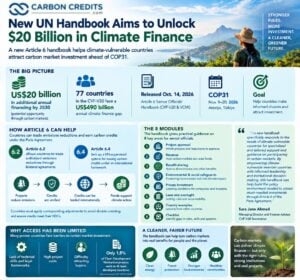
Climate-vulnerable countries could gain access to US$20 billion in additional annual financing by 2030 through carbon markets. A new handbook aims to help them attract this climate funding ahead of the United Nations climate summit COP31.
Released on October 14, 2026, the Article 6 Senior Officials’ Handbook explains how governments can take part in international carbon markets. The Climate Vulnerable Forum and V20 Finance Ministers (CVF-V20) developed it with the Voluntary Carbon Markets Integrity Initiative (VCMI).
The initiative addresses a major funding gap. The 77 countries represented by the CVF-V20 face an estimated US$490 billion annual shortfall in financing for their climate plans. Carbon markets could provide another source of funding. But countries need clear rules, strong public institutions, and reliable safeguards to benefit.
The handbook offers practical advice to help governments make informed choices and attract investment. However, the US$20 billion figure is a potential opportunity, not guaranteed funding.
New Handbook Puts Carbon Finance on the COP31 Agenda
The handbook was released in Bangkok during the 2026 Annual Meetings of the World Bank Group and the International Monetary Fund. Its launch came about a month before COP31, which is scheduled for November 9–20 in Antalya, Türkiye.
The timing highlights a key challenge for climate action: countries need money to turn their climate plans into real projects. The United Nations Environment Programme has also stressed the need to improve access to climate finance and help communities facing serious climate risks.
Many developing countries struggle to attract investment, even when they have clear climate goals. They may lack the laws, technical skills, or project plans needed to secure funding.
Carbon markets could help close part of this gap. Countries can earn money by supporting projects that reduce or remove greenhouse gas emissions. These projects may include forest protection, renewable energy, and methane reduction.
However, governments must first decide which projects to support and how to manage carbon credit sales. The new handbook aims to help officials understand these choices before making deals.
How Article 6 Can Help Countries Raise Money
The handbook focuses on Article 6 of the Paris Agreement, which allows countries to work together to cut greenhouse gas emissions.
Article 6.2 allows countries to trade authorized emissions reductions through agreements with other countries. Article 6.4 sets up a United Nations-supervised system for issuing carbon credits under an international framework.
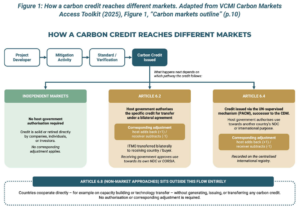
These rules can help countries attract foreign investment into climate projects. For example, a government can approve a project that cuts emissions. It can let some verified reductions be sold to a buyer in another country.
However, these transfers require careful accounting. Countries must follow approval and reporting rules and must also apply corresponding adjustments where required. These adjustments help prevent the same emissions reduction from being counted toward two countries’ climate targets.
Governments must also consider how selling carbon credits affects their own climate commitments, known as nationally determined contributions (NDCs). The handbook explains these choices and covers both Article 6.2 agreements and the Article 6.4 mechanism.
Sara Jane Ahmed, Managing Director and Finance Advisor of CVF-V20 Secretariat, remarked:
“This new handbook specifically responds to the needs of climate-vulnerable countries for specialised and tailored support and guidance on participating in carbon markets. By empowering climate-vulnerable member countries with informed leadership and institutional decision-making, this handbook can help build the policy environment needed to attract much-needed investments through Article 6 of the Paris Agreement.”
Eight Modules Guide Governments Through Carbon Market Rules
The handbook contains eight modules for senior government officials involved in carbon markets. It covers several important areas:
- Project approval: Deciding which projects and emissions reductions can be approved for international transfer.
- Revenue: Assessing how carbon markets could raise money for national climate plans.
- Benefit-sharing: Deciding how project income and other benefits should be shared.
- Environmental and social safeguards: Protecting communities and ensuring projects deliver real climate benefits.
- Private investment: Creating conditions that encourage companies and investors to take part.
- Laws and oversight: Setting rules and assigning responsibility for managing carbon markets.
The handbook also provides country examples and explains common challenges. Governments can use it as a checklist to identify missing rules, skills, or systems before entering the market.
This guidance matters because carbon markets involve more than selling credits. Governments must decide who can approve projects, how money will be managed, and how results will be measured. They also need clear rules to protect communities and ensure that projects deliver the benefits they promise.
Why Poor Countries Have Had Limited Access to Carbon Market Investment
The handbook addresses a long-standing problem: many climate-vulnerable countries have struggled to attract carbon market investment.
Forty-five least developed countries made up just 1.5% of projects registered under the Kyoto Protocol’s Clean Development Mechanism, according to the CVF-V20 and VCMI. This figure relates to an earlier carbon market system, not the entire market today. However, it shows how limited participation has been for many poorer countries.
Several barriers help explain this gap. Some countries lack the technical skills to develop projects or the laws needed to manage carbon credit sales. Others face high project costs or struggle to attract buyers.
The handbook aims to help governments address these problems. It encourages them to link carbon market plans with national development goals. This way, they won’t see credit sales as just a separate income source.
This could help direct investment toward clean energy, forest protection, and stronger local economies. But the guidance alone cannot guarantee funding. Countries still need credible projects that buyers are willing to support.
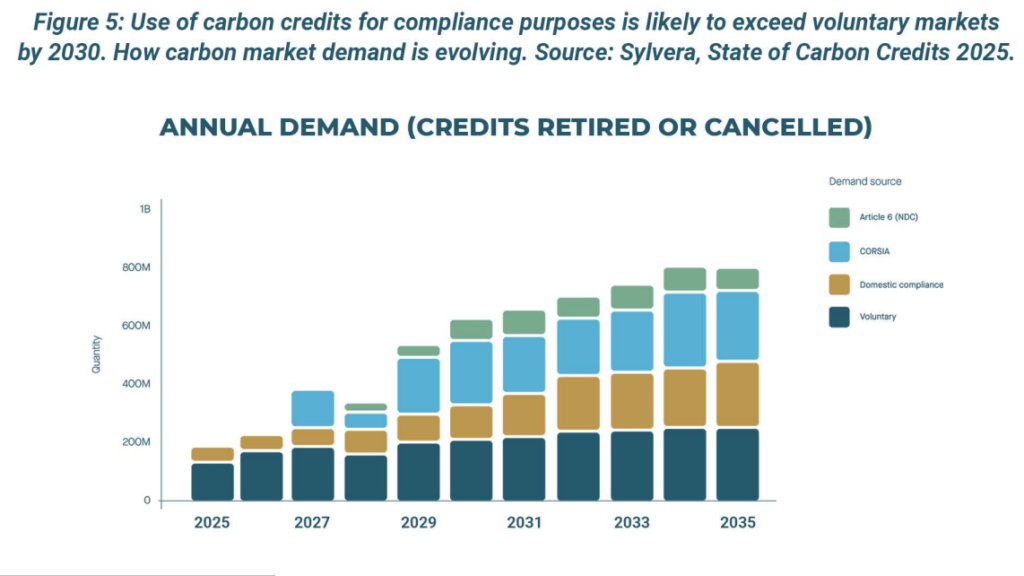
Figure 5 shows that market projections expect compliance demand to outpace voluntary markets over the next decade, a trend sparked first by CORSIA.
Ghana and the Philippines Show How Deals Can Work
The handbook highlights countries that are already exploring international carbon market cooperation. Ghana and Switzerland will work together to create 8 million tonnes of carbon credits. This effort is expected to bring in about US$300 million in carbon revenue and lead to US$1.1 billion in total investment.
These figures are projected outcomes. They do not mean that all the credits have been issued or that the revenue and investment have already been delivered.
The Philippines has also entered into bilateral carbon market agreements with Japan and Singapore, according to the handbook. These agreements can set the rules for transferring approved emissions reductions and support cooperation between governments.
Bhutan offers another example. It has established the Bhutan Climate Fund and a Carbon Market Information Platform. These tools aim to support funding for climate action and give stakeholders information about carbon market opportunities.
The examples show that countries can take different paths to enter international carbon markets, but results will vary. The amount of funding raised depends on the projects available, buyer demand, government approval rules, and the quality of the emissions reductions.
Can Stronger Rules Turn Carbon Credits Into Reliable Climate Funding?
Carbon markets could bring more money to vulnerable countries, but they also carry risks. Some projects may overstate how much carbon they prevent or remove. Others may fail to deliver promised benefits to local communities. Poor rules can also lead to disputes over who receives the money.
Moreover, governments must weigh the benefits of selling carbon credits against their own climate goals. Transferring emissions reductions to another country can attract investment, but it may also affect how the host country counts progress toward its NDC.
For host countries, fair benefit-sharing and public oversight can help ensure that carbon market income supports national priorities and local communities. The handbook gives officials a framework for managing these issues. However, it cannot replace strong laws, project checks, or long-term investment.
As COP31 approaches, the challenge is to turn better guidance into funded climate projects. The new handbook offers a starting point. Yet, its real value will depend on whether governments can use it to attract funding and deliver clear, measurable benefits for people and the climate.