From Resource to Battery-Grade: How NILI Aims to Deliver 99% Purity Lithium

Disseminated on behalf of Surge Battery Metals Inc.

The global race for electric vehicles (EVs) and renewable energy storage is accelerating fast. But beyond the hype around resource discoveries, a quieter and more critical race is taking shape, the race for lithium purity. While many lithium developers highlight their large deposits, what truly matters to EV and battery manufacturers is the ability to deliver ultra-pure, battery-grade lithium.

Surge Battery Metals (TSXV: NILI, OTC: NILIF) is emerging as a leader in this next phase of the lithium story. The company is not just measuring tons in the ground, it is proving its ability to produce 99% pure lithium carbonate, the key ingredient for advanced EV batteries. With its Nevada North Lithium Project (NNLP), NILI is positioning itself to supply premium-quality lithium directly to top-tier EV and energy storage manufacturers.

The company also achieved a significant milestone this September. It signed an LOI with Evolution Mining (ASX: EVN) to form a joint venture at NNLP. Under the agreement, Surge retains 77% and Evolution starts with 23%, funding up to C$10 million for the Preliminary Feasibility Study. This investment could increase Evolutionโ€™s stake to 32.5%, while Surge remains as project manager.

In addition, Evolution contributes 75% of its mineral rights on 880 acres of private land, plus 21,000 more acres of highly prospective ground. This significantly expands the projectโ€™s footprint.

Moving forward, the JV will focus on advancing the Pre-Feasibility Study, building directly on the strong 2025 PEA results and setting the stage for the next development phase.

Why Purity Matters: The Technical Case for 99%

In the battery industry, purity is more than a technical specificationโ€”it defines performance and reliability. EV manufacturers and battery cell producers require lithium carbonate and hydroxide of exceptionally high quality, as even minor impurities can affect efficiency, safety, and longevity.

Even trace amounts of iron, magnesium, or boron can cause major problems. These impurities shorten battery life, reduce energy density, and increase safety risks. As automakers shift to more advanced chemistries like NMC (nickel-manganese-cobalt) and solid-state batteries, the demand for cleaner, high-spec lithium becomes non-negotiable. However, NMC batteries had a drawback. They depended on costly and volatile metals like nickel and cobalt.

And thus, LFP batteries emerged as a game-changer.

lithium
Source: Lithium Harvest

LFP Batteries Are Now Reshaping EVs

LFP, or lithium iron phosphate batteries, remove nickel and cobalt entirely, using iron and phosphate instead. These materials are cheaper, safer, and easier to source. LFP batteries also last longer, charge faster, and handle heat better, making them ideal for affordable, large-scale EV production.

  • In 2022, LFP accounted for 37% of global EV battery chemistry. By 2024, it reached nearly 50%, and the trend continues.
LFP battery lithium
Source: Katusa Research

For lithium investors, this matters. LFP relies heavily on lithium carbonate, the purest, most in-demand form of lithium. With nickel and cobalt out, lithium becomes central, tightening markets as more EV makers adopt LFP

High-purity lithium does more than meet technical standards. It also commands higher prices and long-term supply contracts. Automakers and energy storage providers prefer suppliers who can consistently deliver premium-quality lithium while maintaining environmental responsibility. For them, reliability, repeatability, and sustainability are just as important as cost.

The Nevada North Lithium Project: Scale with Substance

NILIโ€™s flagship Nevada North Lithium Project (NNLP) combines resource scale with exceptional quality. Located in Nevada, a region known for its lithium-rich claystone deposits, NNLP has an inferred resource of 8.65 million tonnes of lithium carbonate equivalent (LCE), grading 2,955 ppm lithium at a 1,250 ppm cutoff.

These numbers put it among the most promising new lithium projects in North America. But NILIโ€™s true edge comes from its ability to turn that resource into battery-grade lithium carbonate. Laboratory and pilot-scale metallurgical tests have already confirmed purity levels at or above 99%, exceeding typical chemical-grade standards.

According to the companyโ€™s Preliminary Economic Assessment (PEA), completed by M3 Engineering & Technology and Independent Mining Consultants, the project is designed for scale and efficiency.

Key highlights include:

  • Annual output: 86,300 tonnes of LCE, expandable to 109,100 tonnes at full production.
  • Recovery rate: Averaging 82.8%, thanks to advanced leaching and purification processes.
  • Operating cost: As low as $5,097 per tonne LCE, ensuring competitive margins.
  • Mine life: Estimated at 42 years, based on a conventional open-pit operation.

This combination of high-grade resource and proven processing ability gives NNLP a powerful advantage in a market shifting toward quality over quantity.

Inside NILIโ€™s Metallurgical Advantage

Metallurgical testing is where NILI truly sets itself apart. Turning claystone into battery-grade lithium requires technical mastery and process control. Surgeโ€™s team has developed a refined purification flowsheet tailored to Nevadaโ€™s unique claystone composition.

Recent pilot-scale trials achieved lithium carbonate purity of 99%, meeting or exceeding international benchmarks. These tests also showed strong impurity control, particularly for metals like iron and boron, which are critical for EV battery safety.

Mr. Greg Reimer, Chief Executive Officer, and Directorย commented,

“Beyond our initial metallurgical and analytical works in 2023 to estimate acid consumption and identify the clay types, we are very pleased to have taken the next step and have passed the important ‘proof of concept’ trial showing that the clays of our Nevada North Lithium Project can be used to produce lithium carbonate exceeding 99% purity. In doing so, we have managed the technological risk sufficient to warrant the next step, which will include upsizing the laboratory trials to build a sufficient inventory of technical grade lithium carbonate that we can purify to demonstrate if the NNLP clay is a suitable source to produce battery-grade lithium carbonate.”

NILIโ€™s process is both efficient and sustainable. By optimizing reagent use and reducing energy consumption, the company supports strong environmental, social, and governance (ESG) goals while keeping costs low.

A Step-by-Step Look at NILIโ€™s Lithium Purification

Hereโ€™s a simplified look at NILIโ€™s five-step purification process that converts raw claystone into 99% pure lithium carbonate:

  1. Ore Preparation and Leaching: The lithium-rich claystone is mined, milled, and treated with acid to dissolve lithium from the rock.
  2. Solid-Liquid Separation: The resulting slurry is filtered to isolate a lithium-rich solution from unwanted solids.
  3. Selective Impurity Removal: Using precipitation, ion-exchange, and solvent extraction, key impurities like magnesium, calcium, and boron are removed.
  4. Lithium Carbonate Precipitation: The purified solution reacts with carbonate sources such as soda ash to form lithium carbonate crystals.
  5. Final Polishing and Quality Control: The crystals are dried, rechecked for purity, and recirculated if needed to achieve consistent 99% results.

This closed-loop design maximizes recovery while minimizing waste, an important feature for both efficiency and sustainability.

Surge Battery Metals Lithium
Source: Surge Battery Metals

Commercial Significance: Why OEMs Are Watching Closely

As the lithium market evolves, a clear divide is forming. Companies capable of producing high-purity, battery-grade material are securing premium contracts and long-term partnerships. Others producing lower-grade lithium face downward pricing pressure and limited buyers.

Energy Storage Systems (ESS) are now becoming a major swing factor in lithium demand. After what looked like a soft stretch for lithium prices, ESS battery shipments have shown massive growth year-to-date. Updated J.P. Morgan forecasts increased ESS shipments +50% for this year and +43% for next year, with ESS now projected to represent 30% of total lithium demand by 2026, rising to 36% by 2030.

By 2030, total lithium demand is expected to reach ~2.8 Mt LCE, aligning with the consensus range referenced by Albemarle. Meanwhile, global EV demand is forecast to grow 3โ€“5% annually between 2025โ€“2030 โ€” making ESS the category that prevents a persistent market surplus and tightens supply.

lithium demand
Source: Lithium Harvest

At the same time, the company aligns with North American supply chain goals, offering secure, ESG-compliant lithium production close to home. With the U.S. and Canadian governments pushing for โ€œfriendshoringโ€ of strategic minerals, NILIโ€™s Nevada-based project fits perfectly into the policy framework for domestic critical mineral supply.

lithium supply and demand
Source: Katusa Research

By focusing on purity and process control, NILI aims not only to sell lithium but to become a trusted technology and supply chain partner for OEMs seeking quality assurance and long-term reliability.

For Investors: Why Processing Capability Matters

For investors, NILIโ€™s story goes beyond having a large lithium deposit. The real value lies in its processing expertise. Producing 99% battery-grade lithium at a commercial scale requires deep technical know-how, efficient design, and capital discipline.

NILIโ€™s PEA shows impressive financial metrics:

  • After-tax NPV: US$9.21 billion (at 8% discount).
  • Internal Rate of Return (IRR): 22.8%.
  • Payback period: Less than five years.
  • High operating margins, supported by strong resource grades and cost-effective processing.

These numbers underline a vital message: processing quality drives profitability. Investors looking for long-term exposure to the clean energy transition should note that companies capable of producing high-purity lithium will capture premium market share and valuation upside.

The Purity Premium in the Lithium Race

As the global energy transition speeds up, success will depend not just on who can find lithium but on who can refine it to perfection. Surge Battery Metals is proving it can deliver battery-grade lithium carbonate with 99% purity, meeting the toughest technical and commercial standards in the industry.

And that is a powerful differentiator for investors. NILIโ€™s combination of resource scale, refining precision, and strategic positioning in Nevada gives it a strong foundation to become a leading supplier to the North American EV and energy storage markets.

In the new lithium economy, purity equals power, and NILI is setting the benchmark for both.

DISCLAIMERย 

New Era Publishing Inc. and/or CarbonCredits.com (โ€œWeโ€ or โ€œUsโ€) are not securities dealers or brokers, investment advisers, or financial advisers, and you should not rely on the information herein as investment advice. Surge Battery Metals Inc. (โ€œCompanyโ€) made a one-time payment of $50,000 to provide marketing services for a term of two months. None of the owners, members, directors, or employees of New Era Publishing Inc. and/or CarbonCredits.com currently hold, or have any beneficial ownership in, any shares, stocks, or options of the companies mentioned.

This article is informational only and is solely for use by prospective investors in determining whether to seek additional information. It does not constitute an offer to sell or a solicitation of an offer to buy any securities. Examples that we provide of share price increases pertaining to a particular issuer from one referenced date to another represent arbitrarily chosen time periods and are no indication whatsoever of future stock prices for that issuer, and are of no predictive value.

Our stock profiles are intended to highlight certain companies for your further investigation; they are not stock recommendations or an offer or sale of the referenced securities. The securities issued by the companies we profile should be considered high-risk; if you do invest despite these warnings, you may lose your entire investment. Please do your own research before investing, including reviewing the companiesโ€™ SEDAR+ and SEC filings, press releases, and risk disclosures.

It is our policy that the information contained in this profile was provided by the company, extracted from SEDAR+ and SEC filings, company websites, and other publicly available sources. We believe the sources and information are accurate and reliable but we cannot guarantee them.

CAUTIONARY STATEMENT AND FORWARD-LOOKING INFORMATION

Certain statements contained in this news release may constitute โ€œforward-looking informationโ€ within the meaning of applicable securities laws. Forward-looking information generally can be identified by words such as โ€œanticipate,โ€ โ€œexpect,โ€ โ€œestimate,โ€ โ€œforecast,โ€ โ€œplan,โ€ and similar expressions suggesting future outcomes or events. Forward-looking information is based on current expectations of management; however, it is subject to known and unknown risks, uncertainties, and other factors that may cause actual results to differ materially from those anticipated.

These factors include, without limitation, statements relating to the Companyโ€™s exploration and development plans, the potential of its mineral projects, financing activities, regulatory approvals, market conditions, and future objectives. Forward-looking information involves numerous risks and uncertainties and actual results might differ materially from results suggested in any forward-looking information. These risks and uncertainties include, among other things, market volatility, the state of financial markets for the Companyโ€™s securities, fluctuations in commodity prices, operational challenges, and changes in business plans.

Forward-looking information is based on several key expectations and assumptions, including, without limitation, that the Company will continue with its stated business objectives and will be able to raise additional capital as required. Although management of the Company has attempted to identify important factors that could cause actual results to differ materially, there may be other factors that cause results not to be as anticipated, estimated, or intended.

There can be no assurance that such forward-looking information will prove to be accurate, as actual results and future events could differ materially. Accordingly, readers should not place undue reliance on forward-looking information. Additional information about risks and uncertainties is contained in the Companyโ€™s managementโ€™s discussion and analysis and annual information form for the year ended December 31, 2024, copies of which are available on SEDAR+ atย www.sedarplus.ca.

The forward-looking information contained herein is expressly qualified in its entirety by this cautionary statement. Forward-looking information reflects managementโ€™s current beliefs and is based on information currently available to the Company. The forward-looking information is made as of the date of this news release, and the Company assumes no obligation to update or revise such information to reflect new events or circumstances except as may be required by applicable law.


Disclosure: Owners, members, directors, and employees of carboncredits.com have/may have stock or option positions in any of the companies mentioned: None.

Carboncredits.com receives compensation for this publication and has a business relationship with any company whose stock(s) is/are mentioned in this article.

Additional disclosure: This communication serves the sole purpose of adding value to the research process and is for information only. Please do your own due diligence. Every investment in securities mentioned in publications of carboncredits.com involves risks that could lead to a total loss of the invested capital.

Please read our Full RISKS and DISCLOSURE here.

ChatGPT vs. Gemini: Who Leads the AI Race and at What Environmental Cost?

The battle between OpenAIโ€™s ChatGPT and Googleโ€™s Gemini is one of the most talked-about stories in technology today. These two artificial intelligence (AI) chatbots dominate the market for generative AI tools. They power smart responses, summaries, writing help, and more.

As users and businesses rely on AI more, questions about market competition and environmental impacts have grown. This article compares the two leaders in terms of market share, energy use, carbon footprint, and water consumption to give a clear picture of where the AI landscape stands in 2026.

Market Share: Where ChatGPT and Gemini Stand

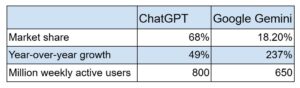
As of early 2026, ChatGPT still leads the AI chatbot market. ChatGPT has around 68% of the market share based on visits and user interactions. This is less than its previous dominance.

In comparison, Google Gemini accounts for about 18.2% of the market share, showing rapid growth over the past year. This shift marks a major change in how users choose AI tools worldwide.

ChatGPT has maintained a large user base with around 800-900 million weekly active users and billions of monthly visits. But Gemini is also growing fast. Its user numbers have increased as Google adds it to more services.

market share chatgpt vs gemini

Other AI platforms, such as DeepSeek, Grok, Perplexity, and Claude, hold smaller shares of the market but are growing in niche areas. ChatGPT and Gemini lead the global chatbot market. This shows a duopoly trend, with two main players in control.

The market positions of ChatGPT and Gemini reflect their different strategies. OpenAI built ChatGPT as a standalone AI platform with powerful language skills. It became popular early and gained millions of users quickly.

Google, meanwhile, embedded Gemini into search engines, Android devices, and other Google apps. This gives Gemini a wide reach, helping it grow faster in recent years as users encounter it automatically.

For users, this means choice. Some prefer ChatGPTโ€™s deep text-generation and creative outputs. Others choose Gemini for quick answers tied to search and Android use.

As both platforms grow, competition will likely push innovation in AI quality, safety, and usefulness. And for climate-conscious and environmentalists, this means taking a closer look at the platforms’ growing energy use, carbon emissions, and water use.ย 

AIโ€™s Energy Footprint: Data Centers and Electricity

As AI use expands rapidly, the energy footprint of the technology has become an important topic. AI models like ChatGPT and Gemini run on large networks of servers housed in data centers. These facilities use electricity to power computing tasks and to keep equipment cool.

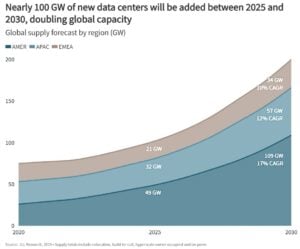
In 2024, data centers used around 415 terawatt-hours (TWh) of electricity. This is about 1.5% of the world’s total electricity consumption. AI workloads are a growing part of this total.

  • The International Energy Agency predicts that data center electricity use may double to around 945 TWh by 2030.

This increase comes as AI and other digital services grow. Another research shows the same trend:

AI data center energy GW 2030

AI electricity use varies by task. Training large modelsโ€”such as initial versions of GPT and other deep learning systemsโ€”can consume very large amounts of power. For example, training early large language models used tens of gigawatt-hours of electricity.

  • Running the model for user queries (called inference) uses much less energy per request but occurs far more frequently.

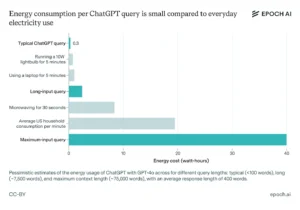
In a direct comparison of per-prompt energy use, Google found that a typical Gemini text prompt consumes about 0.24 watt-hours (Wh) of electricity. This is roughly equivalent to the energy used by a small household device running for a few seconds.ย 

ChatGPT queries, on the other hand, use about 0.34 Wh of electricity. Thatโ€™s similar to running a lightbulb for a short time. This makes per-query energy costs relatively low but still significant when scaled to billions of daily uses. Over time, improvements in hardware and software have greatly reduced energy and carbon use per prompt.

chatGPT energy use
Source: Epoch AI

Carbon in the Cloud: Emissions of AI Systems

Carbon emissions from AI are tied closely to electricity use. Where the electricity comes fromโ€”renewable sources versus fossil fuelsโ€”greatly affects emissions. Data centers powered by coal or gas produce more carbon than those using wind, solar or hydroelectric power.

Global AI and data centers are currently responsible for a small but growing share of carbon emissions. Combined data center emissions contribute to the broader trend of digital technologies impacting climate change.ย 

Projections show that by 2035, AI’s carbon footprint may vary greatly. This depends on future energy mixes and how AI is deployed. Estimates suggest possible annual emissions ranging from 300 to 500 million tonnes of COโ‚‚ by the mid-2030s. The exact share attributable to AI specifically will vary based on how much AI workloads grow within overall data center use.

ChatGPT and Googleโ€™s Gemini differ in their carbon footprints per query. A typical ChatGPT query generates about 0.15 grams of COโ‚‚ per text prompt. In comparison, a typical Google Gemini query emits around 0.03 grams of COโ‚‚ per prompt. This means Geminiโ€™s per-query carbon footprint is about five times lower than ChatGPTโ€™s based on current estimates.

Google Gemini AI carbon emissions
Source: Google

Both companies promise to cut carbon intensity. They plan to do this by improving data center efficiency, buying renewable energy, and upgrading hardware.

For example, Google reported dramatic reductions in energy and carbon footprints for Gemini queries over a one-year period due to efficiency gains and cleaner energy sourcing.

Cooling Costs: Water Use in AI Data Centers

Water consumption is another environmental concern for AI because data centers use water for cooling. Keeping servers cool in large facilities often requires water-cooled systems, especially in warmer climates.

Global AI-related water withdrawal has been rising. Estimates suggest that AI data centers might use 4.2โ€“6.6 billion cubic meters per year by 2027, which is equivalent to 4.2โ€“6.6 billion tonnes of water. This amount is similar to the yearly water use of medium-sized countries.

At the individual query level, water use is very small. For example, OpenAIโ€™s CEO has stated that a single ChatGPT query uses about 0.000085 gallons of water (or ~0.32 ml)โ€”a tiny amount comparable to a few drops. But at scale, with billions of queries each day, total water demand becomes significant in the context of data center cooling systems.

Googleโ€™s data reveals that a typical Gemini text prompt uses about 0.26 milliliters of water. Thatโ€™s about the same as a few drops, considering data center operations.

The Bigger Picture: AI’s Environmental Footprint

AIโ€™s environmental footprint extends beyond individual models and queries. Data centers are expanding rapidly because of increased AI adoption and other online services. Data center electricity use might reach almost 3% of global demand by 2030. This growth highlights the importance of sustainable practices in the tech industry.

While per-query energy and carbon figures can seem small, the aggregate impact of billions of daily AI interactions adds up. Power use and cooling needs can stress local energy grids and water supplies. This happens if companies don’t use renewable sources and efficient technologies.

Major tech companies have made public commitments to use renewable energy and improve energy efficiency at data centers. Experts say that real transparency in environmental impacts needs better reporting. It also requires standardized metrics throughout the AI industry.

So, Who Wins the AI Race?

In the AI chatbot market, ChatGPT continues to lead with about 68% market share in 2026, while Googleโ€™s Gemini holds approximately 18.2% and is growing fast. Their competition reflects differences in strategy, reach, and integration into broader technology ecosystems.

ChatGPT vs .Google Gemini Environmental Footprint

On environmental performance, both AI systems contribute to energy use, carbon emissions, and water consumption through data centers. Per-query measurements such as 0.24โ€“0.30 Wh of electricity and tiny amounts of water per request show that individual impacts are small.ย 

However, the aggregate resource use of running AI at scale is significant and growing. Global demand for electricity in data centers is expected to rise sharply by 2030. Water use might also increase as AI adoption expands.

Understanding these footprints and market dynamics helps users, developers, and policymakers see the costs and benefits of AI. AI tools like ChatGPT and Gemini will keep changing tech markets. They will also influence talks about sustainability in our digital world.

Bain & Company Inks First Direct Air Capture Carbon Removal Deal With Oxy’s 1PointFive

Bain & Company and Oxyโ€™s 1PointFive announced a new agreement for direct air capture carbon removal credits. Under the deal, Bain & Company will purchase 9,000 metric tons of carbon dioxide removal (CDR) credits over three years. The credits will come from direct air capture (DAC) technology developed by 1PointFive at its large STRATOS facility in Texas.

This deal marks an important step in how companies address climate change by removing carbon dioxide (COโ‚‚) directly from the air.ย It also highlights the increasing importance of advanced technologies that pull COโ‚‚ from the air and store it permanently.

How DAC Removes COโ‚‚ from the Atmosphere

Direct Air Capture is a type of technology that pulls COโ‚‚ out of the atmosphere. A machine uses fans and chemical processes to separate COโ‚‚ from the air. Once COโ‚‚ is removed, it is compressed and stored so that it will not return to the atmosphere. This process is a form of carbon dioxide removal that targets emissions already in the air, rather than preventing new emissions at the source.

The COโ‚‚ captured by DAC can be stored deep underground in rock formations. This process is called geologic sequestration. It is one of the most secure ways to keep COโ‚‚ out of the atmosphere for long periods of time.

Climeworks DAC technology

Direct air capture differs from other carbon strategies like energy efficiency, renewable energy, or planting trees. DAC can take out carbon thatโ€™s already in the air. The technology focuses on removing existing carbon, unlike other methods that reduce future emissions or naturally capture some carbon. This helps address what scientists call โ€œhard-to-abateโ€ emissions.

Inside the Bain & Company Carbon Removal Agreement

Bain & Company has taken a significant step in its climate strategy through a new agreement with 1PointFive. This is Bainโ€™s first purchase of carbon removal credits from direct air capture technology, which shows its increasing commitment to innovative carbon solutions.

Key points of the agreement include:

  • Total Credits: 9,000 metric tons of COโ‚‚ to be removed.
  • Timeframe: Delivered over three years.
  • First DAC Purchase: Bainโ€™s initial engagement with direct air capture technology for carbon removal.
  • Climate Strategy Alignment: Supports Bainโ€™s goal to maintain a net-negative carbon impact each year.
  • Emissions Offset Visualization: The 9,000 metric tons of COโ‚‚ are equivalent to the emissions from about 10,000 long-haul round-trip flights for one economy-class passenger.

Sam Israelit, Bainโ€™s Chief Sustainability Officer, said:

“We are proud to partner with 1PointFive and add them to our portfolio of engineered carbon removal technologies. Their track record for developing DAC technology coupled with their deep understanding of what it takes to deliver large-scale infrastructure projects uniquely positions them to be a leader in this emerging segment.โ€

STRATOS and the Scale-Up of Engineered Carbon Removal

1PointFive is a carbon capture, utilization, and sequestration (CCUS) company. It is a subsidiary of Occidental Petroleum (Oxy). 1PointFive aims to scale direct air capture tech. This will help remove COโ‚‚ from the atmosphere at commercial levels.

The carbon credits that Bain will purchase are produced by the STRATOS facility. This plant is a large DAC installation in Ector County, Texas. Once fully operational, STRATOS is expected to be one of the largest DAC facilities in the world. It is designed to remove up to 500,000 metric tons of COโ‚‚ per year when fully running.

STRATOS is still in a start-up phase. It hasn’t started full commercial operations yet. However, it’s moving through initial testing and ramp-up activities.

The COโ‚‚ captured at the DAC facility will be stored underground through geologic sequestration. This means the carbon will be injected into deep rock formations where it stays permanently.

Why Carbon Removal Credits Are Gaining Corporate Attention

Carbon removal credits are becoming more important for businesses. Each credit shows that one metric ton of COโ‚‚ has been removed from the air and stored safely. Companies can buy these credits to offset emissions they cannot reduce through normal operations.

Key reasons why carbon removal credits are important for companies:

  • Offset emissions: Helps companies balance emissions they cannot cut directly.
  • Supports climate goals: Companies can invest in removal technologies while aiming for net-zero or net-negative targets.
  • Long-term impact: Credits help firms create lasting, innovative ways to cut atmospheric carbon. Direct air capture is one such technology that grows in use as firms seek durable solutions.
CDR purchases
Source: AlliedOffsets

CDR purchases are growing by 750% from 2022 to 2023, and 2024 volumes are exceeding prior years. Analysts project the CDR market could expand from about $3.4โ€ฏbillion in 2024 to $25โ€ฏbillion by 2029.

Durable engineered CDR credits, including DAC, alone may generate over $14โ€ฏbillion by 2035. By 2030, annual demand for durable CDR credits could reach up to 100โ€ฏmillion tonnes of COโ‚‚ because ofย corporate climate targets and emerging policies.

CDR credits demand annually 2030
Source: McKinsey & Company

By buying removal credits, companies can manage their carbon footprint while investing in climate technologies that have a real, measurable effect on the atmosphere.

What This Means for Bain & Companyโ€™s Climate Goals

For Bain & Company, this agreement aligns with its established climate commitments: net zero across value chains by 2050. Bain has pledged to maintain a net-negative carbon footprint annually.

Bain & Company net zero roadmap to 2050
Near-term target (2026) vs Long-term (2050), Source: Bain & Company

To achieve this, it aims to reduce emissions and invest in credible carbon removal solutions. The 9,000 metric tons of direct air capture credits will help offset Bainโ€™s leftover operational emissions. These emissions are what remain after all possible reductions.

The company has invested in high-integrity carbon removal credits before. They have supported over 1.1 million metric tons of removal credits from different technologies in the last five years. This indicates Bainโ€™s long-term engagement with carbon removal beyond this new agreement.

By adding DAC-enabled credits from STRATOS, Bain aligns its portfolio with advanced engineered removal methods. These methods are often seen as more durable and reliable in the long run than some natural removal methods.

A Signal for the Carbon Removal Market

The market for carbon removal and carbon credits has grown rapidly. Companies from many industries are purchasing removal credits as part of climate strategies.

In 2023 and 2025, 1PointFive made deals with big companies to buy carbon removal credits. These include deals with major firms such as Amazon and JPMorgan Chase for 250,000 and 50,000 metric tons of CDR credits, respectively. These deals show the rising global interest in DAC-enabled carbon removal.

Carbon removal credits also play a role in voluntary carbon markets. These markets allow companies to buy credits to offset emissions beyond regulatory requirements. As more firms commit to climate goals, demand for high-quality removal credits grows.ย 

The Future of Direct Air Capture and Carbon Removal Credits

The agreement between 1PointFive and Bain & Company reflects a broader trend in climate action. More businesses are using tech-driven carbon removal in their climate plans. As DAC projects like STRATOS scale up, removal credits may become more widely available and standardized.

As companies build portfolios of carbon removal credits, technologies like DAC may play a larger role in global efforts to limit climate change. Experts believe that removing COโ‚‚ from the atmosphere will be necessary alongside rapid emission cuts to meet climate goals.ย 

A boom in DAC credit agreements like the 1PointFive and Bain & Companyโ€™s deal may reflect this emerging reality. As the world faces the challenge of reducing atmospheric COโ‚‚ levels, partnerships like this show how the private sector can contribute to climate mitigation through innovative technology and long-term strategies.

Microsoft Buys 2 Million Tons of Carbon from Rubicon Carbon’s Uganda Forestry Project

Microsoft has agreed to buy 2 million carbon removal credits from a forestry project in Northern Uganda. The credits come from the Kijani Forestry Smallholder Farmer Forestry Project. They will be delivered over about 9 years under a wider agreement with Rubicon Carbon. The deal supports Microsoftโ€™s plan to cut its carbon footprint and invest in nature-based climate solutions.

These credits are known as Afforestation, Reforestation, and Revegetation (ARR) credits. They represent carbon that has been removed from the atmosphere and stored in trees and forests. This type of credit helps fight climate change while also supporting local farmers.

Phillip Goodman, Director of Carbon Removal at Microsoft, said:

“We are pleased to support Kijaniโ€™s work in strengthening farmer livelihoods while restoring ecosystems in Northern Uganda. The framework with Rubicon Carbon streamlines the contracting process, while ensuring project quality and unlocking financing for nature-based removals.”

Trees as Carbon Banks: The Uganda Deal

The Smallholder Farmer Forestry Project in Northern Uganda works with more than 50,000 smallholder farmers. Together, they plant and manage woodlots on land that was previously degraded. By early 2026, the project had planted over 30 million trees with the help of local growers.

Under the agreement, Microsoft will receive 2 million ARR carbon removal credits from the project. Rubicon Carbon could supply Microsoft with up to 18 million tonnes of high-quality carbon removal credits by 2035.

The Uganda forestry project is one of the first approved under Ugandaโ€™s Climate Change Mechanisms Regulations. This gives it official local recognition. Credits will be given as trees grow and take in carbon, following a science-based method to measure and verify results.

How Carbon Credits Work

Carbon credits represent measured reductions in greenhouse gas emissions or the removal of carbon from the air. One carbon credit usually equals one metric ton of carbon dioxide equivalent (COโ‚‚e). In forest projects like ARR, credits are created as trees grow and store carbon in their wood, roots, and soil.

Companies can buy carbon credits to offset emissions they cannot yet eliminate. Microsoft uses credits as part of its wider climate strategy.

The voluntary carbon market (VCM) is where companies choose to buy credits. This market is different from compliance markets, where governments require companies to cut emissions. In the voluntary market, many project types generate credits. These include forestry, soil carbon, clean energy, and methane reduction.

The VCM has grown strongly over the past decade. More companies are making net-zero and climate pledges. Many rely partly on carbon offsets and removal credits to meet those goals.

Source: Sylvera

Forest projects that issue ARR credits must follow strict rules for measurement, reporting, and verification. These rules help ensure the carbon removals are real, additional, and long-lasting. Once verified, credits can be sold or retired by companies to meet climate commitments.

Why Microsoft Is Investing in Carbon Credits

Microsoft, the world’s biggest buyer of CDR credits, has set long-term environmental goals. These include becoming carbon negative by 2030 and removing more carbon than it has emitted since its founding by 2050.

To reach these goals, the tech giant invests in many types of carbon removal solutions. These include both nature-based and engineered approaches.

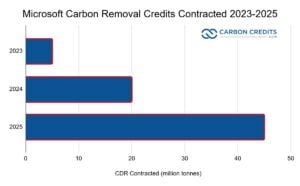
Microsoftโ€™s removal credit commitments have surged. Theyโ€™ve expanded from small contracts in 2023 to large, long-term deals by 2025. The largest commitments in 2025 include:

  • Rubicon Carbon framework (18 million tonnes): nature-based forestry ARR credits over 15โ€“20 years.
  • AtmosClear BECCS (6.75 million tonnes):ย one of the biggest permanent engineered removal agreements.
  • Anew Climate / Aurora Forestry (4.8 million tonnes): improved forest management, nature-based credits.

Other smaller contracts are:

microsoft carbon removal contracts 2023-2025
Source: Data from Microsoft

Total for 2025, including all major disclosed contracts: 45+ million tonnes. Some contracts span many years (up to 20 years) and may deliver credits over time. These numbers reflect contracted commitments of Microsoft, not necessarily credits delivered in a single year.

These actions make Microsoft one of the largest corporate buyers of voluntary carbon removal credits. Corporate demand funds various removal methods. These include better land use, soil carbon storage, engineered solutions, and forest restoration.

Farmers in Focus: Local Benefits

The Uganda forestry project offers benefits beyond carbon removal. It supports smallholder farmers by helping them plant woodlots that generate income.

As trees mature, farmers can earn money from sustainable timber and charcoal. They may also benefit from future carbon revenues linked to the project.

The project also helps restore degraded land and expand forest cover. Healthy forests improve soil quality, help regulate water flows, and support wildlife. These environmental benefits are common in nature-based carbon projects.

The financing model behind the project also helps attract long-term investment. Microsoftโ€™s purchase creates steady demand. This can lead to more funding for forestry and other nature-based solutions. This can help scale carbon removal efforts over time.

Scaling Up Nature-Based Solutions

The global carbon credit market has expanded rapidly, though traded volume has gone down year-over-year since 2022. Companies bought more avoided-emission and carbon removal credits.

Removal-type credits (those that remove carbon from the atmosphere) were priced on average 381% higher than traditional emission-reduction credits in 2024. This reflects strong corporate interest in durable climate action.

carbon removal credits and price

Afforestation and reforestation remain among the largest categories in the voluntary market. Under the Verified Carbon Standard (VCS), more than 1.3 billion credits have been issued across sectors. These include forestry and other land-use projects, with over 776 million credits retired to date, showing heavy participation by land-based nature projects. These projects span regions across Africa, Latin America, and Asia.

Microsoftโ€™s large ARR credit purchase reflects a wider trend. Many companies now include voluntary carbon credits in their climate plans. Major buyers include technology firms, airlines, consumer goods companies, and energy producers.

On the project level, a Rubicon Carbon spokesperson shares exclusive insights with the CarbonCredits.com team on the following questions:

  • How does Rubicon Carbon ensure the long-term permanence of the carbon removals from the Kijani Forestry Project, and what monitoring or verification systems are in place to track carbon storage over time?

R: The project utilizes a comprehensive, site-specific monitoring technology stack. Each farmerโ€™s plot of land is tagged with GPS coordinates and location-tagged photos for ongoing survival checks. In addition, Rubicon Carbonโ€™s asset management approach includes regular monitoring of projects using remote sensing data to supplement the data shared by project developers.

  • Can you provide details on how the smallholder farmers in Northern Uganda benefit financially from this project, and what percentage of project revenues is allocated to local communities?

R: The project is structured so that smallholder farmers directly benefit through shared carbon revenues, sustainable timber and sustainable charcoal offtake, and the provision of all planting inputs and training at no upfront cost. A portion of project revenue is reserved for long-term tree maintenance and stewardship, while farmers earn additional income through annual survival payments that begin in the first year and sustainable charcoal and timber production over time.

  • How does Rubicon Carbon plan to scale this model in other regions or forestry projects, and what challenges do you foresee in meeting large corporate demand for verified carbon removal credits?

R: The Kijani project is exceptionally well-tailored to meet the needs of farmers and communities in Northern Uganda, where illegal charcoal production is a driver of deforestation and a common income-generating activity in rural areas. The project offers multiple alternative revenue streams for farmers and clear benefits for carbon sequestration.

Its success has been driven by deep local relationships and strong farmer engagement, demonstrating how a community-based approach can succeed at scale. We see this project as a compelling example of whatโ€™s possible when we combine carbon finance with nature reforestation. We look forward to bringing similar project tools and capabilities to other parts of Africa with strong partners like the Kijani Forestry team.

Looking Ahead: Challenges, Outlook, and Scale

Despite this growth, challenges remain. High-quality credits require strong verification. Past reviews show that some credits did not always deliver real climate benefits without strict oversight. Thus, the volume of credits traded has fallen.

Voluntary carbon credit market; price, volume, value 2022-2024

As the market grows, buyers and standards bodies are placing more focus on transparency, quality, and long-term monitoring.

The voluntary carbon market continues to change as expectations for quality rise. Forestry projects face risks such as fires, disease, and land-use changes. These risks can affect how long carbon stays stored in forests.

Policy changes may also influence future demand. Some governments are thinking about new climate rules. These rules might change how carbon credits are counted in national records and corporate reports. Such changes could impact prices and demand for nature-based credits.

At the same time, companies like Microsoft are expanding long-term carbon removal contracts. Many of these agreements last for years or decades. This helps projects secure early funding while trees and other systems take time to store carbon.

The deal shows how important nature-based solutions are becoming in corporate climate plans.ย It is part of a larger agreement with Rubicon Carbon that could deliver up to 18 million tonnes of removal credits over the coming decade. As demand for high-quality carbon credits grows, partnerships like this may support climate action while also driving local economic development.

Silverโ€™s New Role in the Clean Energy Era – and What It Means for Sierra Madre Investors

0

Disseminated on behalf of Sierra Madre Gold & Silver Ltd.

Silver is prized for its beauty and use in jewellery, but its true value today lies in technology. Silver is now a key material as the world shifts to renewable energy, electric vehicles, and advanced electronics. Its high conductivity and reflectivity make it essential for solar panels, EV batteries, and 5G networks.

For investors, this shift marks a new chapter for the silver market – one driven less by fashion and more by function. Companies like Sierra Madre Gold & Silver are ready to meet this growing demand for industrial and investment needs.

Rising Demand from the Green Transition

The clean energy transition is rapidly changing how silver is used. The Silver Institute reports that global silver demand hit a record 1.2 billion ounces in 2024. More than 30 percent of this was for industrial uses, mainly in solar power and electronics. That figure is set to rise as countries expand renewable energy capacity.

In 2024, industrial silver use hit an all-time high of 680.5 million ounces, driven by solar manufacturing, electric vehicles, and electronics. Solar energy alone now accounts for more than 30 percent of industrial demand.ย 

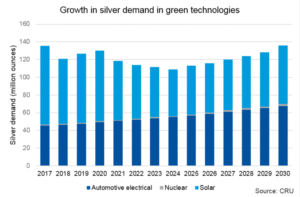
silver demand from solar 2030

Each photovoltaic (PV) panel has 15โ€“25 grams of silver. By 2030, solar installations may top 500 gigawatts each year. This could mean the sector needs 250 million ounces of silver annually.

Electric vehicles are another major source of growth. A single EV uses up to 50 grams of silver, roughly twice that of a traditional car. As production expands, the automotive sectorโ€™s silver demand could triple by 2030.

These trends are tightening the global silver market. Inventories are falling, and analysts warn of persistent supply deficits through the end of the decade.

The Supply Challenge: Falling Mine Output

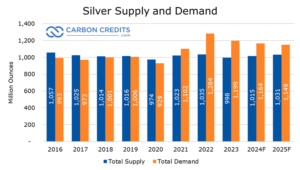
While demand surges, mine output is not keeping pace. The Silver Institute estimates global silver production at about 819.7 million ounces in 2024, up less than 1 percent from the previous year.ย 

Even with this small rise, the world will have a 117.6 million-ounce supply deficit in 2025. This shows ongoing long-term shortages.

Silver Supply and Demand

Mexico remains the worldโ€™s largest silver producer, contributing about 23 percent of global output. But much of this comes from aging or polymetallic mines, where silver is a by-product. New producers like Sierra Madre Gold & Silver attract investors. They blend modern exploration with production. This is happening in one of the richest silver belts on Earth.

Sierra Madreโ€™s Portfolio: Reviving Proven Silver Assets

Sierra Madre Gold & Silver Ltd. (TSXV: SM, OTCQX: SMDRF) is advancing two key projects in Mexicoโ€™s Sierra Madre mineral belt: La Guitarra and Tepic. Together, they represent a blend of production and exploration upside.

Sierra Madre Gold & Silver projects
Source: Sierra Madre Gold & Silver
  • La Guitarra Mine (State of Mexico):
    La Guitarra, acquired from First Majestic Silver Corp., is a fully permitted and producing underground operation. It already has processing infrastructure in place. The company reached commercial production at 500 tonnes per day in January 2025, with plans to expand to up to 1,500 tonnes per day by 2027. La Guitarra could restore one of Mexicoโ€™s best-known silver mines to its former prominence.
  • Tepic Project (Nayarit):
    Tepic is a high-grade epithermal gold-silver deposit. It has near-surface mineralization, which means thereโ€™s great exploration potential. This also allows for options for future growth.

Sierra Madre cuts costs and timeline risks by targeting assets with established infrastructure and clear development paths. This approach is safer than working with early-stage explorers.

Positioned for the New Industrial Cycle

The global shift to cleaner energy sources is reshaping the silver market into something closer to a strategic commodity. Governments and industries now view silver as vital to achieving energy-transition goals. As demand outpaces supply, producers with near-term restart potential stand to benefit most.

Sierra Madre fits neatly into that narrative. The La Guitarra project has restarted production much quicker than greenfield developments. Those often need years for permits and construction. At the same time, its exploration project adds scalability and long-term growth potential.

Mexico has a strong mining infrastructure and a skilled workforce. Itโ€™s also close to North American industrial hubs. This gives Sierra Madre a big logistical advantage. The U.S. is putting policies in place to secure supply chains for key materials. This makes Mexico a more important and reliable supplier.

Market Dynamics: Silver as a Strategic Metal

Silverโ€™s 2025 price action underscores profound shifts in its role within both industrial and investment spheres. After climbing nearly 25 percent year-to-date, silver shattered previous records by reaching its all-time high of $54.24 per ounce in October before correcting and settling in the high-$40 range.ย 

Major analysts such as Metals Focus project that prices could breach the US$60 mark by late 2026 if current supply deficits and clean energy demand trends persist, citing strong industrial momentum – particularly in solar and electronics – as critical drivers.

Silver Spot Price
Source: Bloomberg

Supporting this rally, silver exchange-traded products (ETPs) absorbed 95 million ounces in the first half of 2025, pushing global holdings to 1.13 billion ounces – just 7 percent below their all-time peak.ย 

According to data from the World Silver Survey 2025, industrial fabrication demand reached a new record of 680.5 million ounces in 2024, maintaining upward momentum through 2025. The supply side remains structurally tight: analysts project a market deficit of roughly 149 million ounces this year, marking five consecutive years where demand has outpaced annual mine production.

Why Sierra Madre Stands Out

  • Production: La Guitarra restart completed, targeting output ramp-up in 2026 and 2027.
  • High-Quality Assets: Two projects in Mexicoโ€™s most productive silver-gold belt.
  • Operational Readiness: A fully permitted plant and infrastructure at La Guitarra reduced start-up costs.
  • Strong Market Tailwinds: Silver demand from solar, EVs, and electronics continues to set records.
  • Experienced Leadership: Proven management team with expertise in Mexican mining operations.

These factors make Sierra Madre a unique mix of production, exploration, and expansion potential, and access to one of the fastest-growing industrial metals globally.

A New Chapter for Silver – and for Sierra Madre

Silverโ€™s growing role in the clean-energy transition marks a turning point for the mining industry. Once seen mainly as a precious metal, it is now a cornerstone of the technologies driving global decarbonization.

Sierra Madre Gold & Silver is one of the few junior miners that successfully restarted a permitted mine in Mexicoโ€™s silver heartland and is planning a near-term expansion. This positions them well to benefit from the current structural shift. With rising demand and limited supply, the company is ready to continue with its strategy for La Guitarra. This move connects Mexicoโ€™s rich mining history with a clean-energy future.

DISCLAIMERย 

New Era Publishing Inc. and/or CarbonCredits.com (โ€œWeโ€ or โ€œUsโ€) are not securities dealers or brokers, investment advisers, or financial advisers, and you should not rely on the information herein as investment advice. Sierra Madre Gold and Silver Ltd. (โ€œCompanyโ€) made a one-time payment of $25,000 to provide marketing services for a term of one month. None of the owners, members, directors, or employees of New Era Publishing Inc. and/or CarbonCredits.com currently hold, or have any beneficial ownership in, any shares, stocks, or options of the companies mentioned.

This article is informational only and is solely for use by prospective investors in determining whether to seek additional information. It does not constitute an offer to sell or a solicitation of an offer to buy any securities. Examples that we provide of share price increases pertaining to a particular issuer from one referenced date to another represent arbitrarily chosen time periods and are no indication whatsoever of future stock prices for that issuer and are of no predictive value.

Our stock profiles are intended to highlight certain companies for your further investigation; they are not stock recommendations or an offer or sale of the referenced securities. The securities issued by the companies we profile should be considered high-risk; if you do invest despite these warnings, you may lose your entire investment. Please do your own research before investing, including reviewing the companiesโ€™ SEDAR+ and SEC filings, press releases, and risk disclosures.

It is our policy that the information contained in this profile was provided by the company, extracted from SEDAR+ and SEC filings, company websites, and other publicly available sources. We believe the sources and information are accurate and reliable, but we cannot guarantee them.

CAUTIONARY STATEMENT AND FORWARD-LOOKING INFORMATION

Certain statements contained in this news release may constitute โ€œforward-looking informationโ€ within the meaning of applicable securities laws. Forward-looking information generally can be identified by words such as โ€œanticipate,โ€ โ€œexpect,โ€ โ€œestimate,โ€ โ€œforecast,โ€ โ€œplan,โ€ and similar expressions suggesting future outcomes or events. Forward-looking information is based on current expectations of management; however, it is subject to known and unknown risks, uncertainties, and other factors that may cause actual results to differ materially from those anticipated.

These factors include, without limitation, statements relating to the Companyโ€™s exploration and development plans, the potential of its mineral projects, financing activities, regulatory approvals, market conditions, and future objectives. Forward-looking information involves numerous risks and uncertainties, and actual results might differ materially from results suggested in any forward-looking information. These risks and uncertainties include, among other things, market volatility, the state of financial markets for the Companyโ€™s securities, fluctuations in commodity prices, operational challenges, and changes in business plans.

Forward-looking information is based on several key expectations and assumptions, including, without limitation, that the Company will continue with its stated business objectives and will be able to raise additional capital as required. Although management of the Company has attempted to identify important factors that could cause actual results to differ materially, there may be other factors that cause results not to be as anticipated, estimated, or intended.

There can be no assurance that such forward-looking information will prove to be accurate, as actual results and future events could differ materially. Accordingly, readers should not place undue reliance on forward-looking information. Additional information about risks and uncertainties is contained in the Companyโ€™s managementโ€™s discussion and analysis and annual information form for the year ended December 31, 2024, copies of which are available on SEDAR+ at www.sedarplus.ca.

The forward-looking information contained herein is expressly qualified in its entirety by this cautionary statement. Forward-looking information reflects managementโ€™s current beliefs and is based on information currently available to the Company. The forward-looking information is made as of the date of this news release, and the Company assumes no obligation to update or revise such information to reflect new events or circumstances except as may be required by applicable law.

For more information on the Company, investors should review the Companyโ€™s continuous disclosure filings available on SEDAR+ at www.sedarplus.ca.


Disclosure: Owners, members, directors, and employees of carboncredits.com have/may have stock or option positions in any of the companies mentioned: None.

Carboncredits.com receives compensation for this publication and has a business relationship with any company whose stock(s) is/are mentioned in this article.

Additional disclosure: This communication serves the sole purpose of adding value to the research process and is for information only. Please do your own due diligence. Every investment in securities mentioned in publications of carboncredits.com involves risks that could lead to a total loss of the invested capital.
Please read our Full RISKS and DISCLOSURE here.

Goldโ€™s Enduring Value: How Sierra Madre Is Advancing Mexicoโ€™s Next Generation of Gold Projects

Disseminated on behalf of Sierra Madre Gold & Silver Ltd.

Sierra Madre Gold & Silver is building a strong position in Mexicoโ€™s growing precious metals industry. The company is creating long-term value through smart growth, low costs, and balanced exposure to both gold and silver. With gold prices at record highs, Sierra Madre is turning opportunity into steady progress.

Its main operation, the La Guitarra Mine Complex, reached commercial production in January 2025 after being acquired from First Majestic Silver. Alongside this, the company holds the Tepic Project, expanding Mexicoโ€™s gold and silver frontier. By combining efficient mining with new exploration, Sierra Madre is proving that goldโ€™s value still shines bright in todayโ€™s market.

Goldโ€™s Strength in a Changing World

Gold remains a trusted safe-haven asset in uncertain times. Central banks are buying more gold, and geopolitical tensions are pushing demand higher. JP Morgan expects gold prices to average $3,675โ€“$4,000 per ounce by mid-2026. State Street Global Advisors sees gold holding above $3,000/oz, showing that strong prices are here to stay.

gold
Source: JP Morgan

The Demand and Supply Side

As per the World Gold Council, in Q2 2025, total gold demand reached 1,249 tonnes, up 3% year-over-year. Its value surged 45% to a record US$132 billion, driven by strong investment demand. Gold-backed ETFs, bars, and coins saw the biggest gains amid geopolitical tensions and trade uncertainty. Central banks added 166 tonnes to reserves, though at a slower pace than in previous quarters.

On the supply side, total gold output also rose 3% to 1,249 tonnes, with mine production hitting a Q2 record of 909 tonnes.

gold demand supply
Source: Sources: Metals Focus, Refinitiv GFMS, World Gold Council

This environment supports Sierra Madreโ€™s growth strategy. The company is using these high prices and Mexicoโ€™s low operating costs to boost production and deliver stronger returns to shareholders.

Driving Gold Growth at La Guitarra

The La Guitarra Mine Complex is Sierra Madreโ€™s key asset. Located in Mexicoโ€™s historic Temascaltepec district, it currently produces 500 tonnes per day. The company plans to double that to 1,200 t/d to 1,500 t/d by late 2027.

In April 2025, Sierra Madre started underground mining at the high-grade Coloso vein within the La Guitarra property. This new zone should increase gold output and improve overall grades. At the same time, the company is upgrading its milling systems to raise recovery rates and lower costs.

Sierra Madre Gold & Silver
Source: Sierra Madre Gold & Silver

Tepic Project: Expanding Mexicoโ€™s Gold and Silver Frontier

The Tepic Project adds exciting exploration upside. It sits in Mexicoโ€™s Sierra Madre Geologic Province and hosts low-sulfidation epithermal gold and silver mineralization. Multiple zones stretch over one kilometer long and 200 meters wide.

Once the flagship project of Cream Minerals, Tepic has a historic resource estimate outlined in a 2020 Technical Report. Past drilling covered 31,537 meters across 149 holes. However, with a 76% core recovery rate, grades may have been underestimated.

Recent exploration shows the Dos Hornos breccia veins remain open both along strike and at depth. This finding suggests strong potential for expanding resources in future drilling phases.

ย  Core Drilling Highlights

Sierra Madre gold and silver
Source:https://sierramadregoldandsilver.com/presentations/corporate_presentation.pdf

Location and Infrastructure Benefits

Tepic is just 22 km from Tepic City, the capital of Nayarit, and 120 km from Puerto Vallarta Airport. The project has excellent access to roads, power, and local services. A skilled mining workforce and nearby fabrication shops make operations easier and more cost-efficient.

The project covers 2,612.5 hectares across five mining concessions and is 100% owned by Sierra Madre. Being in a mining-friendly region of Mexico gives the company a stable environment to advance this asset.

Strong Gold Production and Steady Revenue

Sierra Madreโ€™s production results show steady progress and solid performance:

  • Q2 2025 gold sales: 1,096 ounces.
  • H1 2025 gold sales: 2,118 ounces; production totaled 2,049 ounces.
  • Average realized price: $3,271/oz in Q2 and $3,058/oz for H1.
  • Gold recovery: around 78% during the first half of 2025.

Gold revenues reached $3.59 million in Q2 2025, up from $2.89 million in Q1. For the first half of 2025, gold generated $6.48 million in total revenue. Cash costs per silver-equivalent ounce sold were $23.32, showing strong cost control.

As the Coloso mine continues to deliver higher-grade mineralization, Sierra Madre expects better margins and lower costs in the coming quarters.

Financing Growth and Exploration Plans

In mid-2025, Sierra Madre raised C$19.5 million (US$19.5 million) through a private placement. The funds are being used to:

  • Expand throughput at La Guitarra.
  • Launch a +20,000-meter exploration program across 59 km of structures mapped to date.
  • Target new high-grade zones in the East District.

This financing strengthens the companyโ€™s ability to expand production and extend mine life while continuing to explore new areas.

Moving on, Sierra Madre has also begun underground development at the Nazareno silver-gold mine in the La Guitarra complex, Estado de Mexico. The team has delivered over 700 tonnes of mineralized material, not included in the current resource estimate, to the Guitarra mill. Workers are blasting existing workings and advancing the sill drive to test long-hole mining feasibility in the closely spaced veins.

Reconciliation with the 2023 Nazareno resource model shows silver grades 40% higher and gold grades 30% higher than estimated, signaling strong potential to expand the resource.

Taking Advantage of Record Metal Prices

Gold is trading above $4,000 per ounce, giving Sierra Madre a strong tailwind. Its mix of gold and silver exposure provides a natural balance – gold supports financial stability, while silver adds growth potential.

Source: Bloomberg

Analysts also believe that Silver is expected to face a structural deficit for the seventh straight year, due to rising demand from the clean energy and technology sectors. This gives Sierra Madreโ€™s dual-metal strategy even more value in the current market.

Two Metals, One Strong Strategy

Sierra Madreโ€™s dual focus sets it apart. Gold anchors the companyโ€™s stability as a safe-haven asset, while silver brings growth potential through its industrial uses โ€” from solar panels to electric vehicles.

With a combination of efficient operations, strong assets, and focused execution, Sierra Madre is redefining what a modern Mexican mining company looks like one that blends stability with growth potential.


DISCLAIMER

New Era Publishing Inc. and/or CarbonCredits.com (โ€œWeโ€ or โ€œUsโ€) are not securities dealers or brokers, investment advisers, or financial advisers, and you should not rely on the information herein as investment advice. Sierra Madre Gold and Silver Ltd. (โ€œCompanyโ€) made a one-time payment of $25,000 to provide marketing services for a term of one month. None of the owners, members, directors, or employees of New Era Publishing Inc. and/or CarbonCredits.com currently hold, or have any beneficial ownership in, any shares, stocks, or options of the companies mentioned.

This article is informational only and is solely for use by prospective investors in determining whether to seek additional information. It does not constitute an offer to sell or a solicitation of an offer to buy any securities. Examples that we provide of share price increases pertaining to a particular issuer from one referenced date to another represent arbitrarily chosen time periods and are no indication whatsoever of future stock prices for that issuer and are of no predictive value.

Our stock profiles are intended to highlight certain companies for your further investigation; they are not stock recommendations or an offer or sale of the referenced securities. The securities issued by the companies we profile should be considered high-risk; if you do invest despite these warnings, you may lose your entire investment. Please do your own research before investing, including reviewing the companiesโ€™ SEDAR+ and SEC filings, press releases, and risk disclosures.

It is our policy that information contained in this profile was provided by the company, extracted from SEDAR+ and SEC filings, company websites, and other publicly available sources. We believe the sources and information are accurate and reliable but we cannot guarantee them.

CAUTIONARY STATEMENT AND FORWARD-LOOKING INFORMATION

Certain statements contained in this news release may constitute โ€œforward-looking informationโ€ within the meaning of applicable securities laws. Forward-looking information generally can be identified by words such as โ€œanticipate,โ€ โ€œexpect,โ€ โ€œestimate,โ€ โ€œforecast,โ€ โ€œplan,โ€ and similar expressions suggesting future outcomes or events. Forward-looking information is based on current expectations of management; however, it is subject to known and unknown risks, uncertainties, and other factors that may cause actual results to differ materially from those anticipated.

These factors include, without limitation, statements relating to the Companyโ€™s exploration and development plans, the potential of its mineral projects, financing activities, regulatory approvals, market conditions, and future objectives. Forward-looking information involves numerous risks and uncertainties and actual results might differ materially from results suggested in any forward-looking information. These risks and uncertainties include, among other things, market volatility, the state of financial markets for the Companyโ€™s securities, fluctuations in commodity prices, operational challenges, and changes in business plans.

Forward-looking information is based on several key expectations and assumptions, including, without limitation, that the Company will continue with its stated business objectives and will be able to raise additional capital as required. Although management of the Company has attempted to identify important factors that could cause actual results to differ materially, there may be other factors that cause results not to be as anticipated, estimated, or intended.

There can be no assurance that such forward-looking information will prove to be accurate, as actual results and future events could differ materially. Accordingly, readers should not place undue reliance on forward-looking information. Additional information about risks and uncertainties is contained in the Companyโ€™s managementโ€™s discussion and analysis and annual information form for the year ended December 31, 2024, copies of which are available on SEDAR+ at www.sedarplus.ca.

The forward-looking information contained herein is expressly qualified in its entirety by this cautionary statement. Forward-looking information reflects managementโ€™s current beliefs and is based on information currently available to the Company. The forward-looking information is made as of the date of this news release, and the Company assumes no obligation to update or revise such information to reflect new events or circumstances except as may be required by applicable law.

For more information on the Company, investors should review the Companyโ€™s continuous disclosure filings available on SEDAR+ at www.sedarplus.ca.


Disclosure: Owners, members, directors, and employees of carboncredits.com have/may have stock or option positions in any of the companies mentioned: None.

Carboncredits.com receives compensation for this publication and has a business relationship with any company whose stock(s) is/are mentioned in this article.

Additional disclosure: This communication serves the sole purpose of adding value to the research process and is for information only. Please do your own due diligence. Every investment in securities mentioned in publications of carboncredits.com involves risks that could lead to a total loss of the invested capital.
Please read our Full RISKS and DISCLOSURE here.

Sierra Madre: Breathing New Life into Mexicoโ€™s Silver and Gold Heartland

Disseminated on behalf of Sierra Madre Gold & Silver Ltd.

Mexico has been a cornerstone of global silver and gold production for centuries, with historic mining regions such as Zacatecas, Durango, and the Sierra Madre belt supplying the world with these precious metals. Mining represents nearly 2.5% of Mexicoโ€™s GDP and produces significant export revenue.

However, decades of underinvestment and declining output from aging mines led to a slowdown in production growth. Today, a new wave of modern mining companies is reinvigorating Mexicoโ€™s silver and gold industry, bringing capital, modern technology, and strict environmental practices to historic mining regions.

Among these companies, Sierra Madre Gold & Silver Ltd. (TSXV: SM | OTCQX: SMDRF) is emerging as a standout player, spearheading the revival of Mexicoโ€™s rich Temascaltepec district with its La Guitarra Mine.

Mexicoโ€™s Silver and Gold Renaissance: Strategic Importance

Mexico remains the worldโ€™s largest silver producer, contributing roughly 23โ€“25% of global output in 2024, with total production between 5,800 and 6,300 tonnes. The surge in industrial demand for silver is reshaping its role from primarily a jewelry and investment metal to an essential material in the clean energy transition.

  • With silver prices stabilizing around US$28 per ounce in 2025 and climbing above $50 in October, mid-tier producers like Sierra Madre stand to increase shareholder value while supporting rural economies.

Each solar panel consumes about 20 grams of silver, while electric vehicles require up to 50 grams. Analysts predict that by 2030, global silver demand will exceed 1.2 billion ounces annually, highlighting the need for stable, modern supply sources.

Mexicoโ€™s combination of skilled workforce, supportive regulations, and modern infrastructure makes it an attractive destination for exploration and investment. Sierra Madreโ€™s work at La Guitarra, along with exploration at Tepic, exemplifies how new companies are turning dormant assets into engines of growth for the next decade.

Reviving La Guitarra: History Meets Modern Mining

The La Guitarra Mine has a storied history dating back to colonial times, producing both gold and silver under different owners, most recently First Majestic Silver. After a period of care and maintenance, Sierra Madre acquired the mine in 2023 with a clear strategy: restart production (achieved January 2025) and expand output.

The mine comes equipped with a 500-tonnes-per-day processing plant, permitted underground workings, and nearby infrastructure including roads, water, and power. With C$19.5 million in fresh capital and a skilled technical team, it has achieved a full-scale restart, with commercial production announced in January 2025.

  • By 2027, the company aims to up to triple production to 1,500 tonnes per day, leveraging smart mine design and local partnerships to keep costs low while ramping output efficiently.

Furthermore, their leadership blends local mining expertise with strong capital markets knowledge, enabling efficient project execution. La Guitarraโ€™s high-grade veins, clear exploration targets, and straightforward permitting process make it one of Mexicoโ€™s most promising silver-gold projects.

La Guitarra Sierra Madre

Commitment to Responsible Mining

Sierra Madre embodies a new generation of environmentally and socially responsible miners. The company is upgrading waste and water systems to modern standards, reclaiming tailings efficiently, and minimizing water usage. Open communication with local communities, clear permitting, and strong ESG practices reinforce its credibility with stakeholders and investors.

Modernization at La Guitarra is as much about responsible operations as it is about increasing output. This focus on sustainability aligns with global investor expectations while strengthening its long-term partnerships.

Sierra Madre holds one other project in Mexicoโ€™s Sierra Madre mineral belt:

  • Tepic Project (Nayarit): High-grade epithermal gold-silver deposit with near-surface mineralization and strong exploration upside.

By focusing on assets with existing infrastructure and clear development paths, Sierra Madre reduces operational risk compared with early-stage exploration projects.

Industrial Demand Drives Silverโ€™s Strategic Role

Silverโ€™s function has evolved beyond traditional uses. Its high conductivity and reflectivity make it essential in solar panels, EV batteries, 5G networks, and electronics. Industrial demand is rising sharply: in 2024, industrial silver consumption reached 680.5 million ounces, accounting for over 30% of total usage, and solar energy alone represents a growing share.

The EV market further drives demand, with each vehicle requiring up to 50 grams of silver. Rising industrial requirements, combined with structural supply deficits, position companies like Sierra Madre to benefit from near-term production growth.

Global silver production is struggling to keep pace. In 2024, total output was roughly 819.7 million ounces, barely a 1% increase over the previous year. A projected 117.6 million-ounce supply deficit in 2025 underscores the need for reliable producers in Mexicoโ€™s rich silver belt.

silver supply and demand

Leveraging Goldโ€™s Enduring Value in a Record-Price Era

Gold remains a cornerstone of stability. Prices are expected to hold above US$3,000 per ounce, supported by investment demand, central bank buying, and geopolitical uncertainty. In Q2 2025, total gold demand rose 3% year-over-year, reaching 1,249 tonnes, while mine production matched this growth, reflecting a healthy market balance.

At La Guitarra, underground mining at the high-grade Coloso vein started in April 2025, increasing production potential and improving grades. The company is upgrading milling systems to improve recovery rates and lower costs, capitalizing on record-high gold prices.

Strong Operational and Financial Performance

  • In Q2 2025, Sierra Madre sold 173,562 silver-equivalent ounces: 66,011 ounces of silver and 1,048 ounces of gold, generating 168,535 AgEq ounces at an average price of US$30.10 per AgEq ounce.

The Coloso Mine is ramping up to 150 t/d by year-end, while underground development at the Nazareno Mine has already delivered over 700 tonnes of mineralized material to the Guitarra mill, with grades exceeding prior estimates.

The company raised C$19.5 million in mid-2025 to expand throughput, launch a +20,000-meter exploration program across its mineralized belt, and target high-grade zones in the East District. Strong revenue, cash position, and working capital support ongoing operations and exploration, providing a solid financial foundation for growth.

Silver continues to show upside potential. With a gold-to-silver ratio of 70:1, silver is currently undervalued relative to gold. Combined with rising industrial demand and tight supply, this positions Sierra Madreโ€™s dual-metal strategy to capitalize on both growth and stability. Analysts project that silver deficits will persist, reinforcing the value of near-term production assets like La Guitarra.

sierra madre gold&silver

Two Metals, One Growth Strategy

Sierra Madreโ€™s dual-metal approach combines goldโ€™s stability with silverโ€™s growth potential. Gold anchors financial security, while silver leverages rising industrial demand. This strategy enables the company to maximize shareholder value while maintaining operational resilience.

Phased Expansion Plan

Sierra Madre is executing a two-phase expansion at La Guitarra:

  • Phase 1 (Q2 2026): Increase capacity to 750โ€“800 t/d with equipment upgrades, including a new cone crusher and ball mill.
  • Phase 2 (Q3 2027): Ramp up to 1,200โ€“1,500 t/d with additional crushing circuits, producing finer material and improving recovery rates.

No additional permits are required, and the expansion will be fully funded from existing cash flow, ensuring self-sustained growth.

Final Take: Why Sierra Madre Is Poised to Deliver Silver and Gold

Sierra Madre Gold & Silver is at the forefront of Mexicoโ€™s silver and gold revival. With a mix of production-ready assets, exploration upside, and strong financial backing, the company is well-positioned to benefit from rising demand, structural supply deficits, and supportive market dynamics.

Sierra Madre gold & silver

La Guitarra combines history, infrastructure, and timing for near-term production, while Tepic offers significant exploration potential. Sierra Madreโ€™s dual-metal strategy balances stability with growth, leveraging goldโ€™s safe-haven value and silverโ€™s industrial demand.

As global demand for clean energy technologies, electric vehicles, and industrial applications rises, Sierra Madre is uniquely equipped to deliver both silver and gold. Its operational asset, responsible mining practices, and strategic expansion plan position it as a leading junior miner in Mexicoโ€™s most productive silver-gold belt.

In short, Sierra Madre has not just restarted a mineโ€”it is breathing new life into Mexicoโ€™s historic silver and gold heartland while positioning investors to benefit from a transformative decade in precious metals.

DISCLAIMER

New Era Publishing Inc. and/or CarbonCredits.com (โ€œWeโ€ or โ€œUsโ€) are not securities dealers or brokers, investment advisers, or financial advisers, and you should not rely on the information herein as investment advice. Sierra Madre Gold and Silver Ltd. (โ€œCompanyโ€) made a one-time payment of $25,000 to provide marketing services for a term of one month. None of the owners, members, directors, or employees of New Era Publishing Inc. and/or CarbonCredits.com currently hold, or have any beneficial ownership in, any shares, stocks, or options of the companies mentioned.

This article is informational only and is solely for use by prospective investors in determining whether to seek additional information. It does not constitute an offer to sell or a solicitation of an offer to buy any securities. Examples that we provide of share price increases pertaining to a particular issuer from one referenced date to another represent arbitrarily chosen time periods and are no indication whatsoever of future stock prices for that issuer and are of no predictive value.

Our stock profiles are intended to highlight certain companies for your further investigation; they are not stock recommendations or an offer or sale of the referenced securities. The securities issued by the companies we profile should be considered high-risk; if you do invest despite these warnings, you may lose your entire investment. Please do your own research before investing, including reviewing the companiesโ€™ SEDAR+ and SEC filings, press releases, and risk disclosures.

It is our policy that information contained in this profile was provided by the company, extracted from SEDAR+ and SEC filings, company websites, and other publicly available sources. We believe the sources and information are accurate and reliable but we cannot guarantee them.

CAUTIONARY STATEMENT AND FORWARD-LOOKING INFORMATION

Certain statements contained in this news release may constitute โ€œforward-looking informationโ€ within the meaning of applicable securities laws. Forward-looking information generally can be identified by words such as โ€œanticipate,โ€ โ€œexpect,โ€ โ€œestimate,โ€ โ€œforecast,โ€ โ€œplan,โ€ and similar expressions suggesting future outcomes or events. Forward-looking information is based on current expectations of management; however, it is subject to known and unknown risks, uncertainties, and other factors that may cause actual results to differ materially from those anticipated.

These factors include, without limitation, statements relating to the Companyโ€™s exploration and development plans, the potential of its mineral projects, financing activities, regulatory approvals, market conditions, and future objectives. Forward-looking information involves numerous risks and uncertainties and actual results might differ materially from results suggested in any forward-looking information. These risks and uncertainties include, among other things, market volatility, the state of financial markets for the Companyโ€™s securities, fluctuations in commodity prices, operational challenges, and changes in business plans.

Forward-looking information is based on several key expectations and assumptions, including, without limitation, that the Company will continue with its stated business objectives and will be able to raise additional capital as required. Although management of the Company has attempted to identify important factors that could cause actual results to differ materially, there may be other factors that cause results not to be as anticipated, estimated, or intended.

There can be no assurance that such forward-looking information will prove to be accurate, as actual results and future events could differ materially. Accordingly, readers should not place undue reliance on forward-looking information. Additional information about risks and uncertainties is contained in the Companyโ€™s managementโ€™s discussion and analysis and annual information form for the year ended December 31, 2024, copies of which are available on SEDAR+ at www.sedarplus.ca.

The forward-looking information contained herein is expressly qualified in its entirety by this cautionary statement. Forward-looking information reflects managementโ€™s current beliefs and is based on information currently available to the Company. The forward-looking information is made as of the date of this news release, and the Company assumes no obligation to update or revise such information to reflect new events or circumstances except as may be required by applicable law.

For more information on the Company, investors should review the Companyโ€™s continuous disclosure filings available on SEDAR+ at www.sedarplus.ca.


Disclosure: Owners, members, directors, and employees of carboncredits.com have/may have stock or option positions in any of the companies mentioned: None.

Carboncredits.com receives compensation for this publication and has a business relationship with any company whose stock(s) is/are mentioned in this article.

Additional disclosure: This communication serves the sole purpose of adding value to the research process and is for information only. Please do your own due diligence. Every investment in securities mentioned in publications of carboncredits.com involves risks that could lead to a total loss of the invested capital.
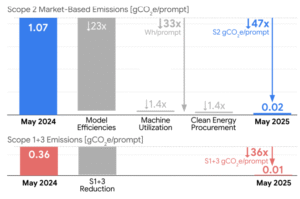
Please read our Full RISKS and DISCLOSURE here.

How BESS and Lithium Demand Are Shaping Energy Storage: Global Shipments to Surge 50% in 2025

Disseminated on behalf of Surge Battery Metals Inc.

The global Battery Energy Storage Systems (BESS) market is growing at a rapid pace. The expansion is driven by the rise of renewable energy, the increasing need for grid stability, and the growth of electric vehicles (EVs).ย 

BESS allows electricity to be stored when supply exceeds demand and released when demand is higher than supply. This technology is becoming essential for utilities, commercial users, and residential applications.

Powering Demand: EVs and Energy Storage Drive Growth

J.P. Morgan’s recent analysis shows that shipments of stationary energy storage batteries will rise by 50% in 2025 and 43% in 2026. This surge is causing the lithium supply to move into a deficit.ย 

lithium demand changes

Analysts estimate that BESS will account for about 30% of global lithium demand by 2026, rising to 36% by 2030. Global lithium demand in lithium-carbonate-equivalent (LCE) terms could reach ~2.8 million tonnes by 2030.

Demand is rising not only from energy storage but also from the EV sector. J.P. Morgan has increased its forecast for EV-related lithium demand by 3โ€“5% for the years 2025 to 2030. This change shows that more people are adopting electric vehicles globally.

Battery EV sales and penetration

The rising demand is further amplified by policies encouraging renewable energy adoption. Many countries are setting goals for renewable energy and cleaner grids. This opens up new chances for energy storage.

Utilities are using BESS more widely. They do this to manage peak loads, integrate renewable energy, and offer services like frequency regulation and black-start capability.

Price Sparks: Lithium Supply and Market Tightness

Despite growing demand, supply faces significant constraints. Many lithium producers hesitate to restart idle production. They want prices to rise enough for them to profit.ย 

J.P.โ€ฏMorgan highlights that prices of $1,200โ€“1,500 per tonne of spodumene are needed to bring new supply online. Spot prices have already risen from around $800/t to ~ $950/t, highlighting tightness in the market.

lithium price changes

Lithium price forecasts have also been upgraded to reflect these market conditions:

  • 2026/27: $1,100โ€“1,200/t
  • Long-term: $1,300/t

Higher price levels boost the economics of lithium projects. This benefits companies with strong ties to the BESS market. Higher prices also create incentives for new players to enter the market and expand existing projects.

Key Market Trends for BESS

The BESS market is evolving rapidly with several structural trends:

  • Grid-scale storage growth: Large-scale BESS deployments are increasing to help utilities manage intermittent renewable generation and maintain grid stability.
  • Distributed energy storage: Behind-the-meter storage for commercial, industrial, and residential users is rising as battery costs fall.
  • Advances in battery technology: Lithium-ion battery performance is improving, with longer lifespans, higher efficiency, and better safety.
  • Policy support: Governments worldwide are providing incentives and creating regulations that encourage energy storage adoption.
  • Supply-chain risks: Lithium, nickel, cobalt, and other critical minerals remain a bottleneck, and securing a reliable supply is a key challenge for the industry.

J.P. Morgan says that high demand and limited supply are creating a structural deficit in the lithium market. This is pushing prices up and making companies that supply lithium for BESS applications more appealing.

Spotlight on Surge Battery Metals: A Rising Player

Surge Battery Metals (TSXV: NILI | OTCQX: NILIF) is advancing the highest-grade lithium clay resource currently reported in the United States. With this level of grade and consistency, the Nevada North Lithium Project (NNLP) represents the type of high-quality, domestic lithium supply that battery makers and grid-scale energy storage developers have been looking for – an โ€œAmerican-madeโ€ resource that strengthens U.S. supply chains and reduces dependence on imported material.

With the lithium market emerging from a prolonged downturn, high-quality projects with strong fundamentals are beginning to stand out. Surge Battery Metals is well-positioned in this environment as the company has:

  • BLM approval for its Exploration Plan of Operations,ย 
  • Hosts the highest-grade lithium clay resource currently reported in the USA, andย 
  • Maintains a strong treasury to advance the NNLP. NNLP holds an inferred resource of 11.24 Mt of lithium carbonate equivalent (LCE) at 3,010 ppm Li, showcasing the scale and potential quality of its lithium assets.

These advantages – combined with a high-grade, near-surface deposit located in mining-friendly Nevada – position Surge as one of the few lithium explorers with the potential to advance meaningfully toward production as market conditions improve. Demand for BESS is rising quickly, which boosts its potential advantage.

Surge joint venture evolution mining

Forecasts and Industry Analysis: Lithium and BESS Outlook

The BESS market is expected to continue growing sharply over the next decade. According to J.P.โ€ฏMorgan, stationary energy storage will account for 30โ€“36% of lithium demand by 2030. Utility-scale projects will lead this growth. However, commercial and residential installations will also play a big role.

Price trends are likely to remain supportive for suppliers. Spot prices are near $950/t, with long-term forecasts at $1,300/t. Companies that produce and supply lithium efficiently can capture significant value.

Industry analysts also highlight several emerging trends:

  • Integration of smart-grid technology: AI and software solutions are being deployed to optimize energy storage and distribution.
  • Hybrid energy storage solutions: Combining batteries with other forms of storage, such as pumped hydro or thermal storage, is becoming more common.
  • Recycling and secondary supply chains: As BESS adoption grows, recycling lithium and other critical metals will become increasingly important.

These trends should boost the flexibility, efficiency, and sustainability of power networks globally.

Strategic Moves: Surgeโ€™s Path to Market Leadership

Surge Battery Metals is positioned to benefit from these industry dynamics. Its focus on high-quality lithium assets aligns with the rising demand for BESS. Key strategic considerations for the company include:

  • Advancing projects efficiently to meet growing market demand.
  • Forming strategic partnerships with battery manufacturers and utility companies to secure offtake agreements.
  • Maintaining operational discipline and cost efficiency to maximize project returns.

Surge Battery Metals is currently advancing lithium exploration at its Nevada North Lithium Project with the goal of defining resources that could support future production. Its metallurgical testing has shown promising results. These include lithium carbonate of 99% purity, but the company is still working toward a full feasibility study. If development proceeds as planned, Surge could become a significant future supplier for the BESS market, although current supply remains limited.

The Bright Future of Energy Storage

Battery Energy Storage Systems are no longer a niche market. The growing use of renewable energy, the rise of electric vehicles, and updates to the grid are increasing the demand for lithium and other battery materials.ย 

Moreover, the outlook for BESS is positive. Demand growth, tech improvements, and policy support all suggest the market will keep expanding. Supply limits and higher prices are opening doors for companies that can deliver lithium effectively.

By 2030, BESS could account for more than one-third of global lithium demand. Surge Battery Metals and similar companies are key to this shift. They help create cleaner, stronger, and more efficient electricity systems.

As the market grows, execution, timing, and partnerships will decide which companies benefit the most. Surge Battery Metals can shine in the energy storage market by focusing on high-quality lithium resources, smart development, and staying aligned with market trends.


DISCLAIMERย 

New Era Publishing Inc. and/or CarbonCredits.com (โ€œWeโ€ or โ€œUsโ€) are not securities dealers or brokers, investment advisers, or financial advisers, and you should not rely on the information herein as investment advice. Surge Battery Metals Inc. (โ€œCompanyโ€) made a one-time payment of $50,000 to provide marketing services for a term of two months. None of the owners, members, directors, or employees of New Era Publishing Inc. and/or CarbonCredits.com currently hold, or have any beneficial ownership in, any shares, stocks, or options of the companies mentioned.

This article is informational only and is solely for use by prospective investors in determining whether to seek additional information. It does not constitute an offer to sell or a solicitation of an offer to buy any securities. Examples that we provide of share price increases pertaining to a particular issuer from one referenced date to another represent arbitrarily chosen time periods and are no indication whatsoever of future stock prices for that issuer and are of no predictive value.

Our stock profiles are intended to highlight certain companies for your further investigation; they are not stock recommendations or an offer or sale of the referenced securities. The securities issued by the companies we profile should be considered high-risk; if you do invest despite these warnings, you may lose your entire investment. Please do your own research before investing, including reviewing the companiesโ€™ SEDAR+ and SEC filings, press releases, and risk disclosures.

It is our policy that information contained in this profile was provided by the company, extracted from SEDAR+ and SEC filings, company websites, and other publicly available sources. We believe the sources and information are accurate and reliable but we cannot guarantee them.


CAUTIONARY STATEMENT AND FORWARD-LOOKING INFORMATION

Certain statements contained in this news release may constitute โ€œforward-looking informationโ€ within the meaning of applicable securities laws. Forward-looking information generally can be identified by words such as โ€œanticipate,โ€ โ€œexpect,โ€ โ€œestimate,โ€ โ€œforecast,โ€ โ€œplan,โ€ and similar expressions suggesting future outcomes or events. Forward-looking information is based on current expectations of management; however, it is subject to known and unknown risks, uncertainties, and other factors that may cause actual results to differ materially from those anticipated.

These factors include, without limitation, statements relating to the Companyโ€™s exploration and development plans, the potential of its mineral projects, financing activities, regulatory approvals, market conditions, and future objectives. Forward-looking information involves numerous risks and uncertainties and actual results might differ materially from results suggested in any forward-looking information. These risks and uncertainties include, among other things, market volatility, the state of financial markets for the Companyโ€™s securities, fluctuations in commodity prices, operational challenges, and changes in business plans.

Forward-looking information is based on several key expectations and assumptions, including, without limitation, that the Company will continue with its stated business objectives and will be able to raise additional capital as required. Although management of the Company has attempted to identify important factors that could cause actual results to differ materially, there may be other factors that cause results not to be as anticipated, estimated, or intended.

There can be no assurance that such forward-looking information will prove to be accurate, as actual results and future events could differ materially. Accordingly, readers should not place undue reliance on forward-looking information. Additional information about risks and uncertainties is contained in the Companyโ€™s managementโ€™s discussion and analysis and annual information form for the year ended December 31, 2024, copies of which are available on SEDAR+ atย www.sedarplus.ca.

The forward-looking information contained herein is expressly qualified in its entirety by this cautionary statement. Forward-looking information reflects managementโ€™s current beliefs and is based on information currently available to the Company. The forward-looking information is made as of the date of this news release, and the Company assumes no obligation to update or revise such information to reflect new events or circumstances except as may be required by applicable law.

Lithium Prices Surge Amid Strong Demand Forecasts, Could Reach Up to $28,000/Ton by 2026

Disseminated on behalf of Surge Battery Metals Inc.

Lithium prices recorded a 2.71% daily gain to reach $22.47/kg globally and ยฅ151,500/Ton in China as of today (Aug 15, 2026). This upward momentum is driven by accelerating destocking efforts and historically low inventories. Furthermore, surging demand for stationary battery storageโ€”fueled by expanding AI data centersโ€”has outpaced expectations, offsetting softer electric vehicle sales. The market is also rebounding as bearish supply sentiments surrounding CATL's mining operations are fully digested, tightening near-term fundamentals.

Lithium prices have jumped, catching the attention of investors, automakers, and battery makers.

Historically, lithium prices have been volatile. Peak prices reached around 150,000 yuan per ton in 2022, followed by a slump during the oversupply period in 2023โ€“2024.

The recent spike followed comments from the chairman of Ganfeng Lithium, Li Liangbin, who projected a 30โ€“40% rise in global demand by 2026. He suggested prices could reach between 150,000 and 200,000 yuan per ton if this growth materializes.

Indeed, lithium prices jumped over 10% on February 26. They hit 178,000 yuan per tonne on China’s futures market.

Moreover, Zimbabwe, Africa’s top lithium producer, suspended all lithium concentrate exports immediately on February 25, after shipping 1.128 million tonnes in 2025, mostly to China. This sparked fears of supply shortages by May.

China’s battery makers rushed orders ahead of April’s VAT export rebate cut from 9% to 6%, boosting short-term demand. Also, Jiangxi’s revocation of 27 expired mining permits (including one lithium site) added bullish pressure.

The surge highlights lithiumโ€™s critical role in powering electric vehicles (EVs) and large-scale energy storage.

Growing Demand for Lithium: What Drives the Boom?

Electric vehicles remain the largest driver of lithium demand. Around 16 million EVs were on the road globally in 2024, up from 10 million in 2022. Sales are forecast to exceed 25 million units by 2026 and reach over 50 million by 2030. Longer-range vehicles require larger batteries, which increases lithium use.

Energy storage systems are another fast-growing source of demand. Utilities expanding solar and wind energy need lithium-based batteries to store surplus electricity. Heavy-duty electric trucks and buses have larger batteries. This means they use more lithium per vehicle compared to passenger EVs.

Long-term trends toward decarbonization and renewable energy growth further support lithium demand. Analysts say that EV batteries make up about 70% of lithium demand. Grid storage accounts for 15%. Electric trucks use 10%, and other uses, like electronics and specialty chemicals, are around 5%.

Supply Challenges Keep Prices Elevated

Lithium carbonate spot prices in China have climbed dramatically, moving from $8,259/tonneย on June 23, 2025 toย $13,003/tonneย on November 26, 2025 – a rise of 57% over five months.

This recent rally is primarily attributed to tight supply conditions, with major Chinese mines, including those operated by CATL, pausing operations due to falling prices earlier in the year. As output was reduced or shut in, inventories were gradually drawn down, tightening available supply.

Source: Bloomberg

Moreover, lithium production is highly concentrated. Australia leads with around 60,000 tonnes LCE annually, followed by Chile (35,000 tonnes), China (25,000 tonnes), Argentina (18,000 tonnes), and the U.S. (โ‰ˆ5,000 tonnes). Geographic concentration adds risk: environmental regulations, political tensions, or operational issues could tighten supply.

Restarting idled mines or opening new projects takes 2โ€“5 years. Inventories from the oversupply period act as a buffer. Current estimates show global lithium stocks at about 350,000 tonnes LCE. This amount can help with short-term supply issues, but it’s not enough for long-term growth.

The factors that keep pushing lithium demand higher include:

Lithium makes up about 20โ€“25% of total EV battery costs. So, price changes can greatly impact EV production costs. Also, battery chemistry trends show that sodium-ion and solid-state batteries might take a small share of the market by 2030. However, lithium-ion will remain the leader for now.

Lithium carbonate prices in China have climbed sharply, as shown in the chart. Prices rose more than 17% this month as investors bet on accelerating demand from the energy storage sector.

What Analysts Say: Forecasts and Future Trends

Fastmarkets predicts a small surplus in 2025, shifting to a deficit of 1,500 tonnes LCE by 2026. A few years ago, the market had a surplus of about 175,000 tonnes in 2023 and 154,000 tonnes in 2024. Cuts in production at high-cost or marginal mines and rising demand from EVs and storage systems are driving this rebalancing.

Arcane Capital forecasts global demand could hit 4.6 million tonnes LCE by 2030, led by EVs, grid storage, and heavy-duty transport.

Benchmark Mineral Intelligence expects lithium carbonate prices to stay between $15,000 and $17,000 USD per ton in 2025, but prices may be lower in 2026 if supply increases faster than demand.

Still, the chart from Katusa Research highlights a growing deficit in lithium supply and demand. This supply deficit will likely underpin upward pressure on lithium prices moving toward 2030.

lithium supply deficit KR
Source: Katusa Research

Production in Australia, China, and South America should grow by about 10% each year, per industry estimates. However, delays or cost overruns might slow this growth.ย 

Risks to the Price Recovery

Lithium prices face several risks. EV adoption could slow if subsidies or incentives drop. Battery makers might adopt sodium-ion or other chemistries if costs rise. Rapid restarts of idled mines or new production could oversupply the market.

Regulatory hurdles, environmental restrictions, and trade tensions could also disrupt supply. Recent price spikes were partly due to speculative trading, highlighting the marketโ€™s sensitivity to sentiment.

Who Wins and Who Loses?

Higher lithium prices may hurt automakers and battery makers, pushing them to secure contracts or invest in recycling. Mining companies benefit from higher prices but must manage timelines and costs.

Meanwhile, investors have opportunities, though volatility is high. Policymakers consider lithium a strategic resource and are encouraging domestic production, recycling, and robust supply chains.

With global supply growth uncertain, focus is turning to projects that provide steady, long-term output. This is especially true in areas aiming to boost domestic supply chains, where Surge Battery Metals comes in.

Spotlight: Surge Battery Metals – US Lithium Hero

Surge Battery Metals (TSX-V: NILI | OTCQX: NILIF) is emerging as a key U.S. lithium developer. Its Nevada North Lithium Project (NNLP) hosts the highest-grade lithium clay resource currently reported in the United States, with an Inferred Resource of 11.24 million tonnes of lithium carbonate equivalent (LCE) grading 3,010 ppm lithium (NI 43-101, September 24, 2024).

Surge Nevada lithium clay comparison
Source: Surge Battery Metals

A Preliminary Economic Assessment (PEA) on the project outlines robust economics, including:

  • After-tax NPVโ‚ˆ%: US$9.21 billion
  • After-tax IRR: 22.8%
  • Low operating costs: US$5,243 per tonne LCE

NNLP benefits from access to regional infrastructure, including established roads and nearby power, supporting future development.ย 

Surgeโ€™s leadership team includes veterans from Millennial Lithium, a company acquired for US$490 million in 2022. The company has also secured a staged C$10 million JV funding agreement with Evolution Mining to advance NNLP toward Pre-Feasibility while maintaining majority ownership.

How Nevada North Fits into the Global Picture

The Nevada North Lithium Project demonstrates the potential to become a globally significant lithium operation. According to comparative analysis from 3L Capital and S&P Global, NNLPโ€™s Life-of-Mine (LOM) average production of 86 kt LCE per yearโ€”as outlined in the PEAโ€”would rank the project as the 5th largest lithium-producing project in the world compared with 2024 producers and developers.

Lithium demand vs supply
Source: Surge Battery Metals

Even in its first year, NNLP is projected to produce 26 kt LCE, placing it among the top 16 lithium projects globally on a 2024 comparative basis. This combination of scale, grade, and location underscores NNLPโ€™s potential as a strategic U.S. supply source in a market seeking domestic, high-quality lithium to reduce dependence on overseas imports.

top lithium producing companies 2024
Source: Surge Battery Metals

If advanced through feasibility, permitting, and construction decisions, NNLP has the potential to become a competitive, American-based lithium operationโ€”supporting both EV manufacturing and large-scale energy storage with โ€œAmerican-madeโ€ battery-grade feedstock.

Lithium Surges, Supply Matters, and America Prepares

Prices are shaped by several key factors. These include updates on production from major mines, trends in EV adoption, grid storage deployment, new battery technologies, and changes in policy. Inventory levels and market speculation will continue to influence short-term volatility.

Lithium prices have jumped, signaling a possible market turning point after past oversupply. High demand from EVs, grid storage, and heavy-duty transport, along with limited production and geographic concentration, is pushing prices up.

Industry stakeholders, investors, and policymakers have to monitor developments closely as lithium continues to play a central role in the global energy transition. Surge Battery Metals shows the type of domestic production needed to meet rising demand and strengthen supply chains in a rapidly evolving market.


DISCLAIMERย 

New Era Publishing Inc. and/or CarbonCredits.com (โ€œWeโ€ or โ€œUsโ€) are not securities dealers or brokers, investment advisers, or financial advisers, and you should not rely on the information herein as investment advice. Surge Battery Metals Inc. (โ€œCompanyโ€) made a one-time payment of $50,000 to provide marketing services for a term of two months. None of the owners, members, directors, or employees of New Era Publishing Inc. and/or CarbonCredits.com currently hold, or have any beneficial ownership in, any shares, stocks, or options of the companies mentioned.

This article is informational only and is solely for use by prospective investors in determining whether to seek additional information. It does not constitute an offer to sell or a solicitation of an offer to buy any securities. Examples that we provide of share price increases pertaining to a particular issuer from one referenced date to another represent arbitrarily chosen time periods and are no indication whatsoever of future stock prices for that issuer and are of no predictive value.

Our stock profiles are intended to highlight certain companies for your further investigation; they are not stock recommendations or an offer or sale of the referenced securities. The securities issued by the companies we profile should be considered high-risk; if you do invest despite these warnings, you may lose your entire investment. Please do your own research before investing, including reviewing the companiesโ€™ SEDAR+ and SEC filings, press releases, and risk disclosures.

It is our policy that the information contained in this profile was provided by the company, extracted from SEDAR+ and SEC filings, company websites, and other publicly available sources. We believe the sources and information are accurate and reliable but we cannot guarantee them.

CAUTIONARY STATEMENT AND FORWARD-LOOKING INFORMATION

Certain statements contained in this news release may constitute โ€œforward-looking informationโ€ within the meaning of applicable securities laws. Forward-looking information generally can be identified by words such as โ€œanticipate,โ€ โ€œexpect,โ€ โ€œestimate,โ€ โ€œforecast,โ€ โ€œplan,โ€ and similar expressions suggesting future outcomes or events. Forward-looking information is based on current expectations of management; however, it is subject to known and unknown risks, uncertainties, and other factors that may cause actual results to differ materially from those anticipated.

These factors include, without limitation, statements relating to the Companyโ€™s exploration and development plans, the potential of its mineral projects, financing activities, regulatory approvals, market conditions, and future objectives. Forward-looking information involves numerous risks and uncertainties and actual results might differ materially from results suggested in any forward-looking information. These risks and uncertainties include, among other things, market volatility, the state of financial markets for the Companyโ€™s securities, fluctuations in commodity prices, operational challenges, and changes in business plans.

Forward-looking information is based on several key expectations and assumptions, including, without limitation, that the Company will continue with its stated business objectives and will be able to raise additional capital as required. Although management of the Company has attempted to identify important factors that could cause actual results to differ materially, there may be other factors that cause results not to be as anticipated, estimated, or intended.

There can be no assurance that such forward-looking information will prove to be accurate, as actual results and future events could differ materially. Accordingly, readers should not place undue reliance on forward-looking information. Additional information about risks and uncertainties is contained in the Companyโ€™s managementโ€™s discussion and analysis and annual information form for the year ended December 31, 2024, copies of which are available on SEDAR+ atย www.sedarplus.ca.

The forward-looking information contained herein is expressly qualified in its entirety by this cautionary statement. Forward-looking information reflects managementโ€™s current beliefs and is based on information currently available to the Company. The forward-looking information is made as of the date of this news release, and the Company assumes no obligation to update or revise such information to reflect new events or circumstances except as may be required by applicable law.


Disclosure: Owners, members, directors, and employees of carboncredits.com have/may have stock or option positions in any of the companies mentioned: None.

Carboncredits.com receives compensation for this publication and has a business relationship with any company whose stock(s) is/are mentioned in this article.

Additional disclosure: This communication serves the sole purpose of adding value to the research process and is for information only. Please do your own due diligence. Every investment in securities mentioned in publications of carboncredits.com involves risks that could lead to a total loss of the invested capital.
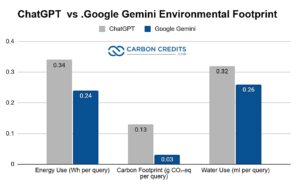
Please read our Full RISKS and DISCLOSURE here.

Reviving Mexicoโ€™s Silver Belt: How Sierra Madreโ€™s La Guitarra Mine Is Leading the Comeback

Disseminated on behalf of Sierra Madre Gold & Silver Ltd.

Mexico has long been one of the worldโ€™s top silver producers. For centuries, its mining regionsโ€”Zacatecas, Durango, and the Sierra Madre beltโ€”have supplied much of the worldโ€™s silver. But after decades of underinvestment and falling output from older mines, the countryโ€™s silver production has started to slow.

That is now changing. Modern mining companies are reinvigorating Mexicoโ€™s silver belt. They bring in new capital, use better technology, and follow stricter environmental standards. Among these companies, Sierra Madre Gold & Silver Ltd. (TSXV: SM | OTCQX: SMDRF) stands out. The plan to restart and expand the La Guitarra Mine in the Temascaltepec district is a big step forward for Mexicoโ€™s precious metals industry.

The Comeback of La Guitarra

The La Guitarra Mine has a long history of production, dating back to colonial times. It produced gold and silver for different owners. Most recently, it was owned by First Majestic Silver. Now, it has restarted commercial production as of January 1, 2025, after a period of care and maintenance.

Sierra Madre Gold & Silver
Source: Sierra Madre Gold & Silver

Sierra Madre acquired the mine in 2023 with a clear strategy: bring it back into production and expand its capacity. The mine has a processing plant that handles 500 tonnes a day. It also has a permitted underground operation. Nearby, there are roads, power, and water infrastructure.

With a strong technical team and fresh funding of C$19.5 million, Sierra Madre is preparing for an expansion. The company aims to boost production to 1,500 tonnes per day by 2027. This will increase up to three times and help keep costs low through smart mine design and local partnerships.

Why Mexicoโ€™s Silver Revival Matters

Mexico continues to hold the worldโ€™s largest silver reserves. It accounted for about 23-25% of global silver output in 2024, producing about 5,800โ€“6,300 tonnes of silver that year. Rising industrial demand is fueling a new focus on production growth.

Silver is no longer just a jewelry or investment metal; itโ€™s essential for clean energy. Each solar panel uses about 20 grams of silver, and electric vehicles (EVs) require up to 50 grams. As the solar and EV industries expand, analysts project that global silver demand will exceed 1.2 billion ounces per year by 2030.

silver

This shift opens new chances for producers in stable, mining-friendly places like Mexico. Mexico is attracting new exploration and investment. Its skilled workforce, supportive rules, and modern infrastructure help. This reaffirms Mexico’s role as the world’s silver leader.

Sierra Madre is part of that national revival. Its work at La Guitarra, and exploration at Tepic shows how new companies are turning dormant assets into growth engines for the next decade.

A Project with Built-In Advantages

La Guitarra offers more than history – it has the right foundations that allow for a fast restart. The processing plant, tailings facility, and underground access are ready. This setup saved years of development time.

The mine is also in a favorable location. Situated in Mexico State, it is close to highways and power lines and only a few hours from Mexico City. This proximity reduces logistics costs and makes it easier to hire skilled workers.

Sierra Madreโ€™s leadership team combines local mining experience with strong capital markets knowledge. This balance allows the company to move efficiently from project restart to expansion. La Guitarra is one of Mexicoโ€™s top silver-gold mines. It has high-grade veins, clear exploration targets, and permits.

Strengthening Mexicoโ€™s Mining Economy

The completed La Guitarra restart is part of a broader trend of economic renewal in Mexicoโ€™s mining regions. The countryโ€™s mining sector directly employs more than 400,000 people and supports over 2.5 million indirect jobs. The sectorโ€™s importance extends beyond jobs. Mining represents nearly 2.5% of Mexicoโ€™s GDP and generates billions in export revenue.

New projects like Sierra Madreโ€™s La Guitarra are helping sustain rural economies by creating stable, long-term employment. The La Guitarra project has created hundreds of jobs when it restarted. Sierra Madre has also invested in training and local infrastructure for the community.

Silver prices are stabilizing around US$48โ€“49 per ounce in late October 2025, having reached an all-time high of $54.24 per ounce on October 16, followed by a swift correction that saw prices dip to the mid-$46 range before rebounding.

Notably, in just 10 weeks from July 31 to the peak, silver surged by nearly 48%, climbing from $36.71 to $54.24 per ounce – a rapid and exceptional rally. This sustained period of around the $50 mark through October is good news for mid-tier producers like Sierra Madre.

They can boost value for shareholders and help local economies, capitalizing on strong price levels and renewed market optimism driven by silver’s resilience after the correction.

silver prices
Source: Bloomberg

Operating with Responsibility

Sierra Madre is also part of a new generation of miners that prioritize environmental and social responsibility. The company is updating its waste and water systems to meet modern standards. They want to use less water and reclaim tailings more efficiently.

Environmental protection is crucial in silver-gold mining areas, where it’s key to balance economic chances with sustainability. Sierra Madre focuses on open communication with the community, clear permitting, and strong ESG practices. This approach meets the needs of local stakeholders and global investors.

The companyโ€™s management stressed that modernization at La Guitarra is both about increasing production and doing it responsibly. This commitment to responsible mining strengthens Sierra Madreโ€™s credibility as it seeks to attract long-term partners and institutional investors.

Why La Guitarra Leads the Silver Belt Revival

What makes La Guitarra central to Mexicoโ€™s silver revival is its combination of history, infrastructure, and timing. The mine already had everything needed to move quickly back into production, supported by rising demand and favorable silver prices.

Few projects in Mexico are as close to immediate output growth as La Guitarra. The companyโ€™s 2025โ€“2027 plan provides a clear growth path: expand capacity, restart exploration, and use cash flow to advance its other assets. This positions Sierra Madre as one of the few junior companies capable of near-term revenue growth in a tightening silver market.

Meanwhile, exploration at the nearby Tepic project could add more resources to support long-term growth. Together, these assets form a strong portfolio with both production and discovery potential.

Looking Ahead

Mexicoโ€™s silver belt is reawakening, and Sierra Madre Gold & Silver is at the heart of that revival. The La Guitarra Mine represents more than a completed restart with an expansion and exploration planned – itโ€™s a symbol of how modern technology and responsible operations can breathe new life into historic mining regions.
As global demand for silver continues to rise across industries, from solar panels to electric vehicles, companies like Sierra Madre will play a vital role in meeting that need.

With production restarted, expansion underway, and exploration advancing, Sierra Madre is well positioned to help lead Mexicoโ€™s next era of silver success – one built on heritage, innovation, and sustainable growth.

DISCLAIMER

New Era Publishing Inc. and/or CarbonCredits.com (โ€œWeโ€ or โ€œUsโ€) are not securities dealers or brokers, investment advisers, or financial advisers, and you should not rely on the information herein as investment advice. Sierra Madre Gold and Silver Ltd. (โ€œCompanyโ€) made a one-time payment of $25,000 to provide marketing services for a term of one month. None of the owners, members, directors, or employees of New Era Publishing Inc. and/or CarbonCredits.com currently hold, or have any beneficial ownership in, any shares, stocks, or options of the companies mentioned.

This article is informational only and is solely for use by prospective investors in determining whether to seek additional information. It does not constitute an offer to sell or a solicitation of an offer to buy any securities. Examples that we provide of share price increases pertaining to a particular issuer from one referenced date to another represent arbitrarily chosen time periods and are no indication whatsoever of future stock prices for that issuer, and are of no predictive value.

Our stock profiles are intended to highlight certain companies for your further investigation; they are not stock recommendations or an offer or sale of the referenced securities. The securities issued by the companies we profile should be considered high-risk; if you do invest despite these warnings, you may lose your entire investment. Please do your own research before investing, including reviewing the companiesโ€™ SEDAR+ and SEC filings, press releases, and risk disclosures.

It is our policy that the information contained in this profile was provided by the company, extracted from SEDAR+ and SEC filings, company websites, and other publicly available sources. We believe the sources and information are accurate and reliable but we cannot guarantee them.

CAUTIONARY STATEMENT AND FORWARD-LOOKING INFORMATION

Certain statements contained in this news release may constitute โ€œforward-looking informationโ€ within the meaning of applicable securities laws. Forward-looking information generally can be identified by words such as โ€œanticipate,โ€ โ€œexpect,โ€ โ€œestimate,โ€ โ€œforecast,โ€ โ€œplan,โ€ and similar expressions suggesting future outcomes or events. Forward-looking information is based on current expectations of management; however, it is subject to known and unknown risks, uncertainties, and other factors that may cause actual results to differ materially from those anticipated.

These factors include, without limitation, statements relating to the Companyโ€™s exploration and development plans, the potential of its mineral projects, financing activities, regulatory approvals, market conditions, and future objectives. Forward-looking information involves numerous risks and uncertainties and actual results might differ materially from results suggested in any forward-looking information. These risks and uncertainties include, among other things, market volatility, the state of financial markets for the Companyโ€™s securities, fluctuations in commodity prices, operational challenges, and changes in business plans.

Forward-looking information is based on several key expectations and assumptions, including, without limitation, that the Company will continue with its stated business objectives and will be able to raise additional capital as required. Although management of the Company has attempted to identify important factors that could cause actual results to differ materially, there may be other factors that cause results not to be as anticipated, estimated, or intended.

There can be no assurance that such forward-looking information will prove to be accurate, as actual results and future events could differ materially. Accordingly, readers should not place undue reliance on forward-looking information. Additional information about risks and uncertainties is contained in the Companyโ€™s managementโ€™s discussion and analysis and annual information form for the year ended December 31, 2024, copies of which are available on SEDAR+ at www.sedarplus.ca.

The forward-looking information contained herein is expressly qualified in its entirety by this cautionary statement. Forward-looking information reflects managementโ€™s current beliefs and is based on information currently available to the Company. The forward-looking information is made as of the date of this news release, and the Company assumes no obligation to update or revise such information to reflect new events or circumstances except as may be required by applicable law.

For more information on the Company, investors should review the Companyโ€™s continuous disclosure filings available on SEDAR+ at www.sedarplus.ca.